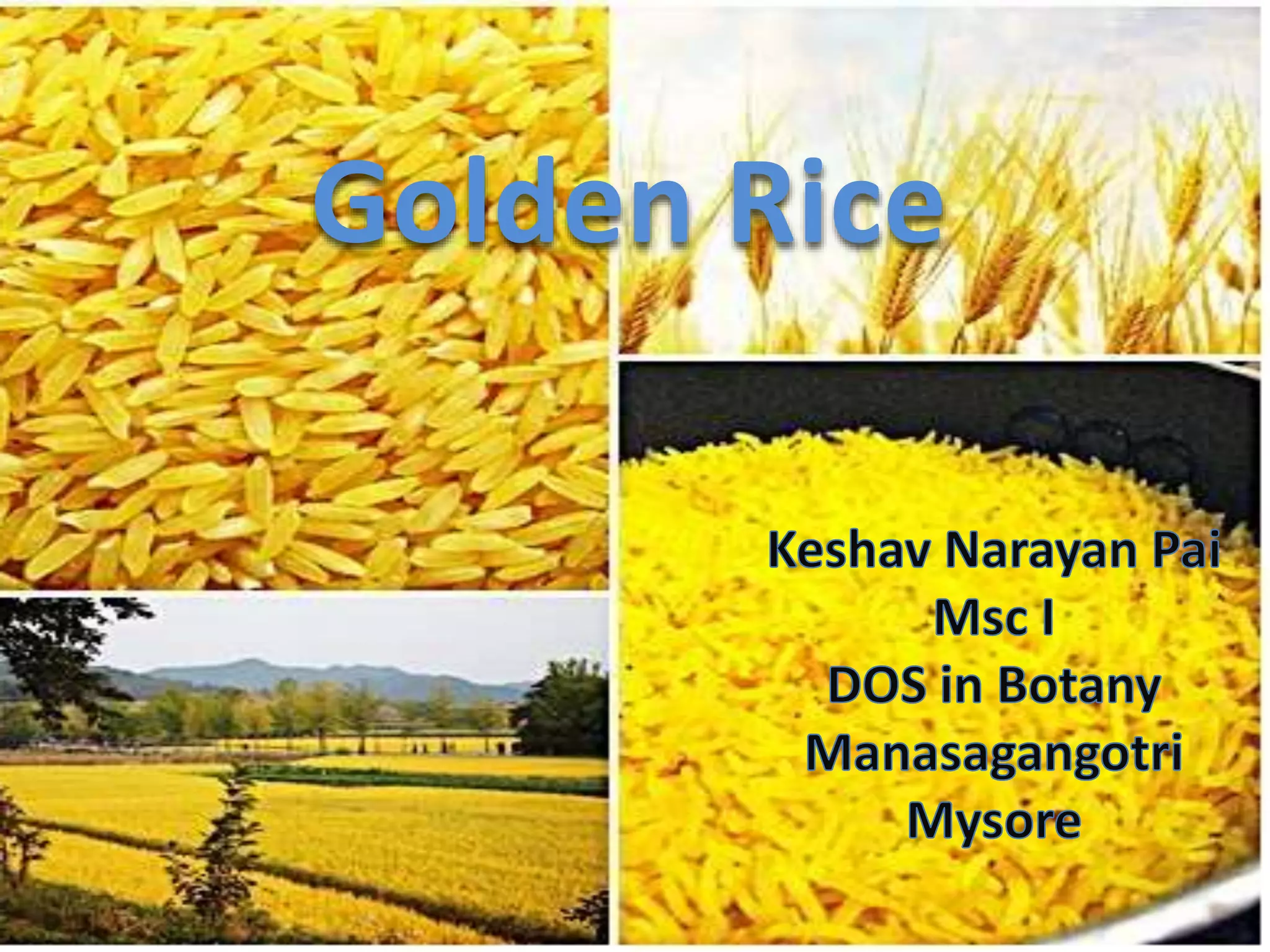
Golden Rice
Content
• Introduction
• Need for Development
• Why Rice?
• Golden Rice Project
• Goals
• Technology
• Production of Golden Rice 1 and 2
• Challenges ahead
• Advantages
• Disadvantage
• Controversies.
• Conclusion
• References
Introduction
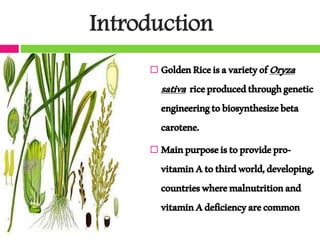
 GoldenRiceisavarietyofOryza
sativa riceproducedthroughgenetic
engineeringtobiosynthesizebeta
carotene.
 Mainpurposeistoprovidepro-
vitaminAtothirdworld,developing,
countrieswheremalnutritionand
vitaminAdeficiencyarecommon
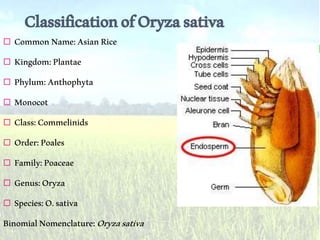
ClassificationofOryzasativa
 CommonName:AsianRice
 Kingdom:Plantae
 Phylum:Anthophyta
 Monocot
 Class:Commelinids
 Order:Poales
 Family:Poaceae
 Genus:Oryza
 Species:O.sativa
BinomialNomenclature:Oryzasativa
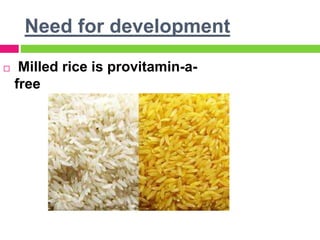
Need for development
 Milled rice is provitamin-a-
free
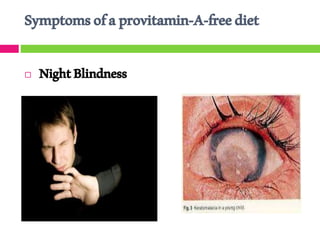
Symptomsofaprovitamin-A-freediet
 NightBlindness
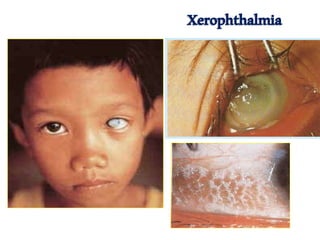
Xerophthalmia
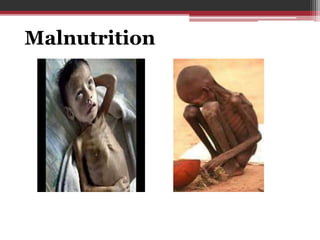
Malnutrition
Cont….
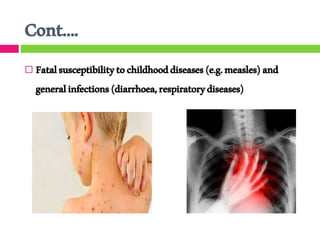
 Fatalsusceptibilitytochildhooddiseases(e.g.measles)and
generalinfections(diarrhoea,respiratorydiseases)
Need for development:
• Itwasconductedwiththegoalofhelpingchildrenwhosufferfrom
vitaminAdeficiency(VAD).
• Childrenandpregnantwomenareathighestrisk.
• Inpregnantwomen,Lactationdeficiency,maternalmortalityupto40%.
• In2005,190millionchildrenand19millionpregnantwomen,in122countries,
wereestimatedtobeaffectedbyVAD.
• VADisresponsiblefor1–2milliondeaths,5,00,000casesofirreversible
blindnessandmillionsofcasesofxerophthalmiaannually.
Why rice?
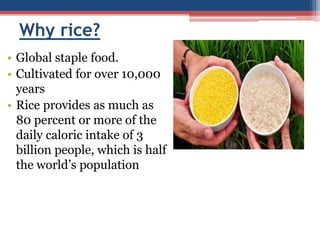
• Global staple food.
• Cultivated for over 10,000
years
• Rice provides as much as
80 percent or more of the
daily caloric intake of 3
billion people, which is half
the world’s population
Who Began the Golden
Rice Project?
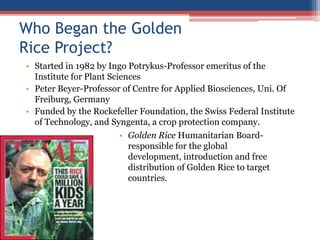
• Started in 1982 by Ingo Potrykus-Professor emeritus of the
Institute for Plant Sciences
• Peter Beyer-Professor of Centre for Applied Biosciences, Uni. Of
Freiburg, Germany
• Funded by the Rockefeller Foundation, the Swiss Federal Institute
of Technology, and Syngenta, a crop protection company.
• Golden Rice Humanitarian Board-
responsible for the global
development, introduction and free
distribution of Golden Rice to target
countries.
Goals: More is What We Aim For
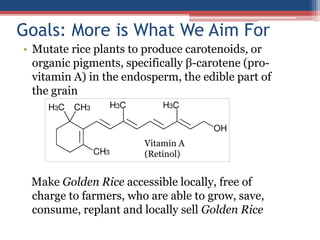
• Mutate rice plants to produce carotenoids, or
organic pigments, specifically β-carotene (pro-
vitamin A) in the endosperm, the edible part of
the grain
Make Golden Rice accessible locally, free of
charge to farmers, who are able to grow, save,
consume, replant and locally sell Golden Rice
Vitamin A
(Retinol)
IPP
Geranylgeranyl diphosphate
Phytoene
Lycopene
 -carotene
(vitamin A precursor)
Phytoene synthase
Phytoene desaturase
Lycopene-beta-cyclase
ξ-carotene desaturase
Daffodil gene
Single bacterial gene;
performs both functions
Daffodil gene
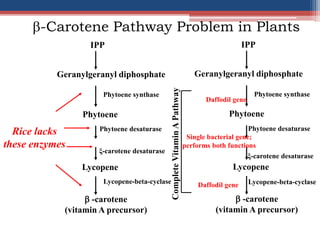
-Carotene Pathway Problem in Plants
IPP
Geranylgeranyl diphosphate
Phytoene
Lycopene
 -carotene
(vitamin A precursor)
Phytoene synthase
Phytoene desaturase
Lycopene-beta-cyclase
ξ-carotene desaturase
Rice lacks
these enzymes
CompleteVitaminAPathway
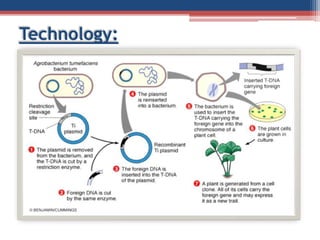
Technology:
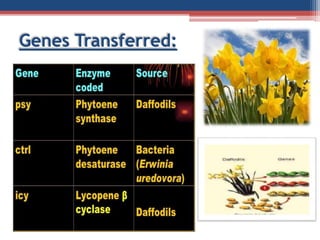
Genes Transferred:
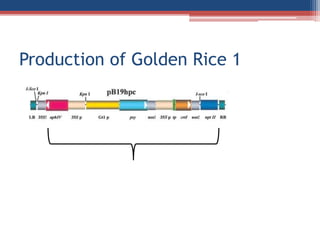
Production of Golden Rice 1
How Does It Work?
• The addition of 2 genes in the rice
genome will complete the biosynthetic
pathway
▫ 1. Phytoene synthase (psy) – derived
from daffodils
▫ 2. Lycopene cyclase (crt1) – from soil
bacteria Erwinia uredovora
• Produces enzymes and catalysts for
the biosynthesis of carotenoids (β-
carotene) in the endosperm
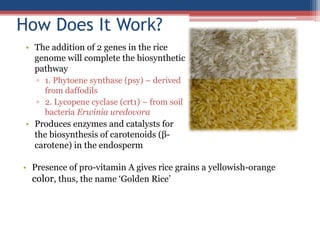
• Presence of pro-vitamin A gives rice grains a yellowish-orange
color, thus, the name ‘Golden Rice’
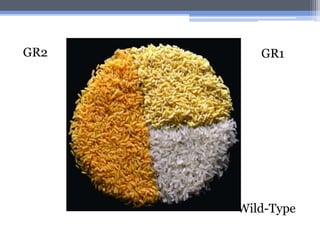
Golden Rice 2
• In 2005, a team of researchers at biotechnology
company, Syngenta, produced a variety of
golden rice called "Golden Rice 2". They
combined the phytoene synthase gene from
maize with crt1 from the original golden rice.
Golden rice 2 produces 23 times more
carotenoids than golden rice (up to 37 µg/g)
GR2 GR1
Wild-Type
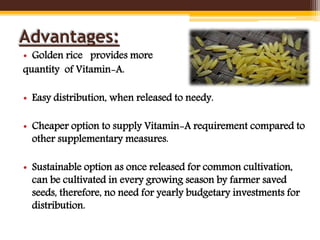
Advantages:
• Golden rice provides more
quantity of Vitamin-A.
• Easy distribution, when released to needy.
• Cheaper option to supply Vitamin-A requirement compared to
other supplementary measures.
• Sustainable option as once released for common cultivation,
can be cultivated in every growing season by farmer saved
seeds, therefore, no need for yearly budgetary investments for
distribution.
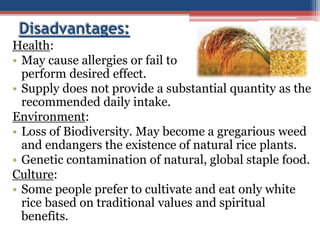
Disadvantages:
Health:
• May cause allergies or fail to
perform desired effect.
• Supply does not provide a substantial quantity as the
recommended daily intake.
Environment:
• Loss of Biodiversity. May become a gregarious weed
and endangers the existence of natural rice plants.
• Genetic contamination of natural, global staple food.
Culture:
• Some people prefer to cultivate and eat only white
rice based on traditional values and spiritual
benefits.
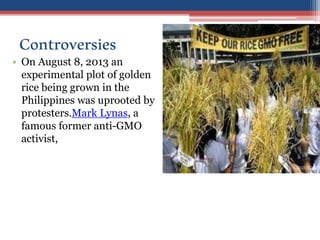
Controversies
• On August 8, 2013 an
experimental plot of golden
rice being grown in the
Philippines was uprooted by
protesters.Mark Lynas, a
famous former anti-GMO
activist,
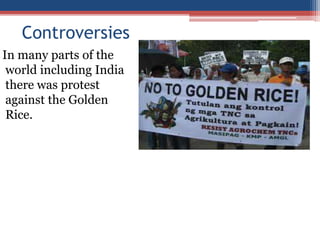
Controversies
In many parts of the
world including India
there was protest
against the Golden
Rice.
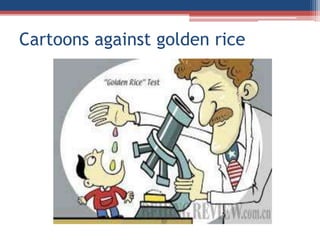
Cartoons against golden rice
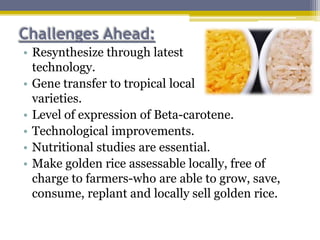
Challenges Ahead:
• Resynthesize through latest
technology.
• Gene transfer to tropical local
varieties.
• Level of expression of Beta-carotene.
• Technological improvements.
• Nutritional studies are essential.
• Make golden rice assessable locally, free of
charge to farmers-who are able to grow, save,
consume, replant and locally sell golden rice.
Research
• University of California
• Rutgers University
• University of Nebraska
and many other universities
in the entire world.
Conclusion:
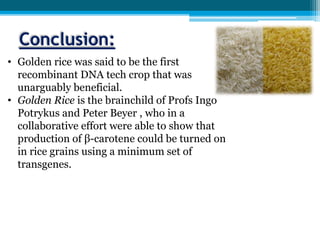
• Golden rice was said to be the first
recombinant DNA tech crop that was
unarguably beneficial.
• Golden Rice is the brainchild of Profs Ingo
Potrykus and Peter Beyer , who in a
collaborative effort were able to show that
production of β-carotene could be turned on
in rice grains using a minimum set of
transgenes.
References:
• "Golden Rice: All Glitter, No Gold,” Greenpeace
International, March 15, 2005 .
• . "Almost Everything You Wanted to Know
About Golden Rice,"goldenrice.org
• Golden Rice Humanitarian Board © 2005. The
Golden Rice Project» pdf
• http://goldenrice.org/Content2-
How/how1_sci.html.
Elite crop (golden rice)

Elite crop (golden rice)

  • 1.
  • 2.
    Content • Introduction • Needfor Development • Why Rice? • Golden Rice Project • Goals • Technology • Production of Golden Rice 1 and 2 • Challenges ahead • Advantages • Disadvantage • Controversies. • Conclusion • References
  • 3.
    Introduction  GoldenRiceisavarietyofOryza sativa riceproducedthroughgenetic engineeringtobiosynthesizebeta carotene. Mainpurposeistoprovidepro- vitaminAtothirdworld,developing, countrieswheremalnutritionand vitaminAdeficiencyarecommon
  • 4.
    ClassificationofOryzasativa  CommonName:AsianRice  Kingdom:Plantae Phylum:Anthophyta  Monocot  Class:Commelinids  Order:Poales  Family:Poaceae  Genus:Oryza  Species:O.sativa BinomialNomenclature:Oryzasativa
  • 5.
    Need for development Milled rice is provitamin-a- free
  • 6.
  • 7.
  • 8.
  • 9.
  • 10.
    Need for development: •Itwasconductedwiththegoalofhelpingchildrenwhosufferfrom vitaminAdeficiency(VAD). • Childrenandpregnantwomenareathighestrisk. • Inpregnantwomen,Lactationdeficiency,maternalmortalityupto40%. • In2005,190millionchildrenand19millionpregnantwomen,in122countries, wereestimatedtobeaffectedbyVAD. • VADisresponsiblefor1–2milliondeaths,5,00,000casesofirreversible blindnessandmillionsofcasesofxerophthalmiaannually.
  • 11.
    Why rice? • Globalstaple food. • Cultivated for over 10,000 years • Rice provides as much as 80 percent or more of the daily caloric intake of 3 billion people, which is half the world’s population
  • 12.
    Who Began theGolden Rice Project? • Started in 1982 by Ingo Potrykus-Professor emeritus of the Institute for Plant Sciences • Peter Beyer-Professor of Centre for Applied Biosciences, Uni. Of Freiburg, Germany • Funded by the Rockefeller Foundation, the Swiss Federal Institute of Technology, and Syngenta, a crop protection company. • Golden Rice Humanitarian Board- responsible for the global development, introduction and free distribution of Golden Rice to target countries.
  • 13.
    Goals: More isWhat We Aim For • Mutate rice plants to produce carotenoids, or organic pigments, specifically β-carotene (pro- vitamin A) in the endosperm, the edible part of the grain Make Golden Rice accessible locally, free of charge to farmers, who are able to grow, save, consume, replant and locally sell Golden Rice Vitamin A (Retinol)
  • 14.
    IPP Geranylgeranyl diphosphate Phytoene Lycopene  -carotene (vitaminA precursor) Phytoene synthase Phytoene desaturase Lycopene-beta-cyclase ξ-carotene desaturase Daffodil gene Single bacterial gene; performs both functions Daffodil gene -Carotene Pathway Problem in Plants IPP Geranylgeranyl diphosphate Phytoene Lycopene  -carotene (vitamin A precursor) Phytoene synthase Phytoene desaturase Lycopene-beta-cyclase ξ-carotene desaturase Rice lacks these enzymes CompleteVitaminAPathway
  • 15.
  • 16.
  • 17.
  • 18.
    How Does ItWork? • The addition of 2 genes in the rice genome will complete the biosynthetic pathway ▫ 1. Phytoene synthase (psy) – derived from daffodils ▫ 2. Lycopene cyclase (crt1) – from soil bacteria Erwinia uredovora • Produces enzymes and catalysts for the biosynthesis of carotenoids (β- carotene) in the endosperm • Presence of pro-vitamin A gives rice grains a yellowish-orange color, thus, the name ‘Golden Rice’
  • 19.
    Golden Rice 2 •In 2005, a team of researchers at biotechnology company, Syngenta, produced a variety of golden rice called "Golden Rice 2". They combined the phytoene synthase gene from maize with crt1 from the original golden rice. Golden rice 2 produces 23 times more carotenoids than golden rice (up to 37 µg/g)
  • 20.
  • 21.
    Advantages: • Golden riceprovides more quantity of Vitamin-A. • Easy distribution, when released to needy. • Cheaper option to supply Vitamin-A requirement compared to other supplementary measures. • Sustainable option as once released for common cultivation, can be cultivated in every growing season by farmer saved seeds, therefore, no need for yearly budgetary investments for distribution.
  • 22.
    Disadvantages: Health: • May causeallergies or fail to perform desired effect. • Supply does not provide a substantial quantity as the recommended daily intake. Environment: • Loss of Biodiversity. May become a gregarious weed and endangers the existence of natural rice plants. • Genetic contamination of natural, global staple food. Culture: • Some people prefer to cultivate and eat only white rice based on traditional values and spiritual benefits.
  • 23.
    Controversies • On August8, 2013 an experimental plot of golden rice being grown in the Philippines was uprooted by protesters.Mark Lynas, a famous former anti-GMO activist,
  • 24.
    Controversies In many partsof the world including India there was protest against the Golden Rice.
  • 25.
  • 26.
    Challenges Ahead: • Resynthesizethrough latest technology. • Gene transfer to tropical local varieties. • Level of expression of Beta-carotene. • Technological improvements. • Nutritional studies are essential. • Make golden rice assessable locally, free of charge to farmers-who are able to grow, save, consume, replant and locally sell golden rice.
  • 27.
    Research • University ofCalifornia • Rutgers University • University of Nebraska and many other universities in the entire world.
  • 28.
    Conclusion: • Golden ricewas said to be the first recombinant DNA tech crop that was unarguably beneficial. • Golden Rice is the brainchild of Profs Ingo Potrykus and Peter Beyer , who in a collaborative effort were able to show that production of β-carotene could be turned on in rice grains using a minimum set of transgenes.
  • 29.
    References: • "Golden Rice:All Glitter, No Gold,” Greenpeace International, March 15, 2005 . • . "Almost Everything You Wanted to Know About Golden Rice,"goldenrice.org • Golden Rice Humanitarian Board © 2005. The Golden Rice Project» pdf • http://goldenrice.org/Content2- How/how1_sci.html.