ACKNOWLEDGEMENT
I would like to thank UP state bridge corporation
limited for giving me this invaluable opportunity
to learn so much practical knowledge which
would have impossible to learn through only
looking at images from textbooks. I have gained
invaluable insights into how construction of any
superstructure is handled and how any difficulty
which comes in between is tackled. Apart from
technical knowledge, I have gain insights into
construction management, efficient man-power
management and lots of other thing.
I am deeply indebted to our training in-charge at site
Mr. JAGDISH (Assistant Engineer) whose help,
stimulating suggestions and encouragement
helped me in all the time at the training site and
also for writing this report. I am also thankful to
Mr. UMESH GANDHI (Junior Engineer) for
helping me understand the process of
construction.
Especially, I would like to give my special thanks to
my parents whose patient love enabled me to
complete this work.
CONTENTS
1. ABOUT UPSBCL
2. DETAILS OF BRIDGE
3. BRIDGE COMPONENTS
3.1. PILE FOUNDATION
3.1.1. PILE AND PILE CAP
3.2. SUBSTRUCTURES
3.2.1. PIER AND PIER CAP
3.2.2. PEDESTAL
3.2.3. BEARING
3.2.4. ABUTMENT
3.2.5. SEISMIC STOPPER
3.3. SUPERSTRUCTURES
3.3.1. GIRDER
3.3.2. SLAB
3.3.3. CRASH BARRIER
4. TEST
4.1 SLUMP TEST
4.2 SIEVE TEST
4.3 SILT TEST
4.4 CUBE TEST (COMPRESIVE STRENGTH
TEST)
ABOUT UPSBCL
U.P. State Bridge Corporation Ltd. started functioning on Ist March 1973 as a company
under U.P. State Government to accelerate the activities of design and construction of
Bridges in the state.
U.P. State is rich in Geographical and topographical diversities like small and big rivers,
varying terrain all through the state. For the speedy development of the state it was
necessary to connect all part of the state by roads and bridges. Simultaneously it also
required provision of best technical support for economic & quality execution,
commensurate to Infrastructural facilities in the form of Bridge engineers and technical
staff available in the State. Initially in U.P.P.W.D. departmental construction units were
established for the purpose of Quality and Speedy construction. With great success the
bridge engineers and technical staff of U.P.P.W.D. were ready to complete the Bridges
departmentally within stipulated time with desired workmanship. This encouraged the
engineers and U.P. Govt. to establish a separate body for design and construction of
bridges and this gave birth to UPSBC.
After successful completion of several bridges, the Board of Director of UPSBC felt that
the technical experts of the State in the filed of Bridge Construction & Design should be
utilized in enhancing the similar activities in other States of the country and abroad. To
achieve this UPSBC started competing in tender process for obtaining the work in open
market competition. If proved to be of great success day by day.
Incidentally due to liberalization of economic environment, the consultants and
contractors have come to occupy a crucial role in Indian economy. They not only provide
the needed expertise to plan, build and manage the projects within the country, but also
bring the foreign currency from assignments abroad, besides promoting transfer of
technologies more effectively and providing professional inputs for industrial &
technological developments. Due to the liberalization policy Indian consultants and
contractors need considerable impulse to expand and grow, and realize its high potential
at home and aboard.
The main theme and activities of UPSBC always remain to provide a strong support in
the field of Bridge and highways construction and Consultancy in design, planning and
maintenance which has a large scope not only in our country but also aboard. UPSBC has
successfully constructed a number of bridges and roads in Iraq , Yemen and Nepal also in
addition to U.P. along with other States of India and earned reputation and foreign
currency for the country. Since UPSBC is a Govt. undertaking, therefore all the profit
earned by UPSBC ultimately adds to State Govt.
DETAILS OF BRIDGE
Seeing the current increase in traffic conditions and
jamming problems due to two lane bridge over
railway crossing at LOCOSHED BRIDGE MORADABAD.
So, “up state bridge corporation limited”
constructed a two lane bridge next to existing bridge
for converted into four lane road.
The bridge is constructed 448 metre over railway
crossing Moradabad. The bridge will connect Delhi
road to Moradabad city.
• 2 LANE ONE WAY BRIDGE
• LENGTH OF BRIDGE – 448 metre
• DESIGN SPEED – 30 KM/HR
• WIDTH OF BRIDGE – 8.5 metre
• NO. OF PIERS – 10
• GAP BETWEEN TWO DECK SLAP – 40mm
• TYPE OF BRIDGE - GIRDER BRIDGE
• HIGHLY TENSILE PRESTRESSED CABLE IS USED
GRADE OF CONCRETE
USED
• LEAN CONCRETE – 1:3:6
• FOUNDATION – M30
• SUBSTRUCTURE – M35
• PSC BEAM – M40
• DECK SLAB – M40
• CRASH BARRIER – M40
DESIGNATION MIX PROPORTION COMPRESSIVE STREGTH
(N/MM^2)
M15 1:2:4 15
M20 1:1.5:3 20
M30 1:1:2 30
M35 35
M40 DESIGNED 40
M45 45
PART OF BRIDGE
• LEAN
• FOOTING (PILE FOOTING)
- PILE AND PILE CAP
• PIER
• PIER CAP
• PEDESTAL
• BEARING PAD
• SIESMIC STOPPER
• GIRDER
• DECK SLAB
• CRASH BARRIER
SIZE OF TMT BARS
6mm , 8mm, 10mm , 12mm, 16mm , 20mm,
25mm , 28mm, 32mm
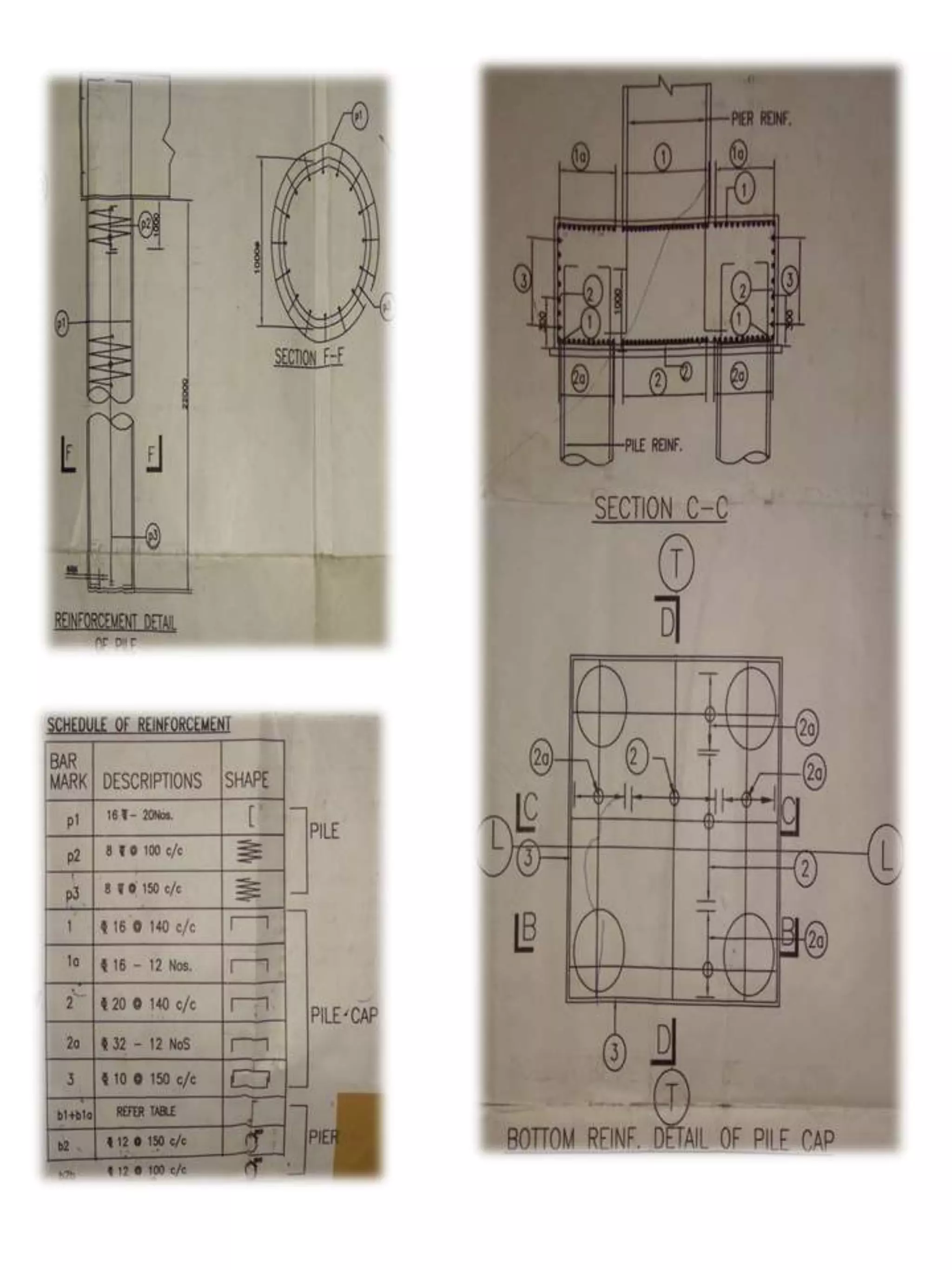
PILE FOUNDATIONS
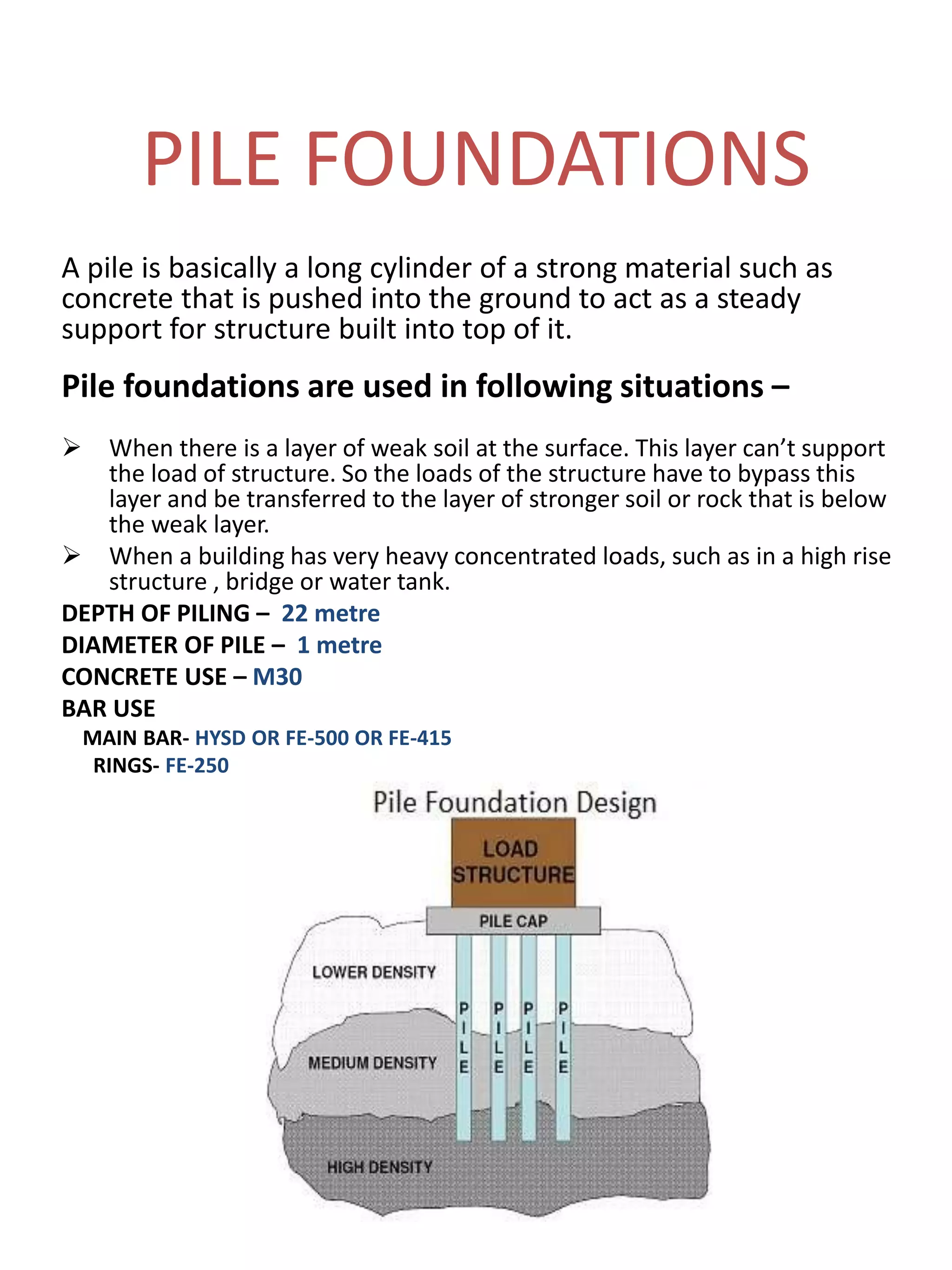
A pile is basically a long cylinder of a strong material such as
concrete that is pushed into the ground to act as a steady
support for structure built into top of it.
Pile foundations are used in following situations –
 When there is a layer of weak soil at the surface. This layer can’t support
the load of structure. So the loads of the structure have to bypass this
layer and be transferred to the layer of stronger soil or rock that is below
the weak layer.
 When a building has very heavy concentrated loads, such as in a high rise
structure , bridge or water tank.
DEPTH OF PILING – 22 metre
DIAMETER OF PILE – 1 metre
CONCRETE USE – M30
BAR USE
MAIN BAR- HYSD OR FE-500 OR FE-415
RINGS- FE-250
TYPES OF PILE
FOUNDATION
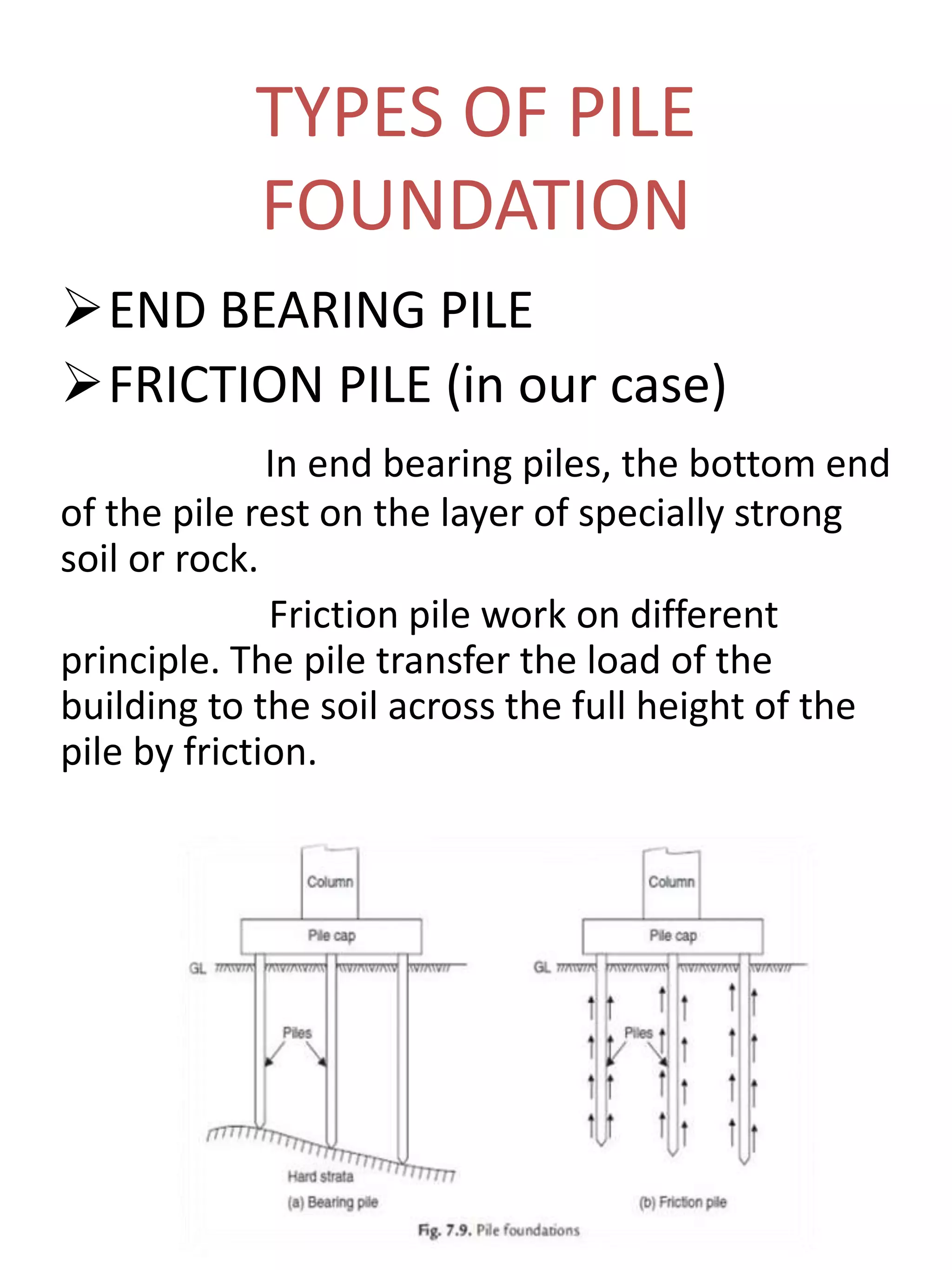
END BEARING PILE
FRICTION PILE (in our case)
In end bearing piles, the bottom end
of the pile rest on the layer of specially strong
soil or rock.
Friction pile work on different
principle. The pile transfer the load of the
building to the soil across the full height of the
pile by friction.
PILE CAP
A pile cap is a thick concrete mat that rests on concrete or timber piles
that have been driven into soft or unstable ground to provide a stable
foundation. It usually forms part of the foundation of a building,
typically a multi-story building, structure or support base for heavy
equipment. The cast concrete pile cap distributes the load of the
building into the piles. A similar structure to a pile cap is a "raft", which
is a concrete foundation floor resting directly onto soft soil which may
be liable to subsidence.
CONSTRUCTION
The mat is made of concrete which is an aggregate of small rocks and
cement. This mixture has to be supported by a framework to avoid
sagging and fracture while setting. This process is known as shuttering
and reinforcing. The materials used are long twisted steel bars between
the piles held in shape by thinner tie wires. Once this steel mat is laid,
timber is attached around the perimeter to contain the wet concrete
mixture. Once poured, (usually as a series of small loads), the concrete
is stirred to remove any air pockets that might weaken the structure
when set. The concrete undergoes a chemical change as it hardens and
this produces a lot of heat. Sometimes, if the mass of concrete is very
large, pipes carrying refrigerant coolant are used in the mass to assist
the setting process to prevent the concrete from cracking.
SIZE OF PILE CAP – ( 4.3 m x 4.3 m x 1.5 m )
BAR USE
MAIN BAR- HYSD OR FE-500 OR FE-415
RINGS- FE-250
CONCRETE USE – M30
PIER
In multi-span bridges , require piers to support
the ends of spans between abutments.
Abutments is give in both end of bridge.
A pier is the upright support of the
superstructure of bridge.
DIAMETER OF PIER – 2.5 metre
BAR USE
MAIN BAR- HYSD OR FE-500 OR FE-415
RINGS- FE-250
CONCRETE USE – M35
REQUIREMENTS OF BRIDGE PIERS
 It should effectively transfer loads from superstructure
to foundation.
 It should withstand all force actions.
 The material for the piers should be easily available.
 It should have pleasant appearance.
 Its design should be simple.
 The piers should be durable against weathering,
impacts and corrosion.
 Cost of construction should be cheap.
 It should have minimum repair and maintanance cost.
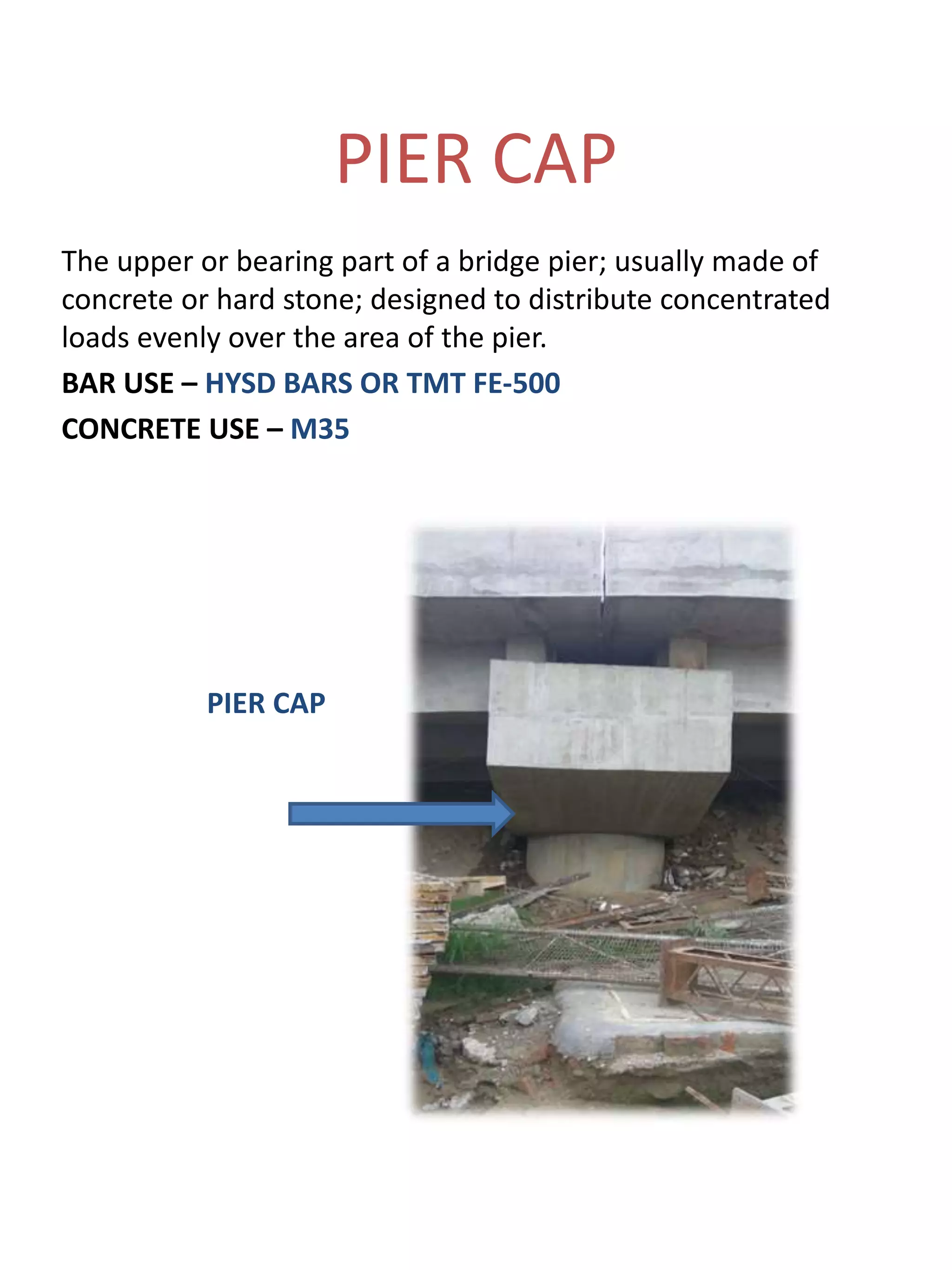
PIER CAP
The upper or bearing part of a bridge pier; usually made of
concrete or hard stone; designed to distribute concentrated
loads evenly over the area of the pier.
BAR USE – HYSD BARS OR TMT FE-500
CONCRETE USE – M35
PIER CAP
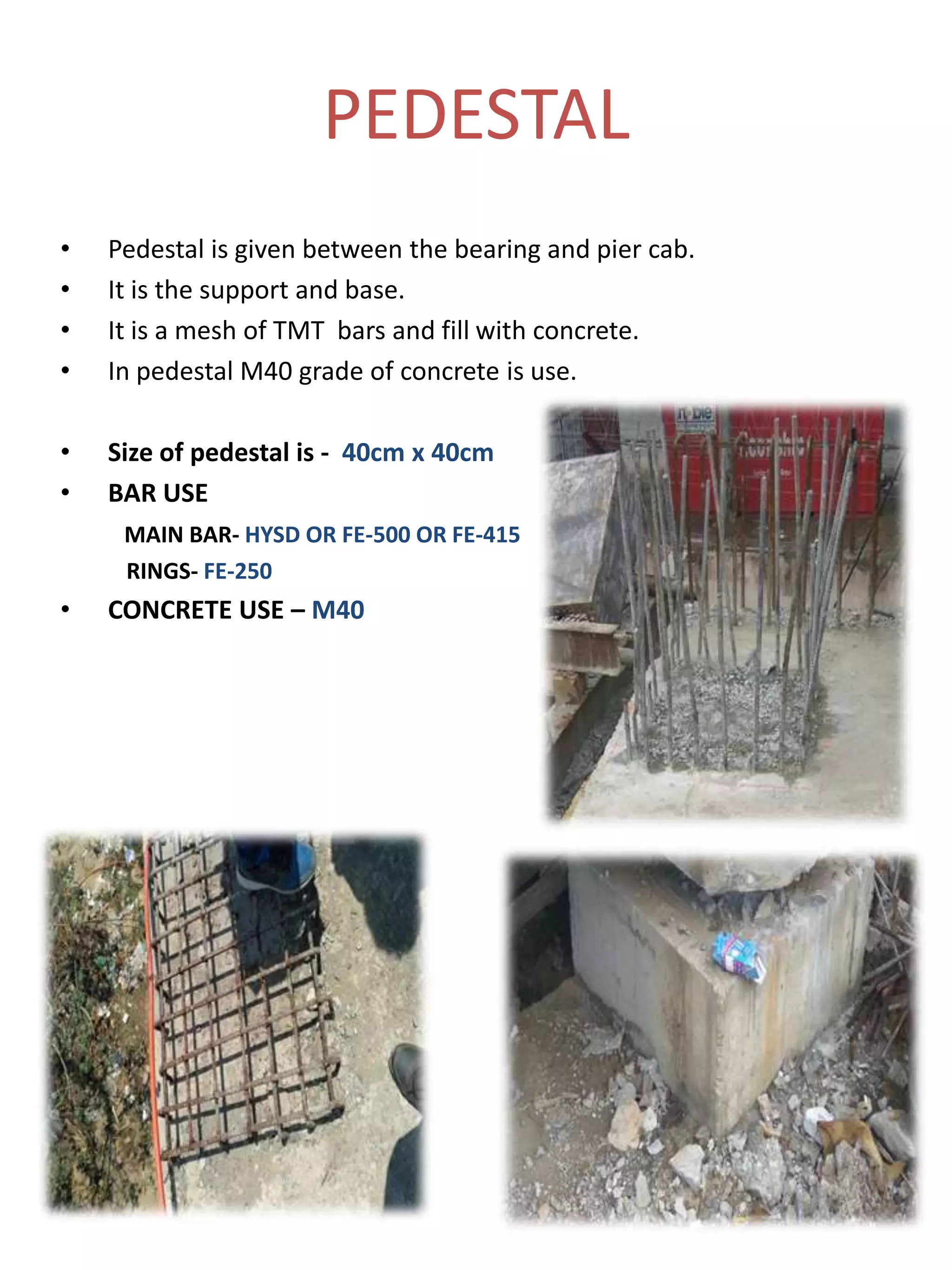
PEDESTAL
• Pedestal is given between the bearing and pier cab.
• It is the support and base.
• It is a mesh of TMT bars and fill with concrete.
• In pedestal M40 grade of concrete is use.
• Size of pedestal is - 40cm x 40cm
• BAR USE
MAIN BAR- HYSD OR FE-500 OR FE-415
RINGS- FE-250
• CONCRETE USE – M40
BEARING
(USED ELASTOMER BEARING IN OUR CASE)
Bearing is the component of a bridge which typically
provides a resting surface between bridge piers and
bridge deck. The purpose of a bearing is to allow
controlled moment and thereby reduced the
stressed involved movement from other sources
such as seismic activity.
There are several type of bridge bearings which are
used depending on a number of different factors
including the bridge span. The oldest form of bridge
bearing is simply two plates resting on top of each
other. A common form of modern bridge bearing is
the elastomeric bridge bearing. Another type of
bridge bearing is mechanical bridge bearing.
SIZE OF BEARING -
ELASTOMER
BEARING
MECHANICAL
BEARING
ABUTMENTS
An abutment is a structure that support one end of a
bridge in other word we can say that it is the structure
located at the end and at the beginning of the bridge.
BAR USE
MAIN BAR- HYSD OR FE-500 OR FE-415
RINGS- FE-250
CONCRETE USE – M35
FUNCTIONS OF ABUTMENTS
 Support the bridge deck at the end.
 Retain the embankment of approaching road.
 Connected the approach road to the bridge deck.
ABUTMENT
WALL
SEISMIC STOPPER
Seismic stopper are mainly based upon the concept
of VCD i.e. vibrations control device with capability
of giving a stable stage to a bridge and mainly it
absorbs the vibrations and prevent the collapse of
the structure.
Despite the fact that stoppers , which restrain the
transverse seismic movement of the deck, are used
frequently in seismically isolated bridges, the use of
longitudinal stoppers is relatively rare, mainly due to
the large in service constraint movement of bridges.
Seismic stoppers are generally attached a both the
abutment
Pier cap at either end of bridge near the bearing.
• BAR USED – HYSD OR TMT FE-500
• CONCRETE USED – M40
SEISMIC
STOPPER
GIRDER
These are the strong beams that carry load from superstructure to the
substructure.
A girder is a support beam used in construction. It is the main horizontal support
of the structure. Girders often have an I – beam cross section composed of two
load bearing flanges separated by a stabilizing web. In our case prestressed girder
is use. Girder were casted at site.
The term "girder" is often used interchangeably with "beam" in reference to
bridge.
CONCRETE USE – M40
BAR USE
MAIN BAR- HYSD OR FE-500 OR FE-415
RINGS- FE-250
PRESTRESSING CABLES - The Prestressing cables serve for Prestressed concrete
which is a kind of reinforced concrete in which the reinforcement means are used
to create an artificial load on the element, and this artificial load opposes the
element's service loads and in fact offsets part of them. Prestressed concrete
beams are generally used for building bridges or coverings bearing great loads
over large spans.
The concrete's artificial load is called tension, and is usually obtained by adding
tensile stresses to the reinforcement of the element, before applying the service
loads. If the prestressing is before casting of the structural element it is called "pre-
tensioned", if it is performed after building of the element, it is called "post-
tensioned".
The prestressing cables are manufactured and supplied in various diameters:
9.53, 11.11, 12.5, 12.7, 15.2, 15.7 mm. Bare and/or grease coated.
In addition prestressing wires in diameters of 5, 6.35 mm.
PRESTRESSED CABLE
GIRDER
DECK SLAB
A bridge deck or road bed is the roadway, or the
pedestrian walkway, surface of a bridge, and is one
structural element of the superstructure of a bridge.
It is not to be confused with any deck of a ship. The
deck may be constructed of concrete, steel, open
grating, or wood. Sometimes the deck is covered
with asphalt concrete or other pavement. The
concrete deck may be an integral part of the bridge
structure (T-beam or double tee structure) or it may
be supported with I-beams or steel girders.
LENGTH OF DECK SLAB – (3x16m + 6x24m +
1x112.30m(rly span) + 5x24m + 1x23.325m)
WIDTH OF DECK SLAB - 8.5metre
THICKNESS OF DECK SLAB –
CONCRETE USE – M40
BAR USE
MAIN BAR- HYSD OR FE-500 OR FE-415
RINGS- FE-250
DECK SLAB SHUTTERING FOR DECK SLAB
CRASH BARRIER
Crash barriers keep vehicles within their roadway and
prevent vehicles from colliding with dangerous obstacles
such as boulders, sign supports, trees, bridge abutments,
buildings, walls, and large storm drains. Traffic barriers
are also installed at the roadside to prevent errant
vehicles from traversing steep (non-recoverable) slopes or
entering deep water. Traffic barriers are installed within
medians of divided highways to prevent errant vehicles
from entering the opposing carriageway of traffic and
help to reduce head-on collisions. Some of these barriers,
designed to be struck from either side, are called median
barriers. Crash barriers can also be used to protect
vulnerable areas like school yards, pedestrian zones, and
fuel tanks from errant vehicles.
While barriers are normally designed to minimize injury
to vehicle occupants, injuries do occur in collisions with
traffic barriers. They should only be installed where a
collision with the barrier is likely to be less severe than a
collision with the hazard behind it. Where possible, it is
preferable to remove, relocate or modify a hazard, rather
than shield it with a barrier.
BAR USE
MAIN BAR- HYSD OR FE-500 OR FE-415
RINGS- FE-250
CONCRETE USE – M40
REINFORCEMENT OF
CRASH BARRIER
CRASH BARRIER
SLUMP TEST
The concrete slump test measures the consistency of
fresh concrete before it sets. It is performed to check the
workability of freshly made concrete, and therefore the
ease with which concrete flows. It can also be used as an
indicator of an improperly mixed batch.
PROCEDURE
The test is carried out using a metal mould in the shape of
a conical frustum known as a slump cone or Abrams
cone, that is open at both ends and has attached handles.
The tool typically has an internal diameter of 100
millimetres (3.9 in) at the top and of 200 millimetres (7.9
in) at the bottom with a height of 305 millimetres (12.0
in).The cone is placed on a hard non-absorbent surface.
This cone is filled with fresh concrete in three stages. Each
time, each layer is tamped 25 times with a 2 ft (600 mm)-
long bullet-nosed metal rod measuring 5/8 in (16 mm) in
diameter. At the end of the third stage, the concrete is
struck off flush with the top of the mould. The mould is
carefully lifted vertically upwards, so as not to disturb the
concrete cone.
The concrete then slumps (subsides). The slump of the
concrete is measured by measuring the distance from the
top of the slumped concrete to the level of the top of the
slump cone.
A
REMOVING CONE HEIGHT
MEASUREMENT
The slumped concrete takes various shapes and according
to the profile of slumped concrete, the slump is termed
as true slump, shear slump or collapse slump. If a shear or
collapse slump is achieved, a fresh sample should be
taken and the test repeated. A collapse slump is an
indication that the mix is too wet.
Only a true slump is of any use in the test. A collapse
slump will generally mean that the mix is too wet or that
it is a high workability mix, for which the slump test is not
appropriate.[1][3] Very dry mixes having slump 0 – 25 mm
are typically used in road making, low workability mixes
having slump 10 – 40 mm are typically used for
foundations with light reinforcement, medium workability
mixes with slump 50 – 90 mm, are typically used for
normal reinforced concrete placed with vibration, high
workability concrete with slump > 100 mm is typically
used where reinforcing has tight spacing, and/or the
concrete has to flow a great distance.
SIEVE TEST
A sieve analysis (or gradation test) is a practice or
procedure used (commonly used in civil engineering) to
assess the particle size distribution (also called gradation)
of a granular material.
PROCEDURE – A gradation test is performed on a
sample of aggregate in a laboratory. A typical sieve
analysis involves a nested column of sieves with wire
mesh cloth (screen). See the separate Mesh (scale) page
for details of sieve sizing.
A representative weighed sample is poured into the top
sieve which has the largest screen openings. Each lower
sieve in the column has smaller openings than the one
above. At the base is a round pan, called the receiver.
The column is typically placed in a mechanical shaker. The
shaker shakes the column, usually for some fixed amount
of time. After the shaking is complete the material on
each sieve is weighed. The weight of the sample of each
sieve is then divided by the total weight to give a
percentage retained on each sieve. The size of the
average particle on each sieve is then analysed to get a
cut-off point or specific size range, which is then captured
on a screen.
The results of this test are used to describe the properties
of the aggregate and to see if it is appropriate for various
civil engineering purposes such as selecting the
appropriate aggregate for concrete mixes and asphalt
mixes as well as sizing of water production well screens.
RESULTS -
The results are presented in a graph of percent passing
versus the sieve size. On the graph the sieve size scale is
logarithmic. To find the percent of aggregate passing
through each sieve, first find the percent retained in each
sieve. To do so, the following equation is used,
%Retained = (Wsieve/Wtotal)x100%
where WSieve is the weight of aggregate in the sieve and
WTotal is the total weight of the aggregate. The next step
is to find the cumulative percent of aggregate retained in
each sieve. To do so, add up the total amount of
aggregate that is retained in each sieve and the amount in
the previous sieves. The cumulative percent passing of
the aggregate is found by subtracting the percent
retained from 100%.
%Cumulative Passing = 100% - %Cumulative
Retained.
SILT TEST
OBJECTIVE- Find out silt content in sand (fine aggregate).
APPARATUS REQUIRED-
• 500 ml measuring cylinder
• Water
• Sand and tray
TEST PROCEDURE-
• First, we have to fill the measuring cylinder with 1% solution
of salt and water up to 50 ml.
• Add sand to it until the level reaches 100 ml. Then fill the
solution up to 150 ml level.
• Cover the cylinder and shake it well (as shown in video)
• After 3 hours, the silt content settled down over the sand
layer
• Now note down the silt layer alone volume as V1 ml (settled
over the sand)
• Then note down the sand volume (below the silt) as V2 ml
• Repeat the procedure two more times to get the average
SILT CONTENT = (V1/V2)X100
• The permissible Silt content in sand percentage is only 6%.
500 ML
MEASURING
CYLINDER
WATER
SILT CONTENT
FINE
AGGREGATE
CUBE TEST
Cube Testing is a Destructive Testing Method of
Concrete Testing, as the cubes are crushed in
Compression Testing Machine. The mostly tested
cubes in practice are of 150x150x150 size in mm.
APPARATUS USED –
• 150x150x150 mm. cube moulds 6 Nos.
• Slide wrench 1 No.
• Trowel 1 No.
• 600mm long and 16mm Dia. Temping Rod 1No.
• Nail 1 No.
• Water Tank 1 No.
• Steel Rule 1 No.
• Compression Testing Machine
• Soft Cloth 1 No.
• Mallet 1 No.
• Lubricating agent.
RAW MATERIALS –
Freshly prepared concrete that is Green Concrete
which is to be tested.
PROCEDURE
• First of all measure the mould for its Length, Breadth
and Height all inner to inner dimensions accurately
with the help of the steel rule.
• If there is any dimensions which deviates from Length
x Breadth x Height = 150x150x150 mm. then loosen
the nut bolts of the mould with the help of slide
wrench and adjust it to the perfect 150x150x150 mm
and tighten the nut and bolts again.
• Now lubricate the inside of the mould thoroughly with
lubricating agent, which may be engine oil or Grease.
• Then pour the green concrete to be tested into the
mould with trowel in Three Layers of each having
height approximately 50mm so that three layers fulfill
the cube mould as 50+50+50 = 150 mm. after pouring
each layer, compact that layer with the help of the
Temping Rod with the bullet ended side stroking into
the concrete for 35 Strokes.
• After Pouring each layer into the mould, struck the
mould from outside on all four wall moderately with
the help of mallet so that no honeycombs forms at the
contact surface of the Concrete and the mould.
• After pouring all three layers according to the step 4
and 5, now trim of the top of the mould and finish it
smooth with the help of trowel.
• Prepare 6 moulds filled with concrete in the same
manner.
• Leave the moulds about 1 hour, then write the cube
nos. as cube 1 cube 2……cube 6 and date on which
they have prepared on the top surface of the concrete
with the help of nail.
• After 24 Hours open the moulds by opening the
nut bolts with the help of slide wrench and
release all the 6 cubes from there moulds, and
immerse completely all of these cubes under
water in water tank at room temperature that is
28C +/- 2C.
• At 7th day from the date of preparation of cubes
take 3 cubes of the 6 cubes and soak the water
on them with cloth and test them in compression
testing machine, crush the cubes one by one and
note the results on the compression testing
machine.
• Do the same for the remaining 3 cubes at 28th
day form the date preparation of the cubes, and
note the results on the compression testing
machine.
• Now calculate the Crushing strength for all cubes
from the obtained results in terms of N/mm^2 by
the following :-
• The top surface area of each cube at Top is
150×150 = 22500 mm^2
7th DAY CRUSHED
Compressive load = 420000 N
Crushing strength of that cube = load at crushing/surface
area of cube in contact
= 420000/22500
= 18.667 N/mm^2
CUBE MOULD
(150X150X150) IN mm
CRUSHED
CUBE
CURING OF CUBE
EQUIPMENTS
USED
1. Bull
Dozer
2. Crane
3. Transit
Mixer
4. Tractor
5. Dumper
THANKS

Training report ON BRIDGE

  • 1.
    ACKNOWLEDGEMENT I would liketo thank UP state bridge corporation limited for giving me this invaluable opportunity to learn so much practical knowledge which would have impossible to learn through only looking at images from textbooks. I have gained invaluable insights into how construction of any superstructure is handled and how any difficulty which comes in between is tackled. Apart from technical knowledge, I have gain insights into construction management, efficient man-power management and lots of other thing. I am deeply indebted to our training in-charge at site Mr. JAGDISH (Assistant Engineer) whose help, stimulating suggestions and encouragement helped me in all the time at the training site and also for writing this report. I am also thankful to Mr. UMESH GANDHI (Junior Engineer) for helping me understand the process of construction. Especially, I would like to give my special thanks to my parents whose patient love enabled me to complete this work.
  • 2.
    CONTENTS 1. ABOUT UPSBCL 2.DETAILS OF BRIDGE 3. BRIDGE COMPONENTS 3.1. PILE FOUNDATION 3.1.1. PILE AND PILE CAP 3.2. SUBSTRUCTURES 3.2.1. PIER AND PIER CAP 3.2.2. PEDESTAL 3.2.3. BEARING 3.2.4. ABUTMENT 3.2.5. SEISMIC STOPPER 3.3. SUPERSTRUCTURES 3.3.1. GIRDER 3.3.2. SLAB 3.3.3. CRASH BARRIER 4. TEST 4.1 SLUMP TEST 4.2 SIEVE TEST 4.3 SILT TEST 4.4 CUBE TEST (COMPRESIVE STRENGTH TEST)
  • 3.
    ABOUT UPSBCL U.P. StateBridge Corporation Ltd. started functioning on Ist March 1973 as a company under U.P. State Government to accelerate the activities of design and construction of Bridges in the state. U.P. State is rich in Geographical and topographical diversities like small and big rivers, varying terrain all through the state. For the speedy development of the state it was necessary to connect all part of the state by roads and bridges. Simultaneously it also required provision of best technical support for economic & quality execution, commensurate to Infrastructural facilities in the form of Bridge engineers and technical staff available in the State. Initially in U.P.P.W.D. departmental construction units were established for the purpose of Quality and Speedy construction. With great success the bridge engineers and technical staff of U.P.P.W.D. were ready to complete the Bridges departmentally within stipulated time with desired workmanship. This encouraged the engineers and U.P. Govt. to establish a separate body for design and construction of bridges and this gave birth to UPSBC. After successful completion of several bridges, the Board of Director of UPSBC felt that the technical experts of the State in the filed of Bridge Construction & Design should be utilized in enhancing the similar activities in other States of the country and abroad. To achieve this UPSBC started competing in tender process for obtaining the work in open market competition. If proved to be of great success day by day. Incidentally due to liberalization of economic environment, the consultants and contractors have come to occupy a crucial role in Indian economy. They not only provide the needed expertise to plan, build and manage the projects within the country, but also bring the foreign currency from assignments abroad, besides promoting transfer of technologies more effectively and providing professional inputs for industrial & technological developments. Due to the liberalization policy Indian consultants and contractors need considerable impulse to expand and grow, and realize its high potential at home and aboard. The main theme and activities of UPSBC always remain to provide a strong support in the field of Bridge and highways construction and Consultancy in design, planning and maintenance which has a large scope not only in our country but also aboard. UPSBC has successfully constructed a number of bridges and roads in Iraq , Yemen and Nepal also in addition to U.P. along with other States of India and earned reputation and foreign currency for the country. Since UPSBC is a Govt. undertaking, therefore all the profit earned by UPSBC ultimately adds to State Govt.
  • 4.
    DETAILS OF BRIDGE Seeingthe current increase in traffic conditions and jamming problems due to two lane bridge over railway crossing at LOCOSHED BRIDGE MORADABAD. So, “up state bridge corporation limited” constructed a two lane bridge next to existing bridge for converted into four lane road. The bridge is constructed 448 metre over railway crossing Moradabad. The bridge will connect Delhi road to Moradabad city. • 2 LANE ONE WAY BRIDGE • LENGTH OF BRIDGE – 448 metre • DESIGN SPEED – 30 KM/HR • WIDTH OF BRIDGE – 8.5 metre • NO. OF PIERS – 10 • GAP BETWEEN TWO DECK SLAP – 40mm • TYPE OF BRIDGE - GIRDER BRIDGE • HIGHLY TENSILE PRESTRESSED CABLE IS USED
  • 5.
    GRADE OF CONCRETE USED •LEAN CONCRETE – 1:3:6 • FOUNDATION – M30 • SUBSTRUCTURE – M35 • PSC BEAM – M40 • DECK SLAB – M40 • CRASH BARRIER – M40 DESIGNATION MIX PROPORTION COMPRESSIVE STREGTH (N/MM^2) M15 1:2:4 15 M20 1:1.5:3 20 M30 1:1:2 30 M35 35 M40 DESIGNED 40 M45 45
  • 6.
    PART OF BRIDGE •LEAN • FOOTING (PILE FOOTING) - PILE AND PILE CAP • PIER • PIER CAP • PEDESTAL • BEARING PAD • SIESMIC STOPPER • GIRDER • DECK SLAB • CRASH BARRIER SIZE OF TMT BARS 6mm , 8mm, 10mm , 12mm, 16mm , 20mm, 25mm , 28mm, 32mm
  • 7.
    PILE FOUNDATIONS A pileis basically a long cylinder of a strong material such as concrete that is pushed into the ground to act as a steady support for structure built into top of it. Pile foundations are used in following situations –  When there is a layer of weak soil at the surface. This layer can’t support the load of structure. So the loads of the structure have to bypass this layer and be transferred to the layer of stronger soil or rock that is below the weak layer.  When a building has very heavy concentrated loads, such as in a high rise structure , bridge or water tank. DEPTH OF PILING – 22 metre DIAMETER OF PILE – 1 metre CONCRETE USE – M30 BAR USE MAIN BAR- HYSD OR FE-500 OR FE-415 RINGS- FE-250
  • 8.
    TYPES OF PILE FOUNDATION ENDBEARING PILE FRICTION PILE (in our case) In end bearing piles, the bottom end of the pile rest on the layer of specially strong soil or rock. Friction pile work on different principle. The pile transfer the load of the building to the soil across the full height of the pile by friction.
  • 9.
    PILE CAP A pilecap is a thick concrete mat that rests on concrete or timber piles that have been driven into soft or unstable ground to provide a stable foundation. It usually forms part of the foundation of a building, typically a multi-story building, structure or support base for heavy equipment. The cast concrete pile cap distributes the load of the building into the piles. A similar structure to a pile cap is a "raft", which is a concrete foundation floor resting directly onto soft soil which may be liable to subsidence. CONSTRUCTION The mat is made of concrete which is an aggregate of small rocks and cement. This mixture has to be supported by a framework to avoid sagging and fracture while setting. This process is known as shuttering and reinforcing. The materials used are long twisted steel bars between the piles held in shape by thinner tie wires. Once this steel mat is laid, timber is attached around the perimeter to contain the wet concrete mixture. Once poured, (usually as a series of small loads), the concrete is stirred to remove any air pockets that might weaken the structure when set. The concrete undergoes a chemical change as it hardens and this produces a lot of heat. Sometimes, if the mass of concrete is very large, pipes carrying refrigerant coolant are used in the mass to assist the setting process to prevent the concrete from cracking. SIZE OF PILE CAP – ( 4.3 m x 4.3 m x 1.5 m ) BAR USE MAIN BAR- HYSD OR FE-500 OR FE-415 RINGS- FE-250 CONCRETE USE – M30
  • 12.
    PIER In multi-span bridges, require piers to support the ends of spans between abutments. Abutments is give in both end of bridge. A pier is the upright support of the superstructure of bridge. DIAMETER OF PIER – 2.5 metre BAR USE MAIN BAR- HYSD OR FE-500 OR FE-415 RINGS- FE-250 CONCRETE USE – M35 REQUIREMENTS OF BRIDGE PIERS  It should effectively transfer loads from superstructure to foundation.  It should withstand all force actions.  The material for the piers should be easily available.  It should have pleasant appearance.  Its design should be simple.  The piers should be durable against weathering, impacts and corrosion.  Cost of construction should be cheap.  It should have minimum repair and maintanance cost.
  • 13.
    PIER CAP The upperor bearing part of a bridge pier; usually made of concrete or hard stone; designed to distribute concentrated loads evenly over the area of the pier. BAR USE – HYSD BARS OR TMT FE-500 CONCRETE USE – M35 PIER CAP
  • 15.
    PEDESTAL • Pedestal isgiven between the bearing and pier cab. • It is the support and base. • It is a mesh of TMT bars and fill with concrete. • In pedestal M40 grade of concrete is use. • Size of pedestal is - 40cm x 40cm • BAR USE MAIN BAR- HYSD OR FE-500 OR FE-415 RINGS- FE-250 • CONCRETE USE – M40
  • 16.
    BEARING (USED ELASTOMER BEARINGIN OUR CASE) Bearing is the component of a bridge which typically provides a resting surface between bridge piers and bridge deck. The purpose of a bearing is to allow controlled moment and thereby reduced the stressed involved movement from other sources such as seismic activity. There are several type of bridge bearings which are used depending on a number of different factors including the bridge span. The oldest form of bridge bearing is simply two plates resting on top of each other. A common form of modern bridge bearing is the elastomeric bridge bearing. Another type of bridge bearing is mechanical bridge bearing. SIZE OF BEARING -
  • 17.
  • 18.
    ABUTMENTS An abutment isa structure that support one end of a bridge in other word we can say that it is the structure located at the end and at the beginning of the bridge. BAR USE MAIN BAR- HYSD OR FE-500 OR FE-415 RINGS- FE-250 CONCRETE USE – M35 FUNCTIONS OF ABUTMENTS  Support the bridge deck at the end.  Retain the embankment of approaching road.  Connected the approach road to the bridge deck.
  • 19.
  • 20.
    SEISMIC STOPPER Seismic stopperare mainly based upon the concept of VCD i.e. vibrations control device with capability of giving a stable stage to a bridge and mainly it absorbs the vibrations and prevent the collapse of the structure. Despite the fact that stoppers , which restrain the transverse seismic movement of the deck, are used frequently in seismically isolated bridges, the use of longitudinal stoppers is relatively rare, mainly due to the large in service constraint movement of bridges. Seismic stoppers are generally attached a both the abutment Pier cap at either end of bridge near the bearing. • BAR USED – HYSD OR TMT FE-500 • CONCRETE USED – M40
  • 21.
  • 22.
    GIRDER These are thestrong beams that carry load from superstructure to the substructure. A girder is a support beam used in construction. It is the main horizontal support of the structure. Girders often have an I – beam cross section composed of two load bearing flanges separated by a stabilizing web. In our case prestressed girder is use. Girder were casted at site. The term "girder" is often used interchangeably with "beam" in reference to bridge. CONCRETE USE – M40 BAR USE MAIN BAR- HYSD OR FE-500 OR FE-415 RINGS- FE-250 PRESTRESSING CABLES - The Prestressing cables serve for Prestressed concrete which is a kind of reinforced concrete in which the reinforcement means are used to create an artificial load on the element, and this artificial load opposes the element's service loads and in fact offsets part of them. Prestressed concrete beams are generally used for building bridges or coverings bearing great loads over large spans. The concrete's artificial load is called tension, and is usually obtained by adding tensile stresses to the reinforcement of the element, before applying the service loads. If the prestressing is before casting of the structural element it is called "pre- tensioned", if it is performed after building of the element, it is called "post- tensioned". The prestressing cables are manufactured and supplied in various diameters: 9.53, 11.11, 12.5, 12.7, 15.2, 15.7 mm. Bare and/or grease coated. In addition prestressing wires in diameters of 5, 6.35 mm.
  • 23.
  • 24.
    DECK SLAB A bridgedeck or road bed is the roadway, or the pedestrian walkway, surface of a bridge, and is one structural element of the superstructure of a bridge. It is not to be confused with any deck of a ship. The deck may be constructed of concrete, steel, open grating, or wood. Sometimes the deck is covered with asphalt concrete or other pavement. The concrete deck may be an integral part of the bridge structure (T-beam or double tee structure) or it may be supported with I-beams or steel girders. LENGTH OF DECK SLAB – (3x16m + 6x24m + 1x112.30m(rly span) + 5x24m + 1x23.325m) WIDTH OF DECK SLAB - 8.5metre THICKNESS OF DECK SLAB – CONCRETE USE – M40 BAR USE MAIN BAR- HYSD OR FE-500 OR FE-415 RINGS- FE-250
  • 25.
    DECK SLAB SHUTTERINGFOR DECK SLAB
  • 26.
    CRASH BARRIER Crash barrierskeep vehicles within their roadway and prevent vehicles from colliding with dangerous obstacles such as boulders, sign supports, trees, bridge abutments, buildings, walls, and large storm drains. Traffic barriers are also installed at the roadside to prevent errant vehicles from traversing steep (non-recoverable) slopes or entering deep water. Traffic barriers are installed within medians of divided highways to prevent errant vehicles from entering the opposing carriageway of traffic and help to reduce head-on collisions. Some of these barriers, designed to be struck from either side, are called median barriers. Crash barriers can also be used to protect vulnerable areas like school yards, pedestrian zones, and fuel tanks from errant vehicles. While barriers are normally designed to minimize injury to vehicle occupants, injuries do occur in collisions with traffic barriers. They should only be installed where a collision with the barrier is likely to be less severe than a collision with the hazard behind it. Where possible, it is preferable to remove, relocate or modify a hazard, rather than shield it with a barrier. BAR USE MAIN BAR- HYSD OR FE-500 OR FE-415 RINGS- FE-250 CONCRETE USE – M40
  • 27.
  • 28.
    SLUMP TEST The concreteslump test measures the consistency of fresh concrete before it sets. It is performed to check the workability of freshly made concrete, and therefore the ease with which concrete flows. It can also be used as an indicator of an improperly mixed batch. PROCEDURE The test is carried out using a metal mould in the shape of a conical frustum known as a slump cone or Abrams cone, that is open at both ends and has attached handles. The tool typically has an internal diameter of 100 millimetres (3.9 in) at the top and of 200 millimetres (7.9 in) at the bottom with a height of 305 millimetres (12.0 in).The cone is placed on a hard non-absorbent surface. This cone is filled with fresh concrete in three stages. Each time, each layer is tamped 25 times with a 2 ft (600 mm)- long bullet-nosed metal rod measuring 5/8 in (16 mm) in diameter. At the end of the third stage, the concrete is struck off flush with the top of the mould. The mould is carefully lifted vertically upwards, so as not to disturb the concrete cone. The concrete then slumps (subsides). The slump of the concrete is measured by measuring the distance from the top of the slumped concrete to the level of the top of the slump cone.
  • 29.
  • 30.
    The slumped concretetakes various shapes and according to the profile of slumped concrete, the slump is termed as true slump, shear slump or collapse slump. If a shear or collapse slump is achieved, a fresh sample should be taken and the test repeated. A collapse slump is an indication that the mix is too wet. Only a true slump is of any use in the test. A collapse slump will generally mean that the mix is too wet or that it is a high workability mix, for which the slump test is not appropriate.[1][3] Very dry mixes having slump 0 – 25 mm are typically used in road making, low workability mixes having slump 10 – 40 mm are typically used for foundations with light reinforcement, medium workability mixes with slump 50 – 90 mm, are typically used for normal reinforced concrete placed with vibration, high workability concrete with slump > 100 mm is typically used where reinforcing has tight spacing, and/or the concrete has to flow a great distance.
  • 31.
    SIEVE TEST A sieveanalysis (or gradation test) is a practice or procedure used (commonly used in civil engineering) to assess the particle size distribution (also called gradation) of a granular material. PROCEDURE – A gradation test is performed on a sample of aggregate in a laboratory. A typical sieve analysis involves a nested column of sieves with wire mesh cloth (screen). See the separate Mesh (scale) page for details of sieve sizing. A representative weighed sample is poured into the top sieve which has the largest screen openings. Each lower sieve in the column has smaller openings than the one above. At the base is a round pan, called the receiver. The column is typically placed in a mechanical shaker. The shaker shakes the column, usually for some fixed amount of time. After the shaking is complete the material on each sieve is weighed. The weight of the sample of each sieve is then divided by the total weight to give a percentage retained on each sieve. The size of the average particle on each sieve is then analysed to get a cut-off point or specific size range, which is then captured on a screen. The results of this test are used to describe the properties of the aggregate and to see if it is appropriate for various civil engineering purposes such as selecting the appropriate aggregate for concrete mixes and asphalt mixes as well as sizing of water production well screens.
  • 32.
    RESULTS - The resultsare presented in a graph of percent passing versus the sieve size. On the graph the sieve size scale is logarithmic. To find the percent of aggregate passing through each sieve, first find the percent retained in each sieve. To do so, the following equation is used, %Retained = (Wsieve/Wtotal)x100% where WSieve is the weight of aggregate in the sieve and WTotal is the total weight of the aggregate. The next step is to find the cumulative percent of aggregate retained in each sieve. To do so, add up the total amount of aggregate that is retained in each sieve and the amount in the previous sieves. The cumulative percent passing of the aggregate is found by subtracting the percent retained from 100%. %Cumulative Passing = 100% - %Cumulative Retained.
  • 33.
    SILT TEST OBJECTIVE- Findout silt content in sand (fine aggregate). APPARATUS REQUIRED- • 500 ml measuring cylinder • Water • Sand and tray TEST PROCEDURE- • First, we have to fill the measuring cylinder with 1% solution of salt and water up to 50 ml. • Add sand to it until the level reaches 100 ml. Then fill the solution up to 150 ml level. • Cover the cylinder and shake it well (as shown in video) • After 3 hours, the silt content settled down over the sand layer • Now note down the silt layer alone volume as V1 ml (settled over the sand) • Then note down the sand volume (below the silt) as V2 ml • Repeat the procedure two more times to get the average SILT CONTENT = (V1/V2)X100 • The permissible Silt content in sand percentage is only 6%.
  • 34.
  • 35.
    CUBE TEST Cube Testingis a Destructive Testing Method of Concrete Testing, as the cubes are crushed in Compression Testing Machine. The mostly tested cubes in practice are of 150x150x150 size in mm. APPARATUS USED – • 150x150x150 mm. cube moulds 6 Nos. • Slide wrench 1 No. • Trowel 1 No. • 600mm long and 16mm Dia. Temping Rod 1No. • Nail 1 No. • Water Tank 1 No. • Steel Rule 1 No. • Compression Testing Machine • Soft Cloth 1 No. • Mallet 1 No. • Lubricating agent. RAW MATERIALS – Freshly prepared concrete that is Green Concrete which is to be tested.
  • 36.
    PROCEDURE • First ofall measure the mould for its Length, Breadth and Height all inner to inner dimensions accurately with the help of the steel rule. • If there is any dimensions which deviates from Length x Breadth x Height = 150x150x150 mm. then loosen the nut bolts of the mould with the help of slide wrench and adjust it to the perfect 150x150x150 mm and tighten the nut and bolts again. • Now lubricate the inside of the mould thoroughly with lubricating agent, which may be engine oil or Grease. • Then pour the green concrete to be tested into the mould with trowel in Three Layers of each having height approximately 50mm so that three layers fulfill the cube mould as 50+50+50 = 150 mm. after pouring each layer, compact that layer with the help of the Temping Rod with the bullet ended side stroking into the concrete for 35 Strokes. • After Pouring each layer into the mould, struck the mould from outside on all four wall moderately with the help of mallet so that no honeycombs forms at the contact surface of the Concrete and the mould. • After pouring all three layers according to the step 4 and 5, now trim of the top of the mould and finish it smooth with the help of trowel. • Prepare 6 moulds filled with concrete in the same manner. • Leave the moulds about 1 hour, then write the cube nos. as cube 1 cube 2……cube 6 and date on which they have prepared on the top surface of the concrete with the help of nail.
  • 37.
    • After 24Hours open the moulds by opening the nut bolts with the help of slide wrench and release all the 6 cubes from there moulds, and immerse completely all of these cubes under water in water tank at room temperature that is 28C +/- 2C. • At 7th day from the date of preparation of cubes take 3 cubes of the 6 cubes and soak the water on them with cloth and test them in compression testing machine, crush the cubes one by one and note the results on the compression testing machine. • Do the same for the remaining 3 cubes at 28th day form the date preparation of the cubes, and note the results on the compression testing machine. • Now calculate the Crushing strength for all cubes from the obtained results in terms of N/mm^2 by the following :- • The top surface area of each cube at Top is 150×150 = 22500 mm^2 7th DAY CRUSHED Compressive load = 420000 N Crushing strength of that cube = load at crushing/surface area of cube in contact = 420000/22500 = 18.667 N/mm^2
  • 38.
    CUBE MOULD (150X150X150) INmm CRUSHED CUBE CURING OF CUBE
  • 39.
    EQUIPMENTS USED 1. Bull Dozer 2. Crane 3.Transit Mixer 4. Tractor 5. Dumper
  • 40.