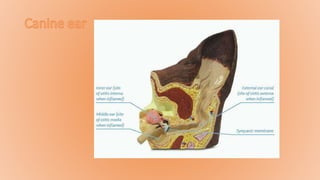
CANINE EAR
Dr.P.Sreenivasa Reddy, MVSc
Veterinary assistant surgeon
RAHTC, GUNTUR
• Ear Is An Organ For --- hearing
--- balance.
It consists of the -outer,
-middle,
-inner ear.
outer ear
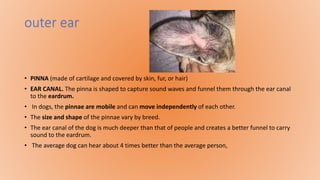
• PINNA (made of cartilage and covered by skin, fur, or hair)
• EAR CANAL. The pinna is shaped to capture sound waves and funnel them through the ear canal
to the eardrum.
• In dogs, the pinnae are mobile and can move independently of each other.
• The size and shape of the pinnae vary by breed.
• The ear canal of the dog is much deeper than that of people and creates a better funnel to carry
sound to the eardrum.
• The average dog can hear about 4 times better than the average person,
Middle ear
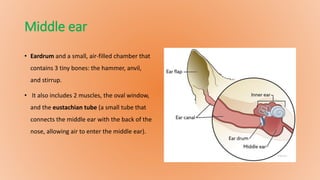
• Eardrum and a small, air-filled chamber that
contains 3 tiny bones: the hammer, anvil,
and stirrup.
• It also includes 2 muscles, the oval window,
and the eustachian tube (a small tube that
connects the middle ear with the back of the
nose, allowing air to enter the middle ear).
inner ear
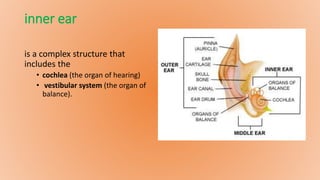
is a complex structure that
includes the
• cochlea (the organ of hearing)
• vestibular system (the organ of
balance).
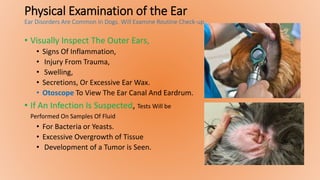
Physical Examination of the Ear
Ear Disorders Are Common In Dogs. Will Examine Routine Check-up.
• Visually Inspect The Outer Ears,
• Signs Of Inflammation,
• Injury From Trauma,
• Swelling,
• Secretions, Or Excessive Ear Wax.
• Otoscope To View The Ear Canal And Eardrum.
• If An Infection Is Suspected, Tests Will be
Performed On Samples Of Fluid
• For Bacteria or Yeasts.
• Excessive Overgrowth of Tissue
• Development of a Tumor is Seen.
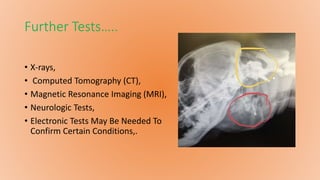
Further Tests…..
• X-rays,
• Computed Tomography (CT),
• Magnetic Resonance Imaging (MRI),
• Neurologic Tests,
• Electronic Tests May Be Needed To
Confirm Certain Conditions,.
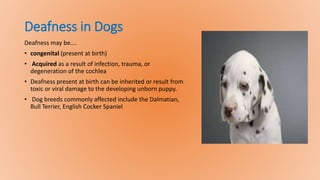
Deafness in Dogs
Deafness may be….
• congenital (present at birth)
• Acquired as a result of infection, trauma, or
degeneration of the cochlea
• Deafness present at birth can be inherited or result from
toxic or viral damage to the developing unborn puppy.
• Dog breeds commonly affected include the Dalmatian,
Bull Terrier, English Cocker Spaniel
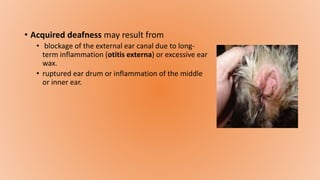
• Acquired deafness may result from
• blockage of the external ear canal due to long-
term inflammation (otitis externa) or excessive ear
wax.
• ruptured ear drum or inflammation of the middle
or inner ear.
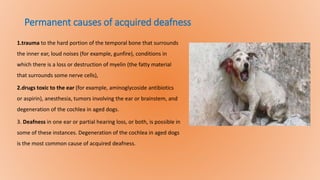
Permanent causes of acquired deafness
1.trauma to the hard portion of the temporal bone that surrounds
the inner ear, loud noises (for example, gunfire), conditions in
which there is a loss or destruction of myelin (the fatty material
that surrounds some nerve cells),
2.drugs toxic to the ear (for example, aminoglycoside antibiotics
or aspirin), anesthesia, tumors involving the ear or brainstem, and
degeneration of the cochlea in aged dogs.
3. Deafness in one ear or partial hearing loss, or both, is possible in
some of these instances. Degeneration of the cochlea in aged dogs
is the most common cause of acquired deafness.
Diagnosis of deafness
• requires
• careful observation of the animal’s
response to sound.
• The response to touch, smell, and
objects that can be seen must be
differentiated from the response to
sound.
• Deafness in one ear is difficult to detect,
Primary sign of deafness
• Failure to respond to a sound,
• Failure to alert to the source of a sound.
• Other signs include unusual behaviour such
as excessive barking,
• Unusual voice,
• Hyperactivity,
• Confusion when given vocal commands, and
• Lack of ear movement.
• Deafness due to blockage of the external ear canal
responds to surgical or medical treatment.
• Deafness due to bacterial infections of the middle and inner ear
 respond to antibiotic treatment.
• deafness is due to persistent intense noise or trauma,
recovery is unlikely.
• Hereditary deafness
may be eliminated from a breed
What Causes Ear Infections in Dogs?
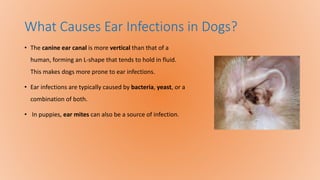
• The canine ear canal is more vertical than that of a
human, forming an L-shape that tends to hold in fluid.
This makes dogs more prone to ear infections.
• Ear infections are typically caused by bacteria, yeast, or a
combination of both.
• In puppies, ear mites can also be a source of infection.
:
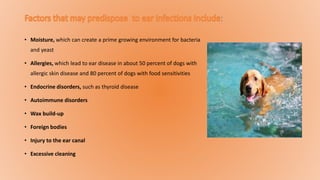
• Moisture, which can create a prime growing environment for bacteria
and yeast
• Allergies, which lead to ear disease in about 50 percent of dogs with
allergic skin disease and 80 percent of dogs with food sensitivities
• Endocrine disorders, such as thyroid disease
• Autoimmune disorders
• Wax build-up
• Foreign bodies
• Injury to the ear canal
• Excessive cleaning
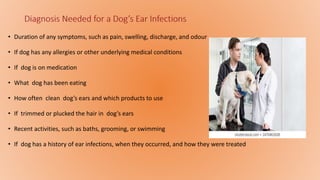
• Duration of any symptoms, such as pain, swelling, discharge, and odour
• If dog has any allergies or other underlying medical conditions
• If dog is on medication
• What dog has been eating
• How often clean dog’s ears and which products to use
• If trimmed or plucked the hair in dog’s ears
• Recent activities, such as baths, grooming, or swimming
• If dog has a history of ear infections, when they occurred, and how they were treated
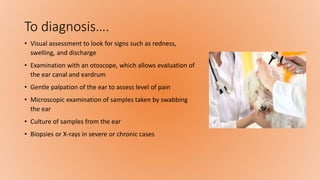
To diagnosis….
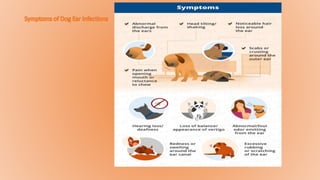
• Visual assessment to look for signs such as redness,
swelling, and discharge
• Examination with an otoscope, which allows evaluation of
the ear canal and eardrum
• Gentle palpation of the ear to assess level of pain
• Microscopic examination of samples taken by swabbing
the ear
• Culture of samples from the ear
• Biopsies or X-rays in severe or chronic cases
Can Prevent Ear
Infections in Dogs?
Excess moisture : dry dog’s ears after
swimming and bathing.
Cleaning dog’s ears at home
steps for ear cleaning:
Next class…..
• Disorders of the Outer Ear
• Ear Infections and Otitis
Externa, Otitis Media and
Interna
• Tumours of the Ear Canal in
Dogs

Canine ear

  • 1.
    CANINE EAR Dr.P.Sreenivasa Reddy,MVSc Veterinary assistant surgeon RAHTC, GUNTUR
  • 2.
    • Ear IsAn Organ For --- hearing --- balance. It consists of the -outer, -middle, -inner ear.
  • 4.
    outer ear • PINNA(made of cartilage and covered by skin, fur, or hair) • EAR CANAL. The pinna is shaped to capture sound waves and funnel them through the ear canal to the eardrum. • In dogs, the pinnae are mobile and can move independently of each other. • The size and shape of the pinnae vary by breed. • The ear canal of the dog is much deeper than that of people and creates a better funnel to carry sound to the eardrum. • The average dog can hear about 4 times better than the average person,
  • 5.
    Middle ear • Eardrumand a small, air-filled chamber that contains 3 tiny bones: the hammer, anvil, and stirrup. • It also includes 2 muscles, the oval window, and the eustachian tube (a small tube that connects the middle ear with the back of the nose, allowing air to enter the middle ear).
  • 6.
    inner ear is acomplex structure that includes the • cochlea (the organ of hearing) • vestibular system (the organ of balance).
  • 7.
    Physical Examination ofthe Ear Ear Disorders Are Common In Dogs. Will Examine Routine Check-up. • Visually Inspect The Outer Ears, • Signs Of Inflammation, • Injury From Trauma, • Swelling, • Secretions, Or Excessive Ear Wax. • Otoscope To View The Ear Canal And Eardrum. • If An Infection Is Suspected, Tests Will be Performed On Samples Of Fluid • For Bacteria or Yeasts. • Excessive Overgrowth of Tissue • Development of a Tumor is Seen.
  • 8.
    Further Tests….. • X-rays, •Computed Tomography (CT), • Magnetic Resonance Imaging (MRI), • Neurologic Tests, • Electronic Tests May Be Needed To Confirm Certain Conditions,.
  • 9.
    Deafness in Dogs Deafnessmay be…. • congenital (present at birth) • Acquired as a result of infection, trauma, or degeneration of the cochlea • Deafness present at birth can be inherited or result from toxic or viral damage to the developing unborn puppy. • Dog breeds commonly affected include the Dalmatian, Bull Terrier, English Cocker Spaniel
  • 10.
    • Acquired deafnessmay result from • blockage of the external ear canal due to long- term inflammation (otitis externa) or excessive ear wax. • ruptured ear drum or inflammation of the middle or inner ear.
  • 11.
    Permanent causes ofacquired deafness 1.trauma to the hard portion of the temporal bone that surrounds the inner ear, loud noises (for example, gunfire), conditions in which there is a loss or destruction of myelin (the fatty material that surrounds some nerve cells), 2.drugs toxic to the ear (for example, aminoglycoside antibiotics or aspirin), anesthesia, tumors involving the ear or brainstem, and degeneration of the cochlea in aged dogs. 3. Deafness in one ear or partial hearing loss, or both, is possible in some of these instances. Degeneration of the cochlea in aged dogs is the most common cause of acquired deafness.
  • 12.
    Diagnosis of deafness •requires • careful observation of the animal’s response to sound. • The response to touch, smell, and objects that can be seen must be differentiated from the response to sound. • Deafness in one ear is difficult to detect,
  • 13.
    Primary sign ofdeafness • Failure to respond to a sound, • Failure to alert to the source of a sound. • Other signs include unusual behaviour such as excessive barking, • Unusual voice, • Hyperactivity, • Confusion when given vocal commands, and • Lack of ear movement.
  • 14.
    • Deafness dueto blockage of the external ear canal responds to surgical or medical treatment. • Deafness due to bacterial infections of the middle and inner ear  respond to antibiotic treatment. • deafness is due to persistent intense noise or trauma, recovery is unlikely. • Hereditary deafness may be eliminated from a breed
  • 16.
    What Causes EarInfections in Dogs? • The canine ear canal is more vertical than that of a human, forming an L-shape that tends to hold in fluid. This makes dogs more prone to ear infections. • Ear infections are typically caused by bacteria, yeast, or a combination of both. • In puppies, ear mites can also be a source of infection.
  • 17.
    : • Moisture, whichcan create a prime growing environment for bacteria and yeast • Allergies, which lead to ear disease in about 50 percent of dogs with allergic skin disease and 80 percent of dogs with food sensitivities • Endocrine disorders, such as thyroid disease • Autoimmune disorders • Wax build-up • Foreign bodies • Injury to the ear canal • Excessive cleaning
  • 18.
    • Duration ofany symptoms, such as pain, swelling, discharge, and odour • If dog has any allergies or other underlying medical conditions • If dog is on medication • What dog has been eating • How often clean dog’s ears and which products to use • If trimmed or plucked the hair in dog’s ears • Recent activities, such as baths, grooming, or swimming • If dog has a history of ear infections, when they occurred, and how they were treated
  • 19.
    To diagnosis…. • Visualassessment to look for signs such as redness, swelling, and discharge • Examination with an otoscope, which allows evaluation of the ear canal and eardrum • Gentle palpation of the ear to assess level of pain • Microscopic examination of samples taken by swabbing the ear • Culture of samples from the ear • Biopsies or X-rays in severe or chronic cases
  • 20.
    Can Prevent Ear Infectionsin Dogs? Excess moisture : dry dog’s ears after swimming and bathing. Cleaning dog’s ears at home steps for ear cleaning:
  • 21.
    Next class….. • Disordersof the Outer Ear • Ear Infections and Otitis Externa, Otitis Media and Interna • Tumours of the Ear Canal in Dogs