Help me Obi-Social Kenobi: Social
is my only hope
Using the Force of Enterprise Social Networks to Keep
Training Alive

1
Presenters
Kim Carlson
Ambassador

Heidi Farris
VP, Marketing

2
Presenters

Obi Social Kenobi
Ambassador in Absentia

3
What is an Enterprise Social Network?
• Enterprise Social Networks are revolutionizing the way
businesses communicate internally.
• The focus is being shifted away from traditional oneway communication channels to facilitating open
communication across and within organizational
structures.

4
What is an Enterprise Social Network?
• ESNs serve as a central system that support a
constant, seamless flow of knowledge throughout an
organization.
• Employees are able to communicate and collaborate
with one another in a real-time setting that is accessible
by all employees, creating a space to access, learn, and
share valuable organizational knowledge.

5
Why do companies use ESNs?
• Improved collaboration
• Access to all organizational knowledge
• Communication not limited by hierarchical structures

• 61% of employees say their companies’ ESNs
make it easier to collaborate*

6
Why do companies use ESNs?
• Increased productivity
• Real-time information
• One-to-many communication channels

• Organizations that implement an Enterprise
Social Network realize a 20-25% increase in
productivity*
*McKinsey Global Institute. “The Social Economy: Unlocking value and productivity through social technologies.” July 2012.

7
Why do companies use ESNs?
• Improved efficiency
• Central repository for information
• Easily searchable content

• Moving communication from email to an
Enterprise Social Network can reduce email
time by up to 30%*
*http://econsultancy.com/us/blog/10986-75-of-businesses-to-use-social-collaboration-tools-in-2013-infographic

8
Why do companies use ESNs?
• Higher employee engagement
• Organizational transparency
• Horizontal communication

• Businesses using Enterprise Social Networks
realize an average 18% increase in employee
engagement year-over-year*
• Compared to the 1% increase seen in businesses not
implementing an Enterprise Social Network*
*Thought Farmer. “Social Intranets & Employee Engagement: An HR solution for meaningful morale building.” 2012.

9
QA Break

10
How ESNs integrate with training
• Improve training outcomes while lowering
costs
• Instill an immediate sense of community
• Socialize employees into the organization and
culture

Slide Deck Title

11
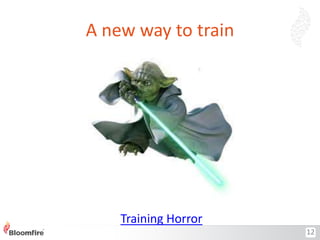
A new way to train

Training Horror
12
A new way to train
• Online
• Takes away the costs of instructors in traditional
training models

• Peer-to-peer collaboration
• Informal training accounts for 80% of learning

13
A new way to train
• Constantly share, ask questions, and learn
• Regardless of geography, time zone and title
• Accessible anytime, anywhere

• Two-way communication
• Facilitates asking and answering questions

14
Post-training involvement
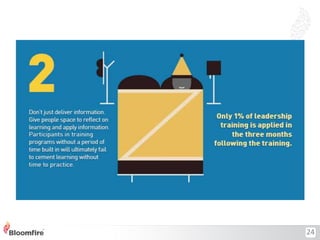
Only 1% of leadership training is applied in the
three months following the training.
With Enterprise Social Networks the learning
never ends..

15
Post-training involvement
• The learning never stops
• Around-the-clock access to information

• Capture, capture, capture
• Information learned is always readily available for future
recall

• Quickly develop productivity
• No need to search - everything you need at your fingertips

16
Post-training involvement
• Open communication channels
• Easily navigate expertise

• Continuous collaborative learning
environment

Slide Deck Title

17
Statistical benefits
• Reduce time to on-board new employees by
two days*
• Increase new hire time-to-value by 30%*
• Increase employee retention by at least 20%*
*McKinsey Global Institute. “The Social Economy: Unlocking value and productivity through social technologies.” July 2012.

18
QA Break

19
What should a trainer look for in an
ESN?
• Ease of use
• Simple for new employees to get acclimated to
• Quick access to experts and information

• Gamification
• Provides incentives for new employees to be actively
engaged and learning
• Easy to acknowledge who is collaborating and
contributing

20
What should a trainer look for in an
ESN?
• Q&A
• Give your trainees a place to go and ask (and answer)
questions once your training is complete
• Storing questions for posterity lets trainees self-serve

• Multimedia content/embedding
• Training content comes in all shapes, sizes, and formats
• Technology that allows embedding enables you to use your
favorite quiz/poll/etc technology seamlessly

21
What should a trainer look for in an
ESN?
• Mobile Ready
• You want your trainees to be able to learn anywhere and
anytime

• Hosted Technology
• Avoid firewalls and VPNs – they only create hurdles and
frustrations

• Free Trial
• You want to be able to kick the tires and run a quick trial
before you buy

22
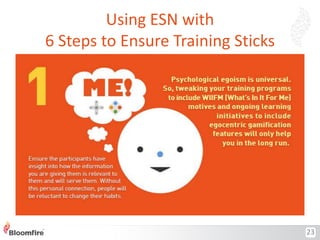
Using ESN with
6 Steps to Ensure Training Sticks

23
24
25
26
27
28
Today’s Learnings
• Type in the chat window any ‘Ah-ha”
moments from today
• Contribute to the TRM Discussion Group

29
www.bloomfire.com
14-Day Free Trial

30

Help me Obi-Social Kenobi: Social is my only hope

  • 1.
    Help me Obi-SocialKenobi: Social is my only hope Using the Force of Enterprise Social Networks to Keep Training Alive 1
  • 2.
  • 3.
  • 4.
    What is anEnterprise Social Network? • Enterprise Social Networks are revolutionizing the way businesses communicate internally. • The focus is being shifted away from traditional oneway communication channels to facilitating open communication across and within organizational structures. 4
  • 5.
    What is anEnterprise Social Network? • ESNs serve as a central system that support a constant, seamless flow of knowledge throughout an organization. • Employees are able to communicate and collaborate with one another in a real-time setting that is accessible by all employees, creating a space to access, learn, and share valuable organizational knowledge. 5
  • 6.
    Why do companiesuse ESNs? • Improved collaboration • Access to all organizational knowledge • Communication not limited by hierarchical structures • 61% of employees say their companies’ ESNs make it easier to collaborate* 6
  • 7.
    Why do companiesuse ESNs? • Increased productivity • Real-time information • One-to-many communication channels • Organizations that implement an Enterprise Social Network realize a 20-25% increase in productivity* *McKinsey Global Institute. “The Social Economy: Unlocking value and productivity through social technologies.” July 2012. 7
  • 8.
    Why do companiesuse ESNs? • Improved efficiency • Central repository for information • Easily searchable content • Moving communication from email to an Enterprise Social Network can reduce email time by up to 30%* *http://econsultancy.com/us/blog/10986-75-of-businesses-to-use-social-collaboration-tools-in-2013-infographic 8
  • 9.
    Why do companiesuse ESNs? • Higher employee engagement • Organizational transparency • Horizontal communication • Businesses using Enterprise Social Networks realize an average 18% increase in employee engagement year-over-year* • Compared to the 1% increase seen in businesses not implementing an Enterprise Social Network* *Thought Farmer. “Social Intranets & Employee Engagement: An HR solution for meaningful morale building.” 2012. 9
  • 10.
  • 11.
    How ESNs integratewith training • Improve training outcomes while lowering costs • Instill an immediate sense of community • Socialize employees into the organization and culture Slide Deck Title 11
  • 12.
    A new wayto train Training Horror 12
  • 13.
    A new wayto train • Online • Takes away the costs of instructors in traditional training models • Peer-to-peer collaboration • Informal training accounts for 80% of learning 13
  • 14.
    A new wayto train • Constantly share, ask questions, and learn • Regardless of geography, time zone and title • Accessible anytime, anywhere • Two-way communication • Facilitates asking and answering questions 14
  • 15.
    Post-training involvement Only 1%of leadership training is applied in the three months following the training. With Enterprise Social Networks the learning never ends.. 15
  • 16.
    Post-training involvement • Thelearning never stops • Around-the-clock access to information • Capture, capture, capture • Information learned is always readily available for future recall • Quickly develop productivity • No need to search - everything you need at your fingertips 16
  • 17.
    Post-training involvement • Opencommunication channels • Easily navigate expertise • Continuous collaborative learning environment Slide Deck Title 17
  • 18.
    Statistical benefits • Reducetime to on-board new employees by two days* • Increase new hire time-to-value by 30%* • Increase employee retention by at least 20%* *McKinsey Global Institute. “The Social Economy: Unlocking value and productivity through social technologies.” July 2012. 18
  • 19.
  • 20.
    What should atrainer look for in an ESN? • Ease of use • Simple for new employees to get acclimated to • Quick access to experts and information • Gamification • Provides incentives for new employees to be actively engaged and learning • Easy to acknowledge who is collaborating and contributing 20
  • 21.
    What should atrainer look for in an ESN? • Q&A • Give your trainees a place to go and ask (and answer) questions once your training is complete • Storing questions for posterity lets trainees self-serve • Multimedia content/embedding • Training content comes in all shapes, sizes, and formats • Technology that allows embedding enables you to use your favorite quiz/poll/etc technology seamlessly 21
  • 22.
    What should atrainer look for in an ESN? • Mobile Ready • You want your trainees to be able to learn anywhere and anytime • Hosted Technology • Avoid firewalls and VPNs – they only create hurdles and frustrations • Free Trial • You want to be able to kick the tires and run a quick trial before you buy 22
  • 23.
    Using ESN with 6Steps to Ensure Training Sticks 23
  • 24.
  • 25.
  • 26.
  • 27.
  • 28.
  • 29.
    Today’s Learnings • Typein the chat window any ‘Ah-ha” moments from today • Contribute to the TRM Discussion Group 29
  • 30.

Editor's Notes

  • #3 Kim – Heidi -
  • #4 Kim – Heidi -
  • #5 Thank you, Gary. Kim and I are excited to be here today to share with all of you best practices on how to use the force of enterprise social networks to keep training alive. Let’s start with:What is an Enterprise Social Network?Technology has come a long way in terms of helping people find the information they need in the consumer world. Social networks like facebook and twitter connect you with your social circles and whether you realize it or not feed you with a lot of knowledge – today’s news, new restaurants, the best house cleaning service – in some ways, consumer social networks are an always-on, realtime feed of life best practices and they work pretty good for this purpose. But what about inside the walls of your business? How do you share best practices between and among teams? How do you share your knowledge with co-workers? Where do you go to get the information you need to do your job? Much like email mail revolutionized business communication in the 80s and 90s by accelerating the rate at which business information could be exchanged, enterprise social networks are now revolutionizing the way business people communicate internally. Anyone remember those manila envelopes with all of the To/From lines on them that used to be used to take business documents to different departments within an organization? You’d put the documents inside the envelope and then write the person and department it goes to on the outside. If you were lucky, the assistant whose job it was to deliver those was timely and you could expect a response sometime tomorrow. Email radically changed this process. But it wasn’t easy to get people to change habits. The adoption of email as a standard business communication tool took years. We’re now going through the same evolution with Enterprise Social Networks. Additionally, ESNS help shift the focus away from traditional one-way communication channels to facilitating open communication across and within organizational structures. Traditional learning and training systems exist in a top-down, one right answer world. Today, communications needs to be top-down, bottom-up, horizontal, cross team, cross functional and dynamic. ESNs support the idea that when one employee gets smarter, the whole company should get smarter.
  • #6 ESNs serve as a central system that support a constant, seamless flow of knowledge throughout an organization. We have a manifesto at Bloomfire and one of our value statements is that “none of us is as smart as all of us.” meaning that the collective intelligence of your company is incredible. But it’s the ability to quickly and effectively share that knowledge that is the key to driving innovation. This is where ESNs add value by building learning into everyday work life.Also, ESNS help people communicate and collaborate with one another in a real-time setting that is accessible by all employees, creating a space to access, learn, and share valuable organizational knowledge. Simply put, enterprise social networks give employees a place to openly share the knowledge they have and learn from the knowledge of others in a central place. By leveraging social feedback from our peers, ESNs have the potential to connect people who have knowledge with those who need it to help achieve business goals.
  • #7 So, that pretty much covers the basics of what an enterprise social network is. The next question to answer is why do companies invest in enterprise social networks? We’ll start with the most common answer, which is to improve team collaboration. The hardest part about collaboration is usually getting everyone’s schedules synched up and finding a physical space and at least an hour that can be spent collaborating on a specific topic or project. By hosting collaboration sessions on an ESN, you allow people to contribute to the conversation when inspiration hits them – wherever they may be. This is possible because ESNs give employees access to all organizational knowledge. I realize that statement is scary to some people. Many of us grew up in business where people only received information on a “need to know” basis and things outside of your realm of expertise was just none of your business. But studies show that companies that broadly collaborate on information are more innovative and more and more companies are adopting this type of open culture. ESNs also help improve team collaboration because communication via an ESN is not limited by hierarchical structures. Hierarchies in general have some basic flaws. They are sort of like playing the telephone game. By the time information gets from the bottom to the top…or vice versa…something is likely lost in translation. ESNs arm everyone up and down the chain of command with collaboration tools, giving everyone a chance to chime in with feedback regardless of title. The results? 61% of employees say their companies’ ESNs make it easier to collaborate*
  • #8 Now, let’s talk about how ESNs help businessesincrease productivity. The most obvious way is that ESNs serve as a central repository that supplies people with real-time information, making it possible for people to get their hands on the information when and where they need it in order to carry out work. Reducing the amount of time that people spend searching for information, increases the time that these people can spend actually solving business problems. The less obvious productivity value of ESNs is that they scale the typical 1-to-1, offline conversation to an online one-to-manycommunication channel, increasingproductivity across the board. So far ESNs have a good productivity story. A recent study by the McKinsey Global Institute, “The Social Economy: Unlocking value and productivity through social technologies” reports that:Organizations that implement an Enterprise Social Network realize a 20-25% increase in productivity*
  • #9 The 3rd reason companies use ESNs is to improved efficiency. While similar to improving productivity which is the amount of work you’re able to do in a given time, efficiency is more about the quality of the work that is produced. In many cases, ESNs serve as a company’s central repository for information.By hosting content, FAQs, and conversations in a single place companies reduce the likelihood of the same work being done by two different teams or departments and also eliminates that annoying email forwarding game where Suzy sends an email to 5 people asking for their feedback on something. John notices that Jim wasn’t copied, so he forwards it on. Jim has feedback but doesn’t include Suzy on his reply and an important piece for project success is left entirely out of the loop. I know we’ve all experienced some version of this craziness. Part 2 of the ESN efficiency story is the ability to easily search for content. Let’s face it, we’d all rather poke our eyes with a fork than search our hard drive or email folders for a document or conversation that took place three months ago. If you’re lucky enough to find what you’re looking for, you likely have questions. Is this information still relevant? Is it the latest version? Who was the original author, so that I can ask him or her? Enterprise social network search capabilities not only help you find what you’re looking for fast, but they also give you the peace of mind in knowing that you are working off of timely and relevant information that will help rather than hinder project success.So, how much more efficient can we be? Recent studies show that Moving communication from email to an Enterprise Social Network can reduce email time by up to 30%*
  • #10 The last reason why companies use enterprise social networks that I will cover today is to achieve higher employee engagement rates. Employee engagement is a big concern for businesses today. A company’s success or failure hinges largely on its ability to engage employees. Companies that do not do this well stand to lose a lot of money and momentum. So how exactly can an ESN increase employee engagement? First ESNs support organizational transparency which leads to two things: open, honest communication and trust up and down the chain of command. These might sound like fluffy nonesense things that real business people shouldn’t waste their time with, but the truth of the matter is that companies who embrace these values have lower turnover rates. Likewise, supporting horizontal communication is key in team building. Current business communication tools can deliver formal information, but they are absolutely terrible at conveying the informal “water cooler” tips and tricks that make up 80% of the knowledge people need to do their jobs. ESNs drive these peer-to-peer conversations, creating relationships that engage employees.As a matter of fact, a recent study by Thought Farmer called “Social Intranets & Employee Engagement: An HR solution for meaningful morale building.” states thatBusinesses using Enterprise Social Networks realize an average 18% increase in employee engagement year-over-year* Compared to the 1% increase seen in businesses not implementing an Enterprise Social Network* I think that covers the basics of what an ESN is and why companies use them. I’d like to pause for a few minutes and answer any questions that any of you might have.
  • #11 Kim
  • #12 Now we’re going to move on to what you all really care about which is How ESNs integrate with training. To cover this, I’m going to hand over the mic to Kim Carlson. Kim has a lot of experience in this area and is going to share some of our findings with you.Thanks Heidi, as heidi said – Next we will be taking a look at how ESNs integrate with training. In the next part of the webinar we will take a look at how ESN’s Improve….READ SLIDE
  • #13 Yes my young padawan learners, there is a NEW way to train, and ironically it is the ‘old’ way from which we will be taking our inspiration today. The new way is capitalizing on how people really learn! -After all, It is in the informal realm where the force is strong. Ok I am done with the Star Wars references for now…But first lets take a look at the way training has been traditionally done in the past – Does the following video look familiar? <<show video>>
  • #14 Kimif that was entertaining for you – be sure and visit our blog at blog.bloomfire.com for the “Training Sucks” series in it’s entirity. There are 3 episodes, enjoy!As you saw in the video the Old way didn’t work out so well…Even now, Classroom training can be expensive, with room rental, travel costs, materials and time away from your job. Heck maybe you are even taking your best performer off the job, to help mentor the new person – unfortunately while your best performer is playing Obi-wan to young Luke, you may also be taking away from productivity.Now let’s take a look at the new way to train! As master Yoda says, you must “You must Unlearn what you have learned” The new way to train is online and I bet that there are many of you out there that have already implemented formal online training. But how many of you are bringing that peer-to peer collaboration online?We now know that 80% of our learning happens informally – whether it is an impromptu conversation around the coffee maker or a co-worker that stops by your desk and helps you refine your process OR do your job better. There is learning that is happening in the hallways and breakrooms. And as I have found in my own work life, It is truly the things that happen on a day to day basis that stick with you in the long run. Now the trick is replicating that in a way that scales across your organization.With an ESN you can capture informal learning and provide a way for people to access training/mentoring when they want it and when they need it.
  • #15 KimWith an ESN you are constantly able to share, ask questions and learn – It doesn’t matter if you are in Northern California or Europe, if you are a new hire or a Department head - an ESN will provide your global organization the ability to share information at any time and in a space that is always accessibleI cannot resist another Yoda quote: “always pass on what you have learned”Two-way communication is powerful in an ESN and passing on what you have learned by sharing and answering questions, just might help someone land their next sales deal or find a creative way to solve a problem or just plain save you time. In other online training formats, the communication stream is organized from the top-down - You put the information in a training module, which someone clicks through in order to check a box. OR perhaps someone provides the information and it is added to the file folder… or sub-folder of the file folder that is really hard to find, because I cannot remember where they told me to look for it – and the email with the information I need is long gone and deleted from my inbox.Being able to ask someone in real time and having my question answered in real time helps an organization mentor and bring people along. With A new way to train you are socializing your people into a culture that mentors each other and is in a state of constant learning and engagement.
  • #16 KimStudies have shown that (READ above) – It is amazing how much of your training is lost once you leave it behind. You are really excited because, your trainees leave the class and are really fired up about all the skills that they learned, and are ready to apply what they learn every day. Reality is, People will learn when they are ready to learn, not when you are ready to teach them. They can only retain the knowledge when they apply it and if you do not have a place for them to apply their knowledge, you are setting them up for failure.Master Yoda: “In a dark place we find ourselves, and a little more knowledge lights our way.”Using the Social Network force, we can be assured that the learning never ends.
  • #17 KimThe new way to train includes post-training involvement where the Learning never stops – I don’t know about you, but in our Global workplace, with flexible work schedules and many time zones….your everyday workers need a place where learning can take place around the clock. I may need that information during the day here in the US, but Asia is going to need the same information while I sleep. Perhaps you might even do your best learning in the middle of the night, wouldn’t it be great to fuel your learning when the time is right for you?Be sure and Capture, Capture, Capture the information learned and make sure it is readily available for future reference and recall - Yoda - “You will only find what you bring in”. Have you ever been in a situation where someone leaves your company? Whether is was retirement or another company…what happened to that tribal knowledge that was readily available in that person’s head? By Capturing that tribal knowledge, your are arming your employees and future employees with that information that normally would have left with that expert. Wouldn’t it be nice to have that expertise ready and available for future recall?You will be amazed at how quickly you develop productivity - no need to go looking for that email string or trying to find the file on the correct drive or the sub folder of a sub folder….now you can have everything you need at your fingertips
  • #18 KimWith an ESN you are encouraging open communication. No longer is information on a ‘need to know’ basis, everyone needs to know and having the ability to tap into your expert base with ease, creates more experts and knowledge sharing workers. You never know where you might find your next expert… that new hire may be new to you, and your company, but perhaps they bring in expertise and ideas from another organization. Recognizing that your new hire has knowledge to share as well as your Executive team creates an environment of trust and also contributes to the continuous collaborative learning. Everyone is learning from each and the boundaries that used to separate and silo top-down organizations are now transformed into a space where your company is more efficient, collborating and communicating with each other and working towards the same goal. Example of how this happens in real life…In 2011, the company I worked for launched an ESN….LifeSize Sales story? Insert here?
  • #19 KIMI can continue to give you great examples of how an ESN has helped orgs in the past , however, when it boils right down to it, you need cold hard facts! Let’s face it your leadership team wants these stats, too! Thanks to the McKinsey Global Institute and their research, studies have shown that using social technologies will : (see above)Reduce time: after all time is money. No longer will you need to have your best performer o = HR person, Increase new hire time to value by 30%…when your new hire is more productive sooner, they will be contributing to the organizations’ goals soonerUsing social technologies will also Increase EE retention by at least 20%…In a marketplace of fierce recruiting competition for the best workers, your EES are more likely to stay if they know that they are at a company that values continuous learning, open communication and collaboration. These are the numbers.BREAK – Before we continue on, we wanted to take a few more questions – Gary?
  • #20 Kim – answer Qs and transition to What you should look for in an ESN?
  • #21 KimSo, as a trainer – what should you look for in an ESN?Ease of use – If you need an implementation team or online training workshops for your ESN – don’t bother. The easier it is to use, the quicker the adoption and engagement for you organization. Make sure the ESN also allows for easy access to experts and information. Searching for information should be a pleasant experience. Think about how we search for information on the internet….we launch our favorite search engine, type in a word and suggestions appear for you! The same thing should happen with your ESN. Do you want to view video, document or ask a person for the information you need. These should all be easy to find in your ESN and there should be minimal time for your team to have the ESN running ‘out of the box” so to speakGamification and by gamification, I mean look for an ESN that applies Gaming behavior techniques – When looking for an ESN, know your team and/or co-workers. There is usually a broad range of personality types of the workers that will be using your ESN. Think about what is going to encourage and motivate everyone to use and adopt this new application. It is not always about the competition, however, in some groups competition is a wonderful motivator. Does your ESN reward those who are learning as much as those who are contributing? It may not seem that someone who doesn’t contribute a whole lot should be rewarded, however, just the opposite is true. Your “bookworms’, so to speak are usually the first ones to view content, consume and understand it all. This type of behavior is just as important as a super contributor and should be rewarded. Find an ESN that makes is Easy to acknowledge one another – Think of how you feel when someone ‘favorites’ one of your tweets or ‘Likes” one of your FB posts. The same is true for an ESN. Around our office we physically Hi-Five one another for a job well done. WE did this so much so that we decided to add a Hi-Five in our product. I feel like such a smart person when soemone virtually hi-fives the information I have shared. I may seem like an extrovert, but in real life validation goes a long way…
  • #22 KimBe sure and give your trainees …….READ above –Back in the day…when I was in front of the classroom, I remember telling my trainees to contact me via inter-office mail and that I would get back to them…If they were lucky in a couple of days…Then came email and whew, the info at least got to the trainee faster, however, the Emial - was a one off and only that person who received the answer to the quesiton, when maybe the entire class can benefit from the info. Or perhaps this is a question that someone else had, but was too shy to send the email or bother the trainer with a stupid question. Your ESN should have a place to store the Questions and answers so your trainees have accessto the follow up information later.READ ABOVE – is also very important in an ESNLet’s face it - as professional trainers, we know that people learn best in different formats. – audio, visual, or just by doing….cover all your bases and make sure that multi-media is alive and well in your ESN. Technology that allows for embedding offers you integrations with video players, calendars and other survey applications that will provide you with valuable feedback.You still might want to embed a quiz or test, but to be honest with your with A new way to train, Really the best way to gauge whether a person knows the information is in performance review or just doing their job well.
  • #23 KimFinally, READ ABOVEMobile Ready – learn anywhere and anytime on any mobile deviceMake sure the technology is as easy as accessing the internet – avoid firewalls and VPNs – READ ABOVEFREE Trial – Make sure your free trial allows you to see and test all the bells and whistles they offer. Why get into a free trial if are locked out of key features that are not available until you buy.
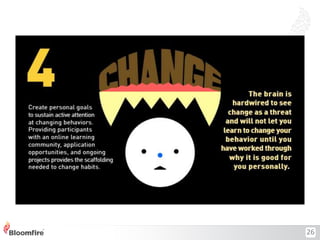
  • #24 KimGamificationgamificationgamification
  • #25 KimHaving an on-demand training tool to deliver training (an ESN) is vital
  • #26 KimCapturing this knowledge with an ESN
  • #27 KimOnline learning community = ESN
  • #28 KimHaving your training on-demand rather than in large chinks allows people to self-serve when they need/want to learn
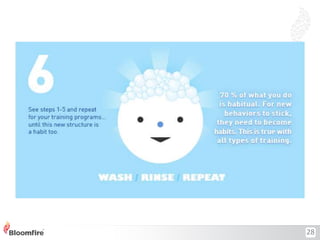
  • #29 KimHaving a hosted ESN allows you to repeat regularly rather than waiting for for monthly, quarterly, or yearly training sessions.
  • #30 Kim
  • #31 Kim