E-LEARNING
…AN UPDATE
ROBERT EDGAR RBEDGAR@STANFORD.EDU
PROGRAM MANAGER, LEARNING SYSTEMS DESIGN
STANFORD UNIVERSITY
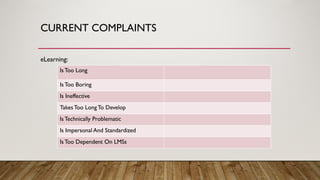
CURRENT COMPLAINTS
eLearning:
IsToo Long
IsToo Boring
Is Ineffective
TakesToo LongTo Develop
IsTechnically Problematic
Is Impersonal And Standardized
IsToo Dependent On LMSs
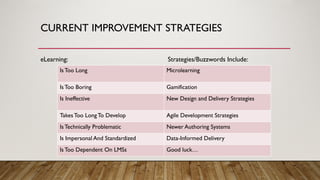
CURRENT IMPROVEMENT STRATEGIES
eLearning: Strategies/Buzzwords Include:
IsToo Long Microlearning
IsToo Boring Gamification
Is Ineffective New Design and Delivery Strategies
TakesToo LongTo Develop Agile Development Strategies
IsTechnically Problematic Newer Authoring Systems
Is Impersonal And Standardized Data-Informed Delivery
IsToo Dependent On LMSs Good luck…
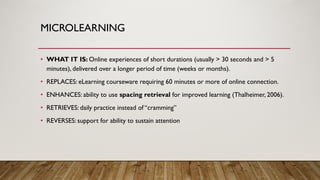
MICROLEARNING
• WHAT IT IS: Online experiences of short durations (usually > 30 seconds and > 5
minutes), delivered over a longer period of time (weeks or months).
• REPLACES: eLearning courseware requiring 60 minutes or more of online connection.
• ENHANCES: ability to use spacing retrieval for improved learning (Thalheimer, 2006).
• RETRIEVES: daily practice instead of “cramming”
• REVERSES: support for ability to sustain attention
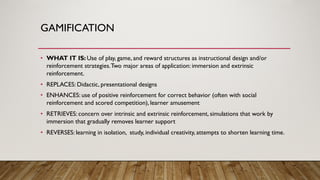
GAMIFICATION
• WHAT IT IS: Use of play, game, and reward structures as instructional design and/or
reinforcement strategies.Two major areas of application: immersion and extrinsic
reinforcement.
• REPLACES: Didactic, presentational designs
• ENHANCES: use of positive reinforcement for correct behavior (often with social
reinforcement and scored competition), learner amusement
• RETRIEVES: concern over intrinsic and extrinsic reinforcement, simulations that work by
immersion that gradually removes learner support
• REVERSES: learning in isolation, study, individual creativity, attempts to shorten learning time.
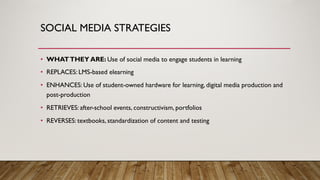
SOCIAL MEDIA STRATEGIES
• WHATTHEY ARE: Use of social media to engage students in learning
• REPLACES: LMS-based elearning
• ENHANCES: Use of student-owned hardware for learning, digital media production and
post-production
• RETRIEVES: after-school events, constructivism, portfolios
• REVERSES: textbooks, standardization of content and testing
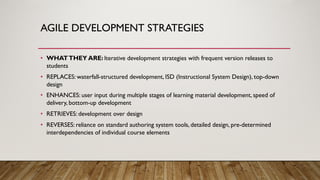
AGILE DEVELOPMENT STRATEGIES
• WHATTHEY ARE: Iterative development strategies with frequent version releases to
students
• REPLACES: waterfall-structured development, ISD (Instructional System Design), top-down
design
• ENHANCES: user input during multiple stages of learning material development, speed of
delivery, bottom-up development
• RETRIEVES: development over design
• REVERSES: reliance on standard authoring system tools, detailed design, pre-determined
interdependencies of individual course elements
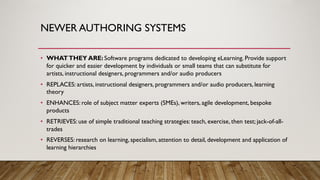
NEWER AUTHORING SYSTEMS
• WHATTHEY ARE: Software programs dedicated to developing eLearning. Provide support
for quicker and easier development by individuals or small teams that can substitute for
artists, instructional designers, programmers and/or audio producers
• REPLACES: artists, instructional designers, programmers and/or audio producers, learning
theory
• ENHANCES: role of subject matter experts (SMEs), writers, agile development, bespoke
products
• RETRIEVES: use of simple traditional teaching strategies: teach, exercise, then test; jack-of-all-
trades
• REVERSES: research on learning, specialism, attention to detail, development and application of
learning hierarchies
DATA-INFORMED DELIVERY
• WHAT IT IS: Using data-driven engines for sequencing learning events within a given course
or curriculum
• REPLACES: pre-set learning sequences, set durations for learning, single learning paths, one-
size-fits-all; post tests; synchronous learning; intervention of teacher;
• ENHANCES: student-centric sequencing of learning events, individualized instruction;
asynchronous learning
• RETRIEVES: iterative testing strategies; real-world performance measurement; collection,
retention and analysis of individual and large-group online test and performance results
• REVERSES: roles of client and server in determining learning sequence
LMSVS SCORM 1.2, 2004,AND EXPERIENCE API
• WHATTHEY ARE: Protocols for communications between eLearning clients and learning
management servers. SCORM 1.2 supported hosting courseware and collection of pass/fail information.
SCORM 2004 expanded collection of student data from eLearning events within an eLearning course.
xAPI expanded collection of data from learning experiences beyond eLearning courseware.
• REPLACES: Each replaces the data collection scope of the previous protocol; drill-and-kill courseware.
• ENHANCES: Each supports the ability to collect, track and analyze a student’s learning in continually
expanding experiential contexts and spaces. Real-world performance date collection.
• RETRIEVES: portfolios, real-world interactions, field trips, lab experiments
• REVERSES: brick and mortar classroom learning, traditional eLearning courseware
QUESTIONS AND RETORTS…
Have at!
Full appreciation to Marshall McLuhan for his tetrad structure.
Robert Edgar
Program Manager, Learning Systems Design
Stanford University
rbedgar@stanford.edu

eLearning: ...an update

  • 1.
    E-LEARNING …AN UPDATE ROBERT EDGARRBEDGAR@STANFORD.EDU PROGRAM MANAGER, LEARNING SYSTEMS DESIGN STANFORD UNIVERSITY
  • 2.
    CURRENT COMPLAINTS eLearning: IsToo Long IsTooBoring Is Ineffective TakesToo LongTo Develop IsTechnically Problematic Is Impersonal And Standardized IsToo Dependent On LMSs
  • 3.
    CURRENT IMPROVEMENT STRATEGIES eLearning:Strategies/Buzzwords Include: IsToo Long Microlearning IsToo Boring Gamification Is Ineffective New Design and Delivery Strategies TakesToo LongTo Develop Agile Development Strategies IsTechnically Problematic Newer Authoring Systems Is Impersonal And Standardized Data-Informed Delivery IsToo Dependent On LMSs Good luck…
  • 4.
    MICROLEARNING • WHAT ITIS: Online experiences of short durations (usually > 30 seconds and > 5 minutes), delivered over a longer period of time (weeks or months). • REPLACES: eLearning courseware requiring 60 minutes or more of online connection. • ENHANCES: ability to use spacing retrieval for improved learning (Thalheimer, 2006). • RETRIEVES: daily practice instead of “cramming” • REVERSES: support for ability to sustain attention
  • 5.
    GAMIFICATION • WHAT ITIS: Use of play, game, and reward structures as instructional design and/or reinforcement strategies.Two major areas of application: immersion and extrinsic reinforcement. • REPLACES: Didactic, presentational designs • ENHANCES: use of positive reinforcement for correct behavior (often with social reinforcement and scored competition), learner amusement • RETRIEVES: concern over intrinsic and extrinsic reinforcement, simulations that work by immersion that gradually removes learner support • REVERSES: learning in isolation, study, individual creativity, attempts to shorten learning time.
  • 6.
    SOCIAL MEDIA STRATEGIES •WHATTHEY ARE: Use of social media to engage students in learning • REPLACES: LMS-based elearning • ENHANCES: Use of student-owned hardware for learning, digital media production and post-production • RETRIEVES: after-school events, constructivism, portfolios • REVERSES: textbooks, standardization of content and testing
  • 7.
    AGILE DEVELOPMENT STRATEGIES •WHATTHEY ARE: Iterative development strategies with frequent version releases to students • REPLACES: waterfall-structured development, ISD (Instructional System Design), top-down design • ENHANCES: user input during multiple stages of learning material development, speed of delivery, bottom-up development • RETRIEVES: development over design • REVERSES: reliance on standard authoring system tools, detailed design, pre-determined interdependencies of individual course elements
  • 8.
    NEWER AUTHORING SYSTEMS •WHATTHEY ARE: Software programs dedicated to developing eLearning. Provide support for quicker and easier development by individuals or small teams that can substitute for artists, instructional designers, programmers and/or audio producers • REPLACES: artists, instructional designers, programmers and/or audio producers, learning theory • ENHANCES: role of subject matter experts (SMEs), writers, agile development, bespoke products • RETRIEVES: use of simple traditional teaching strategies: teach, exercise, then test; jack-of-all- trades • REVERSES: research on learning, specialism, attention to detail, development and application of learning hierarchies
  • 9.
    DATA-INFORMED DELIVERY • WHATIT IS: Using data-driven engines for sequencing learning events within a given course or curriculum • REPLACES: pre-set learning sequences, set durations for learning, single learning paths, one- size-fits-all; post tests; synchronous learning; intervention of teacher; • ENHANCES: student-centric sequencing of learning events, individualized instruction; asynchronous learning • RETRIEVES: iterative testing strategies; real-world performance measurement; collection, retention and analysis of individual and large-group online test and performance results • REVERSES: roles of client and server in determining learning sequence
  • 10.
    LMSVS SCORM 1.2,2004,AND EXPERIENCE API • WHATTHEY ARE: Protocols for communications between eLearning clients and learning management servers. SCORM 1.2 supported hosting courseware and collection of pass/fail information. SCORM 2004 expanded collection of student data from eLearning events within an eLearning course. xAPI expanded collection of data from learning experiences beyond eLearning courseware. • REPLACES: Each replaces the data collection scope of the previous protocol; drill-and-kill courseware. • ENHANCES: Each supports the ability to collect, track and analyze a student’s learning in continually expanding experiential contexts and spaces. Real-world performance date collection. • RETRIEVES: portfolios, real-world interactions, field trips, lab experiments • REVERSES: brick and mortar classroom learning, traditional eLearning courseware
  • 11.
    QUESTIONS AND RETORTS… Haveat! Full appreciation to Marshall McLuhan for his tetrad structure. Robert Edgar Program Manager, Learning Systems Design Stanford University rbedgar@stanford.edu