VEDA AND VEDANGAS
INTRODUCTION
• The base of eastern religious Value are Vedas.
• The Vedas are ancient South Asian scriptures, revered as the foundational
texts of Sanatana Dharma (the Eternal Dharma or Truth),
• The word "Veda" means "knowledge" or "wisdom," and these texts are
considered divine revelations (śruti) received by sages in deep meditative
states.
VEDAS and VEDANGAS
• Four Vedas: Rigveda, Yajuraveda, Samaveda, and
Atharvaveda.
• Subdivision of Vedas: Samhitas, Aranyak, Brahmanas,
Upanishadas, Upasanas
• Four Upavedas: Arthaveda, Dhanurveda, Gandharvaveda and
Ayurveda.
• Four Brahmanas: Aiteriya, Titeriya, Satpath and Gopath
• Six principal Vedic Philosophies: Mimamsa, Vedanta, Nyaya,
Vaisheshika, Shankhya and Yoga
VEDAS and VEDANGAS
• Other Vedic Philosophies: Ramanuja Darshan (Vishishta
Adweta), Purnapragya Darshana (Dweta Vedanta), Nakulish
Pashupat Darshana, Shaiva Darshana, Pratyabhigya
Darshana, Ayurved Darshan, Panini Darshana, Adweta
Vedanta Darshan
• Non Vedic Philosophies: Charvakism, Bhuddism, Jainism,
Ajivikism.
• Six Principal Vedangas: Shiksha (Phonetics), Vyakarana
(Grammar), Chandas (Prosody), Nirukta (Etymology) Kalpa
(Rituals). Jyotisha (Astronomy and Astrology)
VEDIC LITERATURE
• Vedas literally means knowledge.
There are four vedas – Rig Veda, Sama Veda, Yajur Veda and Atharva Veda.
Each of these Vedas is comprised of four parts.
• (i) Samhitas
• (ii) Brahmanas
• (iii) Aranyakas
• (iv) Upanishads.
FOUR VEDAS
• Rigveda: The oldest Veda, containing hymns and praises to various
deities like Agni, Indra, and Surya. It focuses on invoking divine forces
and understanding cosmic order.
• Samaveda: Known as the "Veda of Melodies," it includes chants and
musical hymns, emphasizing the rhythmic and musical aspects of Vedic
worship.
• Yajurveda: Primarily a guide for rituals and sacrificial rites, it provides
instructions and mantras for performing yajnas (sacrificial ceremonies).
• Atharvaveda: Contains hymns, spells, and charms dealing with daily
life, health, healing, and protection, blending spiritual practices with
practical wisdom.
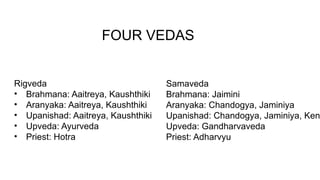
Rigveda
• Brahmana: Aaitreya, Kaushthiki
• Aranyaka: Aaitreya, Kaushthiki
• Upanishad: Aaitreya, Kaushthiki
• Upveda: Ayurveda
• Priest: Hotra
Samaveda
Brahmana: Jaimini
Aranyaka: Chandogya, Jaminiya
Upanishad: Chandogya, Jaminiya, Ken
Upveda: Gandharvaveda
Priest: Adharvyu
FOUR VEDAS
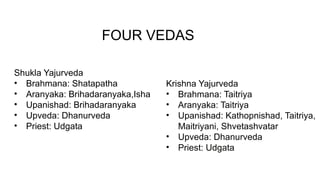
Shukla Yajurveda
• Brahmana: Shatapatha
• Aranyaka: Brihadaranyaka,Isha
• Upanishad: Brihadaranyaka
• Upveda: Dhanurveda
• Priest: Udgata
Krishna Yajurveda
• Brahmana: Taitriya
• Aranyaka: Taitriya
• Upanishad: Kathopnishad, Taitriya,
Maitriyani, Shvetashvatar
• Upveda: Dhanurveda
• Priest: Udgata
FOUR VEDAS
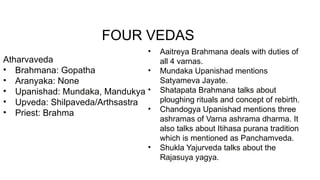
Atharvaveda
• Brahmana: Gopatha
• Aranyaka: None
• Upanishad: Mundaka, Mandukya
• Upveda: Shilpaveda/Arthsastra
• Priest: Brahma
• Aaitreya Brahmana deals with duties of
all 4 varnas.
• Mundaka Upanishad mentions
Satyameva Jayate.
• Shatapata Brahmana talks about
ploughing rituals and concept of rebirth.
• Chandogya Upanishad mentions three
ashramas of Varna ashrama dharma. It
also talks about Itihasa purana tradition
which is mentioned as Panchamveda.
• Shukla Yajurveda talks about the
Rajasuya yagya.
FOUR VEDAS
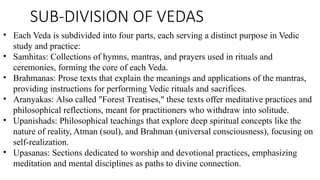
SUB-DIVISION OF VEDAS
• Each Veda is subdivided into four parts, each serving a distinct purpose in Vedic
study and practice:
• Samhitas: Collections of hymns, mantras, and prayers used in rituals and
ceremonies, forming the core of each Veda.
• Brahmanas: Prose texts that explain the meanings and applications of the mantras,
providing instructions for performing Vedic rituals and sacrifices.
• Aranyakas: Also called "Forest Treatises," these texts offer meditative practices and
philosophical reflections, meant for practitioners who withdraw into solitude.
• Upanishads: Philosophical teachings that explore deep spiritual concepts like the
nature of reality, Atman (soul), and Brahman (universal consciousness), focusing on
self-realization.
• Upasanas: Sections dedicated to worship and devotional practices, emphasizing
meditation and mental disciplines as paths to divine connection.
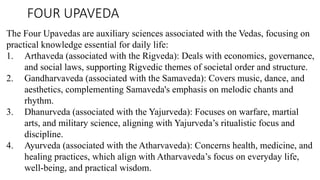
FOUR UPAVEDA
The Four Upavedas are auxiliary sciences associated with the Vedas, focusing on
practical knowledge essential for daily life:
1. Arthaveda (associated with the Rigveda): Deals with economics, governance,
and social laws, supporting Rigvedic themes of societal order and structure.
2. Gandharvaveda (associated with the Samaveda): Covers music, dance, and
aesthetics, complementing Samaveda's emphasis on melodic chants and
rhythm.
3. Dhanurveda (associated with the Yajurveda): Focuses on warfare, martial
arts, and military science, aligning with Yajurveda’s ritualistic focus and
discipline.
4. Ayurveda (associated with the Atharvaveda): Concerns health, medicine, and
healing practices, which align with Atharvaveda’s focus on everyday life,
well-being, and practical wisdom.
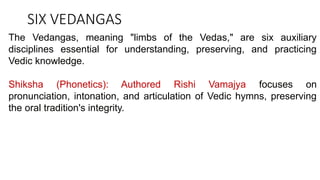
SIX VEDANGAS
The Vedangas, meaning "limbs of the Vedas," are six auxiliary
disciplines essential for understanding, preserving, and practicing
Vedic knowledge.
Shiksha (Phonetics): Authored Rishi Vamajya focuses on
pronunciation, intonation, and articulation of Vedic hymns, preserving
the oral tradition's integrity.
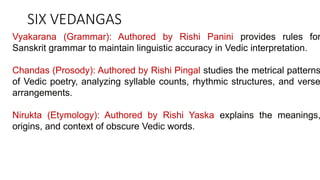
SIX VEDANGAS
Vyakarana (Grammar): Authored by Rishi Panini provides rules for
Sanskrit grammar to maintain linguistic accuracy in Vedic interpretation.
Chandas (Prosody): Authored by Rishi Pingal studies the metrical patterns
of Vedic poetry, analyzing syllable counts, rhythmic structures, and verse
arrangements.
Nirukta (Etymology): Authored by Rishi Yaska explains the meanings,
origins, and context of obscure Vedic words.
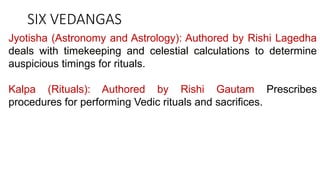
SIX VEDANGAS
Jyotisha (Astronomy and Astrology): Authored by Rishi Lagedha
deals with timekeeping and celestial calculations to determine
auspicious timings for rituals.
Kalpa (Rituals): Authored by Rishi Gautam Prescribes
procedures for performing Vedic rituals and sacrifices.


VEDA AND VEDANGAS IN INDIAN KNOWLEDGE SYSTEM

  • 1.
  • 2.
    INTRODUCTION • The baseof eastern religious Value are Vedas. • The Vedas are ancient South Asian scriptures, revered as the foundational texts of Sanatana Dharma (the Eternal Dharma or Truth), • The word "Veda" means "knowledge" or "wisdom," and these texts are considered divine revelations (śruti) received by sages in deep meditative states.
  • 4.
    VEDAS and VEDANGAS •Four Vedas: Rigveda, Yajuraveda, Samaveda, and Atharvaveda. • Subdivision of Vedas: Samhitas, Aranyak, Brahmanas, Upanishadas, Upasanas • Four Upavedas: Arthaveda, Dhanurveda, Gandharvaveda and Ayurveda. • Four Brahmanas: Aiteriya, Titeriya, Satpath and Gopath • Six principal Vedic Philosophies: Mimamsa, Vedanta, Nyaya, Vaisheshika, Shankhya and Yoga
  • 5.
    VEDAS and VEDANGAS •Other Vedic Philosophies: Ramanuja Darshan (Vishishta Adweta), Purnapragya Darshana (Dweta Vedanta), Nakulish Pashupat Darshana, Shaiva Darshana, Pratyabhigya Darshana, Ayurved Darshan, Panini Darshana, Adweta Vedanta Darshan • Non Vedic Philosophies: Charvakism, Bhuddism, Jainism, Ajivikism. • Six Principal Vedangas: Shiksha (Phonetics), Vyakarana (Grammar), Chandas (Prosody), Nirukta (Etymology) Kalpa (Rituals). Jyotisha (Astronomy and Astrology)
  • 6.
    VEDIC LITERATURE • Vedasliterally means knowledge. There are four vedas – Rig Veda, Sama Veda, Yajur Veda and Atharva Veda. Each of these Vedas is comprised of four parts. • (i) Samhitas • (ii) Brahmanas • (iii) Aranyakas • (iv) Upanishads.
  • 7.
    FOUR VEDAS • Rigveda:The oldest Veda, containing hymns and praises to various deities like Agni, Indra, and Surya. It focuses on invoking divine forces and understanding cosmic order. • Samaveda: Known as the "Veda of Melodies," it includes chants and musical hymns, emphasizing the rhythmic and musical aspects of Vedic worship. • Yajurveda: Primarily a guide for rituals and sacrificial rites, it provides instructions and mantras for performing yajnas (sacrificial ceremonies). • Atharvaveda: Contains hymns, spells, and charms dealing with daily life, health, healing, and protection, blending spiritual practices with practical wisdom.
  • 8.
    Rigveda • Brahmana: Aaitreya,Kaushthiki • Aranyaka: Aaitreya, Kaushthiki • Upanishad: Aaitreya, Kaushthiki • Upveda: Ayurveda • Priest: Hotra Samaveda Brahmana: Jaimini Aranyaka: Chandogya, Jaminiya Upanishad: Chandogya, Jaminiya, Ken Upveda: Gandharvaveda Priest: Adharvyu FOUR VEDAS
  • 9.
    Shukla Yajurveda • Brahmana:Shatapatha • Aranyaka: Brihadaranyaka,Isha • Upanishad: Brihadaranyaka • Upveda: Dhanurveda • Priest: Udgata Krishna Yajurveda • Brahmana: Taitriya • Aranyaka: Taitriya • Upanishad: Kathopnishad, Taitriya, Maitriyani, Shvetashvatar • Upveda: Dhanurveda • Priest: Udgata FOUR VEDAS
  • 10.
    Atharvaveda • Brahmana: Gopatha •Aranyaka: None • Upanishad: Mundaka, Mandukya • Upveda: Shilpaveda/Arthsastra • Priest: Brahma • Aaitreya Brahmana deals with duties of all 4 varnas. • Mundaka Upanishad mentions Satyameva Jayate. • Shatapata Brahmana talks about ploughing rituals and concept of rebirth. • Chandogya Upanishad mentions three ashramas of Varna ashrama dharma. It also talks about Itihasa purana tradition which is mentioned as Panchamveda. • Shukla Yajurveda talks about the Rajasuya yagya. FOUR VEDAS
  • 11.
    SUB-DIVISION OF VEDAS •Each Veda is subdivided into four parts, each serving a distinct purpose in Vedic study and practice: • Samhitas: Collections of hymns, mantras, and prayers used in rituals and ceremonies, forming the core of each Veda. • Brahmanas: Prose texts that explain the meanings and applications of the mantras, providing instructions for performing Vedic rituals and sacrifices. • Aranyakas: Also called "Forest Treatises," these texts offer meditative practices and philosophical reflections, meant for practitioners who withdraw into solitude. • Upanishads: Philosophical teachings that explore deep spiritual concepts like the nature of reality, Atman (soul), and Brahman (universal consciousness), focusing on self-realization. • Upasanas: Sections dedicated to worship and devotional practices, emphasizing meditation and mental disciplines as paths to divine connection.
  • 12.
    FOUR UPAVEDA The FourUpavedas are auxiliary sciences associated with the Vedas, focusing on practical knowledge essential for daily life: 1. Arthaveda (associated with the Rigveda): Deals with economics, governance, and social laws, supporting Rigvedic themes of societal order and structure. 2. Gandharvaveda (associated with the Samaveda): Covers music, dance, and aesthetics, complementing Samaveda's emphasis on melodic chants and rhythm. 3. Dhanurveda (associated with the Yajurveda): Focuses on warfare, martial arts, and military science, aligning with Yajurveda’s ritualistic focus and discipline. 4. Ayurveda (associated with the Atharvaveda): Concerns health, medicine, and healing practices, which align with Atharvaveda’s focus on everyday life, well-being, and practical wisdom.
  • 13.
    SIX VEDANGAS The Vedangas,meaning "limbs of the Vedas," are six auxiliary disciplines essential for understanding, preserving, and practicing Vedic knowledge. Shiksha (Phonetics): Authored Rishi Vamajya focuses on pronunciation, intonation, and articulation of Vedic hymns, preserving the oral tradition's integrity.
  • 14.
    SIX VEDANGAS Vyakarana (Grammar):Authored by Rishi Panini provides rules for Sanskrit grammar to maintain linguistic accuracy in Vedic interpretation. Chandas (Prosody): Authored by Rishi Pingal studies the metrical patterns of Vedic poetry, analyzing syllable counts, rhythmic structures, and verse arrangements. Nirukta (Etymology): Authored by Rishi Yaska explains the meanings, origins, and context of obscure Vedic words.
  • 15.
    SIX VEDANGAS Jyotisha (Astronomyand Astrology): Authored by Rishi Lagedha deals with timekeeping and celestial calculations to determine auspicious timings for rituals. Kalpa (Rituals): Authored by Rishi Gautam Prescribes procedures for performing Vedic rituals and sacrifices.
Editor's Notes