Understanding the Solid
Waste Management Rules,
2016
Welcome, esteemed officials, waste management professionals, and
concerned citizens. This presentation delves into the crucial Solid Waste
Management Rules, 2016, focusing on their purpose, key provisions,
and implementation strategies.
by surekha t
The Purpose of the Rules
The Solid Waste Management Rules, 2016, were enacted by
the Ministry of Environment, Forest and Climate Change to
streamline waste management practices across India. They
aim to establish a comprehensive framework for the safe,
hygienic, and environmentally sound disposal of solid
waste.
The rules aim to ensure that waste is collected, transported,
treated, and disposed of in a manner that protects human
health and the environment. They emphasize the need for
source segregation, recycling, composting, and the
minimization of waste generation. The goal is to create
sustainable waste management systems that benefit
communities and the planet.
Key Provisions of the Rules
1 Source Segregation
The rules mandate source
segregation of waste at the
household level. This involves
separating waste into categories
like biodegradable, recyclable, and
hazardous waste.
2 Waste Collection and
Transportation
Efficient waste collection and
transportation systems are
emphasized, with proper vehicles
and appropriate storage facilities
for each waste category.
3 Waste Processing and
Treatment
The rules promote the use of
various waste processing and
treatment technologies, such as
composting, anaerobic digestion,
and waste-to-energy conversion.
4 Waste Disposal
Safe and environmentally sound
waste disposal practices are
encouraged, including landfill
management and the minimization
of waste going to landfills.
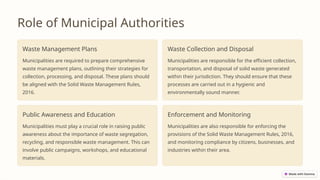
Role of Municipal Authorities
Waste Management Plans
Municipalities are required to prepare comprehensive
waste management plans, outlining their strategies for
collection, processing, and disposal. These plans should
be aligned with the Solid Waste Management Rules,
2016.
Waste Collection and Disposal
Municipalities are responsible for the efficient collection,
transportation, and disposal of solid waste generated
within their jurisdiction. They should ensure that these
processes are carried out in a hygienic and
environmentally sound manner.
Public Awareness and Education
Municipalities must play a crucial role in raising public
awareness about the importance of waste segregation,
recycling, and responsible waste management. This can
involve public campaigns, workshops, and educational
materials.
Enforcement and Monitoring
Municipalities are also responsible for enforcing the
provisions of the Solid Waste Management Rules, 2016,
and monitoring compliance by citizens, businesses, and
industries within their area.
The Citizen's Role in Waste Management
Segregation
Segregating waste at source
is a key aspect of
responsible waste
management. This involves
separating waste into
different categories like
biodegradable, recyclable,
and hazardous waste,
ensuring that each category
is disposed of appropriately.
Composting
Composting is the process
of decomposing organic
waste, such as food scraps
and yard waste, into
nutrient-rich compost. This
compost can be used to
enrich soil, promoting
sustainable gardening and
reducing the amount of
waste sent to landfills.
Recycling
Recycling is the process of
converting waste materials
into reusable products, such
as paper, glass, plastic, and
metals. Recycling reduces
the need for virgin materials
and lowers the
environmental impact of
waste disposal.
Reduce
Reducing waste generation
is an essential part of
sustainable waste
management. This can
involve using reusable bags,
avoiding single-use plastics,
and making conscious
choices about packaging
and consumption.
Challenges to Effective Implementation
1
Lack of Awareness
Limited public awareness about the importance of waste segregation, recycling, and proper
waste disposal remains a significant challenge.
2
Insufficient Infrastructure
The lack of adequate waste collection, sorting, and processing facilities,
particularly in smaller towns and villages, poses a barrier to effective waste
management.
3
Financial Constraints
Limited financial resources often hinder the implementation of
comprehensive waste management programs, including investment
in infrastructure, technology, and public awareness campaigns.
Solutions and Future Directions
1
Public Education
Continuous public education campaigns and awareness programs are essential to promote understanding and
participation in responsible waste management practices.
2
Technological Advancements
Embracing innovative technologies, such as waste-to-energy conversion, advanced
sorting systems, and smart waste management solutions, can enhance efficiency and
sustainability.
3
Community Engagement
Promoting community engagement and participation in waste
management initiatives, such as composting programs, recycling
drives, and community clean-up events, can foster a sense of
ownership and responsibility.
Key Takeaways and Next
Steps
The Solid Waste Management Rules, 2016, provide a comprehensive
framework for sustainable waste management in India. Effective
implementation requires collaboration between municipal authorities,
citizens, and various stakeholders. By promoting awareness, embracing
technology, and fostering community engagement, we can create a
cleaner, healthier, and more sustainable future for all.

Understanding-the-Solid-Waste-Management-Rules-2016.pptx

  • 1.
    Understanding the Solid WasteManagement Rules, 2016 Welcome, esteemed officials, waste management professionals, and concerned citizens. This presentation delves into the crucial Solid Waste Management Rules, 2016, focusing on their purpose, key provisions, and implementation strategies. by surekha t
  • 2.
    The Purpose ofthe Rules The Solid Waste Management Rules, 2016, were enacted by the Ministry of Environment, Forest and Climate Change to streamline waste management practices across India. They aim to establish a comprehensive framework for the safe, hygienic, and environmentally sound disposal of solid waste. The rules aim to ensure that waste is collected, transported, treated, and disposed of in a manner that protects human health and the environment. They emphasize the need for source segregation, recycling, composting, and the minimization of waste generation. The goal is to create sustainable waste management systems that benefit communities and the planet.
  • 3.
    Key Provisions ofthe Rules 1 Source Segregation The rules mandate source segregation of waste at the household level. This involves separating waste into categories like biodegradable, recyclable, and hazardous waste. 2 Waste Collection and Transportation Efficient waste collection and transportation systems are emphasized, with proper vehicles and appropriate storage facilities for each waste category. 3 Waste Processing and Treatment The rules promote the use of various waste processing and treatment technologies, such as composting, anaerobic digestion, and waste-to-energy conversion. 4 Waste Disposal Safe and environmentally sound waste disposal practices are encouraged, including landfill management and the minimization of waste going to landfills.
  • 4.
    Role of MunicipalAuthorities Waste Management Plans Municipalities are required to prepare comprehensive waste management plans, outlining their strategies for collection, processing, and disposal. These plans should be aligned with the Solid Waste Management Rules, 2016. Waste Collection and Disposal Municipalities are responsible for the efficient collection, transportation, and disposal of solid waste generated within their jurisdiction. They should ensure that these processes are carried out in a hygienic and environmentally sound manner. Public Awareness and Education Municipalities must play a crucial role in raising public awareness about the importance of waste segregation, recycling, and responsible waste management. This can involve public campaigns, workshops, and educational materials. Enforcement and Monitoring Municipalities are also responsible for enforcing the provisions of the Solid Waste Management Rules, 2016, and monitoring compliance by citizens, businesses, and industries within their area.
  • 5.
    The Citizen's Rolein Waste Management Segregation Segregating waste at source is a key aspect of responsible waste management. This involves separating waste into different categories like biodegradable, recyclable, and hazardous waste, ensuring that each category is disposed of appropriately. Composting Composting is the process of decomposing organic waste, such as food scraps and yard waste, into nutrient-rich compost. This compost can be used to enrich soil, promoting sustainable gardening and reducing the amount of waste sent to landfills. Recycling Recycling is the process of converting waste materials into reusable products, such as paper, glass, plastic, and metals. Recycling reduces the need for virgin materials and lowers the environmental impact of waste disposal. Reduce Reducing waste generation is an essential part of sustainable waste management. This can involve using reusable bags, avoiding single-use plastics, and making conscious choices about packaging and consumption.
  • 6.
    Challenges to EffectiveImplementation 1 Lack of Awareness Limited public awareness about the importance of waste segregation, recycling, and proper waste disposal remains a significant challenge. 2 Insufficient Infrastructure The lack of adequate waste collection, sorting, and processing facilities, particularly in smaller towns and villages, poses a barrier to effective waste management. 3 Financial Constraints Limited financial resources often hinder the implementation of comprehensive waste management programs, including investment in infrastructure, technology, and public awareness campaigns.
  • 7.
    Solutions and FutureDirections 1 Public Education Continuous public education campaigns and awareness programs are essential to promote understanding and participation in responsible waste management practices. 2 Technological Advancements Embracing innovative technologies, such as waste-to-energy conversion, advanced sorting systems, and smart waste management solutions, can enhance efficiency and sustainability. 3 Community Engagement Promoting community engagement and participation in waste management initiatives, such as composting programs, recycling drives, and community clean-up events, can foster a sense of ownership and responsibility.
  • 8.
    Key Takeaways andNext Steps The Solid Waste Management Rules, 2016, provide a comprehensive framework for sustainable waste management in India. Effective implementation requires collaboration between municipal authorities, citizens, and various stakeholders. By promoting awareness, embracing technology, and fostering community engagement, we can create a cleaner, healthier, and more sustainable future for all.