TRANSPORTATION SURVEYS
Presented by:
BALAR RAJ P.
Guided by:
Miss. Dipali Paneria
Proff. SNPIT UMRAKH, BARDOLI
SITARAMBHAI NARANJIBHAI PATEL INSTITUTE OF TECHNOLOGY
& RESEARCH CENTRE
UMRAKH, BARDOLI
ORIGIN AND DESTINATION SURVEY
• The O and D studies of vehicular traffic determines their number, their origin and
destination in each zone under study. The data of number of passengers in each
vehicles, purpose of trip, intermediate stops made and reasons, actual direction of
travel, selection of routes and length of trip etc. also collected.
Methods of O and D survey are :
• Road side interview method
• License plate method
• Return post card method
• Tag on car method
• Home interview method
1
ROAD SIDE INTERVIEW METHOD
• In this method interview station are
previously decided on the road.
• The vehicles are stopped at the interview
station by a group of persons and
questionnaire are collected on the spot.
3
ROAD SIDE INTERVIEW METHOD
4
LICENSE PLATE METHOD
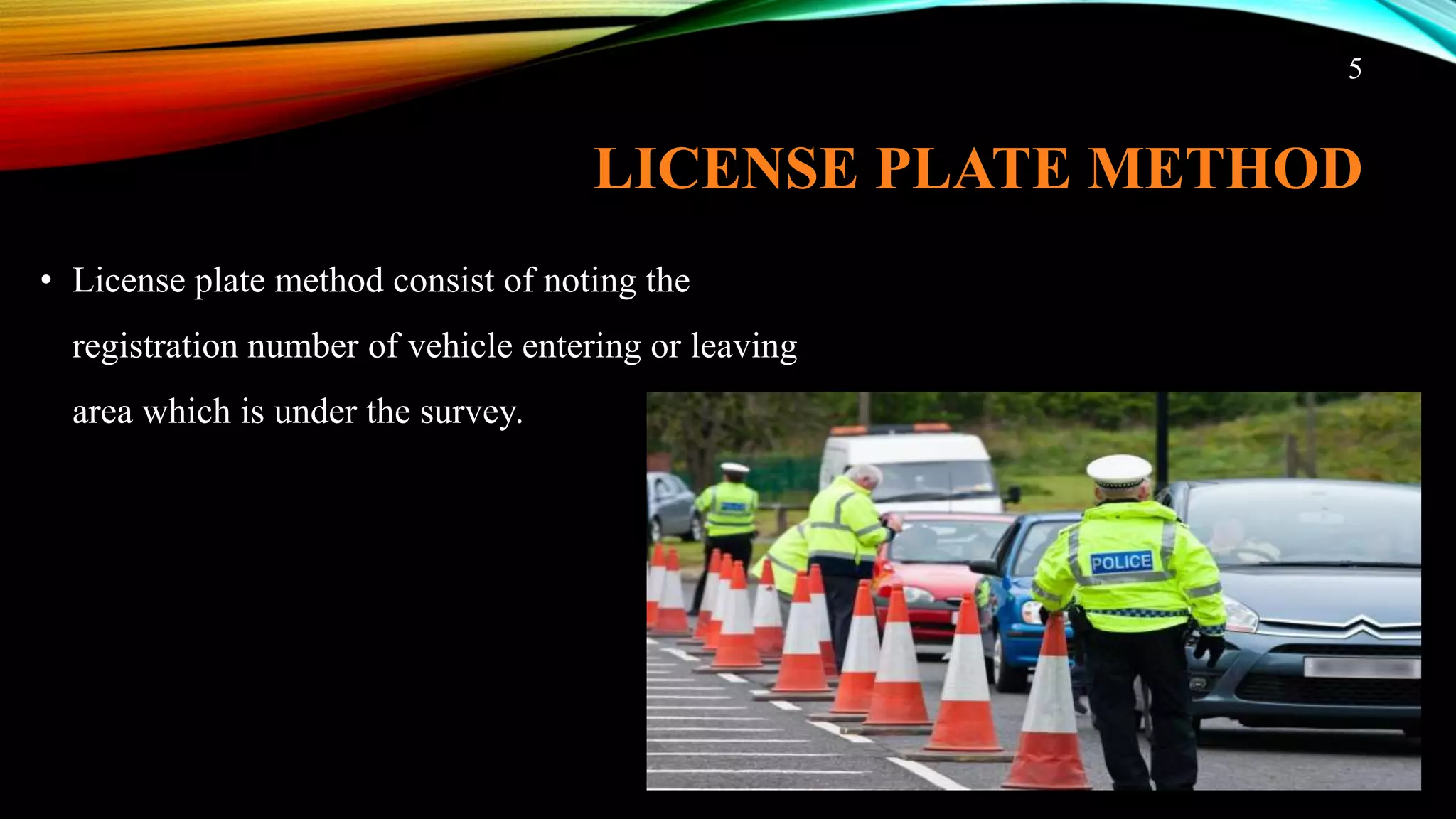
• License plate method consist of noting the
registration number of vehicle entering or leaving
area which is under the survey.
5
RETURN POST CARD METHOD
• In this method reply-paid questionnaires are handed over to the drivers at the survey
points and requesting to all of the drivers to complete the information and RETURN
IT BY POST.
6
TAG ON CAR METHOD
• In this method at each point where road cross the cordon line, vehicles are stopped
and a tag is fixed usually under a wind screen wiper.
• The tag for different survey stations have different shapes / colour to identify the
survey station.
• The vehicles are stopped again at the exit point where the tags are removed.
• The time of entering and leaving the area may be marked on the tags in order to
determine the journey time.
7
HOME INTERVIEW METHOD
• In this method a random sample of 0.5 to 10% of the population is selected and the
residence are visited by the trained persons who collect the travel data from each
member of the households.
• The data collected might be useful either for road planning network and other road
facilities.
DATA COLLECTION :
• Number of trip mode & their O & D
• Purpose of trip
• Travel Mode
8
HOME INTERVIEW METHOD
9
TRAFFIC SURVEY
• Traffic survey are carried out on weekday on all busy roads in order to study the
density of traffic continuously for about 16 hours in order to assess the total daily
volume and their peakig patterns as well as their direction.
• Mode wise vehicle counts for example Car, Buses, Tricks, Auto rickshaws are
generally made and recorded at every 15 minutes intervals.
• The volume/capacity ratio of road stretches can be obtained from these data in order to
help in planning and accident prone stretches will also be identified.
10
PUBLIC TRANSPORT SURVEYS
11
• In this method interviewer may enter the vehicle and carry out the interviews when the
vehicles is in motion.
• Direct interview is likely to result in large delays and required a large number of interviews.
Post card questionnaires eliminates delays but are likely to evoke poor response.
• Public transport survey covers inventory of public transport vehicles, capacity, their routing
pattern, schedules, and fare structure. These are to be collected from the operators.
• An external cordon rail survey can be carried out by interviewing the passengers on trains.
Alternatively prepaid questionnaires may be distributed to persons residing at stations outside
the survey area.
PUBLIC TRANSPORT SURVEYS
12

Origin and destination survey

  • 1.
    TRANSPORTATION SURVEYS Presented by: BALARRAJ P. Guided by: Miss. Dipali Paneria Proff. SNPIT UMRAKH, BARDOLI SITARAMBHAI NARANJIBHAI PATEL INSTITUTE OF TECHNOLOGY & RESEARCH CENTRE UMRAKH, BARDOLI
  • 2.
    ORIGIN AND DESTINATIONSURVEY • The O and D studies of vehicular traffic determines their number, their origin and destination in each zone under study. The data of number of passengers in each vehicles, purpose of trip, intermediate stops made and reasons, actual direction of travel, selection of routes and length of trip etc. also collected. Methods of O and D survey are : • Road side interview method • License plate method • Return post card method • Tag on car method • Home interview method 1
  • 4.
    ROAD SIDE INTERVIEWMETHOD • In this method interview station are previously decided on the road. • The vehicles are stopped at the interview station by a group of persons and questionnaire are collected on the spot. 3
  • 5.
  • 6.
    LICENSE PLATE METHOD •License plate method consist of noting the registration number of vehicle entering or leaving area which is under the survey. 5
  • 7.
    RETURN POST CARDMETHOD • In this method reply-paid questionnaires are handed over to the drivers at the survey points and requesting to all of the drivers to complete the information and RETURN IT BY POST. 6
  • 8.
    TAG ON CARMETHOD • In this method at each point where road cross the cordon line, vehicles are stopped and a tag is fixed usually under a wind screen wiper. • The tag for different survey stations have different shapes / colour to identify the survey station. • The vehicles are stopped again at the exit point where the tags are removed. • The time of entering and leaving the area may be marked on the tags in order to determine the journey time. 7
  • 9.
    HOME INTERVIEW METHOD •In this method a random sample of 0.5 to 10% of the population is selected and the residence are visited by the trained persons who collect the travel data from each member of the households. • The data collected might be useful either for road planning network and other road facilities. DATA COLLECTION : • Number of trip mode & their O & D • Purpose of trip • Travel Mode 8
  • 10.
  • 11.
    TRAFFIC SURVEY • Trafficsurvey are carried out on weekday on all busy roads in order to study the density of traffic continuously for about 16 hours in order to assess the total daily volume and their peakig patterns as well as their direction. • Mode wise vehicle counts for example Car, Buses, Tricks, Auto rickshaws are generally made and recorded at every 15 minutes intervals. • The volume/capacity ratio of road stretches can be obtained from these data in order to help in planning and accident prone stretches will also be identified. 10
  • 12.
    PUBLIC TRANSPORT SURVEYS 11 •In this method interviewer may enter the vehicle and carry out the interviews when the vehicles is in motion. • Direct interview is likely to result in large delays and required a large number of interviews. Post card questionnaires eliminates delays but are likely to evoke poor response. • Public transport survey covers inventory of public transport vehicles, capacity, their routing pattern, schedules, and fare structure. These are to be collected from the operators. • An external cordon rail survey can be carried out by interviewing the passengers on trains. Alternatively prepaid questionnaires may be distributed to persons residing at stations outside the survey area.
  • 13.