ROAD MARKING AND ITS
TYPES
Present by
VIJAY S 1AT19ME413
ROAD MARKING
• Road markings are the special arrangements on the road use to control and to guide
the traffic and ensure the safety.
• These are in the form of certain lines, patterns, words ,symbols, reflectors ,kerb and
sides of islands or on fixed object of near road ways
FUNCTIONS OF ROAD MARKING
• Road markings are used to control and regulate the flow.
• The are used to ensure maximum safety.
• They also provide the messages conveyed by the road
signals and sings.
• They are used as controlling to devices some cases.
TYPES OF ROAD MARKINGS
•Centre lines : A centre lines is a carriageway marking used to
indicate the centre of carriageways to sperate the traffic in
opposite directions .The pattern of the centreline depends either
urban road or rural road
Traffic Lane Lines : The division of the carriageway into
separate lanes for traffic travelling in the same direction on either
side of the centre line median strip helps to promote travel in
proper lanes for the drivers, thus promoting safety and ensuring
maximum capacity
No Overtaking Zone Markings: No overtaking
zone markings are provided on horizontal curves ,summit
curves and the places where the availability safe . The no
overtaking zone consists of a combination line along the
centre line.
•Pavement Edge lines: Pavement edge lines are used
to indicate the edges of the carriageway without kerbs. These
are in the from of single continuous lines placed about 15cm
from the edges . Pavement edge lines are of 15 to 20cm wide .
•Obstruction Approach Markings: These markings
are necessary to guide the traffic approach to the fixed
obstruction within the carriageway . It should be designed to
guide the traffic , away from the obstructions .
•Stop lines: Stop lines are solid white lines provided transversely
to the carriageway and used to indicate the point behind which
vehicles are required to stop in compliance with a STOP signal (or)
traffic police .As per the Indian standards ,the width of the stop
lines is given as
• For Rural Roads -30cm
• For Urban Roads -20cm
•Word Messages: Word messages are used to guide, to warn
and regulate the traffic in terms of words and letters.
• For example : SLOW
• SPEED LIMIT 30
• STOP
•Pedestrian Crossings : Pedestrian crossings are
very important markings and marked at all intersections
,where there is substantial conflict between vehicle and
pedestrian movements . They are located to ensure that
adequate visibility and space for pedestrian waiting .The
minimum and maximum width of pedestrian crossing should
be 2m and 4m respectively. The pedestrian crossing at right
angled and acute angled crossings .
•Cyclist crossings :Cyclist crossings are marked by
50CM *50CM square markings with a centre to centre spacing
of 100m.The width of the cyclist markings same as the cycle
tracks .
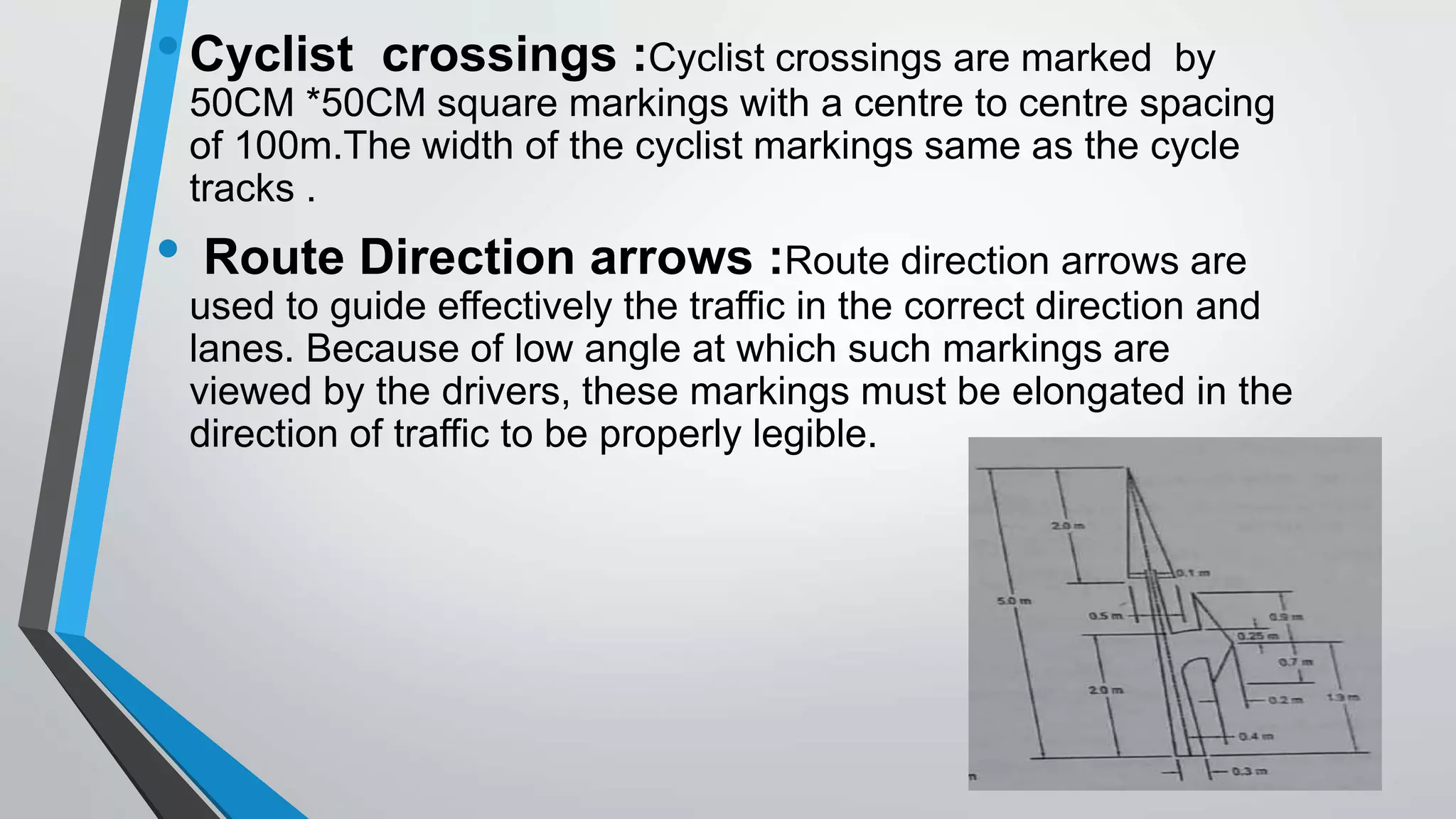
• Route Direction arrows :Route direction arrows are
used to guide effectively the traffic in the correct direction and
lanes. Because of low angle at which such markings are
viewed by the drivers, these markings must be elongated in the
direction of traffic to be properly legible.
•Parking Space Limits :These markings are used to
indicate and to limit the space provided for the parking of
various on the either side of the roads .
•Bus Stops : Bus stops are the construction (or)
arrangement made for the purpose of various vehicles on
either side of roads .
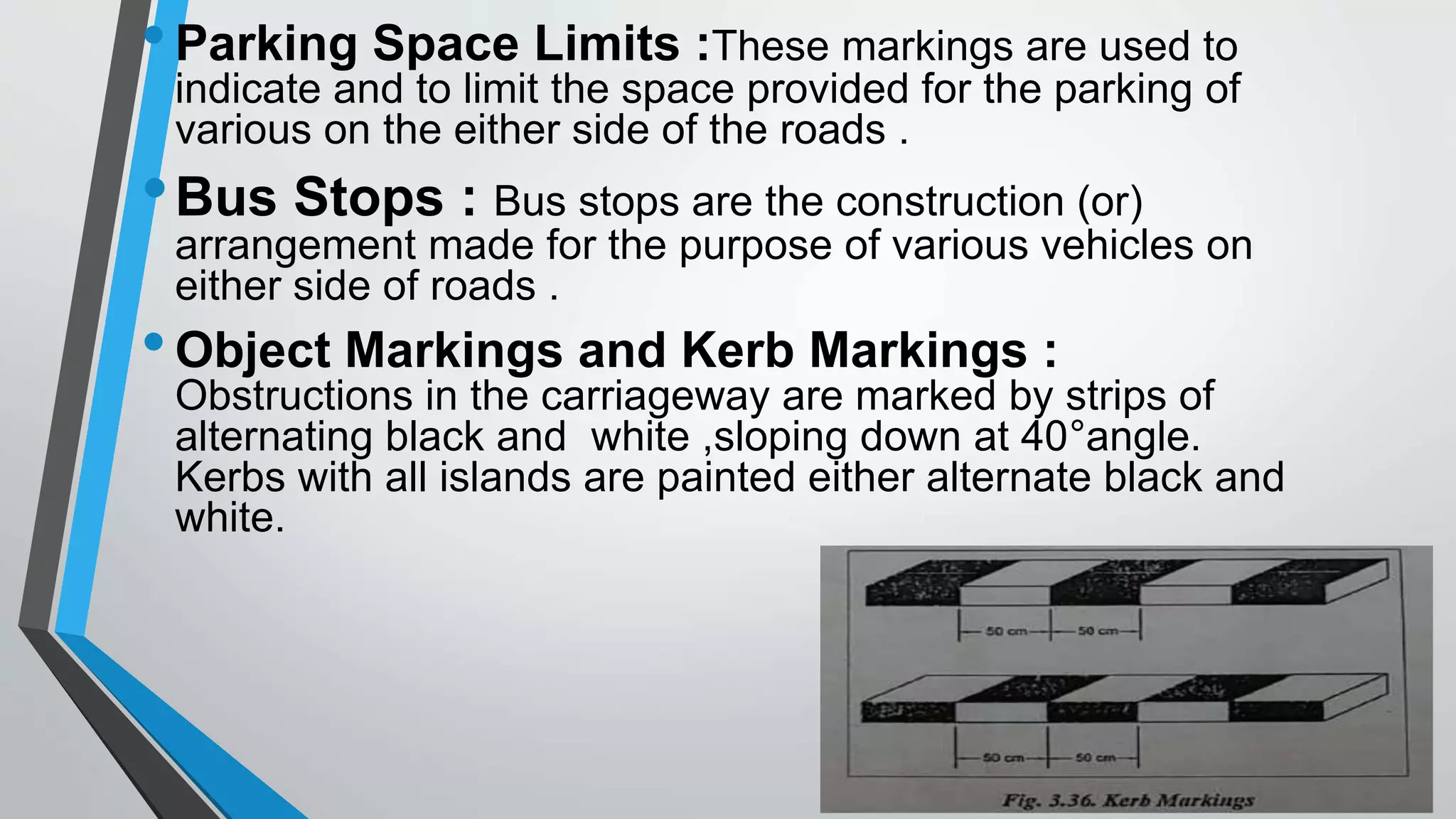
•Object Markings and Kerb Markings :
Obstructions in the carriageway are marked by strips of
alternating black and white ,sloping down at 40°angle.
Kerbs with all islands are painted either alternate black and
white.
Question Appeared In VTU Exams
•Q1) Discuss briefly about the different
types of road markings. ( June/July
2018,Jan 2019,July 2019,Sep2020)

Road marking and its types

  • 1.
    ROAD MARKING ANDITS TYPES Present by VIJAY S 1AT19ME413
  • 2.
    ROAD MARKING • Roadmarkings are the special arrangements on the road use to control and to guide the traffic and ensure the safety. • These are in the form of certain lines, patterns, words ,symbols, reflectors ,kerb and sides of islands or on fixed object of near road ways
  • 3.
    FUNCTIONS OF ROADMARKING • Road markings are used to control and regulate the flow. • The are used to ensure maximum safety. • They also provide the messages conveyed by the road signals and sings. • They are used as controlling to devices some cases.
  • 4.
    TYPES OF ROADMARKINGS •Centre lines : A centre lines is a carriageway marking used to indicate the centre of carriageways to sperate the traffic in opposite directions .The pattern of the centreline depends either urban road or rural road
  • 5.
    Traffic Lane Lines: The division of the carriageway into separate lanes for traffic travelling in the same direction on either side of the centre line median strip helps to promote travel in proper lanes for the drivers, thus promoting safety and ensuring maximum capacity
  • 6.
    No Overtaking ZoneMarkings: No overtaking zone markings are provided on horizontal curves ,summit curves and the places where the availability safe . The no overtaking zone consists of a combination line along the centre line.
  • 7.
    •Pavement Edge lines:Pavement edge lines are used to indicate the edges of the carriageway without kerbs. These are in the from of single continuous lines placed about 15cm from the edges . Pavement edge lines are of 15 to 20cm wide . •Obstruction Approach Markings: These markings are necessary to guide the traffic approach to the fixed obstruction within the carriageway . It should be designed to guide the traffic , away from the obstructions .
  • 8.
    •Stop lines: Stoplines are solid white lines provided transversely to the carriageway and used to indicate the point behind which vehicles are required to stop in compliance with a STOP signal (or) traffic police .As per the Indian standards ,the width of the stop lines is given as • For Rural Roads -30cm • For Urban Roads -20cm •Word Messages: Word messages are used to guide, to warn and regulate the traffic in terms of words and letters. • For example : SLOW • SPEED LIMIT 30 • STOP
  • 9.
    •Pedestrian Crossings :Pedestrian crossings are very important markings and marked at all intersections ,where there is substantial conflict between vehicle and pedestrian movements . They are located to ensure that adequate visibility and space for pedestrian waiting .The minimum and maximum width of pedestrian crossing should be 2m and 4m respectively. The pedestrian crossing at right angled and acute angled crossings .
  • 10.
    •Cyclist crossings :Cyclistcrossings are marked by 50CM *50CM square markings with a centre to centre spacing of 100m.The width of the cyclist markings same as the cycle tracks . • Route Direction arrows :Route direction arrows are used to guide effectively the traffic in the correct direction and lanes. Because of low angle at which such markings are viewed by the drivers, these markings must be elongated in the direction of traffic to be properly legible.
  • 11.
    •Parking Space Limits:These markings are used to indicate and to limit the space provided for the parking of various on the either side of the roads . •Bus Stops : Bus stops are the construction (or) arrangement made for the purpose of various vehicles on either side of roads . •Object Markings and Kerb Markings : Obstructions in the carriageway are marked by strips of alternating black and white ,sloping down at 40°angle. Kerbs with all islands are painted either alternate black and white.
  • 12.
    Question Appeared InVTU Exams •Q1) Discuss briefly about the different types of road markings. ( June/July 2018,Jan 2019,July 2019,Sep2020)