Department of
Civil Engineering
AHSANULLAH UNIVERSITY
OF
SCIENCE AND TECHNOLOGY

1
This Presentation is done as a requirement of a Sessional
Course-

CE-452
TRANSPORTATION
ENGINEERING SESSIONAL II

2
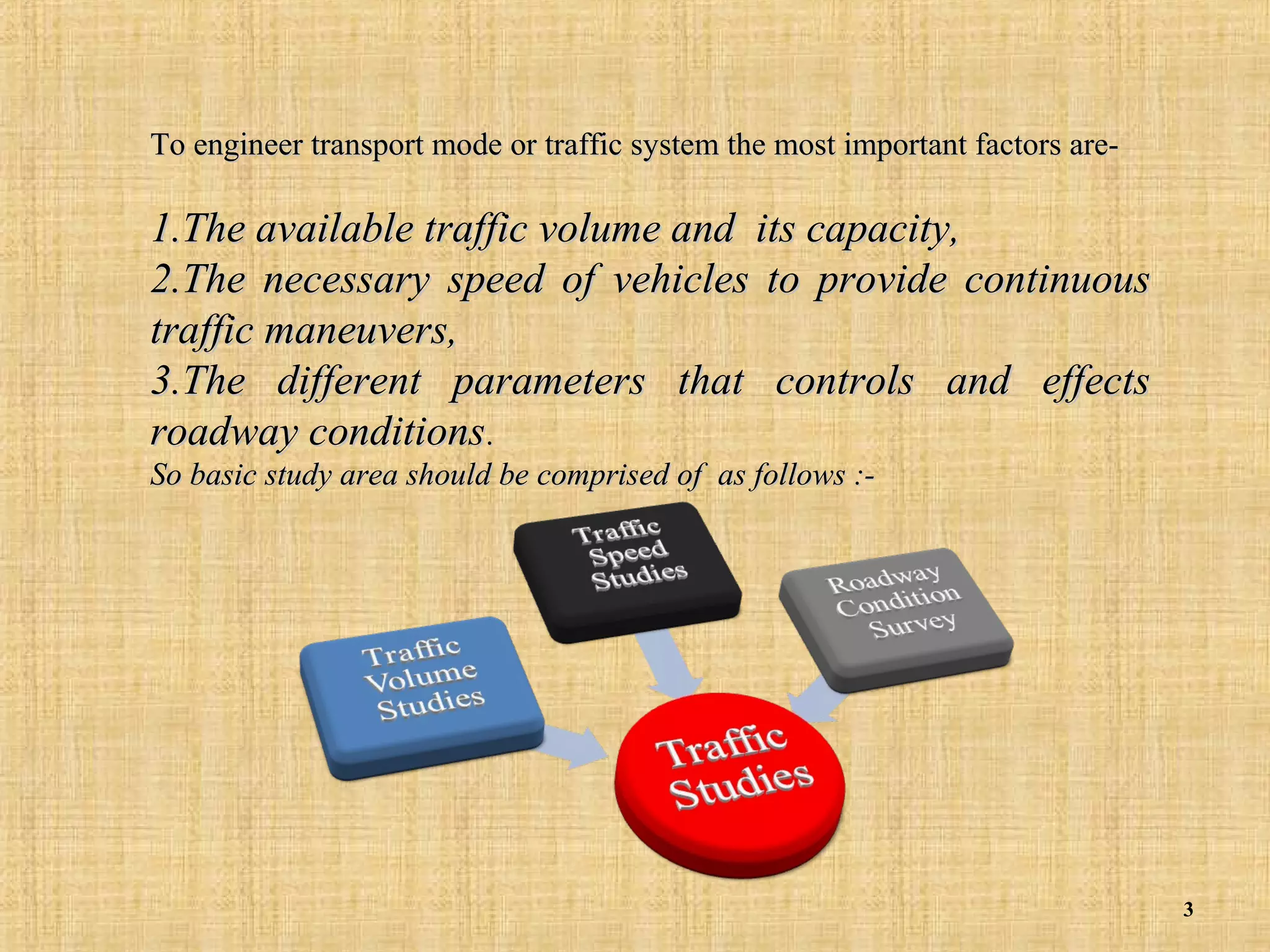
To engineer transport mode or traffic system the most important factors are-

1.The available traffic volume and its capacity,
2.The necessary speed of vehicles to provide continuous
traffic maneuvers,
3.The different parameters that controls and effects
roadway conditions.
So basic study area should be comprised of as follows :-

3
In this case, our study subject is ----------

Traffic Volume
Study
4
This will be presented by-

GROUP NO.07
Name

Student ID

Muhib Muazzam
Bakhtiar Omar Omi
Yeasin Talukder
Md. Firoz Mahmood Ovi
Shaibal Ahmed

09.02.03.044
09.02.03.045
09.02.03.046
09.02.03.047
09.02.03.049

5
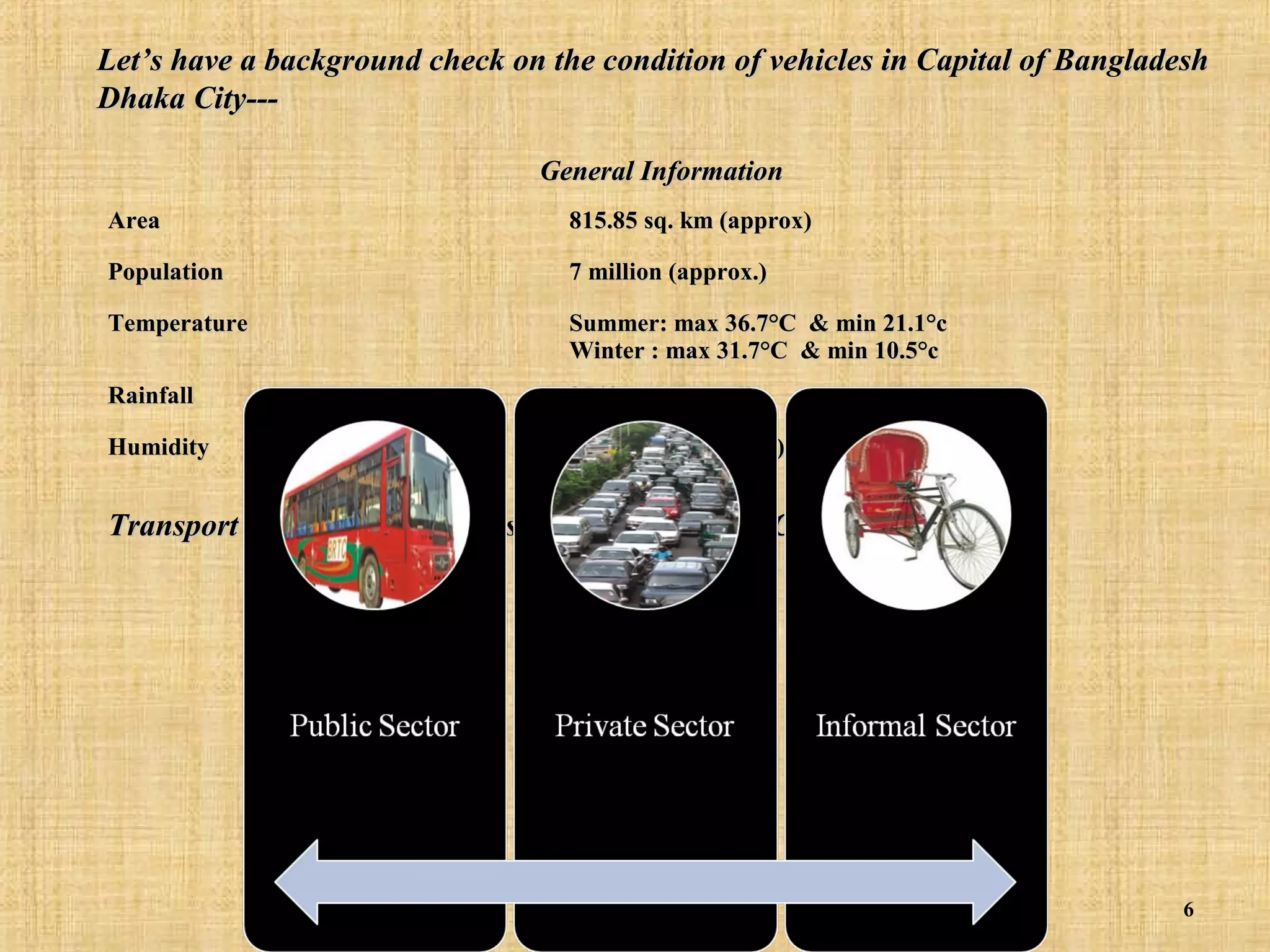
Let’s have a background check on the condition of vehicles in Capital of Bangladesh
Dhaka City--General Information
Area

815.85 sq. km (approx)

Population

7 million (approx.)

Temperature

Summer: max 36.7°C & min 21.1°c
Winter : max 31.7°C & min 10.5°c

Rainfall

2540 mm annually.

Humidity

80 percent (approx.)

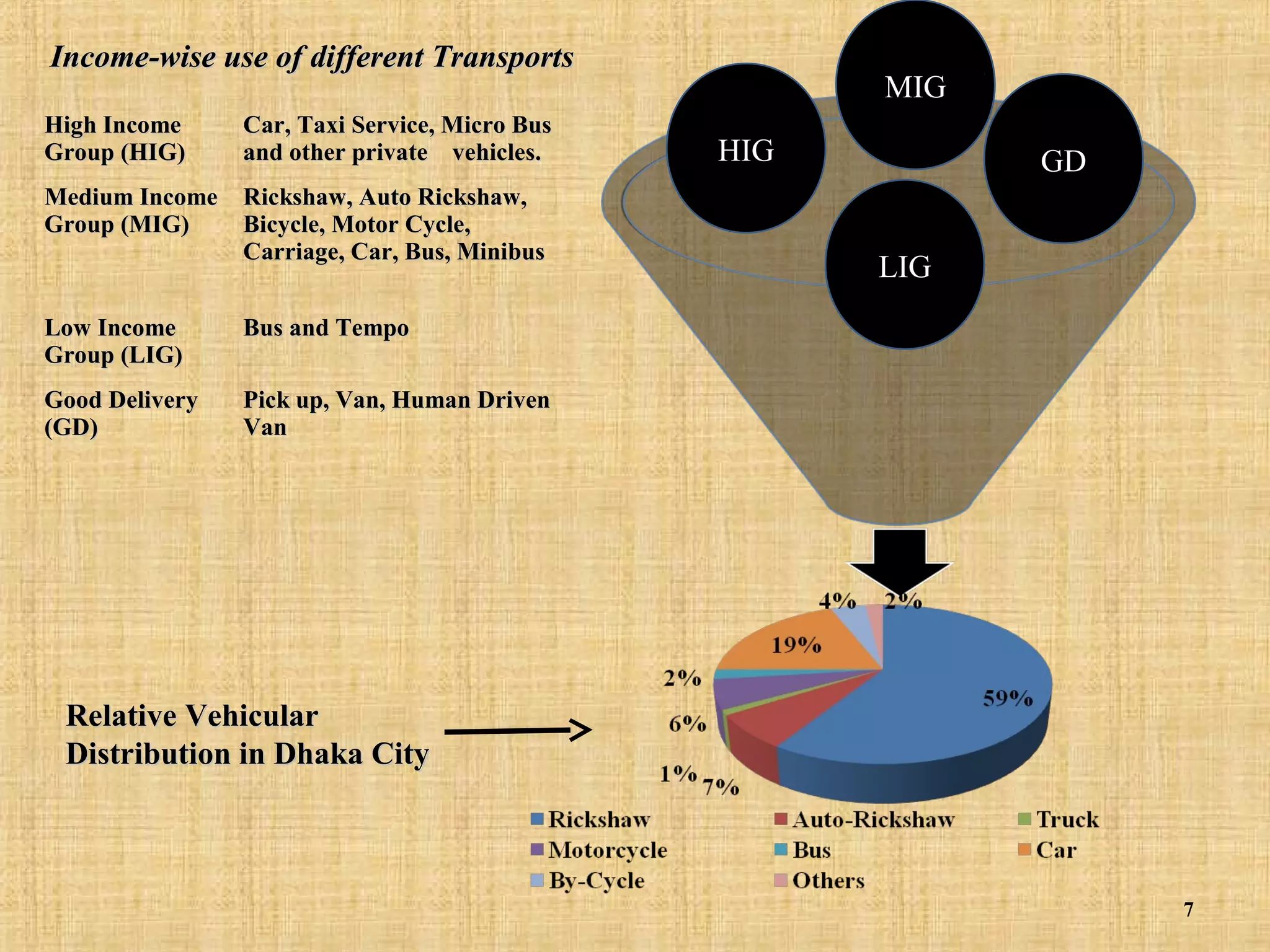
Transport Sectors &Vehicle distribution of Dhaka City is as follows-

6
Income-wise use of different Transports
High Income
Group (HIG)

Car, Taxi Service, Micro Bus
and other private vehicles.

Medium Income Rickshaw, Auto Rickshaw,
Group (MIG)
Bicycle, Motor Cycle,
Carriage, Car, Bus, Minibus
Low Income
Group (LIG)

HIG

GD
LIG

Bus and Tempo

Good Delivery
(GD)

MIG

Pick up, Van, Human Driven
Van

Relative Vehicular
Distribution in Dhaka City

7
1.
2.
3.
4.
5.

Objective
To determine of vehicle composition in traffic stream.
To determine of service flow rate in PCU/PCE unit.
To estimate of ADT based on expansion factors.
To determine directional distribution(DD).
To draw flow fluctuation curves.

Scope of The
Test

Magnitudes, classifications and the time and directional split of
vehicular flows;
Proportions of vehicles in traffic stream;
Hourly, daily, yearly and seasonal variation of vehicular flows;
Flow fluctuation on different approaches at a junction or different
parts of a road network system.

8
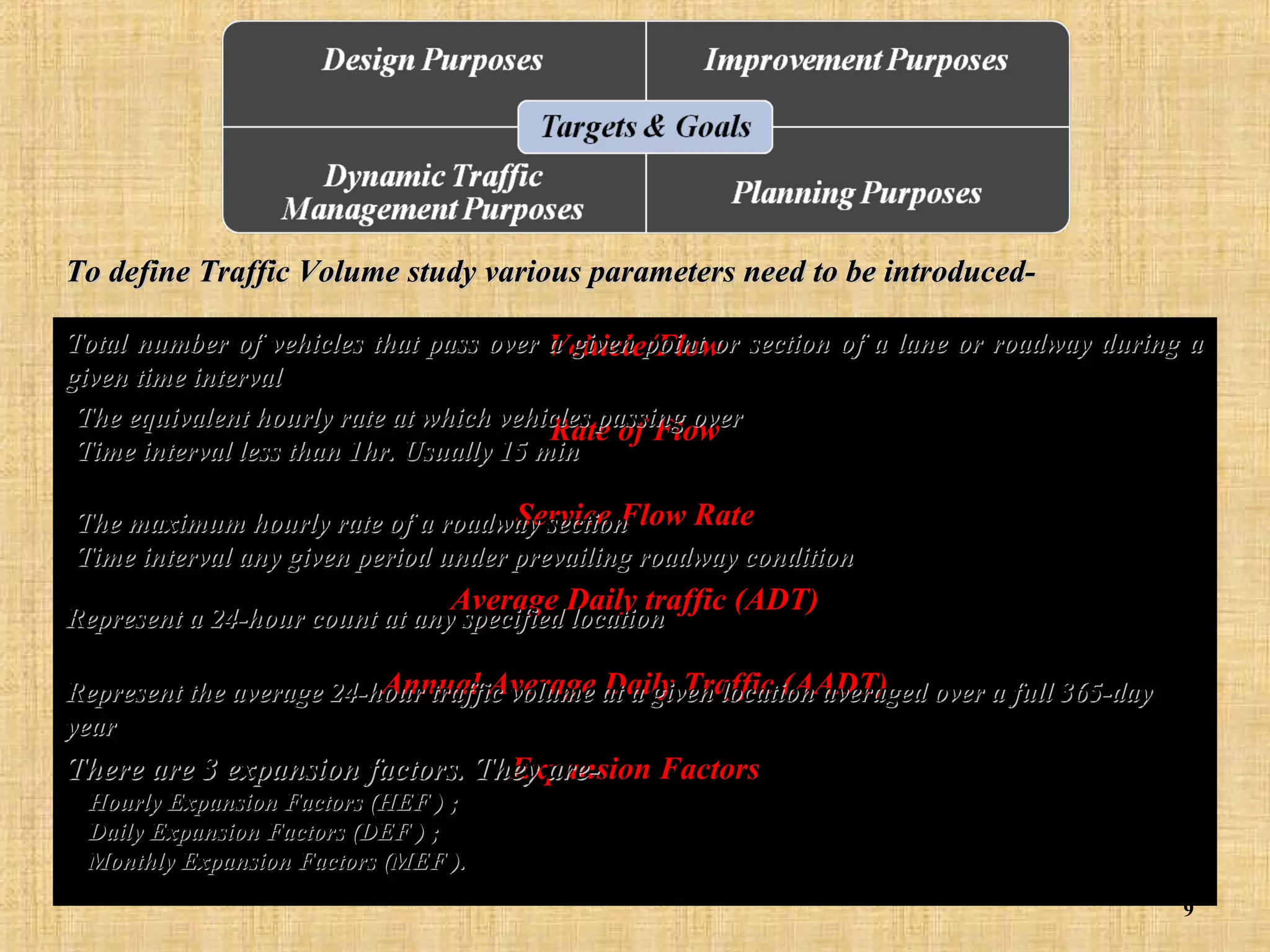
To define Traffic Volume study various parameters need to be introducedTotal number of vehicles that pass over a given point or section of a lane or roadway during a
Vehicle/Flow
given time interval
•The equivalent hourly rate at which vehicles passing over
Rate of Flow
•Time interval less than 1hr. Usually 15 min

Service Flow Rate
•The maximum hourly rate of a roadway section
•Time interval any given period under prevailing roadway condition
Average Daily traffic (ADT)

Represent a 24-hour count at any specified location

Annual Average Daily Traffic (AADT)
Represent the average 24-hour traffic volume at a given location averaged over a full 365-day
year
There are 3 expansion factors. They areExpansion Factors
Hourly Expansion Factors (HEF ) ;
Daily Expansion Factors (DEF ) ;
Monthly Expansion Factors (MEF ).
9
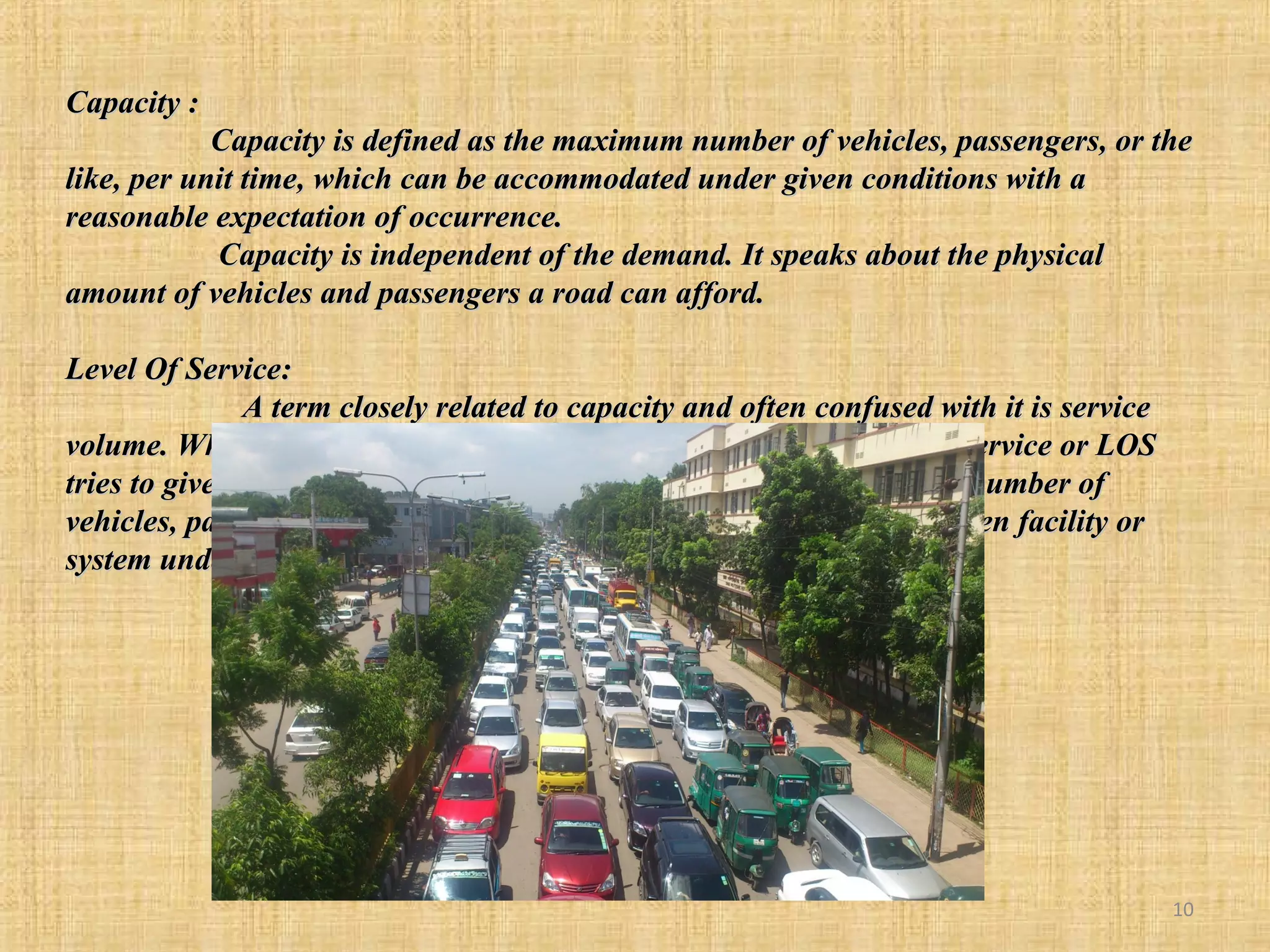
Capacity :
Capacity is defined as the maximum number of vehicles, passengers, or the
like, per unit time, which can be accommodated under given conditions with a
reasonable expectation of occurrence.
Capacity is independent of the demand. It speaks about the physical
amount of vehicles and passengers a road can afford.
Level Of Service:
A term closely related to capacity and often confused with it is service
volume. When capacity gives a quantitative measure of trac, level of service or LOS
tries to give a qualitative measure. A service volume is the maximum number of
vehicles, passengers, or the like, which can be accommodated by a given facility or
system under given conditions at a given level of service.

10
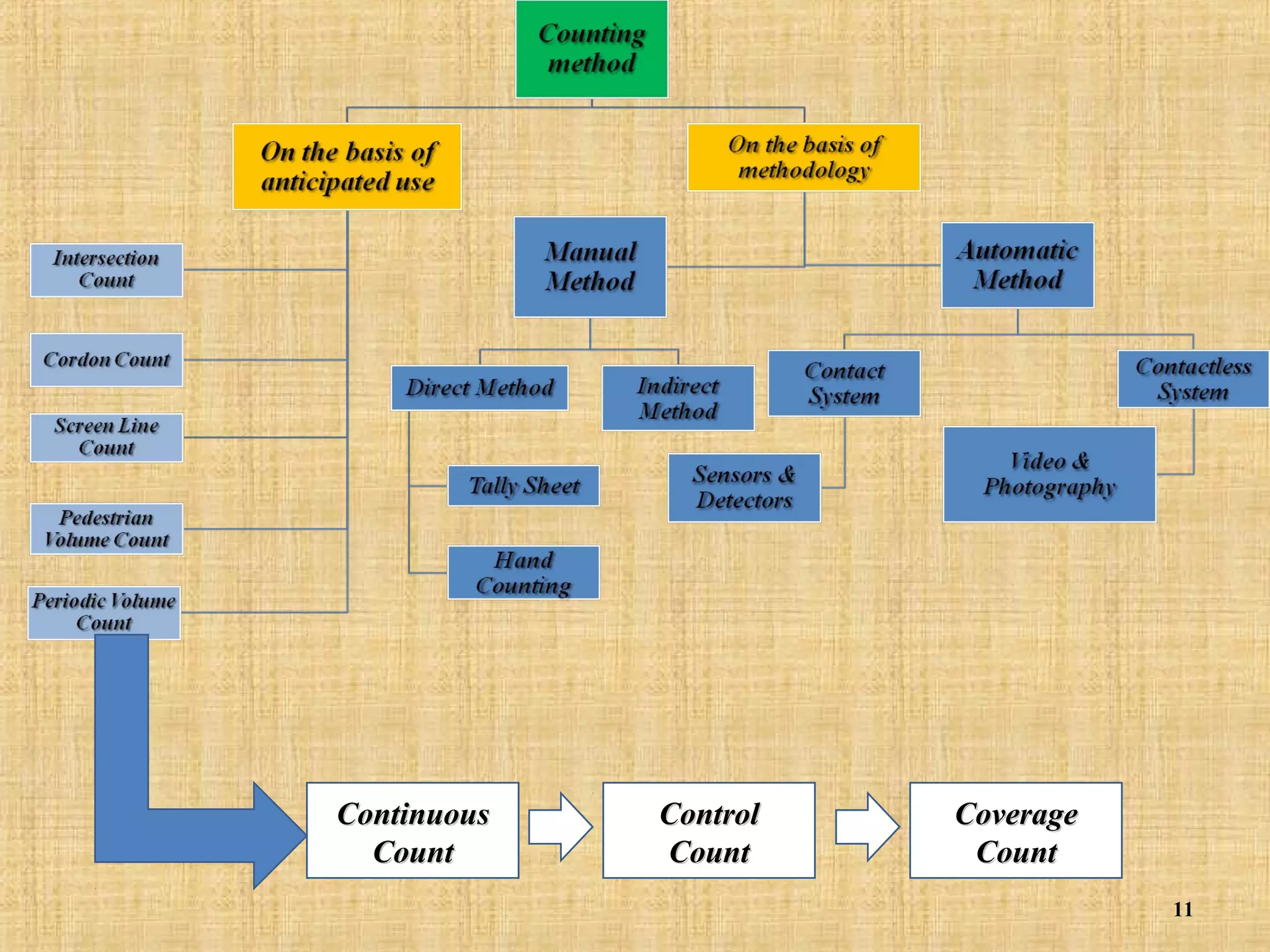
Continuous
Count

Control
Count

Coverage
Count
11
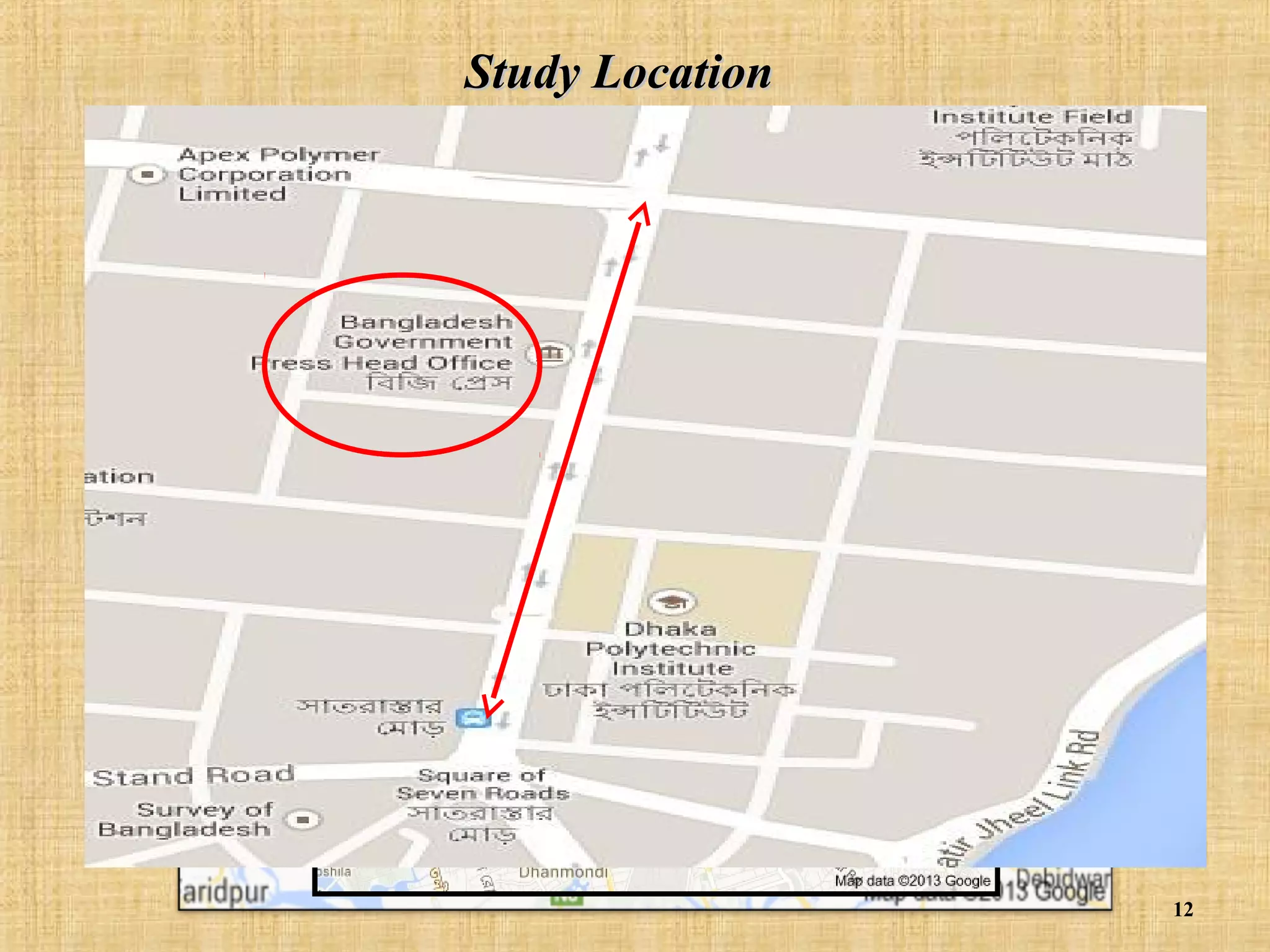
Study Location
Study Zone : Tejgaon; Industrial Area
Population : 2,20,012
Area : 8.75 km²
Household: 37,644
Study Road : SHAHEED TAJUDDIN AHMED AVENUE
Length : 0.560 km
Lanes : 3 lanes both direction; each 13 ft approximately
Width : 42 ft at intersection of SAATH RASTA
44 ft at intersection of FLYOVER

12
13
Before proceed to vehicle counting it is customary to do• Pilot Survey,
•Reconnaissance Surveys.
From our Reconnaissance Surveys we found that• At Saath Rasta intersection there was a construction going on for a fly over .
• Most of the buildings are there educational & official.
• Around the metal sculpture there are about 7 manholes & about 15 potholes.
• At median there are 6 median openings including both ends.
• At footpath there is more than enough manholes.
• Along flyover to saath rasta ther is 5 and along saath rasta to flyover there is 4 local roads.
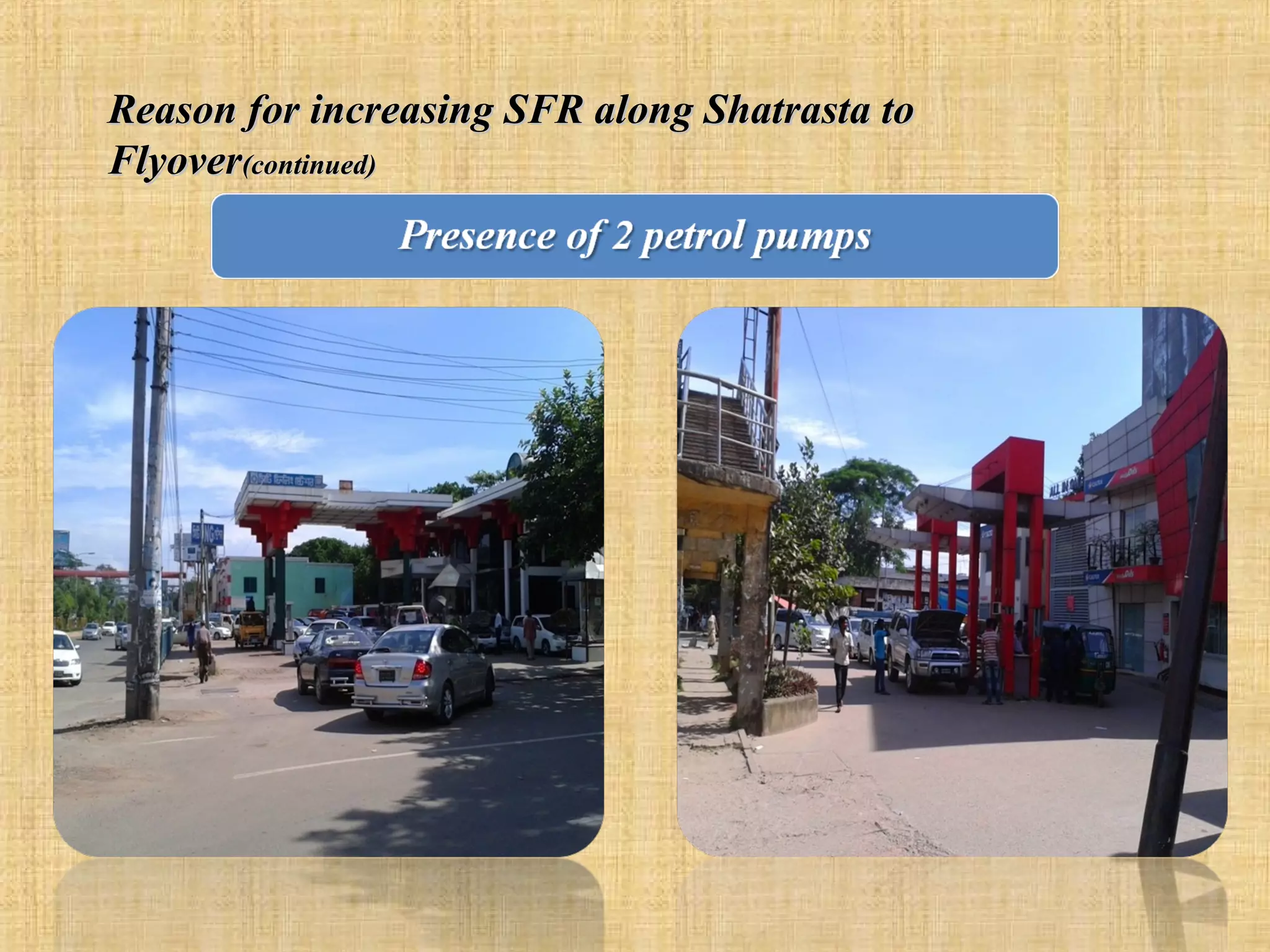
• Along saath rasta to flyover there is 2 gas station and 1 filing station
• On street parking is common in both direction.
•At Saath Rasta vehicles are actuated manually by TRAFFIC POLICE.
• Although a signal actuated intersection, Fly Over intersection is manually controlled.
14
Conditions & Specifications
Location: Shatrasta to flyover
Station: In front of BG Press
Date: 20th June 2013(Thursday)
Time: Time of data collection 8:30 am to 8:45 am
Weather Condition: Sunny
Observation: Classified Vehicle Counts
Method: Direct Manual Method
Duration: 15 minutes(Short Count)
Equipment: Stop watch, Pencils, Eraser, Tally sheet(Field Data Sheet), Clip board
Number of Enumerators: Five
15
• Before the day of counting we had gone to our location for

a reconnaissance survey and locate necessary reference
buildings.
• On the promised day, we reached our station and observed
the various vehicles that went by and distributed specified
vehicles among our 5 Enumerators to count them for 15
minutes

Procedure of
Works
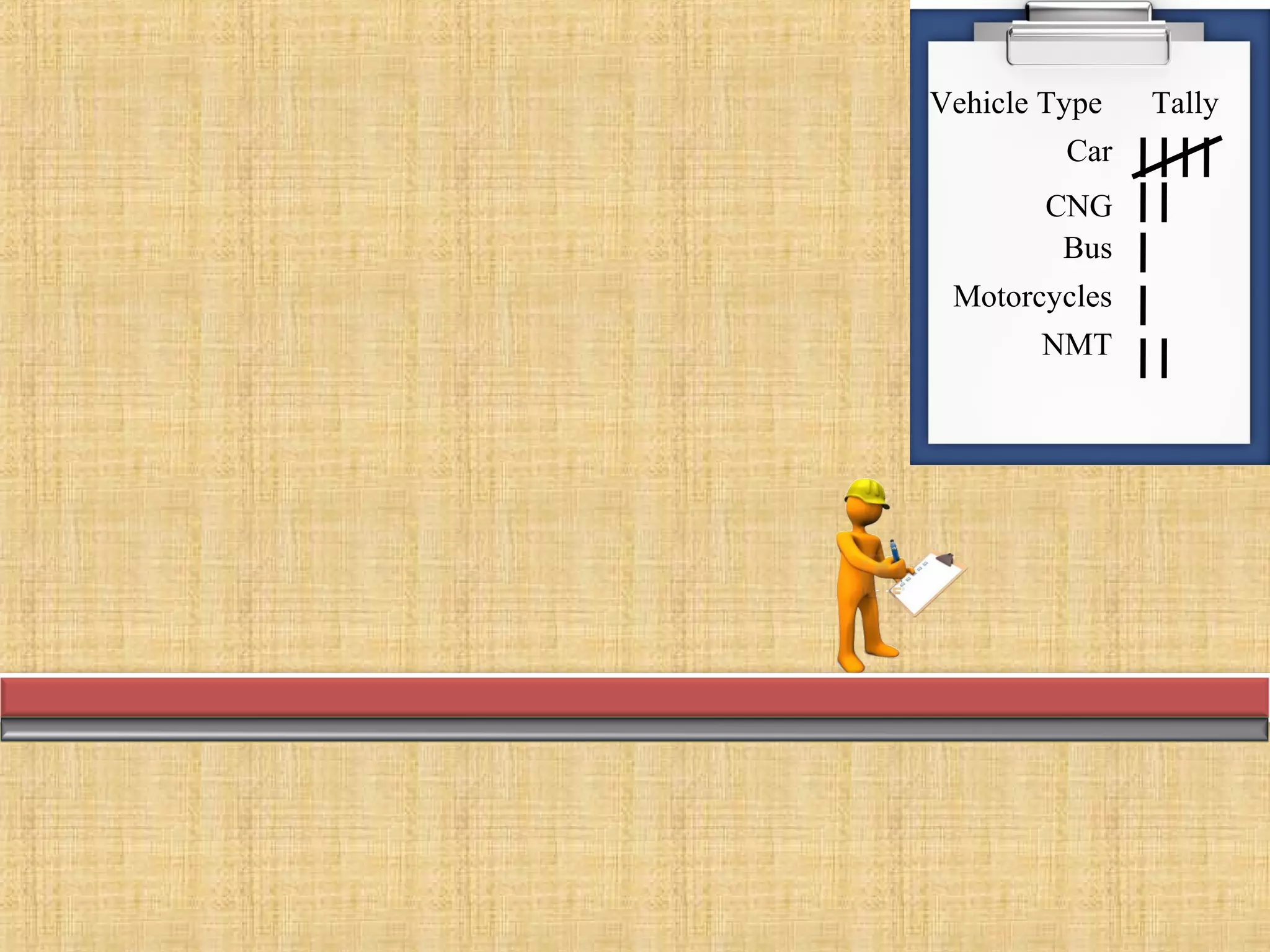
• We use tally to lessens our clumsiness and error of
counting.

• After 15 minutes we counted the total vehicles of each
types.

• Finally we prepared a field observation data sheet and filled
the necessary data.
16
Vehicle Type
Car
CNG
Bus
Motorcycles
NMT

Tally
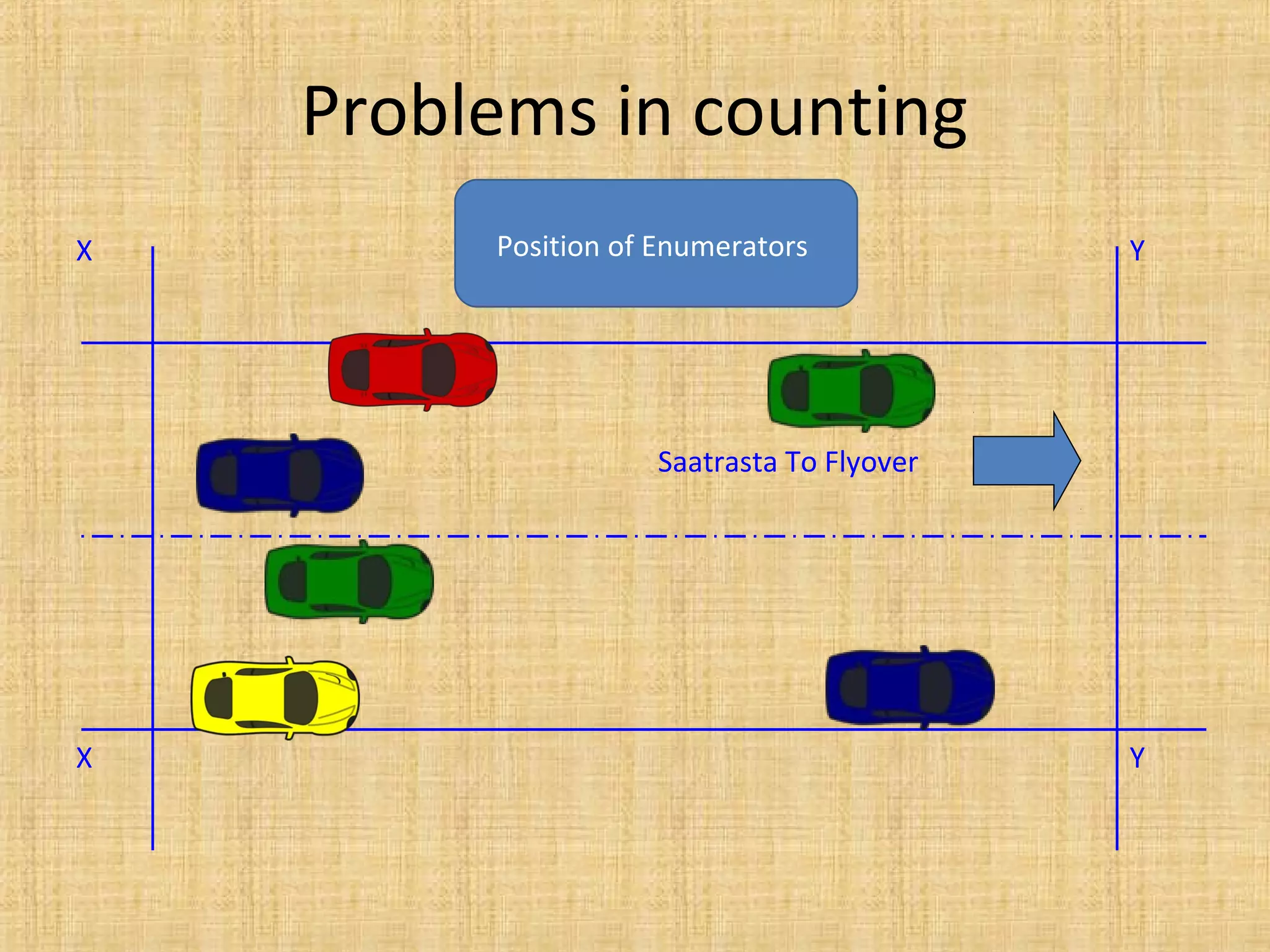
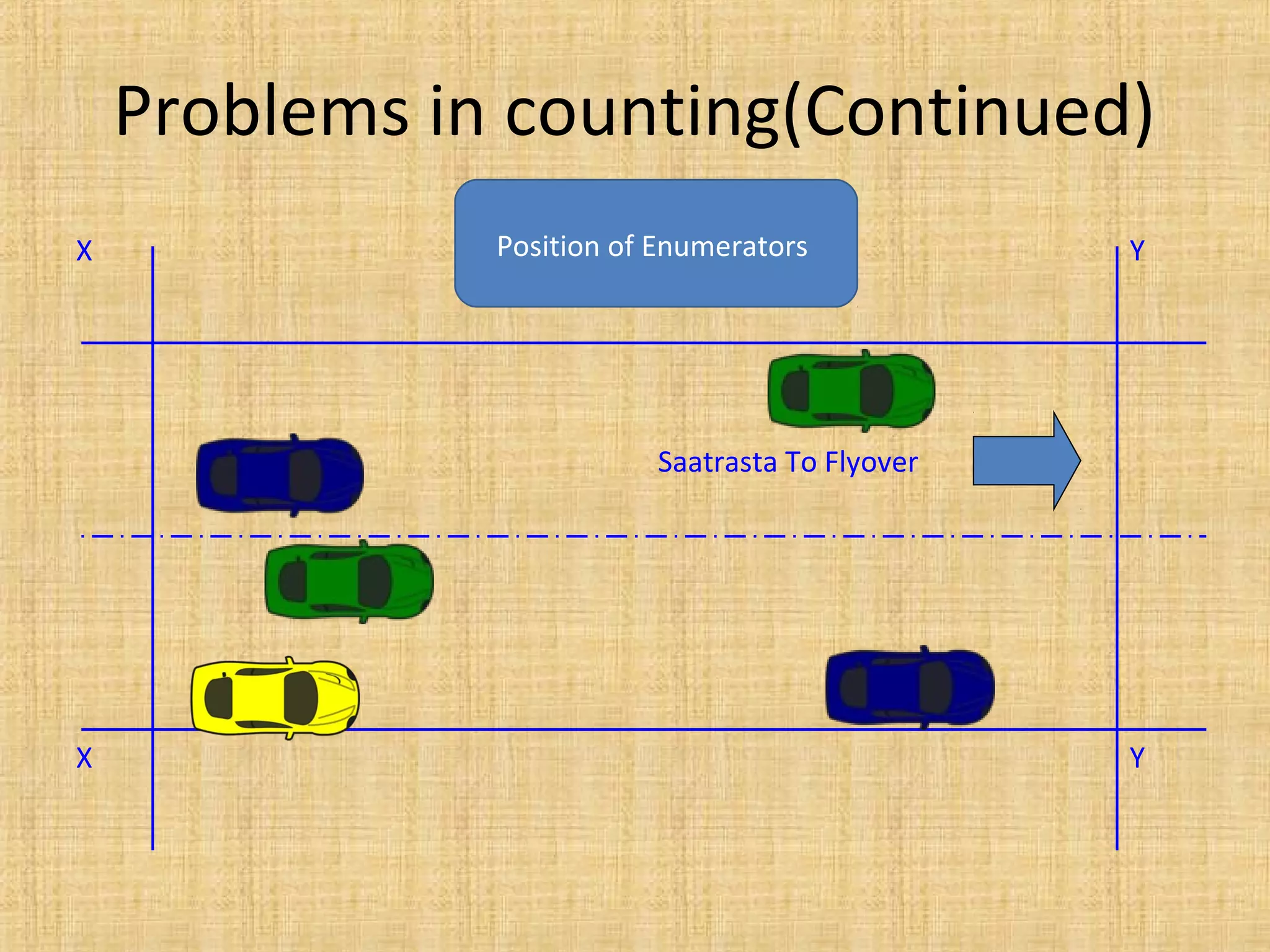
Problems in counting
X

Position of Enumerators

Y

Saatrasta To Flyover

X

Y
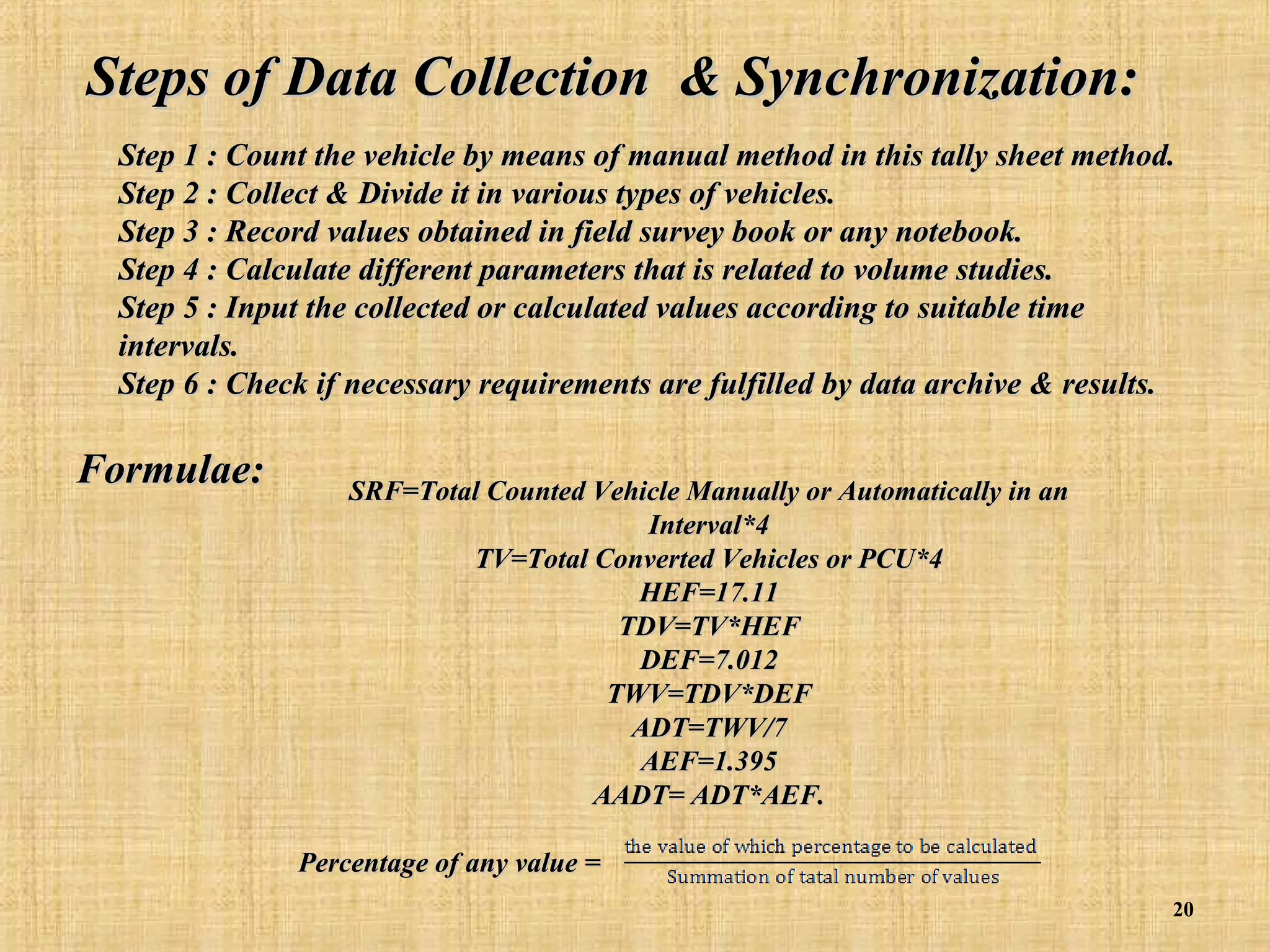
Problems in counting(Continued)
X

Position of Enumerators

Y

Saatrasta To Flyover

X

Y
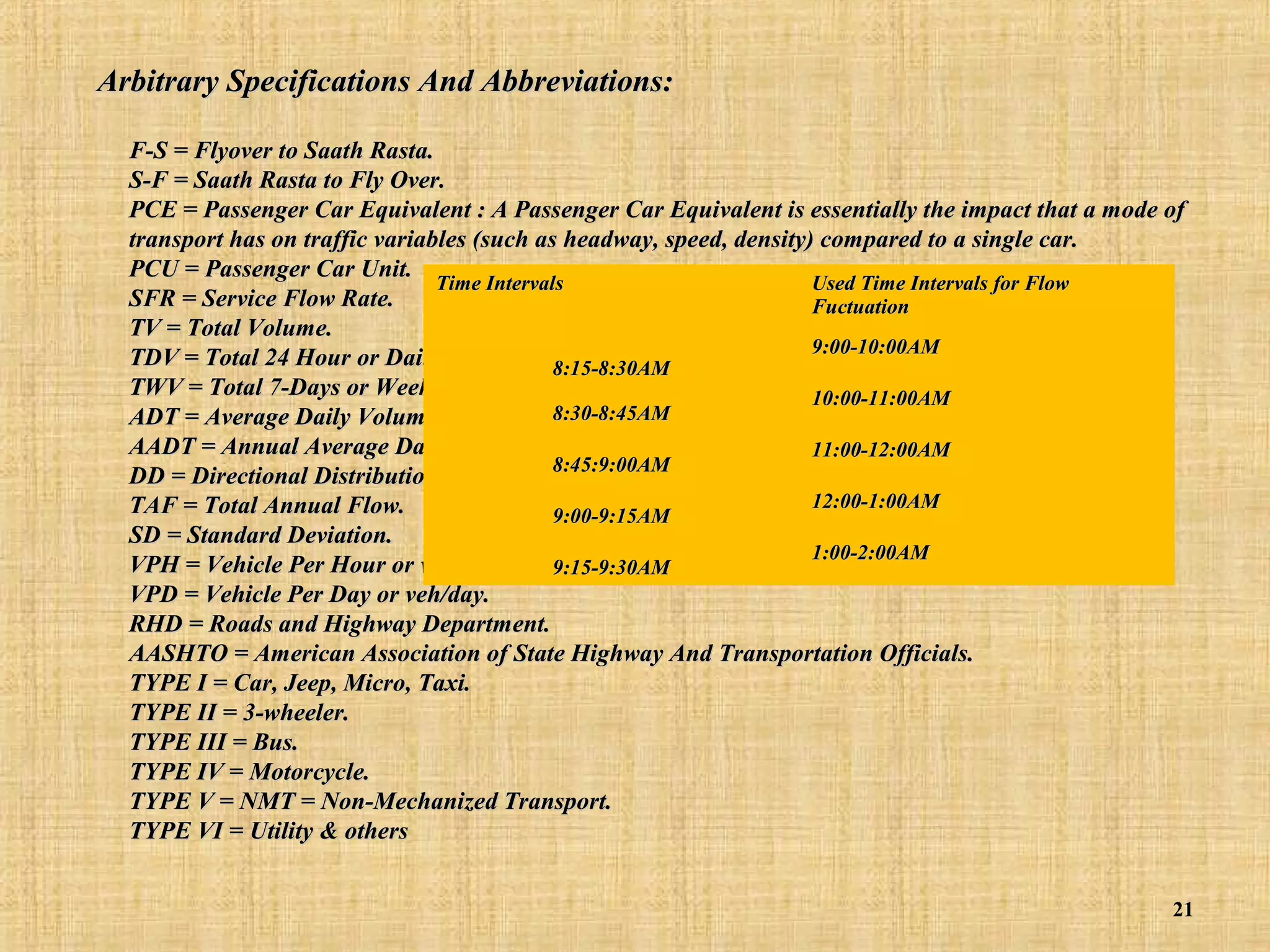
Steps of Data Collection & Synchronization:
Step 1 : Count the vehicle by means of manual method in this tally sheet method.
Step 2 : Collect & Divide it in various types of vehicles.
Step 3 : Record values obtained in field survey book or any notebook.
Step 4 : Calculate different parameters that is related to volume studies.
Step 5 : Input the collected or calculated values according to suitable time
intervals.
Step 6 : Check if necessary requirements are fulfilled by data archive & results.

Formulae:

SRF=Total Counted Vehicle Manually or Automatically in an
Interval*4
TV=Total Converted Vehicles or PCU*4
HEF=17.11
TDV=TV*HEF
DEF=7.012
TWV=TDV*DEF
ADT=TWV/7
AEF=1.395
AADT= ADT*AEF.
Percentage of any value =
20
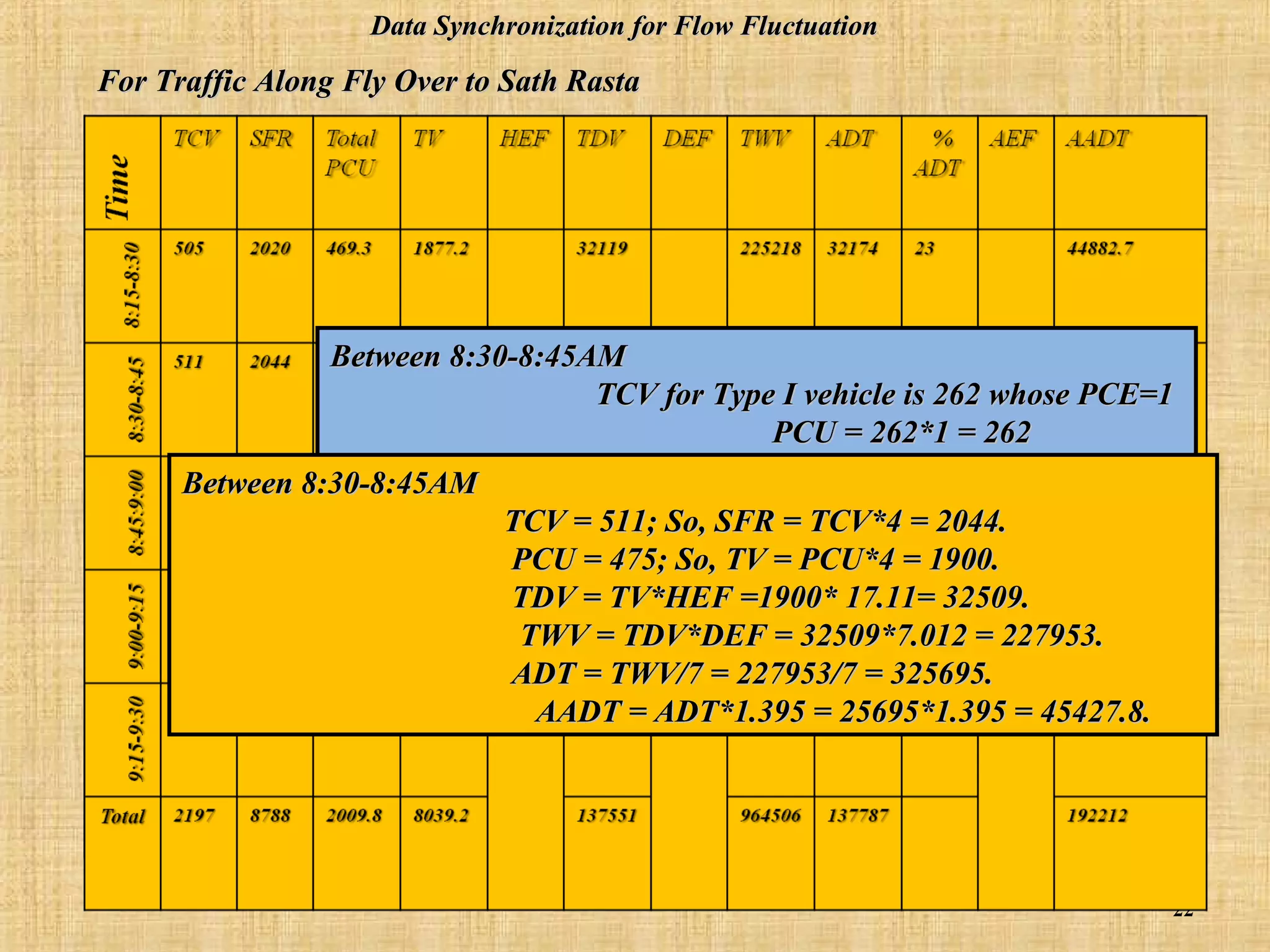
Arbitrary Specifications And Abbreviations:
F-S = Flyover to Saath Rasta.
S-F = Saath Rasta to Fly Over.
PCE = Passenger Car Equivalent : A Passenger Car Equivalent is essentially the impact that a mode of
transport has on traffic variables (such as headway, speed, density) compared to a single car.
PCU = Passenger Car Unit.
Time Intervals
Used Time Intervals for Flow
SFR = Service Flow Rate.
Fuctuation
TV = Total Volume.
9:00-10:00AM
TDV = Total 24 Hour or Daily Volume. 8:15-8:30AM
TWV = Total 7-Days or Weekly Volume.
10:00-11:00AM
8:30-8:45AM
ADT = Average Daily Volume.
AADT = Annual Average Daily Volume
11:00-12:00AM
8:45:9:00AM
DD = Directional Distribution.
12:00-1:00AM
TAF = Total Annual Flow.
9:00-9:15AM
SD = Standard Deviation.
1:00-2:00AM
VPH = Vehicle Per Hour or veh/hr.
9:15-9:30AM
VPD = Vehicle Per Day or veh/day.
RHD = Roads and Highway Department.
AASHTO = American Association of State Highway And Transportation Officials.
TYPE I = Car, Jeep, Micro, Taxi.
TYPE II = 3-wheeler.
TYPE III = Bus.
TYPE IV = Motorcycle.
TYPE V = NMT = Non-Mechanized Transport.
TYPE VI = Utility & others
21
Data Synchronization for Flow Fluctuation

For Traffic Along Fly Over to Sath Rasta

Between 8:30-8:45AM
TCV for Type I vehicle is 262 whose PCE=1
PCU = 262*1 = 262
Between 8:30-8:45AM
TCV = 511; So, SFR = TCV*4 = 2044.
PCU = 475; So, TV = PCU*4 = 1900.
TDV = TV*HEF =1900* 17.11= 32509.
TWV = TDV*DEF = 32509*7.012 = 227953.
ADT = TWV/7 = 227953/7 = 325695.
AADT = ADT*1.395 = 25695*1.395 = 45427.8.

22
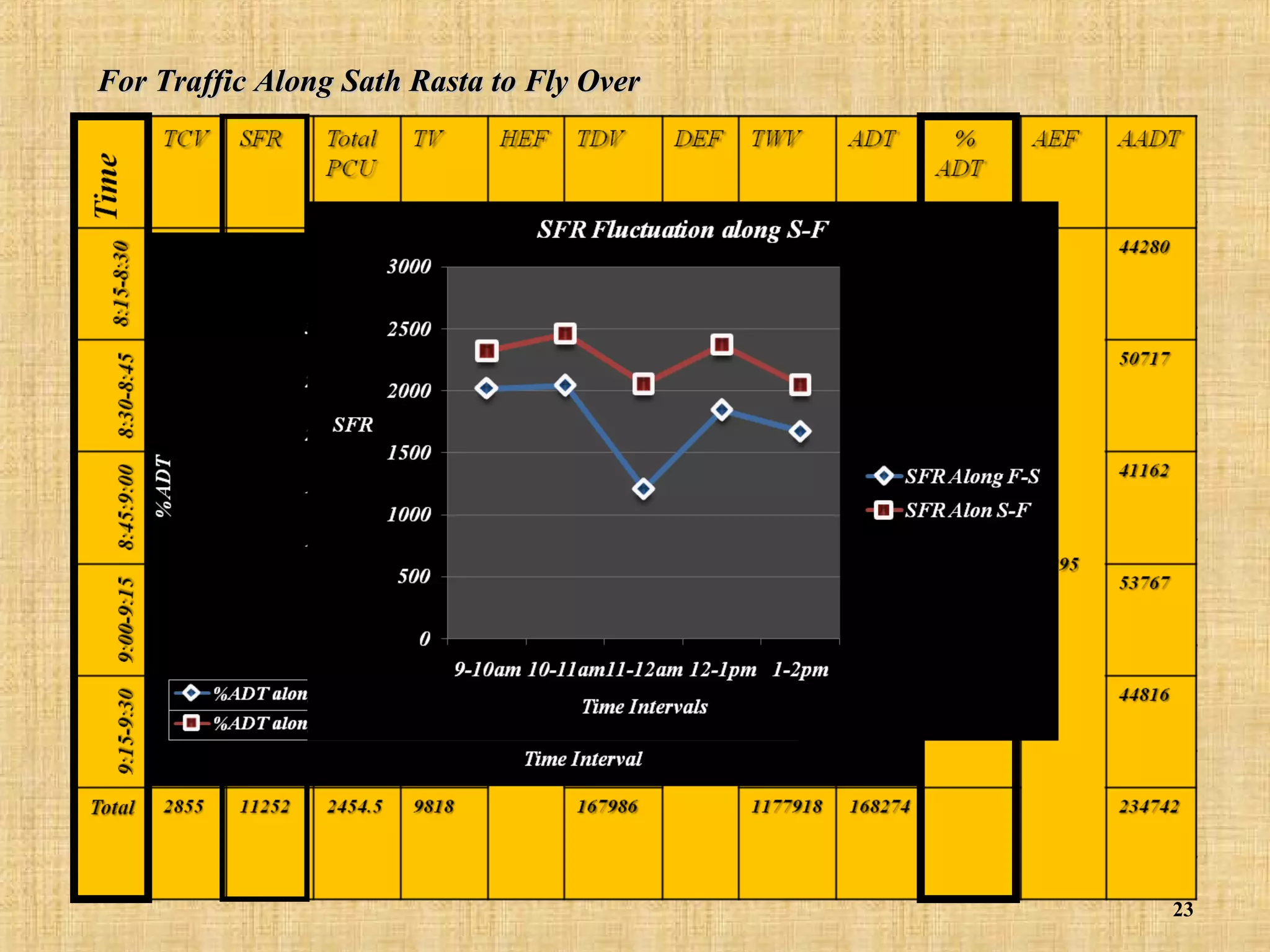
For Traffic Along Sath Rasta to Fly Over

23
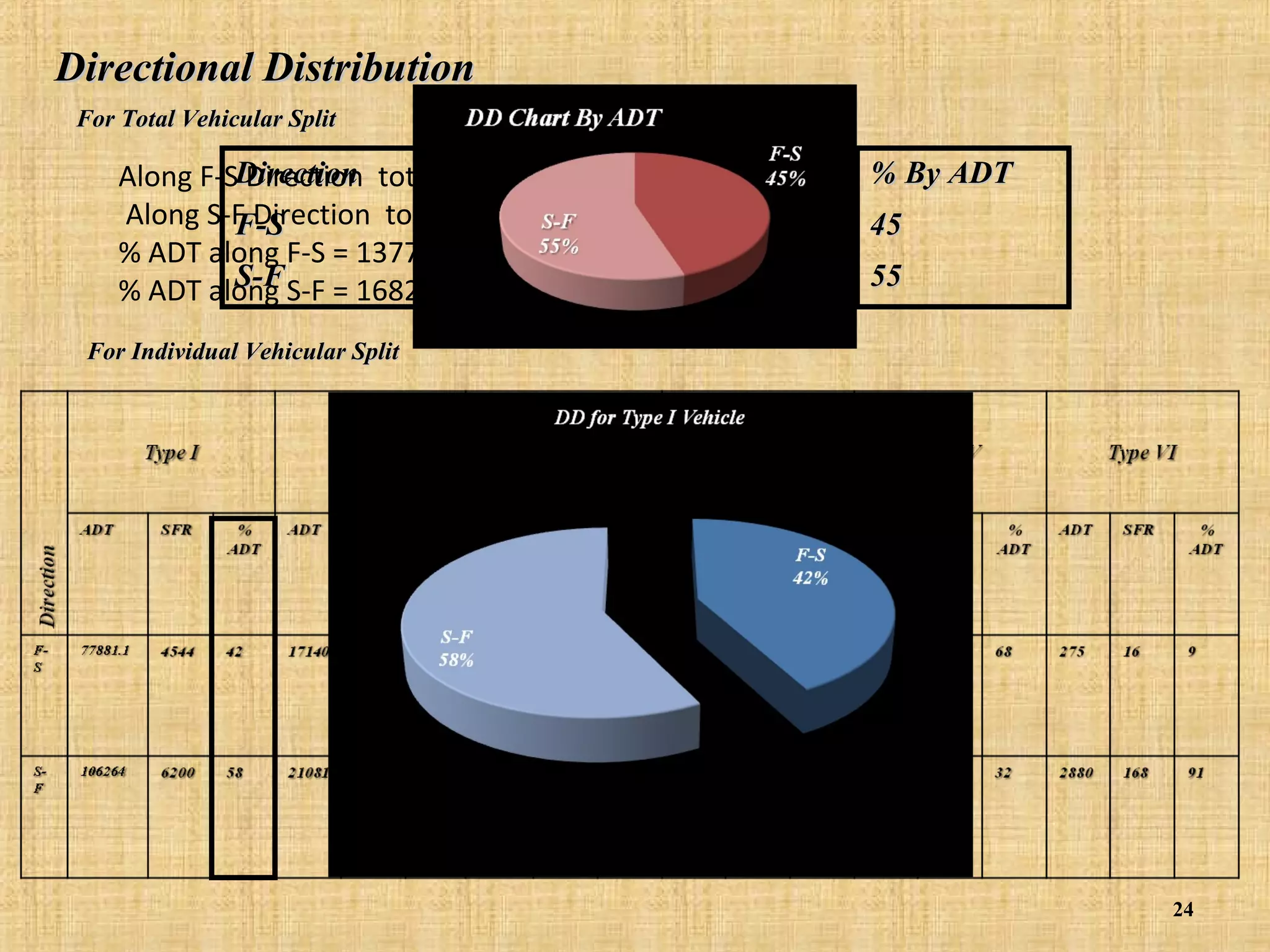
Directional Distribution
For Total Vehicular Split

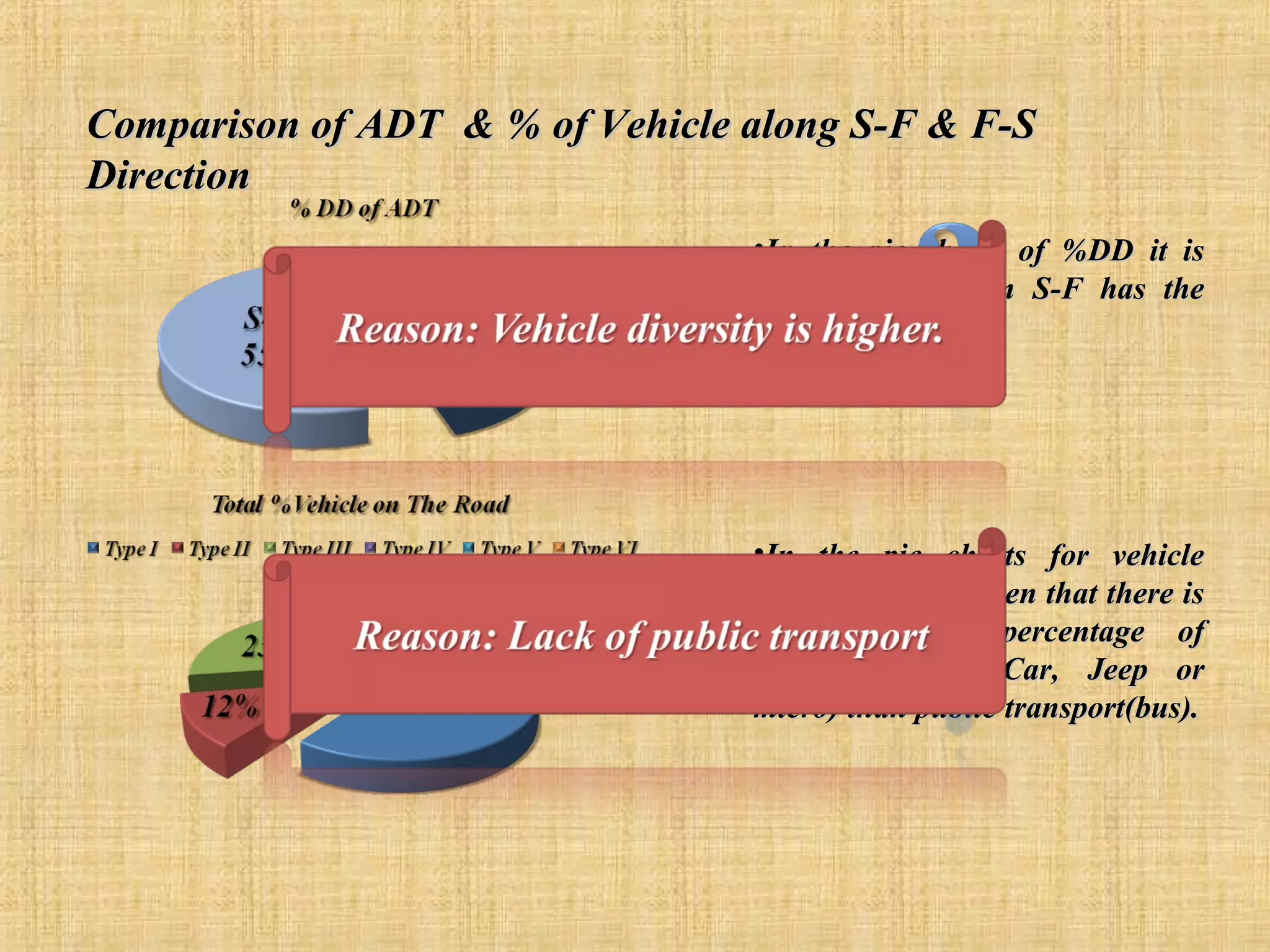
% By 137787 % By SFR
Along F-SDirection total ADT = TV
Direction
Along S-F Direction total45 = 168274 44
ADT
F-S
% ADT along F-S = 137787/(137787+168274) = 45%
S-F
55
56
% ADT along S-F = 168274/(137787+168274) = 55%

% By ADT
45
55

For Individual Vehicular Split

24
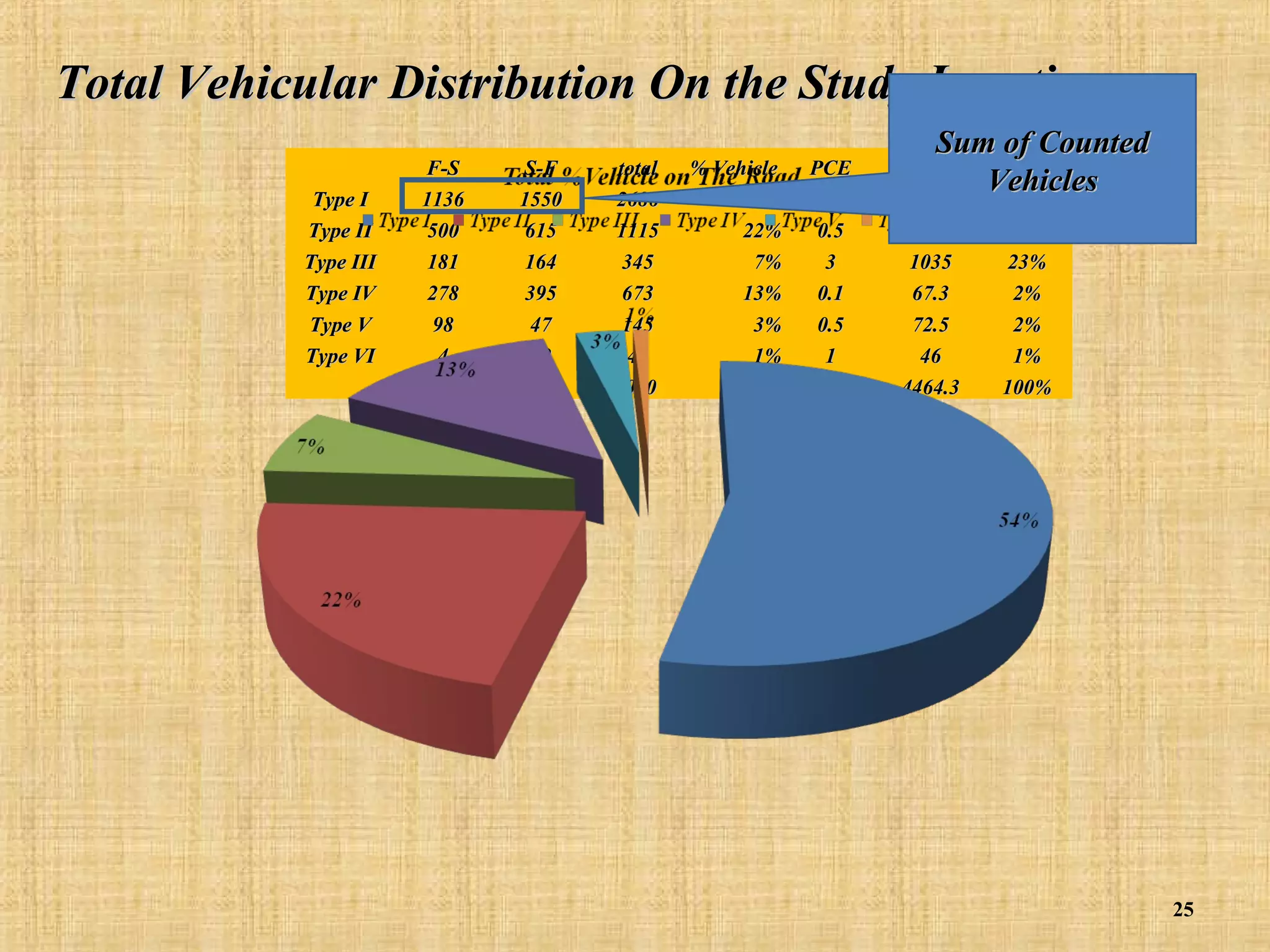
Total Vehicular Distribution On the Study Location
Type I
Type II
Type III
Type IV
Type V
Type VI

F-S
1136
500
181
278
98
4

S-F
1550
615
164
395
47
42

total
2686
1115
345
673
145
46
5010

% Vehicle
54%
22%
7%
13%
3%
1%
100%

PCE
1
0.5
3
0.1
0.5
1

Sum of Counted
%PCU
Vehicles
60%

PCU
2686
557.5
1035
67.3
72.5
46
4464.3

12%
23%
2%
2%
1%
100%

25
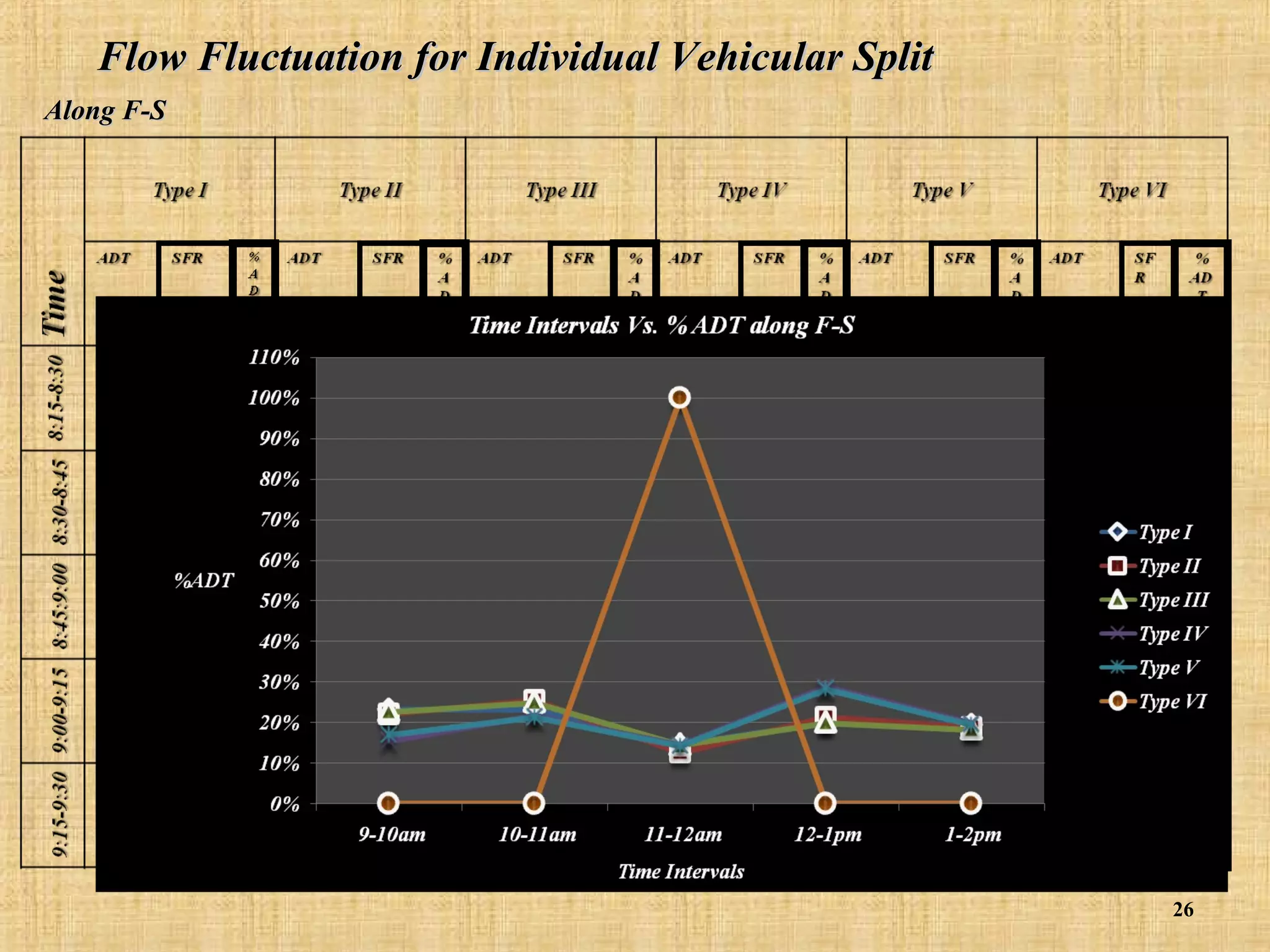
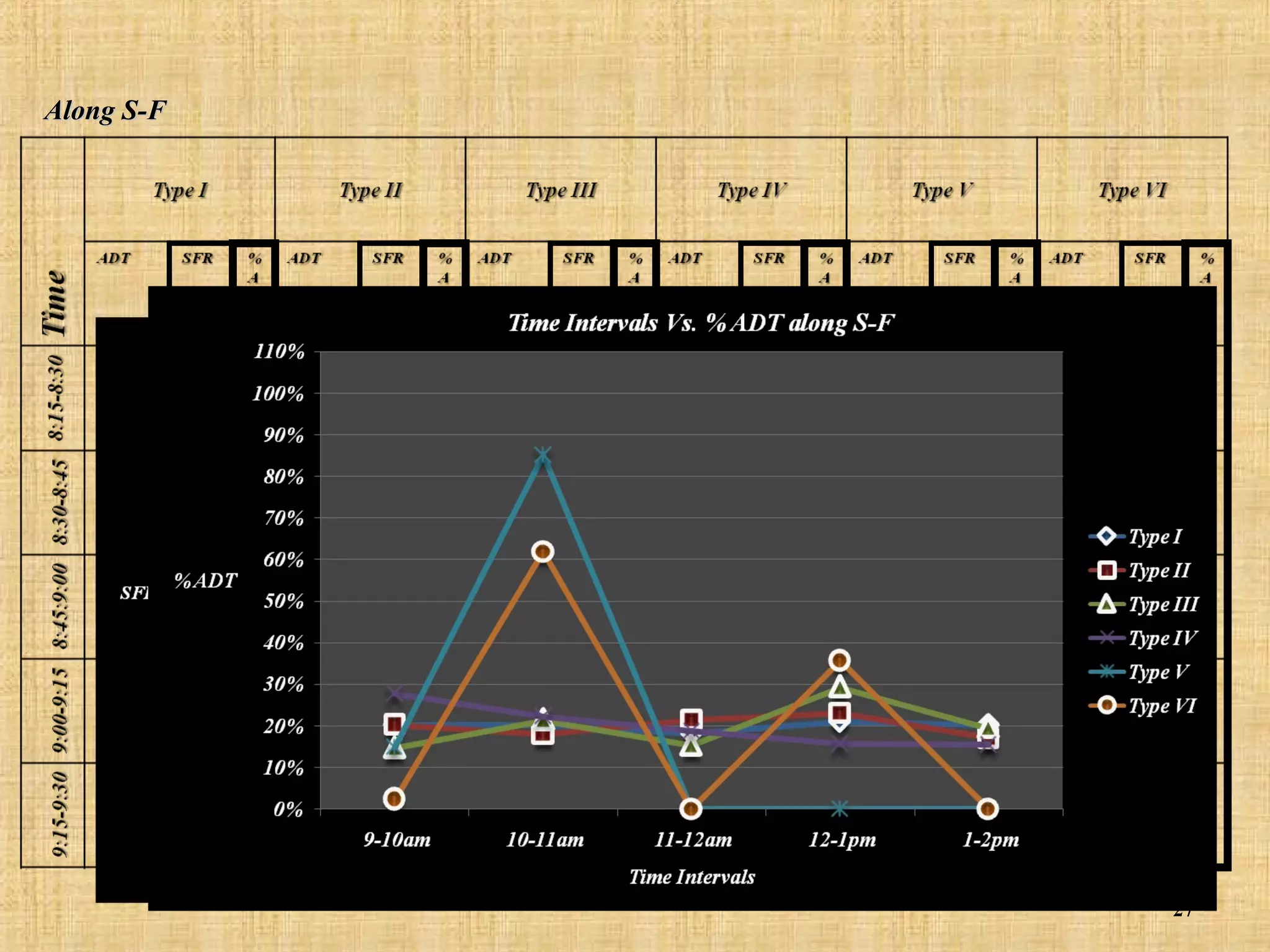
Flow Fluctuation for Individual Vehicular Split
Along F-S

26
Along S-F

27
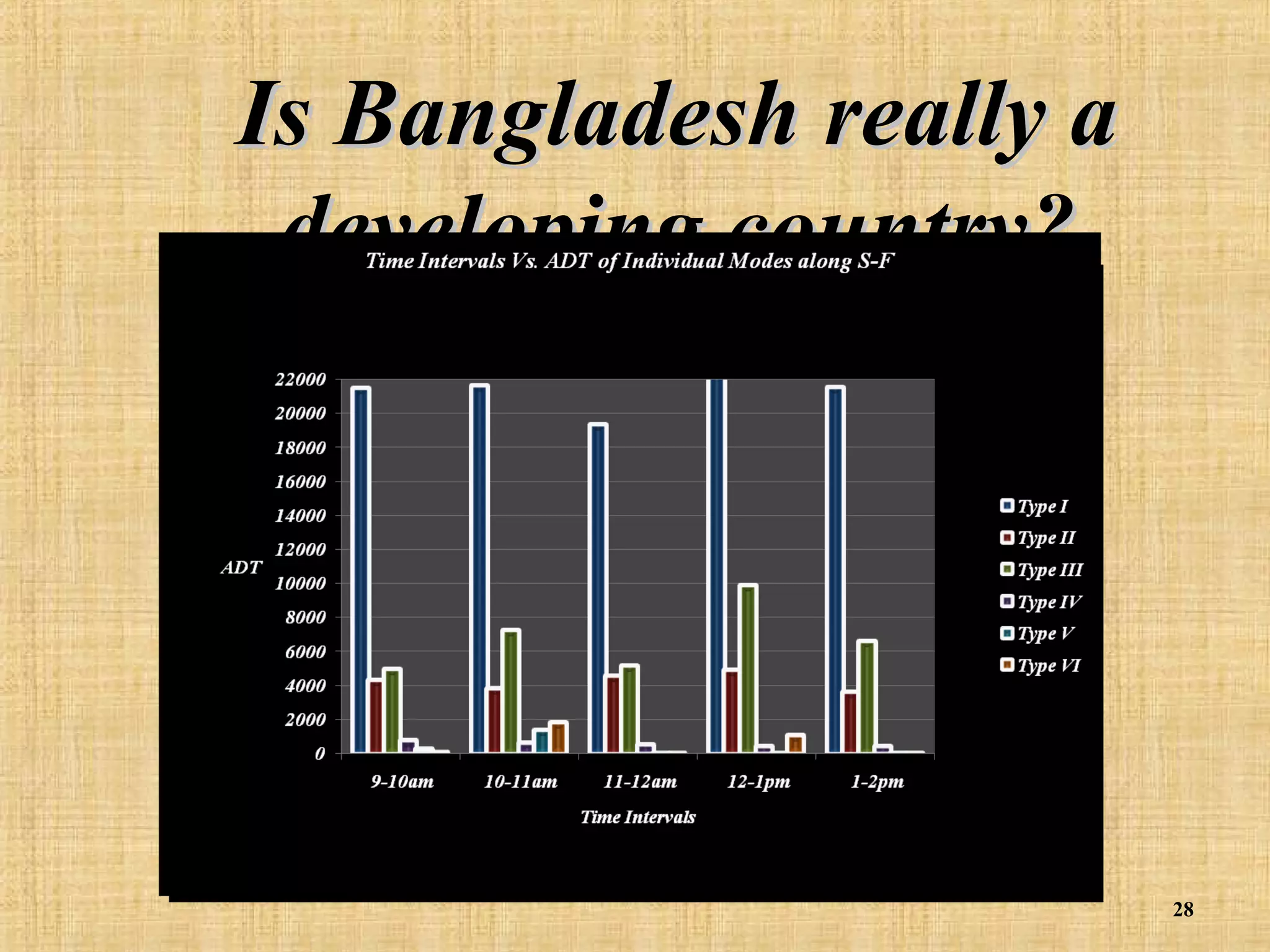
Is Bangladesh really a
developing country?

28
Result Analysis & Discussion
• Result is the most critical part in a survey or
project or data-based research.
• Result decides or gives an overview on
whether the value we have got or collected is
good or insufficient to go further in our
research.
Result Analysis & Discussion(continued)
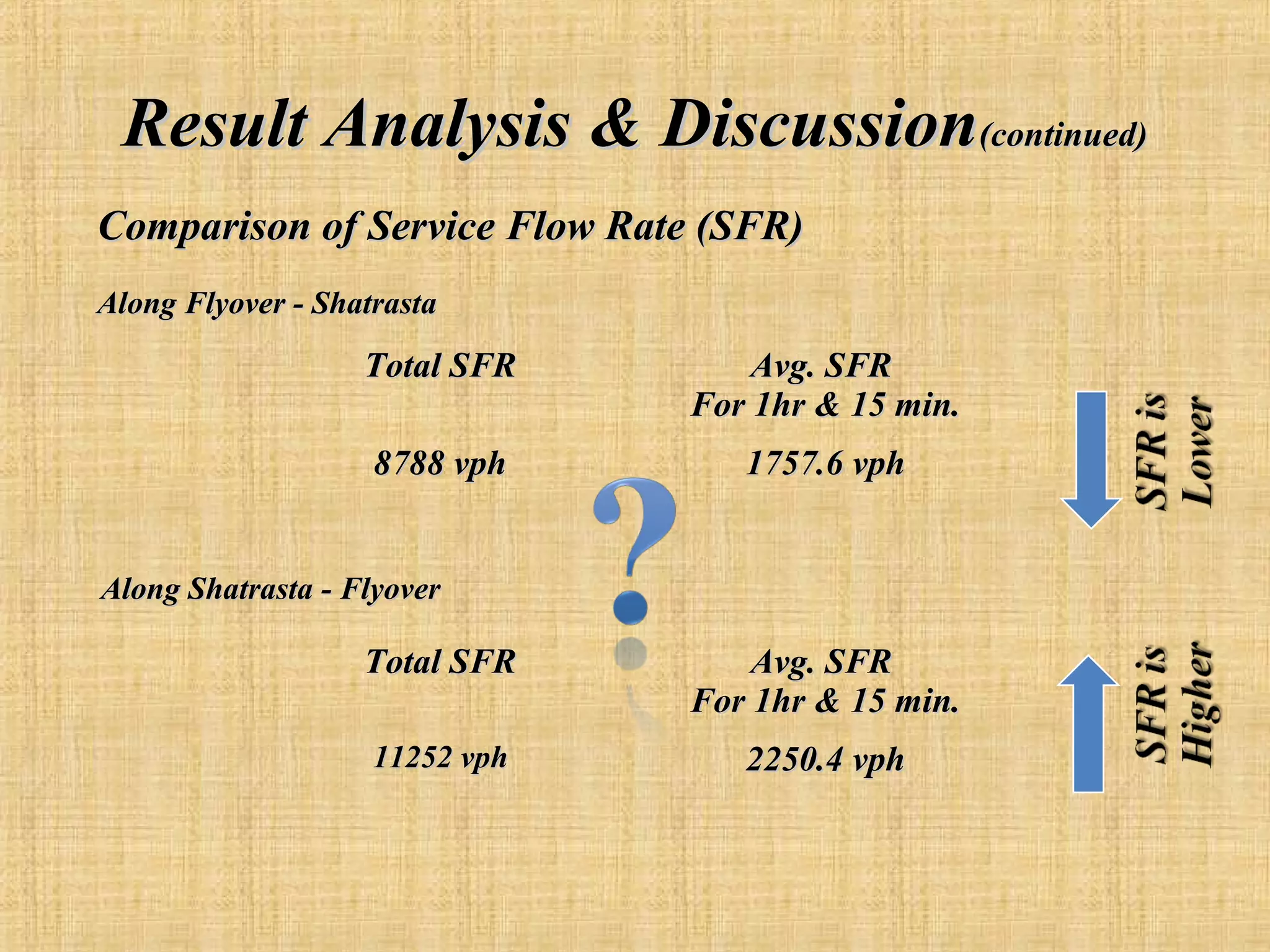
Comparison of Service Flow Rate (SFR)
Along Flyover - Shatrasta

Total SFR

Avg. SFR
For 1hr & 15 min.

8788 vph

1757.6 vph

Along Shatrasta - Flyover

Total SFR

Avg. SFR
For 1hr & 15 min.

11252 vph

2250.4 vph
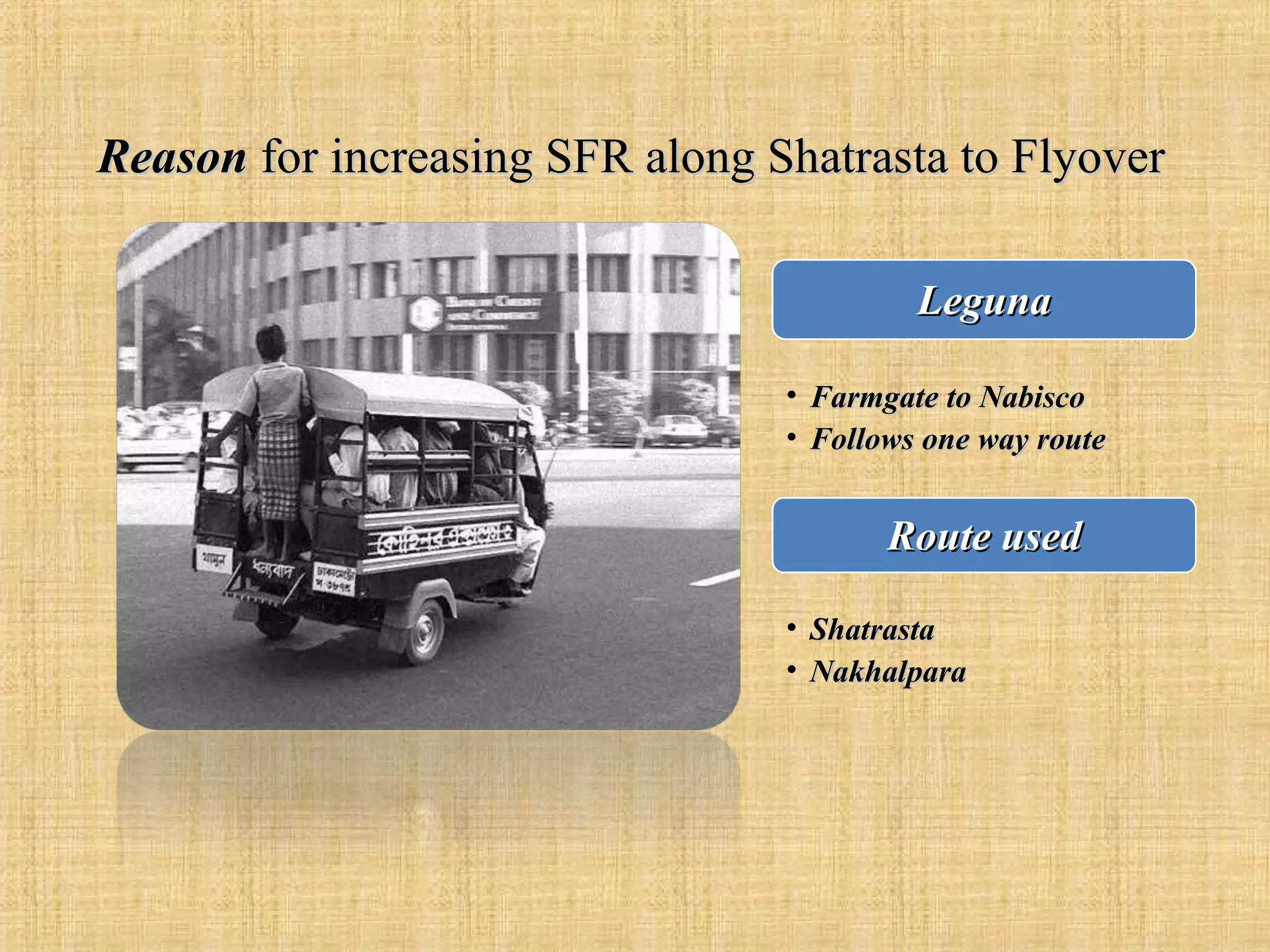
Reason for increasing SFR along Shatrasta to Flyover
Leguna
• Farmgate to Nabisco
• Follows one way route

Route used
• Shatrasta
• Nakhalpara
Reason for increasing SFR along Shatrasta to
Flyover(continued)
Comparison of ADT & % of Vehicle along S-F & F-S
Direction
•In the pie charts of %DD it is
seen that direction S-F has the
greater value.

•In the pie charts for vehicle
composition it is seen that there is
always greater percentage of
private transport(Car, Jeep or
micro) than public transport(bus).
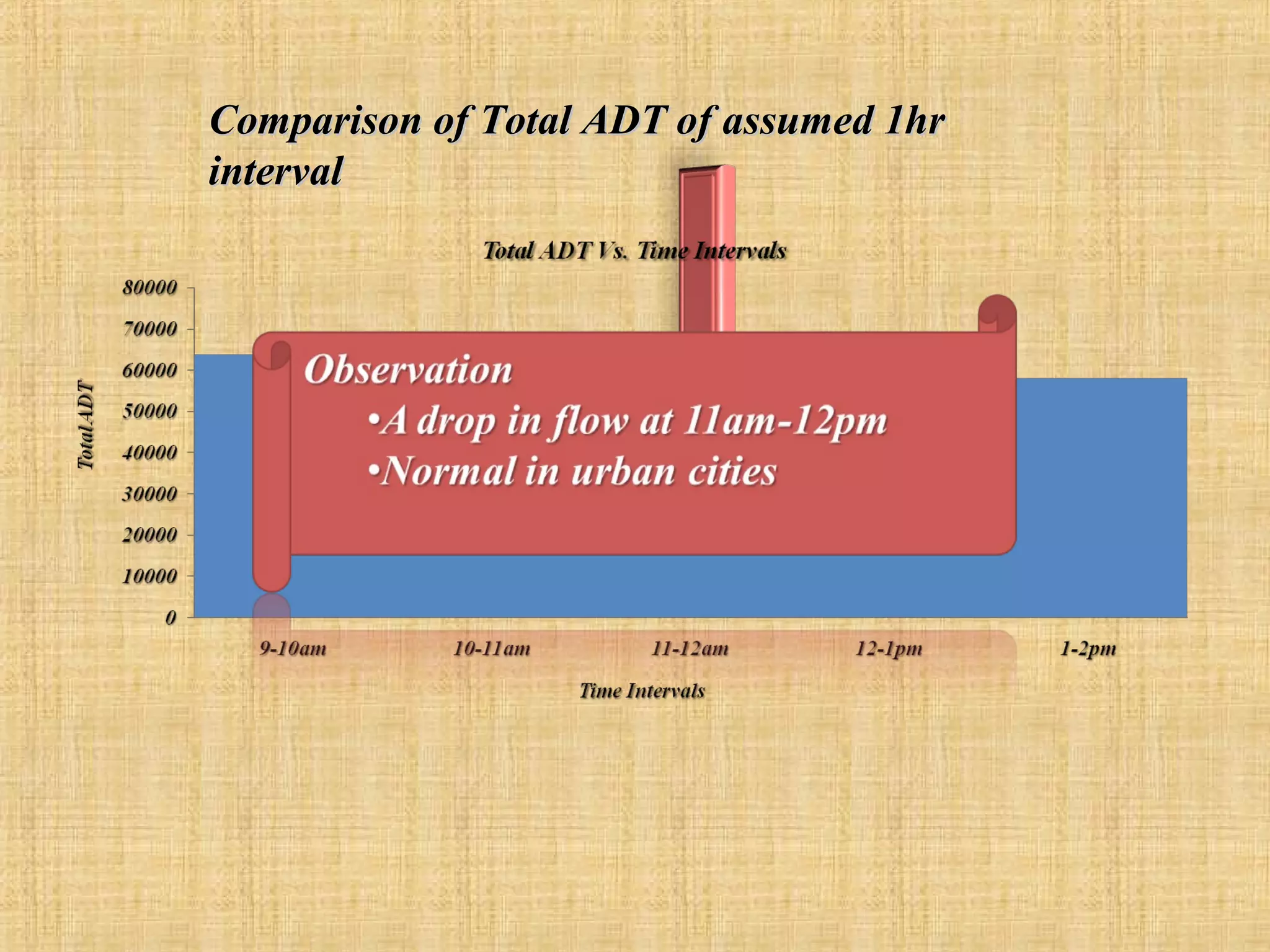
Comparison of Total ADT of assumed 1hr
interval
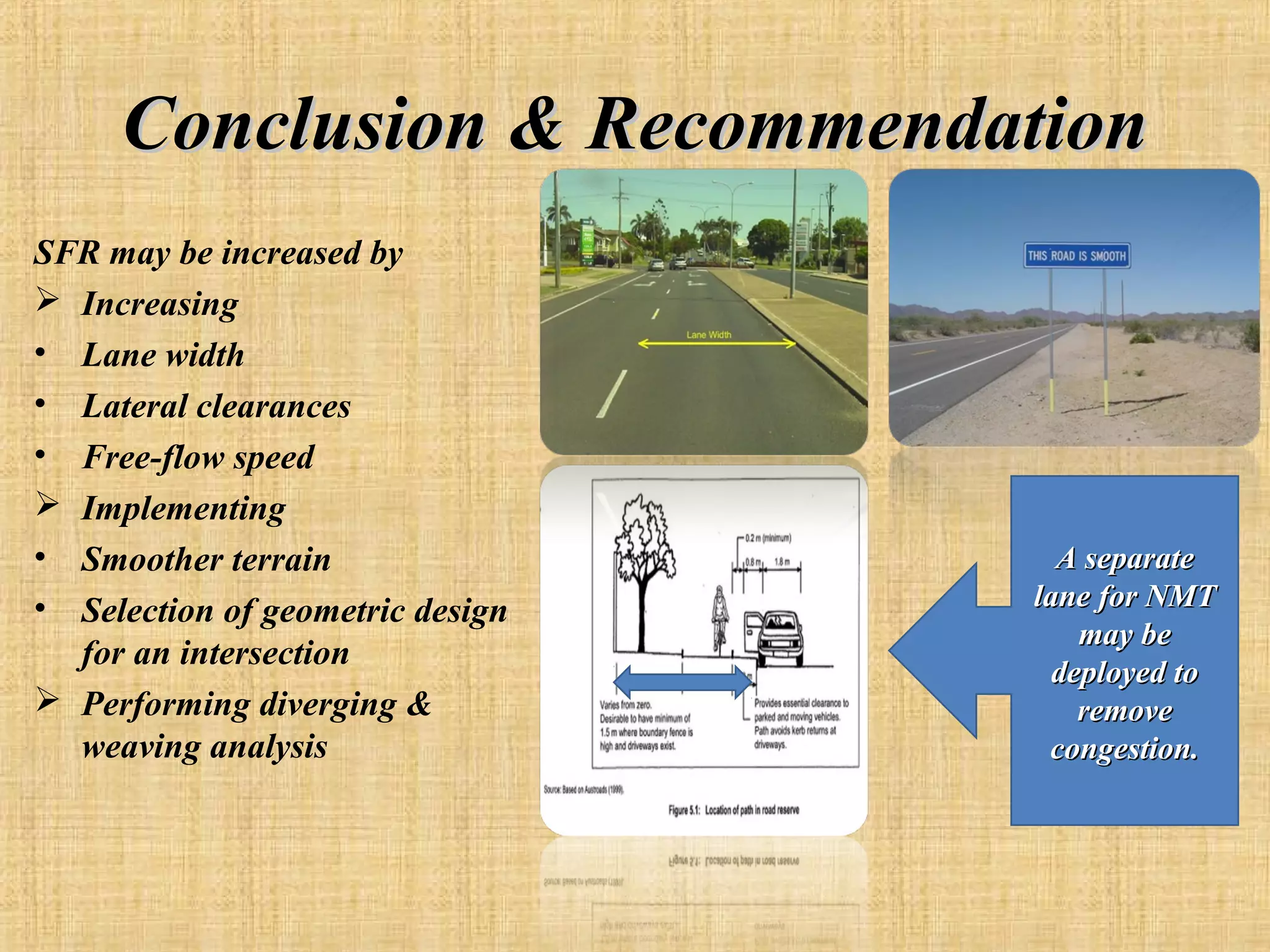
Conclusion & Recommendation
SFR may be increased by
 Increasing
• Lane width
• Lateral clearances
• Free-flow speed
 Implementing
• Smoother terrain
• Selection of geometric design
for an intersection
 Performing diverging &
weaving analysis

A separate
lane for NMT
may be
deployed to
remove
congestion.
Conclusion & Recommendation(continued)
•

Traffic volume counting
should be automatic and most
importantly contactless
method as it is not clumsy.

•

Before final survey
reconnaissance survey or pilot
survey is necessary.

•

Choose a vintage point; if not
possible then select a
reference station.

•

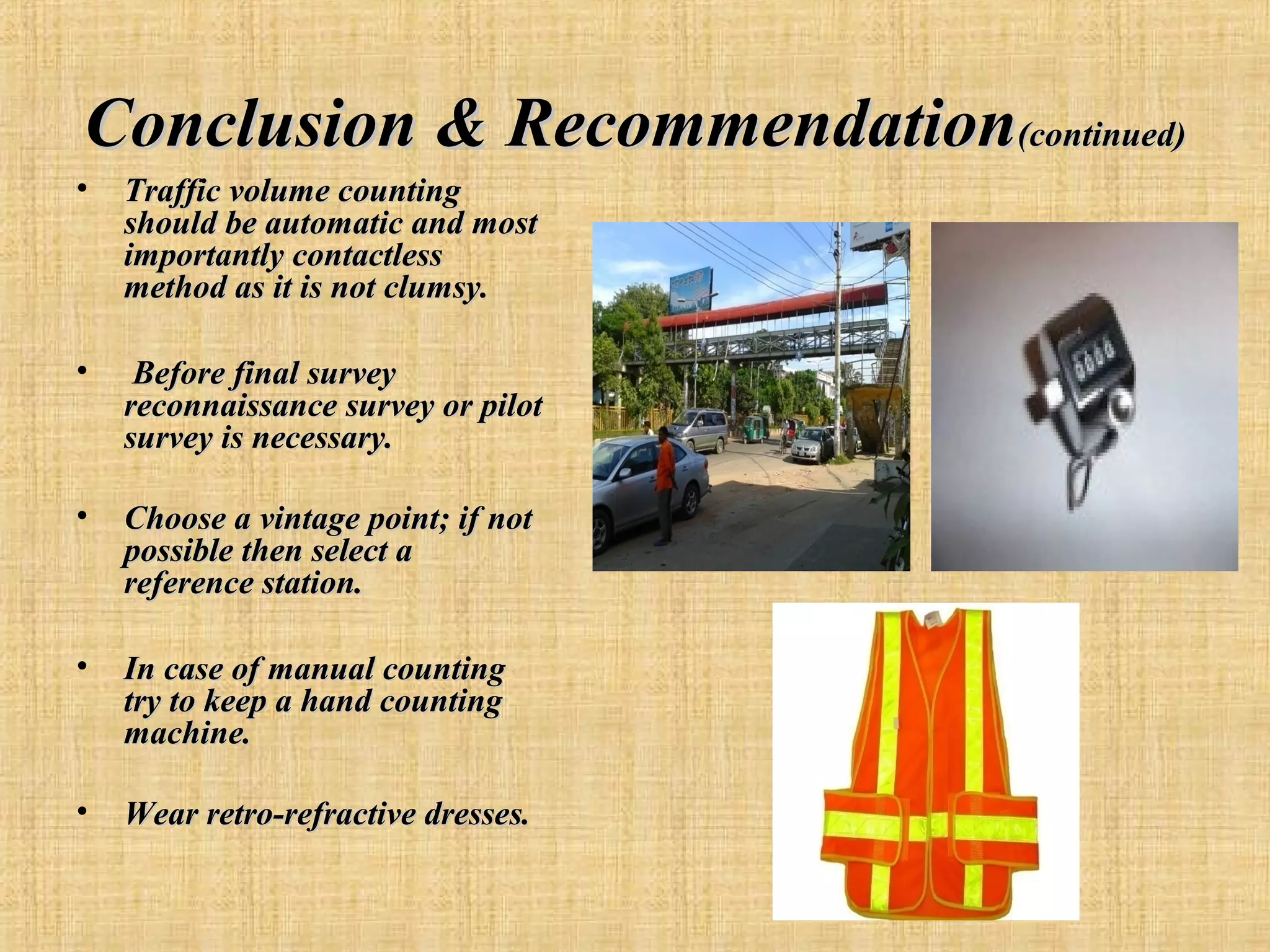
In case of manual counting
try to keep a hand counting
machine.

•

Wear retro-refractive dresses.
Thank you for your attention

ANY QUESTIONS ?

Presentation on Traffic Volume Survey

  • 1.
    Department of Civil Engineering AHSANULLAHUNIVERSITY OF SCIENCE AND TECHNOLOGY 1
  • 2.
    This Presentation isdone as a requirement of a Sessional Course- CE-452 TRANSPORTATION ENGINEERING SESSIONAL II 2
  • 3.
    To engineer transportmode or traffic system the most important factors are- 1.The available traffic volume and its capacity, 2.The necessary speed of vehicles to provide continuous traffic maneuvers, 3.The different parameters that controls and effects roadway conditions. So basic study area should be comprised of as follows :- 3
  • 4.
    In this case,our study subject is ---------- Traffic Volume Study 4
  • 5.
    This will bepresented by- GROUP NO.07 Name Student ID Muhib Muazzam Bakhtiar Omar Omi Yeasin Talukder Md. Firoz Mahmood Ovi Shaibal Ahmed 09.02.03.044 09.02.03.045 09.02.03.046 09.02.03.047 09.02.03.049 5
  • 6.
    Let’s have abackground check on the condition of vehicles in Capital of Bangladesh Dhaka City--General Information Area 815.85 sq. km (approx) Population 7 million (approx.) Temperature Summer: max 36.7°C & min 21.1°c Winter : max 31.7°C & min 10.5°c Rainfall 2540 mm annually. Humidity 80 percent (approx.) Transport Sectors &Vehicle distribution of Dhaka City is as follows- 6
  • 7.
    Income-wise use ofdifferent Transports High Income Group (HIG) Car, Taxi Service, Micro Bus and other private vehicles. Medium Income Rickshaw, Auto Rickshaw, Group (MIG) Bicycle, Motor Cycle, Carriage, Car, Bus, Minibus Low Income Group (LIG) HIG GD LIG Bus and Tempo Good Delivery (GD) MIG Pick up, Van, Human Driven Van Relative Vehicular Distribution in Dhaka City 7
  • 8.
    1. 2. 3. 4. 5. Objective To determine ofvehicle composition in traffic stream. To determine of service flow rate in PCU/PCE unit. To estimate of ADT based on expansion factors. To determine directional distribution(DD). To draw flow fluctuation curves. Scope of The Test Magnitudes, classifications and the time and directional split of vehicular flows; Proportions of vehicles in traffic stream; Hourly, daily, yearly and seasonal variation of vehicular flows; Flow fluctuation on different approaches at a junction or different parts of a road network system. 8
  • 9.
    To define TrafficVolume study various parameters need to be introducedTotal number of vehicles that pass over a given point or section of a lane or roadway during a Vehicle/Flow given time interval •The equivalent hourly rate at which vehicles passing over Rate of Flow •Time interval less than 1hr. Usually 15 min Service Flow Rate •The maximum hourly rate of a roadway section •Time interval any given period under prevailing roadway condition Average Daily traffic (ADT) Represent a 24-hour count at any specified location Annual Average Daily Traffic (AADT) Represent the average 24-hour traffic volume at a given location averaged over a full 365-day year There are 3 expansion factors. They areExpansion Factors Hourly Expansion Factors (HEF ) ; Daily Expansion Factors (DEF ) ; Monthly Expansion Factors (MEF ). 9
  • 10.
    Capacity : Capacity isdefined as the maximum number of vehicles, passengers, or the like, per unit time, which can be accommodated under given conditions with a reasonable expectation of occurrence. Capacity is independent of the demand. It speaks about the physical amount of vehicles and passengers a road can afford. Level Of Service: A term closely related to capacity and often confused with it is service volume. When capacity gives a quantitative measure of trac, level of service or LOS tries to give a qualitative measure. A service volume is the maximum number of vehicles, passengers, or the like, which can be accommodated by a given facility or system under given conditions at a given level of service. 10
  • 11.
  • 12.
    Study Location Study Zone: Tejgaon; Industrial Area Population : 2,20,012 Area : 8.75 km² Household: 37,644 Study Road : SHAHEED TAJUDDIN AHMED AVENUE Length : 0.560 km Lanes : 3 lanes both direction; each 13 ft approximately Width : 42 ft at intersection of SAATH RASTA 44 ft at intersection of FLYOVER 12
  • 13.
  • 14.
    Before proceed tovehicle counting it is customary to do• Pilot Survey, •Reconnaissance Surveys. From our Reconnaissance Surveys we found that• At Saath Rasta intersection there was a construction going on for a fly over . • Most of the buildings are there educational & official. • Around the metal sculpture there are about 7 manholes & about 15 potholes. • At median there are 6 median openings including both ends. • At footpath there is more than enough manholes. • Along flyover to saath rasta ther is 5 and along saath rasta to flyover there is 4 local roads. • Along saath rasta to flyover there is 2 gas station and 1 filing station • On street parking is common in both direction. •At Saath Rasta vehicles are actuated manually by TRAFFIC POLICE. • Although a signal actuated intersection, Fly Over intersection is manually controlled. 14
  • 15.
    Conditions & Specifications Location:Shatrasta to flyover Station: In front of BG Press Date: 20th June 2013(Thursday) Time: Time of data collection 8:30 am to 8:45 am Weather Condition: Sunny Observation: Classified Vehicle Counts Method: Direct Manual Method Duration: 15 minutes(Short Count) Equipment: Stop watch, Pencils, Eraser, Tally sheet(Field Data Sheet), Clip board Number of Enumerators: Five 15
  • 16.
    • Before theday of counting we had gone to our location for a reconnaissance survey and locate necessary reference buildings. • On the promised day, we reached our station and observed the various vehicles that went by and distributed specified vehicles among our 5 Enumerators to count them for 15 minutes Procedure of Works • We use tally to lessens our clumsiness and error of counting. • After 15 minutes we counted the total vehicles of each types. • Finally we prepared a field observation data sheet and filled the necessary data. 16
  • 17.
  • 18.
    Problems in counting X Positionof Enumerators Y Saatrasta To Flyover X Y
  • 19.
    Problems in counting(Continued) X Positionof Enumerators Y Saatrasta To Flyover X Y
  • 20.
    Steps of DataCollection & Synchronization: Step 1 : Count the vehicle by means of manual method in this tally sheet method. Step 2 : Collect & Divide it in various types of vehicles. Step 3 : Record values obtained in field survey book or any notebook. Step 4 : Calculate different parameters that is related to volume studies. Step 5 : Input the collected or calculated values according to suitable time intervals. Step 6 : Check if necessary requirements are fulfilled by data archive & results. Formulae: SRF=Total Counted Vehicle Manually or Automatically in an Interval*4 TV=Total Converted Vehicles or PCU*4 HEF=17.11 TDV=TV*HEF DEF=7.012 TWV=TDV*DEF ADT=TWV/7 AEF=1.395 AADT= ADT*AEF. Percentage of any value = 20
  • 21.
    Arbitrary Specifications AndAbbreviations: F-S = Flyover to Saath Rasta. S-F = Saath Rasta to Fly Over. PCE = Passenger Car Equivalent : A Passenger Car Equivalent is essentially the impact that a mode of transport has on traffic variables (such as headway, speed, density) compared to a single car. PCU = Passenger Car Unit. Time Intervals Used Time Intervals for Flow SFR = Service Flow Rate. Fuctuation TV = Total Volume. 9:00-10:00AM TDV = Total 24 Hour or Daily Volume. 8:15-8:30AM TWV = Total 7-Days or Weekly Volume. 10:00-11:00AM 8:30-8:45AM ADT = Average Daily Volume. AADT = Annual Average Daily Volume 11:00-12:00AM 8:45:9:00AM DD = Directional Distribution. 12:00-1:00AM TAF = Total Annual Flow. 9:00-9:15AM SD = Standard Deviation. 1:00-2:00AM VPH = Vehicle Per Hour or veh/hr. 9:15-9:30AM VPD = Vehicle Per Day or veh/day. RHD = Roads and Highway Department. AASHTO = American Association of State Highway And Transportation Officials. TYPE I = Car, Jeep, Micro, Taxi. TYPE II = 3-wheeler. TYPE III = Bus. TYPE IV = Motorcycle. TYPE V = NMT = Non-Mechanized Transport. TYPE VI = Utility & others 21
  • 22.
    Data Synchronization forFlow Fluctuation For Traffic Along Fly Over to Sath Rasta Between 8:30-8:45AM TCV for Type I vehicle is 262 whose PCE=1 PCU = 262*1 = 262 Between 8:30-8:45AM TCV = 511; So, SFR = TCV*4 = 2044. PCU = 475; So, TV = PCU*4 = 1900. TDV = TV*HEF =1900* 17.11= 32509. TWV = TDV*DEF = 32509*7.012 = 227953. ADT = TWV/7 = 227953/7 = 325695. AADT = ADT*1.395 = 25695*1.395 = 45427.8. 22
  • 23.
    For Traffic AlongSath Rasta to Fly Over 23
  • 24.
    Directional Distribution For TotalVehicular Split % By 137787 % By SFR Along F-SDirection total ADT = TV Direction Along S-F Direction total45 = 168274 44 ADT F-S % ADT along F-S = 137787/(137787+168274) = 45% S-F 55 56 % ADT along S-F = 168274/(137787+168274) = 55% % By ADT 45 55 For Individual Vehicular Split 24
  • 25.
    Total Vehicular DistributionOn the Study Location Type I Type II Type III Type IV Type V Type VI F-S 1136 500 181 278 98 4 S-F 1550 615 164 395 47 42 total 2686 1115 345 673 145 46 5010 % Vehicle 54% 22% 7% 13% 3% 1% 100% PCE 1 0.5 3 0.1 0.5 1 Sum of Counted %PCU Vehicles 60% PCU 2686 557.5 1035 67.3 72.5 46 4464.3 12% 23% 2% 2% 1% 100% 25
  • 26.
    Flow Fluctuation forIndividual Vehicular Split Along F-S 26
  • 27.
  • 28.
    Is Bangladesh reallya developing country? 28
  • 29.
    Result Analysis &Discussion • Result is the most critical part in a survey or project or data-based research. • Result decides or gives an overview on whether the value we have got or collected is good or insufficient to go further in our research.
  • 30.
    Result Analysis &Discussion(continued) Comparison of Service Flow Rate (SFR) Along Flyover - Shatrasta Total SFR Avg. SFR For 1hr & 15 min. 8788 vph 1757.6 vph Along Shatrasta - Flyover Total SFR Avg. SFR For 1hr & 15 min. 11252 vph 2250.4 vph
  • 31.
    Reason for increasingSFR along Shatrasta to Flyover Leguna • Farmgate to Nabisco • Follows one way route Route used • Shatrasta • Nakhalpara
  • 32.
    Reason for increasingSFR along Shatrasta to Flyover(continued)
  • 33.
    Comparison of ADT& % of Vehicle along S-F & F-S Direction •In the pie charts of %DD it is seen that direction S-F has the greater value. •In the pie charts for vehicle composition it is seen that there is always greater percentage of private transport(Car, Jeep or micro) than public transport(bus).
  • 34.
    Comparison of TotalADT of assumed 1hr interval
  • 35.
    Conclusion & Recommendation SFRmay be increased by  Increasing • Lane width • Lateral clearances • Free-flow speed  Implementing • Smoother terrain • Selection of geometric design for an intersection  Performing diverging & weaving analysis A separate lane for NMT may be deployed to remove congestion.
  • 36.
    Conclusion & Recommendation(continued) • Trafficvolume counting should be automatic and most importantly contactless method as it is not clumsy. • Before final survey reconnaissance survey or pilot survey is necessary. • Choose a vintage point; if not possible then select a reference station. • In case of manual counting try to keep a hand counting machine. • Wear retro-refractive dresses.
  • 37.
    Thank you foryour attention ANY QUESTIONS ?

Editor's Notes

  • #2 Aaaaabdffgfhg……………….