PRESENTED BY
AGLAIA
ACCIDENT STUDY
Introduction
▪ The problem of accident is a very acute in highway transportation
due to complex flow pattern of vehicular traffic, presence of mixed
traffic along with pedestrians.
▪ The traffic engineers have to undertake a big responsibility of
providing safe traffic movements to the road users and ensure their
safety.
▪ Road accidents cannot be totally prevented but by suitable traffic
engineering and management the accident rate can be reduced to a
certain extent.
▪ For this reason systematic study of traffic accidents are required to
be carried out.
▪ Proper investigation of the cause of accident will help to propose
preventive measures in terms of design and control.
Objectives of accident studies
▪ To study the causes of accidents and suggest corrective measures
at potential location
▪ To evaluate existing design
▪ To compute the financial losses incurred
▪ To support the proposed design and provide economic justification
to the improvement suggested by the traffic engineer
▪ To carry out before and after studies and to demonstrate the
improvement in the problem
Causes of road accidents
▪ Road Users - Excessive speed and rash driving, violation of
traffic rules, failure to perceive traffic situation or sign or signal
in adequate time, carelessness, fatigue, alcohol, sleep etc.
▪ Vehicle - Defects such as failure of brakes, steering system,
tyre burst, lighting system .
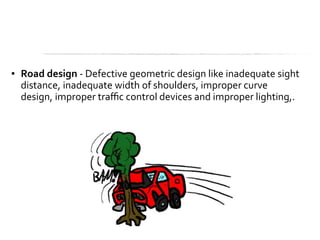
▪ Road design - Defective geometric design like inadequate sight
distance, inadequate width of shoulders, improper curve
design, improper traffic control devices and improper lighting,.
▪ Environmental factors -unfavorable weather conditions like
mist, snow, smoke and heavy rainfall which restrict normal
visibility and and makes driving unsafe.
▪ Road Condition - Skidding road surface, pot holes,
ruts.
▪ Other causes -improper location of advertisement boards,
gate of level crossing not closed when required etc..
Accident Analysis
1. Accident data collection
▪ The accident data collection is the first step in the accident study.
▪ The data collection of the accidents is primarily done by the
police.
▪ Motorist accident reports are secondary data which are filed by
motorists themselves.
▪ The data to be collected should comprise all of these
parameters:
1. General - Date, time, person involved in accident, classification
of accident like fatal, serious, minor
2. Location - Description and detail of location of accident
3.Details of vehicle involved - Registration number, description of
vehicle, loading detail, vehicular defects
4. Nature of accident - Details of collision, damages, injury and
casualty
5. Road and traffic condition - Details of road geometry, surface
characteristics, type of traffic, traffic density etc..
6. Primary causes of accident - Details of various possible cases
(already mentioned) which are the main causes of accident.
7. Accident cost - Financial losses incurred due to property damage,
personal injury and casualty
Used of accident data
▪ Identification of location of points at which unusually high
number of accident occur.
▪ Detailed functional evaluation of critical accident location to
identify the causes of accidents.
▪ Development of procedure that allows identification of
hazards before large number of accidents occurs.
▪ Development of different statistical measures of various
accident related factors to give insight into general trends,
common casual factors, driver profiles, etc.
Accident investigation
The accident data collection involves extensive investigation which involves the following
procedure:
1. Reporting: It involves basic data collection in form of two methods:
▪ Motorist accident report - It is filed by the involved motorist involved in all accidents fatal
or injurious.
▪ Police accident report - It is filed by the attendant police officer for all accidents at which
an officer is present.
▪ This generally includes fatal accidents or mostly accidents involving serious injury
required emergency or hospital treatment or which have incurred heavy property
damage.
2. At Scene-Investigation: It involves obtaining information at scene
such as measurement of skid marks, examination of damage of
vehicles, photograph of final position of vehicles, examination of
condition and functioning of traffic control devices and other road
equipments.
3.Technical Preparation: This data collection step is needed for
organization and interpretation of the study made. In this step
measurement of grades, sight distance, preparing drawing of after
accident situation, determination of critical and design speed for
curves is done.
4. Professional Reconstruction: In this step effort is made to determine
from whatever data is available how the accident occurs from the
available data.This involves accident reconstruction which has been
discussed under Section No.7 in details. It is professionally referred as
determining behavioral or mediate causes of accident.
5. Cause Analysis: It is the effort made to determine why the accident
occurred from the data available and the analysis of accident
reconstruction studies..
Accident data analysis
▪ The purpose is to find the possible causes of accident related to
driver, vehicle, and roadway.
Accident analyses are made to develop information such as:
▪ Driver and Pedestrian - Accident occurrence by age groups and
relationships of accidents to physical capacities and to
psychological test results.
▪ Vehicle - Accident occurrence related to characteristic of
vehicle, severity, location and extent of damage related to
vehicles.
▪ Roadway conditions - Relationships of accident occurrence and
severity to characteristics of the roadway and roadway
condition and relative values of changes related to roadways.
Safety measures
▪ The ultimate goal is to develop certain improvement measures to mitigate
the circumstances leading to the accidents.
▪ The measures to decrease the accident rates are generally divided into three
groups engineering, enforcement and education.
The various measures of engineering that may be useful to prevent accidents are
enumerated below
 Visual guidance to driver
▪ There is consecutive change of picture in drivers mind while he is in motion.
▪ The number of factors that the driver can distinguish and clearly fix in his
mind is limited.
▪ On an average the perception time for vision is 1/16th, for hearing is 1/20th
and for muscular reaction is 1/20th.
▪ The number of factors that can be taken into account by organs of sense of a
driver in one second is given by the formula below.
E = MV/L (42.21)
▪ where, M = No. of factors that can be taken into account by the organ
of sense of driver for L m long,V = speed of vehicle in m/sec.
Factors affecting drivers attention when he is on road;
▪ 1. Factors relating to the road elements of road that directly affect the
driving of a vehicle are traffic signs, changes in direction of road, three
legged intersection and various other things.
▪ 2. Factors connected with traffic Other vehicles, cycles, pedestrians.
▪ 3. Factors related indirectly to the vehicle motion Building and
structures that strike the eye, vegetation, landscape, etc.
using the laws of visual perception certain measures have been
suggested:
▪ Contrast in visibility of the road should be achieved by provision of
elements that differ from its surrounding by colors, pattern such as
shoulder strips, shoulder covered with grass, edge markings.
▪ Providing road side vegetation is an effective means.
▪ The visibility of crown of trees from a distant location is also very
useful in visual guiding.
▪ The provision of guard rails of different contrasting colors also
takes drivers attention and prevent from monotonous driving.
Other methods
Various other methods of traffic accident mitigation are described
below:
▪ Street lighting: Street lightning of appropriate standard
contributes to safety in urban area during night time due to poor
visibility.
▪ Installation of good lighting results in 21% reduction in all
accidents, 29% reduction in “all casualty” accidents, 21%
reduction in “non pedestrian casualty” accidents, and 57%
reduction in “pedestrian casualty” accidents.
▪ Improvement in skid resistance If road is very smooth then
skidding of the vehicles may occur or if the pavement is wet then
wet weather crashes occur which account about 20-30%.Thus it is
important to improve the skid resistance of the road.Various
ways of increasing the skid resistance of road are by constructing
high-friction overlay or cutting of grooves into the pavement.
▪ Road markings Road markings ensure proper guidance and
control to the traffic on a highway.They serve as supplementary
function of road sign.They serve as psychological barrier and
delineation of traffic path and its lateral clearance from traffic
hazards for the safe movement of traffic.Thus their purpose is to
provide smooth and safe traffic flow.
▪ Guide posts with or without reflectorThey are provided at the edge of
the roadway to prevent the vehicles from being off tracked from the
roadway.Their provision is very essential in hilly road to prevent the
vehicle from sliding from top. Guide posts with reflector guide the
movement of vehicle during night.
▪ Guard rail Guard rail have similar function as of guide post. On high
embankments, hilly roads, road running parallel to the bank of river,
shores of lake, near rock protrusion, trees, bridge, abutments a
collision with which is a great hazard for a vehicle. It is required to
retain the vehicle on the roadway which has accidentally left the road
because of fault or improper operation on the part of the driver.
Driver who has lost control create a major problem which can be
curbed by this measure.
▪ Driver reviver stop Driver reviver stop are generally in use in countries
like U.S.A where driver can stop and refresh himself with food,
recreation and rest.They play a very important part in traffic safety as
they relieve the driver from the mental tension of constant driving.
These stops are required to be provided after every 2 hour travel time.
▪ Constructing flyovers and bypass In areas where local traffic is high
bypasses are required to separate through traffic from local traffic to
decrease the accident rate.To minimize conflicts at major
intersections flyovers are required for better safety and less accident
rate
▪ Regular accident studies Based on the previous records of accidents
the preventive measures are taken and after that the data related to
accidents are again collected to check the efficiency of the measures
and for future implementation of further preventive measures.
Safety measures related to
enforcement
▪ The various measures of enforcement that may be useful to prevent
accidents at spots prone to accidents are enumerated below.These rules are
revised from time to time to make them more comprehensive.
▪ Speed control
▪ Checks on spot speed of all vehicles should be done at different locations and
timings and legal actions on those who violate the speed limit should be
taken
▪ Training and supervision
▪ The transport authorities should be strict while issuing licence to drivers of
public service vehicles and taxis. Driving license of the driver may be renewed
after specified period, only after conducting some tests to check whether the
driver is fit
▪ Medical check
▪ The drivers should be tested for vision and reaction time at prescribed
intervals of time
Safety measures related to
education
▪ The various measures of education that may be useful to prevent
accidents are enumerated below.
▪ Education of road users
▪ The passengers and pedestrians should be taught the rules of the
road, correct manner of crossing etc. by introducing necessary
instruction in the schools for the children and by the help of posters
exhibiting the serious results due to carelessness of road users.
▪ Safety drive
▪ Imposing traffic safety week when the road users are properly
directed by the help of traffic police as a means of training the public.
Training courses and workshops should be organized for drivers in
different parts of the country.
Thank you
For more…. Mail to aglaiaconnect2018@gmail.com

Accident study

  • 1.
  • 2.
    Introduction ▪ The problemof accident is a very acute in highway transportation due to complex flow pattern of vehicular traffic, presence of mixed traffic along with pedestrians. ▪ The traffic engineers have to undertake a big responsibility of providing safe traffic movements to the road users and ensure their safety. ▪ Road accidents cannot be totally prevented but by suitable traffic engineering and management the accident rate can be reduced to a certain extent. ▪ For this reason systematic study of traffic accidents are required to be carried out. ▪ Proper investigation of the cause of accident will help to propose preventive measures in terms of design and control.
  • 3.
    Objectives of accidentstudies ▪ To study the causes of accidents and suggest corrective measures at potential location ▪ To evaluate existing design ▪ To compute the financial losses incurred ▪ To support the proposed design and provide economic justification to the improvement suggested by the traffic engineer ▪ To carry out before and after studies and to demonstrate the improvement in the problem
  • 4.
    Causes of roadaccidents ▪ Road Users - Excessive speed and rash driving, violation of traffic rules, failure to perceive traffic situation or sign or signal in adequate time, carelessness, fatigue, alcohol, sleep etc.
  • 5.
    ▪ Vehicle -Defects such as failure of brakes, steering system, tyre burst, lighting system .
  • 6.
    ▪ Road design- Defective geometric design like inadequate sight distance, inadequate width of shoulders, improper curve design, improper traffic control devices and improper lighting,.
  • 7.
    ▪ Environmental factors-unfavorable weather conditions like mist, snow, smoke and heavy rainfall which restrict normal visibility and and makes driving unsafe.
  • 8.
    ▪ Road Condition- Skidding road surface, pot holes, ruts.
  • 9.
    ▪ Other causes-improper location of advertisement boards, gate of level crossing not closed when required etc..
  • 10.
    Accident Analysis 1. Accidentdata collection ▪ The accident data collection is the first step in the accident study. ▪ The data collection of the accidents is primarily done by the police. ▪ Motorist accident reports are secondary data which are filed by motorists themselves. ▪ The data to be collected should comprise all of these parameters: 1. General - Date, time, person involved in accident, classification of accident like fatal, serious, minor 2. Location - Description and detail of location of accident
  • 11.
    3.Details of vehicleinvolved - Registration number, description of vehicle, loading detail, vehicular defects 4. Nature of accident - Details of collision, damages, injury and casualty 5. Road and traffic condition - Details of road geometry, surface characteristics, type of traffic, traffic density etc.. 6. Primary causes of accident - Details of various possible cases (already mentioned) which are the main causes of accident. 7. Accident cost - Financial losses incurred due to property damage, personal injury and casualty
  • 12.
    Used of accidentdata ▪ Identification of location of points at which unusually high number of accident occur. ▪ Detailed functional evaluation of critical accident location to identify the causes of accidents. ▪ Development of procedure that allows identification of hazards before large number of accidents occurs. ▪ Development of different statistical measures of various accident related factors to give insight into general trends, common casual factors, driver profiles, etc.
  • 13.
    Accident investigation The accidentdata collection involves extensive investigation which involves the following procedure: 1. Reporting: It involves basic data collection in form of two methods: ▪ Motorist accident report - It is filed by the involved motorist involved in all accidents fatal or injurious. ▪ Police accident report - It is filed by the attendant police officer for all accidents at which an officer is present. ▪ This generally includes fatal accidents or mostly accidents involving serious injury required emergency or hospital treatment or which have incurred heavy property damage.
  • 14.
    2. At Scene-Investigation:It involves obtaining information at scene such as measurement of skid marks, examination of damage of vehicles, photograph of final position of vehicles, examination of condition and functioning of traffic control devices and other road equipments. 3.Technical Preparation: This data collection step is needed for organization and interpretation of the study made. In this step measurement of grades, sight distance, preparing drawing of after accident situation, determination of critical and design speed for curves is done. 4. Professional Reconstruction: In this step effort is made to determine from whatever data is available how the accident occurs from the available data.This involves accident reconstruction which has been discussed under Section No.7 in details. It is professionally referred as determining behavioral or mediate causes of accident. 5. Cause Analysis: It is the effort made to determine why the accident occurred from the data available and the analysis of accident reconstruction studies..
  • 15.
    Accident data analysis ▪The purpose is to find the possible causes of accident related to driver, vehicle, and roadway. Accident analyses are made to develop information such as: ▪ Driver and Pedestrian - Accident occurrence by age groups and relationships of accidents to physical capacities and to psychological test results. ▪ Vehicle - Accident occurrence related to characteristic of vehicle, severity, location and extent of damage related to vehicles. ▪ Roadway conditions - Relationships of accident occurrence and severity to characteristics of the roadway and roadway condition and relative values of changes related to roadways.
  • 16.
    Safety measures ▪ Theultimate goal is to develop certain improvement measures to mitigate the circumstances leading to the accidents. ▪ The measures to decrease the accident rates are generally divided into three groups engineering, enforcement and education. The various measures of engineering that may be useful to prevent accidents are enumerated below  Visual guidance to driver ▪ There is consecutive change of picture in drivers mind while he is in motion. ▪ The number of factors that the driver can distinguish and clearly fix in his mind is limited. ▪ On an average the perception time for vision is 1/16th, for hearing is 1/20th and for muscular reaction is 1/20th. ▪ The number of factors that can be taken into account by organs of sense of a driver in one second is given by the formula below.
  • 17.
    E = MV/L(42.21) ▪ where, M = No. of factors that can be taken into account by the organ of sense of driver for L m long,V = speed of vehicle in m/sec. Factors affecting drivers attention when he is on road; ▪ 1. Factors relating to the road elements of road that directly affect the driving of a vehicle are traffic signs, changes in direction of road, three legged intersection and various other things. ▪ 2. Factors connected with traffic Other vehicles, cycles, pedestrians.
  • 18.
    ▪ 3. Factorsrelated indirectly to the vehicle motion Building and structures that strike the eye, vegetation, landscape, etc. using the laws of visual perception certain measures have been suggested: ▪ Contrast in visibility of the road should be achieved by provision of elements that differ from its surrounding by colors, pattern such as shoulder strips, shoulder covered with grass, edge markings. ▪ Providing road side vegetation is an effective means. ▪ The visibility of crown of trees from a distant location is also very useful in visual guiding. ▪ The provision of guard rails of different contrasting colors also takes drivers attention and prevent from monotonous driving.
  • 19.
    Other methods Various othermethods of traffic accident mitigation are described below: ▪ Street lighting: Street lightning of appropriate standard contributes to safety in urban area during night time due to poor visibility. ▪ Installation of good lighting results in 21% reduction in all accidents, 29% reduction in “all casualty” accidents, 21% reduction in “non pedestrian casualty” accidents, and 57% reduction in “pedestrian casualty” accidents.
  • 20.
    ▪ Improvement inskid resistance If road is very smooth then skidding of the vehicles may occur or if the pavement is wet then wet weather crashes occur which account about 20-30%.Thus it is important to improve the skid resistance of the road.Various ways of increasing the skid resistance of road are by constructing high-friction overlay or cutting of grooves into the pavement. ▪ Road markings Road markings ensure proper guidance and control to the traffic on a highway.They serve as supplementary function of road sign.They serve as psychological barrier and delineation of traffic path and its lateral clearance from traffic hazards for the safe movement of traffic.Thus their purpose is to provide smooth and safe traffic flow.
  • 21.
    ▪ Guide postswith or without reflectorThey are provided at the edge of the roadway to prevent the vehicles from being off tracked from the roadway.Their provision is very essential in hilly road to prevent the vehicle from sliding from top. Guide posts with reflector guide the movement of vehicle during night. ▪ Guard rail Guard rail have similar function as of guide post. On high embankments, hilly roads, road running parallel to the bank of river, shores of lake, near rock protrusion, trees, bridge, abutments a collision with which is a great hazard for a vehicle. It is required to retain the vehicle on the roadway which has accidentally left the road because of fault or improper operation on the part of the driver. Driver who has lost control create a major problem which can be curbed by this measure.
  • 22.
    ▪ Driver reviverstop Driver reviver stop are generally in use in countries like U.S.A where driver can stop and refresh himself with food, recreation and rest.They play a very important part in traffic safety as they relieve the driver from the mental tension of constant driving. These stops are required to be provided after every 2 hour travel time. ▪ Constructing flyovers and bypass In areas where local traffic is high bypasses are required to separate through traffic from local traffic to decrease the accident rate.To minimize conflicts at major intersections flyovers are required for better safety and less accident rate ▪ Regular accident studies Based on the previous records of accidents the preventive measures are taken and after that the data related to accidents are again collected to check the efficiency of the measures and for future implementation of further preventive measures.
  • 23.
    Safety measures relatedto enforcement ▪ The various measures of enforcement that may be useful to prevent accidents at spots prone to accidents are enumerated below.These rules are revised from time to time to make them more comprehensive. ▪ Speed control ▪ Checks on spot speed of all vehicles should be done at different locations and timings and legal actions on those who violate the speed limit should be taken ▪ Training and supervision ▪ The transport authorities should be strict while issuing licence to drivers of public service vehicles and taxis. Driving license of the driver may be renewed after specified period, only after conducting some tests to check whether the driver is fit ▪ Medical check ▪ The drivers should be tested for vision and reaction time at prescribed intervals of time
  • 24.
    Safety measures relatedto education ▪ The various measures of education that may be useful to prevent accidents are enumerated below. ▪ Education of road users ▪ The passengers and pedestrians should be taught the rules of the road, correct manner of crossing etc. by introducing necessary instruction in the schools for the children and by the help of posters exhibiting the serious results due to carelessness of road users. ▪ Safety drive ▪ Imposing traffic safety week when the road users are properly directed by the help of traffic police as a means of training the public. Training courses and workshops should be organized for drivers in different parts of the country.
  • 25.
    Thank you For more….Mail to aglaiaconnect2018@gmail.com