1 
Calibration of Conventional Macroscopic Traffic Flow Models for Nepalese Roads: 
(A Case Study of Jadibuti - Suryabinayak SectionN) 
Hemant Tiwari1, Anil Marsani2 
1 Graduate Student, Department of Transportation Engineering, Central Campus, Pulchowk, IOE 
2 Coordinator, M.Sc. in Transportation Engineering, Department of Civil Engineering, Central Campus, Pulchowk, IOE 
Corresponding Email: hemu.ioe@gmail.com 
Abstract: The importance of understanding the relationship between speed, flow and density is unquestionable, from the perspective of planning, design, traffic operations, and improvement of facilities. This particular research tries to address the necessity of understanding the relationship between traffic flow parameters via calibration of various macroscopic traffic flow models, which will provide quantitative estimates of the change in speed as a function of anticipated changes in traffic demand for Jadibuti - Suryabinayak section. Various conventional macroscopic speed- density models namely Greenshields, Greenberg, Underwood, Drake, Pipes – Munjal, Polynomial and modified Drake and Underwood models, were first calibrated and further validated. Due to significant goodness of fit (R2 value and standard error) and realistic estimates of free flow speed, optimum speed and optimum density for the section under consideration, Conventional Underwood model was recommended as the best fit model. This calibrated model can be used in predicting speed for the anticipated traffic volume, and even helps in quantifying congestion for oversaturated condition. 
Keywords: Macroscopic traffic flow model; PCU; free flow speed; jam density; goodness of fit 
1. Introduction 
Tremendous developments in the transportation system along with increased road network and overdependence on automobiles give rise to the evolution of various traffic flow theories. These theories illustrate traffic stream characteristics which includes behavior of vehicles on road at different circumstances, interaction of road user and roadway environment. Researcher have categorized various traffic flow models under two categories viz. macroscopic and microscopic. Conventional mathematical models that formulate the relationships among the integrated parameter associated with traffic stream i.e. speed, flow and density are termed as macroscopic traffic flow model. Such models convert single entity level characteristics to comparable system level characteristics by integrating microscopic traffic flow model, thus looking the traffic flow from the broader perspective. Greenshield, Greenberg, Underwood, Drake model etc. are some of the examples of macroscopic traffic flow models. Microscopic traffic flow model on the other hand deals with the traffic stream characteristics from microscopic view point which includes headway, clearance etc. via modeling driver-driver and driver- road interactions within a traffic stream. Car following model, Pipe’s model, Forbes’ model are some of the microscopic traffic flow models. 
The importance of understanding the relationship between speed, flow and density is unquestionable from the standpoint of highway planning, design and operation as it provides quantitative estimates of the change in speed as a function of anticipated changes in traffic demand. These traffic flow models have a significant role on prediction of highway capacity, free flow speed and level of service offered by the facilities and to determine the geometric features of road so as to provide the targeted level of service. They are equally useful in real-time traffic control, a basic component of Intelligent Transportation System (ITS) which is based on changes in traffic flow parameters. Calibration and validation of various macroscopic models is the first step towards creating theoretical background for successful planning and design. 
2. Objectives of Study 
Despite being the widely accepted macroscopic traffic flow model, it is not universal that Greenshield model will always be the best fit model. Many countries had calibrated macroscopic models for different parts or even at different segment of roads, but our country lacks such calibration till date. Thus the objectives this research work is to identify conventional macroscopic traffic flow models; develop, calibrate and validate them for heterogeneous traffic flow condition and recommend the most suitable one. 
3. Study Area
2 | P a g e 
Calibration of traffic flow models is of great importance on urban areas where large traffic flow occurs and thus Kathmandu area was chosen. Various constraints, such as time, manpower and fund c lead to confine the study area to Jadibuti – Suryabinayak road section, along the Araniko Highway. It serves significant traffic from Kathmandu to Bhaktapur, forms a part of Asian Highway 42 running towards the Chinese border with significant traffic volume and has one of the highest traffic volumes among the trunk roads in Nepal. Moreover, it is anticipated that the road will get much more congested than at present once the Sindhuli Road is completed. At the same time this road section is characterized by operating traffic signals which is rare to see in Kathmandu valley. 
4. Literature Review In general, traffic streams are not uniform but vary over both space and time, thus it is a difficult to describe traffic flow phenomenon without the use of a common set of terms: volume or flow rate, speed, and density or concentration. 
Average speed (V) is defined as average spot speed of several vehicles passing a specific location. Flow or volume (Q) is defined as the number of vehicles crossing a particular section within stated period of time. Volume and flow are interchangeably used in some literature whereas in Highway Capacity Manual (HCM) flow rate corresponds to equivalent hourly rate at which vehicles pass over a given point or section of a roadway during a given time interval of less than 1 hour, usually 15 minute. Density or concentration (K) is defined as the number of vehicles occupying the particular section of road. 
For multilane, traffic flow need to be expressed as vehicle per unit time per lane but due to the lack of lane discipline in most of the developing countries having mixed traffic condition, flow is expressed as vehicles per unit time per total width of road (Arasan and Krishnamurthy, 2008) and so does density which is also expressed in terms of total width. 
Heterogeneous Traffic and Passenger Car Unit 
The real world consists of vehicles having varying physical as well as operating characteristics rather than stream of uniform vehicles. Assuming homogeneous traffic stream makes calculations much simpler but doesn’t reflect the real scenario. The dividing line between homogeneous and heterogeneous is not clear cut. Arasan and Krishnamurthy (2008) suggest heterogeneous traffic to exist when the percentage of the dominant mode is less than 80% of the traffic while Fazio, Hoque, and Tiwari (1999) suggest the value to be slightly higher at 85%. Only a few model are develop in context of mixed traffic condition, some model convert heterogeneous traffic to equivalent passenger car-units and then applying procedures for homogeneous traffic. 
In case of heterogeneous traffic flow condition, various types of vehicles need to be converted to equivalent vehicle using Passenger Car Unit (PCU) or Passenger Car Equivalent (PCE) factor. The PCU value of a given type of a vehicle is related to its lane occupancy relative to a standard passenger car, whose PCU value is taken as 1. NRS 2070 has provided PCU values for different types of vehicles. PCE values depend on the traffic flow parameters and are subjected to variations due to the factors that influence the traffic flow parameters. Therefore it may not be precisely correct to adopt a constant set of PCE values under different roadway and traffic conditions (Justo and Tuladhar, 1984). 
Greenshield’s Model The first simplest classical macroscopic traffic flow model was proposed by Greenshield’s in 1935 which assume that under uninterrupted flow conditions, speed and density are linearly related. This model is considered as the powerful tool in the field of traffic flow modeling due to its simplicity and reasonable goodness of fit but yet its acceptability is not universal as it don’t yield reasonable goodness of fit to data corresponding to congested and extremely low density road. Mathematically, the model is written as: 
퐔= 퐔퐟∗{ퟏ− 퐊 퐊퐣 } Where, U represents Speed corresponding to density K; Uf and Kj represents free flow speed and Jam Density respectively. This model satisfies both boundary condition (at k = kj, u=0 and at k = 0, u = uf). Greenberg Model 
Greenberg (1959) observed traffic flow in the north tube of the Lincoln Tunnel at New York City and developed a logarithmic speed-density model, assuming that the traffic flow along a roadway can be considered as a one-dimensional fluid. The mathematical form of Greenshield model is given by: 푉=푉푐×푙푛( 퐾푗 퐾 ) 
Where, V represents Speed corresponding to density K, Kj and Vc represents jam density and constant representing speed corresponding to capacity. This
model shows strong goodness of fit under congested conditions but does not satisfy the boundary condition at low density regime i.e. fails to predict free flow speed. 
Underwood’s Exponential Model 
Underwood (1961) proposed another exponential form of macroscopic traffic flow model, so as to overcome the drawback of Greenshield model. The Underwood model is expressed mathematically as: 
푉=푉푓×푒(−퐾 퐾0⁄) Where, V represents speed corresponding to density K, Vf and Ko represent free flow speed and optimum density (density corresponding to the maximum flow). This model gives better fit than the Greenshields and Greenberg models for the uncongested traffic conditions, but fails to do so for congested conditions. It doesn’t satisfy the boundary condition at high density regime. 
Underwood Model with Taylor Series Expansion 
Exponential function of Underwood model can be expanded in a Taylor series for the numerical approximation of jam density, which can’t be obtained from conventional Underwood model u= ufe−kkc⁄ = uf(1− kkc+ k22kc2− k36kc3+ k424kc4− k5120kc5+⋯) 
Considering up to third degree of k yields u=ufe−kkc⁄ = uf (1− kkc+ k22kc2− k36kc3) 
The above equation gives the realistic estimate for the jam density (kj) by substituting u = 0 
Drake Model (Bell-Shaped Curve Model) 
Drake (1961) improved Underwood model, by proposing bell shaped model after analyzing all model from statistical point of view. He estimate density from speed and flow data, fitted the speed vs. density function and transformed the speed vs. density function to a speed vs. flow function to validate his model. The mathematical expression is: 
V=푉푓exp[− 퐾22∗퐾푐 2] 
Where, V represents speed corresponding to density k, Kc and Vf represents density corresponding to maximum flow and free flow speed respectively. Drake model generally yields a best fit than other models for uncongested conditions, but fails to provide a good fit for congested conditions. 
Pipes-Munjal model Pipes proposed a model with introduction of new parameter (n) to provide a more generalized modeling approach shown by the following equation. When n =1, Pipe's model resembles Greenshields' model. Thus by varying the values of ‘n’, a family of models can be developed. 
U= Uf∗{1−( KKj)n} 
Where symbol have their usual meanings Polynomial Model: Polynomial models of order 2,3,4 and onwards are calibrated based on the data and are checked for their goodness of fit and other estimate. Density and speed relationship expressed as quadratically (polynomial of order 2) is expressed as: 
u = uf+ b*k + c*k2 
Where, b and c are additional model parameters, to be determined. 
Modified Greenberg Model 
Ardekani and Ghandehari (2008) proposed a Modified Greenberg model introducing a non-zero average minimum density, Ko, assuming that there is always some vehicles on the freeway. u=uc∗ln ( kj+kok+ko) 
Where Uc and Ko represents speed corresponding to maximum flow and Average minimum density respectively. This model yields a finite free flow speed of Uf=Uc* ln(1 + kj/ko) when density approaches zero. Density at capacity of this model will be kc≈ 0.4kj, a value close to that of the classical Greenberg model, (kc≈ 0.368kj) obtained by solving for dq/dk= 0. 
The Drake Model with Taylor Series Expansion 
Conventional Drake model can be expanded using Taylor series expansion to obtain a numerical approximation for the jam density, as follows: 
u=uf(1− k22kc2+ k48kc4− k648kc6)
4 | P a g e 
5. Methodology 
A. Site Selection 
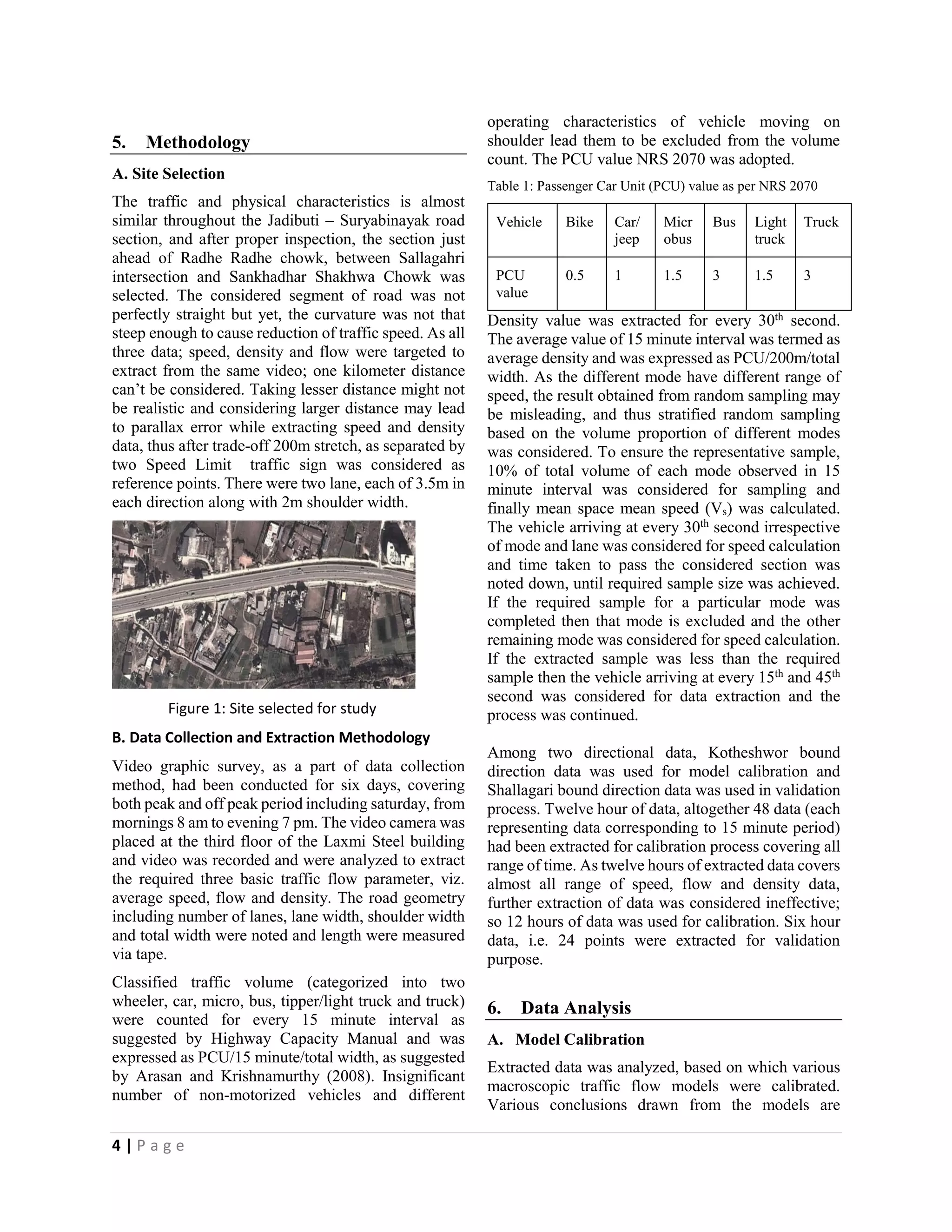
The traffic and physical characteristics is almost similar throughout the Jadibuti – Suryabinayak road section, and after proper inspection, the section just ahead of Radhe Radhe chowk, between Sallagahri intersection and Sankhadhar Shakhwa Chowk was selected. The considered segment of road was not perfectly straight but yet, the curvature was not that steep enough to cause reduction of traffic speed. As all three data; speed, density and flow were targeted to extract from the same video; one kilometer distance can’t be considered. Taking lesser distance might not be realistic and considering larger distance may lead to parallax error while extracting speed and density data, thus after trade-off 200m stretch, as separated by two Speed Limit traffic sign was considered as reference points. There were two lane, each of 3.5m in each direction along with 2m shoulder width. 
Figure 1: Site selected for study 
B. Data Collection and Extraction Methodology 
Video graphic survey, as a part of data collection method, had been conducted for six days, covering both peak and off peak period including saturday, from mornings 8 am to evening 7 pm. The video camera was placed at the third floor of the Laxmi Steel building and video was recorded and were analyzed to extract the required three basic traffic flow parameter, viz. average speed, flow and density. The road geometry including number of lanes, lane width, shoulder width and total width were noted and length were measured via tape. 
Classified traffic volume (categorized into two wheeler, car, micro, bus, tipper/light truck and truck) were counted for every 15 minute interval as suggested by Highway Capacity Manual and was expressed as PCU/15 minute/total width, as suggested by Arasan and Krishnamurthy (2008). Insignificant number of non-motorized vehicles and different operating characteristics of vehicle moving on shoulder lead them to be excluded from the volume count. The PCU value NRS 2070 was adopted. 
Table 1: Passenger Car Unit (PCU) value as per NRS 2070 
Vehicle 
Bike 
Car/ jeep 
Microbus 
Bus 
Light truck 
Truck 
PCU value 
0.5 
1 
1.5 
3 
1.5 
3 
Density value was extracted for every 30th second. The average value of 15 minute interval was termed as average density and was expressed as PCU/200m/total width. As the different mode have different range of speed, the result obtained from random sampling may be misleading, and thus stratified random sampling based on the volume proportion of different modes was considered. To ensure the representative sample, 10% of total volume of each mode observed in 15 minute interval was considered for sampling and finally mean space mean speed (Vs) was calculated. The vehicle arriving at every 30th second irrespective of mode and lane was considered for speed calculation and time taken to pass the considered section was noted down, until required sample size was achieved. If the required sample for a particular mode was completed then that mode is excluded and the other remaining mode was considered for speed calculation. If the extracted sample was less than the required sample then the vehicle arriving at every 15th and 45th second was considered for data extraction and the process was continued. 
Among two directional data, Kotheshwor bound direction data was used for model calibration and Shallagari bound direction data was used in validation process. Twelve hour of data, altogether 48 data (each representing data corresponding to 15 minute period) had been extracted for calibration process covering all range of time. As twelve hours of extracted data covers almost all range of speed, flow and density data, further extraction of data was considered ineffective; so 12 hours of data was used for calibration. Six hour data, i.e. 24 points were extracted for validation purpose. 
6. Data Analysis 
A. Model Calibration 
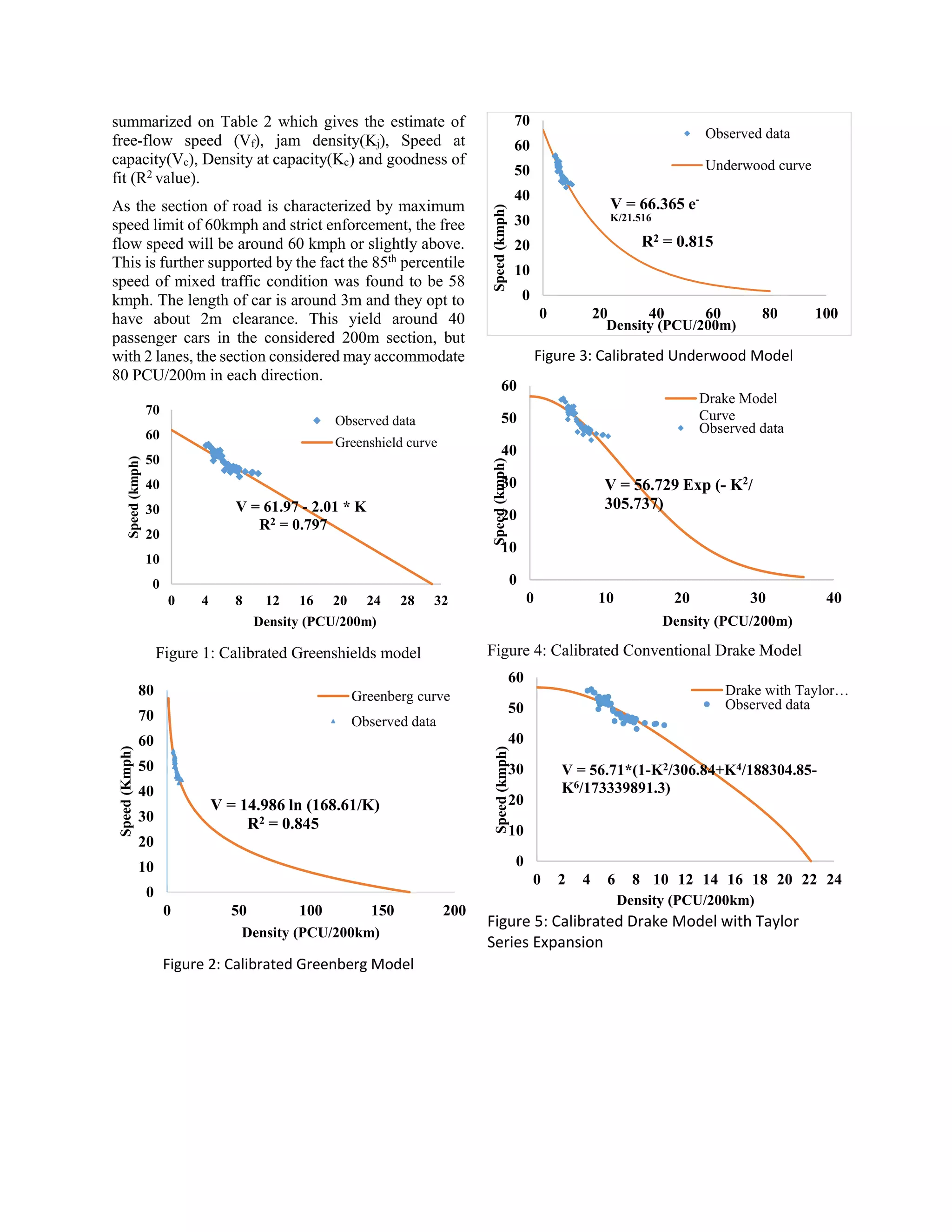
Extracted data was analyzed, based on which various macroscopic traffic flow models were calibrated. Various conclusions drawn from the models are
summarized on Table 2 which gives the estimate of free-flow speed (Vf), jam density(Kj), Speed at capacity(Vc), Density at capacity(Kc) and goodness of fit (R2 value). 
As the section of road is characterized by maximum speed limit of 60kmph and strict enforcement, the free flow speed will be around 60 kmph or slightly above. This is further supported by the fact the 85th percentile speed of mixed traffic condition was found to be 58 kmph. The length of car is around 3m and they opt to have about 2m clearance. This yield around 40 passenger cars in the considered 200m section, but with 2 lanes, the section considered may accommodate 80 PCU/200m in each direction. 
Figure 1: Calibrated Greenshields model 
Figure 2: Calibrated Greenberg Model 
Figure 3: Calibrated Underwood Model 
Figure 4: Calibrated Conventional Drake Model 
Figure 5: Calibrated Drake Model with Taylor Series Expansion 
0 
10 
20 
30 
40 
50 
60 
70 
0 
4 
8 
12 
16 
20 
24 
28 
32 
Speed (kmph) 
Density (PCU/200m) 
Observed data 
Greenshield curve 
V= 61.97 -2.01 * K 
R2= 0.797 
0 
10 
20 
30 
40 
50 
60 
70 
80 
0 
50 
100 
150 
200 
Speed (Kmph) 
Density (PCU/200km) 
Greenberg curve 
Observed data 
V = 14.986ln (168.61/K) 
R2= 0.845 
0 
10 
20 
30 
40 
50 
60 
70 
0 
20 
40 
60 
80 
100 
Speed (kmph) 
Density (PCU/200m) 
Observed data 
Underwood curve 
V = 66.365 e- K/21.516 
R2= 0.815 
0 
10 
20 
30 
40 
50 
60 
0 
10 
20 
30 
40 
Speed (kmph) 
Density (PCU/200m) 
Drake ModelCurve 
Observed data 
V = 56.729 Exp (-K2/ 305.737) 
0 
10 
20 
30 
40 
50 
60 
0 
2 
4 
6 
8 
10 
12 
14 
16 
18 
20 
22 
24 
Speed (kmph) 
Density (PCU/200km) 
Drake with Taylor… 
Observed data 
V = 56.71*(1-K2/306.84+K4/188304.85- K6/173339891.3)
6 | P a g e 
Figure 6: Calibrated Two degree polynomial model 
Figure 7: Calibrated Pipes – Munjal Model for N = 2. 
Figure 8: Calibrated Underwood Model with Taylor Series Expansion 
Table 2: Calibration of various macroscopic traffic flow model 
Model 
Calibrated Equation 
Vf 
(kmph) 
Vc 
(kmph) 
Kj 
(PCU/200m) 
Kc 
(PCU/200m) 
R2 
Greenshields 
V = 61.97 (1 – K/30.83) 
61.97 
30.98 
30.83 
15.42 
0.80 
Greenberg 
V = 14.99 Ln (168.61/K) 
- 
14.99 
168.61 
62.03 
0.84 
Conventional Underwood 
V = 66.36Exp ( -K/21.52) 
66.36 
24.4 2 
- 
21.52 
0.82 
Underwood with Taylor Expansion 
V = 66.16 * (1- K/21.8+K2/948.6- K3/61976.96) 
66.16 
22.05 
34.81 
21.8 
0.82 
Conventional Drake 
V = 56.73Exp (- K2 / 305.737) 
56.73 
34.41 
- 
12.36 
0.75 
Drake with Taylor Series Expansion 
V = 56.71*(1- K2/306.84+K4/188304.85 - K6/173339891.3) 
56.71 
34.26 
22.13 
12.39 
0.75 
Pipes-Munjal(N=2) 
U = 55.83 * {1 – (K/19.29)2} 
55.83 
37.22 
19.29 
11.14 
0.72 
Polynomial (N = 2) 
V = 0.4018*K2 - 7.7448*K + 81.696 
81.69 
- 
- 
- 
0.88 
0 
10 
20 
30 
40 
50 
60 
70 
80 
90 
0 
2 
4 
6 
8 
10 
12 
14 
Speed (kmph) 
Density (PCU/200m) 
Two degreepolynomial fit 
Observed Data 
V = 0.4018*K2-7.7448*K + 81.696R² = 0.8778 
0 
10 
20 
30 
40 
50 
60 
0 
2 
4 
6 
8 
10 
12 
14 
16 
18 
20 
22 
Speed (Kmph) 
Density (PCU/200m) 
Pipes-Munjal model (N=2) 
Observed Data 
V= 55.834*[1- (K/19.29)2] 
0 
10 
20 
30 
40 
50 
60 
70 
0 
10 
20 
30 
40 
Speed (kmph) 
Density (PCU/200m) 
Underwood with TaylorExpansion 
Observed points 
V = 66.16*(1-K/21.8+K2/948.6- K3/61976.96 
R2value = 0.814
Table 3: Re-calibration of recommended models based on validation data 
Model 
Re-Calibrated Equation 
Vf 
(kmph) 
Vc 
(kmph) 
Kj 
(PCU/200m) 
Kc 
(PCU/200m) 
R2 
Greenshields 
V = 62.93 (1 – K/30.11) 
62.93 
30.11 
31.46 
15.06 
0.87 
Greenberg 
V = 12.94 Ln (290.33/K) 
- 
12.94 
290.33 
106.81 
0.89 
Conventional Underwood 
V = 64.94 Exp (-K /23.59) 
64.94 
23.89 
- 
23.59 
0.88 
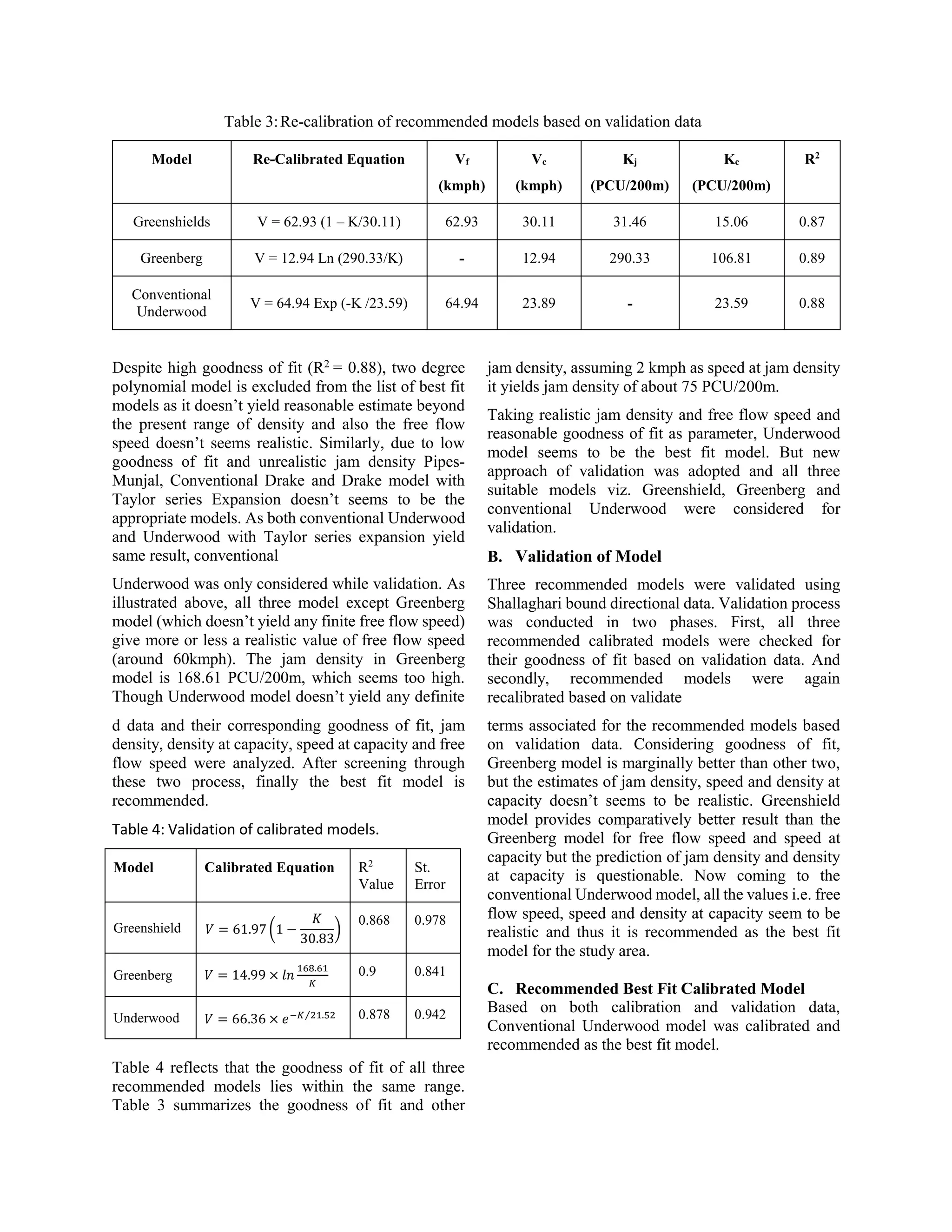
Despite high goodness of fit (R2 = 0.88), two degree polynomial model is excluded from the list of best fit models as it doesn’t yield reasonable estimate beyond the present range of density and also the free flow speed doesn’t seems realistic. Similarly, due to low goodness of fit and unrealistic jam density Pipes- Munjal, Conventional Drake and Drake model with Taylor series Expansion doesn’t seems to be the appropriate models. As both conventional Underwood and Underwood with Taylor series expansion yield same result, conventional 
Underwood was only considered while validation. As illustrated above, all three model except Greenberg model (which doesn’t yield any finite free flow speed) give more or less a realistic value of free flow speed (around 60kmph). The jam density in Greenberg model is 168.61 PCU/200m, which seems too high. Though Underwood model doesn’t yield any definite jam density, assuming 2 kmph as speed at jam density it yields jam density of about 75 PCU/200m. 
Taking realistic jam density and free flow speed and reasonable goodness of fit as parameter, Underwood model seems to be the best fit model. But new approach of validation was adopted and all three suitable models viz. Greenshield, Greenberg and conventional Underwood were considered for validation. 
B. Validation of Model 
Three recommended models were validated using Shallaghari bound directional data. Validation process was conducted in two phases. First, all three recommended calibrated models were checked for their goodness of fit based on validation data. And secondly, recommended models were again recalibrated based on validate 
d data and their corresponding goodness of fit, jam density, density at capacity, speed at capacity and free flow speed were analyzed. After screening through these two process, finally the best fit model is recommended. 
Table 4: Validation of calibrated models. 
Model 
Calibrated Equation 
R2 Value 
St. Error 
Greenshield 
푉=61.97(1− 퐾 30.83) 
0.868 
0.978 
Greenberg 
푉=14.99×푙푛 168.61 퐾 
0.9 
0.841 
Underwood 
푉=66.36×푒−퐾21.52⁄ 
0.878 
0.942 
Table 4 reflects that the goodness of fit of all three recommended models lies within the same range. Table 3 summarizes the goodness of fit and other terms associated for the recommended models based on validation data. Considering goodness of fit, Greenberg model is marginally better than other two, but the estimates of jam density, speed and density at capacity doesn’t seems to be realistic. Greenshield model provides comparatively better result than the Greenberg model for free flow speed and speed at capacity but the prediction of jam density and density at capacity is questionable. Now coming to the conventional Underwood model, all the values i.e. free flow speed, speed and density at capacity seem to be realistic and thus it is recommended as the best fit model for the study area. 
C. Recommended Best Fit Calibrated Model 
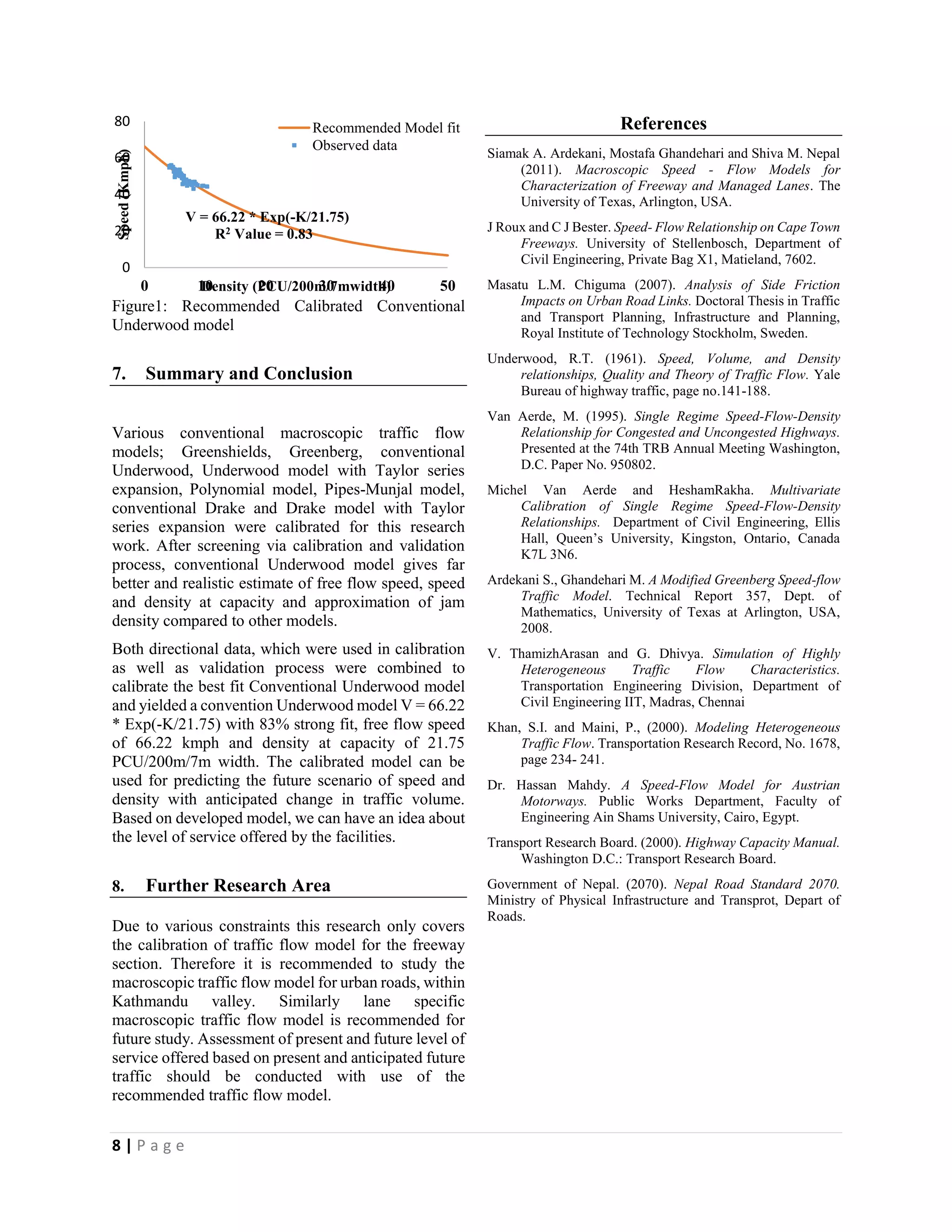
Based on both calibration and validation data, Conventional Underwood model was calibrated and recommended as the best fit model.
8 | P a g e 
Figure1: Recommended Calibrated Conventional Underwood model 
7. Summary and Conclusion Various conventional macroscopic traffic flow models; Greenshields, Greenberg, conventional Underwood, Underwood model with Taylor series expansion, Polynomial model, Pipes-Munjal model, conventional Drake and Drake model with Taylor series expansion were calibrated for this research work. After screening via calibration and validation process, conventional Underwood model gives far better and realistic estimate of free flow speed, speed and density at capacity and approximation of jam density compared to other models. Both directional data, which were used in calibration as well as validation process were combined to calibrate the best fit Conventional Underwood model and yielded a convention Underwood model V = 66.22 * Exp(-K/21.75) with 83% strong fit, free flow speed of 66.22 kmph and density at capacity of 21.75 PCU/200m/7m width. The calibrated model can be used for predicting the future scenario of speed and density with anticipated change in traffic volume. Based on developed model, we can have an idea about the level of service offered by the facilities. 
8. Further Research Area 
Due to various constraints this research only covers the calibration of traffic flow model for the freeway section. Therefore it is recommended to study the macroscopic traffic flow model for urban roads, within Kathmandu valley. Similarly lane specific macroscopic traffic flow model is recommended for future study. Assessment of present and future level of service offered based on present and anticipated future traffic should be conducted with use of the recommended traffic flow model. 
References 
Siamak A. Ardekani, Mostafa Ghandehari and Shiva M. Nepal (2011). Macroscopic Speed - Flow Models for Characterization of Freeway and Managed Lanes. The University of Texas, Arlington, USA. 
J Roux and C J Bester. Speed- Flow Relationship on Cape Town Freeways. University of Stellenbosch, Department of Civil Engineering, Private Bag X1, Matieland, 7602. 
Masatu L.M. Chiguma (2007). Analysis of Side Friction Impacts on Urban Road Links. Doctoral Thesis in Traffic and Transport Planning, Infrastructure and Planning, Royal Institute of Technology Stockholm, Sweden. 
Underwood, R.T. (1961). Speed, Volume, and Density relationships, Quality and Theory of Traffic Flow. Yale Bureau of highway traffic, page no.141-188. 
Van Aerde, M. (1995). Single Regime Speed-Flow-Density Relationship for Congested and Uncongested Highways. Presented at the 74th TRB Annual Meeting Washington, D.C. Paper No. 950802. 
Michel Van Aerde and HeshamRakha. Multivariate Calibration of Single Regime Speed-Flow-Density Relationships. Department of Civil Engineering, Ellis Hall, Queen’s University, Kingston, Ontario, Canada K7L 3N6. 
Ardekani S., Ghandehari M. A Modified Greenberg Speed-flow Traffic Model. Technical Report 357, Dept. of Mathematics, University of Texas at Arlington, USA, 2008. 
V. ThamizhArasan and G. Dhivya. Simulation of Highly Heterogeneous Traffic Flow Characteristics. Transportation Engineering Division, Department of Civil Engineering IIT, Madras, Chennai 
Khan, S.I. and Maini, P., (2000). Modeling Heterogeneous Traffic Flow. Transportation Research Record, No. 1678, page 234- 241. 
Dr. Hassan Mahdy. A Speed-Flow Model for Austrian Motorways. Public Works Department, Faculty of Engineering Ain Shams University, Cairo, Egypt. 
Transport Research Board. (2000). Highway Capacity Manual. Washington D.C.: Transport Research Board. Government of Nepal. (2070). Nepal Road Standard 2070. Ministry of Physical Infrastructure and Transprot, Depart of Roads. 
0 
20 
40 
60 
80 
0 
10 
20 
30 
40 
50 
Speed (Kmph) 
Density (PCU/200m/7mwidth) 
Recommended Model fit 
Observed data 
V =66.22 * Exp(-K/21.75) 
R2Value = 0.83

Macroscopic Traffic Flow model for nepalese roads

  • 1.
    1 Calibration ofConventional Macroscopic Traffic Flow Models for Nepalese Roads: (A Case Study of Jadibuti - Suryabinayak SectionN) Hemant Tiwari1, Anil Marsani2 1 Graduate Student, Department of Transportation Engineering, Central Campus, Pulchowk, IOE 2 Coordinator, M.Sc. in Transportation Engineering, Department of Civil Engineering, Central Campus, Pulchowk, IOE Corresponding Email: hemu.ioe@gmail.com Abstract: The importance of understanding the relationship between speed, flow and density is unquestionable, from the perspective of planning, design, traffic operations, and improvement of facilities. This particular research tries to address the necessity of understanding the relationship between traffic flow parameters via calibration of various macroscopic traffic flow models, which will provide quantitative estimates of the change in speed as a function of anticipated changes in traffic demand for Jadibuti - Suryabinayak section. Various conventional macroscopic speed- density models namely Greenshields, Greenberg, Underwood, Drake, Pipes – Munjal, Polynomial and modified Drake and Underwood models, were first calibrated and further validated. Due to significant goodness of fit (R2 value and standard error) and realistic estimates of free flow speed, optimum speed and optimum density for the section under consideration, Conventional Underwood model was recommended as the best fit model. This calibrated model can be used in predicting speed for the anticipated traffic volume, and even helps in quantifying congestion for oversaturated condition. Keywords: Macroscopic traffic flow model; PCU; free flow speed; jam density; goodness of fit 1. Introduction Tremendous developments in the transportation system along with increased road network and overdependence on automobiles give rise to the evolution of various traffic flow theories. These theories illustrate traffic stream characteristics which includes behavior of vehicles on road at different circumstances, interaction of road user and roadway environment. Researcher have categorized various traffic flow models under two categories viz. macroscopic and microscopic. Conventional mathematical models that formulate the relationships among the integrated parameter associated with traffic stream i.e. speed, flow and density are termed as macroscopic traffic flow model. Such models convert single entity level characteristics to comparable system level characteristics by integrating microscopic traffic flow model, thus looking the traffic flow from the broader perspective. Greenshield, Greenberg, Underwood, Drake model etc. are some of the examples of macroscopic traffic flow models. Microscopic traffic flow model on the other hand deals with the traffic stream characteristics from microscopic view point which includes headway, clearance etc. via modeling driver-driver and driver- road interactions within a traffic stream. Car following model, Pipe’s model, Forbes’ model are some of the microscopic traffic flow models. The importance of understanding the relationship between speed, flow and density is unquestionable from the standpoint of highway planning, design and operation as it provides quantitative estimates of the change in speed as a function of anticipated changes in traffic demand. These traffic flow models have a significant role on prediction of highway capacity, free flow speed and level of service offered by the facilities and to determine the geometric features of road so as to provide the targeted level of service. They are equally useful in real-time traffic control, a basic component of Intelligent Transportation System (ITS) which is based on changes in traffic flow parameters. Calibration and validation of various macroscopic models is the first step towards creating theoretical background for successful planning and design. 2. Objectives of Study Despite being the widely accepted macroscopic traffic flow model, it is not universal that Greenshield model will always be the best fit model. Many countries had calibrated macroscopic models for different parts or even at different segment of roads, but our country lacks such calibration till date. Thus the objectives this research work is to identify conventional macroscopic traffic flow models; develop, calibrate and validate them for heterogeneous traffic flow condition and recommend the most suitable one. 3. Study Area
  • 2.
    2 | Pa g e Calibration of traffic flow models is of great importance on urban areas where large traffic flow occurs and thus Kathmandu area was chosen. Various constraints, such as time, manpower and fund c lead to confine the study area to Jadibuti – Suryabinayak road section, along the Araniko Highway. It serves significant traffic from Kathmandu to Bhaktapur, forms a part of Asian Highway 42 running towards the Chinese border with significant traffic volume and has one of the highest traffic volumes among the trunk roads in Nepal. Moreover, it is anticipated that the road will get much more congested than at present once the Sindhuli Road is completed. At the same time this road section is characterized by operating traffic signals which is rare to see in Kathmandu valley. 4. Literature Review In general, traffic streams are not uniform but vary over both space and time, thus it is a difficult to describe traffic flow phenomenon without the use of a common set of terms: volume or flow rate, speed, and density or concentration. Average speed (V) is defined as average spot speed of several vehicles passing a specific location. Flow or volume (Q) is defined as the number of vehicles crossing a particular section within stated period of time. Volume and flow are interchangeably used in some literature whereas in Highway Capacity Manual (HCM) flow rate corresponds to equivalent hourly rate at which vehicles pass over a given point or section of a roadway during a given time interval of less than 1 hour, usually 15 minute. Density or concentration (K) is defined as the number of vehicles occupying the particular section of road. For multilane, traffic flow need to be expressed as vehicle per unit time per lane but due to the lack of lane discipline in most of the developing countries having mixed traffic condition, flow is expressed as vehicles per unit time per total width of road (Arasan and Krishnamurthy, 2008) and so does density which is also expressed in terms of total width. Heterogeneous Traffic and Passenger Car Unit The real world consists of vehicles having varying physical as well as operating characteristics rather than stream of uniform vehicles. Assuming homogeneous traffic stream makes calculations much simpler but doesn’t reflect the real scenario. The dividing line between homogeneous and heterogeneous is not clear cut. Arasan and Krishnamurthy (2008) suggest heterogeneous traffic to exist when the percentage of the dominant mode is less than 80% of the traffic while Fazio, Hoque, and Tiwari (1999) suggest the value to be slightly higher at 85%. Only a few model are develop in context of mixed traffic condition, some model convert heterogeneous traffic to equivalent passenger car-units and then applying procedures for homogeneous traffic. In case of heterogeneous traffic flow condition, various types of vehicles need to be converted to equivalent vehicle using Passenger Car Unit (PCU) or Passenger Car Equivalent (PCE) factor. The PCU value of a given type of a vehicle is related to its lane occupancy relative to a standard passenger car, whose PCU value is taken as 1. NRS 2070 has provided PCU values for different types of vehicles. PCE values depend on the traffic flow parameters and are subjected to variations due to the factors that influence the traffic flow parameters. Therefore it may not be precisely correct to adopt a constant set of PCE values under different roadway and traffic conditions (Justo and Tuladhar, 1984). Greenshield’s Model The first simplest classical macroscopic traffic flow model was proposed by Greenshield’s in 1935 which assume that under uninterrupted flow conditions, speed and density are linearly related. This model is considered as the powerful tool in the field of traffic flow modeling due to its simplicity and reasonable goodness of fit but yet its acceptability is not universal as it don’t yield reasonable goodness of fit to data corresponding to congested and extremely low density road. Mathematically, the model is written as: 퐔= 퐔퐟∗{ퟏ− 퐊 퐊퐣 } Where, U represents Speed corresponding to density K; Uf and Kj represents free flow speed and Jam Density respectively. This model satisfies both boundary condition (at k = kj, u=0 and at k = 0, u = uf). Greenberg Model Greenberg (1959) observed traffic flow in the north tube of the Lincoln Tunnel at New York City and developed a logarithmic speed-density model, assuming that the traffic flow along a roadway can be considered as a one-dimensional fluid. The mathematical form of Greenshield model is given by: 푉=푉푐×푙푛( 퐾푗 퐾 ) Where, V represents Speed corresponding to density K, Kj and Vc represents jam density and constant representing speed corresponding to capacity. This
  • 3.
    model shows stronggoodness of fit under congested conditions but does not satisfy the boundary condition at low density regime i.e. fails to predict free flow speed. Underwood’s Exponential Model Underwood (1961) proposed another exponential form of macroscopic traffic flow model, so as to overcome the drawback of Greenshield model. The Underwood model is expressed mathematically as: 푉=푉푓×푒(−퐾 퐾0⁄) Where, V represents speed corresponding to density K, Vf and Ko represent free flow speed and optimum density (density corresponding to the maximum flow). This model gives better fit than the Greenshields and Greenberg models for the uncongested traffic conditions, but fails to do so for congested conditions. It doesn’t satisfy the boundary condition at high density regime. Underwood Model with Taylor Series Expansion Exponential function of Underwood model can be expanded in a Taylor series for the numerical approximation of jam density, which can’t be obtained from conventional Underwood model u= ufe−kkc⁄ = uf(1− kkc+ k22kc2− k36kc3+ k424kc4− k5120kc5+⋯) Considering up to third degree of k yields u=ufe−kkc⁄ = uf (1− kkc+ k22kc2− k36kc3) The above equation gives the realistic estimate for the jam density (kj) by substituting u = 0 Drake Model (Bell-Shaped Curve Model) Drake (1961) improved Underwood model, by proposing bell shaped model after analyzing all model from statistical point of view. He estimate density from speed and flow data, fitted the speed vs. density function and transformed the speed vs. density function to a speed vs. flow function to validate his model. The mathematical expression is: V=푉푓exp[− 퐾22∗퐾푐 2] Where, V represents speed corresponding to density k, Kc and Vf represents density corresponding to maximum flow and free flow speed respectively. Drake model generally yields a best fit than other models for uncongested conditions, but fails to provide a good fit for congested conditions. Pipes-Munjal model Pipes proposed a model with introduction of new parameter (n) to provide a more generalized modeling approach shown by the following equation. When n =1, Pipe's model resembles Greenshields' model. Thus by varying the values of ‘n’, a family of models can be developed. U= Uf∗{1−( KKj)n} Where symbol have their usual meanings Polynomial Model: Polynomial models of order 2,3,4 and onwards are calibrated based on the data and are checked for their goodness of fit and other estimate. Density and speed relationship expressed as quadratically (polynomial of order 2) is expressed as: u = uf+ b*k + c*k2 Where, b and c are additional model parameters, to be determined. Modified Greenberg Model Ardekani and Ghandehari (2008) proposed a Modified Greenberg model introducing a non-zero average minimum density, Ko, assuming that there is always some vehicles on the freeway. u=uc∗ln ( kj+kok+ko) Where Uc and Ko represents speed corresponding to maximum flow and Average minimum density respectively. This model yields a finite free flow speed of Uf=Uc* ln(1 + kj/ko) when density approaches zero. Density at capacity of this model will be kc≈ 0.4kj, a value close to that of the classical Greenberg model, (kc≈ 0.368kj) obtained by solving for dq/dk= 0. The Drake Model with Taylor Series Expansion Conventional Drake model can be expanded using Taylor series expansion to obtain a numerical approximation for the jam density, as follows: u=uf(1− k22kc2+ k48kc4− k648kc6)
  • 4.
    4 | Pa g e 5. Methodology A. Site Selection The traffic and physical characteristics is almost similar throughout the Jadibuti – Suryabinayak road section, and after proper inspection, the section just ahead of Radhe Radhe chowk, between Sallagahri intersection and Sankhadhar Shakhwa Chowk was selected. The considered segment of road was not perfectly straight but yet, the curvature was not that steep enough to cause reduction of traffic speed. As all three data; speed, density and flow were targeted to extract from the same video; one kilometer distance can’t be considered. Taking lesser distance might not be realistic and considering larger distance may lead to parallax error while extracting speed and density data, thus after trade-off 200m stretch, as separated by two Speed Limit traffic sign was considered as reference points. There were two lane, each of 3.5m in each direction along with 2m shoulder width. Figure 1: Site selected for study B. Data Collection and Extraction Methodology Video graphic survey, as a part of data collection method, had been conducted for six days, covering both peak and off peak period including saturday, from mornings 8 am to evening 7 pm. The video camera was placed at the third floor of the Laxmi Steel building and video was recorded and were analyzed to extract the required three basic traffic flow parameter, viz. average speed, flow and density. The road geometry including number of lanes, lane width, shoulder width and total width were noted and length were measured via tape. Classified traffic volume (categorized into two wheeler, car, micro, bus, tipper/light truck and truck) were counted for every 15 minute interval as suggested by Highway Capacity Manual and was expressed as PCU/15 minute/total width, as suggested by Arasan and Krishnamurthy (2008). Insignificant number of non-motorized vehicles and different operating characteristics of vehicle moving on shoulder lead them to be excluded from the volume count. The PCU value NRS 2070 was adopted. Table 1: Passenger Car Unit (PCU) value as per NRS 2070 Vehicle Bike Car/ jeep Microbus Bus Light truck Truck PCU value 0.5 1 1.5 3 1.5 3 Density value was extracted for every 30th second. The average value of 15 minute interval was termed as average density and was expressed as PCU/200m/total width. As the different mode have different range of speed, the result obtained from random sampling may be misleading, and thus stratified random sampling based on the volume proportion of different modes was considered. To ensure the representative sample, 10% of total volume of each mode observed in 15 minute interval was considered for sampling and finally mean space mean speed (Vs) was calculated. The vehicle arriving at every 30th second irrespective of mode and lane was considered for speed calculation and time taken to pass the considered section was noted down, until required sample size was achieved. If the required sample for a particular mode was completed then that mode is excluded and the other remaining mode was considered for speed calculation. If the extracted sample was less than the required sample then the vehicle arriving at every 15th and 45th second was considered for data extraction and the process was continued. Among two directional data, Kotheshwor bound direction data was used for model calibration and Shallagari bound direction data was used in validation process. Twelve hour of data, altogether 48 data (each representing data corresponding to 15 minute period) had been extracted for calibration process covering all range of time. As twelve hours of extracted data covers almost all range of speed, flow and density data, further extraction of data was considered ineffective; so 12 hours of data was used for calibration. Six hour data, i.e. 24 points were extracted for validation purpose. 6. Data Analysis A. Model Calibration Extracted data was analyzed, based on which various macroscopic traffic flow models were calibrated. Various conclusions drawn from the models are
  • 5.
    summarized on Table2 which gives the estimate of free-flow speed (Vf), jam density(Kj), Speed at capacity(Vc), Density at capacity(Kc) and goodness of fit (R2 value). As the section of road is characterized by maximum speed limit of 60kmph and strict enforcement, the free flow speed will be around 60 kmph or slightly above. This is further supported by the fact the 85th percentile speed of mixed traffic condition was found to be 58 kmph. The length of car is around 3m and they opt to have about 2m clearance. This yield around 40 passenger cars in the considered 200m section, but with 2 lanes, the section considered may accommodate 80 PCU/200m in each direction. Figure 1: Calibrated Greenshields model Figure 2: Calibrated Greenberg Model Figure 3: Calibrated Underwood Model Figure 4: Calibrated Conventional Drake Model Figure 5: Calibrated Drake Model with Taylor Series Expansion 0 10 20 30 40 50 60 70 0 4 8 12 16 20 24 28 32 Speed (kmph) Density (PCU/200m) Observed data Greenshield curve V= 61.97 -2.01 * K R2= 0.797 0 10 20 30 40 50 60 70 80 0 50 100 150 200 Speed (Kmph) Density (PCU/200km) Greenberg curve Observed data V = 14.986ln (168.61/K) R2= 0.845 0 10 20 30 40 50 60 70 0 20 40 60 80 100 Speed (kmph) Density (PCU/200m) Observed data Underwood curve V = 66.365 e- K/21.516 R2= 0.815 0 10 20 30 40 50 60 0 10 20 30 40 Speed (kmph) Density (PCU/200m) Drake ModelCurve Observed data V = 56.729 Exp (-K2/ 305.737) 0 10 20 30 40 50 60 0 2 4 6 8 10 12 14 16 18 20 22 24 Speed (kmph) Density (PCU/200km) Drake with Taylor… Observed data V = 56.71*(1-K2/306.84+K4/188304.85- K6/173339891.3)
  • 6.
    6 | Pa g e Figure 6: Calibrated Two degree polynomial model Figure 7: Calibrated Pipes – Munjal Model for N = 2. Figure 8: Calibrated Underwood Model with Taylor Series Expansion Table 2: Calibration of various macroscopic traffic flow model Model Calibrated Equation Vf (kmph) Vc (kmph) Kj (PCU/200m) Kc (PCU/200m) R2 Greenshields V = 61.97 (1 – K/30.83) 61.97 30.98 30.83 15.42 0.80 Greenberg V = 14.99 Ln (168.61/K) - 14.99 168.61 62.03 0.84 Conventional Underwood V = 66.36Exp ( -K/21.52) 66.36 24.4 2 - 21.52 0.82 Underwood with Taylor Expansion V = 66.16 * (1- K/21.8+K2/948.6- K3/61976.96) 66.16 22.05 34.81 21.8 0.82 Conventional Drake V = 56.73Exp (- K2 / 305.737) 56.73 34.41 - 12.36 0.75 Drake with Taylor Series Expansion V = 56.71*(1- K2/306.84+K4/188304.85 - K6/173339891.3) 56.71 34.26 22.13 12.39 0.75 Pipes-Munjal(N=2) U = 55.83 * {1 – (K/19.29)2} 55.83 37.22 19.29 11.14 0.72 Polynomial (N = 2) V = 0.4018*K2 - 7.7448*K + 81.696 81.69 - - - 0.88 0 10 20 30 40 50 60 70 80 90 0 2 4 6 8 10 12 14 Speed (kmph) Density (PCU/200m) Two degreepolynomial fit Observed Data V = 0.4018*K2-7.7448*K + 81.696R² = 0.8778 0 10 20 30 40 50 60 0 2 4 6 8 10 12 14 16 18 20 22 Speed (Kmph) Density (PCU/200m) Pipes-Munjal model (N=2) Observed Data V= 55.834*[1- (K/19.29)2] 0 10 20 30 40 50 60 70 0 10 20 30 40 Speed (kmph) Density (PCU/200m) Underwood with TaylorExpansion Observed points V = 66.16*(1-K/21.8+K2/948.6- K3/61976.96 R2value = 0.814
  • 7.
    Table 3: Re-calibrationof recommended models based on validation data Model Re-Calibrated Equation Vf (kmph) Vc (kmph) Kj (PCU/200m) Kc (PCU/200m) R2 Greenshields V = 62.93 (1 – K/30.11) 62.93 30.11 31.46 15.06 0.87 Greenberg V = 12.94 Ln (290.33/K) - 12.94 290.33 106.81 0.89 Conventional Underwood V = 64.94 Exp (-K /23.59) 64.94 23.89 - 23.59 0.88 Despite high goodness of fit (R2 = 0.88), two degree polynomial model is excluded from the list of best fit models as it doesn’t yield reasonable estimate beyond the present range of density and also the free flow speed doesn’t seems realistic. Similarly, due to low goodness of fit and unrealistic jam density Pipes- Munjal, Conventional Drake and Drake model with Taylor series Expansion doesn’t seems to be the appropriate models. As both conventional Underwood and Underwood with Taylor series expansion yield same result, conventional Underwood was only considered while validation. As illustrated above, all three model except Greenberg model (which doesn’t yield any finite free flow speed) give more or less a realistic value of free flow speed (around 60kmph). The jam density in Greenberg model is 168.61 PCU/200m, which seems too high. Though Underwood model doesn’t yield any definite jam density, assuming 2 kmph as speed at jam density it yields jam density of about 75 PCU/200m. Taking realistic jam density and free flow speed and reasonable goodness of fit as parameter, Underwood model seems to be the best fit model. But new approach of validation was adopted and all three suitable models viz. Greenshield, Greenberg and conventional Underwood were considered for validation. B. Validation of Model Three recommended models were validated using Shallaghari bound directional data. Validation process was conducted in two phases. First, all three recommended calibrated models were checked for their goodness of fit based on validation data. And secondly, recommended models were again recalibrated based on validate d data and their corresponding goodness of fit, jam density, density at capacity, speed at capacity and free flow speed were analyzed. After screening through these two process, finally the best fit model is recommended. Table 4: Validation of calibrated models. Model Calibrated Equation R2 Value St. Error Greenshield 푉=61.97(1− 퐾 30.83) 0.868 0.978 Greenberg 푉=14.99×푙푛 168.61 퐾 0.9 0.841 Underwood 푉=66.36×푒−퐾21.52⁄ 0.878 0.942 Table 4 reflects that the goodness of fit of all three recommended models lies within the same range. Table 3 summarizes the goodness of fit and other terms associated for the recommended models based on validation data. Considering goodness of fit, Greenberg model is marginally better than other two, but the estimates of jam density, speed and density at capacity doesn’t seems to be realistic. Greenshield model provides comparatively better result than the Greenberg model for free flow speed and speed at capacity but the prediction of jam density and density at capacity is questionable. Now coming to the conventional Underwood model, all the values i.e. free flow speed, speed and density at capacity seem to be realistic and thus it is recommended as the best fit model for the study area. C. Recommended Best Fit Calibrated Model Based on both calibration and validation data, Conventional Underwood model was calibrated and recommended as the best fit model.
  • 8.
    8 | Pa g e Figure1: Recommended Calibrated Conventional Underwood model 7. Summary and Conclusion Various conventional macroscopic traffic flow models; Greenshields, Greenberg, conventional Underwood, Underwood model with Taylor series expansion, Polynomial model, Pipes-Munjal model, conventional Drake and Drake model with Taylor series expansion were calibrated for this research work. After screening via calibration and validation process, conventional Underwood model gives far better and realistic estimate of free flow speed, speed and density at capacity and approximation of jam density compared to other models. Both directional data, which were used in calibration as well as validation process were combined to calibrate the best fit Conventional Underwood model and yielded a convention Underwood model V = 66.22 * Exp(-K/21.75) with 83% strong fit, free flow speed of 66.22 kmph and density at capacity of 21.75 PCU/200m/7m width. The calibrated model can be used for predicting the future scenario of speed and density with anticipated change in traffic volume. Based on developed model, we can have an idea about the level of service offered by the facilities. 8. Further Research Area Due to various constraints this research only covers the calibration of traffic flow model for the freeway section. Therefore it is recommended to study the macroscopic traffic flow model for urban roads, within Kathmandu valley. Similarly lane specific macroscopic traffic flow model is recommended for future study. Assessment of present and future level of service offered based on present and anticipated future traffic should be conducted with use of the recommended traffic flow model. References Siamak A. Ardekani, Mostafa Ghandehari and Shiva M. Nepal (2011). Macroscopic Speed - Flow Models for Characterization of Freeway and Managed Lanes. The University of Texas, Arlington, USA. J Roux and C J Bester. Speed- Flow Relationship on Cape Town Freeways. University of Stellenbosch, Department of Civil Engineering, Private Bag X1, Matieland, 7602. Masatu L.M. Chiguma (2007). Analysis of Side Friction Impacts on Urban Road Links. Doctoral Thesis in Traffic and Transport Planning, Infrastructure and Planning, Royal Institute of Technology Stockholm, Sweden. Underwood, R.T. (1961). Speed, Volume, and Density relationships, Quality and Theory of Traffic Flow. Yale Bureau of highway traffic, page no.141-188. Van Aerde, M. (1995). Single Regime Speed-Flow-Density Relationship for Congested and Uncongested Highways. Presented at the 74th TRB Annual Meeting Washington, D.C. Paper No. 950802. Michel Van Aerde and HeshamRakha. Multivariate Calibration of Single Regime Speed-Flow-Density Relationships. Department of Civil Engineering, Ellis Hall, Queen’s University, Kingston, Ontario, Canada K7L 3N6. Ardekani S., Ghandehari M. A Modified Greenberg Speed-flow Traffic Model. Technical Report 357, Dept. of Mathematics, University of Texas at Arlington, USA, 2008. V. ThamizhArasan and G. Dhivya. Simulation of Highly Heterogeneous Traffic Flow Characteristics. Transportation Engineering Division, Department of Civil Engineering IIT, Madras, Chennai Khan, S.I. and Maini, P., (2000). Modeling Heterogeneous Traffic Flow. Transportation Research Record, No. 1678, page 234- 241. Dr. Hassan Mahdy. A Speed-Flow Model for Austrian Motorways. Public Works Department, Faculty of Engineering Ain Shams University, Cairo, Egypt. Transport Research Board. (2000). Highway Capacity Manual. Washington D.C.: Transport Research Board. Government of Nepal. (2070). Nepal Road Standard 2070. Ministry of Physical Infrastructure and Transprot, Depart of Roads. 0 20 40 60 80 0 10 20 30 40 50 Speed (Kmph) Density (PCU/200m/7mwidth) Recommended Model fit Observed data V =66.22 * Exp(-K/21.75) R2Value = 0.83