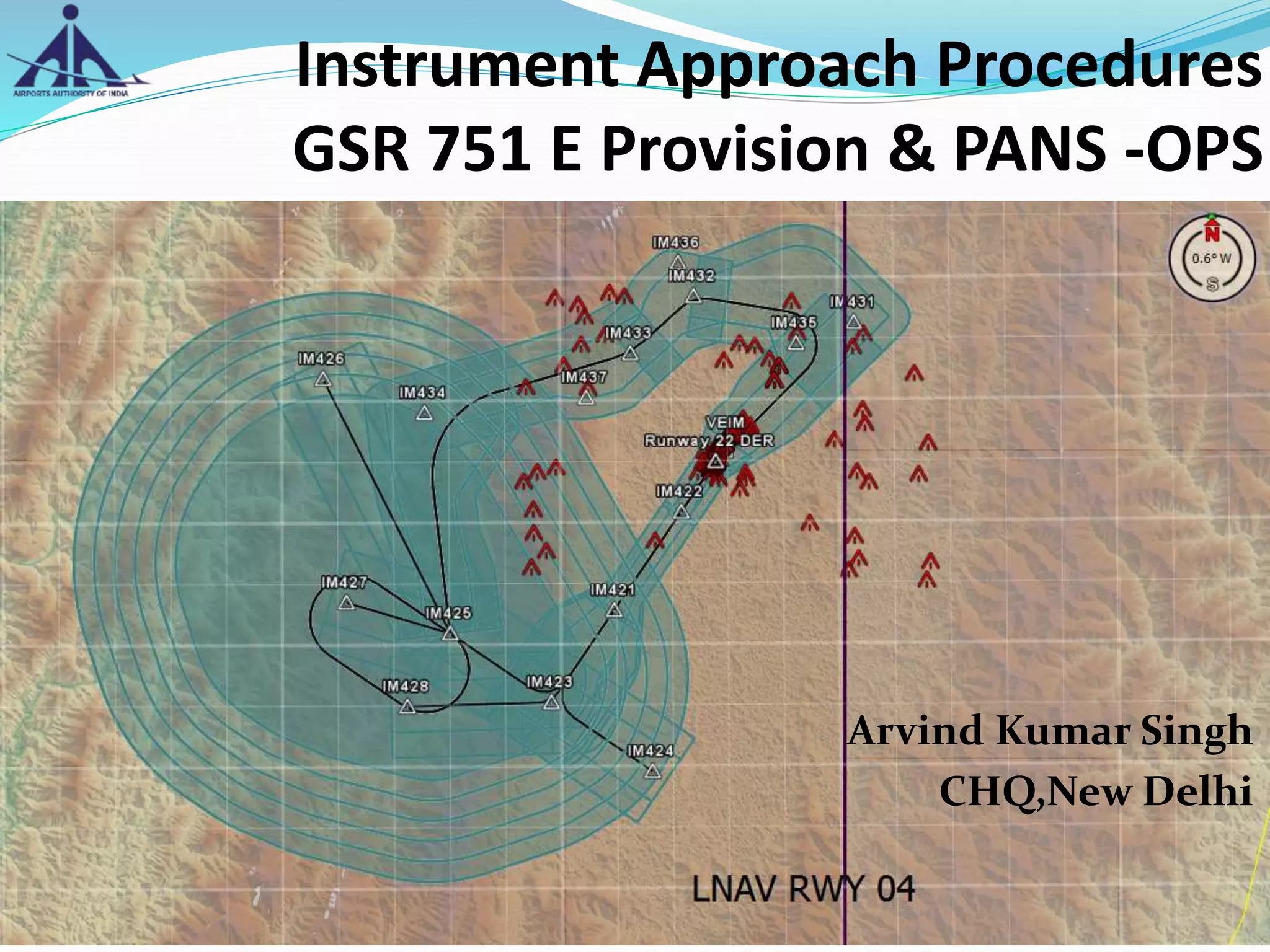

Instrument Approach Procedures
GSR 751 E Provision & PANS -OPS
Arvind Kumar Singh
CHQ,New Delhi
Instrument Approach to Land
(IAL) procedures
6/20/2020 2
Why are they required?
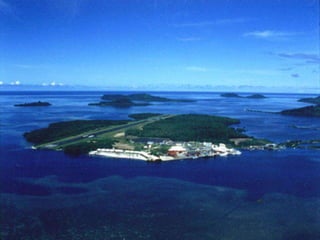
Clear sky and great visibility
6/20/2020 3
6/20/2020 4
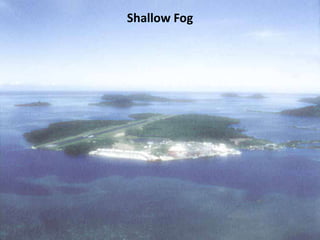
Shallow Fog
6/20/2020 5
Dense Fog/Cloud
 A series of predetermined manoeuvres
 By reference to flight instruments
 With specified protection from obstacles from the initial
approach fix, or where applicable, from the beginning of a
defined arrival route to a point from which a landing can be
completed and
 Thereafter, if a landing is not completed, to a position at which
holding or en-route obstacle clearance criteria apply.
6/20/2020 6
IAL Procedure
Role of PANS-OPS in NOC
 Flight procedures are designed for normal operations as per the provisions
of ICAO DOC 8168 Vol-II.
 As any structure erected around an airport may adversely impact the Flight
Procedures.
 Regulate the permissible height of the proposed structure with respect to
Flight Procedures.
 Any adverse impact on Flight procedures due to any structure will adversely
impact the aircraft operations.
 To protect Flight procedures, permissible height of an structures needs to be
regulated from PANS-OPS criteria.
 Accordingly, NOC for height issued to any structure is the least of AGA, CNS
and PANS-OPS.
 Minimum Sector Altitude (MSA)
 Minimum Holding Altitude (MHA)
 Minimum Vectoring Altitude (MVA)
 Minimum Altitude of Initial and Intermediate Segments
 OCA/H (Straight-in-and Circling) for all aircraft categories
 STARs /SIDs procedure altitude.
 Basic ILS Surface
6/20/2020 8
PANS-OPS Criteria(GSR 751 E)
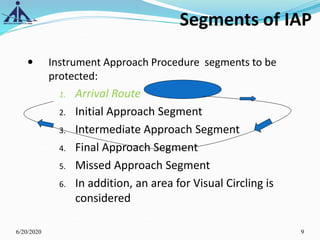
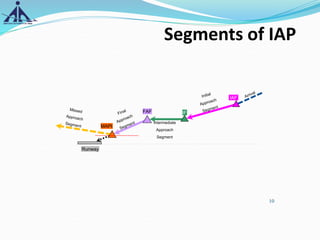
Segments of IAP
 Instrument Approach Procedure segments to be
protected:
1. Arrival Route
2. Initial Approach Segment
3. Intermediate Approach Segment
4. Final Approach Segment
5. Missed Approach Segment
6. In addition, an area for Visual Circling is
considered
6/20/2020 9
10
IAF
FAF IF
MAPt
Intermediate
Approach
Segment
Runway
Segments of IAP
6/20/2020 11
Types of Instrument Approach
Procedures
1. Non Precision Approach-VOR/DME, NDB
2. Precision Approach-ILS
3. RNAV (GNSS)
LNAV,LNAV/VNAV,LPV& RNP AR
6/20/2020 12
Non-Precision Approach
• In India MDH 400 Ft OR More
• Taking a fictitious obstacle of 45 M AGL
• DGCA CAR Section 8 (Aircraft Operations) Series C Part 1
(AWO)
• Visibility Requirement
MDH FALS IALS BALS NALS
400 1100 1400 1600 1800
6/20/2020 13
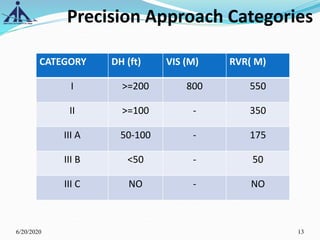
Precision Approach Categories
CATEGORY DH (ft) VIS (M) RVR( M)
I >=200 800 550
II >=100 - 350
III A 50-100 - 175
III B <50 - 50
III C NO - NO
6/20/2020 14
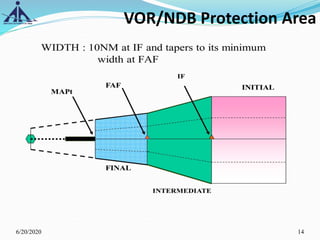
VOR/NDB Protection Area
6/20/2020 15
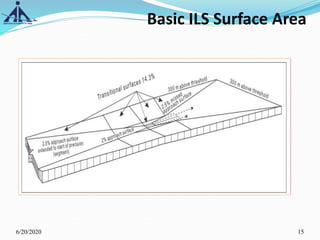
Basic ILS Surface Area
6/20/2020 16
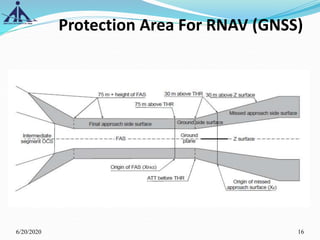
Protection Area For RNAV (GNSS)
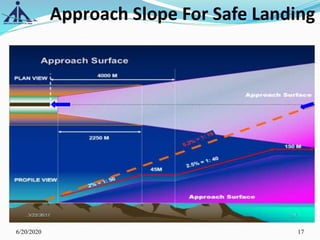
Approach Slope For Safe Landing
6/20/2020 17
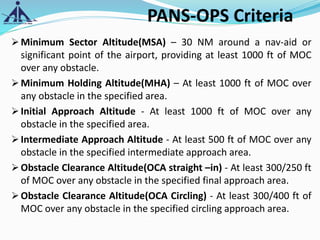
PANS-OPS Criteria
Minimum Sector Altitude(MSA) – 30 NM around a nav-aid or
significant point of the airport, providing at least 1000 ft of MOC
over any obstacle.
Minimum Holding Altitude(MHA) – At least 1000 ft of MOC over
any obstacle in the specified area.
Initial Approach Altitude - At least 1000 ft of MOC over any
obstacle in the specified area.
Intermediate Approach Altitude - At least 500 ft of MOC over any
obstacle in the specified intermediate approach area.
Obstacle Clearance Altitude(OCA straight –in) - At least 300/250 ft
of MOC over any obstacle in the specified final approach area.
Obstacle Clearance Altitude(OCA Circling) - At least 300/400 ft of
MOC over any obstacle in the specified circling approach area.
6/20/2020 19
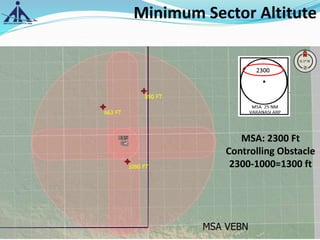
Minimum Sector Altitute
MSA: 2300 Ft
Controlling Obstacle
2300-1000=1300 ft
6/20/2020 20
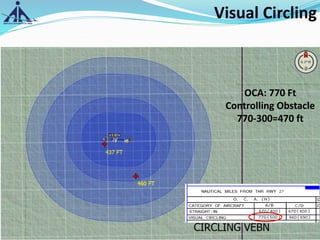
Visual Circling
OCA: 770 Ft
Controlling Obstacle
770-300=470 ft
6/20/2020 21
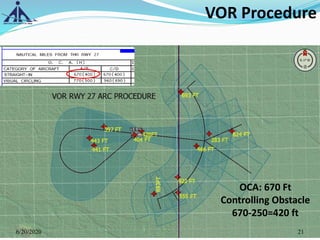
VOR Procedure
OCA: 670 Ft
Controlling Obstacle
670-250=420 ft
6/20/2020 22
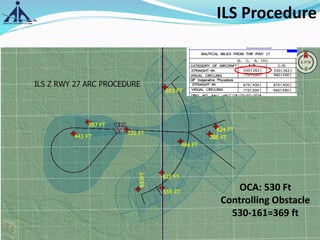
ILS Procedure
OCA: 530 Ft
Controlling Obstacle
530-161=369 ft
6/20/2020 23
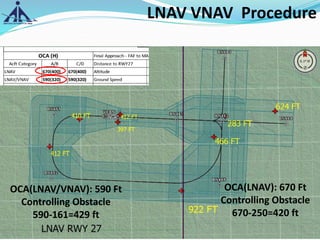
LNAV VNAV Procedure
OCA(LNAV): 670 Ft
Controlling Obstacle
670-250=420 ft
OCA(LNAV/VNAV): 590 Ft
Controlling Obstacle
590-161=429 ft
6/20/2020 24
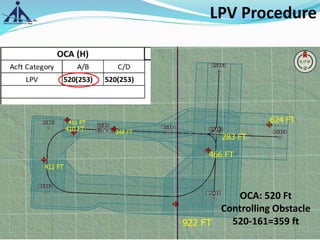
LPV Procedure
OCA: 520 Ft
Controlling Obstacle
520-161=359 ft
CASE STUDIES
VOR-VOMM RWY 07
ILS-VOMM RWY 25
6/20/2020 25
6/20/2020 26
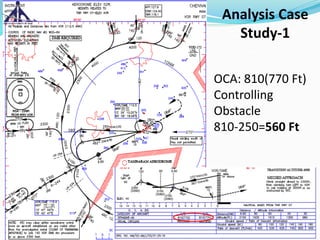
Analysis Case
Study-1
OCA: 810(770 Ft)
Controlling
Obstacle
810-250=560 Ft
6/20/2020 27
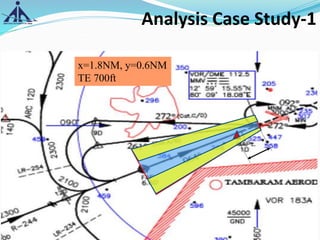
x=1.8NM, y=0.6NM
TE 700ft
Analysis Case Study-1
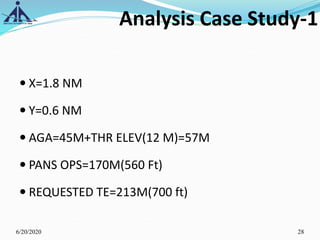
 X=1.8 NM
 Y=0.6 NM
 AGA=45M+THR ELEV(12 M)=57M
 PANS OPS=170M(560 Ft)
 REQUESTED TE=213M(700 ft)
6/20/2020 28
6/20/2020 29
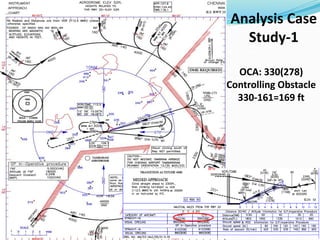
Analysis Case
Study-1
OCA: 330(278)
Controlling Obstacle
330-161=169 ft
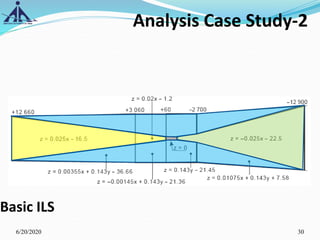
Basic ILS
6/20/2020 30
Analysis Case Study-2
6/20/2020 31
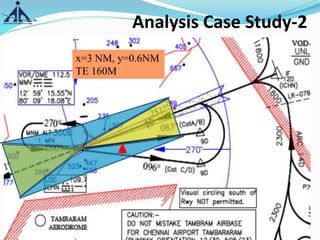
x=3 NM, y=0.6NM
TE 160M
Analysis Case Study-2
 X=3 NM
 Y=0.6 NM
 AGA=45M+THR ELEV(12 M)=57M
 PANS OPS=154M
[{(0.00355X3+0.143X.6)X1852-36.66}+12(THR Ele.)]
 REQUESTED TE=160M
6/20/2020 32
6/20/2020 33

Instrument approach procedures GSR 751 E provision & PANS OPS ops

  • 1.
    Instrument Approach Procedures GSR751 E Provision & PANS -OPS Arvind Kumar Singh CHQ,New Delhi
  • 2.
    Instrument Approach toLand (IAL) procedures 6/20/2020 2 Why are they required?
  • 3.
    Clear sky andgreat visibility 6/20/2020 3
  • 4.
  • 5.
  • 6.
     A seriesof predetermined manoeuvres  By reference to flight instruments  With specified protection from obstacles from the initial approach fix, or where applicable, from the beginning of a defined arrival route to a point from which a landing can be completed and  Thereafter, if a landing is not completed, to a position at which holding or en-route obstacle clearance criteria apply. 6/20/2020 6 IAL Procedure
  • 7.
    Role of PANS-OPSin NOC  Flight procedures are designed for normal operations as per the provisions of ICAO DOC 8168 Vol-II.  As any structure erected around an airport may adversely impact the Flight Procedures.  Regulate the permissible height of the proposed structure with respect to Flight Procedures.  Any adverse impact on Flight procedures due to any structure will adversely impact the aircraft operations.  To protect Flight procedures, permissible height of an structures needs to be regulated from PANS-OPS criteria.  Accordingly, NOC for height issued to any structure is the least of AGA, CNS and PANS-OPS.
  • 8.
     Minimum SectorAltitude (MSA)  Minimum Holding Altitude (MHA)  Minimum Vectoring Altitude (MVA)  Minimum Altitude of Initial and Intermediate Segments  OCA/H (Straight-in-and Circling) for all aircraft categories  STARs /SIDs procedure altitude.  Basic ILS Surface 6/20/2020 8 PANS-OPS Criteria(GSR 751 E)
  • 9.
    Segments of IAP Instrument Approach Procedure segments to be protected: 1. Arrival Route 2. Initial Approach Segment 3. Intermediate Approach Segment 4. Final Approach Segment 5. Missed Approach Segment 6. In addition, an area for Visual Circling is considered 6/20/2020 9
  • 10.
  • 11.
    6/20/2020 11 Types ofInstrument Approach Procedures 1. Non Precision Approach-VOR/DME, NDB 2. Precision Approach-ILS 3. RNAV (GNSS) LNAV,LNAV/VNAV,LPV& RNP AR
  • 12.
    6/20/2020 12 Non-Precision Approach •In India MDH 400 Ft OR More • Taking a fictitious obstacle of 45 M AGL • DGCA CAR Section 8 (Aircraft Operations) Series C Part 1 (AWO) • Visibility Requirement MDH FALS IALS BALS NALS 400 1100 1400 1600 1800
  • 13.
    6/20/2020 13 Precision ApproachCategories CATEGORY DH (ft) VIS (M) RVR( M) I >=200 800 550 II >=100 - 350 III A 50-100 - 175 III B <50 - 50 III C NO - NO
  • 14.
  • 15.
  • 16.
  • 17.
    Approach Slope ForSafe Landing 6/20/2020 17
  • 18.
    PANS-OPS Criteria Minimum SectorAltitude(MSA) – 30 NM around a nav-aid or significant point of the airport, providing at least 1000 ft of MOC over any obstacle. Minimum Holding Altitude(MHA) – At least 1000 ft of MOC over any obstacle in the specified area. Initial Approach Altitude - At least 1000 ft of MOC over any obstacle in the specified area. Intermediate Approach Altitude - At least 500 ft of MOC over any obstacle in the specified intermediate approach area. Obstacle Clearance Altitude(OCA straight –in) - At least 300/250 ft of MOC over any obstacle in the specified final approach area. Obstacle Clearance Altitude(OCA Circling) - At least 300/400 ft of MOC over any obstacle in the specified circling approach area.
  • 19.
    6/20/2020 19 Minimum SectorAltitute MSA: 2300 Ft Controlling Obstacle 2300-1000=1300 ft
  • 20.
    6/20/2020 20 Visual Circling OCA:770 Ft Controlling Obstacle 770-300=470 ft
  • 21.
    6/20/2020 21 VOR Procedure OCA:670 Ft Controlling Obstacle 670-250=420 ft
  • 22.
    6/20/2020 22 ILS Procedure OCA:530 Ft Controlling Obstacle 530-161=369 ft
  • 23.
    6/20/2020 23 LNAV VNAVProcedure OCA(LNAV): 670 Ft Controlling Obstacle 670-250=420 ft OCA(LNAV/VNAV): 590 Ft Controlling Obstacle 590-161=429 ft
  • 24.
    6/20/2020 24 LPV Procedure OCA:520 Ft Controlling Obstacle 520-161=359 ft
  • 25.
    CASE STUDIES VOR-VOMM RWY07 ILS-VOMM RWY 25 6/20/2020 25
  • 26.
    6/20/2020 26 Analysis Case Study-1 OCA:810(770 Ft) Controlling Obstacle 810-250=560 Ft
  • 27.
    6/20/2020 27 x=1.8NM, y=0.6NM TE700ft Analysis Case Study-1
  • 28.
    Analysis Case Study-1 X=1.8 NM  Y=0.6 NM  AGA=45M+THR ELEV(12 M)=57M  PANS OPS=170M(560 Ft)  REQUESTED TE=213M(700 ft) 6/20/2020 28
  • 29.
    6/20/2020 29 Analysis Case Study-1 OCA:330(278) Controlling Obstacle 330-161=169 ft
  • 30.
  • 31.
    6/20/2020 31 x=3 NM,y=0.6NM TE 160M Analysis Case Study-2
  • 32.
    Analysis Case Study-2 X=3 NM  Y=0.6 NM  AGA=45M+THR ELEV(12 M)=57M  PANS OPS=154M [{(0.00355X3+0.143X.6)X1852-36.66}+12(THR Ele.)]  REQUESTED TE=160M 6/20/2020 32
  • 33.