A Seminar Report
ON
Traffic Collision Avoidance System (TCAS)
Submitted by
Adithya Mallisetty
14BF1A04B7
II B.Tech. I Sem.
Under the guidance of
Ms.T. Devi Padmaja, M. Tech.
Asst. Professor
Dept of ELECTRONICS AND COMMUNICATION ENGINEERING
Sri Venkateswara College of Engineering
(Affiliated to Jawaharlal Nehru Technological University Anantapur,
Anantapuramu)
Karakambadi road, Tirupati- 517 507.
2015-2016
Abstract
A TRAFFIC COLLISION AVOIDANCE SYSTEM or TRAFFIC ALERT AND AND
COLLISION AVOIDANCE SYSTEM is an aircraft collision avoidance system designed to
reduce the incidence of mid-air collisions between aircraft. It monitors airspace around the air
craft to spot for any of the inbound aircrafts,birds etc…,
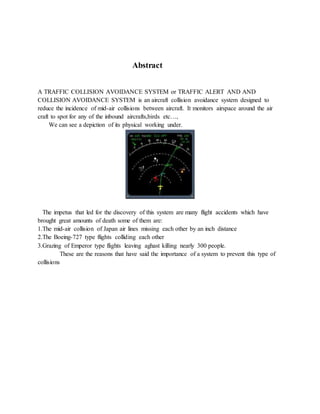
We can see a depiction of its physical working under.
The impetus that led for the discovery of this system are many flight accidents which have
brought great amounts of death some of them are:
1.The mid-air collision of Japan air lines missing each other by an inch distance
2.The Boeing-727 type flights colliding each other
3.Grazing of Emperor type flights leaving aghast killing nearly 300 people.
These are the reasons that have said the importance of a system to prevent this type of
collisions
Description
TCAS or ACAS is based on secondary surveillance radar transponder. It runs independently over
ground crew who are working at ATC.
In modern glass cockpit aircraft,the TCAS display maybe integrated in the
navigation display or electronic horizontal situation indicator, in older glass cockpit aircraft and
those with mechanical instrumentation , such an integrated TCAS display may replace the
mechanical vertical speed indicator.
System Declaration:
TCAS involves communication between all aircraft equipped with an appropriate transponder.
Each TCAS-equipped aircraft interrogates all other aircraft in a determined range about their
position(with 1.03GHz radio frequency). And all other aircraft reply to these interrogations (via
1.09GHz frequency). This cycle occurs several times per second. This interrogations mainly
occurs by triangulating the position of the aircraft that are responding for its questions that are
being asked by the current aircraft.
System components:
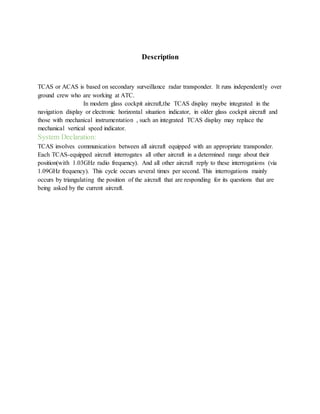
There are mainly three types of units that are required for the functioning of TCAS unit
perfectly. They are:-
TCAS computer unit:
Performs airspace surveillance ,intruder tracking ,its own aircraft altitude tracking ,threat
detection , Resolution advisory manoeuvre determination and selection, Generation of advisories
.The TCAS processor uses pressure altitude, radar altitude, discrete aircraft status inputs from its
own aircraft to control the collision avoidance logic parameters.
Antennas:
The antennas used by TCAS II include a directional antenna that is mounted aon the top of the
aircraft. Most installations use the optional directional antenna on the bottom of the aircraft. In
addition to the two TCAS antennas two other antennas are also required.
Cockpit presentation:
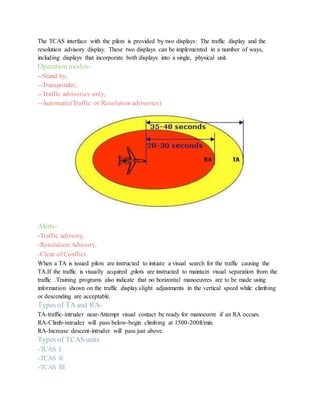
The TCAS interface with the pilots is provided by two displays: The traffic display and the
resolution advisory display. These two displays can be implemented in a number of ways,
including displays that incorporate both displays into a single, physical unit.
Operation modes-
--Stand by,
--Transponder,
--Traffic advisories only,
--Automatic(Traffic or Resolution advisories)
Alerts-
-Traffic advisory,
-Resolution Advisory,
-Clear of Conflict.
When a TA is issued pilots are instructed to initiate a visual search for the traffic causing the
TA.If the traffic is visually acquired ,pilots are instructed to maintain visual separation from the
traffic .Training programs also indicate that no horizontal manoeuvres are to be made using
information shown on the traffic display.slight adjustments in the vertical speed while climbing
or descending are acceptable.
Types of TA and RA-
TA-traffic-intruder near-Attempt visual contact be ready for manoeuvre if an RA occurs.
RA-Climb-intruder will pass below-begin climbing at 1500-200ft/min.
RA-Increase descent-intruder will pass just above.
Types of TCAS units
-TCAS I
-TCAS II
-TCAS III
-TCAS IV
Limitations of TCAS:
1. Pilots frequently cite TCAS II related auditory and work load interference with normal cockpit
duties.
2. It is limited to only support vertical separation advisories.
3. Like a controller TCAS II used mode c information to determine vertical separation on the
traffic.
Advantages
1. Cheap and capable
2. Voice based suggestions for the pilot
3. can give advisories both on vertical and horizontal basis.
Applications
-It can be employed in aircrafts carrying more than 7 persons.
References
1. EUROCONTROL ACAS website
2. ACAS Program work package 1
3. Change proposal CP116
4. ICAO document 9863-Chapter 6
Sign of Guide Sign of HOD

Tcas

  • 1.
    A Seminar Report ON TrafficCollision Avoidance System (TCAS) Submitted by Adithya Mallisetty 14BF1A04B7 II B.Tech. I Sem. Under the guidance of Ms.T. Devi Padmaja, M. Tech. Asst. Professor Dept of ELECTRONICS AND COMMUNICATION ENGINEERING Sri Venkateswara College of Engineering (Affiliated to Jawaharlal Nehru Technological University Anantapur, Anantapuramu) Karakambadi road, Tirupati- 517 507. 2015-2016
  • 2.
    Abstract A TRAFFIC COLLISIONAVOIDANCE SYSTEM or TRAFFIC ALERT AND AND COLLISION AVOIDANCE SYSTEM is an aircraft collision avoidance system designed to reduce the incidence of mid-air collisions between aircraft. It monitors airspace around the air craft to spot for any of the inbound aircrafts,birds etc…, We can see a depiction of its physical working under. The impetus that led for the discovery of this system are many flight accidents which have brought great amounts of death some of them are: 1.The mid-air collision of Japan air lines missing each other by an inch distance 2.The Boeing-727 type flights colliding each other 3.Grazing of Emperor type flights leaving aghast killing nearly 300 people. These are the reasons that have said the importance of a system to prevent this type of collisions
  • 3.
    Description TCAS or ACASis based on secondary surveillance radar transponder. It runs independently over ground crew who are working at ATC. In modern glass cockpit aircraft,the TCAS display maybe integrated in the navigation display or electronic horizontal situation indicator, in older glass cockpit aircraft and those with mechanical instrumentation , such an integrated TCAS display may replace the mechanical vertical speed indicator. System Declaration: TCAS involves communication between all aircraft equipped with an appropriate transponder. Each TCAS-equipped aircraft interrogates all other aircraft in a determined range about their position(with 1.03GHz radio frequency). And all other aircraft reply to these interrogations (via 1.09GHz frequency). This cycle occurs several times per second. This interrogations mainly occurs by triangulating the position of the aircraft that are responding for its questions that are being asked by the current aircraft.
  • 4.
    System components: There aremainly three types of units that are required for the functioning of TCAS unit perfectly. They are:- TCAS computer unit: Performs airspace surveillance ,intruder tracking ,its own aircraft altitude tracking ,threat detection , Resolution advisory manoeuvre determination and selection, Generation of advisories .The TCAS processor uses pressure altitude, radar altitude, discrete aircraft status inputs from its own aircraft to control the collision avoidance logic parameters. Antennas: The antennas used by TCAS II include a directional antenna that is mounted aon the top of the aircraft. Most installations use the optional directional antenna on the bottom of the aircraft. In addition to the two TCAS antennas two other antennas are also required. Cockpit presentation:
  • 5.
    The TCAS interfacewith the pilots is provided by two displays: The traffic display and the resolution advisory display. These two displays can be implemented in a number of ways, including displays that incorporate both displays into a single, physical unit. Operation modes- --Stand by, --Transponder, --Traffic advisories only, --Automatic(Traffic or Resolution advisories) Alerts- -Traffic advisory, -Resolution Advisory, -Clear of Conflict. When a TA is issued pilots are instructed to initiate a visual search for the traffic causing the TA.If the traffic is visually acquired ,pilots are instructed to maintain visual separation from the traffic .Training programs also indicate that no horizontal manoeuvres are to be made using information shown on the traffic display.slight adjustments in the vertical speed while climbing or descending are acceptable. Types of TA and RA- TA-traffic-intruder near-Attempt visual contact be ready for manoeuvre if an RA occurs. RA-Climb-intruder will pass below-begin climbing at 1500-200ft/min. RA-Increase descent-intruder will pass just above. Types of TCAS units -TCAS I -TCAS II -TCAS III
  • 6.
    -TCAS IV Limitations ofTCAS: 1. Pilots frequently cite TCAS II related auditory and work load interference with normal cockpit duties. 2. It is limited to only support vertical separation advisories. 3. Like a controller TCAS II used mode c information to determine vertical separation on the traffic. Advantages 1. Cheap and capable 2. Voice based suggestions for the pilot 3. can give advisories both on vertical and horizontal basis. Applications -It can be employed in aircrafts carrying more than 7 persons. References 1. EUROCONTROL ACAS website 2. ACAS Program work package 1 3. Change proposal CP116 4. ICAO document 9863-Chapter 6 Sign of Guide Sign of HOD