1
Preface

    This booklet provides the background for
    a better understanding of the Traffic Alert
    and Collision Avoidance System (TCAS II)
    by     personnel    involved     in    the
    implementation and operation of TCAS II.
    This booklet is an update of a similar
    booklet published in 1990 by the Federal
    Aviation Administration (FAA). This
    update describes TCAS II Version 7.


2
Table of Contents
PREFACE ......................................................................................................................................................2

THE TCAS SOLUTION...............................................................................................................................5
    BACKGROUND .............................................................................................................................................6
    TCAS II DEVELOPMENT ..............................................................................................................................7
    IN-SERVICE OPERATIONAL EVALUATIONS ..................................................................................................8
    TOWARD A REQUIREMENT FOR WORLDWIDE CARRIAGE ............................................................................9
    STANDARDS AND GUIDANCE MATERIAL ...................................................................................................10
TCAS II TECHNICAL DESCRIPTION ..................................................................................................11
    SYSTEM COMPONENTS ...............................................................................................................................11
      Mode S/TCAS Control Panel ...............................................................................................................11
      Antennas ..............................................................................................................................................12
      Cockpit Presentation............................................................................................................................12
             Traffic Display................................................................................................................................................ 12
             Resolution Advisory Display .......................................................................................................................... 14
TARGET SURVEILLANCE .....................................................................................................................17
    MODE S SURVEILLANCE............................................................................................................................17
    MODE C SURVEILLANCE ...........................................................................................................................17
    INTERFERENCE LIMITING...........................................................................................................................20
    ELECTROMAGNETIC COMPATIBILITY ........................................................................................................20
COLLISION AVOIDANCE CONCEPTS ................................................................................................21
    SENSITIVITY LEVEL ...................................................................................................................................21
    TAU ...........................................................................................................................................................22
    PROTECTED VOLUME ................................................................................................................................23
CAS LOGIC FUNCTIONS ........................................................................................................................26
    TRACKING .................................................................................................................................................26
    TRAFFIC ADVISORY ...................................................................................................................................27
    THREAT DETECTION ..................................................................................................................................27
    RESOLUTION ADVISORY SELECTION .........................................................................................................28
    TCAS/TCAS COORDINATION ...................................................................................................................30
    ADVISORY ANNUNCIATION .......................................................................................................................31
    AIR/GROUND COMMUNICATIONS ..............................................................................................................32
    TRAFFIC ADVISORY DISPLAY ....................................................................................................................32
    RESOLUTION ADVISORY DISPLAYS ...........................................................................................................32
    AURAL ANNUNCIATIONS ...........................................................................................................................32
    PERFORMANCE MONITORING ....................................................................................................................32
USE OF TCAS .............................................................................................................................................34
    REGULATIONS AND OPERATIONAL GUIDANCE ..........................................................................................34
      Controllers Responsibilities.................................................................................................................34
      Pilot Responsibilities ...........................................................................................................................35
    OPERATIONAL EXPERIENCE.......................................................................................................................37
    TRAINING PROGRAMS ...............................................................................................................................38
      Pilot Training Programs......................................................................................................................39
      Controller Training Programs.............................................................................................................39
SUMMARY..................................................................................................................................................40


                                                                                                                                                                         3
ABBREVIATIONS .....................................................................................................................................41

GLOSSARY .................................................................................................................................................42

BIBLIOGRAPHY .......................................................................................................................................45


4
against aircraft that do not have an operating
The TCAS Solution                                 transponder.

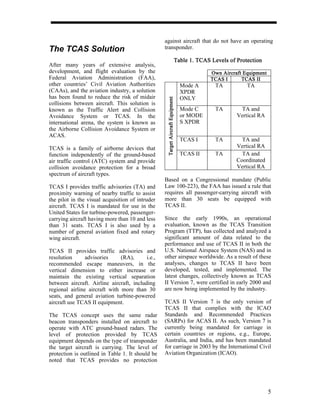
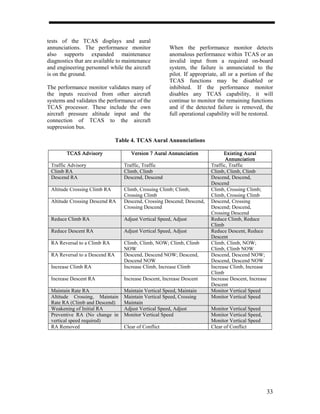
                                                                               Table 1. TCAS Levels of Protection
After many years of extensive analysis,
development, and flight evaluation by the                                                                 Equip
                                                                                             Own Aircraft Equip ment
Federal Aviation Administration (FAA),                                                       TCAS I      TCAS II
other countries’ Civil Aviation Authorities                                      Mode A        TA          TA
(CAAs), and the aviation industry, a solution                                    XPDR
has been found to reduce the risk of midair                                      ONLY


                                                                   Equipment
                                                   Target Aircraft Equipment
collisions between aircraft. This solution is
known as the Traffic Alert and Collision                                         Mode C        TA       TA and
Avoidance System or TCAS. In the                                                 or MODE               Vertical RA
international arena, the system is known as                                      S XPDR
the Airborne Collision Avoidance System or
ACAS.
                                                                                 TCAS I        TA        TA and
TCAS is a family of airborne devices that                                                              Vertical RA
function independently of the ground-based                                       TCAS II       TA        TA and
air traffic control (ATC) system and provide                                                           Coordinated
collision avoidance protection for a broad                                                             Vertical RA
spectrum of aircraft types.
                                                  Based on a Congressional mandate (Public
TCAS I provides traffic advisories (TA) and       Law 100-223), the FAA has issued a rule that
proximity warning of nearby traffic to assist     requires all passenger-carrying aircraft with
the pilot in the visual acquisition of intruder   more than 30 seats be equipped with
aircraft. TCAS I is mandated for use in the       TCAS II.
United States for turbine-powered, passenger-
carrying aircraft having more than 10 and less    Since the early 1990s, an operational
than 31 seats. TCAS I is also used by a           evaluation, known as the TCAS Transition
number of general aviation fixed and rotary       Program (TTP), has collected and analyzed a
wing aircraft.                                    significant amount of data related to the
                                                  performance and use of TCAS II in both the
TCAS II provides traffic advisories and           U.S. National Airspace System (NAS) and in
resolution      advisories     (RA),      i.e.,   other airspace worldwide. As a result of these
recommended escape maneuvers, in the              analyses, changes to TCAS II have been
vertical dimension to either increase or          developed, tested, and implemented. The
maintain the existing vertical separation         latest changes, collectively known as TCAS
between aircraft. Airline aircraft, including     II Version 7, were certified in early 2000 and
regional airline aircraft with more than 30       are now being implemented by the industry.
seats, and general aviation turbine-powered
aircraft use TCAS II equipment.                   TCAS II Version 7 is the only version of
                                                  TCAS II that complies with the ICAO
The TCAS concept uses the same radar              Standards and Recommended Practices
beacon transponders installed on aircraft to      (SARPs) for ACAS II. As such, Version 7 is
operate with ATC ground-based radars. The         currently being mandated for carriage in
level of protection provided by TCAS              certain countries or regions, e.g., Europe,
equipment depends on the type of transponder      Australia, and India, and has been mandated
the target aircraft is carrying. The level of     for carriage in 2003 by the International Civil
protection is outlined in Table 1. It should be   Aviation Organization (ICAO).
noted that TCAS provides no protection


                                                                                                                       5
Background                                        International Civil Aviation and its use is
                                                  regulated in Procedures for Air Navigation
The development of an effective airborne          Services ---- Aircraft Operations (PANS-OPS)
                                                              -
collision avoidance system has been a goal of     and Procedures for Air Navigation Services
the aviation industry for a number of years.      ---- Rules of the Air and Air Traffic Services
                                                     -
As air traffic has continued to grow over the     (PANS-RAC). In November 1995, the
years, development of and improvements to         SARPs and Guidance Material for ACAS II
ATC systems and procedures have made it           were approved, and they appear in Annex 10
possible for controllers and pilots to cope       of the Convention on International Civil
with this increase in operations, while           Aviation.
maintaining the necessary levels of flight
safety. However, the risk of airborne collision   During the late 1950s and early 1960s,
remains. That is why, as early as the 1950s,      collision avoidance development efforts
the concept and initial development of an         included an emphasis on passive and
airborne collision avoidance system, acting as    noncooperating systems. These concepts
a last resort, was being considered.              proved to be impractical. One major
                                                  operational problem that could not be
A series of midair collisions that occurred in    overcome with these designs was the need for
the United States, has been the impetus for       nonconflicting, complementary avoidance
the development and refinement of an              maneuvers that require a high-integrity
airborne collision avoidance system. These        communications link between aircraft
tragic milestones included the following          involved in the conflict.
collisions:
                                                  One of the most important developments in
      • In 1956, the collision between two        the collision avoidance concept was the
        airliners over the Grand Canyon           derivation of the range/range rate, or tau,
        spurred both the airlines and the         concept by Dr. John S. Morrell of Bendix.
        aviation authorities to initiate system   This concept is based on time, rather than
        development studies for an effective      distance, to the closest point of approach in
        system.                                   an encounter.
      • In 1978, the collision between a light
        aircraft and an airliner over San Diego   During the late 1960s and early 1970s,
        led the FAA to initiate the               several manufacturers developed aircraft
        development of TCAS.                      collision avoidance systems based on
     • Finally, in 1986, the collision between    interrogator/transponder and time/frequency
        a DC-9 and a private aircraft over        techniques.     Although     these     systems
        Cerritos, California, resulted in a       functioned properly during staged aircraft
        Congressional mandate that required       encounter testing, the FAA and the airlines
        some categories of American and           jointly concluded that in normal airline
        foreign aircraft to be equipped with      operations, they would generate a high rate of
        TCAS for flight operations in U.S.        unnecessary alarms in dense terminal areas.
        airspace.                                 This problem would have undermined the
                                                  credibility of the system with the flight
                                                  crews. In addition, each target aircraft would
In parallel to the development of TCAS
                                                  have to be equipped with the same equipment
equipment in the United States, ICAO has
                                                  to provide protection to an equipped aircraft.
been working since the early 1980s to
develop standards for ACAS. ICAO                  In the mid 1970s, the Beacon Collision
officially recognized ACAS on 11                  Avoidance System (BCAS) was developed.
November 1993. Its descriptive definition         BCAS used reply data from the Air Traffic
appears in Annex 2 of the Convention on


6
Control Radar Beacon System (ATCRBS)                    aircraft. When the intruder aircraft is
transponders to determine an intruder’s range           also fitted with TCAS II, both TCAS’
and altitude. At that time, ATCRBS                      coordinate their RAs through the
transponders were installed in all airline and          Mode S data link to ensure that
military aircraft and a large number of                 complementary resolution senses are
general aviation aircraft. Thus, any BCAS-              selected.
equipped aircraft would be able to detect and
be protected against the majority of other        TCAS II is designed to operate in traffic
aircraft in the air without imposing additional   densities of up to 0.3 aircraft per square
equipment requirements on those other             nautical mile (nmi), i.e., 24 aircraft within a 5
aircraft. In addition, the discrete address       nmi radius, which is the highest traffic
communications techniques used in the             density envisioned over the next 20 years.
Mode S transponders then under development
permitted two conflicting BCAS aircraft to        Development of the TCAS II collision
perform coordinated escape maneuvers with a       avoidance      algorithms    included    the
high degree of reliability.                       completion of millions of computer
                                                  simulations to optimize the protection
TCAS II development                               provided by the system, while minimizing the
                                                  frequency of unacceptable or nuisance
In 1981, the FAA made a decision to develop       advisories. In addition to these computer
and implement TCAS utilizing the basic            simulations, early versions of the collision
BCAS design for interrogation and tracking,       avoidance algorithms were evaluated via pilot
but providing additional capabilities.            in the loop simulations and during the
                                                  operation of prototype equipment in FAA
TCAS is designed to work autonomously of          aircraft throughout the NAS.
the aircraft navigation equipment and
                                                  Extensive safety studies were also performed
independently of the ground systems used
                                                  to estimate the safety improvements that
to provide ATC services. TCAS interrogates
                                                  could be expected with the introduction of
ICAO-compliant transponders of all aircraft
                                                  TCAS into service. These safety studies have
in the vicinity and based on the replies
                                                  been continuously updated throughout the
received, tracks the slant range, altitude
                                                  refinement of the collision avoidance
(when it is included in the reply message),
                                                  algorithms. The safety studies have shown
and bearing of surrounding traffic. From
                                                  that TCAS II will resolve nearly all of the
several successive replies, TCAS calculates a
                                                  critical near midair collisions involving
time to reach the CPA (Closest Point of
                                                  airline aircraft. However, TCAS cannot
Approach) with the intruder, by dividing the
                                                  handle all situations. In particular, it is
range by the closure rate. This time value is
                                                  dependent on the accuracy of the threat
the main parameter for issuing alerts. If the
                                                  aircraft’s reported altitude and on the
transponder replies from nearby aircraft
                                                  expectation that the threat aircraft will not
includes their altitude, TCAS also computes
                                                  make an abrupt maneuver that defeats the
the time to reach co-altitude. TCAS can issue
                                                  TCAS RA. The safety study also shows that
two types of alerts:
                                                  TCAS II will induce some critical near midair
    • TAs to assist the pilot in the visual       collisions, but overall, the number of near
       search for the intruder aircraft and to    midair collisions with TCAS is less than 10%
       prepare the pilot for a potential RA;      of the number that would have occurred
       and                                        without the presence of TCAS.
    • RAs to recommend maneuvers that will
       either increase or maintain the existing   Extensive studies were also carried out to
       vertical separation from an intruder       evaluate the interaction between TCAS and


                                                                                                 7
ATC. The analysis of ATC radar data                In 1987, Piedmont flew an upgraded version
showed that in 90% of the cases, the vertical      of the Dalmo Victor equipment for
displacement required to resolve an RA was         approximately 1200 hours. During this
less than 300 feet. Based on these studies, it     evaluation, the TCAS displays were visible to
was concluded that the possibility of the          the pilots and the pilots were permitted to use
response to a TCAS RA causing an aircraft to       the information provided to maneuver the
infringe on the protected airspace for another     aircraft in response to RAs. This installation
aircraft was remote. However, operational          included a dedicated TCAS data recorder so
experience has shown that the actual               that quantitative data could be obtained on the
displacement resulting from an RA response         performance of TCAS. In addition, pilot and
is often much greater than 300 feet, and           observers completed questionnaires following
TCAS has had an adverse affect on the              each TA and RA so that assessments could be
controllers and the ATC system. Because of         made regarding the value of the system to the
this operational experience, Version 7             flight crews.
contains numerous changes and enhancements
to the collision avoidance algorithms, the         This evaluation also provided the basis for the
aural annunciations, the RA displays, and          development of avionics certification criteria
pilot training programs to minimize the            for production equipment, validated pilot
displacement while responding to an RA.            training guidelines, provided the justification
                                                   for improvements to the TCAS algorithms
In-Service
In-Service Operational                             and displays, and validated the pilot
                                                   procedures for using the equipment.
Evalua
Evaluations
                                                   Following the successful completion of the
To ensure that TCAS performed as expected          second Piedmont evaluation, the FAA
in its intended operational environment,           initiated the Limited Installation Program
several operational evaluations of the system      (LIP). Under the LIP, Bendix-King and
have been conducted. These evaluations             Honeywell built and tested commercial
provided a means for the pilots using TCAS         quality, pre-production TCAS II equipment
and the controllers responsible for providing      that was in compliance with the TCAS II
separation services to TCAS-equipped               Minimum         Operational     Performance
aircraft to have a direct influence on the final   Standards (MOPS). Engineering flight tests
system design and performance requirements.        of this equipment were conducted on the
                                                   manufacturers' aircraft, as well as FAA
The initial operational evaluation of TCAS         aircraft. Using data collected during these
was conducted by Piedmont Airlines in 1982.        flight tests, together with data collected
Using a TCAS II prototype unit manufactured        during factory and ground testing, both
by     Dalmo      Victor,   Piedmont     flew      manufacturers’ equipment was certified via a
approximately 900 hours in scheduled,              Supplemental Type Certificate (STC) for use
revenue service while recording data on the        in commercial, revenue service.
performance of TCAS. These recorded data
were analyzed to assess the frequency and          The Bendix-King units were operated by
suitability of the TAs and RAs. During this        United Airlines on a B737-200 and a DC8-73
evaluation, the TCAS displays were not             aircraft. Northwest Airlines operated the
visible to the pilots, and observers from the      Honeywell equipment on two MD-80 aircraft.
aviation industry flew with the aircraft to        Over 2000 hours of operating experience
monitor the system performance and to              were obtained with the United aircraft and
provide technical and operational comments         approximately 2500 hours of operating
on its design.                                     experience were obtained with the Northwest
                                                   installations.


8
development of Version 7. The MOPS for
The experience provided by these operational     Version 7 was approved in December 1997
evaluations resulted in further enhancements     and Version 7 units became available for
to the TCAS II logic, improved test              installation in late 1999. Version 7 is
procedures, and finalized the procedures for     expected to further improve TCAS
certification of production equipment. The       compatibility with the air traffic control
most important information obtained from the     system throughout the world.
operational evaluations was the nearly
unanimous conclusion that TCAS II was safe,      Toward a Requirement for
operationally effective, and ready for more
widespread implementation.                       Worldwide Carriage
With the successful completion of these early    The United States was the first member of
operational evaluations, there was a high        ICAO to mandate carriage of an airborne
degree of confidence that a system with          collision avoidance system for passenger
sufficient maturity was available to meet the    carrying aircraft operating in its airspace.
Congressionally mandated implementation of
TCAS II in U.S. airspace.                        Because of this mandate, the number of long-
                                                 range aircraft fitted with TCAS II and
As part of this mandated implementation , the    operating in European and Asian airspace
largest operational evaluation of TCAS,          continued to increase, although the system
known as the TTP, was initiated. The TTP         carriage and operation were not mandatory in
began in late 1991 and has continued through     this airspace. As studies, operational
the initial implementation, the mandated         experience, and evaluations continued to
upgrade to Version 6.04A Enhanced, and is        demonstrate the safety benefits of TCAS II,
still active as Version 7 enters operation. In   some non-U.S. airlines also equipped their
conjunction with the TTP in the U.S.,            short-haul fleets with TCAS.
EUROCONTROL has conducted extensive
evaluations of TCAS operations in Europe,        In 1995, the EUROCONTROL Committee of
and the Japan Civil Aviation Bureau (JCAB)       Management approved an implementation
has conducted similar assessments of             policy and schedule for the mandatory
TCAS II performance in Japanese and              carriage of TCAS II in Europe. The European
surrounding airspace. Other countries also       Air Traffic Control Harmonization and
conducted operational evaluations as the use     Integration Program (EATCHIP) Project
of TCAS increased during the past 10 years.      Board then ratified this policy. The approved
                                                 policy requires the following:
The system improvements suggested as a               • From 1 January 2000, all civil fixed-
result of these TCAS II evaluations led to the         wing, turbine-powered aircraft having a
development and release of Version 6.04A               maximum take-off mass exceeding
Enhanced in 1993. The principal aim of this            15,000 kg, or a maximum approved
modification was the reduction of nuisance             passenger seating configuration of
alerts, which were occurring at low altitudes          more than 30, will be required to be
and during level-off encounters, and the               equipped with TCAS II, Version 7; and
correction of a problem in the altitude
                                                    • From 1 January 2005, all civil fixed-
crossing logic.
                                                      wing, turbine-powered aircraft having a
                                                      maximum take-off mass exceeding
After the implementation of Version 6.04A
                                                      5,700 kg, or a maximum approved
Enhanced, operational evaluations continued
                                                      passenger seating configuration of
with the same objective, and proposed
                                                      more that 19, will be required to be
performance improvements led to the
                                                      equipped with TCAS II, Version 7.


                                                                                            9
describes the standards, requirements, and
Because of delays in obtaining Version 7          test procedures for TCAS Version 7.
equipment, a number of exemptions to the
1 January 2000 date were granted by               RTCA has also published MOPS for TCAS I,
EUROCONTROL. Each of the exemptions               DO-197A, which defines the requirements
granted have a unique end date for the            and test procedures for TCAS I equipment
exemption, but all exemptions will expire on      intended for use on airline aircraft operated in
31 March 2001.                                    revenue service.

Other countries, including Argentina,             The FAA has issued Technical Standard
Australia, Chile, Egypt, India, and Japan,        Order (TSO) C118a that defines the
have also mandated carriage of TCAS II            requirements for the approval of TCAS I
avionics on aircraft operating in their           equipment. A draft Advisory Circular
respective airspace.                              outlining the certification requirements and
                                                  the requirements for obtaining operational
The demonstrated safety benefits of the           approval of the system has been prepared and
equipment, and the 1996 midair collision          is being used by the FAA’s Aircraft
between a Saudia Boeing 747 and a                 Certification Offices (ACO) as the basis for
Kazakhstan Ilyushin 76, resulted in an ICAO       approving TCAS I installations and
proposal for worldwide mandatory carriage of      operation.
ACAS II on all aircraft, including cargo
aircraft, beginning in 2003. To guarantee the     For TCAS II, TSO C119b and Advisory
effectiveness of this mandate, ICAO has also      Circular 20-131a have been published for use
mandated the carriage and use of pressure         by FAA airworthiness authorities in
altitude reporting transponders, which are a      certifying the installation of TCAS II on
prerequisite for generating RAs.                  various classes of aircraft. Advisory Circular
                                                  120-55a defines the procedures for obtaining
After the mid-air collision between a German      operational approval for the use of TCAS II.
Air Force Tupolev 154 and a U.S. Air Force        While the FAA developed these documents,
C-141 transport aircraft, off Namibia in          they have been used throughout the world by
September 1997, urgent consideration was          civil aviation authorities to approve the
given to the need to equip military transport     installation and use of TCAS.
aircraft with TCAS. Although only a limited
number of countries have included military        ICAO SARPs and Guidance Material for
and other government-owned aircraft in their      ACAS I and ACAS II have been published in
mandates for TCAS carriage, several               Annex 10. The procedures for use of ACAS
countries, including the United States, have      have been published in PANS-RAC and
initiated programs to equip tanker, transport,    PANS-OPS. These documents provide
and cargo aircraft within their military fleets   international standardization for collision
with TCAS II Version 7.                           avoidance systems.

Standards and Guidance                            For the avionics, the Airlines Electronic
                                                  Engineering Committee (AEEC) has
Material                                          completed work on ARINC Characteristic
                                                  735 to define the form, fit, and function of
The data obtained from the FAA and industry       TCAS II units. Similar work on the Mode S
sponsored studies, simulations, flight tests,     transponder has been competed, and the
and operational evaluations have enabled          results of that work are contained in ARINC
RTCA to publish the MOPS for TCAS II.             Characteristic 718.
The current version of the MOPS, DO-185A,


10
TCAS II Technical
Description

System components
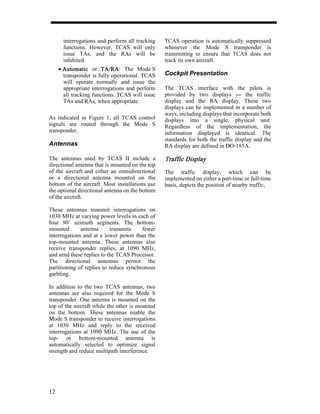
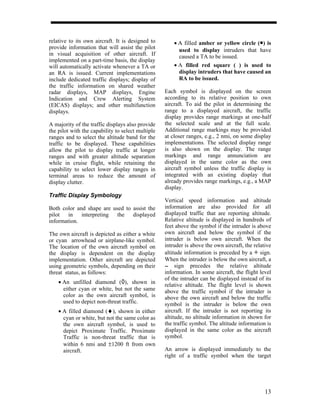
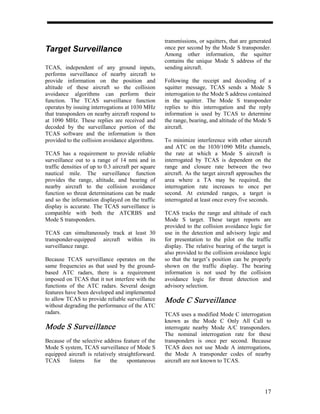
Figure 1 is a block diagram of TCAS II. A
TCAS II installation consists of the following          Figure 1. TCAS II Block Diagram
major components.
                                                    Mode S Transponder
TCAS Computer Unit
                                                    A Mode S transponder is required to be
The TCAS Computer Unit, or TCAS                     installed and operational for TCAS II to be
Processor, performs airspace surveillance,          operational. If the Mode S transponder fails,
intruder tracking, its own aircraft altitude        the TCAS Performance Monitor will detect
tracking, threat detection, RA maneuver             this failure and automatically place TCAS
determination and selection, and generation         into Standby. The Mode S transponder
of advisories. The TCAS Processor uses              performs the normal functions to support the
pressure altitude, radar altitude, and discrete     ground-based ATC system and can work with
aircraft status inputs from its own aircraft to     either an ATCRBS or a Mode S ground
control the collision avoidance logic               sensor. The Mode S transponder is also used
parameters that determine the protection            to provide air-to-air data exchange between
volume around the TCAS aircraft. If a               TCAS-equipped aircraft so that coordinated,
tracked aircraft is a collision threat, the         complementary RAs can be issued when
processor selects an avoidance maneuver that        required.
will provide adequate vertical miss distance
from the intruder while minimizing the
                                                    Mode S/TCAS Control Panel
perturbations to the existing flight path. If the
threat aircraft is also equipped with TCAS II,
the avoidance maneuver will be coordinated          A single control panel is provided to allow
with the threat aircraft.                           the flight crew to select and control all TCAS
                                                    equipment, including the TCAS Processor,
    DIRECTIONAL                                     the Mode S transponder, and in some cases,
    ANTENNA                                         the TCAS displays. A typical control panel
    (TOP)                                           provides four basic control positions:
              RADAR ALTITUDE &
                                   PRESSURE             • Stand-by
                                                          Stand-by: Power is applied to the
              DISCRETE INPUTS
                                   ALTITUDE               TCAS Processor and the Mode S
                TCAS                                      transponder, but TCAS does not issue
              COMPUTER                                    any interrogations and the transponder
                UNIT            MODE S
                             TRANSPONDER                  will    reply    to   only     discrete
                                                          interrogations.
                                                        • Transponder The Mode S transponder
                                                          Transponder:
                                                          is fully operational and will reply to all
BOTTOM              RA      RA
                    Dis-    Dis-
                                                          appropriate     ground    and      TCAS
OMNI
ANTENNA             play    play                          interrogations. TCAS remains in
(Optional                                                 Standby.
Directional
Antenna)                                                • TA Only: The Mode S transponder is
                                                              Only
                                                          fully operational. TCAS will operate
                 AURAL                                    normally and issue the appropriate
                 ANNUNCIATION       MODE S/TCAS
                                     CONTROL
                                      PANEL


                                                                                                 11
                         TA
                       Display
interrogations and perform all tracking   TCAS operation is automatically suppressed
       functions. However, TCAS will only        whenever the Mode S transponder is
       issue TAs, and the RAs will be            transmitting to ensure that TCAS does not
       inhibited.                                track its own aircraft.
     • Automatic or TA/RA The Mode S
                        TA/RA:
       transponder is fully operational. TCAS    Cockpit Presentation
       will operate normally and issue the
       appropriate interrogations and perform    The TCAS interface with the pilots is
       all tracking functions. TCAS will issue   provided by two displays ---- the traffic
                                                                                  -
       TAs and RAs, when appropriate.            display and the RA display. These two
                                                 displays can be implemented in a number of
                                                 ways, including displays that incorporate both
As indicated in Figure 1, all TCAS control       displays into a single, physical unit.
signals are routed through the Mode S            Regardless of the implementation, the
transponder.                                     information displayed is identical. The
                                                 standards for both the traffic display and the
Antennas                                         RA display are defined in DO-185A.

The antennas used by TCAS II include a           Traffic Display
directional antenna that is mounted on the top
of the aircraft and either an omnidirectional    The traffic display, which can be
or a directional antenna mounted on the          implemented on either a part-time or full-time
bottom of the aircraft. Most installations use   basis, depicts the position of nearby traffic,
the optional directional antenna on the bottom
of the aircraft.

These antennas transmit interrogations on
1030 MHz at varying power levels in each of
four 90˚ azimuth segments. The bottom-
mounted       antenna       transmits   fewer
interrogations and at a lower power than the
top-mounted antenna. These antennas also
receive transponder replies, at 1090 MHz,
and send these replies to the TCAS Processor.
The directional antennas permit the
partitioning of replies to reduce synchronous
garbling.

In addition to the two TCAS antennas, two
antennas are also required for the Mode S
transponder. One antenna is mounted on the
top of the aircraft while the other is mounted
on the bottom. These antennas enable the
Mode S transponder to receive interrogations
at 1030 MHz and reply to the received
interrogations at 1090 MHz. The use of the
top- or bottom-mounted antenna is
automatically selected to optimize signal
strength and reduce multipath interference.


12
relative to its own aircraft. It is designed to        • Α filled amber or yellow circle (•) is
provide information that will assist the pilot           used to display intruders that have
in visual acquisition of other aircraft. If              caused a TA to be issued.
implemented on a part-time basis, the display
will automatically activate whenever a TA or           • A filled red square (&) is used to
an RA is issued. Current implementations                 display intruders that have caused an
include dedicated traffic displays; display of           RA to be issued.
the traffic information on shared weather
radar displays, MAP displays, Engine               Each symbol is displayed on the screen
Indication and Crew Alerting System                according to its relative position to own
(EICAS) displays; and other multifunction          aircraft. To aid the pilot in determining the
displays.                                          range to a displayed aircraft, the traffic
                                                   display provides range markings at one-half
A majority of the traffic displays also provide    the selected scale and at the full scale.
the pilot with the capability to select multiple   Additional range markings may be provided
ranges and to select the altitude band for the     at closer ranges, e.g., 2 nmi, on some display
traffic to be displayed. These capabilities        implementations. The selected display range
allow the pilot to display traffic at longer       is also shown on the display. The range
ranges and with greater altitude separation        markings and range annunciation are
while in cruise flight, while retaining the        displayed in the same color as the own
capability to select lower display ranges in       aircraft symbol unless the traffic display is
terminal areas to reduce the amount of             integrated with an existing display that
display clutter.                                   already provides range markings, e.g., a MAP
                                                   display.
Traffic Display Symbology
                                                   Vertical speed information and altitude
Both color and shape are used to assist the        information are also provided for all
pilot   in   interpreting  the   displayed         displayed traffic that are reporting altitude.
information.                                       Relative altitude is displayed in hundreds of
                                                   feet above the symbol if the intruder is above
The own aircraft is depicted as either a white     own aircraft and below the symbol if the
or cyan arrowhead or airplane-like symbol.         intruder is below own aircraft. When the
The location of the own aircraft symbol on         intruder is above the own aircraft, the relative
the display is dependent on the display            altitude information is preceded by a + sign.
implementation. Other aircraft are depicted        When the intruder is below the own aircraft, a
using geometric symbols, depending on their        -- sign precedes the relative altitude
                                                    -
threat status, as follows:                         information. In some aircraft, the flight level
                                                   of the intruder can be displayed instead of its
    • Αn unfilled diamond (à), shown in            relative altitude. The flight level is shown
      either cyan or white, but not the same       above the traffic symbol if the intruder is
      color as the own aircraft symbol, is         above the own aircraft and below the traffic
      used to depict non-threat traffic.           symbol is the intruder is below the own
    • Α filled diamond (♦), shown in either        aircraft. If the intruder is not reporting its
      cyan or white, but not the same color as     altitude, no altitude information in shown for
      the own aircraft symbol, is used to          the traffic symbol. The altitude information is
      depict Proximate Traffic. Proximate          displayed in the same color as the aircraft
      Traffic is non-threat traffic that is        symbol.
      within 6 nmi and ±1200 ft from own
      aircraft.                                    An arrow is displayed immediately to the
                                                   right of a traffic symbol when the target


                                                                                                13
aircraft is reporting its altitude and is           Resolution Advisory Display
                                                               Advisory
climbing or descending at more than 600
fpm. An up arrow is used for a climbing             The RA display provides the pilot with
aircraft; a down arrow is used for a                information on the vertical speed or pitch
descending aircraft. The arrow is displayed in      angle to fly or avoid to resolve an encounter.
the same color as the aircraft symbol.              The RA display is typically implemented on
                                                    an instantaneous vertical speed indicator
When an aircraft causing a TA or RA is              (IVSI); a vertical speed tape that is part of a
beyond the currently selected range of the          Primary Flight Display (PFD); or using pitch
traffic display, half TA or RA symbols will         cues displayed on the PFD. RA guidance has
be displayed at the edge of the display at the      also been implemented on a Heads-Up
proper      relative   bearing.    In     some      Display (HUD). The implementations using
implementations, a written message such as          the IVSI or a vertical speed tape use red and
TRAFFIC, TFC, or TCAS is displayed on the           green lights or markings to indicate the
traffic display if the intruder is beyond the       vertical speeds to be avoided (red) and the
selected display range. The half symbol or the      desired vertical speed to be flown (green). An
written message will remain displayed until         implementation using pitch cues uses a
the traffic moves within the selected display       unique shape on the PFD to show the pitch
range; the pilot increases the range on a           angle to be flown or avoided to resolve an
variable range display to allow the intruder to     encounter. HUD implementations also use a
be displayed; or the pilot selects a display        unique shape to indicate the flight path to be
mode that allows traffic to be displayed.           flown or avoided to resolve an encounter.

In some instances, TCAS may not have a              In     general,     the    round-dial     IVSI
reliable bearing for an intruder causing a TA       implementation is used on the older nonglass
or RA. Because bearing information is used          aircraft. However, some operators have
for display purposes only, the lack of bearing      implemented this display in their glass
information does not affect the ability of          aircraft to provide a common display across
TCAS to issue TAs and RAs. When a ‘‘No-             their fleet types. Some IVSI implementations
Bearing’’ TA or RA is issued, the threat level,     use mechanical instruments with a series of
as well as the range, relative altitude, and        red and green LEDs around the perimeter of
vertical rate of the intruder, are written on the   the display, while other implementations use
traffic display. This text is shown in red for      an LCD display that draws the red and green
an RA and in amber or yellow for a TA. For          arcs at the appropriate locations. The LCD
example, if an RA was issued against an             display implementations also have the
intruder at a range of 4.5 nmi and with a           capability to provide both the traffic and RA
relative altitude of +1200 feet and                 display on a single instrument.
descending, the ‘‘No Bearing’’ indication on
the traffic display would be:                       On glass aircraft equipped with a PFD, some
                                                    airframe manufacturers have implemented the
        RA 4.5 +12↓
               +12↓                                 RA display on the vertical speed tape; some
                                                    have elected to provide pitch cues; and other
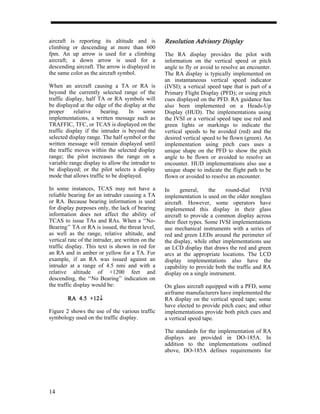
Figure 2 shows the use of the various traffic       implementations provide both pitch cues and
symbology used on the traffic display.              a vertical speed tape.

                                                    The standards for the implementation of RA
                                                    displays are provided in DO-185A. In
                                                    addition to the implementations outlined
                                                    above, DO-185A defines requirements for


14
implementation of the RA display via the
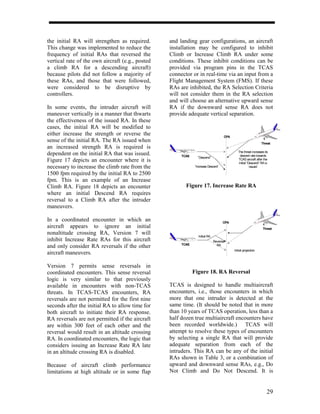
flight director and a HUD.                                       Own Aircraft. Airplane
                                                                 Symbol in White or
                                                                 Cyan
Two RA displays are required ---- one in the
                                  -
primary field of view of each pilot.
                                                                Non Intruding Traffic
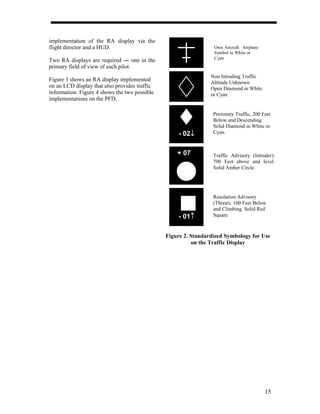
Figure 3 shows an RA display implemented                        Altitude Unknown
on an LCD display that also provides traffic                    Open Diamond in White
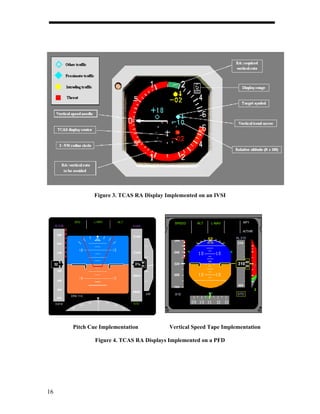
information. Figure 4 shows the two possible                    or Cyan
implementations on the PFD.

                                                                 Proximity Traffic, 200 Feet
                                                                 Below and Descending.
                                                                 Solid Diamond in White or
                                                        ↓
                                                    - 02↓        Cyan.


                                                 ++ 07           Traffic Advisory (Intruder).
                                                                 700 Feet above and level.
                                                                 Solid Amber Circle.


                                                                 Resolution Advisory
                                                                 (Threat). 100 Feet Below
                                                                 and Climbing. Solid Red
                                                        ↑
                                                    - 01↑        Square


                                               Figure 2. Standardized Symbology for Use
                                                         on the Traffic Display


                                                                                          15
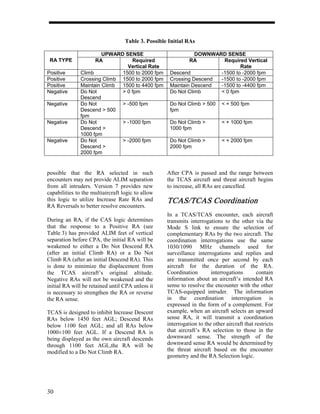
Figure 3. TCAS RA Display Implemented on an IVSI


                                         SPEED   ALT   L-NAV       AP1

                                                                   A/THR
                                                               FL 310
                                         360
                                                                315

                                         340


                                         320                    310 40
                                                                    20
                                                                           7

                                         300


                                                                305
                                         280
                                                                           2
                                         .818                   STD


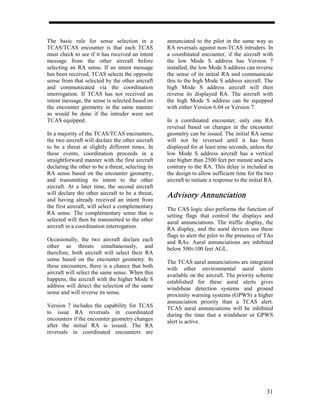
     Pitch Cue Implementation          Vertical Speed Tape Implementation

             Figure 4. TCAS RA Displays Implemented on a PFD


16
transmissions, or squitters, that are generated
Target Surveillance                                  once per second by the Mode S transponder.
                                                     Among other information, the squitter
                                                     contains the unique Mode S address of the
TCAS, independent of any ground inputs,              sending aircraft.
performs surveillance of nearby aircraft to
provide information on the position and              Following the receipt and decoding of a
altitude of these aircraft so the collision          squitter message, TCAS sends a Mode S
avoidance algorithms can perform their               interrogation to the Mode S address contained
function. The TCAS surveillance function             in the squitter. The Mode S transponder
operates by issuing interrogations at 1030 MHz       replies to this interrogation and the reply
that transponders on nearby aircraft respond to      information is used by TCAS to determine
at 1090 MHz. These replies are received and          the range, bearing, and altitude of the Mode S
decoded by the surveillance portion of the           aircraft.
TCAS software and the information is then
provided to the collision avoidance algorithms.      To minimize interference with other aircraft
                                                     and ATC on the 1030/1090 MHz channels,
TCAS has a requirement to provide reliable           the rate at which a Mode S aircraft is
surveillance out to a range of 14 nmi and in         interrogated by TCAS is dependent on the
traffic densities of up to 0.3 aircraft per square   range and closure rate between the two
nautical mile. The surveillance function             aircraft. As the target aircraft approaches the
provides the range, altitude, and bearing of         area where a TA may be required, the
nearby aircraft to the collision avoidance           interrogation rate increases to once per
function so threat determinations can be made        second. At extended ranges, a target is
and so the information displayed on the traffic      interrogated at least once every five seconds.
display is accurate. The TCAS surveillance is
compatible with both the ATCRBS and                  TCAS tracks the range and altitude of each
Mode S transponders.                                 Mode S target. These target reports are
                                                     provided to the collision avoidance logic for
TCAS can simultaneously track at least 30            use in the detection and advisory logic and
transponder-equipped aircraft within its             for presentation to the pilot on the traffic
surveillance range.                                  display. The relative bearing of the target is
                                                     also provided to the collision avoidance logic
Because TCAS surveillance operates on the            so that the target’s position can be properly
same frequencies as that used by the ground-         shown on the traffic display. The bearing
based ATC radars, there is a requirement             information is not used by the collision
imposed on TCAS that it not interfere with the       avoidance logic for threat detection and
functions of the ATC radars. Several design          advisory selection.
features have been developed and implemented
to allow TCAS to provide reliable surveillance       Mode C Surveillance
without degrading the performance of the ATC
radars.                                              TCAS uses a modified Mode C interrogation
                                                     known as the Mode C Only All Call to
Mode S Surveillance                                  interrogate nearby Mode A/C transponders.
                                                     The nominal interrogation rate for these
Because of the selective address feature of the      transponders is once per second. Because
Mode S system, TCAS surveillance of Mode S           TCAS does not use Mode A interrogations,
equipped aircraft is relatively straightforward.     the Mode A transponder codes of nearby
TCAS     listens     for    the     spontaneous      aircraft are not known to TCAS.


                                                                                                 17
Aircraft that are not equipped with an operating           Hardware degarblers can reliably decode up
altitude encoder reply to these interrogations             to three overlapping replies, and the
with no data contained in the altitude field of            combined use of variable interrogation power
the reply. TCAS uses the framing pulses of the             levels and suppression pulses reduces the
reply to initiate and maintain a range and                 number of transponders that reply to a single
bearing track on these targets. As with the                interrogation. This technique, known as
Mode S tracks, these replies are passed to the             whisper-shout (WS) takes advantage of
collision avoidance logic for traffic advisory             differences between the receiver sensitivity of
detection and for presentation on the traffic              transponders and the transponder antenna
display.                                                   gains of target aircraft.

The replies from aircraft that are capable of              A low power level is used for the first
providing their Mode C altitude are tracked in             interrogation step in a WS sequence. During
range, altitude, and bearing. These target                 the next WS step, a suppression pulse is first
reports are passed to the collision avoidance              transmitted at a slightly lower level than the
logic for TA and RA detection and for                      first interrogation. The suppression pulse is
presentation on the traffic display.                       followed two microseconds later by an
                                                           interrogation at a slightly higher power level.
TCAS surveillance of Mode C targets is                     This action suppresses most of the
complicated by problems of synchronous and                 transponders that had replied to the previous
nonsynchronous garbling, as well as reflections            interrogation, but elicits replies from an
of signals from the ground (multipath). When a             additional group of transponder that did not
Mode C Only All Call interrogation is issued               reply to the previous interrogation. As shown
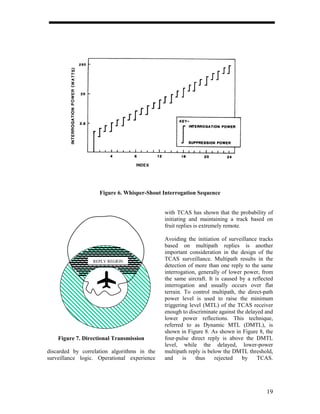
by TCAS, all Mode C transponders that detect               in Figure 6, the WS procedure is followed
the interrogation will reply. Because of the               progressively in 24 steps, to separate the
length of the reply message (21 microseconds),             Mode C replies into several groups, and thus
all Mode C equipped aircraft within a range                reduces the possibility of garbling. The WS
difference of 1.7 nmi from the TCAS aircraft               sequence is transmitted once during each
will generate replies that garble, or overlap              surveillance update period, which is
each other, when received by TCAS. This is                 nominally one second.
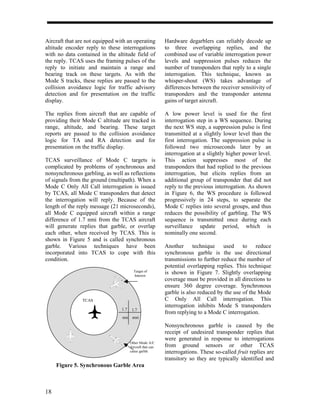
shown in Figure 5 and is called synchronous
garble. Various techniques have been                       Another technique used to reduce
incorporated into TCAS to cope with this                   synchronous garble is the use directional
condition.                                                 transmissions to further reduce the number of
                                                           potential overlapping replies. This technique
                                         Target of
                                         Interest
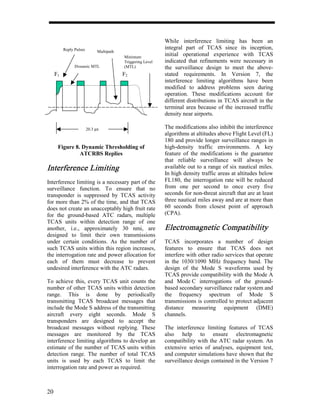
                                                           is shown in Figure 7. Slightly overlapping
                                                           coverage must be provided in all directions to
                                                           ensure 360 degree coverage. Synchronous
                                                           garble is also reduced by the use of the Mode
                TCAS                                       C Only All Call interrogation. This
                                                           interrogation inhibits Mode S transponders
                                 1.7    1.7
                                                           from replying to a Mode C interrogation.
                                 nmi nmi

                                                           Nonsynchronous garble is caused by the
                                                           receipt of undesired transponder replies that
                                                           were generated in response to interrogations
                                       Other Mode A/C
                                       Aircraft that can   from ground sensors or other TCAS
                                       cause garble        interrogations. These so-called fruit replies are
                                                           transitory so they are typically identified and
     Figure 5. Synchronous Garble Area


18
Figure 6. Whisper-Shout Interrogation Sequence


                                             with TCAS has shown that the probability of
                                             initiating and maintaining a track based on
                                             fruit replies is extremely remote.

                                             Avoiding the initiation of surveillance tracks
                                             based on multipath replies is another
                                             important consideration in the design of the
                 REPLY REGION
                                             TCAS surveillance. Multipath results in the
                                             detection of more than one reply to the same
                                             interrogation, generally of lower power, from
                                             the same aircraft. It is caused by a reflected
                                             interrogation and usually occurs over flat
                                             terrain. To control multipath, the direct-path
                                             power level is used to raise the minimum
                                             triggering level (MTL) of the TCAS receiver
                                             enough to discriminate against the delayed and
                                             lower power reflections. This technique,
                                             referred to as Dynamic MTL (DMTL), is
                                             shown in Figure 8. As shown in Figure 8, the
    Figure 7. Directional Transmission       four-pulse direct reply is above the DMTL
                                             level, while the delayed, lower-power
discarded by correlation algorithms in the   multipath reply is below the DMTL threshold,
surveillance logic. Operational experience   and     is    thus    rejected   by     TCAS.


                                                                                        19
While interference limiting has been an
          Reply Pulses                                        integral part of TCAS since its inception,
                               Multipath
                                           Minimum
                                                              initial operational experience with TCAS
                                           Triggering Level   indicated that refinements were necessary in
                Dynamic MTL                (MTL)              the surveillance design to meet the above-
     F1                                    F2                 stated requirements. In Version 7, the
                                                              interference limiting algorithms have been
                                                              modified to address problems seen during
                                                              operation. These modifications account for
                                                              different distributions in TCAS aircraft in the
                                                              terminal area because of the increased traffic
                                                              density near airports.

                         20.3 µs                              The modifications also inhibit the interference
                                                              algorithms at altitudes above Flight Level (FL)
                                                              180 and provide longer surveillance ranges in
      Figure 8. Dynamic Thresholding of                       high-density traffic environments. A key
               ATCRBS Replies                                 feature of the modifications is the guarantee
                                                              that reliable surveillance will always be
Interference Limiting                                         available out to a range of six nautical miles.
                                                              In high density traffic areas at altitudes below
Interference limiting is a necessary part of the              FL180, the interrogation rate will be reduced
surveillance function. To ensure that no                      from one per second to once every five
transponder is suppressed by TCAS activity                    seconds for non-threat aircraft that are at least
for more than 2% of the time, and that TCAS                   three nautical miles away and are at more than
does not create an unacceptably high fruit rate               60 seconds from closest point of approach
for the ground-based ATC radars, multiple                     (CPA).
TCAS units within detection range of one
another, i.e., approximately 30 nmi, are                      Electromagnetic Compatibility
designed to limit their own transmissions
under certain conditions. As the number of                    TCAS incorporates a number of design
such TCAS units within this region increases,                 features to ensure that TCAS does not
the interrogation rate and power allocation for               interfere with other radio services that operate
each of them must decrease to prevent                         in the 1030/1090 MHz frequency band. The
undesired interference with the ATC radars.                   design of the Mode S waveforms used by
                                                              TCAS provide compatibility with the Mode A
To achieve this, every TCAS unit counts the                   and Mode C interrogations of the ground-
number of other TCAS units within detection                   based secondary surveillance radar system and
range. This is done by periodically                           the frequency spectrum of Mode S
transmitting TCAS broadcast messages that                     transmissions is controlled to protect adjacent
include the Mode S address of the transmitting                distance measuring equipment (DME)
aircraft every eight seconds. Mode S                          channels.
transponders are designed to accept the
broadcast messages without replying. These                    The interference limiting features of TCAS
messages are monitored by the TCAS                            also help to ensure electromagnetic
interference limiting algorithms to develop an                compatibility with the ATC radar system. An
estimate of the number of TCAS units within                   extensive series of analyses, equipment test,
detection range. The number of total TCAS                     and computer simulations have shown that the
units is used by each TCAS to limit the                       surveillance design contained in the Version 7
interrogation rate and power as required.


20
software have demonstrated that operationally              of Standby on the Control Panel is
significant interference will not occur between            normally the only way that SL1 will
TCAS, secondary surveillance radar, and                    be selected.
DME systems.                                             • When the pilot selects TA-ONLY on
                                                           the control panel, TCAS is placed into
Collision Avoidance                                        SL2. While in SL2, TCAS performs
                                                           all surveillance functions and will
Concepts                                                   issue TAs, as required. RAs are
                                                           inhibited in SL2.
Airborne collision avoidance is a complex
                                                         • When the pilot selects TA-RA or the
problem. It has taken many years to develop
                                                           equivalent mode on the control panel,
an operationally acceptable solution and the
                                                           the TCAS logic automatically selects
refinement of the system continues to
                                                           the appropriate SL based on the
maximize the compatibility between TCAS,
                                                           altitude of the own aircraft. Table 2
ATC systems throughout the world, and
                                                           provides the altitude threshold at
existing cockpit procedures. The heart of
                                                           which TCAS automatically changes
collision avoidance is the collision avoidance
                                                           SL and the associated SL for that
system logic or the CAS logic. To explain the
                                                           altitude band. In these SLs, TCAS
operation of the CAS logic, the basic CAS
                                                           performs all surveillance functions
concepts of sensitivity level, tau, and protected
                                                           and will issue TAs and RAs, as
volume need to be understood.
                                                           required
                                                    2. Ground-Based Selection. Although the use
Sensitivity Level                                      of ground-based control of SL has not
                                                       been agreed to between pilots, controllers,
Effective CAS logic operation requires a               and the FAA and is not envisioned for use
trade-off between necessary protection and             in U.S. airspace, the capability for ground-
unnecessary advisories. This trade-off is              based selection of SL is included in the
accomplished by controlling the sensitivity            TCAS design. This design feature allows
level (SL), which controls the time or tau             the operating SL to be selected from the
thresholds for TA and RA issuance, and                 ground by using a Mode S uplink
therefore the dimensions of the protected              message. The TCAS design allows the
airspace around each TCAS-equipped aircraft.           selection of any SL shown in Table 2 with
The higher the SL, the larger the amount of            the exception of SL1.
protected airspace. However, as the amount of
protected airspace increases, the incidence of
unnecessary alerts has the potential to             When the pilot has selected the TA-RA mode
increase.                                           on the Control Panel, the operating SL is
                                                    automatically selected via inputs from the
TCAS uses two means of determining the              aircraft’s radar or pressure altimeter. SL2 will
operating SL.                                       be selected when the TCAS aircraft is below
                                                    1,000 feet above ground level (AGL) (±100
1. Pilot Selection. The TCAS Control Panel          feet) as determined by the radar altimeter
   provides a means for the pilot to select         input. As previously stated, when in SL2, RAs
   three operating modes:                           are inhibited and only TAs will be issued.
     • When the Control Panel switch is             In SL3 through SL7, RAs are enabled and
       placed in the Standby Position, TCAS         issued at the times shown in Table 2. SL3 is
       is operating in SL1. In SL1, TCAS            set based on inputs from the radar altimeter,
       does not transmit any interrogations.        while the remaining SLs are set based on
       SL1 is normally selected only when
       the aircraft is on the ground or if
       TCAS has failed. The pilot selection


                                                                                                 21
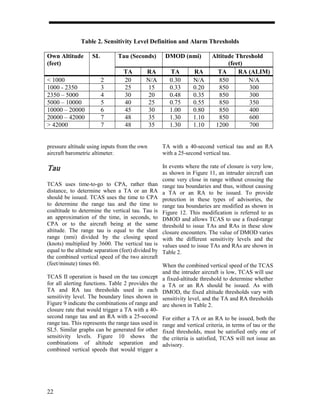
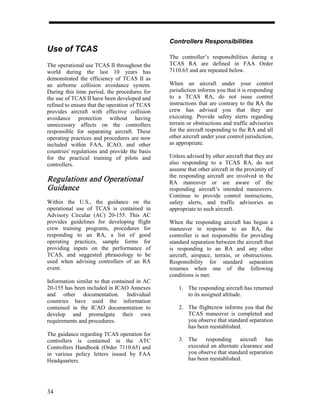
Table 2. Sensitivity Level Definition and Alarm Thresholds

Own Altitude       SL          Tau (Seconds)        DMOD (nmi)          Altitude Threshold
(feet)                                                                        (feet)
                                 TA        RA         TA        RA        TA      RA (ALIM)
< 1000                  2        20        N/A        0.30      N/A       850        N/A
1000 - 2350             3        25         15        0.33      0.20      850        300
2350 – 5000             4        30         20        0.48      0.35      850        300
5000 – 10000            5        40         25        0.75      0.55      850        350
10000 – 20000           6        45         30        1.00      0.80      850        400
20000 – 42000           7        48         35        1.30      1.10      850        600
> 42000                 7        48         35        1.30      1.10     1200        700


pressure altitude using inputs from the own        TA with a 40-second vertical tau and an RA
aircraft barometric altimeter.                     with a 25-second vertical tau.

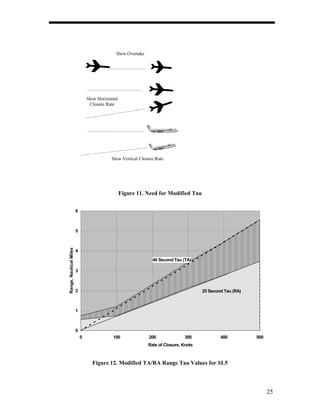
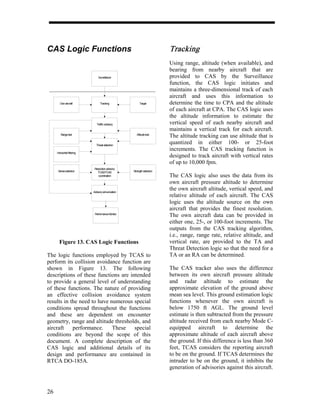
Tau                                                In events where the rate of closure is very low,
                                                   as shown in Figure 11, an intruder aircraft can
                                                   come very close in range without crossing the
TCAS uses time-to-go to CPA, rather than           range tau boundaries and thus, without causing
distance, to determine when a TA or an RA          a TA or an RA to be issued. To provide
should be issued. TCAS uses the time to CPA        protection in these types of advisories, the
to determine the range tau and the time to         range tau boundaries are modified as shown in
coaltitude to determine the vertical tau. Tau is   Figure 12. This modification is referred to as
an approximation of the time, in seconds, to       DMOD and allows TCAS to use a fixed-range
CPA or to the aircraft being at the same           threshold to issue TAs and RAs in these slow
altitude. The range tau is equal to the slant      closure encounters. The value of DMOD varies
range (nmi) divided by the closing speed           with the different sensitivity levels and the
(knots) multiplied by 3600. The vertical tau is    values used to issue TAs and RAs are shown in
equal to the altitude separation (feet) divided by Table 2.
the combined vertical speed of the two aircraft
(feet/minute) times 60.                            When the combined vertical speed of the TCAS
                                                   and the intruder aircraft is low, TCAS will use
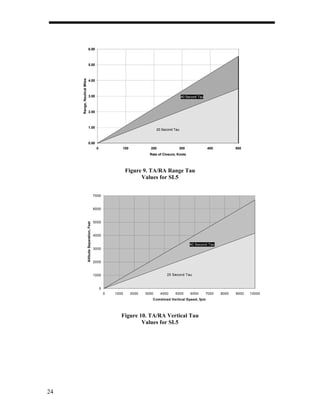
TCAS II operation is based on the tau concept a fixed-altitude threshold to determine whether
for all alerting functions. Table 2 provides the a TA or an RA should be issued. As with
TA and RA tau thresholds used in each DMOD, the fixed altitude thresholds vary with
sensitivity level. The boundary lines shown in sensitivity level, and the TA and RA thresholds
Figure 9 indicate the combinations of range and are shown in Table 2.
closure rate that would trigger a TA with a 40-
second range tau and an RA with a 25-second For either a TA or an RA to be issued, both the
range tau. This represents the range taus used in range and vertical criteria, in terms of tau or the
SL5. Similar graphs can be generated for other fixed thresholds, must be satisfied only one of
sensitivity levels. Figure 10 shows the the criteria is satisfied, TCAS will not issue an
combinations of altitude separation and advisory.
combined vertical speeds that would trigger a


22
Protected Volume                                The horizontal dimensions of the protected
                                                airspace are not based on distance, but on tau.
A protected volume of airspace surrounds each Thus, the size of the protected volume depends
TCAS-equipped aircraft. The tau and DMOD on the speed and heading of the aircraft
criteria described above shape the horizontal involved in the encounter.
boundaries of this volume. The vertical tau and
the fixed altitude thresholds determine the TCAS II is designed to provide collision
vertical dimensions of the protected volume.    avoidance protection in the case of any two
                                                aircraft that are closing horizontally at any rate
                                                up to 1200 knots and vertically up to 10,000
                                                feet per minute (fpm).


                                                                                               23
6.00


                                     5.00


     Range, Nautical Miles
                                     4.00


                                     3.00                                                                    40 Second Tau


                                     2.00


                                     1.00
                                                                                             25 Second Tau


                                     0.00
                                                          0              100            200              300                 400           500
                                                                                        Rate of Closure, Knots


                                                                             Figure 9. TA/RA Range Tau
                                                                                   Values for SL5


                                                         7000


                                                         6000


                                                         5000
                             Altitude Separation, Feet


                                                         4000

                                                                                                                  40 Second Tau
                                                         3000


                                                         2000


                                                         1000                                      25 Second Tau


                                                              0
                                                                  0   1000     2000   3000     4000    5000       6000       7000   8000   9000   10000
                                                                                         Combined Vertical Speed, fpm


                                                                         Figure 10. TA/RA Vertical Tau
                                                                                 Values for SL5


24
Slow Overtake


                                Slow Horizontal
                                 Closure Rate


                                            Slow Vertical Closure Rate


                                                  Figure 11. Need for Modified Tau


                        6


                        5
Range, Nautical Miles


                        4

                                                                40 Second Tau (TA)

                        3


                        2                                                              25 Second Tau (RA)


                        1


                        0
                            0               100               200               300            400          500
                                                              Rate of Closure, Knots


                                  Figure 12. Modified TA/RA Range Tau Values for SL5


                                                                                                                  25
CAS Logic Functions                                                      Tracking
                                                                         Using range, altitude (when available), and
                                                                         bearing from nearby aircraft that are
                                Surveillance                             provided to CAS by the Surveillance
                                                                         function, the CAS logic initiates and
                                                                         maintains a three-dimensional track of each
                                                                         aircraft and uses this information to
        Own aircraft              Tracking               Target          determine the time to CPA and the altitude
                                                                         of each aircraft at CPA. The CAS logic uses
                                                                         the altitude information to estimate the
                               Traffic advisory                          vertical speed of each nearby aircraft and
                                                                         maintains a vertical track for each aircraft.
        Range test                                     Altitude test
                                                                         The altitude tracking can use altitude that is
                              Threat detection
                                                                         quantized in either 100- or 25-foot
                                                                         increments. The CAS tracking function is
     Horizontal filtering
                                                                         designed to track aircraft with vertical rates
                                                                         of up to 10,000 fpm.
                             Resolution advisory
      Sense selection          TCAS/TCAS            Strength selection
                                coordination                             The CAS logic also uses the data from its
                                                                         own aircraft pressure altitude to determine
                            Advisory annunciation
                                                                         the own aircraft altitude, vertical speed, and
                                                                         relative altitude of each aircraft. The CAS
                                                                         logic uses the altitude source on the own
                                                                         aircraft that provides the finest resolution.
                             Performance Monitor
                                                                         The own aircraft data can be provided in
                                                                         either one, 25-, or 100-foot increments. The
                                                                         outputs from the CAS tracking algorithm,
                                                                         i.e., range, range rate, relative altitude, and
       Figure 13. CAS Logic Functions                                    vertical rate, are provided to the TA and
                                                                         Threat Detection logic so that the need for a
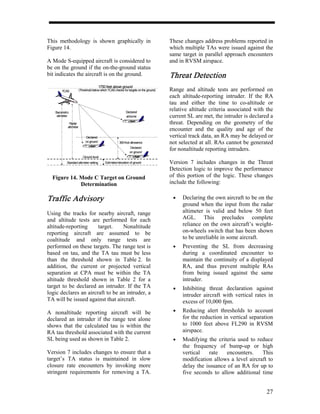
The logic functions employed by TCAS to                                  TA or an RA can be determined.
perform its collision avoidance function are
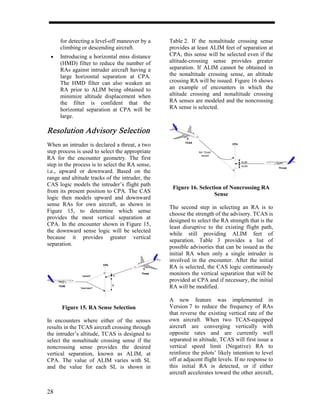
shown in Figure 13. The following                                        The CAS tracker also uses the difference
descriptions of these functions are intended                             between its own aircraft pressure altitude
to provide a general level of understanding                              and radar altitude to estimate the
of these functions. The nature of providing                              approximate elevation of the ground above
an effective collision avoidance system                                  mean sea level. This ground estimation logic
results in the need to have numerous special                             functions whenever the own aircraft is
conditions spread throughout the functions                               below 1750 ft AGL. The ground level
and these are dependent on encounter                                     estimate is then subtracted from the pressure
geometry, range and altitude thresholds, and                             altitude received from each nearby Mode C-
aircraft    performance.     These    special                            equipped aircraft to determine the
conditions are beyond the scope of this                                  approximate altitude of each aircraft above
document. A complete description of the                                  the ground. If this difference is less than 360
CAS logic and additional details of its                                  feet, TCAS considers the reporting aircraft
design and performance are contained in                                  to be on the ground. If TCAS determines the
RTCA DO-185A.                                                            intruder to be on the ground, it inhibits the
                                                                         generation of advisories against this aircraft.


26
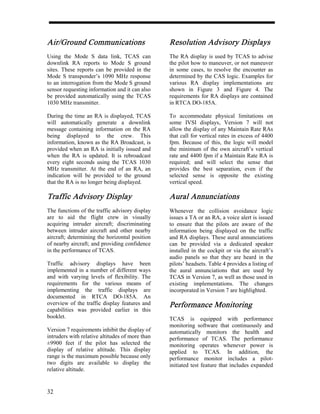
This methodology is shown graphically in                                                These changes address problems reported in
Figure 14.                                                                              which multiple TAs were issued against the
                                                                                        same target in parallel approach encounters
A Mode S-equipped aircraft is considered to                                             and in RVSM airspace.
be on the ground if the on-the-ground status
bit indicates the aircraft is on the ground.                                            Threat Detection
                                         1750 feet above ground
       TCAS             (Threshold below which TCAS checks for targets on the ground)   Range and altitude tests are performed on
                                                                                        each altitude-reporting intruder. If the RA
                                                                                        tau and either the time to co-altitude or
   Barometric                                                Declared
                                                                                        relative altitude criteria associated with the
    altimeter                                                airborne                   current SL are met, the intruder is declared a
             Radar                                                                      threat. Depending on the geometry of the
            altimeter
                                                                                        encounter and the quality and age of the
                             Declared                                                   vertical track data, an RA may be delayed or
                             on ground                  360-foot allowance              not selected at all. RAs cannot be generated
                                                                Declared
                                                                on ground
                                                                                        for nonaltitude reporting intruders.
                           Ground level
           Standard altimeter setting        Estimated elevation of ground              Version 7 includes changes in the Threat
                                                                                        Detection logic to improve the performance
  Figure 14. Mode C Target on Ground                                                    of this portion of the logic. These changes
             Determination                                                              include the following:

Traffic Advisory                                                                         •   Declaring the own aircraft to be on the
                                                                                             ground when the input from the radar
Using the tracks for nearby aircraft, range                                                  altimeter is valid and below 50 feet
and altitude tests are performed for each                                                    AGL. This precludes complete
altitude-reporting     target.    Nonaltitude                                                reliance on the own aircraft’s weight-
reporting aircraft are assumed to be                                                         on-wheels switch that has been shown
coaltitude and only range tests are                                                          to be unreliable in some aircraft.
performed on these targets. The range test is                                            •   Preventing the SL from decreasing
based on tau, and the TA tau must be less                                                    during a coordinated encounter to
than the threshold shown in Table 2. In                                                      maintain the continuity of a displayed
addition, the current or projected vertical                                                  RA, and thus prevent multiple RAs
separation at CPA must be within the TA                                                      from being issued against the same
altitude threshold shown in Table 2 for a                                                    intruder.
target to be declared an intruder. If the TA                                             •   Inhibiting threat declaration against
logic declares an aircraft to be an intruder, a                                              intruder aircraft with vertical rates in
TA will be issued against that aircraft.                                                     excess of 10,000 fpm.
A nonaltitude reporting aircraft will be                                                 •   Reducing alert thresholds to account
declared an intruder if the range test alone                                                 for the reduction in vertical separation
shows that the calculated tau is within the                                                  to 1000 feet above FL290 in RVSM
RA tau threshold associated with the current                                                 airspace.
SL being used as shown in Table 2.                                                       •   Modifying the criteria used to reduce
                                                                                             the frequency of bump-up or high
Version 7 includes changes to ensure that a                                                  vertical    rate   encounters.    This
target’s TA status is maintained in slow                                                     modification allows a level aircraft to
closure rate encounters by invoking more                                                     delay the issuance of an RA for up to
stringent requirements for removing a TA.                                                    five seconds to allow additional time


                                                                                                                                   27
for detecting a level-off maneuver by a       Table 2. If the nonaltitude crossing sense
     climbing or descending aircraft.              provides at least ALIM feet of separation at
 •   Introducing a horizontal miss distance        CPA, this sense will be selected even if the
     (HMD) filter to reduce the number of          altitude-crossing sense provides greater
     RAs against intruder aircraft having a        separation. If ALIM cannot be obtained in
     large horizontal separation at CPA.           the nonaltitude crossing sense, an altitude
     The HMD filter can also weaken an             crossing RA will be issued. Figure 16 shows
     RA prior to ALIM being obtained to            an example of encounters in which the
     minimize altitude displacement when           altitude crossing and nonaltitude crossing
     the filter is confident that the              RA senses are modeled and the noncrossing
     horizontal separation at CPA will be          RA sense is selected.
     large.

Resolution Advisory Selection
When an intruder is declared a threat, a two              TCAS
                                                                                CPA


step process is used to select the appropriate                   RA ”Climb”

RA for the encounter geometry. The first
                                                                  issued


step in the process is to select the RA sense,
                                                                                      ALIM
                                                                                      ALIM
                                                                                                      Threat
i.e., upward or downward. Based on the
range and altitude tracks of the intruder, the
CAS logic models the intruder’s flight path
                                                    Figure 16. Selection of Noncrossing RA
from its present position to CPA. The CAS
                                                                     Sense
logic then models upward and downward
sense RAs for own aircraft, as shown in
                                                   The second step in selecting an RA is to
Figure 15, to determine which sense
                                                   choose the strength of the advisory. TCAS is
provides the most vertical separation at
                                                   designed to select the RA strength that is the
CPA. In the encounter shown in Figure 15,
                                                   least disruptive to the existing flight path,
the downward sense logic will be selected
                                                   while still providing ALIM feet of
because it provides greater vertical
                                                   separation. Table 3 provides a list of
separation.
                                                   possible advisories that can be issued as the
                                                   initial RA when only a single intruder is
                                                   involved in the encounter. After the initial
                           CPA
                                                   RA is selected, the CAS logic continuously
               “upward”          A
                                          Threat   monitors the vertical separation that will be
                                                   provided at CPA and if necessary, the initial
     TCAS
              “downward”
                                 B
                                                   RA will be modified.

                                                   A new feature was implemented in
      Figure 15. RA Sense Selection                Version 7 to reduce the frequency of RAs
                                                   that reverse the existing vertical rate of the
In encounters where either of the senses           own aircraft. When two TCAS-equipped
results in the TCAS aircraft crossing through      aircraft are converging vertically with
the intruder’s altitude, TCAS is designed to       opposite rates and are currently well
select the nonaltitude crossing sense if the       separated in altitude, TCAS will first issue a
noncrossing sense provides the desired             vertical speed limit (Negative) RA to
vertical separation, known as ALIM, at             reinforce the pilots’ likely intention to level
CPA. The value of ALIM varies with SL              off at adjacent flight levels. If no response to
and the value for each SL is shown in              this initial RA is detected, or if either
                                                   aircraft accelerates toward the other aircraft,


28
the initial RA will strengthen as required.       and landing gear configurations, an aircraft
This change was implemented to reduce the         installation may be configured to inhibit
frequency of initial RAs that reversed the        Climb or Increase Climb RA under some
vertical rate of the own aircraft (e.g., posted   conditions. These inhibit conditions can be
a climb RA for a descending aircraft)             provided via program pins in the TCAS
because pilots did not follow a majority of       connector or in real-time via an input from a
these RAs, and those that were followed,          Flight Management System (FMS). If these
were considered to be disruptive by               RAs are inhibited, the RA Selection Criteria
controllers.                                      will not consider them in the RA selection
                                                  and will choose an alternative upward sense
In some events, the intruder aircraft will        RA if the downward sense RA does not
maneuver vertically in a manner that thwarts      provide adequate vertical separation.
the effectiveness of the issued RA. In these
cases, the initial RA will be modified to
either increase the strength or reverse the                                         CPA
sense of the initial RA. The RA issued when                                                                    Threat
an increased strength RA is required is
dependent on the initial RA that was issued.           TCAS
                                                                                             The threat increases its
                                                                                              descent rate towards
                                                                ”Descend”
Figure 17 depicts an encounter where it is                                                   TCAS aircraft after the
                                                                                             initial “Descend” RA is
necessary to increase the climb rate from the                 ”Increase Descent”                       issued

1500 fpm required by the initial RA to 2500
fpm. This is an example of an Increase
Climb RA. Figure 18 depicts an encounter                 Figure 17. Increase Rate RA
where an initial Descend RA requires
reversal to a Climb RA after the intruder
maneuvers.

In a coordinated encounter in which an                                             CPA
aircraft appears to ignore an initial                                                                           Threat
nonaltitude crossing RA, Version 7 will                         Initial RA
inhibit Increase Rate RAs for this aircraft                                  Reversal
                                                       TCAS
and only consider RA reversals if the other                                    RA
                                                                                          Initial projection
aircraft maneuvers.

Version 7 permits sense reversals in
coordinated encounters. This sense reversal                   Figure 18. RA Reversal
logic is very similar to that previously
available in encounters with non-TCAS             TCAS is designed to handle multiaircraft
threats. In TCAS-TCAS encounters, RA              encounters, i.e., those encounters in which
reversals are not permitted for the first nine    more that one intruder is detected at the
seconds after the initial RA to allow time for    same time. (It should be noted that in more
both aircraft to initiate their RA response.      than 10 years of TCAS operation, less than a
RA reversals are not permitted if the aircraft    half dozen true multiaircraft encounters have
are within 300 feet of each other and the         been recorded worldwide.) TCAS will
reversal would result in an altitude crossing     attempt to resolve these types of encounters
RA. In coordinated encounters, the logic that     by selecting a single RA that will provide
considers issuing an Increase Rate RA late        adequate separation from each of the
in an altitude crossing RA is disabled.           intruders. This RA can be any of the initial
                                                  RAs shown in Table 3, or a combination of
Because of aircraft climb performance             upward and downward sense RAs, e.g., Do
limitations at high altitude or in some flap      Not Climb and Do Not Descend. It is


                                                                                                                    29
Table 3. Possible Initial RAs

                        UPWARD SENSE                           DOWNWARD SENSE
 RA TYPE             RA           Required                   RA        Required Vertical
                                Vertical Rate                                 Rate
Positive       Climb          1500 to 2000 fpm       Descend          -1500 to -2000 fpm
Positive       Crossing Climb 1500 to 2000 fpm       Crossing Descend -1500 to -2000 fpm
Positive       Maintain Climb 1500 to 4400 fpm       Maintain Descend -1500 to -4400 fpm
Negative       Do Not         > 0 fpm                Do Not Climb     < 0 fpm
               Descend
Negative       Do Not         > -500 fpm             Do Not Climb > 500      < + 500 fpm
               Descend > 500                         fpm
               fpm
Negative       Do Not         > -1000 fpm            Do Not Climb >          < + 1000 fpm
               Descend >                             1000 fpm
               1000 fpm
Negative       Do Not         > -2000 fpm            Do Not Climb >          < + 2000 fpm
               Descend >                             2000 fpm
               2000 fpm


possible that the RA selected in such               After CPA is passed and the range between
encounters may not provide ALIM separation          the TCAS aircraft and threat aircraft begins
from all intruders. Version 7 provides new          to increase, all RAs are cancelled.
capabilities to the multiaircraft logic to allow
this logic to utilize Increase Rate RAs and         TCAS/TCAS Coordination
RA Reversals to better resolve encounters.
                                                    In a TCAS/TCAS encounter, each aircraft
During an RA, if the CAS logic determines           transmits interrogations to the other via the
that the response to a Positive RA (see             Mode S link to ensure the selection of
Table 3) has provided ALIM feet of vertical         complementary RAs by the two aircraft. The
separation before CPA, the initial RA will be       coordination interrogations use the same
weakened to either a Do Not Descend RA              1030/1090 MHz channels used for
(after an initial Climb RA) or a Do Not             surveillance interrogations and replies and
Climb RA (after an initial Descend RA). This        are transmitted once per second by each
is done to minimize the displacement from           aircraft for the duration of the RA.
the TCAS aircraft’s original altitude.              Coordination        interrogations        contain
Negative RAs will not be weakened and the           information about an aircraft’s intended RA
initial RA will be retained until CPA unless it     sense to resolve the encounter with the other
is necessary to strengthen the RA or reverse        TCAS-equipped intruder. The information
the RA sense.                                       in the coordination interrogation is
                                                    expressed in the form of a complement. For
TCAS is designed to inhibit Increase Descent        example, when an aircraft selects an upward
RAs below 1450 feet AGL; Descend RAs                sense RA, it will transmit a coordination
below 1100 feet AGL; and all RAs below              interrogation to the other aircraft that restricts
1000±100 feet AGL. If a Descend RA is               that aircraft’s RA selection to those in the
being displayed as the own aircraft descends        downward sense. The strength of the
through 1100 feet AGL,the RA will be                downward sense RA would be determined by
modified to a Do Not Climb RA.                      the threat aircraft based on the encounter
                                                    geometry and the RA Selection logic.


30
The basic rule for sense selection in a             annunciated to the pilot in the same way as
TCAS/TCAS encounter is that each TCAS               RA reversals against non-TCAS intruders. In
must check to see if it has received an intent      a coordinated encounter, if the aircraft with
message from the other aircraft before              the low Mode S address has Version 7
selecting an RA sense. If an intent message         installed, the low Mode S address can reverse
has been received, TCAS selects the opposite        the sense of its initial RA and communicate
sense from that selected by the other aircraft      this to the high Mode S address aircraft. The
and communicated via the coordination               high Mode S address aircraft will then
interrogation. If TCAS has not received an          reverse its displayed RA. The aircraft with
intent message, the sense is selected based on      the high Mode S address can be equipped
the encounter geometry in the same manner           with either Version 6.04 or Version 7.
as would be done if the intruder were not
TCAS equipped.                                      In a coordinated encounter, only one RA
                                                    reversal based on changes in the encounter
In a majority of the TCAS/TCAS encounters,          geometry can be issued. The initial RA sense
the two aircraft will declare the other aircraft    will not be reversed until it has been
to be a threat at slightly different times. In      displayed for at least nine seconds, unless the
these events, coordination proceeds in a            low Mode S address aircraft has a vertical
straightforward manner with the first aircraft      rate higher than 2500 feet per minute and acts
declaring the other to be a threat, selecting its   contrary to the RA. This delay is included in
RA sense based on the encounter geometry,           the design to allow sufficient time for the two
and transmitting its intent to the other            aircraft to initiate a response to the initial RA.
aircraft. At a later time, the second aircraft
will declare the other aircraft to be a threat,     Advisory Annunciation
and having already received an intent from
the first aircraft, will select a complementary     The CAS logic also performs the function of
RA sense. The complementary sense that is           setting flags that control the displays and
selected will then be transmitted to the other      aural annunciations. The traffic display, the
aircraft in a coordination interrogation.           RA display, and the aural devices use these
                                                    flags to alert the pilot to the presence of TAs
Occasionally, the two aircraft declare each         and RAs. Aural annunciations are inhibited
other as threats simultaneously, and                below 500±100 feet AGL.
therefore, both aircraft will select their RA
sense based on the encounter geometry. In           The TCAS aural annunciations are integrated
these encounters, there is a chance that both       with other environmental aural alerts
aircraft will select the same sense. When this      available on the aircraft. The priority scheme
happens, the aircraft with the higher Mode S        established for these aural alerts gives
address will detect the selection of the same       windshear detection systems and ground
sense and will reverse its sense.                   proximity warning systems (GPWS) a higher
                                                    annunciation priority than a TCAS alert.
Version 7 includes the capability for TCAS          TCAS aural annunciations will be inhibited
to issue RA reversals in coordinated                during the time that a windshear or GPWS
encounters if the encounter geometry changes        alert is active.
after the initial RA is issued. The RA
reversals in coordinated encounters are


                                                                                                  31
Air/Ground Communications                        Resolution Advisory Displays
Using the Mode S data link, TCAS can             The RA display is used by TCAS to advise
downlink RA reports to Mode S ground             the pilot how to maneuver, or not maneuver
sites. These reports can be provided in the      in some cases, to resolve the encounter as
Mode S transponder’s 1090 MHz response           determined by the CAS logic. Examples for
to an interrogation from the Mode S ground       various RA display implementations are
sensor requesting information and it can also    shown in Figure 3 and Figure 4. The
be provided automatically using the TCAS         requirements for RA displays are contained
1030 MHz transmitter.                            in RTCA DO-185A.

During the time an RA is displayed, TCAS         To accommodate physical limitations on
will automatically generate a downlink           some IVSI displays, Version 7 will not
message containing information on the RA         allow the display of any Maintain Rate RAs
being displayed to the crew. This                that call for vertical rates in excess of 4400
information, known as the RA Broadcast, is       fpm. Because of this, the logic will model
provided when an RA is initially issued and      the minimum of the own aircraft’s vertical
when the RA is updated. It is rebroadcast        rate and 4400 fpm if a Maintain Rate RA is
every eight seconds using the TCAS 1030          required; and will select the sense that
MHz transmitter. At the end of an RA, an         provides the best separation, even if the
indication will be provided to the ground        selected sense is opposite the existing
that the RA is no longer being displayed.        vertical speed.

Traffic Advisory Display                         Aural Annunciations
The functions of the traffic advisory display    Whenever the collision avoidance logic
are to aid the flight crew in visually           issues a TA or an RA, a voice alert is issued
acquiring intruder aircraft; discriminating      to ensure that the pilots are aware of the
between intruder aircraft and other nearby       information being displayed on the traffic
aircraft; determining the horizontal position    and RA displays. These aural annunciations
of nearby aircraft; and providing confidence     can be provided via a dedicated speaker
in the performance of TCAS.                      installed in the cockpit or via the aircraft’s
                                                 audio panels so that they are heard in the
Traffic advisory displays have been              pilots’ headsets. Table 4 provides a listing of
implemented in a number of different ways        the aural annunciations that are used by
and with varying levels of flexibility. The      TCAS in Version 7, as well as those used in
requirements for the various means of            existing implementations. The changes
implementing the traffic displays are            incorporated in Version 7 are highlighted.
documented in RTCA DO-185A. An
overview of the traffic display features and     Performance Monitoring
capabilities was provided earlier in this
booklet.                                         TCAS is equipped with performance
                                                 monitoring software that continuously and
Version 7 requirements inhibit the display of    automatically monitors the health and
intruders with relative altitudes of more than   performance of TCAS. The performance
±9900 feet if the pilot has selected the         monitoring operates whenever power is
display of relative altitude. This display       applied to TCAS. In addition, the
range is the maximum possible because only       performance monitor includes a pilot-
two digits are available to display the          initiated test feature that includes expanded
relative altitude.


32
tests of the TCAS displays and aural
annunciations. The performance monitor                 When the performance monitor detects
also supports expanded maintenance                     anomalous performance within TCAS or an
diagnostics that are available to maintenance          invalid input from a required on-board
and engineering personnel while the aircraft           system, the failure is annunciated to the
is on the ground.                                      pilot. If appropriate, all or a portion of the
                                                       TCAS functions may be disabled or
The performance monitor validates many of              inhibited. If the performance monitor
the inputs received from other aircraft                disables any TCAS capability, it will
systems and validates the performance of the           continue to monitor the remaining functions
TCAS processor. These include the own                  and if the detected failure is removed, the
aircraft pressure altitude input and the               full operational capability will be restored.
connection of TCAS to the aircraft
suppression bus.

                               Table 4. TCAS Aural Annunciations

        TCAS Advisory                Version 7 Aural Annunciation              Existing Aural
                                                                                Annunciation
 Traffic Advisory                 Traffic, Traffic                       Traffic, Traffic
 Climb RA                         Climb, Climb                           Climb, Climb, Climb
 Descend RA                       Descend, Descend                       Descend, Descend,
                                                                         Descend
 Altitude Crossing Climb RA       Climb, Crossing Climb; Climb,          Climb, Crossing Climb;
                                  Crossing Climb                         Climb, Crossing Climb
 Altitude Crossing Descend RA     Descend, Crossing Descend; Descend,    Descend, Crossing
                                  Crossing Descend                       Descend; Descend,
                                                                         Crossing Descend
 Reduce Climb RA                  Adjust Vertical Speed, Adjust          Reduce Climb, Reduce
                                                                         Climb
 Reduce Descent RA                Adjust Vertical Speed, Adjust          Reduce Descent, Reduce
                                                                         Descent
 RA Reversal to a Climb RA        Climb, Climb, NOW; Climb, Climb        Climb, Climb, NOW;
                                  NOW                                    Climb, Climb NOW
 RA Reversal to a Descend RA      Descend, Descend NOW; Descend,         Descend, Descend NOW;
                                  Descend NOW                            Descend, Descend NOW
 Increase Climb RA                Increase Climb, Increase Climb         Increase Climb, Increase
                                                                         Climb
 Increase Descent RA              Increase Descent, Increase Descent     Increase Descent, Increase
                                                                         Descent
 Maintain Rate RA                 Maintain Vertical Speed, Maintain      Monitor Vertical Speed
 Altitude Crossing, Maintain      Maintain Vertical Speed, Crossing      Monitor Vertical Speed
 Rate RA (Climb and Descend)      Maintain
 Weakening of Initial RA          Adjust Vertical Speed, Adjust          Monitor Vertical Speed
 Preventive RA (No change in      Monitor Vertical Speed                 Monitor Vertical Speed,
 vertical speed required)                                                Monitor Vertical Speed
 RA Removed                       Clear of Conflict                      Clear of Conflict


                                                                                                      33
Controllers Responsibilities
Use of TCAS
                                               The controller’s responsibilities during a
The operational use TCAS II throughout the     TCAS RA are defined in FAA Order
world during the last 10 years has             7110.65 and are repeated below.
demonstrated the efficiency of TCAS II as
an airborne collision avoidance system.        When an aircraft under your control
During this time period, the procedures for    jurisdiction informs you that it is responding
the use of TCAS II have been developed and     to a TCAS RA, do not issue control
refined to ensure that the operation of TCAS   instructions that are contrary to the RA the
provides aircraft with effective collision     crew has advised you that they are
avoidance protection without having            executing. Provide safety alerts regarding
unnecessary affects on the controllers         terrain or obstructions and traffic advisories
responsible for separating aircraft. These     for the aircraft responding to the RA and all
operating practices and procedures are now     other aircraft under your control jurisdiction,
included within FAA, ICAO, and other           as appropriate.
countries' regulations and provide the basis
for the practical training of pilots and       Unless advised by other aircraft that they are
controllers.                                   also responding to a TCAS RA, do not
                                               assume that other aircraft in the proximity of
                                               the responding aircraft are involved in the
Regulations and Operational                    RA maneuver or are aware of the
Guid
Guidance                                       responding aircraft’s intended maneuvers.
                                               Continue to provide control instructions,
Within the U.S., the guidance on the           safety alerts, and traffic advisories as
operational use of TCAS is contained in        appropriate to such aircraft.
Advisory Circular (AC) 20-155. This AC
provides guidelines for developing flight      When the responding aircraft has begun a
crew training programs, procedures for         maneuver in response to an RA, the
responding to an RA, a list of good            controller is not responsible for providing
operating practices, sample forms for          standard separation between the aircraft that
providing inputs on the performance of         is responding to an RA and any other
TCAS, and suggested phraseology to be          aircraft, airspace, terrain, or obstructions.
used when advising controllers of an RA        Responsibility for standard separation
event.                                         resumes when one of the following
                                               conditions is met:
Information similar to that contained in AC
20-155 has been included in ICAO Annexes           1. The responding aircraft has returned
and other documentation. Individual                   to its assigned altitude.
countries have used the information
contained in the ICAO documentation to             2. The flightcrew informs you that the
develop and promulgate their own                      TCAS maneuver is completed and
requirements and procedures.                          you observe that standard separation
                                                      has been reestablished.
The guidance regarding TCAS operation for
controllers is contained in the ATC                3. The responding aircraft has
Controllers Handbook (Order 7110.65) and              executed an alternate clearance and
in various policy letters issued by FAA               you observe that standard separation
Headquarters.                                         has been reestablished.


34
FAA Order 7110.65 also references AC               Table 5. Suggested Pitch Adjustment
120-55 to provide information on the               Required to Comply with TCAS RA
suggested phraseology to be used by pilots
to notify the controller about a TCAS event.             Speed                   Pitch
The suggested phraseology is discussed in                                    Adjustment
the following section, Pilot Responsibilities.    .80 Mach                2 degrees
                                                  250 Knots Indicated
Pilot Responsibilities                            Airspeed (KIAS)         4 degrees
                                                  Below 10,000 feet
In general terms, the following procedures        Below 200 KIAS          5 to 7 degrees
and practices have been developed regarding
the pilots responsibilities and actions while    Then refer to the vertical speed indicator and
using TCAS. These procedures and practices       make necessary pitch adjustments to place
have been extracted from AC 20-155.              the vertical speed indicator in the green arc
                                                 of the RA display. On aircraft with pitch
Respond to TAs by attempting to establish        guidance TCAS RA displays, follow the RA
visual contact with the intruder aircraft and    pitch command for initial, increase, and
other aircraft that may be in the vicinity.      weakening RAs.
Coordinate to the degree possible with other
crewmembers to assist in searching for           Excursions from assigned altitude, when
traffic. Do not deviate from an assigned         responding to an RA, typically should be no
clearance based only on TA information.          more than 300 to 500 feet to satisfy the
For any traffic that is acquired visually,       conflict. Vertical speed responses should be
continue to maintain or attain safe separation   made to avoid red arcs or outlined pitch
in accordance with current Federal Aviation      avoidance areas, and, if applicable, to
Regulations (FAR) and good operating             accurately fly to the green arc or outlined
practices.                                       pitch guidance area.

When an RA occurs, the pilot flying should       Respond immediately to any increase or
respond immediately by direct attention to       reversal RA maneuver advisories. Initial
RA displays and maneuver as indicated            vertical speed response to an increase or
unless doing so would jeopardize the safe        reversal RA is expected by TCAS, using
operation of the flight or unless in the         1/3 g acceleration, within 2-1/2 seconds
approach environment the flight crew can         after issuance of the advisory. Again, avoid
assure separation with the help of definitive    red arcs or outlined pitch avoidance areas
visual acquisition of the aircraft causing the   and fly to the green arc or outlined pitch
RA. By not responding to an RA, the              guidance area.
flightcrew effectively takes responsibility
for achieving safe separation.                   If an initial corrective RA is downgraded or
                                                 weakened (for example, a Climb RA
Satisfy RAs by disconnecting the autopilot,      downgrades to a Do Not Descend RA),
using prompt, positive control inputs in the     pilots should respond to the weakening RA
direction and with the magnitude TCAS            and adjust the aircraft's vertical speed
advises. To achieve the required vertical rate   accordingly but still keep the needle or pitch
(normally 1,500 fpm climb or descent), first     guidance symbol out of the red arc or
adjust the aircraft’s pitch using the            outlined pitch avoidance area. Pilots are
suggested guidelines shown in Table 5.           reminded that attention to the RA display
                                                 and prompt reaction to the weakened RA
                                                 will minimize altitude excursions and
                                                 potential disruptions to ATC. This will


                                                                                            35
allow for proper TCAS-to-TCAS resolution         Instrument Flight Rules (IFR) clearances are
of encounters and reduce the probability of      predicated on avoiding high terrain or
additional RAs against the intruder or other     obstacles, it is particularly important that
traffic.                                         pilots maintain situational awareness and
                                                 continue to use good operating practices and
In some instances, it may not be possible to     judgment when following TCAS RAs.
respond to a TCAS RA and continue to             Maintain frequent outside visual scan, use
satisfy a clearance at the same time. Even if    see and avoid vigilance, and continue to
a TCAS RA maneuver is inconsistent with          communicate as needed and as appropriate
the current clearance, respond appropriately     with ATC.
to the RA. Because TCAS tracks all
transponder-equipped aircraft in the vicinity,   The pilot is to inform the controller about
responding to an RA for an intruder assures      the RA deviation as soon as possible. The
a safe avoidance maneuver from that              phraseology, to be used by pilots, is shown
intruder and from other Mode C-equipped          in Table 6. The phraseology was developed
aircraft.                                        by ICAO and has been published in PANS-
                                                 RAC. The FAA has incorporated these
If a TCAS RA response requires deviation         recommendations into AC 20-155.
from an ATC clearance, expeditiously return
                                                  Table
                                                  Table 6. Recommended Phraseology for
to the current ATC clearance when the
                                                              Reporting RAs
traffic conflict is resolved or the TCAS
message “Clear of Conflict” is heard, or
                                                        Situation            Phraseology
follow any subsequent change to clearance
                                                 Responding to an       ‘‘TCAS Climb’’ or
as advised by ATC. In responding to a
                                                 RA                     ‘‘TCAS Descend’’
TCAS RA that directs a deviation from
assigned altitude, communicate with ATC as       Initial RA report      ‘‘TCAS Climb (or
soon as practicable after responding to the      issued after RA is     descent), returning
RA. When the RA is cleared, the flight crew      completed              to [assigned
                                                                        clearance]’’
should advise ATC that they are returning to
                                                 Initial RA report      ‘‘TCAS Climb (or
their previously assigned clearance or
                                                 issued after returning descent) completed,
should acknowledge any amended clearance
                                                 to assigned clearance [assigned clearance]
issued.                                                                 resumed’’
                                                 Unable to follow a     ‘‘Unable to comply,
Unless approved by the Administrator, pilots     newly issued           TCAS resolution
are expected to operate TCAS while in-           clearance because of advisory’’
flight in all airspace, including oceanic,       an RA
international, and foreign airspace.             Controller             No specific
                                                 acknowledgement of phraseology is
TCAS does not alter or diminish the pilot's      any TCAS report        defined
basic authority and responsibility to ensure
safe flight. Because TCAS does not respond
to aircraft that are not transponder-equipped
                                                 The phraseology shown in Table 6 is
or aircraft with a transponder failure, TCAS
                                                 suggested and should contain: (1) name of
alone does not ensure safe separation in
                                                 the ATC facility, (2) aircraft identification
every case. Further, TCAS RAs may, in
                                                 (ID), and (3) nature of the TCAS deviation.
some cases, conflict with flight path
                                                 When a flight crew receives a TCAS RA to
requirements because of terrain, such as an
                                                 either climb or descend from their assigned
obstacle limited climb segment or an
                                                 altitude, or the RA otherwise affects their
approach to rising terrain. Because many
                                                 ATC clearance or their pending maneuver or
approved instrument procedures and


36
maneuver in progress, the crew should             Pilots sometimes deviate significantly
inform ATC when beginning the excursion           further from their original clearance than
from clearance or as soon as workload             was required or desired while complying
allows in the following manner: “XYZ              with an RA. Data and simulator trials have
Center,     (Aircraft   ID),     TCAS             shown that pilots often are not aware of the
Climb/Descent.”                                   RA being weakened and many pilots do not
                                                  want to begin maneuvering back toward
Following such a communication, the               their original clearance until the RA is over.
designated air traffic facility is not required   To reduce the frequency of the large altitude
to provide approved standard separation to        displacements while responding to an RA,
the TCAS maneuvering aircraft until the           Version      7    introduces     new     aural
TCAS encounter is cleared and standard            annunciations to accompany the weakening
                                                  RAs and provides a target vertical speed on
ATC separation is achieved. If workload
                                                  the RA display for the weakened RA. In
permits, traffic information may be provided
                                                  addition, the CAS logic has been modified
by the controller in accordance with FAA
                                                  to provide only one type of weakened RA
Order 7110.65.                                    and that RA is either a Do Not Climb or Do
                                                  Not Descend RA. This results in the
When the RA is clear, the flight crew should      weakened RA always calling for the aircraft
advise ATC that they are returning to their       to be leveled after ALIM feet of separation
previously assigned clearance or subsequent       have been obtained.
amended clearance. When the deviating
aircraft has renegotiated its clearance with      Pilots are often slow in reporting the initial
ATC, the designated air traffic facility is       deviation to the controller and this resulted
expected to resume providing appropriate          in situations where the controller was
separation services in accordance with FAA        issuing clearances that were in the opposite
Order 7110.65.                                    sense than that directed by the RA. The
                                                  standard ICAO phraseology is sometimes
NOTE: Communication is not required if the        not used and at times, the controller does not
pilot is able to satisfy the RA guidance and      understand the initial RA notification from
maintain the appropriate ATC clearance.           the pilot. In some events, this resulted in
                                                  distracting dialogue between the pilot and
                                                  controller regarding the RA.
Operational Experience
                                                  Some pilots request information, or refuse a
The evaluation of TCAS II performance             clearance, based upon information shown on
during its implementation has demonstrated        the traffic display. These practices are not
that this equipment provides an overall           encouraged because they can cause added
improvement in flight safety. In reportedly       congestion on the radio channel and may
dangerous situations, TAs have made visual        result in higher controller and pilot
acquisition of intruders possible in sufficient   workloads. This improper use of the traffic
time to avoid any risk of collision. In some      display has been addressed via pilot training
events, RAs have been issued that are             programs.
believed to have prevented critical near
midair collisions and midair collisions from      Aircraft have also been observed making
taking place.                                     horizontal maneuvers based solely on the
                                                  information shown on the traffic display,
However, the operational experience has           without visual acquisition by the aircrew.
indicated that some issues related to TCAS        Such maneuvers may cause a significant
continue to occur. These issues include the       degradation in the level of flight safety and
following.                                        are contrary to a limitation contained in the
                                                  TCAS Airplane Flight Manual Supplement.


                                                                                             37
level-off maneuver by the intruder. A
Event reports also indicate that some pilots      previous version of the logic included these
have not reacted to RAs, when they have           algorithms at lower altitudes, and these have
traffic information from the controller, but      been effective in reducing the frequency of
have not visually acquired the intruder. This     this type of RA. Version 7 expands the use
is a potentially hazardous situation if the       of this logic to higher altitudes to address the
ground radar is not tracking the intruder         occurrence of these types of RAs in the en
causing the RA. In addition, if the intruder is   route airspace structure.
also TCAS-equipped, the RAs will be
coordinated, and a nonresponse by one             Altitude crossing clearances issued by a
aircraft will result in the other aircraft        controller based on maintaining visual
having to maneuver further to resolve the         separation may result in RAs being issued,
RA.                                               particularly if one of the aircraft is level

An RA is generally unexpected by a                Advisories issued against some categories of
controller and in a majority of the cases is a    aircraft, e.g., aircraft operating under visual
disruption to his or her workload. This           flight rules (VFR), high performance
disruption is due to an aircraft’s unexpected     military aircraft during high g
deviation from the ATC clearance, the             maneuvers, and helicopters operating in
subsequent discussion regarding the RA on         the immediate vicinity of the airport.
the active frequency, and the possibility of      Although minor modifications have been
an induced conflict with a third aircraft.        made to TCAS to address these types of
Although      the      latter   concern     is    RAs, these problems are related as much to
understandable, many controllers do not           the airspace management, in general, as to
understand the multiaircraft logic that is        the function of TCAS II.
provided by TCAS so that the initial RA can
be modified if the response does result in a
conflict with a third aircraft.
                                                  Training Programs
                                                           Programs
Operational experience has shown that the
                                                  Many of the operational issues identified
unexpected interactions between TCAS and
                                                  during the initial operations of TCAS can
the ATC systems can occur under the
                                                  be traced to misunderstandings regarding
following conditions.
                                                  the operation of TCAS, its capabilities, and
                                                  its limitations. For these reasons, it is
Aircraft leveling off at 1,000 ft above or
                                                  essential that all pilots operating the system
below conflicting traffic that is level may
                                                  be trained in how to use the system and that
result in RAs being issued to the level           all controllers receive training on how
aircraft. These RAs are triggered because         TCAS operates, how pilots are expected to
the climbing or descending aircraft               use the systems, and the potential
maintains high vertical speeds when               interactions between TCAS and the ATC
approaching the cleared altitude or flight        system.
level. The CAS logic contains algorithms
that will recognize this encounter geometry       The FAA and the industry have worked
and will delay the issuance of the RA to the      together to develop and refine training
level aircraft by up to five seconds to allow     guidelines for both pilots and controllers.
TCAS to detect the initiation of the              AC 120-55 contains guidance for the
                                                  development and implementation of pilot
                                                  training programs. While this AC is not


38
directly applicable to operators that are        RAs, proper use of TCAS-displayed
governed by Part 91 and Part 135 of the          information, phraseology, and system
Federal Aviation Regulations, the training       limitations. This training is generally
guidelines contained in the AC should be         accomplished in a classroom environment.
followed by these operators.
                                                 Simulator practice. The response to an RA
The FAA has also developed and distributed       requires prompt and appropriate reactions
a controller training program to all of its      from the aircrews involved. Therefore, it is
ATC facilities.                                  necessary to include RA events in the
                                                 routine flight simulator training exercises, so
ICAO has developed guidelines for both           that pilots can experience the circumstances
pilot and controller training programs, and      surrounding an RA in a realistic
this information has been distributed to all     environment. When the inclusion of TCAS
ICAO member countries.                           into simulator training programs is not
                                                 possible, the FAA has approved the use of
Pilot Training Programs                          other interactive training devices to
                                                 supplement the classroom training.
Experience has shown that it is essential that
crews operating TCAS-equipped aircraft           Controller Training Programs
complete an approved pilot-training course.
The proper use of TCAS II by pilots is           While controllers do not use TCAS II, they
required to ensure the proper integration of     need to be aware of its presence,
TCAS into the air traffic control                capabilities,     and    limitations   while
environment and the realization of the           performing their responsibilities. The
expected improvements in flight safety. Pilot    controller training should be similar to the
training should include two complementary        classroom training provided to pilots, but
parts as defined below.                          supplemented        with     material   that
                                                 demonstrates advisories that have had both
Theory.     Pilots   should    have   an         positive and negative impacts on the control
understanding of how TCAS works. This            and traffic situation.
includes an understanding of the alert
thresholds, expected response to TAs and


                                                                                             39
SUMMARY

TCAS is a last resort tool designed to prevent midair collisions between aircraft. Operational
experience has demonstrated the utility and efficiency of TCAS. At the same time, operation of
TCAS has identified areas in which the design and algorithms needed refinement or improvement
to further enhance the efficiency of TCAS and its interaction with the controllers and the ATC
system. As a result, the aviation industry has worked to develop, test, certify, and implement
TCAS Version 7. Version 7 is now being introduced into service worldwide. The technical
features of the system provide a significant improvement in flight safety, and this has now
attained universal recognition in the world of aviation. Many countries have mandated the
carriage of TCAS II, and ICAO has proposed a worldwide mandate of TCAS II Version 7 by
2003.

However, one must be aware that TCAS is not a perfect system. TCAS cannot preclude all
collision risks and the system may, marginally, induce an additional risk. Consequently, it is
essential that ATC procedures are designed to provide flight safety without any reliance upon the
use of TCAS and that both pilots and controllers are well versed in the operational capabilities
and limitations of TCAS.

For more information on TCAS and the capabilities and requirements for Version 7, contact the
Aircraft Certification Office, AIR-130, 800 Independence Avenue, S.W., Washington, D.C.
20591.


40
ABBREVIATIONS
ACAS      Airborne Collision Avoidance System
ACO       Aircraft Certification Office
ADC       Air Data Computer
AEEC      Airline Electronic Engineering Committee
AGL       Above Ground Level
AIC       Aeronautical Information Circular
ALIM      Altitude Limit
ATCRBS    Air Traffic Control Radar Beacon System

BCAS      Beacon Collision Avoidance System

CAA       Civil Aviation Authority
CAS       Collision Avoidance System
CPA       Closest Point of Approach

DMOD      Distance MODification
DME       Distance Measuring Equipment
DMTL      Dynamic Minimum Triggering Level

EATCHIP   European Air Traffic Control Harmonization and Integration Program
EFIS      Electronic Flight Instrument System
EICAS     Engine Indication and Crew Alerting System

FAA       Federal Aviation Administration
FL        Flight Level
FMS       Flight Management System
FRUIT     False Replies from Unsynchronized Interrogator Transmissions
ft        feet
fpm       feet per minute

GPWS      Ground Proximity Warning System

HMD       Horizontal Miss Distance
HUD       Heads Up Display

ICAO      International Civil Aviation Organization
IFR       Instrument Flight Rules
IVSI      Instantaneous Vertical Speed Indicator

JCAB      Japan Civil Aviation Bureau

KIAS      Knots Indicated Airspeed

LCD       Liquid Crystal Display


                                                                               41
LED                   Light Emitting Diode

MDF                   Miss Distance Filtering
MHz                   Megahertz
MOPS                  Minimum Operational Performance Standards
MTL                   Minimum Triggering Level

NAS                   National Airspace System
ND                    Navigation Display
NMAC                  Near-Midair-Collision
nmi                   Nautical Miles

PANS                  Procedures for Air Navigation Services
PFD                   Primary Flight Display

RA                    Resolution Advisory
RVSM                  Reduced Vertical Separation Minimums

SARPs         Standards And Recommended Practices
SICASP               SSR Improvement and Collision Avoidance System Panel
SL                   Sensitivity Level
SSR                  Secondary Surveillance Radar
STC                  Supplemental Type Certificate

TA                    Traffic Advisory
TCAS                  Traffic alert and Collision Avoidance System
TFC                   Traffic
TSO                   Technical Standard Order

VFR                   Visual Flight Rules
VSI                   Vertical Speed Indicator

WS                    Whisper Shout

XPDR                  Transponder

Glossary

ALTITUDE, RELATIVE: The difference in altitude between own aircraft and a target
aircraft. The value is positive when the target is higher and negative when the target is
lower.

BEARING: The angle of the target aircraft in the horizontal plane, measure clockwise
from the longitudinal axis of the own aircraft.

CAS: Generic term for collision avoidance system.


42
COORDINATION: Data communications between TCAS-equipped aircraft to ensure
that they will provide complementary, i.e., nonconflicting RAs.

CPA: Closest point of approach as computed from a threat’s range and range rate.

CROSSOVER: Encounters in which own aircraft and the threat aircraft are projected to
cross in altitude prior to reaching CPA.

ESCAPE MANEUVER: See resolution maneuver.

FRUIT: See Garble, Nonsynchronous

GARBLE, NONSYNCHRONOUS: Reply pulses received from a transponder that is
being interrogated from some other source. Also called fruit.

GARBLE, SYNCHRONOUS: An overlap of the reply pulses received from two or more
transponders answering the same interrogation.

INTRUDER: A target that has satisfied the traffic detection criteria.

OWN AIRCRAFT: The TCAS-equipped reference aircraft.

PROXIMITY TARGET: Any target that is less than 6 nmi in range and within ±1,200
feet vertically, but that does not meet the intruder or threat criteria.

RA: Resolution advisory. An indication given by TCAS II to a flight crew that a vertical
maneuver should, or in some cases should not, be performed to attain or maintain safe
separation from a threat.

RESOLUTION MANEUVER: Maneuver in the vertical plane resulting from compliance
with an RA.

SENSE REVERSAL: Encounter in which it is necessary to reverse the sense of the
original RA to avoid a threat. This is most likely to occur when an unequipped threat
changes its vertical rate in a direction that thwarts the original RA.

SL: Sensitivity Level. A value used in defining the size of the protected volume around
the own aircraft.

SQUITTER:       Spontaneous transmission generated once per second by Mode S
transponders.

TA: Traffic Advisory. An indication given by TCAS to the pilot when an aircraft has
entered, or is projected to enter, the protected volume around the own aircraft.


                                                                                     43
TA-ONLY MODE: A TCAS mode of operation in which TAs are displayed when
required, but all RAs are inhibited.

TARGET: An aircraft that is being tracked by a TCAS-equipped aircraft.

TCAS: Traffic Alert and Collision Avoidance System.

THREAT: An intruder that has satisfied the threat detection criteria and thus requires an
RA to be issued.

TRANSPONDER, MODE C: ATC transponder that replies with both identification and
altitude data. If the transponder does not have an interface with an encoding altimeter
source, only the altitude bracket pulses are transmitted and no altitude data are provided.

TRANSPONDER, MODE S: ATC transponder that replies to an interrogation
containing its own, unique 24-bit selective address, and typically with altitude data.

VSI: Vertical speed indicator.

WHISPER-SHOUT (WS): A method of controlling synchronous garble from ATCRBS
transponders, through the combined use of variable power levels and suppression pulses.


44
Bibliography
Additional information on the performance, design, and requirements for TCAS can be
found in the following documents.

 •   RTCA/DO-185A, Minimum Operational Performance Standards for Traffic Alert
     and Collision Avoidance System (TCAS II) Airborne Equipment
 •   FAA Technical Standard Order C-119B, Traffic Alert and Collision Avoidance
     System (TCAS) Airborne Equipment
 •   FAA Advisory Circular 20-131, Airworthiness Approval of Traffic Alert and
     Collision Avoidance System (TCAS II) and Mode S Transponders
 •   FAA Advisory Circular 120-55, Air Carrier Operational Approval and Use of
     TCAS II
 •   ICAO Annex 10, Standards and Recommended Practices and Guidance Material for
     Airborne Collision Avoidance Systems
 •   AEEC/ARINC Characteristic 735, Traffic Alert and Collision Avoidance System
     (TCAS)
 •   AEEC/ARINC Characteristic 718, Mark 2 Air Traffic Control Transponder
     (ATCRBS/ Mode S)
 •   RTCA/DO-197A, Minimum Operational Performance Standards for an Active
     Traffic Alert and Collision Avoidance System (Active TCAS I)
 •   FAA Technical Standard Order C-118, Traffic Alert and Collision Avoidance
     System (TCAS I) Airborne Equipment


                                                                                45

TCAS

  • 1.
  • 2.
    Preface This booklet provides the background for a better understanding of the Traffic Alert and Collision Avoidance System (TCAS II) by personnel involved in the implementation and operation of TCAS II. This booklet is an update of a similar booklet published in 1990 by the Federal Aviation Administration (FAA). This update describes TCAS II Version 7. 2
  • 3.
    Table of Contents PREFACE......................................................................................................................................................2 THE TCAS SOLUTION...............................................................................................................................5 BACKGROUND .............................................................................................................................................6 TCAS II DEVELOPMENT ..............................................................................................................................7 IN-SERVICE OPERATIONAL EVALUATIONS ..................................................................................................8 TOWARD A REQUIREMENT FOR WORLDWIDE CARRIAGE ............................................................................9 STANDARDS AND GUIDANCE MATERIAL ...................................................................................................10 TCAS II TECHNICAL DESCRIPTION ..................................................................................................11 SYSTEM COMPONENTS ...............................................................................................................................11 Mode S/TCAS Control Panel ...............................................................................................................11 Antennas ..............................................................................................................................................12 Cockpit Presentation............................................................................................................................12 Traffic Display................................................................................................................................................ 12 Resolution Advisory Display .......................................................................................................................... 14 TARGET SURVEILLANCE .....................................................................................................................17 MODE S SURVEILLANCE............................................................................................................................17 MODE C SURVEILLANCE ...........................................................................................................................17 INTERFERENCE LIMITING...........................................................................................................................20 ELECTROMAGNETIC COMPATIBILITY ........................................................................................................20 COLLISION AVOIDANCE CONCEPTS ................................................................................................21 SENSITIVITY LEVEL ...................................................................................................................................21 TAU ...........................................................................................................................................................22 PROTECTED VOLUME ................................................................................................................................23 CAS LOGIC FUNCTIONS ........................................................................................................................26 TRACKING .................................................................................................................................................26 TRAFFIC ADVISORY ...................................................................................................................................27 THREAT DETECTION ..................................................................................................................................27 RESOLUTION ADVISORY SELECTION .........................................................................................................28 TCAS/TCAS COORDINATION ...................................................................................................................30 ADVISORY ANNUNCIATION .......................................................................................................................31 AIR/GROUND COMMUNICATIONS ..............................................................................................................32 TRAFFIC ADVISORY DISPLAY ....................................................................................................................32 RESOLUTION ADVISORY DISPLAYS ...........................................................................................................32 AURAL ANNUNCIATIONS ...........................................................................................................................32 PERFORMANCE MONITORING ....................................................................................................................32 USE OF TCAS .............................................................................................................................................34 REGULATIONS AND OPERATIONAL GUIDANCE ..........................................................................................34 Controllers Responsibilities.................................................................................................................34 Pilot Responsibilities ...........................................................................................................................35 OPERATIONAL EXPERIENCE.......................................................................................................................37 TRAINING PROGRAMS ...............................................................................................................................38 Pilot Training Programs......................................................................................................................39 Controller Training Programs.............................................................................................................39 SUMMARY..................................................................................................................................................40 3
  • 4.
  • 5.
    against aircraft thatdo not have an operating The TCAS Solution transponder. Table 1. TCAS Levels of Protection After many years of extensive analysis, development, and flight evaluation by the Equip Own Aircraft Equip ment Federal Aviation Administration (FAA), TCAS I TCAS II other countries’ Civil Aviation Authorities Mode A TA TA (CAAs), and the aviation industry, a solution XPDR has been found to reduce the risk of midair ONLY Equipment Target Aircraft Equipment collisions between aircraft. This solution is known as the Traffic Alert and Collision Mode C TA TA and Avoidance System or TCAS. In the or MODE Vertical RA international arena, the system is known as S XPDR the Airborne Collision Avoidance System or ACAS. TCAS I TA TA and TCAS is a family of airborne devices that Vertical RA function independently of the ground-based TCAS II TA TA and air traffic control (ATC) system and provide Coordinated collision avoidance protection for a broad Vertical RA spectrum of aircraft types. Based on a Congressional mandate (Public TCAS I provides traffic advisories (TA) and Law 100-223), the FAA has issued a rule that proximity warning of nearby traffic to assist requires all passenger-carrying aircraft with the pilot in the visual acquisition of intruder more than 30 seats be equipped with aircraft. TCAS I is mandated for use in the TCAS II. United States for turbine-powered, passenger- carrying aircraft having more than 10 and less Since the early 1990s, an operational than 31 seats. TCAS I is also used by a evaluation, known as the TCAS Transition number of general aviation fixed and rotary Program (TTP), has collected and analyzed a wing aircraft. significant amount of data related to the performance and use of TCAS II in both the TCAS II provides traffic advisories and U.S. National Airspace System (NAS) and in resolution advisories (RA), i.e., other airspace worldwide. As a result of these recommended escape maneuvers, in the analyses, changes to TCAS II have been vertical dimension to either increase or developed, tested, and implemented. The maintain the existing vertical separation latest changes, collectively known as TCAS between aircraft. Airline aircraft, including II Version 7, were certified in early 2000 and regional airline aircraft with more than 30 are now being implemented by the industry. seats, and general aviation turbine-powered aircraft use TCAS II equipment. TCAS II Version 7 is the only version of TCAS II that complies with the ICAO The TCAS concept uses the same radar Standards and Recommended Practices beacon transponders installed on aircraft to (SARPs) for ACAS II. As such, Version 7 is operate with ATC ground-based radars. The currently being mandated for carriage in level of protection provided by TCAS certain countries or regions, e.g., Europe, equipment depends on the type of transponder Australia, and India, and has been mandated the target aircraft is carrying. The level of for carriage in 2003 by the International Civil protection is outlined in Table 1. It should be Aviation Organization (ICAO). noted that TCAS provides no protection 5
  • 6.
    Background International Civil Aviation and its use is regulated in Procedures for Air Navigation The development of an effective airborne Services ---- Aircraft Operations (PANS-OPS) - collision avoidance system has been a goal of and Procedures for Air Navigation Services the aviation industry for a number of years. ---- Rules of the Air and Air Traffic Services - As air traffic has continued to grow over the (PANS-RAC). In November 1995, the years, development of and improvements to SARPs and Guidance Material for ACAS II ATC systems and procedures have made it were approved, and they appear in Annex 10 possible for controllers and pilots to cope of the Convention on International Civil with this increase in operations, while Aviation. maintaining the necessary levels of flight safety. However, the risk of airborne collision During the late 1950s and early 1960s, remains. That is why, as early as the 1950s, collision avoidance development efforts the concept and initial development of an included an emphasis on passive and airborne collision avoidance system, acting as noncooperating systems. These concepts a last resort, was being considered. proved to be impractical. One major operational problem that could not be A series of midair collisions that occurred in overcome with these designs was the need for the United States, has been the impetus for nonconflicting, complementary avoidance the development and refinement of an maneuvers that require a high-integrity airborne collision avoidance system. These communications link between aircraft tragic milestones included the following involved in the conflict. collisions: One of the most important developments in • In 1956, the collision between two the collision avoidance concept was the airliners over the Grand Canyon derivation of the range/range rate, or tau, spurred both the airlines and the concept by Dr. John S. Morrell of Bendix. aviation authorities to initiate system This concept is based on time, rather than development studies for an effective distance, to the closest point of approach in system. an encounter. • In 1978, the collision between a light aircraft and an airliner over San Diego During the late 1960s and early 1970s, led the FAA to initiate the several manufacturers developed aircraft development of TCAS. collision avoidance systems based on • Finally, in 1986, the collision between interrogator/transponder and time/frequency a DC-9 and a private aircraft over techniques. Although these systems Cerritos, California, resulted in a functioned properly during staged aircraft Congressional mandate that required encounter testing, the FAA and the airlines some categories of American and jointly concluded that in normal airline foreign aircraft to be equipped with operations, they would generate a high rate of TCAS for flight operations in U.S. unnecessary alarms in dense terminal areas. airspace. This problem would have undermined the credibility of the system with the flight crews. In addition, each target aircraft would In parallel to the development of TCAS have to be equipped with the same equipment equipment in the United States, ICAO has to provide protection to an equipped aircraft. been working since the early 1980s to develop standards for ACAS. ICAO In the mid 1970s, the Beacon Collision officially recognized ACAS on 11 Avoidance System (BCAS) was developed. November 1993. Its descriptive definition BCAS used reply data from the Air Traffic appears in Annex 2 of the Convention on 6
  • 7.
    Control Radar BeaconSystem (ATCRBS) aircraft. When the intruder aircraft is transponders to determine an intruder’s range also fitted with TCAS II, both TCAS’ and altitude. At that time, ATCRBS coordinate their RAs through the transponders were installed in all airline and Mode S data link to ensure that military aircraft and a large number of complementary resolution senses are general aviation aircraft. Thus, any BCAS- selected. equipped aircraft would be able to detect and be protected against the majority of other TCAS II is designed to operate in traffic aircraft in the air without imposing additional densities of up to 0.3 aircraft per square equipment requirements on those other nautical mile (nmi), i.e., 24 aircraft within a 5 aircraft. In addition, the discrete address nmi radius, which is the highest traffic communications techniques used in the density envisioned over the next 20 years. Mode S transponders then under development permitted two conflicting BCAS aircraft to Development of the TCAS II collision perform coordinated escape maneuvers with a avoidance algorithms included the high degree of reliability. completion of millions of computer simulations to optimize the protection TCAS II development provided by the system, while minimizing the frequency of unacceptable or nuisance In 1981, the FAA made a decision to develop advisories. In addition to these computer and implement TCAS utilizing the basic simulations, early versions of the collision BCAS design for interrogation and tracking, avoidance algorithms were evaluated via pilot but providing additional capabilities. in the loop simulations and during the operation of prototype equipment in FAA TCAS is designed to work autonomously of aircraft throughout the NAS. the aircraft navigation equipment and Extensive safety studies were also performed independently of the ground systems used to estimate the safety improvements that to provide ATC services. TCAS interrogates could be expected with the introduction of ICAO-compliant transponders of all aircraft TCAS into service. These safety studies have in the vicinity and based on the replies been continuously updated throughout the received, tracks the slant range, altitude refinement of the collision avoidance (when it is included in the reply message), algorithms. The safety studies have shown and bearing of surrounding traffic. From that TCAS II will resolve nearly all of the several successive replies, TCAS calculates a critical near midair collisions involving time to reach the CPA (Closest Point of airline aircraft. However, TCAS cannot Approach) with the intruder, by dividing the handle all situations. In particular, it is range by the closure rate. This time value is dependent on the accuracy of the threat the main parameter for issuing alerts. If the aircraft’s reported altitude and on the transponder replies from nearby aircraft expectation that the threat aircraft will not includes their altitude, TCAS also computes make an abrupt maneuver that defeats the the time to reach co-altitude. TCAS can issue TCAS RA. The safety study also shows that two types of alerts: TCAS II will induce some critical near midair • TAs to assist the pilot in the visual collisions, but overall, the number of near search for the intruder aircraft and to midair collisions with TCAS is less than 10% prepare the pilot for a potential RA; of the number that would have occurred and without the presence of TCAS. • RAs to recommend maneuvers that will either increase or maintain the existing Extensive studies were also carried out to vertical separation from an intruder evaluate the interaction between TCAS and 7
  • 8.
    ATC. The analysisof ATC radar data In 1987, Piedmont flew an upgraded version showed that in 90% of the cases, the vertical of the Dalmo Victor equipment for displacement required to resolve an RA was approximately 1200 hours. During this less than 300 feet. Based on these studies, it evaluation, the TCAS displays were visible to was concluded that the possibility of the the pilots and the pilots were permitted to use response to a TCAS RA causing an aircraft to the information provided to maneuver the infringe on the protected airspace for another aircraft in response to RAs. This installation aircraft was remote. However, operational included a dedicated TCAS data recorder so experience has shown that the actual that quantitative data could be obtained on the displacement resulting from an RA response performance of TCAS. In addition, pilot and is often much greater than 300 feet, and observers completed questionnaires following TCAS has had an adverse affect on the each TA and RA so that assessments could be controllers and the ATC system. Because of made regarding the value of the system to the this operational experience, Version 7 flight crews. contains numerous changes and enhancements to the collision avoidance algorithms, the This evaluation also provided the basis for the aural annunciations, the RA displays, and development of avionics certification criteria pilot training programs to minimize the for production equipment, validated pilot displacement while responding to an RA. training guidelines, provided the justification for improvements to the TCAS algorithms In-Service In-Service Operational and displays, and validated the pilot procedures for using the equipment. Evalua Evaluations Following the successful completion of the To ensure that TCAS performed as expected second Piedmont evaluation, the FAA in its intended operational environment, initiated the Limited Installation Program several operational evaluations of the system (LIP). Under the LIP, Bendix-King and have been conducted. These evaluations Honeywell built and tested commercial provided a means for the pilots using TCAS quality, pre-production TCAS II equipment and the controllers responsible for providing that was in compliance with the TCAS II separation services to TCAS-equipped Minimum Operational Performance aircraft to have a direct influence on the final Standards (MOPS). Engineering flight tests system design and performance requirements. of this equipment were conducted on the manufacturers' aircraft, as well as FAA The initial operational evaluation of TCAS aircraft. Using data collected during these was conducted by Piedmont Airlines in 1982. flight tests, together with data collected Using a TCAS II prototype unit manufactured during factory and ground testing, both by Dalmo Victor, Piedmont flew manufacturers’ equipment was certified via a approximately 900 hours in scheduled, Supplemental Type Certificate (STC) for use revenue service while recording data on the in commercial, revenue service. performance of TCAS. These recorded data were analyzed to assess the frequency and The Bendix-King units were operated by suitability of the TAs and RAs. During this United Airlines on a B737-200 and a DC8-73 evaluation, the TCAS displays were not aircraft. Northwest Airlines operated the visible to the pilots, and observers from the Honeywell equipment on two MD-80 aircraft. aviation industry flew with the aircraft to Over 2000 hours of operating experience monitor the system performance and to were obtained with the United aircraft and provide technical and operational comments approximately 2500 hours of operating on its design. experience were obtained with the Northwest installations. 8
  • 9.
    development of Version7. The MOPS for The experience provided by these operational Version 7 was approved in December 1997 evaluations resulted in further enhancements and Version 7 units became available for to the TCAS II logic, improved test installation in late 1999. Version 7 is procedures, and finalized the procedures for expected to further improve TCAS certification of production equipment. The compatibility with the air traffic control most important information obtained from the system throughout the world. operational evaluations was the nearly unanimous conclusion that TCAS II was safe, Toward a Requirement for operationally effective, and ready for more widespread implementation. Worldwide Carriage With the successful completion of these early The United States was the first member of operational evaluations, there was a high ICAO to mandate carriage of an airborne degree of confidence that a system with collision avoidance system for passenger sufficient maturity was available to meet the carrying aircraft operating in its airspace. Congressionally mandated implementation of TCAS II in U.S. airspace. Because of this mandate, the number of long- range aircraft fitted with TCAS II and As part of this mandated implementation , the operating in European and Asian airspace largest operational evaluation of TCAS, continued to increase, although the system known as the TTP, was initiated. The TTP carriage and operation were not mandatory in began in late 1991 and has continued through this airspace. As studies, operational the initial implementation, the mandated experience, and evaluations continued to upgrade to Version 6.04A Enhanced, and is demonstrate the safety benefits of TCAS II, still active as Version 7 enters operation. In some non-U.S. airlines also equipped their conjunction with the TTP in the U.S., short-haul fleets with TCAS. EUROCONTROL has conducted extensive evaluations of TCAS operations in Europe, In 1995, the EUROCONTROL Committee of and the Japan Civil Aviation Bureau (JCAB) Management approved an implementation has conducted similar assessments of policy and schedule for the mandatory TCAS II performance in Japanese and carriage of TCAS II in Europe. The European surrounding airspace. Other countries also Air Traffic Control Harmonization and conducted operational evaluations as the use Integration Program (EATCHIP) Project of TCAS increased during the past 10 years. Board then ratified this policy. The approved policy requires the following: The system improvements suggested as a • From 1 January 2000, all civil fixed- result of these TCAS II evaluations led to the wing, turbine-powered aircraft having a development and release of Version 6.04A maximum take-off mass exceeding Enhanced in 1993. The principal aim of this 15,000 kg, or a maximum approved modification was the reduction of nuisance passenger seating configuration of alerts, which were occurring at low altitudes more than 30, will be required to be and during level-off encounters, and the equipped with TCAS II, Version 7; and correction of a problem in the altitude • From 1 January 2005, all civil fixed- crossing logic. wing, turbine-powered aircraft having a maximum take-off mass exceeding After the implementation of Version 6.04A 5,700 kg, or a maximum approved Enhanced, operational evaluations continued passenger seating configuration of with the same objective, and proposed more that 19, will be required to be performance improvements led to the equipped with TCAS II, Version 7. 9
  • 10.
    describes the standards,requirements, and Because of delays in obtaining Version 7 test procedures for TCAS Version 7. equipment, a number of exemptions to the 1 January 2000 date were granted by RTCA has also published MOPS for TCAS I, EUROCONTROL. Each of the exemptions DO-197A, which defines the requirements granted have a unique end date for the and test procedures for TCAS I equipment exemption, but all exemptions will expire on intended for use on airline aircraft operated in 31 March 2001. revenue service. Other countries, including Argentina, The FAA has issued Technical Standard Australia, Chile, Egypt, India, and Japan, Order (TSO) C118a that defines the have also mandated carriage of TCAS II requirements for the approval of TCAS I avionics on aircraft operating in their equipment. A draft Advisory Circular respective airspace. outlining the certification requirements and the requirements for obtaining operational The demonstrated safety benefits of the approval of the system has been prepared and equipment, and the 1996 midair collision is being used by the FAA’s Aircraft between a Saudia Boeing 747 and a Certification Offices (ACO) as the basis for Kazakhstan Ilyushin 76, resulted in an ICAO approving TCAS I installations and proposal for worldwide mandatory carriage of operation. ACAS II on all aircraft, including cargo aircraft, beginning in 2003. To guarantee the For TCAS II, TSO C119b and Advisory effectiveness of this mandate, ICAO has also Circular 20-131a have been published for use mandated the carriage and use of pressure by FAA airworthiness authorities in altitude reporting transponders, which are a certifying the installation of TCAS II on prerequisite for generating RAs. various classes of aircraft. Advisory Circular 120-55a defines the procedures for obtaining After the mid-air collision between a German operational approval for the use of TCAS II. Air Force Tupolev 154 and a U.S. Air Force While the FAA developed these documents, C-141 transport aircraft, off Namibia in they have been used throughout the world by September 1997, urgent consideration was civil aviation authorities to approve the given to the need to equip military transport installation and use of TCAS. aircraft with TCAS. Although only a limited number of countries have included military ICAO SARPs and Guidance Material for and other government-owned aircraft in their ACAS I and ACAS II have been published in mandates for TCAS carriage, several Annex 10. The procedures for use of ACAS countries, including the United States, have have been published in PANS-RAC and initiated programs to equip tanker, transport, PANS-OPS. These documents provide and cargo aircraft within their military fleets international standardization for collision with TCAS II Version 7. avoidance systems. Standards and Guidance For the avionics, the Airlines Electronic Engineering Committee (AEEC) has Material completed work on ARINC Characteristic 735 to define the form, fit, and function of The data obtained from the FAA and industry TCAS II units. Similar work on the Mode S sponsored studies, simulations, flight tests, transponder has been competed, and the and operational evaluations have enabled results of that work are contained in ARINC RTCA to publish the MOPS for TCAS II. Characteristic 718. The current version of the MOPS, DO-185A, 10
  • 11.
    TCAS II Technical Description Systemcomponents Figure 1 is a block diagram of TCAS II. A TCAS II installation consists of the following Figure 1. TCAS II Block Diagram major components. Mode S Transponder TCAS Computer Unit A Mode S transponder is required to be The TCAS Computer Unit, or TCAS installed and operational for TCAS II to be Processor, performs airspace surveillance, operational. If the Mode S transponder fails, intruder tracking, its own aircraft altitude the TCAS Performance Monitor will detect tracking, threat detection, RA maneuver this failure and automatically place TCAS determination and selection, and generation into Standby. The Mode S transponder of advisories. The TCAS Processor uses performs the normal functions to support the pressure altitude, radar altitude, and discrete ground-based ATC system and can work with aircraft status inputs from its own aircraft to either an ATCRBS or a Mode S ground control the collision avoidance logic sensor. The Mode S transponder is also used parameters that determine the protection to provide air-to-air data exchange between volume around the TCAS aircraft. If a TCAS-equipped aircraft so that coordinated, tracked aircraft is a collision threat, the complementary RAs can be issued when processor selects an avoidance maneuver that required. will provide adequate vertical miss distance from the intruder while minimizing the Mode S/TCAS Control Panel perturbations to the existing flight path. If the threat aircraft is also equipped with TCAS II, the avoidance maneuver will be coordinated A single control panel is provided to allow with the threat aircraft. the flight crew to select and control all TCAS equipment, including the TCAS Processor, DIRECTIONAL the Mode S transponder, and in some cases, ANTENNA the TCAS displays. A typical control panel (TOP) provides four basic control positions: RADAR ALTITUDE & PRESSURE • Stand-by Stand-by: Power is applied to the DISCRETE INPUTS ALTITUDE TCAS Processor and the Mode S TCAS transponder, but TCAS does not issue COMPUTER any interrogations and the transponder UNIT MODE S TRANSPONDER will reply to only discrete interrogations. • Transponder The Mode S transponder Transponder: is fully operational and will reply to all BOTTOM RA RA Dis- Dis- appropriate ground and TCAS OMNI ANTENNA play play interrogations. TCAS remains in (Optional Standby. Directional Antenna) • TA Only: The Mode S transponder is Only fully operational. TCAS will operate AURAL normally and issue the appropriate ANNUNCIATION MODE S/TCAS CONTROL PANEL 11 TA Display
  • 12.
    interrogations and performall tracking TCAS operation is automatically suppressed functions. However, TCAS will only whenever the Mode S transponder is issue TAs, and the RAs will be transmitting to ensure that TCAS does not inhibited. track its own aircraft. • Automatic or TA/RA The Mode S TA/RA: transponder is fully operational. TCAS Cockpit Presentation will operate normally and issue the appropriate interrogations and perform The TCAS interface with the pilots is all tracking functions. TCAS will issue provided by two displays ---- the traffic - TAs and RAs, when appropriate. display and the RA display. These two displays can be implemented in a number of ways, including displays that incorporate both As indicated in Figure 1, all TCAS control displays into a single, physical unit. signals are routed through the Mode S Regardless of the implementation, the transponder. information displayed is identical. The standards for both the traffic display and the Antennas RA display are defined in DO-185A. The antennas used by TCAS II include a Traffic Display directional antenna that is mounted on the top of the aircraft and either an omnidirectional The traffic display, which can be or a directional antenna mounted on the implemented on either a part-time or full-time bottom of the aircraft. Most installations use basis, depicts the position of nearby traffic, the optional directional antenna on the bottom of the aircraft. These antennas transmit interrogations on 1030 MHz at varying power levels in each of four 90˚ azimuth segments. The bottom- mounted antenna transmits fewer interrogations and at a lower power than the top-mounted antenna. These antennas also receive transponder replies, at 1090 MHz, and send these replies to the TCAS Processor. The directional antennas permit the partitioning of replies to reduce synchronous garbling. In addition to the two TCAS antennas, two antennas are also required for the Mode S transponder. One antenna is mounted on the top of the aircraft while the other is mounted on the bottom. These antennas enable the Mode S transponder to receive interrogations at 1030 MHz and reply to the received interrogations at 1090 MHz. The use of the top- or bottom-mounted antenna is automatically selected to optimize signal strength and reduce multipath interference. 12
  • 13.
    relative to itsown aircraft. It is designed to • Α filled amber or yellow circle (•) is provide information that will assist the pilot used to display intruders that have in visual acquisition of other aircraft. If caused a TA to be issued. implemented on a part-time basis, the display will automatically activate whenever a TA or • A filled red square (&) is used to an RA is issued. Current implementations display intruders that have caused an include dedicated traffic displays; display of RA to be issued. the traffic information on shared weather radar displays, MAP displays, Engine Each symbol is displayed on the screen Indication and Crew Alerting System according to its relative position to own (EICAS) displays; and other multifunction aircraft. To aid the pilot in determining the displays. range to a displayed aircraft, the traffic display provides range markings at one-half A majority of the traffic displays also provide the selected scale and at the full scale. the pilot with the capability to select multiple Additional range markings may be provided ranges and to select the altitude band for the at closer ranges, e.g., 2 nmi, on some display traffic to be displayed. These capabilities implementations. The selected display range allow the pilot to display traffic at longer is also shown on the display. The range ranges and with greater altitude separation markings and range annunciation are while in cruise flight, while retaining the displayed in the same color as the own capability to select lower display ranges in aircraft symbol unless the traffic display is terminal areas to reduce the amount of integrated with an existing display that display clutter. already provides range markings, e.g., a MAP display. Traffic Display Symbology Vertical speed information and altitude Both color and shape are used to assist the information are also provided for all pilot in interpreting the displayed displayed traffic that are reporting altitude. information. Relative altitude is displayed in hundreds of feet above the symbol if the intruder is above The own aircraft is depicted as either a white own aircraft and below the symbol if the or cyan arrowhead or airplane-like symbol. intruder is below own aircraft. When the The location of the own aircraft symbol on intruder is above the own aircraft, the relative the display is dependent on the display altitude information is preceded by a + sign. implementation. Other aircraft are depicted When the intruder is below the own aircraft, a using geometric symbols, depending on their -- sign precedes the relative altitude - threat status, as follows: information. In some aircraft, the flight level of the intruder can be displayed instead of its • Αn unfilled diamond (à), shown in relative altitude. The flight level is shown either cyan or white, but not the same above the traffic symbol if the intruder is color as the own aircraft symbol, is above the own aircraft and below the traffic used to depict non-threat traffic. symbol is the intruder is below the own • Α filled diamond (♦), shown in either aircraft. If the intruder is not reporting its cyan or white, but not the same color as altitude, no altitude information in shown for the own aircraft symbol, is used to the traffic symbol. The altitude information is depict Proximate Traffic. Proximate displayed in the same color as the aircraft Traffic is non-threat traffic that is symbol. within 6 nmi and ±1200 ft from own aircraft. An arrow is displayed immediately to the right of a traffic symbol when the target 13
  • 14.
    aircraft is reportingits altitude and is Resolution Advisory Display Advisory climbing or descending at more than 600 fpm. An up arrow is used for a climbing The RA display provides the pilot with aircraft; a down arrow is used for a information on the vertical speed or pitch descending aircraft. The arrow is displayed in angle to fly or avoid to resolve an encounter. the same color as the aircraft symbol. The RA display is typically implemented on an instantaneous vertical speed indicator When an aircraft causing a TA or RA is (IVSI); a vertical speed tape that is part of a beyond the currently selected range of the Primary Flight Display (PFD); or using pitch traffic display, half TA or RA symbols will cues displayed on the PFD. RA guidance has be displayed at the edge of the display at the also been implemented on a Heads-Up proper relative bearing. In some Display (HUD). The implementations using implementations, a written message such as the IVSI or a vertical speed tape use red and TRAFFIC, TFC, or TCAS is displayed on the green lights or markings to indicate the traffic display if the intruder is beyond the vertical speeds to be avoided (red) and the selected display range. The half symbol or the desired vertical speed to be flown (green). An written message will remain displayed until implementation using pitch cues uses a the traffic moves within the selected display unique shape on the PFD to show the pitch range; the pilot increases the range on a angle to be flown or avoided to resolve an variable range display to allow the intruder to encounter. HUD implementations also use a be displayed; or the pilot selects a display unique shape to indicate the flight path to be mode that allows traffic to be displayed. flown or avoided to resolve an encounter. In some instances, TCAS may not have a In general, the round-dial IVSI reliable bearing for an intruder causing a TA implementation is used on the older nonglass or RA. Because bearing information is used aircraft. However, some operators have for display purposes only, the lack of bearing implemented this display in their glass information does not affect the ability of aircraft to provide a common display across TCAS to issue TAs and RAs. When a ‘‘No- their fleet types. Some IVSI implementations Bearing’’ TA or RA is issued, the threat level, use mechanical instruments with a series of as well as the range, relative altitude, and red and green LEDs around the perimeter of vertical rate of the intruder, are written on the the display, while other implementations use traffic display. This text is shown in red for an LCD display that draws the red and green an RA and in amber or yellow for a TA. For arcs at the appropriate locations. The LCD example, if an RA was issued against an display implementations also have the intruder at a range of 4.5 nmi and with a capability to provide both the traffic and RA relative altitude of +1200 feet and display on a single instrument. descending, the ‘‘No Bearing’’ indication on the traffic display would be: On glass aircraft equipped with a PFD, some airframe manufacturers have implemented the RA 4.5 +12↓ +12↓ RA display on the vertical speed tape; some have elected to provide pitch cues; and other Figure 2 shows the use of the various traffic implementations provide both pitch cues and symbology used on the traffic display. a vertical speed tape. The standards for the implementation of RA displays are provided in DO-185A. In addition to the implementations outlined above, DO-185A defines requirements for 14
  • 15.
    implementation of theRA display via the flight director and a HUD. Own Aircraft. Airplane Symbol in White or Cyan Two RA displays are required ---- one in the - primary field of view of each pilot. Non Intruding Traffic Figure 3 shows an RA display implemented Altitude Unknown on an LCD display that also provides traffic Open Diamond in White information. Figure 4 shows the two possible or Cyan implementations on the PFD. Proximity Traffic, 200 Feet Below and Descending. Solid Diamond in White or ↓ - 02↓ Cyan. ++ 07 Traffic Advisory (Intruder). 700 Feet above and level. Solid Amber Circle. Resolution Advisory (Threat). 100 Feet Below and Climbing. Solid Red ↑ - 01↑ Square Figure 2. Standardized Symbology for Use on the Traffic Display 15
  • 16.
    Figure 3. TCASRA Display Implemented on an IVSI SPEED ALT L-NAV AP1 A/THR FL 310 360 315 340 320 310 40 20 7 300 305 280 2 .818 STD Pitch Cue Implementation Vertical Speed Tape Implementation Figure 4. TCAS RA Displays Implemented on a PFD 16
  • 17.
    transmissions, or squitters,that are generated Target Surveillance once per second by the Mode S transponder. Among other information, the squitter contains the unique Mode S address of the TCAS, independent of any ground inputs, sending aircraft. performs surveillance of nearby aircraft to provide information on the position and Following the receipt and decoding of a altitude of these aircraft so the collision squitter message, TCAS sends a Mode S avoidance algorithms can perform their interrogation to the Mode S address contained function. The TCAS surveillance function in the squitter. The Mode S transponder operates by issuing interrogations at 1030 MHz replies to this interrogation and the reply that transponders on nearby aircraft respond to information is used by TCAS to determine at 1090 MHz. These replies are received and the range, bearing, and altitude of the Mode S decoded by the surveillance portion of the aircraft. TCAS software and the information is then provided to the collision avoidance algorithms. To minimize interference with other aircraft and ATC on the 1030/1090 MHz channels, TCAS has a requirement to provide reliable the rate at which a Mode S aircraft is surveillance out to a range of 14 nmi and in interrogated by TCAS is dependent on the traffic densities of up to 0.3 aircraft per square range and closure rate between the two nautical mile. The surveillance function aircraft. As the target aircraft approaches the provides the range, altitude, and bearing of area where a TA may be required, the nearby aircraft to the collision avoidance interrogation rate increases to once per function so threat determinations can be made second. At extended ranges, a target is and so the information displayed on the traffic interrogated at least once every five seconds. display is accurate. The TCAS surveillance is compatible with both the ATCRBS and TCAS tracks the range and altitude of each Mode S transponders. Mode S target. These target reports are provided to the collision avoidance logic for TCAS can simultaneously track at least 30 use in the detection and advisory logic and transponder-equipped aircraft within its for presentation to the pilot on the traffic surveillance range. display. The relative bearing of the target is also provided to the collision avoidance logic Because TCAS surveillance operates on the so that the target’s position can be properly same frequencies as that used by the ground- shown on the traffic display. The bearing based ATC radars, there is a requirement information is not used by the collision imposed on TCAS that it not interfere with the avoidance logic for threat detection and functions of the ATC radars. Several design advisory selection. features have been developed and implemented to allow TCAS to provide reliable surveillance Mode C Surveillance without degrading the performance of the ATC radars. TCAS uses a modified Mode C interrogation known as the Mode C Only All Call to Mode S Surveillance interrogate nearby Mode A/C transponders. The nominal interrogation rate for these Because of the selective address feature of the transponders is once per second. Because Mode S system, TCAS surveillance of Mode S TCAS does not use Mode A interrogations, equipped aircraft is relatively straightforward. the Mode A transponder codes of nearby TCAS listens for the spontaneous aircraft are not known to TCAS. 17
  • 18.
    Aircraft that arenot equipped with an operating Hardware degarblers can reliably decode up altitude encoder reply to these interrogations to three overlapping replies, and the with no data contained in the altitude field of combined use of variable interrogation power the reply. TCAS uses the framing pulses of the levels and suppression pulses reduces the reply to initiate and maintain a range and number of transponders that reply to a single bearing track on these targets. As with the interrogation. This technique, known as Mode S tracks, these replies are passed to the whisper-shout (WS) takes advantage of collision avoidance logic for traffic advisory differences between the receiver sensitivity of detection and for presentation on the traffic transponders and the transponder antenna display. gains of target aircraft. The replies from aircraft that are capable of A low power level is used for the first providing their Mode C altitude are tracked in interrogation step in a WS sequence. During range, altitude, and bearing. These target the next WS step, a suppression pulse is first reports are passed to the collision avoidance transmitted at a slightly lower level than the logic for TA and RA detection and for first interrogation. The suppression pulse is presentation on the traffic display. followed two microseconds later by an interrogation at a slightly higher power level. TCAS surveillance of Mode C targets is This action suppresses most of the complicated by problems of synchronous and transponders that had replied to the previous nonsynchronous garbling, as well as reflections interrogation, but elicits replies from an of signals from the ground (multipath). When a additional group of transponder that did not Mode C Only All Call interrogation is issued reply to the previous interrogation. As shown by TCAS, all Mode C transponders that detect in Figure 6, the WS procedure is followed the interrogation will reply. Because of the progressively in 24 steps, to separate the length of the reply message (21 microseconds), Mode C replies into several groups, and thus all Mode C equipped aircraft within a range reduces the possibility of garbling. The WS difference of 1.7 nmi from the TCAS aircraft sequence is transmitted once during each will generate replies that garble, or overlap surveillance update period, which is each other, when received by TCAS. This is nominally one second. shown in Figure 5 and is called synchronous garble. Various techniques have been Another technique used to reduce incorporated into TCAS to cope with this synchronous garble is the use directional condition. transmissions to further reduce the number of potential overlapping replies. This technique Target of Interest is shown in Figure 7. Slightly overlapping coverage must be provided in all directions to ensure 360 degree coverage. Synchronous garble is also reduced by the use of the Mode TCAS C Only All Call interrogation. This interrogation inhibits Mode S transponders 1.7 1.7 from replying to a Mode C interrogation. nmi nmi Nonsynchronous garble is caused by the receipt of undesired transponder replies that were generated in response to interrogations Other Mode A/C Aircraft that can from ground sensors or other TCAS cause garble interrogations. These so-called fruit replies are transitory so they are typically identified and Figure 5. Synchronous Garble Area 18
  • 19.
    Figure 6. Whisper-ShoutInterrogation Sequence with TCAS has shown that the probability of initiating and maintaining a track based on fruit replies is extremely remote. Avoiding the initiation of surveillance tracks based on multipath replies is another important consideration in the design of the REPLY REGION TCAS surveillance. Multipath results in the detection of more than one reply to the same interrogation, generally of lower power, from the same aircraft. It is caused by a reflected interrogation and usually occurs over flat terrain. To control multipath, the direct-path power level is used to raise the minimum triggering level (MTL) of the TCAS receiver enough to discriminate against the delayed and lower power reflections. This technique, referred to as Dynamic MTL (DMTL), is shown in Figure 8. As shown in Figure 8, the Figure 7. Directional Transmission four-pulse direct reply is above the DMTL level, while the delayed, lower-power discarded by correlation algorithms in the multipath reply is below the DMTL threshold, surveillance logic. Operational experience and is thus rejected by TCAS. 19
  • 20.
    While interference limitinghas been an Reply Pulses integral part of TCAS since its inception, Multipath Minimum initial operational experience with TCAS Triggering Level indicated that refinements were necessary in Dynamic MTL (MTL) the surveillance design to meet the above- F1 F2 stated requirements. In Version 7, the interference limiting algorithms have been modified to address problems seen during operation. These modifications account for different distributions in TCAS aircraft in the terminal area because of the increased traffic density near airports. 20.3 µs The modifications also inhibit the interference algorithms at altitudes above Flight Level (FL) 180 and provide longer surveillance ranges in Figure 8. Dynamic Thresholding of high-density traffic environments. A key ATCRBS Replies feature of the modifications is the guarantee that reliable surveillance will always be Interference Limiting available out to a range of six nautical miles. In high density traffic areas at altitudes below Interference limiting is a necessary part of the FL180, the interrogation rate will be reduced surveillance function. To ensure that no from one per second to once every five transponder is suppressed by TCAS activity seconds for non-threat aircraft that are at least for more than 2% of the time, and that TCAS three nautical miles away and are at more than does not create an unacceptably high fruit rate 60 seconds from closest point of approach for the ground-based ATC radars, multiple (CPA). TCAS units within detection range of one another, i.e., approximately 30 nmi, are Electromagnetic Compatibility designed to limit their own transmissions under certain conditions. As the number of TCAS incorporates a number of design such TCAS units within this region increases, features to ensure that TCAS does not the interrogation rate and power allocation for interfere with other radio services that operate each of them must decrease to prevent in the 1030/1090 MHz frequency band. The undesired interference with the ATC radars. design of the Mode S waveforms used by TCAS provide compatibility with the Mode A To achieve this, every TCAS unit counts the and Mode C interrogations of the ground- number of other TCAS units within detection based secondary surveillance radar system and range. This is done by periodically the frequency spectrum of Mode S transmitting TCAS broadcast messages that transmissions is controlled to protect adjacent include the Mode S address of the transmitting distance measuring equipment (DME) aircraft every eight seconds. Mode S channels. transponders are designed to accept the broadcast messages without replying. These The interference limiting features of TCAS messages are monitored by the TCAS also help to ensure electromagnetic interference limiting algorithms to develop an compatibility with the ATC radar system. An estimate of the number of TCAS units within extensive series of analyses, equipment test, detection range. The number of total TCAS and computer simulations have shown that the units is used by each TCAS to limit the surveillance design contained in the Version 7 interrogation rate and power as required. 20
  • 21.
    software have demonstratedthat operationally of Standby on the Control Panel is significant interference will not occur between normally the only way that SL1 will TCAS, secondary surveillance radar, and be selected. DME systems. • When the pilot selects TA-ONLY on the control panel, TCAS is placed into Collision Avoidance SL2. While in SL2, TCAS performs all surveillance functions and will Concepts issue TAs, as required. RAs are inhibited in SL2. Airborne collision avoidance is a complex • When the pilot selects TA-RA or the problem. It has taken many years to develop equivalent mode on the control panel, an operationally acceptable solution and the the TCAS logic automatically selects refinement of the system continues to the appropriate SL based on the maximize the compatibility between TCAS, altitude of the own aircraft. Table 2 ATC systems throughout the world, and provides the altitude threshold at existing cockpit procedures. The heart of which TCAS automatically changes collision avoidance is the collision avoidance SL and the associated SL for that system logic or the CAS logic. To explain the altitude band. In these SLs, TCAS operation of the CAS logic, the basic CAS performs all surveillance functions concepts of sensitivity level, tau, and protected and will issue TAs and RAs, as volume need to be understood. required 2. Ground-Based Selection. Although the use Sensitivity Level of ground-based control of SL has not been agreed to between pilots, controllers, Effective CAS logic operation requires a and the FAA and is not envisioned for use trade-off between necessary protection and in U.S. airspace, the capability for ground- unnecessary advisories. This trade-off is based selection of SL is included in the accomplished by controlling the sensitivity TCAS design. This design feature allows level (SL), which controls the time or tau the operating SL to be selected from the thresholds for TA and RA issuance, and ground by using a Mode S uplink therefore the dimensions of the protected message. The TCAS design allows the airspace around each TCAS-equipped aircraft. selection of any SL shown in Table 2 with The higher the SL, the larger the amount of the exception of SL1. protected airspace. However, as the amount of protected airspace increases, the incidence of unnecessary alerts has the potential to When the pilot has selected the TA-RA mode increase. on the Control Panel, the operating SL is automatically selected via inputs from the TCAS uses two means of determining the aircraft’s radar or pressure altimeter. SL2 will operating SL. be selected when the TCAS aircraft is below 1,000 feet above ground level (AGL) (±100 1. Pilot Selection. The TCAS Control Panel feet) as determined by the radar altimeter provides a means for the pilot to select input. As previously stated, when in SL2, RAs three operating modes: are inhibited and only TAs will be issued. • When the Control Panel switch is In SL3 through SL7, RAs are enabled and placed in the Standby Position, TCAS issued at the times shown in Table 2. SL3 is is operating in SL1. In SL1, TCAS set based on inputs from the radar altimeter, does not transmit any interrogations. while the remaining SLs are set based on SL1 is normally selected only when the aircraft is on the ground or if TCAS has failed. The pilot selection 21
  • 22.
    Table 2. SensitivityLevel Definition and Alarm Thresholds Own Altitude SL Tau (Seconds) DMOD (nmi) Altitude Threshold (feet) (feet) TA RA TA RA TA RA (ALIM) < 1000 2 20 N/A 0.30 N/A 850 N/A 1000 - 2350 3 25 15 0.33 0.20 850 300 2350 – 5000 4 30 20 0.48 0.35 850 300 5000 – 10000 5 40 25 0.75 0.55 850 350 10000 – 20000 6 45 30 1.00 0.80 850 400 20000 – 42000 7 48 35 1.30 1.10 850 600 > 42000 7 48 35 1.30 1.10 1200 700 pressure altitude using inputs from the own TA with a 40-second vertical tau and an RA aircraft barometric altimeter. with a 25-second vertical tau. Tau In events where the rate of closure is very low, as shown in Figure 11, an intruder aircraft can come very close in range without crossing the TCAS uses time-to-go to CPA, rather than range tau boundaries and thus, without causing distance, to determine when a TA or an RA a TA or an RA to be issued. To provide should be issued. TCAS uses the time to CPA protection in these types of advisories, the to determine the range tau and the time to range tau boundaries are modified as shown in coaltitude to determine the vertical tau. Tau is Figure 12. This modification is referred to as an approximation of the time, in seconds, to DMOD and allows TCAS to use a fixed-range CPA or to the aircraft being at the same threshold to issue TAs and RAs in these slow altitude. The range tau is equal to the slant closure encounters. The value of DMOD varies range (nmi) divided by the closing speed with the different sensitivity levels and the (knots) multiplied by 3600. The vertical tau is values used to issue TAs and RAs are shown in equal to the altitude separation (feet) divided by Table 2. the combined vertical speed of the two aircraft (feet/minute) times 60. When the combined vertical speed of the TCAS and the intruder aircraft is low, TCAS will use TCAS II operation is based on the tau concept a fixed-altitude threshold to determine whether for all alerting functions. Table 2 provides the a TA or an RA should be issued. As with TA and RA tau thresholds used in each DMOD, the fixed altitude thresholds vary with sensitivity level. The boundary lines shown in sensitivity level, and the TA and RA thresholds Figure 9 indicate the combinations of range and are shown in Table 2. closure rate that would trigger a TA with a 40- second range tau and an RA with a 25-second For either a TA or an RA to be issued, both the range tau. This represents the range taus used in range and vertical criteria, in terms of tau or the SL5. Similar graphs can be generated for other fixed thresholds, must be satisfied only one of sensitivity levels. Figure 10 shows the the criteria is satisfied, TCAS will not issue an combinations of altitude separation and advisory. combined vertical speeds that would trigger a 22
  • 23.
    Protected Volume The horizontal dimensions of the protected airspace are not based on distance, but on tau. A protected volume of airspace surrounds each Thus, the size of the protected volume depends TCAS-equipped aircraft. The tau and DMOD on the speed and heading of the aircraft criteria described above shape the horizontal involved in the encounter. boundaries of this volume. The vertical tau and the fixed altitude thresholds determine the TCAS II is designed to provide collision vertical dimensions of the protected volume. avoidance protection in the case of any two aircraft that are closing horizontally at any rate up to 1200 knots and vertically up to 10,000 feet per minute (fpm). 23
  • 24.
    6.00 5.00 Range, Nautical Miles 4.00 3.00 40 Second Tau 2.00 1.00 25 Second Tau 0.00 0 100 200 300 400 500 Rate of Closure, Knots Figure 9. TA/RA Range Tau Values for SL5 7000 6000 5000 Altitude Separation, Feet 4000 40 Second Tau 3000 2000 1000 25 Second Tau 0 0 1000 2000 3000 4000 5000 6000 7000 8000 9000 10000 Combined Vertical Speed, fpm Figure 10. TA/RA Vertical Tau Values for SL5 24
  • 25.
    Slow Overtake Slow Horizontal Closure Rate Slow Vertical Closure Rate Figure 11. Need for Modified Tau 6 5 Range, Nautical Miles 4 40 Second Tau (TA) 3 2 25 Second Tau (RA) 1 0 0 100 200 300 400 500 Rate of Closure, Knots Figure 12. Modified TA/RA Range Tau Values for SL5 25
  • 26.
    CAS Logic Functions Tracking Using range, altitude (when available), and bearing from nearby aircraft that are Surveillance provided to CAS by the Surveillance function, the CAS logic initiates and maintains a three-dimensional track of each aircraft and uses this information to Own aircraft Tracking Target determine the time to CPA and the altitude of each aircraft at CPA. The CAS logic uses the altitude information to estimate the Traffic advisory vertical speed of each nearby aircraft and maintains a vertical track for each aircraft. Range test Altitude test The altitude tracking can use altitude that is Threat detection quantized in either 100- or 25-foot increments. The CAS tracking function is Horizontal filtering designed to track aircraft with vertical rates of up to 10,000 fpm. Resolution advisory Sense selection TCAS/TCAS Strength selection coordination The CAS logic also uses the data from its own aircraft pressure altitude to determine Advisory annunciation the own aircraft altitude, vertical speed, and relative altitude of each aircraft. The CAS logic uses the altitude source on the own aircraft that provides the finest resolution. Performance Monitor The own aircraft data can be provided in either one, 25-, or 100-foot increments. The outputs from the CAS tracking algorithm, i.e., range, range rate, relative altitude, and Figure 13. CAS Logic Functions vertical rate, are provided to the TA and Threat Detection logic so that the need for a The logic functions employed by TCAS to TA or an RA can be determined. perform its collision avoidance function are shown in Figure 13. The following The CAS tracker also uses the difference descriptions of these functions are intended between its own aircraft pressure altitude to provide a general level of understanding and radar altitude to estimate the of these functions. The nature of providing approximate elevation of the ground above an effective collision avoidance system mean sea level. This ground estimation logic results in the need to have numerous special functions whenever the own aircraft is conditions spread throughout the functions below 1750 ft AGL. The ground level and these are dependent on encounter estimate is then subtracted from the pressure geometry, range and altitude thresholds, and altitude received from each nearby Mode C- aircraft performance. These special equipped aircraft to determine the conditions are beyond the scope of this approximate altitude of each aircraft above document. A complete description of the the ground. If this difference is less than 360 CAS logic and additional details of its feet, TCAS considers the reporting aircraft design and performance are contained in to be on the ground. If TCAS determines the RTCA DO-185A. intruder to be on the ground, it inhibits the generation of advisories against this aircraft. 26
  • 27.
    This methodology isshown graphically in These changes address problems reported in Figure 14. which multiple TAs were issued against the same target in parallel approach encounters A Mode S-equipped aircraft is considered to and in RVSM airspace. be on the ground if the on-the-ground status bit indicates the aircraft is on the ground. Threat Detection 1750 feet above ground TCAS (Threshold below which TCAS checks for targets on the ground) Range and altitude tests are performed on each altitude-reporting intruder. If the RA tau and either the time to co-altitude or Barometric Declared relative altitude criteria associated with the altimeter airborne current SL are met, the intruder is declared a Radar threat. Depending on the geometry of the altimeter encounter and the quality and age of the Declared vertical track data, an RA may be delayed or on ground 360-foot allowance not selected at all. RAs cannot be generated Declared on ground for nonaltitude reporting intruders. Ground level Standard altimeter setting Estimated elevation of ground Version 7 includes changes in the Threat Detection logic to improve the performance Figure 14. Mode C Target on Ground of this portion of the logic. These changes Determination include the following: Traffic Advisory • Declaring the own aircraft to be on the ground when the input from the radar Using the tracks for nearby aircraft, range altimeter is valid and below 50 feet and altitude tests are performed for each AGL. This precludes complete altitude-reporting target. Nonaltitude reliance on the own aircraft’s weight- reporting aircraft are assumed to be on-wheels switch that has been shown coaltitude and only range tests are to be unreliable in some aircraft. performed on these targets. The range test is • Preventing the SL from decreasing based on tau, and the TA tau must be less during a coordinated encounter to than the threshold shown in Table 2. In maintain the continuity of a displayed addition, the current or projected vertical RA, and thus prevent multiple RAs separation at CPA must be within the TA from being issued against the same altitude threshold shown in Table 2 for a intruder. target to be declared an intruder. If the TA • Inhibiting threat declaration against logic declares an aircraft to be an intruder, a intruder aircraft with vertical rates in TA will be issued against that aircraft. excess of 10,000 fpm. A nonaltitude reporting aircraft will be • Reducing alert thresholds to account declared an intruder if the range test alone for the reduction in vertical separation shows that the calculated tau is within the to 1000 feet above FL290 in RVSM RA tau threshold associated with the current airspace. SL being used as shown in Table 2. • Modifying the criteria used to reduce the frequency of bump-up or high Version 7 includes changes to ensure that a vertical rate encounters. This target’s TA status is maintained in slow modification allows a level aircraft to closure rate encounters by invoking more delay the issuance of an RA for up to stringent requirements for removing a TA. five seconds to allow additional time 27
  • 28.
    for detecting alevel-off maneuver by a Table 2. If the nonaltitude crossing sense climbing or descending aircraft. provides at least ALIM feet of separation at • Introducing a horizontal miss distance CPA, this sense will be selected even if the (HMD) filter to reduce the number of altitude-crossing sense provides greater RAs against intruder aircraft having a separation. If ALIM cannot be obtained in large horizontal separation at CPA. the nonaltitude crossing sense, an altitude The HMD filter can also weaken an crossing RA will be issued. Figure 16 shows RA prior to ALIM being obtained to an example of encounters in which the minimize altitude displacement when altitude crossing and nonaltitude crossing the filter is confident that the RA senses are modeled and the noncrossing horizontal separation at CPA will be RA sense is selected. large. Resolution Advisory Selection When an intruder is declared a threat, a two TCAS CPA step process is used to select the appropriate RA ”Climb” RA for the encounter geometry. The first issued step in the process is to select the RA sense, ALIM ALIM Threat i.e., upward or downward. Based on the range and altitude tracks of the intruder, the CAS logic models the intruder’s flight path Figure 16. Selection of Noncrossing RA from its present position to CPA. The CAS Sense logic then models upward and downward sense RAs for own aircraft, as shown in The second step in selecting an RA is to Figure 15, to determine which sense choose the strength of the advisory. TCAS is provides the most vertical separation at designed to select the RA strength that is the CPA. In the encounter shown in Figure 15, least disruptive to the existing flight path, the downward sense logic will be selected while still providing ALIM feet of because it provides greater vertical separation. Table 3 provides a list of separation. possible advisories that can be issued as the initial RA when only a single intruder is involved in the encounter. After the initial CPA RA is selected, the CAS logic continuously “upward” A Threat monitors the vertical separation that will be provided at CPA and if necessary, the initial TCAS “downward” B RA will be modified. A new feature was implemented in Figure 15. RA Sense Selection Version 7 to reduce the frequency of RAs that reverse the existing vertical rate of the In encounters where either of the senses own aircraft. When two TCAS-equipped results in the TCAS aircraft crossing through aircraft are converging vertically with the intruder’s altitude, TCAS is designed to opposite rates and are currently well select the nonaltitude crossing sense if the separated in altitude, TCAS will first issue a noncrossing sense provides the desired vertical speed limit (Negative) RA to vertical separation, known as ALIM, at reinforce the pilots’ likely intention to level CPA. The value of ALIM varies with SL off at adjacent flight levels. If no response to and the value for each SL is shown in this initial RA is detected, or if either aircraft accelerates toward the other aircraft, 28
  • 29.
    the initial RAwill strengthen as required. and landing gear configurations, an aircraft This change was implemented to reduce the installation may be configured to inhibit frequency of initial RAs that reversed the Climb or Increase Climb RA under some vertical rate of the own aircraft (e.g., posted conditions. These inhibit conditions can be a climb RA for a descending aircraft) provided via program pins in the TCAS because pilots did not follow a majority of connector or in real-time via an input from a these RAs, and those that were followed, Flight Management System (FMS). If these were considered to be disruptive by RAs are inhibited, the RA Selection Criteria controllers. will not consider them in the RA selection and will choose an alternative upward sense In some events, the intruder aircraft will RA if the downward sense RA does not maneuver vertically in a manner that thwarts provide adequate vertical separation. the effectiveness of the issued RA. In these cases, the initial RA will be modified to either increase the strength or reverse the CPA sense of the initial RA. The RA issued when Threat an increased strength RA is required is dependent on the initial RA that was issued. TCAS The threat increases its descent rate towards ”Descend” Figure 17 depicts an encounter where it is TCAS aircraft after the initial “Descend” RA is necessary to increase the climb rate from the ”Increase Descent” issued 1500 fpm required by the initial RA to 2500 fpm. This is an example of an Increase Climb RA. Figure 18 depicts an encounter Figure 17. Increase Rate RA where an initial Descend RA requires reversal to a Climb RA after the intruder maneuvers. In a coordinated encounter in which an CPA aircraft appears to ignore an initial Threat nonaltitude crossing RA, Version 7 will Initial RA inhibit Increase Rate RAs for this aircraft Reversal TCAS and only consider RA reversals if the other RA Initial projection aircraft maneuvers. Version 7 permits sense reversals in coordinated encounters. This sense reversal Figure 18. RA Reversal logic is very similar to that previously available in encounters with non-TCAS TCAS is designed to handle multiaircraft threats. In TCAS-TCAS encounters, RA encounters, i.e., those encounters in which reversals are not permitted for the first nine more that one intruder is detected at the seconds after the initial RA to allow time for same time. (It should be noted that in more both aircraft to initiate their RA response. than 10 years of TCAS operation, less than a RA reversals are not permitted if the aircraft half dozen true multiaircraft encounters have are within 300 feet of each other and the been recorded worldwide.) TCAS will reversal would result in an altitude crossing attempt to resolve these types of encounters RA. In coordinated encounters, the logic that by selecting a single RA that will provide considers issuing an Increase Rate RA late adequate separation from each of the in an altitude crossing RA is disabled. intruders. This RA can be any of the initial RAs shown in Table 3, or a combination of Because of aircraft climb performance upward and downward sense RAs, e.g., Do limitations at high altitude or in some flap Not Climb and Do Not Descend. It is 29
  • 30.
    Table 3. PossibleInitial RAs UPWARD SENSE DOWNWARD SENSE RA TYPE RA Required RA Required Vertical Vertical Rate Rate Positive Climb 1500 to 2000 fpm Descend -1500 to -2000 fpm Positive Crossing Climb 1500 to 2000 fpm Crossing Descend -1500 to -2000 fpm Positive Maintain Climb 1500 to 4400 fpm Maintain Descend -1500 to -4400 fpm Negative Do Not > 0 fpm Do Not Climb < 0 fpm Descend Negative Do Not > -500 fpm Do Not Climb > 500 < + 500 fpm Descend > 500 fpm fpm Negative Do Not > -1000 fpm Do Not Climb > < + 1000 fpm Descend > 1000 fpm 1000 fpm Negative Do Not > -2000 fpm Do Not Climb > < + 2000 fpm Descend > 2000 fpm 2000 fpm possible that the RA selected in such After CPA is passed and the range between encounters may not provide ALIM separation the TCAS aircraft and threat aircraft begins from all intruders. Version 7 provides new to increase, all RAs are cancelled. capabilities to the multiaircraft logic to allow this logic to utilize Increase Rate RAs and TCAS/TCAS Coordination RA Reversals to better resolve encounters. In a TCAS/TCAS encounter, each aircraft During an RA, if the CAS logic determines transmits interrogations to the other via the that the response to a Positive RA (see Mode S link to ensure the selection of Table 3) has provided ALIM feet of vertical complementary RAs by the two aircraft. The separation before CPA, the initial RA will be coordination interrogations use the same weakened to either a Do Not Descend RA 1030/1090 MHz channels used for (after an initial Climb RA) or a Do Not surveillance interrogations and replies and Climb RA (after an initial Descend RA). This are transmitted once per second by each is done to minimize the displacement from aircraft for the duration of the RA. the TCAS aircraft’s original altitude. Coordination interrogations contain Negative RAs will not be weakened and the information about an aircraft’s intended RA initial RA will be retained until CPA unless it sense to resolve the encounter with the other is necessary to strengthen the RA or reverse TCAS-equipped intruder. The information the RA sense. in the coordination interrogation is expressed in the form of a complement. For TCAS is designed to inhibit Increase Descent example, when an aircraft selects an upward RAs below 1450 feet AGL; Descend RAs sense RA, it will transmit a coordination below 1100 feet AGL; and all RAs below interrogation to the other aircraft that restricts 1000±100 feet AGL. If a Descend RA is that aircraft’s RA selection to those in the being displayed as the own aircraft descends downward sense. The strength of the through 1100 feet AGL,the RA will be downward sense RA would be determined by modified to a Do Not Climb RA. the threat aircraft based on the encounter geometry and the RA Selection logic. 30
  • 31.
    The basic rulefor sense selection in a annunciated to the pilot in the same way as TCAS/TCAS encounter is that each TCAS RA reversals against non-TCAS intruders. In must check to see if it has received an intent a coordinated encounter, if the aircraft with message from the other aircraft before the low Mode S address has Version 7 selecting an RA sense. If an intent message installed, the low Mode S address can reverse has been received, TCAS selects the opposite the sense of its initial RA and communicate sense from that selected by the other aircraft this to the high Mode S address aircraft. The and communicated via the coordination high Mode S address aircraft will then interrogation. If TCAS has not received an reverse its displayed RA. The aircraft with intent message, the sense is selected based on the high Mode S address can be equipped the encounter geometry in the same manner with either Version 6.04 or Version 7. as would be done if the intruder were not TCAS equipped. In a coordinated encounter, only one RA reversal based on changes in the encounter In a majority of the TCAS/TCAS encounters, geometry can be issued. The initial RA sense the two aircraft will declare the other aircraft will not be reversed until it has been to be a threat at slightly different times. In displayed for at least nine seconds, unless the these events, coordination proceeds in a low Mode S address aircraft has a vertical straightforward manner with the first aircraft rate higher than 2500 feet per minute and acts declaring the other to be a threat, selecting its contrary to the RA. This delay is included in RA sense based on the encounter geometry, the design to allow sufficient time for the two and transmitting its intent to the other aircraft to initiate a response to the initial RA. aircraft. At a later time, the second aircraft will declare the other aircraft to be a threat, Advisory Annunciation and having already received an intent from the first aircraft, will select a complementary The CAS logic also performs the function of RA sense. The complementary sense that is setting flags that control the displays and selected will then be transmitted to the other aural annunciations. The traffic display, the aircraft in a coordination interrogation. RA display, and the aural devices use these flags to alert the pilot to the presence of TAs Occasionally, the two aircraft declare each and RAs. Aural annunciations are inhibited other as threats simultaneously, and below 500±100 feet AGL. therefore, both aircraft will select their RA sense based on the encounter geometry. In The TCAS aural annunciations are integrated these encounters, there is a chance that both with other environmental aural alerts aircraft will select the same sense. When this available on the aircraft. The priority scheme happens, the aircraft with the higher Mode S established for these aural alerts gives address will detect the selection of the same windshear detection systems and ground sense and will reverse its sense. proximity warning systems (GPWS) a higher annunciation priority than a TCAS alert. Version 7 includes the capability for TCAS TCAS aural annunciations will be inhibited to issue RA reversals in coordinated during the time that a windshear or GPWS encounters if the encounter geometry changes alert is active. after the initial RA is issued. The RA reversals in coordinated encounters are 31
  • 32.
    Air/Ground Communications Resolution Advisory Displays Using the Mode S data link, TCAS can The RA display is used by TCAS to advise downlink RA reports to Mode S ground the pilot how to maneuver, or not maneuver sites. These reports can be provided in the in some cases, to resolve the encounter as Mode S transponder’s 1090 MHz response determined by the CAS logic. Examples for to an interrogation from the Mode S ground various RA display implementations are sensor requesting information and it can also shown in Figure 3 and Figure 4. The be provided automatically using the TCAS requirements for RA displays are contained 1030 MHz transmitter. in RTCA DO-185A. During the time an RA is displayed, TCAS To accommodate physical limitations on will automatically generate a downlink some IVSI displays, Version 7 will not message containing information on the RA allow the display of any Maintain Rate RAs being displayed to the crew. This that call for vertical rates in excess of 4400 information, known as the RA Broadcast, is fpm. Because of this, the logic will model provided when an RA is initially issued and the minimum of the own aircraft’s vertical when the RA is updated. It is rebroadcast rate and 4400 fpm if a Maintain Rate RA is every eight seconds using the TCAS 1030 required; and will select the sense that MHz transmitter. At the end of an RA, an provides the best separation, even if the indication will be provided to the ground selected sense is opposite the existing that the RA is no longer being displayed. vertical speed. Traffic Advisory Display Aural Annunciations The functions of the traffic advisory display Whenever the collision avoidance logic are to aid the flight crew in visually issues a TA or an RA, a voice alert is issued acquiring intruder aircraft; discriminating to ensure that the pilots are aware of the between intruder aircraft and other nearby information being displayed on the traffic aircraft; determining the horizontal position and RA displays. These aural annunciations of nearby aircraft; and providing confidence can be provided via a dedicated speaker in the performance of TCAS. installed in the cockpit or via the aircraft’s audio panels so that they are heard in the Traffic advisory displays have been pilots’ headsets. Table 4 provides a listing of implemented in a number of different ways the aural annunciations that are used by and with varying levels of flexibility. The TCAS in Version 7, as well as those used in requirements for the various means of existing implementations. The changes implementing the traffic displays are incorporated in Version 7 are highlighted. documented in RTCA DO-185A. An overview of the traffic display features and Performance Monitoring capabilities was provided earlier in this booklet. TCAS is equipped with performance monitoring software that continuously and Version 7 requirements inhibit the display of automatically monitors the health and intruders with relative altitudes of more than performance of TCAS. The performance ±9900 feet if the pilot has selected the monitoring operates whenever power is display of relative altitude. This display applied to TCAS. In addition, the range is the maximum possible because only performance monitor includes a pilot- two digits are available to display the initiated test feature that includes expanded relative altitude. 32
  • 33.
    tests of theTCAS displays and aural annunciations. The performance monitor When the performance monitor detects also supports expanded maintenance anomalous performance within TCAS or an diagnostics that are available to maintenance invalid input from a required on-board and engineering personnel while the aircraft system, the failure is annunciated to the is on the ground. pilot. If appropriate, all or a portion of the TCAS functions may be disabled or The performance monitor validates many of inhibited. If the performance monitor the inputs received from other aircraft disables any TCAS capability, it will systems and validates the performance of the continue to monitor the remaining functions TCAS processor. These include the own and if the detected failure is removed, the aircraft pressure altitude input and the full operational capability will be restored. connection of TCAS to the aircraft suppression bus. Table 4. TCAS Aural Annunciations TCAS Advisory Version 7 Aural Annunciation Existing Aural Annunciation Traffic Advisory Traffic, Traffic Traffic, Traffic Climb RA Climb, Climb Climb, Climb, Climb Descend RA Descend, Descend Descend, Descend, Descend Altitude Crossing Climb RA Climb, Crossing Climb; Climb, Climb, Crossing Climb; Crossing Climb Climb, Crossing Climb Altitude Crossing Descend RA Descend, Crossing Descend; Descend, Descend, Crossing Crossing Descend Descend; Descend, Crossing Descend Reduce Climb RA Adjust Vertical Speed, Adjust Reduce Climb, Reduce Climb Reduce Descent RA Adjust Vertical Speed, Adjust Reduce Descent, Reduce Descent RA Reversal to a Climb RA Climb, Climb, NOW; Climb, Climb Climb, Climb, NOW; NOW Climb, Climb NOW RA Reversal to a Descend RA Descend, Descend NOW; Descend, Descend, Descend NOW; Descend NOW Descend, Descend NOW Increase Climb RA Increase Climb, Increase Climb Increase Climb, Increase Climb Increase Descent RA Increase Descent, Increase Descent Increase Descent, Increase Descent Maintain Rate RA Maintain Vertical Speed, Maintain Monitor Vertical Speed Altitude Crossing, Maintain Maintain Vertical Speed, Crossing Monitor Vertical Speed Rate RA (Climb and Descend) Maintain Weakening of Initial RA Adjust Vertical Speed, Adjust Monitor Vertical Speed Preventive RA (No change in Monitor Vertical Speed Monitor Vertical Speed, vertical speed required) Monitor Vertical Speed RA Removed Clear of Conflict Clear of Conflict 33
  • 34.
    Controllers Responsibilities Use ofTCAS The controller’s responsibilities during a The operational use TCAS II throughout the TCAS RA are defined in FAA Order world during the last 10 years has 7110.65 and are repeated below. demonstrated the efficiency of TCAS II as an airborne collision avoidance system. When an aircraft under your control During this time period, the procedures for jurisdiction informs you that it is responding the use of TCAS II have been developed and to a TCAS RA, do not issue control refined to ensure that the operation of TCAS instructions that are contrary to the RA the provides aircraft with effective collision crew has advised you that they are avoidance protection without having executing. Provide safety alerts regarding unnecessary affects on the controllers terrain or obstructions and traffic advisories responsible for separating aircraft. These for the aircraft responding to the RA and all operating practices and procedures are now other aircraft under your control jurisdiction, included within FAA, ICAO, and other as appropriate. countries' regulations and provide the basis for the practical training of pilots and Unless advised by other aircraft that they are controllers. also responding to a TCAS RA, do not assume that other aircraft in the proximity of the responding aircraft are involved in the Regulations and Operational RA maneuver or are aware of the Guid Guidance responding aircraft’s intended maneuvers. Continue to provide control instructions, Within the U.S., the guidance on the safety alerts, and traffic advisories as operational use of TCAS is contained in appropriate to such aircraft. Advisory Circular (AC) 20-155. This AC provides guidelines for developing flight When the responding aircraft has begun a crew training programs, procedures for maneuver in response to an RA, the responding to an RA, a list of good controller is not responsible for providing operating practices, sample forms for standard separation between the aircraft that providing inputs on the performance of is responding to an RA and any other TCAS, and suggested phraseology to be aircraft, airspace, terrain, or obstructions. used when advising controllers of an RA Responsibility for standard separation event. resumes when one of the following conditions is met: Information similar to that contained in AC 20-155 has been included in ICAO Annexes 1. The responding aircraft has returned and other documentation. Individual to its assigned altitude. countries have used the information contained in the ICAO documentation to 2. The flightcrew informs you that the develop and promulgate their own TCAS maneuver is completed and requirements and procedures. you observe that standard separation has been reestablished. The guidance regarding TCAS operation for controllers is contained in the ATC 3. The responding aircraft has Controllers Handbook (Order 7110.65) and executed an alternate clearance and in various policy letters issued by FAA you observe that standard separation Headquarters. has been reestablished. 34
  • 35.
    FAA Order 7110.65also references AC Table 5. Suggested Pitch Adjustment 120-55 to provide information on the Required to Comply with TCAS RA suggested phraseology to be used by pilots to notify the controller about a TCAS event. Speed Pitch The suggested phraseology is discussed in Adjustment the following section, Pilot Responsibilities. .80 Mach 2 degrees 250 Knots Indicated Pilot Responsibilities Airspeed (KIAS) 4 degrees Below 10,000 feet In general terms, the following procedures Below 200 KIAS 5 to 7 degrees and practices have been developed regarding the pilots responsibilities and actions while Then refer to the vertical speed indicator and using TCAS. These procedures and practices make necessary pitch adjustments to place have been extracted from AC 20-155. the vertical speed indicator in the green arc of the RA display. On aircraft with pitch Respond to TAs by attempting to establish guidance TCAS RA displays, follow the RA visual contact with the intruder aircraft and pitch command for initial, increase, and other aircraft that may be in the vicinity. weakening RAs. Coordinate to the degree possible with other crewmembers to assist in searching for Excursions from assigned altitude, when traffic. Do not deviate from an assigned responding to an RA, typically should be no clearance based only on TA information. more than 300 to 500 feet to satisfy the For any traffic that is acquired visually, conflict. Vertical speed responses should be continue to maintain or attain safe separation made to avoid red arcs or outlined pitch in accordance with current Federal Aviation avoidance areas, and, if applicable, to Regulations (FAR) and good operating accurately fly to the green arc or outlined practices. pitch guidance area. When an RA occurs, the pilot flying should Respond immediately to any increase or respond immediately by direct attention to reversal RA maneuver advisories. Initial RA displays and maneuver as indicated vertical speed response to an increase or unless doing so would jeopardize the safe reversal RA is expected by TCAS, using operation of the flight or unless in the 1/3 g acceleration, within 2-1/2 seconds approach environment the flight crew can after issuance of the advisory. Again, avoid assure separation with the help of definitive red arcs or outlined pitch avoidance areas visual acquisition of the aircraft causing the and fly to the green arc or outlined pitch RA. By not responding to an RA, the guidance area. flightcrew effectively takes responsibility for achieving safe separation. If an initial corrective RA is downgraded or weakened (for example, a Climb RA Satisfy RAs by disconnecting the autopilot, downgrades to a Do Not Descend RA), using prompt, positive control inputs in the pilots should respond to the weakening RA direction and with the magnitude TCAS and adjust the aircraft's vertical speed advises. To achieve the required vertical rate accordingly but still keep the needle or pitch (normally 1,500 fpm climb or descent), first guidance symbol out of the red arc or adjust the aircraft’s pitch using the outlined pitch avoidance area. Pilots are suggested guidelines shown in Table 5. reminded that attention to the RA display and prompt reaction to the weakened RA will minimize altitude excursions and potential disruptions to ATC. This will 35
  • 36.
    allow for properTCAS-to-TCAS resolution Instrument Flight Rules (IFR) clearances are of encounters and reduce the probability of predicated on avoiding high terrain or additional RAs against the intruder or other obstacles, it is particularly important that traffic. pilots maintain situational awareness and continue to use good operating practices and In some instances, it may not be possible to judgment when following TCAS RAs. respond to a TCAS RA and continue to Maintain frequent outside visual scan, use satisfy a clearance at the same time. Even if see and avoid vigilance, and continue to a TCAS RA maneuver is inconsistent with communicate as needed and as appropriate the current clearance, respond appropriately with ATC. to the RA. Because TCAS tracks all transponder-equipped aircraft in the vicinity, The pilot is to inform the controller about responding to an RA for an intruder assures the RA deviation as soon as possible. The a safe avoidance maneuver from that phraseology, to be used by pilots, is shown intruder and from other Mode C-equipped in Table 6. The phraseology was developed aircraft. by ICAO and has been published in PANS- RAC. The FAA has incorporated these If a TCAS RA response requires deviation recommendations into AC 20-155. from an ATC clearance, expeditiously return Table Table 6. Recommended Phraseology for to the current ATC clearance when the Reporting RAs traffic conflict is resolved or the TCAS message “Clear of Conflict” is heard, or Situation Phraseology follow any subsequent change to clearance Responding to an ‘‘TCAS Climb’’ or as advised by ATC. In responding to a RA ‘‘TCAS Descend’’ TCAS RA that directs a deviation from assigned altitude, communicate with ATC as Initial RA report ‘‘TCAS Climb (or soon as practicable after responding to the issued after RA is descent), returning RA. When the RA is cleared, the flight crew completed to [assigned clearance]’’ should advise ATC that they are returning to Initial RA report ‘‘TCAS Climb (or their previously assigned clearance or issued after returning descent) completed, should acknowledge any amended clearance to assigned clearance [assigned clearance] issued. resumed’’ Unable to follow a ‘‘Unable to comply, Unless approved by the Administrator, pilots newly issued TCAS resolution are expected to operate TCAS while in- clearance because of advisory’’ flight in all airspace, including oceanic, an RA international, and foreign airspace. Controller No specific acknowledgement of phraseology is TCAS does not alter or diminish the pilot's any TCAS report defined basic authority and responsibility to ensure safe flight. Because TCAS does not respond to aircraft that are not transponder-equipped The phraseology shown in Table 6 is or aircraft with a transponder failure, TCAS suggested and should contain: (1) name of alone does not ensure safe separation in the ATC facility, (2) aircraft identification every case. Further, TCAS RAs may, in (ID), and (3) nature of the TCAS deviation. some cases, conflict with flight path When a flight crew receives a TCAS RA to requirements because of terrain, such as an either climb or descend from their assigned obstacle limited climb segment or an altitude, or the RA otherwise affects their approach to rising terrain. Because many ATC clearance or their pending maneuver or approved instrument procedures and 36
  • 37.
    maneuver in progress,the crew should Pilots sometimes deviate significantly inform ATC when beginning the excursion further from their original clearance than from clearance or as soon as workload was required or desired while complying allows in the following manner: “XYZ with an RA. Data and simulator trials have Center, (Aircraft ID), TCAS shown that pilots often are not aware of the Climb/Descent.” RA being weakened and many pilots do not want to begin maneuvering back toward Following such a communication, the their original clearance until the RA is over. designated air traffic facility is not required To reduce the frequency of the large altitude to provide approved standard separation to displacements while responding to an RA, the TCAS maneuvering aircraft until the Version 7 introduces new aural TCAS encounter is cleared and standard annunciations to accompany the weakening RAs and provides a target vertical speed on ATC separation is achieved. If workload the RA display for the weakened RA. In permits, traffic information may be provided addition, the CAS logic has been modified by the controller in accordance with FAA to provide only one type of weakened RA Order 7110.65. and that RA is either a Do Not Climb or Do Not Descend RA. This results in the When the RA is clear, the flight crew should weakened RA always calling for the aircraft advise ATC that they are returning to their to be leveled after ALIM feet of separation previously assigned clearance or subsequent have been obtained. amended clearance. When the deviating aircraft has renegotiated its clearance with Pilots are often slow in reporting the initial ATC, the designated air traffic facility is deviation to the controller and this resulted expected to resume providing appropriate in situations where the controller was separation services in accordance with FAA issuing clearances that were in the opposite Order 7110.65. sense than that directed by the RA. The standard ICAO phraseology is sometimes NOTE: Communication is not required if the not used and at times, the controller does not pilot is able to satisfy the RA guidance and understand the initial RA notification from maintain the appropriate ATC clearance. the pilot. In some events, this resulted in distracting dialogue between the pilot and controller regarding the RA. Operational Experience Some pilots request information, or refuse a The evaluation of TCAS II performance clearance, based upon information shown on during its implementation has demonstrated the traffic display. These practices are not that this equipment provides an overall encouraged because they can cause added improvement in flight safety. In reportedly congestion on the radio channel and may dangerous situations, TAs have made visual result in higher controller and pilot acquisition of intruders possible in sufficient workloads. This improper use of the traffic time to avoid any risk of collision. In some display has been addressed via pilot training events, RAs have been issued that are programs. believed to have prevented critical near midair collisions and midair collisions from Aircraft have also been observed making taking place. horizontal maneuvers based solely on the information shown on the traffic display, However, the operational experience has without visual acquisition by the aircrew. indicated that some issues related to TCAS Such maneuvers may cause a significant continue to occur. These issues include the degradation in the level of flight safety and following. are contrary to a limitation contained in the TCAS Airplane Flight Manual Supplement. 37
  • 38.
    level-off maneuver bythe intruder. A Event reports also indicate that some pilots previous version of the logic included these have not reacted to RAs, when they have algorithms at lower altitudes, and these have traffic information from the controller, but been effective in reducing the frequency of have not visually acquired the intruder. This this type of RA. Version 7 expands the use is a potentially hazardous situation if the of this logic to higher altitudes to address the ground radar is not tracking the intruder occurrence of these types of RAs in the en causing the RA. In addition, if the intruder is route airspace structure. also TCAS-equipped, the RAs will be coordinated, and a nonresponse by one Altitude crossing clearances issued by a aircraft will result in the other aircraft controller based on maintaining visual having to maneuver further to resolve the separation may result in RAs being issued, RA. particularly if one of the aircraft is level An RA is generally unexpected by a Advisories issued against some categories of controller and in a majority of the cases is a aircraft, e.g., aircraft operating under visual disruption to his or her workload. This flight rules (VFR), high performance disruption is due to an aircraft’s unexpected military aircraft during high g deviation from the ATC clearance, the maneuvers, and helicopters operating in subsequent discussion regarding the RA on the immediate vicinity of the airport. the active frequency, and the possibility of Although minor modifications have been an induced conflict with a third aircraft. made to TCAS to address these types of Although the latter concern is RAs, these problems are related as much to understandable, many controllers do not the airspace management, in general, as to understand the multiaircraft logic that is the function of TCAS II. provided by TCAS so that the initial RA can be modified if the response does result in a conflict with a third aircraft. Training Programs Programs Operational experience has shown that the Many of the operational issues identified unexpected interactions between TCAS and during the initial operations of TCAS can the ATC systems can occur under the be traced to misunderstandings regarding following conditions. the operation of TCAS, its capabilities, and its limitations. For these reasons, it is Aircraft leveling off at 1,000 ft above or essential that all pilots operating the system below conflicting traffic that is level may be trained in how to use the system and that result in RAs being issued to the level all controllers receive training on how aircraft. These RAs are triggered because TCAS operates, how pilots are expected to the climbing or descending aircraft use the systems, and the potential maintains high vertical speeds when interactions between TCAS and the ATC approaching the cleared altitude or flight system. level. The CAS logic contains algorithms that will recognize this encounter geometry The FAA and the industry have worked and will delay the issuance of the RA to the together to develop and refine training level aircraft by up to five seconds to allow guidelines for both pilots and controllers. TCAS to detect the initiation of the AC 120-55 contains guidance for the development and implementation of pilot training programs. While this AC is not 38
  • 39.
    directly applicable tooperators that are RAs, proper use of TCAS-displayed governed by Part 91 and Part 135 of the information, phraseology, and system Federal Aviation Regulations, the training limitations. This training is generally guidelines contained in the AC should be accomplished in a classroom environment. followed by these operators. Simulator practice. The response to an RA The FAA has also developed and distributed requires prompt and appropriate reactions a controller training program to all of its from the aircrews involved. Therefore, it is ATC facilities. necessary to include RA events in the routine flight simulator training exercises, so ICAO has developed guidelines for both that pilots can experience the circumstances pilot and controller training programs, and surrounding an RA in a realistic this information has been distributed to all environment. When the inclusion of TCAS ICAO member countries. into simulator training programs is not possible, the FAA has approved the use of Pilot Training Programs other interactive training devices to supplement the classroom training. Experience has shown that it is essential that crews operating TCAS-equipped aircraft Controller Training Programs complete an approved pilot-training course. The proper use of TCAS II by pilots is While controllers do not use TCAS II, they required to ensure the proper integration of need to be aware of its presence, TCAS into the air traffic control capabilities, and limitations while environment and the realization of the performing their responsibilities. The expected improvements in flight safety. Pilot controller training should be similar to the training should include two complementary classroom training provided to pilots, but parts as defined below. supplemented with material that demonstrates advisories that have had both Theory. Pilots should have an positive and negative impacts on the control understanding of how TCAS works. This and traffic situation. includes an understanding of the alert thresholds, expected response to TAs and 39
  • 40.
    SUMMARY TCAS is alast resort tool designed to prevent midair collisions between aircraft. Operational experience has demonstrated the utility and efficiency of TCAS. At the same time, operation of TCAS has identified areas in which the design and algorithms needed refinement or improvement to further enhance the efficiency of TCAS and its interaction with the controllers and the ATC system. As a result, the aviation industry has worked to develop, test, certify, and implement TCAS Version 7. Version 7 is now being introduced into service worldwide. The technical features of the system provide a significant improvement in flight safety, and this has now attained universal recognition in the world of aviation. Many countries have mandated the carriage of TCAS II, and ICAO has proposed a worldwide mandate of TCAS II Version 7 by 2003. However, one must be aware that TCAS is not a perfect system. TCAS cannot preclude all collision risks and the system may, marginally, induce an additional risk. Consequently, it is essential that ATC procedures are designed to provide flight safety without any reliance upon the use of TCAS and that both pilots and controllers are well versed in the operational capabilities and limitations of TCAS. For more information on TCAS and the capabilities and requirements for Version 7, contact the Aircraft Certification Office, AIR-130, 800 Independence Avenue, S.W., Washington, D.C. 20591. 40
  • 41.
    ABBREVIATIONS ACAS Airborne Collision Avoidance System ACO Aircraft Certification Office ADC Air Data Computer AEEC Airline Electronic Engineering Committee AGL Above Ground Level AIC Aeronautical Information Circular ALIM Altitude Limit ATCRBS Air Traffic Control Radar Beacon System BCAS Beacon Collision Avoidance System CAA Civil Aviation Authority CAS Collision Avoidance System CPA Closest Point of Approach DMOD Distance MODification DME Distance Measuring Equipment DMTL Dynamic Minimum Triggering Level EATCHIP European Air Traffic Control Harmonization and Integration Program EFIS Electronic Flight Instrument System EICAS Engine Indication and Crew Alerting System FAA Federal Aviation Administration FL Flight Level FMS Flight Management System FRUIT False Replies from Unsynchronized Interrogator Transmissions ft feet fpm feet per minute GPWS Ground Proximity Warning System HMD Horizontal Miss Distance HUD Heads Up Display ICAO International Civil Aviation Organization IFR Instrument Flight Rules IVSI Instantaneous Vertical Speed Indicator JCAB Japan Civil Aviation Bureau KIAS Knots Indicated Airspeed LCD Liquid Crystal Display 41
  • 42.
    LED Light Emitting Diode MDF Miss Distance Filtering MHz Megahertz MOPS Minimum Operational Performance Standards MTL Minimum Triggering Level NAS National Airspace System ND Navigation Display NMAC Near-Midair-Collision nmi Nautical Miles PANS Procedures for Air Navigation Services PFD Primary Flight Display RA Resolution Advisory RVSM Reduced Vertical Separation Minimums SARPs Standards And Recommended Practices SICASP SSR Improvement and Collision Avoidance System Panel SL Sensitivity Level SSR Secondary Surveillance Radar STC Supplemental Type Certificate TA Traffic Advisory TCAS Traffic alert and Collision Avoidance System TFC Traffic TSO Technical Standard Order VFR Visual Flight Rules VSI Vertical Speed Indicator WS Whisper Shout XPDR Transponder Glossary ALTITUDE, RELATIVE: The difference in altitude between own aircraft and a target aircraft. The value is positive when the target is higher and negative when the target is lower. BEARING: The angle of the target aircraft in the horizontal plane, measure clockwise from the longitudinal axis of the own aircraft. CAS: Generic term for collision avoidance system. 42
  • 43.
    COORDINATION: Data communicationsbetween TCAS-equipped aircraft to ensure that they will provide complementary, i.e., nonconflicting RAs. CPA: Closest point of approach as computed from a threat’s range and range rate. CROSSOVER: Encounters in which own aircraft and the threat aircraft are projected to cross in altitude prior to reaching CPA. ESCAPE MANEUVER: See resolution maneuver. FRUIT: See Garble, Nonsynchronous GARBLE, NONSYNCHRONOUS: Reply pulses received from a transponder that is being interrogated from some other source. Also called fruit. GARBLE, SYNCHRONOUS: An overlap of the reply pulses received from two or more transponders answering the same interrogation. INTRUDER: A target that has satisfied the traffic detection criteria. OWN AIRCRAFT: The TCAS-equipped reference aircraft. PROXIMITY TARGET: Any target that is less than 6 nmi in range and within ±1,200 feet vertically, but that does not meet the intruder or threat criteria. RA: Resolution advisory. An indication given by TCAS II to a flight crew that a vertical maneuver should, or in some cases should not, be performed to attain or maintain safe separation from a threat. RESOLUTION MANEUVER: Maneuver in the vertical plane resulting from compliance with an RA. SENSE REVERSAL: Encounter in which it is necessary to reverse the sense of the original RA to avoid a threat. This is most likely to occur when an unequipped threat changes its vertical rate in a direction that thwarts the original RA. SL: Sensitivity Level. A value used in defining the size of the protected volume around the own aircraft. SQUITTER: Spontaneous transmission generated once per second by Mode S transponders. TA: Traffic Advisory. An indication given by TCAS to the pilot when an aircraft has entered, or is projected to enter, the protected volume around the own aircraft. 43
  • 44.
    TA-ONLY MODE: ATCAS mode of operation in which TAs are displayed when required, but all RAs are inhibited. TARGET: An aircraft that is being tracked by a TCAS-equipped aircraft. TCAS: Traffic Alert and Collision Avoidance System. THREAT: An intruder that has satisfied the threat detection criteria and thus requires an RA to be issued. TRANSPONDER, MODE C: ATC transponder that replies with both identification and altitude data. If the transponder does not have an interface with an encoding altimeter source, only the altitude bracket pulses are transmitted and no altitude data are provided. TRANSPONDER, MODE S: ATC transponder that replies to an interrogation containing its own, unique 24-bit selective address, and typically with altitude data. VSI: Vertical speed indicator. WHISPER-SHOUT (WS): A method of controlling synchronous garble from ATCRBS transponders, through the combined use of variable power levels and suppression pulses. 44
  • 45.
    Bibliography Additional information onthe performance, design, and requirements for TCAS can be found in the following documents. • RTCA/DO-185A, Minimum Operational Performance Standards for Traffic Alert and Collision Avoidance System (TCAS II) Airborne Equipment • FAA Technical Standard Order C-119B, Traffic Alert and Collision Avoidance System (TCAS) Airborne Equipment • FAA Advisory Circular 20-131, Airworthiness Approval of Traffic Alert and Collision Avoidance System (TCAS II) and Mode S Transponders • FAA Advisory Circular 120-55, Air Carrier Operational Approval and Use of TCAS II • ICAO Annex 10, Standards and Recommended Practices and Guidance Material for Airborne Collision Avoidance Systems • AEEC/ARINC Characteristic 735, Traffic Alert and Collision Avoidance System (TCAS) • AEEC/ARINC Characteristic 718, Mark 2 Air Traffic Control Transponder (ATCRBS/ Mode S) • RTCA/DO-197A, Minimum Operational Performance Standards for an Active Traffic Alert and Collision Avoidance System (Active TCAS I) • FAA Technical Standard Order C-118, Traffic Alert and Collision Avoidance System (TCAS I) Airborne Equipment 45