TRAFFIC COLLISION AVOIDANCE SYSTEM
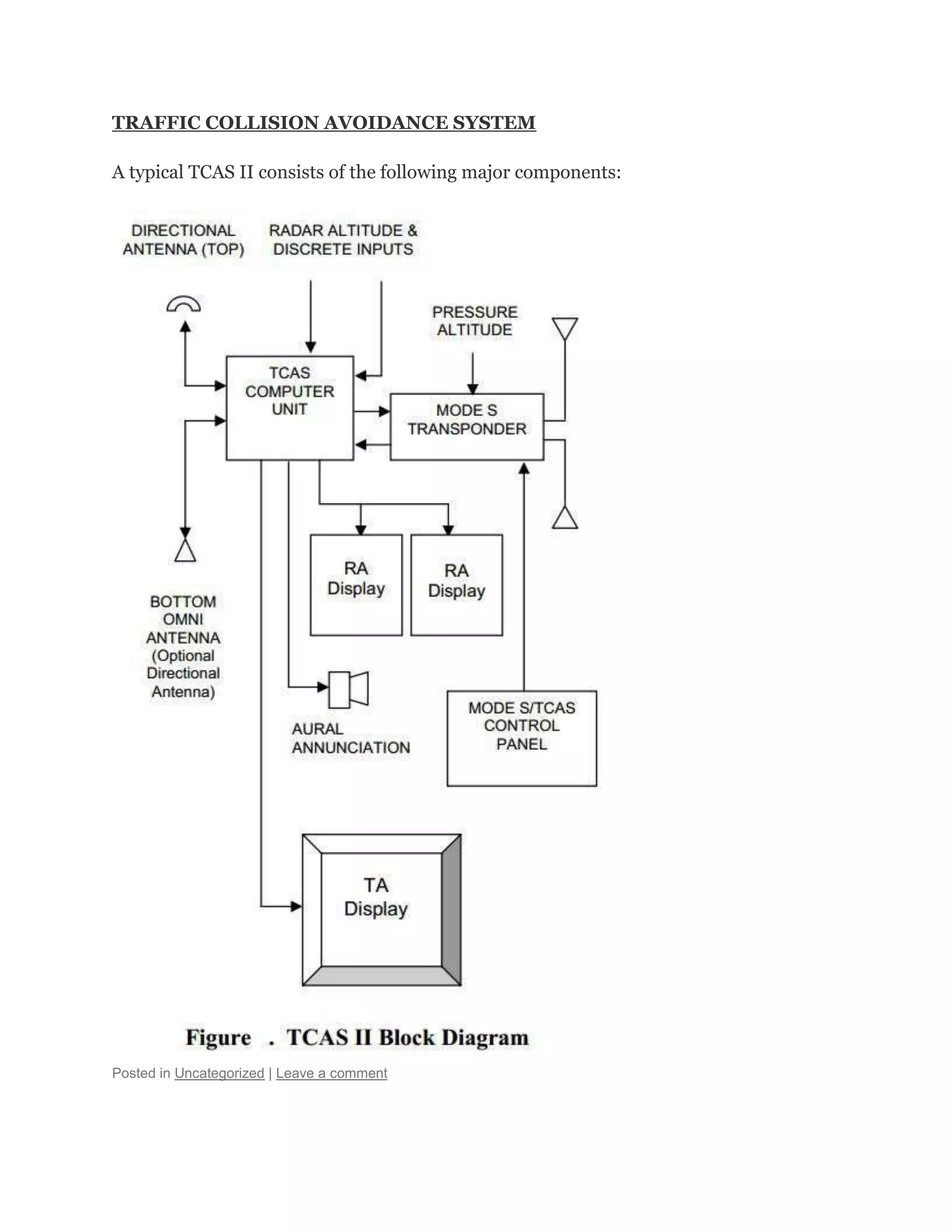
A typical TCAS II consists of the following major components:
Posted in Uncategorized | Leave a comment
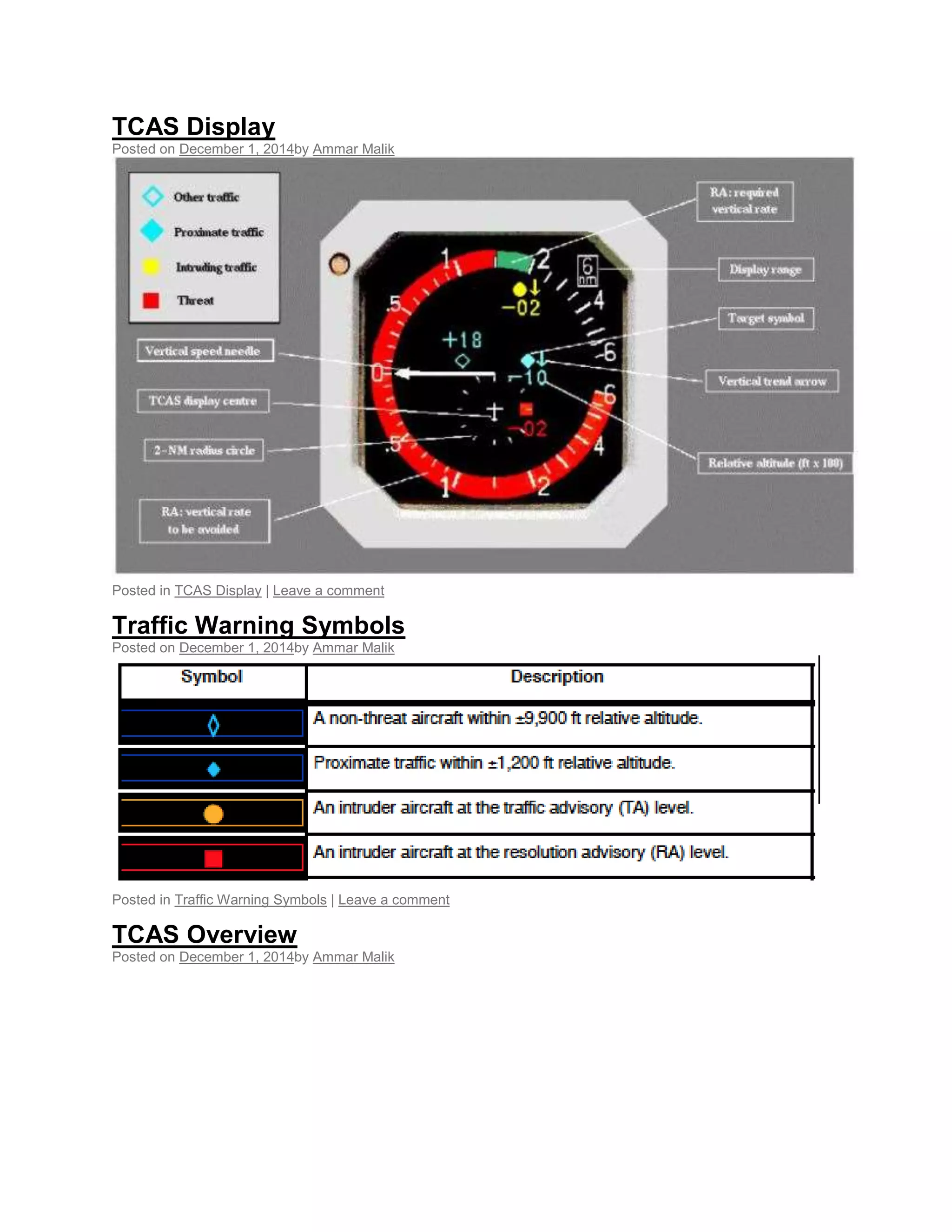
TCAS Display
Posted on December 1, 2014by Ammar Malik
Posted in TCAS Display | Leave a comment
Traffic Warning Symbols
Posted on December 1, 2014by Ammar Malik
Posted in Traffic Warning Symbols | Leave a comment
TCAS Overview
Posted on December 1, 2014by Ammar Malik
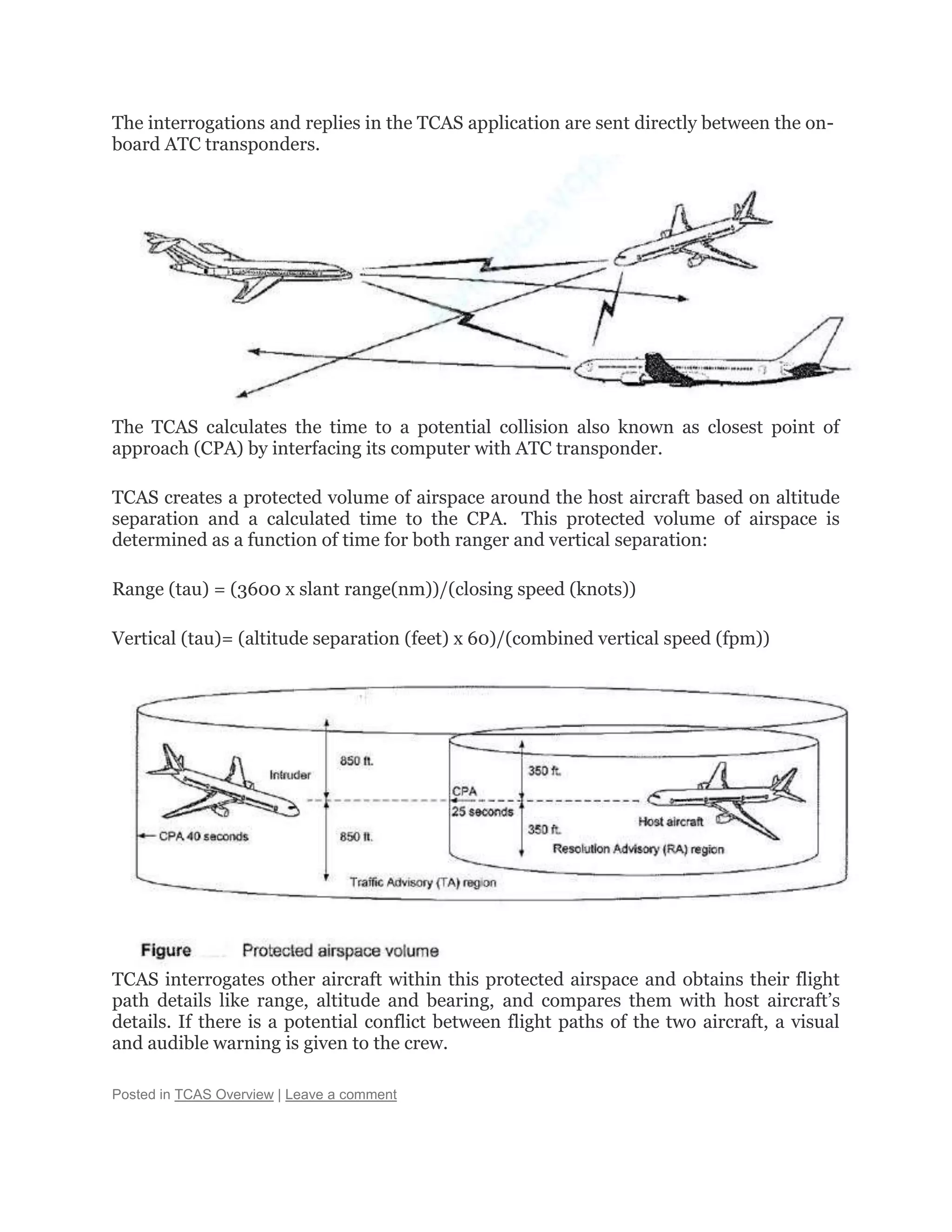
The interrogations and replies in the TCAS application are sent directly between the on-
board ATC transponders.
The TCAS calculates the time to a potential collision also known as closest point of
approach (CPA) by interfacing its computer with ATC transponder.
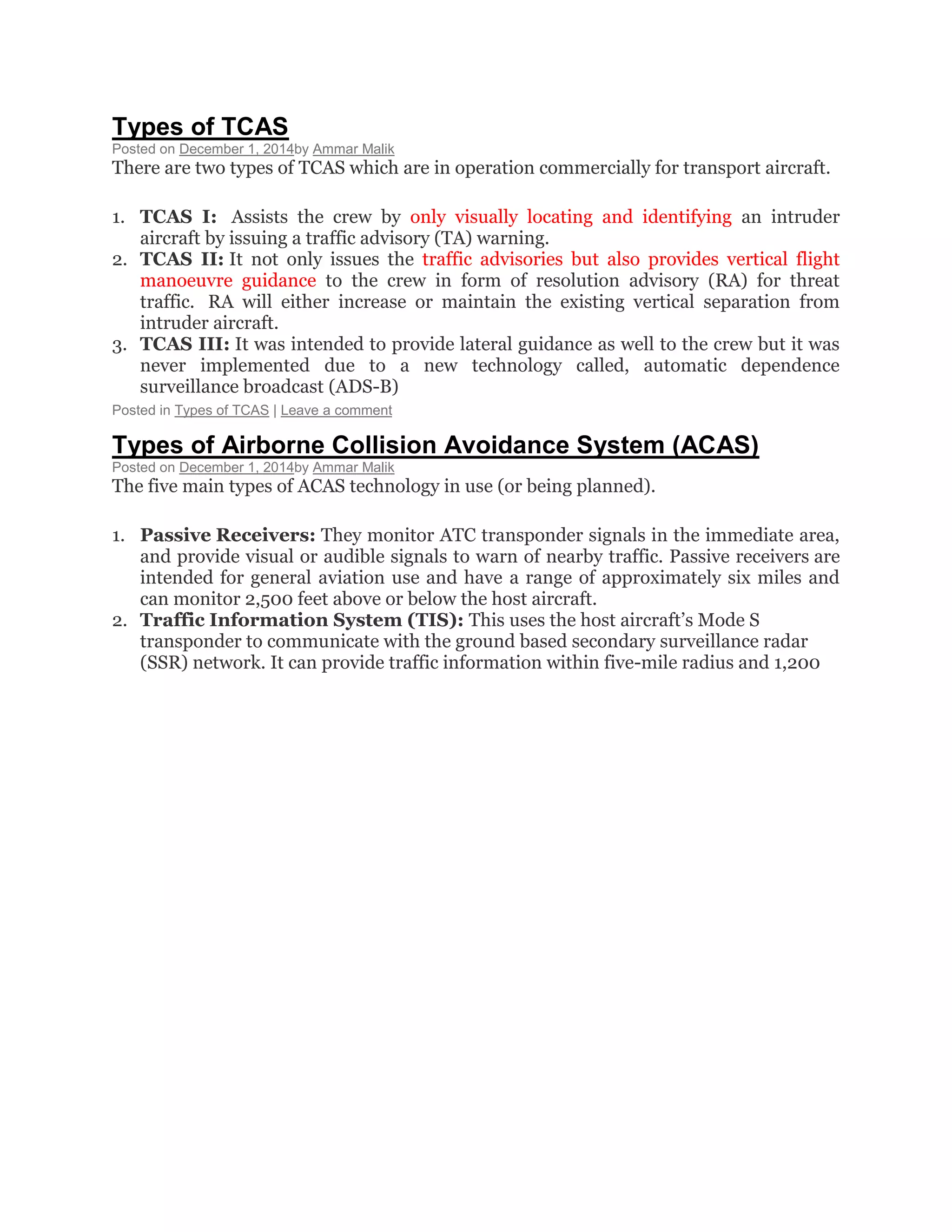
TCAS creates a protected volume of airspace around the host aircraft based on altitude
separation and a calculated time to the CPA. This protected volume of airspace is
determined as a function of time for both ranger and vertical separation:
Range (tau) = (3600 x slant range(nm))/(closing speed (knots))
Vertical (tau)= (altitude separation (feet) x 60)/(combined vertical speed (fpm))
TCAS interrogates other aircraft within this protected airspace and obtains their flight
path details like range, altitude and bearing, and compares them with host aircraft’s
details. If there is a potential conflict between flight paths of the two aircraft, a visual
and audible warning is given to the crew.
Posted in TCAS Overview | Leave a comment
Types of TCAS
Posted on December 1, 2014by Ammar Malik
There are two types of TCAS which are in operation commercially for transport aircraft.
1. TCAS I: Assists the crew by only visually locating and identifying an intruder
aircraft by issuing a traffic advisory (TA) warning.
2. TCAS II: It not only issues the traffic advisories but also provides vertical flight
manoeuvre guidance to the crew in form of resolution advisory (RA) for threat
traffic. RA will either increase or maintain the existing vertical separation from
intruder aircraft.
3. TCAS III: It was intended to provide lateral guidance as well to the crew but it was
never implemented due to a new technology called, automatic dependence
surveillance broadcast (ADS-B)
Posted in Types of TCAS | Leave a comment
Types of Airborne Collision Avoidance System (ACAS)
Posted on December 1, 2014by Ammar Malik
The five main types of ACAS technology in use (or being planned).
1. Passive Receivers: They monitor ATC transponder signals in the immediate area,
and provide visual or audible signals to warn of nearby traffic. Passive receivers are
intended for general aviation use and have a range of approximately six miles and
can monitor 2,500 feet above or below the host aircraft.
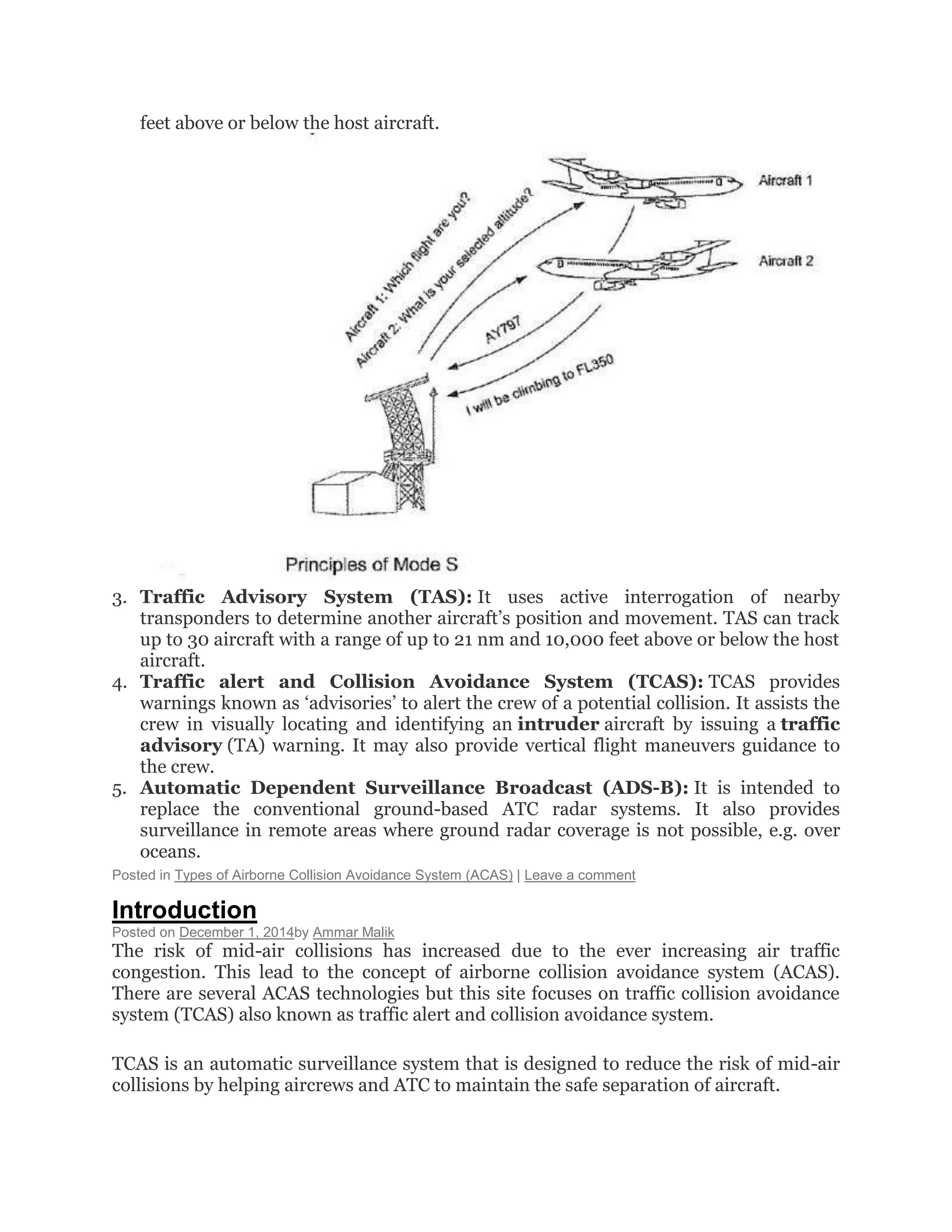
2. Traffic Information System (TIS): This uses the host aircraft’s Mode S
transponder to communicate with the ground based secondary surveillance radar
(SSR) network. It can provide traffic information within five-mile radius and 1,200
feet above or below the host aircraft.
3. Traffic Advisory System (TAS): It uses active interrogation of nearby
transponders to determine another aircraft’s position and movement. TAS can track
up to 30 aircraft with a range of up to 21 nm and 10,000 feet above or below the host
aircraft.
4. Traffic alert and Collision Avoidance System (TCAS): TCAS provides
warnings known as ‘advisories’ to alert the crew of a potential collision. It assists the
crew in visually locating and identifying an intruder aircraft by issuing a traffic
advisory (TA) warning. It may also provide vertical flight maneuvers guidance to
the crew.
5. Automatic Dependent Surveillance Broadcast (ADS-B): It is intended to
replace the conventional ground-based ATC radar systems. It also provides
surveillance in remote areas where ground radar coverage is not possible, e.g. over
oceans.
Posted in Types of Airborne Collision Avoidance System (ACAS) | Leave a comment
Introduction
Posted on December 1, 2014by Ammar Malik
The risk of mid-air collisions has increased due to the ever increasing air traffic
congestion. This lead to the concept of airborne collision avoidance system (ACAS).
There are several ACAS technologies but this site focuses on traffic collision avoidance
system (TCAS) also known as traffic alert and collision avoidance system.
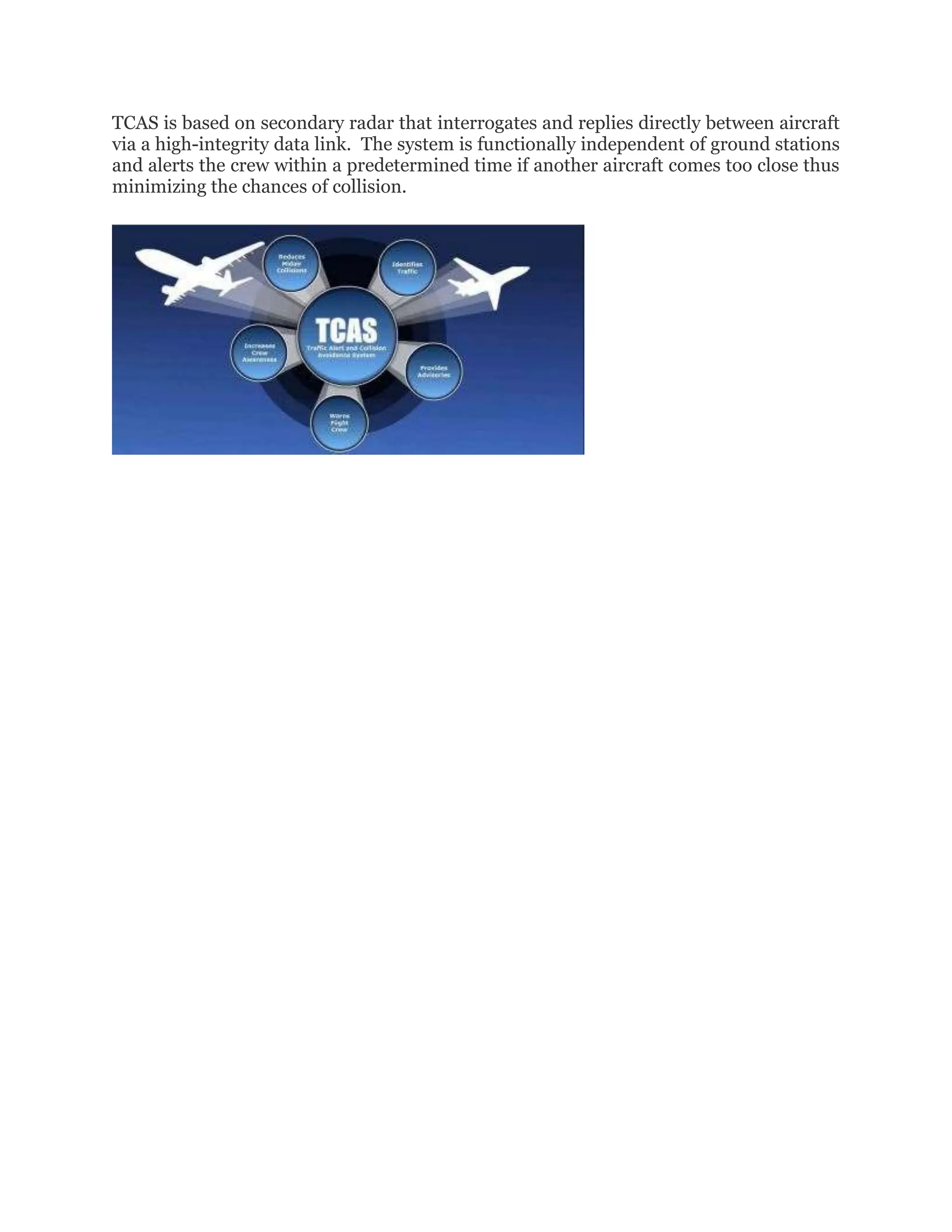
TCAS is an automatic surveillance system that is designed to reduce the risk of mid-air
collisions by helping aircrews and ATC to maintain the safe separation of aircraft.
TCAS is based on secondary radar that interrogates and replies directly between aircraft
via a high-integrity data link. The system is functionally independent of ground stations
and alerts the crew within a predetermined time if another aircraft comes too close thus
minimizing the chances of collision.

TRAFFIC COLLISION AVOIDANCE SYSTEM NOTES 2.docx

  • 1.
    TRAFFIC COLLISION AVOIDANCESYSTEM A typical TCAS II consists of the following major components: Posted in Uncategorized | Leave a comment
  • 2.
    TCAS Display Posted onDecember 1, 2014by Ammar Malik Posted in TCAS Display | Leave a comment Traffic Warning Symbols Posted on December 1, 2014by Ammar Malik Posted in Traffic Warning Symbols | Leave a comment TCAS Overview Posted on December 1, 2014by Ammar Malik
  • 3.
    The interrogations andreplies in the TCAS application are sent directly between the on- board ATC transponders. The TCAS calculates the time to a potential collision also known as closest point of approach (CPA) by interfacing its computer with ATC transponder. TCAS creates a protected volume of airspace around the host aircraft based on altitude separation and a calculated time to the CPA. This protected volume of airspace is determined as a function of time for both ranger and vertical separation: Range (tau) = (3600 x slant range(nm))/(closing speed (knots)) Vertical (tau)= (altitude separation (feet) x 60)/(combined vertical speed (fpm)) TCAS interrogates other aircraft within this protected airspace and obtains their flight path details like range, altitude and bearing, and compares them with host aircraft’s details. If there is a potential conflict between flight paths of the two aircraft, a visual and audible warning is given to the crew. Posted in TCAS Overview | Leave a comment
  • 4.
    Types of TCAS Postedon December 1, 2014by Ammar Malik There are two types of TCAS which are in operation commercially for transport aircraft. 1. TCAS I: Assists the crew by only visually locating and identifying an intruder aircraft by issuing a traffic advisory (TA) warning. 2. TCAS II: It not only issues the traffic advisories but also provides vertical flight manoeuvre guidance to the crew in form of resolution advisory (RA) for threat traffic. RA will either increase or maintain the existing vertical separation from intruder aircraft. 3. TCAS III: It was intended to provide lateral guidance as well to the crew but it was never implemented due to a new technology called, automatic dependence surveillance broadcast (ADS-B) Posted in Types of TCAS | Leave a comment Types of Airborne Collision Avoidance System (ACAS) Posted on December 1, 2014by Ammar Malik The five main types of ACAS technology in use (or being planned). 1. Passive Receivers: They monitor ATC transponder signals in the immediate area, and provide visual or audible signals to warn of nearby traffic. Passive receivers are intended for general aviation use and have a range of approximately six miles and can monitor 2,500 feet above or below the host aircraft. 2. Traffic Information System (TIS): This uses the host aircraft’s Mode S transponder to communicate with the ground based secondary surveillance radar (SSR) network. It can provide traffic information within five-mile radius and 1,200
  • 5.
    feet above orbelow the host aircraft. 3. Traffic Advisory System (TAS): It uses active interrogation of nearby transponders to determine another aircraft’s position and movement. TAS can track up to 30 aircraft with a range of up to 21 nm and 10,000 feet above or below the host aircraft. 4. Traffic alert and Collision Avoidance System (TCAS): TCAS provides warnings known as ‘advisories’ to alert the crew of a potential collision. It assists the crew in visually locating and identifying an intruder aircraft by issuing a traffic advisory (TA) warning. It may also provide vertical flight maneuvers guidance to the crew. 5. Automatic Dependent Surveillance Broadcast (ADS-B): It is intended to replace the conventional ground-based ATC radar systems. It also provides surveillance in remote areas where ground radar coverage is not possible, e.g. over oceans. Posted in Types of Airborne Collision Avoidance System (ACAS) | Leave a comment Introduction Posted on December 1, 2014by Ammar Malik The risk of mid-air collisions has increased due to the ever increasing air traffic congestion. This lead to the concept of airborne collision avoidance system (ACAS). There are several ACAS technologies but this site focuses on traffic collision avoidance system (TCAS) also known as traffic alert and collision avoidance system. TCAS is an automatic surveillance system that is designed to reduce the risk of mid-air collisions by helping aircrews and ATC to maintain the safe separation of aircraft.
  • 6.
    TCAS is basedon secondary radar that interrogates and replies directly between aircraft via a high-integrity data link. The system is functionally independent of ground stations and alerts the crew within a predetermined time if another aircraft comes too close thus minimizing the chances of collision.