WELCOME
“Sense and avoid”-what’s required
for aircraft safety?
CONTENTS
1) INTRODUCTION
2) PRIMARY RADAR AND ATCRBS
3) MODE-S TRANSPONDER
4) ACAS
5) ADS-B
6) DUE REGARD RADAR SYSTEM
7) REGULATORY ISSUES
8) ALTERNATE SENSOR TECHNOLOGY
9) RECOMMENDATIONS
10) CONCLUSION
INTRODUCTION
 This paper addresses technological aspects of aircraft collision avoidance realizing that the
FAA must implement procedural changes to assure flight safety.
 Unmanned Aerial Vehicles present new challenges for operation in the NAS.
 Currently, UAS operations require observers to provide “see and avoid” capability to the UAS
crew. New FAA proposed rules may allow UAS weighing less than 55 pounds to operate at a
maximum altitude of 400 feet, clear of manned air traffic.
 Currently, the FAA permits UAS operation only if it is controlled remotely by a pilot who can
visually see the aircraft, and certain other limitations.
 Operation of UASs in an autonomous mode would require precise knowledge of the concept
of operations, operating environment, and uncertainty of responses to unknown conditions
such as false alarms and system failures.
PRIMARY RADAR AND ATCRBS FOR
SECONDARY RADAR
 Primary Radar simply refers to a directed Radio Frequency source being
reflected by an airborne object to a highly directional receiver that can
graphically depict a range and azimuth from that source. While primary
radar is adequate for military early warning systems in an environment
where the only thing airborne is a threat.
 ATCRBS sends a directional interrogation signal during the radar volume
scan on a 1030 MHz carrier frequency and expects a Mode 3/A (and Mode
C) reply in the 1090 MHz band.
 The advent of denser air traffic has resulted in the need for a greater
volume of data from the target transmitter (primarily for more detailed
identification) and considerably faster and more reliable digital processing
has given birth to a solution in the form of the Mode-S transponder
standard.
MODE-S
TRANSPONDER
OPERATION
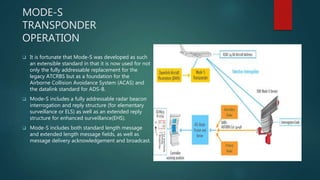
 It is fortunate that Mode-S was developed as such
an extensible standard in that it is now used for not
only the fully addressable replacement for the
legacy ATCRBS but as a foundation for the
Airborne Collision Avoidance System (ACAS) and
the datalink standard for ADS-B.
 Mode-S includes a fully addressable radar beacon
interrogation and reply structure (for elementary
surveillance or ELS) as well as an extended reply
structure for enhanced surveillance(EHS).
 Mode-S includes both standard length message
and extended length message fields, as well as
message delivery acknowledgement and broadcast.
AIRBORNE COLLISION
AVOIDANCE SYSTEM
 Instead of interrogations from ATC Ground Stations, the BCAS system would issue the
interrogation from the aircraft on which it was being carried,receiving replies from aircraft in
the vicinity carrying an associated ATC transponder, that being the Air Traffic Control Radar
Beacon System (ATCRBS).
 Replies from the ATCRBS contain a message with that aircraft’s altitude,and enable the BCAS
to estimate the range to the responding aircraft. Given this information, BCAS determines if
the target aircraft poses a collision threat.
 The Traffic Alert and Collision Avoidance System(TCAS) analyzes this information and when
necessary issues alerts to the pilot,who combines this information with what he is observing
visually to decide if and how to react.
 If both aircraft have TCAS systems, when flying at the same altitude and on a collision course,
a coordinated response will be given for one aircraft to climb and the other aircraft to
descend to maintain a safe separation.
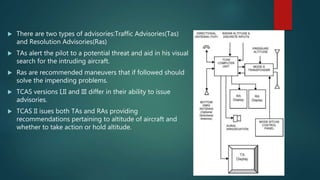
 There are two types of advisories:Traffic Advisories(Tas)
and Resolution Advisories(Ras)
 TAs alert the pilot to a potential threat and aid in his visual
search for the intruding aircraft.
 Ras are recommended maneuvers that if followed should
solve the impending problems.
 TCAS versions I,II and III differ in their ability to issue
advisories.
 TCAS II isues both TAs and RAs providing
recommendations pertaining to altitude of aircraft and
whether to take action or hold altitude.
A follow on system to TCAS called
the Airborne Collision Avoidance
System X(ACASX) has in recent
years been the focus of a
consortium of organizations formed
by the FAA. MIT laboratory has
been developing algorithms that
specifically address trajectory
prediction errors caused by sensors
currently available to TCAS systems.
The ACAS X systems will be
incorporating this type of improved
prediction algorithm.
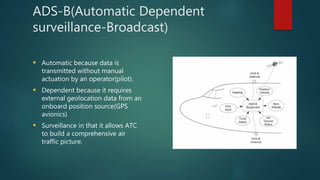
ADS-B(Automatic Dependent
surveillance-Broadcast)
 Automatic because data is
transmitted without manual
actuation by an operator(pilot).
 Dependent because it requires
external geolocation data from an
onboard position source(GPS
avionics)
 Surveillance in that it allows ATC
to build a comprehensive air
traffic picture.
 To facilitate the efficient transfer of the greater volume of data required by
ADS-B, the squitter size was increased and equipment having this
enhancement was labeled Extended Squitter (ES) capable.
 The FAA had been experimenting with various GPS augmentation schemes
to increase the precision of the geolocation solution available with GPS for
the purpose of precision approach capability (without the use of ground
based navigation aids).
 While many proposals were explored, the WAAS (Wide Area Augmentation
System)was adopted and is currently capable of providing position
accuracy data of 7 meters both vertically and horizontally.
 Paired with a suitable position source, a Mode-S(Extended Squitter)
transponder forms one possible implementation of ADS-B (Out).
DUE REGARD RADAR SYSTEMS
 “Tactical reconnaissance radars, and electro-optic
surveillance systems, has completed several planned flight
tests during 2013-2015 of a Sense and Avoid (SAA)
architecture and Self Separation functionality.
 The system has functioned as a true "system of systems" to detect every
class of aircraft equipage and paves the way for a Due
Regard radar system capability.”
 The radar itself is an active electronically scanned array system, such as is carried by modern
fighter aircraft.
 The radar can track any airborne vehicle, but isn’t intended to focus on those that aren’t
already tracked by another system, such as air traffic control. Instead, it looks for
“noncooperative” aircraft or those that aren’t broadcasting their location.
 The radar requirements were built around this idea that the radar could detect everything but
should focus on the aircraft that are not being tracked by another sensor, which we call non-
cooperative.
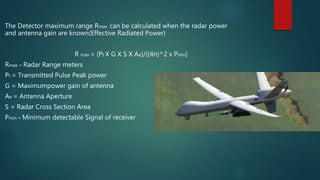
The Detector maximum range Rmax can be calculated when the radar power
and antenna gain are known(Effective Radiated Power)
R max = (Pt X G X S X Ae)/((4n)^2 x Pmin)
Rmax = Radar Range meters
Pt = Transmitted Pulse Peak power
G = Maximumpower gain of antenna
Ae = Antenna Aperture
S = Radar Cross Section Area
Pmin = Minimum detectable Signal of receiver
REGULATORY ISSUES
 NextGEN is composed of programs to facilitate a safer,faster,
cheaper, more efficient air traffic management system in the
FAA area of responsibility.
 To reduce the costs inherent in ground based radar systems
and improve aircraft tracking accuracy, an air traffic system
based entirely on self reporting traffic is proposed. The
cornerstone of this program is ADS-B.
 When all users are capable of determining their three
dimensional position and vector and then transmitting that to
the appropriate ATC facility, the requirement for ground
based radar acquisition becomes obsolete.
ALTERNATIVE SENSOR TECHNOLOGIES
Technology advances have occurred by integrating technologies to provide more
flexibility and performance.It also reduces pilot overload and provide improved
situational awareness for greater flight safety.
 LIDAR-Light Detection and Ranging is a remote sensing method used to
examine the surface of earth.Presents hazards for manned aircraft due to LASER
emissions.
 Military aircraft systems are more expensive but show how 360degree situational
awareness could be applied to collision avoidance.
 The Distributed Aparture System (DAS) surrounds the aircraft and warns the
PILOT of incoming aircraft or missile or friendly aircraft for tactical maneuvering.
 Bistatic Radar systems with radio detection(electromagnetic waves) and
ranging were developed in the 20th century with terrestrial, space and
airborne applications.
 There may be an application for bistatic radar systems to provide collision
avoidance equipment for aircraft recognizing the limitation of receiver
spatial placement onboard aircraft and intermittent reliability of
commercially broadcast transmitter signals.
 Miniature transponders, telemetry to provide “First Person View (FPV) and
Global Positioning System (GPS)with enhanced autopilot systems such as
Pixhawk ®, using open source control, may lead to a solution providing
small UASs with minimal collision avoidance capabilities
RECOMMENDATIONS
 Future safety equipment for manned and unmanned aircraft must meet two
requirements – compatibility with the FAA NextGEN ATC System, and operational
performance exceeding the existing collision avoidance systems.
 The integration of the UAS into the NAS is expected to build upon that tenant, with
human operators engaged in the application of procedures for maintaining separation
with all other air traffic.
 The additional capabilities and safety enhancement that could be provided by the
adoption of ACAS-X and/or the addition of the various alternative sensor systems are
promising, but the regulatory environment is far behind the technology
CONCLUSION While the “cockpit window – see
and avoid” concept is not readily achievable with an
“unmanned” platform, current FAA rulemaking requires
that UASs operate in such a way that their flight path is
observable and controllable by an operator. Based on the
above constraints, the ADS-B Out solution provides the best
cost benefit picture of any of the proposed solutions.
Exclusive of antennas and cabling ADS-B (Out) solutions
exist weighing only 4 lbs with a volume of 0.2 cubic feet
enabling inclusion in the ATC “picture” without dependence
on ground radar [20]. The additional capabilities and safety
enhancement that could be provided by the adoption of
ACAS-X and/or the addition of the various alternative
sensor systems are promising, but the regulatory
environment is far behind the technology. Once the UAS is
integrated unto the NAS, procedural enhancements and new
technologies that improve sense and avoid and air traffic
safety should be the next step.
REFERENCES
 IEEE
 NATGEO(AIR CRASH INVESTIGATION)
 Encarta encyclopedia 2015
Thank you

Seban ppt

  • 1.
  • 2.
    “Sense and avoid”-what’srequired for aircraft safety?
  • 3.
    CONTENTS 1) INTRODUCTION 2) PRIMARYRADAR AND ATCRBS 3) MODE-S TRANSPONDER 4) ACAS 5) ADS-B 6) DUE REGARD RADAR SYSTEM 7) REGULATORY ISSUES 8) ALTERNATE SENSOR TECHNOLOGY 9) RECOMMENDATIONS 10) CONCLUSION
  • 4.
    INTRODUCTION  This paperaddresses technological aspects of aircraft collision avoidance realizing that the FAA must implement procedural changes to assure flight safety.  Unmanned Aerial Vehicles present new challenges for operation in the NAS.  Currently, UAS operations require observers to provide “see and avoid” capability to the UAS crew. New FAA proposed rules may allow UAS weighing less than 55 pounds to operate at a maximum altitude of 400 feet, clear of manned air traffic.  Currently, the FAA permits UAS operation only if it is controlled remotely by a pilot who can visually see the aircraft, and certain other limitations.  Operation of UASs in an autonomous mode would require precise knowledge of the concept of operations, operating environment, and uncertainty of responses to unknown conditions such as false alarms and system failures.
  • 5.
    PRIMARY RADAR ANDATCRBS FOR SECONDARY RADAR  Primary Radar simply refers to a directed Radio Frequency source being reflected by an airborne object to a highly directional receiver that can graphically depict a range and azimuth from that source. While primary radar is adequate for military early warning systems in an environment where the only thing airborne is a threat.  ATCRBS sends a directional interrogation signal during the radar volume scan on a 1030 MHz carrier frequency and expects a Mode 3/A (and Mode C) reply in the 1090 MHz band.  The advent of denser air traffic has resulted in the need for a greater volume of data from the target transmitter (primarily for more detailed identification) and considerably faster and more reliable digital processing has given birth to a solution in the form of the Mode-S transponder standard.
  • 6.
    MODE-S TRANSPONDER OPERATION  It isfortunate that Mode-S was developed as such an extensible standard in that it is now used for not only the fully addressable replacement for the legacy ATCRBS but as a foundation for the Airborne Collision Avoidance System (ACAS) and the datalink standard for ADS-B.  Mode-S includes a fully addressable radar beacon interrogation and reply structure (for elementary surveillance or ELS) as well as an extended reply structure for enhanced surveillance(EHS).  Mode-S includes both standard length message and extended length message fields, as well as message delivery acknowledgement and broadcast.
  • 7.
    AIRBORNE COLLISION AVOIDANCE SYSTEM Instead of interrogations from ATC Ground Stations, the BCAS system would issue the interrogation from the aircraft on which it was being carried,receiving replies from aircraft in the vicinity carrying an associated ATC transponder, that being the Air Traffic Control Radar Beacon System (ATCRBS).  Replies from the ATCRBS contain a message with that aircraft’s altitude,and enable the BCAS to estimate the range to the responding aircraft. Given this information, BCAS determines if the target aircraft poses a collision threat.  The Traffic Alert and Collision Avoidance System(TCAS) analyzes this information and when necessary issues alerts to the pilot,who combines this information with what he is observing visually to decide if and how to react.  If both aircraft have TCAS systems, when flying at the same altitude and on a collision course, a coordinated response will be given for one aircraft to climb and the other aircraft to descend to maintain a safe separation.
  • 8.
     There aretwo types of advisories:Traffic Advisories(Tas) and Resolution Advisories(Ras)  TAs alert the pilot to a potential threat and aid in his visual search for the intruding aircraft.  Ras are recommended maneuvers that if followed should solve the impending problems.  TCAS versions I,II and III differ in their ability to issue advisories.  TCAS II isues both TAs and RAs providing recommendations pertaining to altitude of aircraft and whether to take action or hold altitude.
  • 9.
    A follow onsystem to TCAS called the Airborne Collision Avoidance System X(ACASX) has in recent years been the focus of a consortium of organizations formed by the FAA. MIT laboratory has been developing algorithms that specifically address trajectory prediction errors caused by sensors currently available to TCAS systems. The ACAS X systems will be incorporating this type of improved prediction algorithm.
  • 10.
    ADS-B(Automatic Dependent surveillance-Broadcast)  Automaticbecause data is transmitted without manual actuation by an operator(pilot).  Dependent because it requires external geolocation data from an onboard position source(GPS avionics)  Surveillance in that it allows ATC to build a comprehensive air traffic picture.
  • 11.
     To facilitatethe efficient transfer of the greater volume of data required by ADS-B, the squitter size was increased and equipment having this enhancement was labeled Extended Squitter (ES) capable.  The FAA had been experimenting with various GPS augmentation schemes to increase the precision of the geolocation solution available with GPS for the purpose of precision approach capability (without the use of ground based navigation aids).  While many proposals were explored, the WAAS (Wide Area Augmentation System)was adopted and is currently capable of providing position accuracy data of 7 meters both vertically and horizontally.  Paired with a suitable position source, a Mode-S(Extended Squitter) transponder forms one possible implementation of ADS-B (Out).
  • 12.
    DUE REGARD RADARSYSTEMS  “Tactical reconnaissance radars, and electro-optic surveillance systems, has completed several planned flight tests during 2013-2015 of a Sense and Avoid (SAA) architecture and Self Separation functionality.  The system has functioned as a true "system of systems" to detect every class of aircraft equipage and paves the way for a Due Regard radar system capability.”  The radar itself is an active electronically scanned array system, such as is carried by modern fighter aircraft.  The radar can track any airborne vehicle, but isn’t intended to focus on those that aren’t already tracked by another system, such as air traffic control. Instead, it looks for “noncooperative” aircraft or those that aren’t broadcasting their location.  The radar requirements were built around this idea that the radar could detect everything but should focus on the aircraft that are not being tracked by another sensor, which we call non- cooperative.
  • 13.
    The Detector maximumrange Rmax can be calculated when the radar power and antenna gain are known(Effective Radiated Power) R max = (Pt X G X S X Ae)/((4n)^2 x Pmin) Rmax = Radar Range meters Pt = Transmitted Pulse Peak power G = Maximumpower gain of antenna Ae = Antenna Aperture S = Radar Cross Section Area Pmin = Minimum detectable Signal of receiver
  • 14.
    REGULATORY ISSUES  NextGENis composed of programs to facilitate a safer,faster, cheaper, more efficient air traffic management system in the FAA area of responsibility.  To reduce the costs inherent in ground based radar systems and improve aircraft tracking accuracy, an air traffic system based entirely on self reporting traffic is proposed. The cornerstone of this program is ADS-B.  When all users are capable of determining their three dimensional position and vector and then transmitting that to the appropriate ATC facility, the requirement for ground based radar acquisition becomes obsolete.
  • 15.
    ALTERNATIVE SENSOR TECHNOLOGIES Technologyadvances have occurred by integrating technologies to provide more flexibility and performance.It also reduces pilot overload and provide improved situational awareness for greater flight safety.  LIDAR-Light Detection and Ranging is a remote sensing method used to examine the surface of earth.Presents hazards for manned aircraft due to LASER emissions.  Military aircraft systems are more expensive but show how 360degree situational awareness could be applied to collision avoidance.  The Distributed Aparture System (DAS) surrounds the aircraft and warns the PILOT of incoming aircraft or missile or friendly aircraft for tactical maneuvering.
  • 16.
     Bistatic Radarsystems with radio detection(electromagnetic waves) and ranging were developed in the 20th century with terrestrial, space and airborne applications.  There may be an application for bistatic radar systems to provide collision avoidance equipment for aircraft recognizing the limitation of receiver spatial placement onboard aircraft and intermittent reliability of commercially broadcast transmitter signals.  Miniature transponders, telemetry to provide “First Person View (FPV) and Global Positioning System (GPS)with enhanced autopilot systems such as Pixhawk ®, using open source control, may lead to a solution providing small UASs with minimal collision avoidance capabilities
  • 17.
    RECOMMENDATIONS  Future safetyequipment for manned and unmanned aircraft must meet two requirements – compatibility with the FAA NextGEN ATC System, and operational performance exceeding the existing collision avoidance systems.  The integration of the UAS into the NAS is expected to build upon that tenant, with human operators engaged in the application of procedures for maintaining separation with all other air traffic.  The additional capabilities and safety enhancement that could be provided by the adoption of ACAS-X and/or the addition of the various alternative sensor systems are promising, but the regulatory environment is far behind the technology
  • 18.
    CONCLUSION While the“cockpit window – see and avoid” concept is not readily achievable with an “unmanned” platform, current FAA rulemaking requires that UASs operate in such a way that their flight path is observable and controllable by an operator. Based on the above constraints, the ADS-B Out solution provides the best cost benefit picture of any of the proposed solutions. Exclusive of antennas and cabling ADS-B (Out) solutions exist weighing only 4 lbs with a volume of 0.2 cubic feet enabling inclusion in the ATC “picture” without dependence on ground radar [20]. The additional capabilities and safety enhancement that could be provided by the adoption of ACAS-X and/or the addition of the various alternative sensor systems are promising, but the regulatory environment is far behind the technology. Once the UAS is integrated unto the NAS, procedural enhancements and new technologies that improve sense and avoid and air traffic safety should be the next step.
  • 19.
    REFERENCES  IEEE  NATGEO(AIRCRASH INVESTIGATION)  Encarta encyclopedia 2015
  • 20.