Office of Aviation Safety
Air Traffic Control
Trust, But Verify!
2
Trust ATC…
• …but never forget who’s in the
plane!
• Overall, controllers do a great job
• They (and you) are still subject to all
the normal human failings in
memory, communication, attention,
fatigue, skill, etc, etc…
3
…but verify!
• Be prepared for your flight
– Skills where they should be
– Thorough flight planning
• Route
• Weather
• Alternatives
• Update as needed
• Ask yourself: does this seem right?
4
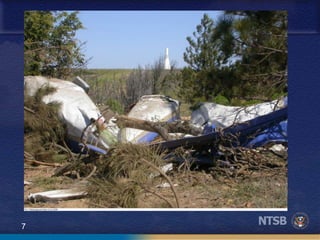
Accident Scenario
• N304PA – Controlled flight into
terrain near San Diego, California
• Night VMC, IFR flight plan
• Aircraft flown by commercial students
• Controller – almost 30 years of ATC
5
Accident Scenario
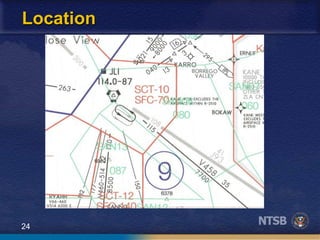
• N304PA had just been handed off to
SoCal TRACON by Los Angeles
Center sector 9.
• The aircraft had not yet left sector 9’s
area of responsibility
• Both the center and TRACON
controllers were required to monitor
the flight until it entered the TRACON
6
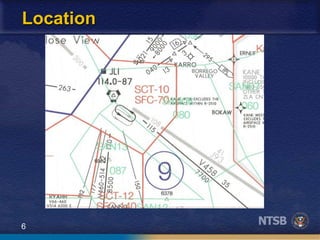
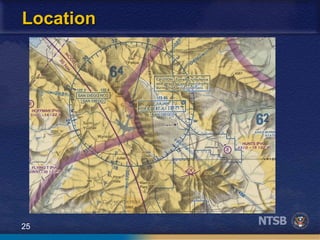
Location
7
8
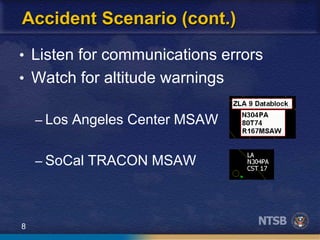
Accident Scenario (cont.)
• Listen for communications errors
• Watch for altitude warnings
– Los Angeles Center MSAW
– SoCal TRACON MSAW
9
Accident Scenario
• Radar Replay
10
ATC Issues
• Communications problems
– Numerous callsign errors
– Procedural deviations
– Controller missed incorrect readback
• Awareness of aircraft status
– Pilot ATIS report: off altitude?
• Non-compliance with safety alert
requirements
11
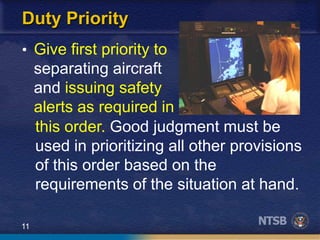
Duty Priority
• Give first priority to
separating aircraft
and issuing safety
alerts as required in
this order. Good judgment must be
used in prioritizing all other provisions
of this order based on the
requirements of the situation at hand.
12
Duty Priority (cont.)
• …When more than one action is
required, controllers must exercise
their best judgment based on the
facts and circumstances known to
them. That action which is most
critical from a safety standpoint is
performed first.
13
Safety Alerts
• Issue a safety alert to an aircraft if
you are aware the aircraft is in a
position/altitude which, in your
judgment, places it in unsafe
proximity to terrain, obstructions, or
other aircraft.
14
Safety Alerts (cont.)
• Do not assume that because
someone else has responsibility for
the aircraft that the unsafe situation
has been observed and the safety
alert issued; inform the appropriate
controller.
15
Safety Alerts (cont.)
• The issuance of a safety alert is a
first priority once the controller
observes and recognizes a situation
of unsafe aircraft proximity to
terrain, obstacles, or other aircraft.
16
Safety Alerts (cont.)
• While a controller cannot see
immediately the development of
every situation where a safety alert
must be issued, the controller must
remain vigilant for such situations
and issue a safety alert when the
situation is recognized.
17
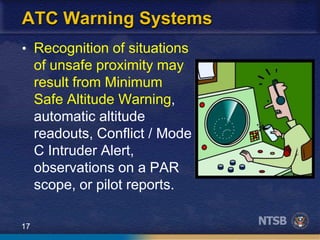
ATC Warning Systems
• Recognition of situations
of unsafe proximity may
result from Minimum
Safe Altitude Warning,
automatic altitude
readouts, Conflict / Mode
C Intruder Alert,
observations on a PAR
scope, or pilot reports.
18
Terrain / Obstruction Alert
• Immediately issue/initiate an alert to
an aircraft if you are aware the
aircraft is at an altitude which, in
your judgment, places it in unsafe
proximity to terrain/obstructions.
19
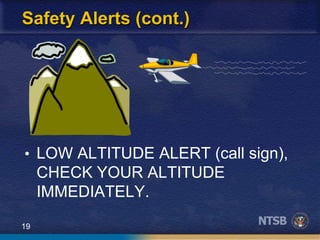
Safety Alerts (cont.)
• LOW ALTITUDE ALERT (call sign),
CHECK YOUR ALTITUDE
IMMEDIATELY.
20
Similar-Sounding Callsigns
• 2-4-20. AIRCRAFT IDENTIFICATION
– Use the full identification in reply to aircraft
with similar sounding identifications.
21
Similar-Sounding Callsigns
• 2-4-9. ABBREVIATED TRANSMISSIONS
– Transmissions may be abbreviated as
follows:
• a. Use the identification prefix and the
last 3 digits or letters of the aircraft
identification after communications have been
established. Do not abbreviate similar
sounding aircraft identifications or the
identification of an air carrier or other civil
aircraft having an FAA authorized call sign.
22
Similar-Sounding Callsigns
• 2-4-15. EMPHASIS FOR CLARITY
– Emphasize appropriate digits, letters, or similar
sounding words to aid in distinguishing between
similar sounding aircraft identifications.
Additionally:
– Notify each pilot concerned when communicating
with aircraft having similar sounding
identifications.
– EXAMPLE: "United Thirty-one United, Miami
Center, U.S. Air Thirty-one is also on this
frequency, acknowledge.”
23
Pilot Issues
• Low total experience
• Low IFR experience
• Situational awareness / area familiarity
• Assertiveness
• N434PA caught the ATC mistake!
24
Location
25
Location
26
Probable Cause
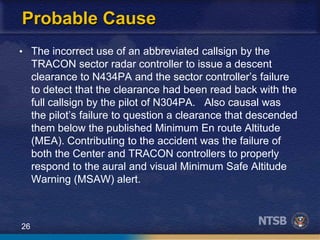
• The incorrect use of an abbreviated callsign by the
TRACON sector radar controller to issue a descent
clearance to N434PA and the sector controller’s failure
to detect that the clearance had been read back with the
full callsign by the pilot of N304PA. Also causal was
the pilot’s failure to question a clearance that descended
them below the published Minimum En route Altitude
(MEA). Contributing to the accident was the failure of
both the Center and TRACON controllers to properly
respond to the aural and visual Minimum Safe Altitude
Warning (MSAW) alert.
27
Self-Defense
• Controllers are human – we all
make mistakes
• Think about what’s happening – if it
doesn’t make sense, ask!
• Flight planning still matters
– Weather conditions
– Lighting
– Terrain awareness – use VFR charts!
28
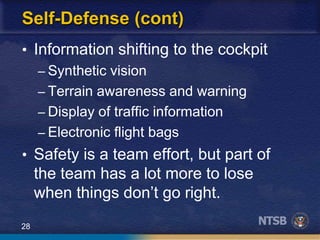
Self-Defense (cont)
• Information shifting to the cockpit
– Synthetic vision
– Terrain awareness and warning
– Display of traffic information
– Electronic flight bags
• Safety is a team effort, but part of
the team has a lot more to lose
when things don’t go right.
29
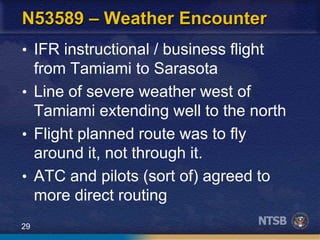
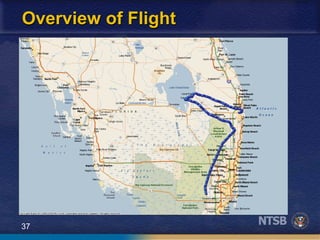
N53589 – Weather Encounter
• IFR instructional / business flight
from Tamiami to Sarasota
• Line of severe weather west of
Tamiami extending well to the north
• Flight planned route was to fly
around it, not through it.
• ATC and pilots (sort of) agreed to
more direct routing
30
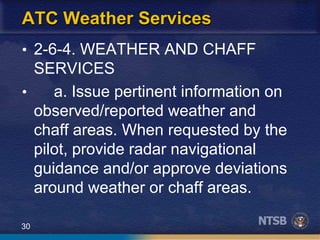
ATC Weather Services
• 2-6-4. WEATHER AND CHAFF
SERVICES
• a. Issue pertinent information on
observed/reported weather and
chaff areas. When requested by the
pilot, provide radar navigational
guidance and/or approve deviations
around weather or chaff areas.
31
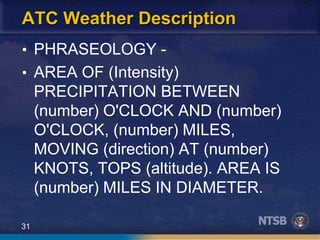
ATC Weather Description
• PHRASEOLOGY -
• AREA OF (Intensity)
PRECIPITATION BETWEEN
(number) O'CLOCK AND (number)
O'CLOCK, (number) MILES,
MOVING (direction) AT (number)
KNOTS, TOPS (altitude). AREA IS
(number) MILES IN DIAMETER.
32
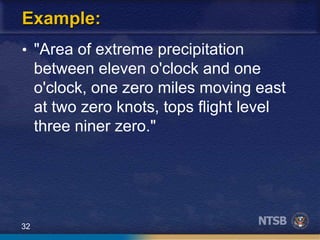
Example:
• "Area of extreme precipitation
between eleven o'clock and one
o'clock, one zero miles moving east
at two zero knots, tops flight level
three niner zero."
33
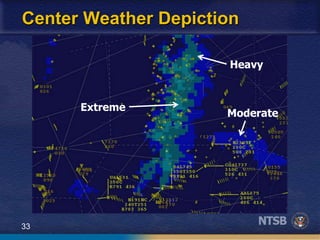
Center Weather Depiction
Moderate
Heavy
Extreme
34
You Need to Ask for Help!
• In areas of significant weather, plan
ahead and be prepared to suggest,
upon pilot request, the use of
alternative routes/altitudes.
35
What’s “Significant Weather?”
• Weather significant to the safety of
aircraft includes such conditions as
funnel cloud activity, lines of
thunderstorms, embedded
thunderstorms, large hail, wind
shear, microbursts, moderate to
extreme turbulence (including CAT),
and light to severe icing.
36
Duty Priority
• Providing weather information is an
“additional service”, meaning that it
is required – but only if higher
priority workload permits.
• IFR separation and safety alerts are
first, everything else is second.
37
Overview of Flight
38
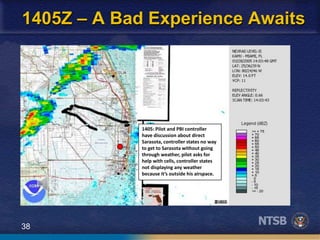
1405Z – A Bad Experience Awaits
1405: Pilot and PBI controller
have discussion about direct
Sarasota, controller states no way
to get to Sarasota without going
through weather, pilot asks for
help with cells, controller states
not displaying any weather
because it’s outside his airspace.
39
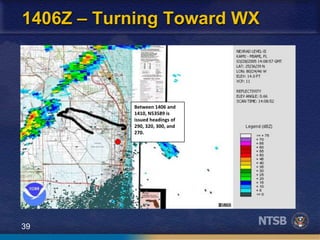
1406Z – Turning Toward WX
Between 1406 and
1410, N53589 is
issued headings of
290, 320, 300, and
270.
40
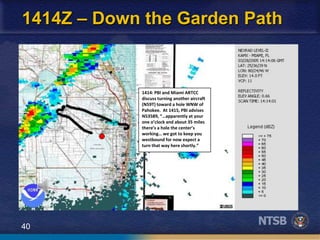
1414Z – Down the Garden Path
1414: PBI and Miami ARTCC
discuss turning another aircraft
(N59T) toward a hole WNW of
Pahokee. At 1415, PBI advises
N53589, “…apparently at your
one o’clock and about 35 miles
there’s a hole the center’s
working… we got to keep you
westbound for now expect a
turn that way here shortly.”
41
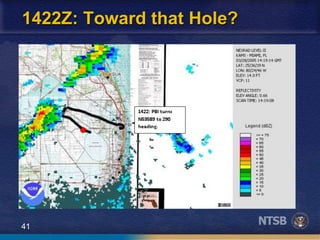
1422Z: Toward that Hole?
42
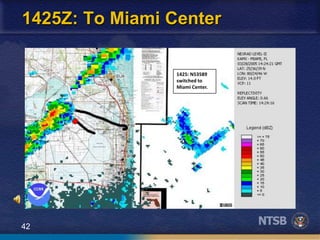
1425Z: To Miami Center
1425: N53589
switched to
Miami Center.
43
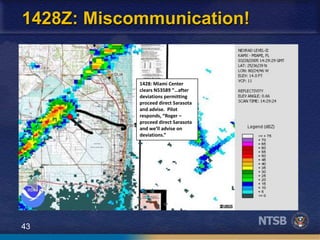
1428Z: Miscommunication!
1428: Miami Center
clears N53589 “…after
deviations permitting
proceed direct Sarasota
and advise. Pilot
responds, “Roger –
proceed direct Sarasota
and we’ll advise on
deviations.”
44
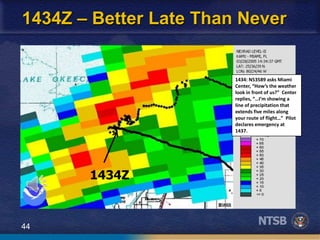
1434Z – Better Late Than Never
1434: N53589 asks Miami
Center, “How’s the weather
look in front of us?” Center
replies, “…I’m showing a
line of precipitation that
extends five miles along
your route of flight…” Pilot
declares emergency at
1437.
1434Z
45
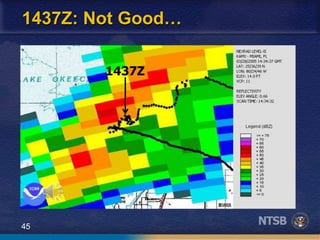
1437Z: Not Good…
1437Z
46
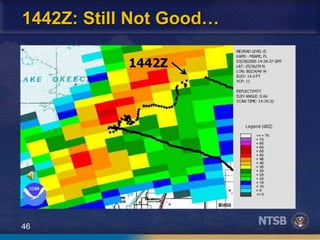
1442Z: Still Not Good…
1442Z
47
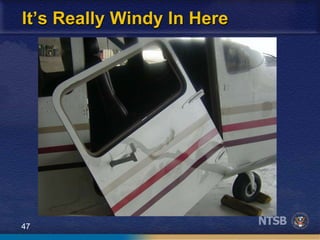
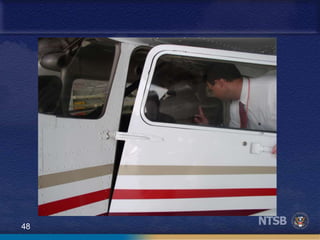
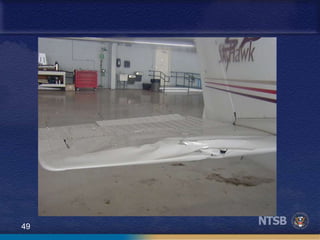
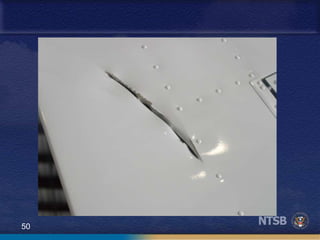
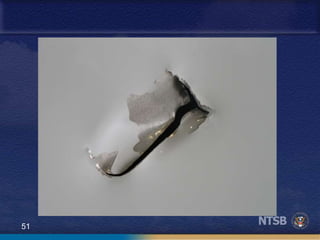
It’s Really Windy In Here
48
49
50
51
52
Self-Defense, Part II
• Avoid complete dependence on
ATC for severe weather avoidance.
– Weather info is NOT their first priority
– Controllers don’t know you, your
equipment, or your flight conditions
• Ask a lot of questions…and get
complete information!
53

NTSB presents: Air Traffic Control - Trust but Verify

  • 1.
    Office of AviationSafety Air Traffic Control Trust, But Verify!
  • 2.
    2 Trust ATC… • …butnever forget who’s in the plane! • Overall, controllers do a great job • They (and you) are still subject to all the normal human failings in memory, communication, attention, fatigue, skill, etc, etc…
  • 3.
    3 …but verify! • Beprepared for your flight – Skills where they should be – Thorough flight planning • Route • Weather • Alternatives • Update as needed • Ask yourself: does this seem right?
  • 4.
    4 Accident Scenario • N304PA– Controlled flight into terrain near San Diego, California • Night VMC, IFR flight plan • Aircraft flown by commercial students • Controller – almost 30 years of ATC
  • 5.
    5 Accident Scenario • N304PAhad just been handed off to SoCal TRACON by Los Angeles Center sector 9. • The aircraft had not yet left sector 9’s area of responsibility • Both the center and TRACON controllers were required to monitor the flight until it entered the TRACON
  • 6.
  • 7.
  • 8.
    8 Accident Scenario (cont.) •Listen for communications errors • Watch for altitude warnings – Los Angeles Center MSAW – SoCal TRACON MSAW
  • 9.
  • 10.
    10 ATC Issues • Communicationsproblems – Numerous callsign errors – Procedural deviations – Controller missed incorrect readback • Awareness of aircraft status – Pilot ATIS report: off altitude? • Non-compliance with safety alert requirements
  • 11.
    11 Duty Priority • Givefirst priority to separating aircraft and issuing safety alerts as required in this order. Good judgment must be used in prioritizing all other provisions of this order based on the requirements of the situation at hand.
  • 12.
    12 Duty Priority (cont.) •…When more than one action is required, controllers must exercise their best judgment based on the facts and circumstances known to them. That action which is most critical from a safety standpoint is performed first.
  • 13.
    13 Safety Alerts • Issuea safety alert to an aircraft if you are aware the aircraft is in a position/altitude which, in your judgment, places it in unsafe proximity to terrain, obstructions, or other aircraft.
  • 14.
    14 Safety Alerts (cont.) •Do not assume that because someone else has responsibility for the aircraft that the unsafe situation has been observed and the safety alert issued; inform the appropriate controller.
  • 15.
    15 Safety Alerts (cont.) •The issuance of a safety alert is a first priority once the controller observes and recognizes a situation of unsafe aircraft proximity to terrain, obstacles, or other aircraft.
  • 16.
    16 Safety Alerts (cont.) •While a controller cannot see immediately the development of every situation where a safety alert must be issued, the controller must remain vigilant for such situations and issue a safety alert when the situation is recognized.
  • 17.
    17 ATC Warning Systems •Recognition of situations of unsafe proximity may result from Minimum Safe Altitude Warning, automatic altitude readouts, Conflict / Mode C Intruder Alert, observations on a PAR scope, or pilot reports.
  • 18.
    18 Terrain / ObstructionAlert • Immediately issue/initiate an alert to an aircraft if you are aware the aircraft is at an altitude which, in your judgment, places it in unsafe proximity to terrain/obstructions.
  • 19.
    19 Safety Alerts (cont.) •LOW ALTITUDE ALERT (call sign), CHECK YOUR ALTITUDE IMMEDIATELY.
  • 20.
    20 Similar-Sounding Callsigns • 2-4-20.AIRCRAFT IDENTIFICATION – Use the full identification in reply to aircraft with similar sounding identifications.
  • 21.
    21 Similar-Sounding Callsigns • 2-4-9.ABBREVIATED TRANSMISSIONS – Transmissions may be abbreviated as follows: • a. Use the identification prefix and the last 3 digits or letters of the aircraft identification after communications have been established. Do not abbreviate similar sounding aircraft identifications or the identification of an air carrier or other civil aircraft having an FAA authorized call sign.
  • 22.
    22 Similar-Sounding Callsigns • 2-4-15.EMPHASIS FOR CLARITY – Emphasize appropriate digits, letters, or similar sounding words to aid in distinguishing between similar sounding aircraft identifications. Additionally: – Notify each pilot concerned when communicating with aircraft having similar sounding identifications. – EXAMPLE: "United Thirty-one United, Miami Center, U.S. Air Thirty-one is also on this frequency, acknowledge.”
  • 23.
    23 Pilot Issues • Lowtotal experience • Low IFR experience • Situational awareness / area familiarity • Assertiveness • N434PA caught the ATC mistake!
  • 24.
  • 25.
  • 26.
    26 Probable Cause • Theincorrect use of an abbreviated callsign by the TRACON sector radar controller to issue a descent clearance to N434PA and the sector controller’s failure to detect that the clearance had been read back with the full callsign by the pilot of N304PA. Also causal was the pilot’s failure to question a clearance that descended them below the published Minimum En route Altitude (MEA). Contributing to the accident was the failure of both the Center and TRACON controllers to properly respond to the aural and visual Minimum Safe Altitude Warning (MSAW) alert.
  • 27.
    27 Self-Defense • Controllers arehuman – we all make mistakes • Think about what’s happening – if it doesn’t make sense, ask! • Flight planning still matters – Weather conditions – Lighting – Terrain awareness – use VFR charts!
  • 28.
    28 Self-Defense (cont) • Informationshifting to the cockpit – Synthetic vision – Terrain awareness and warning – Display of traffic information – Electronic flight bags • Safety is a team effort, but part of the team has a lot more to lose when things don’t go right.
  • 29.
    29 N53589 – WeatherEncounter • IFR instructional / business flight from Tamiami to Sarasota • Line of severe weather west of Tamiami extending well to the north • Flight planned route was to fly around it, not through it. • ATC and pilots (sort of) agreed to more direct routing
  • 30.
    30 ATC Weather Services •2-6-4. WEATHER AND CHAFF SERVICES • a. Issue pertinent information on observed/reported weather and chaff areas. When requested by the pilot, provide radar navigational guidance and/or approve deviations around weather or chaff areas.
  • 31.
    31 ATC Weather Description •PHRASEOLOGY - • AREA OF (Intensity) PRECIPITATION BETWEEN (number) O'CLOCK AND (number) O'CLOCK, (number) MILES, MOVING (direction) AT (number) KNOTS, TOPS (altitude). AREA IS (number) MILES IN DIAMETER.
  • 32.
    32 Example: • "Area ofextreme precipitation between eleven o'clock and one o'clock, one zero miles moving east at two zero knots, tops flight level three niner zero."
  • 33.
  • 34.
    34 You Need toAsk for Help! • In areas of significant weather, plan ahead and be prepared to suggest, upon pilot request, the use of alternative routes/altitudes.
  • 35.
    35 What’s “Significant Weather?” •Weather significant to the safety of aircraft includes such conditions as funnel cloud activity, lines of thunderstorms, embedded thunderstorms, large hail, wind shear, microbursts, moderate to extreme turbulence (including CAT), and light to severe icing.
  • 36.
    36 Duty Priority • Providingweather information is an “additional service”, meaning that it is required – but only if higher priority workload permits. • IFR separation and safety alerts are first, everything else is second.
  • 37.
  • 38.
    38 1405Z – ABad Experience Awaits 1405: Pilot and PBI controller have discussion about direct Sarasota, controller states no way to get to Sarasota without going through weather, pilot asks for help with cells, controller states not displaying any weather because it’s outside his airspace.
  • 39.
    39 1406Z – TurningToward WX Between 1406 and 1410, N53589 is issued headings of 290, 320, 300, and 270.
  • 40.
    40 1414Z – Downthe Garden Path 1414: PBI and Miami ARTCC discuss turning another aircraft (N59T) toward a hole WNW of Pahokee. At 1415, PBI advises N53589, “…apparently at your one o’clock and about 35 miles there’s a hole the center’s working… we got to keep you westbound for now expect a turn that way here shortly.”
  • 41.
  • 42.
    42 1425Z: To MiamiCenter 1425: N53589 switched to Miami Center.
  • 43.
    43 1428Z: Miscommunication! 1428: MiamiCenter clears N53589 “…after deviations permitting proceed direct Sarasota and advise. Pilot responds, “Roger – proceed direct Sarasota and we’ll advise on deviations.”
  • 44.
    44 1434Z – BetterLate Than Never 1434: N53589 asks Miami Center, “How’s the weather look in front of us?” Center replies, “…I’m showing a line of precipitation that extends five miles along your route of flight…” Pilot declares emergency at 1437. 1434Z
  • 45.
  • 46.
    46 1442Z: Still NotGood… 1442Z
  • 47.
  • 48.
  • 49.
  • 50.
  • 51.
  • 52.
    52 Self-Defense, Part II •Avoid complete dependence on ATC for severe weather avoidance. – Weather info is NOT their first priority – Controllers don’t know you, your equipment, or your flight conditions • Ask a lot of questions…and get complete information!
  • 53.