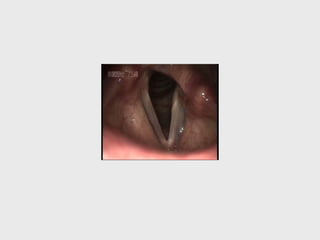
RECURRENT
LARYNGEAL NERVE
PARALYSIS
BY:
NILUFER
For normal voice production:
• VOCAL CORDS must :
• 1. be able to approximate with each
other
• 2. have proper size and stiffness
• 3. have an ability to vibrate reg. in
response to air column
• in vocal cord palsy ;
•
• - loss of approximation of vc
• - decreased stiffness of vc
ANATOMY OF LARYNX
LOCATION :
in the middle and ant.part of
the neck , opp. C3 - C6
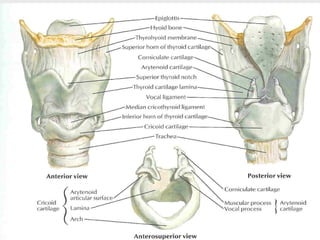
CARTILAGES :
1. paired
2.unpaired
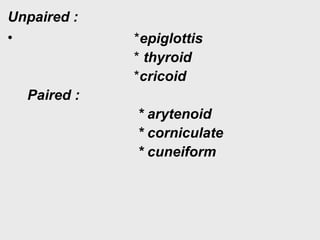
Unpaired :
• *epiglottis
* thyroid
*cricoid
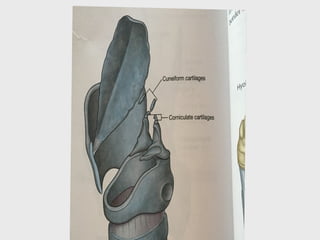
Paired :
* arytenoid
* corniculate
* cuneiform
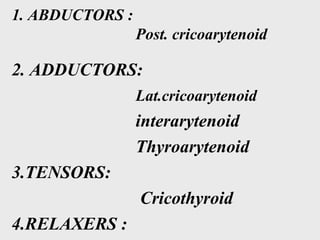
1. ABDUCTORS :
Post. cricoarytenoid
2. ADDUCTORS:
Lat.cricoarytenoid
interarytenoid
Thyroarytenoid
3.TENSORS:
Cricothyroid
4.RELAXERS :
Vocalis
Thyroarytenoid (int part)
Acting on l.inlet:
1.OPENERS
Thyroepiglottic
2.CLOSERS
Interarytenoid
(oblique p.)
Aryepiglottic
(post. ob. p.)
Extrinsic muscles :
• 1. elevators
• 2. depressors
NERVE SUPPLY OF LARYNX
1. sensory :
* above vocal cords - SLN (ILN)
* below vocal cords - RLN
2.motor:
* all intrinsic muscles - RLN
# except . cricothyroid ( SLN -
external)
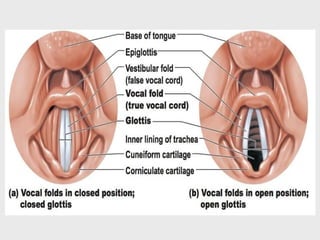
VOCAL CORDS
• *DEFN : are pearly white mucous memb.
infoldings that stretch horizontally across
mid.laryngeal cavity.
• ATTACHMENTS: Ant : thyroid cartilage
Post : arytenoid cartilage (
vocal process)
EDGES: Outer - attached to muscle in larynx
Inner - free ( form rima glottidis)
• TYPES:
• 1. TRUE : formed from conus
elasticus (inf layer of
infolded membrane)
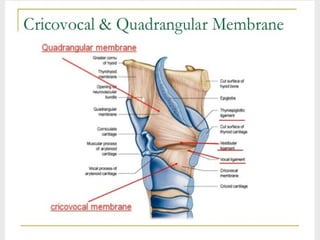
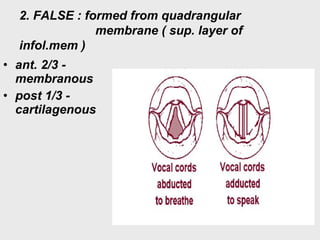
2. FALSE : formed from quadrangular
membrane ( sup. layer of
infol.mem )
• ant. 2/3 -
membranous
• post 1/3 -
cartilagenous
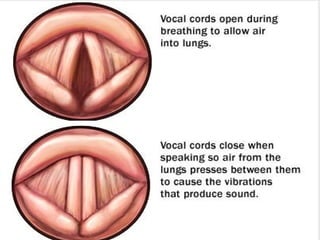
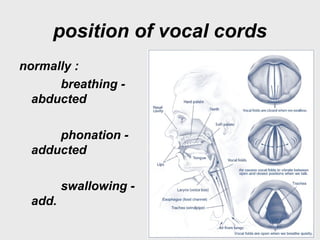
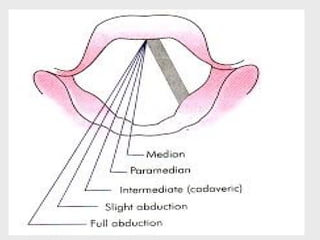
position of vocal cords
normally :
breathing -
abducted
phonation -
adducted
swallowing -
add.
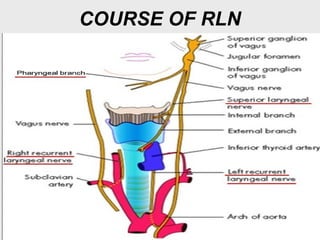
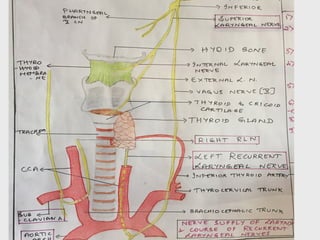
COURSE OF RLN
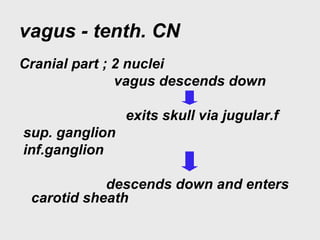
vagus - tenth. CN
Cranial part ; 2 nuclei
vagus descends down
exits skull via jugular.f
sup. ganglion
inf.ganglion
descends down and enters
carotid sheath
below inf.gang.
• gives SLN
• at level of hyoid bone it
divides into
external internal
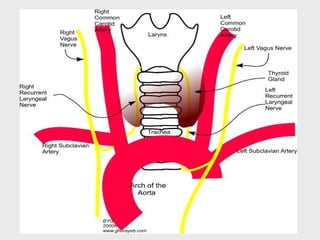
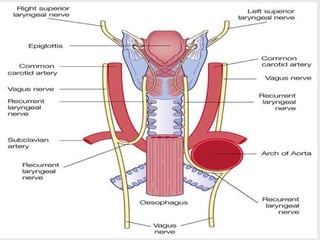
at level of SCA - GIVES RIGHT RLN
• at thr level of arch of aorta - gives LEFT
• RLN
• GALEN 'ANASTOMOSIS: btw SLN &
RLN
• NON RECURRENT LARYNGEAL N.
• WHY LEFT RLN more prone for
paralysis?
CLASSIFICATION
• 1. RLN
• 2. SLN
• 3. COMBINED
• * 1. CONGENITAL/ ACQUIRED
• 2. U/L or B/L
• 3. COMPLETE/ INCOMPLETE
• 4. ABDUCTOR / ADDUCTOR/ BOTH
5. SENSORY / MOTOR
• * ETIOLOGY :
• 1. supranuclear
• 2. nuclear
• 3. vagus nerve ( high vagal )
• 4. low vagal trunk
• - right RLN
• - left RLN
• - both
• 5. systemic causes
CAUSES OF RLNP
• RIGHT : neck
• - neck trauma
• - thyroid disease
• -malignancy
• - iatrogenic
• - cer. lymphadenopathy
• - aneurysm of SCA
• - CA.apex rt.lung
• - TBofcer.pleura
• - idiopathic
LEFT : 1. in the NECK;
• - acc.trauma
• - thy. disease
• - iatrogenic
• - malignancy
• - c.lymph.
• in the MEDIASTINUM ;
• - Bronchogenic.CA
• - CA.tho.eso
• - aortic aneurysm
• - M. lymph
• - ortner s syn.
• - intrathoracic surgry
BOTH ;
• thy.surgry
• CA.thyroid
• CAcer. oeso
• cer. lymphadenopathy
TYPES OF RLNP
1. UNILATERAL
2. BILATERAL
1.UNILATERAL RLNP :
DEFN: Condition which leads to ipsilateral
paralysis of all intrinsic laryngeal muscles
except cricothyroid .
INCIDENCE :
usually affects adults
SEX : both males n females
•clinical
• features
THEORIES TO EXPLAIN THE POSITION
OF VOCAL CORDS IN PARALYSIS
• 1. SEMON 'S LAW :
• "in all the prog. org. lesions,
abd.fibres of nerve which are
phylogenetically newer, are more
susceptible & are first to be paralysed
compared to adductors.
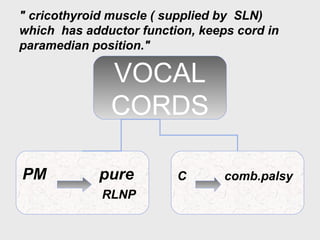
• 2. WAGNER AND GROSSMAN 'S LAW
" cricothyroid muscle ( supplied by SLN)
which has adductor function, keeps cord in
paramedian position."
VOCAL
CORDS
PM pure
RLNP
C comb.palsy
• ETIO :
• - BRONCHOGENIC CA.
• - THYROID SURGERY
C/F :
- VOICE
- POSITION OF VOCAL CORDS
- RESPIRATION ( stridor)
- SWALLOWING ( aspiration )
• 1. VOICE :
- asympotomatic in 1/3 cases
- left sided; hoarseness
-no change
- improves gradually by
compensation
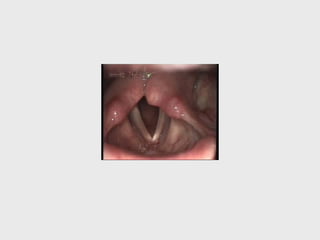
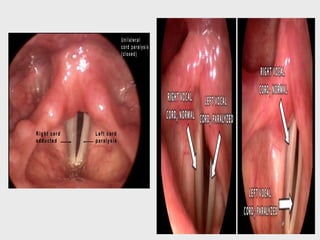
2. POSITION OF VC : median or paramedian
- aff. vc may lie at a lower
level
3. no prob. of aspiration or breathing
INVESTIGATIONS :
• 1. Chest X-Ray
• 2. biopsy
• 3. radiography of barium swallow
• 4. panendoscopy - dir.laryngoscopy,
bronchoscopy, esophagoscopy
• 5. blood sugar
• 6. VDRL
• 7. ESR
• 8. neurological invest.
• 9. CVS
• 10. CT- SCAN and MRI
MANAGEMENT :
- if asymptomatic - no trtmnt reqd,.
- temporary paralysis recovers in 6 to 12
months
- advisable to wait
- voice improvement during waiting period
- 1. speech therapy
-
• if paralysis persists for 9 to 12 months,
then following procedures performed:
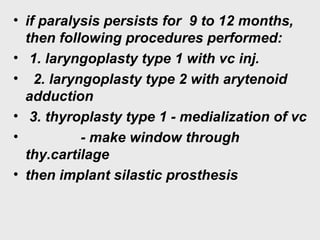
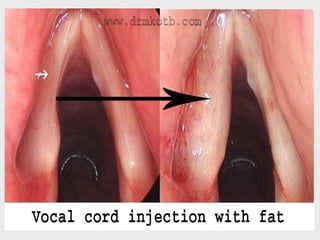
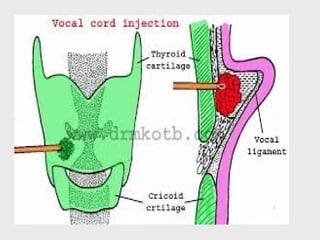
• 1. laryngoplasty type 1 with vc inj.
• 2. laryngoplasty type 2 with arytenoid
adduction
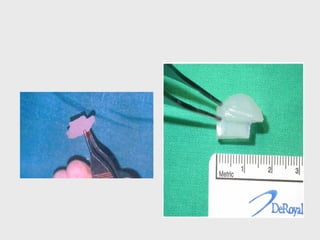
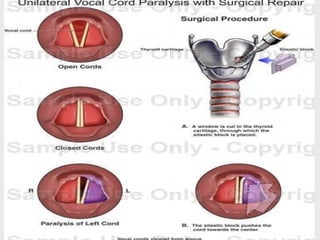
• 3. thyroplasty type 1 - medialization of vc
• - make window through
thy.cartilage
• then implant silastic prosthesis
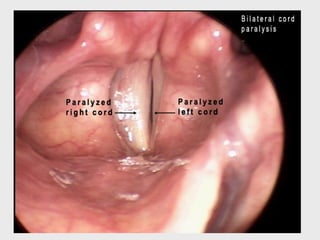
BILATERAL RLNP
( ABDUCTOR PARALYSIS)
DEFN: condition in which al the intrinsic
muscles of larynx are paralysed
bilaterally. except cricothyroid
ETIO : neuritis
thyroid surgery
C/F :
- Acute in onset
- dyspnea
- stridor
• - becomes worse during exertion and
infection
• voice : good
• position of vc: median / paramedian
INVESTIGATIONS
MANAGEMENT :
1. Surgical treatmnt
2 modalities;
1. permanent tracheostomy
with speaking valve
2. lateralization of cord
• by endoscopy or ext.cervical approach
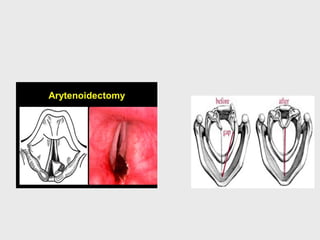
• 1.arytenoidectomy
• 2. arytenoidopexy
• 3.transverse cordotomy ( kashima op.)
• 4. thyroplasty type 2
• 5. reinnervation
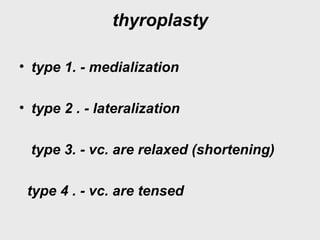
thyroplasty
• type 1. - medialization
• type 2 . - lateralization
type 3. - vc. are relaxed (shortening)
type 4 . - vc. are tensed
reinnervation
• innervate the paralysed post.
cricoarytenoid muscle by
• implanting nerve muscle pedicle from
sternohyoid or omohyoid with its n.s.
from ansa cervicalis.
Recurrent laryngeal nerve paralysis

Recurrent laryngeal nerve paralysis

  • 1.
  • 2.
    For normal voiceproduction: • VOCAL CORDS must : • 1. be able to approximate with each other • 2. have proper size and stiffness • 3. have an ability to vibrate reg. in response to air column
  • 3.
    • in vocalcord palsy ; • • - loss of approximation of vc • - decreased stiffness of vc
  • 4.
    ANATOMY OF LARYNX LOCATION: in the middle and ant.part of the neck , opp. C3 - C6 CARTILAGES : 1. paired 2.unpaired
  • 5.
    Unpaired : • *epiglottis *thyroid *cricoid Paired : * arytenoid * corniculate * cuneiform
  • 8.
    1. ABDUCTORS : Post.cricoarytenoid 2. ADDUCTORS: Lat.cricoarytenoid interarytenoid Thyroarytenoid 3.TENSORS: Cricothyroid 4.RELAXERS :
  • 9.
    Vocalis Thyroarytenoid (int part) Actingon l.inlet: 1.OPENERS Thyroepiglottic 2.CLOSERS Interarytenoid (oblique p.) Aryepiglottic (post. ob. p.)
  • 10.
    Extrinsic muscles : •1. elevators • 2. depressors
  • 11.
    NERVE SUPPLY OFLARYNX 1. sensory : * above vocal cords - SLN (ILN) * below vocal cords - RLN 2.motor: * all intrinsic muscles - RLN # except . cricothyroid ( SLN - external)
  • 12.
    VOCAL CORDS • *DEFN: are pearly white mucous memb. infoldings that stretch horizontally across mid.laryngeal cavity. • ATTACHMENTS: Ant : thyroid cartilage Post : arytenoid cartilage ( vocal process) EDGES: Outer - attached to muscle in larynx Inner - free ( form rima glottidis) • TYPES: • 1. TRUE : formed from conus elasticus (inf layer of infolded membrane)
  • 14.
    2. FALSE :formed from quadrangular membrane ( sup. layer of infol.mem ) • ant. 2/3 - membranous • post 1/3 - cartilagenous
  • 17.
    position of vocalcords normally : breathing - abducted phonation - adducted swallowing - add.
  • 18.
  • 20.
    vagus - tenth.CN Cranial part ; 2 nuclei vagus descends down exits skull via jugular.f sup. ganglion inf.ganglion descends down and enters carotid sheath
  • 21.
    below inf.gang. • givesSLN • at level of hyoid bone it divides into external internal
  • 23.
    at level ofSCA - GIVES RIGHT RLN • at thr level of arch of aorta - gives LEFT • RLN • GALEN 'ANASTOMOSIS: btw SLN & RLN • NON RECURRENT LARYNGEAL N. • WHY LEFT RLN more prone for paralysis?
  • 25.
    CLASSIFICATION • 1. RLN •2. SLN • 3. COMBINED • * 1. CONGENITAL/ ACQUIRED • 2. U/L or B/L • 3. COMPLETE/ INCOMPLETE • 4. ABDUCTOR / ADDUCTOR/ BOTH
  • 26.
    5. SENSORY /MOTOR • * ETIOLOGY : • 1. supranuclear • 2. nuclear • 3. vagus nerve ( high vagal ) • 4. low vagal trunk • - right RLN • - left RLN • - both • 5. systemic causes
  • 27.
    CAUSES OF RLNP •RIGHT : neck • - neck trauma • - thyroid disease • -malignancy • - iatrogenic • - cer. lymphadenopathy • - aneurysm of SCA • - CA.apex rt.lung • - TBofcer.pleura • - idiopathic
  • 28.
    LEFT : 1.in the NECK; • - acc.trauma • - thy. disease • - iatrogenic • - malignancy • - c.lymph. • in the MEDIASTINUM ; • - Bronchogenic.CA • - CA.tho.eso • - aortic aneurysm • - M. lymph • - ortner s syn. • - intrathoracic surgry
  • 29.
    BOTH ; • thy.surgry •CA.thyroid • CAcer. oeso • cer. lymphadenopathy
  • 30.
    TYPES OF RLNP 1.UNILATERAL 2. BILATERAL 1.UNILATERAL RLNP : DEFN: Condition which leads to ipsilateral paralysis of all intrinsic laryngeal muscles except cricothyroid . INCIDENCE : usually affects adults SEX : both males n females
  • 31.
  • 33.
    THEORIES TO EXPLAINTHE POSITION OF VOCAL CORDS IN PARALYSIS • 1. SEMON 'S LAW : • "in all the prog. org. lesions, abd.fibres of nerve which are phylogenetically newer, are more susceptible & are first to be paralysed compared to adductors. • 2. WAGNER AND GROSSMAN 'S LAW
  • 34.
    " cricothyroid muscle( supplied by SLN) which has adductor function, keeps cord in paramedian position." VOCAL CORDS PM pure RLNP C comb.palsy
  • 35.
    • ETIO : •- BRONCHOGENIC CA. • - THYROID SURGERY C/F : - VOICE - POSITION OF VOCAL CORDS - RESPIRATION ( stridor) - SWALLOWING ( aspiration )
  • 36.
    • 1. VOICE: - asympotomatic in 1/3 cases - left sided; hoarseness -no change - improves gradually by compensation 2. POSITION OF VC : median or paramedian - aff. vc may lie at a lower level 3. no prob. of aspiration or breathing
  • 38.
    INVESTIGATIONS : • 1.Chest X-Ray • 2. biopsy • 3. radiography of barium swallow • 4. panendoscopy - dir.laryngoscopy, bronchoscopy, esophagoscopy • 5. blood sugar • 6. VDRL • 7. ESR • 8. neurological invest. • 9. CVS • 10. CT- SCAN and MRI
  • 40.
    MANAGEMENT : - ifasymptomatic - no trtmnt reqd,. - temporary paralysis recovers in 6 to 12 months - advisable to wait - voice improvement during waiting period - 1. speech therapy -
  • 41.
    • if paralysispersists for 9 to 12 months, then following procedures performed: • 1. laryngoplasty type 1 with vc inj. • 2. laryngoplasty type 2 with arytenoid adduction • 3. thyroplasty type 1 - medialization of vc • - make window through thy.cartilage • then implant silastic prosthesis
  • 46.
    BILATERAL RLNP ( ABDUCTORPARALYSIS) DEFN: condition in which al the intrinsic muscles of larynx are paralysed bilaterally. except cricothyroid ETIO : neuritis thyroid surgery C/F : - Acute in onset - dyspnea - stridor
  • 48.
    • - becomesworse during exertion and infection • voice : good • position of vc: median / paramedian INVESTIGATIONS MANAGEMENT : 1. Surgical treatmnt
  • 49.
    2 modalities; 1. permanenttracheostomy with speaking valve 2. lateralization of cord
  • 50.
    • by endoscopyor ext.cervical approach • 1.arytenoidectomy • 2. arytenoidopexy • 3.transverse cordotomy ( kashima op.) • 4. thyroplasty type 2 • 5. reinnervation
  • 52.
    thyroplasty • type 1.- medialization • type 2 . - lateralization type 3. - vc. are relaxed (shortening) type 4 . - vc. are tensed
  • 54.
    reinnervation • innervate theparalysed post. cricoarytenoid muscle by • implanting nerve muscle pedicle from sternohyoid or omohyoid with its n.s. from ansa cervicalis.