TRACHEITIS
Done by: Zabunova D., group 306-A
Checked by:
Kazakh-Russian Medical University
PLAN
1. What Is Tracheitis?
2. The causes of tracheitis
3. Symptoms of tracheitis
4. How is bacterial tracheitis diagnosed?
5. Tracheitis Treatment
6. Glossary
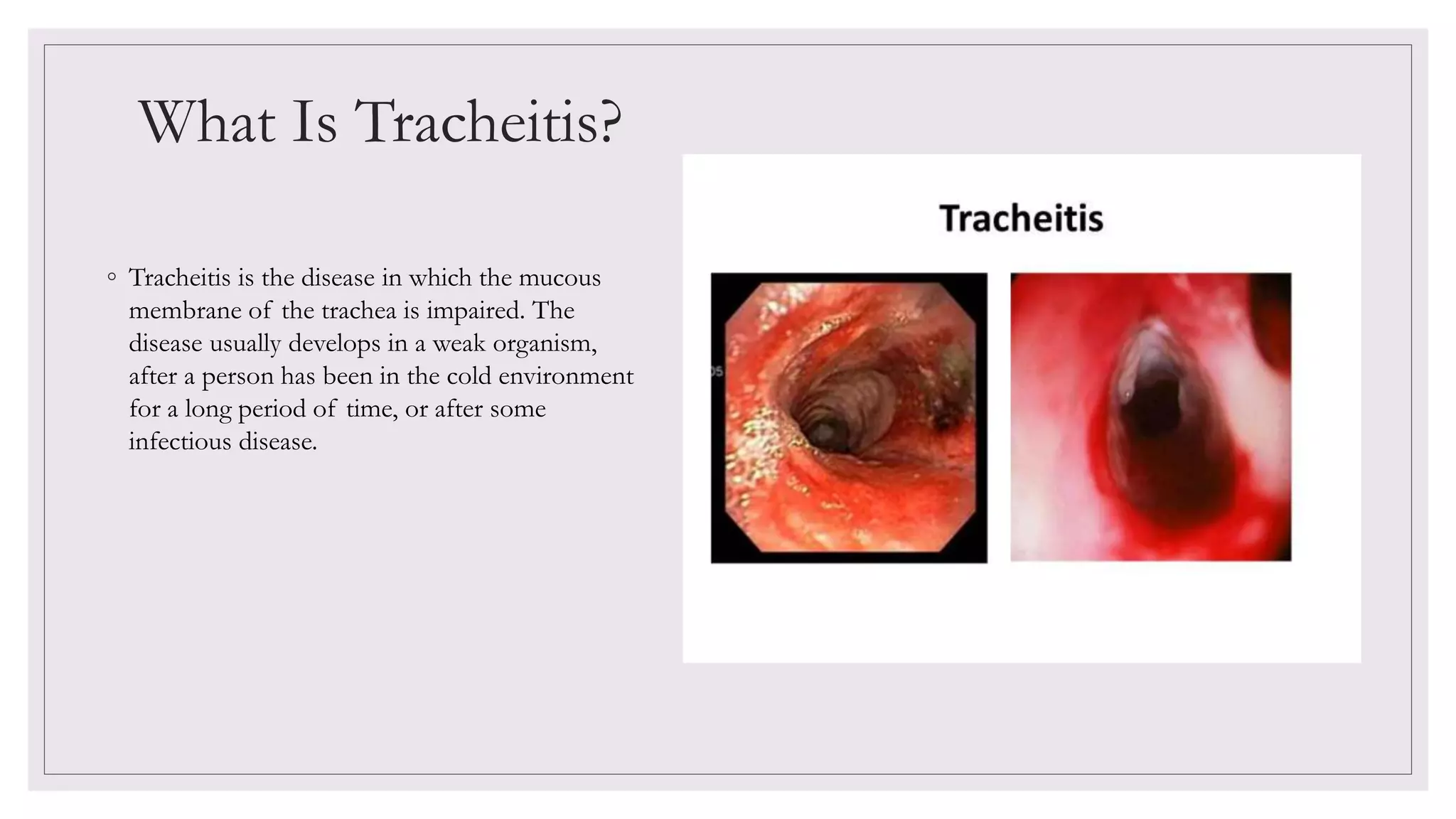
What Is Tracheitis?
◦ Tracheitis is the disease in which the mucous
membrane of the trachea is impaired. The
disease usually develops in a weak organism,
after a person has been in the cold environment
for a long period of time, or after some
infectious disease.
The causes of tracheitis
Bacterial tracheitis is usually caused by Staphylococcus
aureus bacteria. Other bacteria can also cause it, including:
◦ Streptococcus pneumonia
◦ Hemophilic influenza
◦ Moraxella catarrhalis
Most cases of bacterial tracheitis develop after a common
cold or flu. Following an URI, bacteria can more easily
invade your child’s trachea. This can cause infection,
inflammation, and rapid swelling
Staphylococcus aureus Streptococcus pneumonia
Hemophilic influenza Moraxella catarrhalis
Symptoms of tracheitis
The main symptom of tracheitis is the cough, usually dry
at first. But in a day or two it becomes productive. After
the attack of cough the patient feels pain in the
substernal area and in the throat. The general condition
becomes worse. When the attacks of cough are
particularly long, a bad headache may develop. In the
adults the temperature may not be high, but in the
children it may be as high as 39°C.
◦ high fever
◦ deep severe cough
◦ difficulty breathing
◦ wheezing
◦ nasal flaring
◦ cyanosis, a blue tinge to their skin
How is bacterial tracheitis diagnosed?
To help confirm their diagnosis and rule out other
possible causes of their symptoms, your doctor may
order additional tests. These may include:
◦ A nasopharyngeal culture, which is a sample of
secretions from the uppermost part of your throat to
test if bacteria are present.
◦ A tracheal culture, which is a sample of secretions from
your trachea.
◦ Blood tests to measure your level of blood oxygen.
◦ An X-ray of your airways to see if any inflammation,
swelling, or infection exists.
◦ Endoscopy, which is a nonsurgical procedure that
allows your doctor to view the throat using a thin tube
with a camera.
Tracheitis Treatment
◦ Individual treatment prescribed by a doctor (otolaryngologist) is based on symptoms and diagnostic results. Drugs
include: antiinfective ones, antitussive medicine and expectorants. In some cases, anti-pyretic, anti-allergic, anti-
viral drugs are need. Any medication should be taken only after prescribed and under the regular supervision.
◦ The patient with tracheitis usually follows home treatment receiving a sick-leave for the period of his disease. The
patient must be in a warm room well aired. He may be administered aspirin or codein which gives some relief. He
may also be recommended to have warm milk with soda several times a day.
Complication of tracheitis
◦ Your outlook will depend on the severity of their condition and how quickly they get treatment.
◦ If your infection is caused by S. aureus bacteria, they can also potentially develop toxic shock syndrome. This
condition can cause fever, shock, organ failure, and even death.
Glossary
The trachea - commonly known as the windpipe, is a tube about 4 inches long and less than an inch in
diameter in most people.
URI - upper respiratory tract infection (инфекция верхних дыхательный путей)
Toxic shock syndrome (TSS) is a condition caused by bacterial toxins. Symptoms may include fever, rash,
skin peeling, and low blood pressure.There may also be symptoms related to the specific underlying infection
such as mastitis, osteomyelitis, necrotising fasciitis, or pneumonia. (Токсический шок)
Moraxella catarrhalis —representative of the normal microflora of the upper respiratory tract. This
microorganism is found in the nasopharynx in 36-50% of infants and young children and in 5-7% of adults
(представитель нормальной микрофлоры верхних дыхательных путей. Этот микроорганизм
обнаруживается в носоглотке у 36—50% детей грудного и младшего возраста и у 5—7% взрослых)
Hemophilic influenza - Haemophilus influenzae is a type of bacteria that mainly causes illness in babies and
young children. Гемофильная палочка, палочка Пфайффера, палочка инфлюэнцы — вид
грамотрицательных неподвижных бактерий семейства Pasteurellaceae

Tracheitis.......ppt

  • 1.
    TRACHEITIS Done by: ZabunovaD., group 306-A Checked by: Kazakh-Russian Medical University
  • 2.
    PLAN 1. What IsTracheitis? 2. The causes of tracheitis 3. Symptoms of tracheitis 4. How is bacterial tracheitis diagnosed? 5. Tracheitis Treatment 6. Glossary
  • 3.
    What Is Tracheitis? ◦Tracheitis is the disease in which the mucous membrane of the trachea is impaired. The disease usually develops in a weak organism, after a person has been in the cold environment for a long period of time, or after some infectious disease.
  • 4.
    The causes oftracheitis Bacterial tracheitis is usually caused by Staphylococcus aureus bacteria. Other bacteria can also cause it, including: ◦ Streptococcus pneumonia ◦ Hemophilic influenza ◦ Moraxella catarrhalis Most cases of bacterial tracheitis develop after a common cold or flu. Following an URI, bacteria can more easily invade your child’s trachea. This can cause infection, inflammation, and rapid swelling Staphylococcus aureus Streptococcus pneumonia Hemophilic influenza Moraxella catarrhalis
  • 5.
    Symptoms of tracheitis Themain symptom of tracheitis is the cough, usually dry at first. But in a day or two it becomes productive. After the attack of cough the patient feels pain in the substernal area and in the throat. The general condition becomes worse. When the attacks of cough are particularly long, a bad headache may develop. In the adults the temperature may not be high, but in the children it may be as high as 39°C. ◦ high fever ◦ deep severe cough ◦ difficulty breathing ◦ wheezing ◦ nasal flaring ◦ cyanosis, a blue tinge to their skin
  • 6.
    How is bacterialtracheitis diagnosed? To help confirm their diagnosis and rule out other possible causes of their symptoms, your doctor may order additional tests. These may include: ◦ A nasopharyngeal culture, which is a sample of secretions from the uppermost part of your throat to test if bacteria are present. ◦ A tracheal culture, which is a sample of secretions from your trachea. ◦ Blood tests to measure your level of blood oxygen. ◦ An X-ray of your airways to see if any inflammation, swelling, or infection exists. ◦ Endoscopy, which is a nonsurgical procedure that allows your doctor to view the throat using a thin tube with a camera.
  • 7.
    Tracheitis Treatment ◦ Individualtreatment prescribed by a doctor (otolaryngologist) is based on symptoms and diagnostic results. Drugs include: antiinfective ones, antitussive medicine and expectorants. In some cases, anti-pyretic, anti-allergic, anti- viral drugs are need. Any medication should be taken only after prescribed and under the regular supervision. ◦ The patient with tracheitis usually follows home treatment receiving a sick-leave for the period of his disease. The patient must be in a warm room well aired. He may be administered aspirin or codein which gives some relief. He may also be recommended to have warm milk with soda several times a day.
  • 8.
    Complication of tracheitis ◦Your outlook will depend on the severity of their condition and how quickly they get treatment. ◦ If your infection is caused by S. aureus bacteria, they can also potentially develop toxic shock syndrome. This condition can cause fever, shock, organ failure, and even death.
  • 9.
    Glossary The trachea -commonly known as the windpipe, is a tube about 4 inches long and less than an inch in diameter in most people. URI - upper respiratory tract infection (инфекция верхних дыхательный путей) Toxic shock syndrome (TSS) is a condition caused by bacterial toxins. Symptoms may include fever, rash, skin peeling, and low blood pressure.There may also be symptoms related to the specific underlying infection such as mastitis, osteomyelitis, necrotising fasciitis, or pneumonia. (Токсический шок) Moraxella catarrhalis —representative of the normal microflora of the upper respiratory tract. This microorganism is found in the nasopharynx in 36-50% of infants and young children and in 5-7% of adults (представитель нормальной микрофлоры верхних дыхательных путей. Этот микроорганизм обнаруживается в носоглотке у 36—50% детей грудного и младшего возраста и у 5—7% взрослых) Hemophilic influenza - Haemophilus influenzae is a type of bacteria that mainly causes illness in babies and young children. Гемофильная палочка, палочка Пфайффера, палочка инфлюэнцы — вид грамотрицательных неподвижных бактерий семейства Pasteurellaceae