By Prof. Raghavendran V

QUALITY FUNCTION DEPLOYMENT &
FMEA
By Prof. Raghavendran V


FAILURE MODE AND EFFECT ANALYSIS(FMEA)

FMEA is also known as Failure mode, effect & critical
  analysis(FMECA).
Failure mode & Effect analysis is a group of activities
  intended to “recognize & evaluate the potential
  failure of a product or process and its effect before
  the product/ service being produced & used,
  identify actions that could eliminate or reduce the
  chances of potential failures and lastly documenting
  the process.


                                                      2
By Prof. Raghavendran V


   FMEA is an analytical technique that
    combines the technology & Experience of the
    people in identifying foreseeable failures
    modes of a product or process and planning
    for its elimination. It is “Before-an-Event”
    action requiring a team effort to easily and
    Inexpensive effect changes in design and
    production.


                                                   3
By Prof. Raghavendran V


FMEA is categorized in broadly 3 systems and
  they are:
1. Failure mode analysis

2. Failure effect analysis

3. Failure criticality analysis


                                                4
By Prof. Raghavendran V


FAILURE MODE ANALYSIS

It is analyzing the operations of the
   product or process to foresee, what are
   the most likely modes where the failure
   would occur. This would include the
   components involved, describing the
   components involved, the time,
   locations and many more.

                                               5
By Prof. Raghavendran V


FAILURE EFFECT ANALYSIS

It is study of the potential failure to
   ascertain the likely impact on the
   performance of the whole product, the
   process or service and related
   elements.


                                               6
By Prof. Raghavendran V


FAILURE CRITICALITY ANALYSIS

It is study of the criticality or intensity of
   potential failures of the product, process
   or service. The criticality may range
   from customer irritation to catastrophic
   occurrence.


                                                 7
By Prof. Raghavendran V


FMEA DOCUMENTATION

 Block Diagram is very much needed to
  understand physical attributes of the product.
 The Documentation of FMEA consists:
        FMEA number
        Item

        Design responsibility

        Prepared by

        Model number/year

        Key date

        FMEA Date

        Core Team

        Function
                                                           8
By Prof. Raghavendran V


TYPES OF FMEA’S

They are:
   Design FMEA,
   Process FMEA,

   Concept FMEA,

   Maintenance FMEA,

   System FMEA,

   Environmental FMEA,

   Service FMEA.


                                                    9
By Prof. Raghavendran V


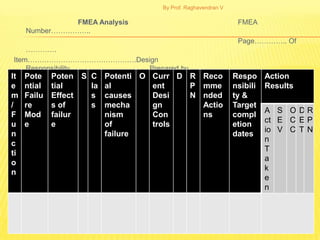
DESIGN FMEA FORM TEMPLATE


                                      10
By Prof. Raghavendran V

               FMEA Analysis                                 FMEA
     Number……………..
                                                             Page………….. Of
     ………….
 Item……………………………………….Design
     Responsibility…………………………….Prepared by……………………
It Pote Poten S C Potenti O Curr D R Reco Respo Action
 Model Number/year…………………………..Key date……………………….FMEA Date
e ntial tial          la al
     (Orig)…………(Rev)……….        ent       P mme nsibili Results
m Failu Effect
 Core                 s causes  Desi      N nded ty &
/ re team:…………………………………………………………………………………………………
            s of      s mecha   gn          Actio Target
     …………………………………
                                                         A S O DR
F Mod failur             nism   Con         ns    compl
                                                                    ct E C E P
u    e    e           of        trols                       etion
                                                                    io V C T N
n                     failure                               dates
                                                                    n
c
                                                                    T
ti
                                                                    a
o
                                                                    k
n
                                                                    e
                                                                    n


                                                                             11
By Prof. Raghavendran V


BENEFITS OF FMEA
 Systematic review of component failures.
 Determining the effects that any failure will have
  on other items in the product or process and
  their functions.
 Determining those parts of the product or
  process whose failure will have critical effect or
  impact on product or process.
 Helping uncover oversights, misjudgments and
  errors that may have been made.
 Helping reduce development time and cost of
  manufacturing process.
                                                    12
By Prof. Raghavendran V


QUALITY FUNCTIONAL DEPLOYMENT
It is invented by Dr. Mizuno, professor of Tokyo
   institute of technology. It is planning tool
   which can be applied to any organization to
   fulfill customer expectations.
It focuses on customers expectations or need,
   often referred to as customer’s voice. It is
   team based tool in which customer needs
   are the driving force for the product
   development process. Conflicting needs are
   identified early in QFD Process and can be
   resolved before production.                    13
QUALITY FUNCTION DEPLOYMENT


 A systematic method for transferring
   customer wants/needs/expectations
   into product and process
   characteristics
QUALITY FUNCTION DEPLOYMENT

   Quality Function Deployment
      Voice of the customer

      House of Quality


QFD: An approach that integrates the “voice of the
     customer” into the product and service
     development process.
By Prof. Raghavendran V


QUALITY FUNCTIONAL DEPLOYMENT
QFD employed to translate customers
 expectations, in terms of specific
 requirements, into directions & actions, in
 terms of engineering or technical
 characteristics, that can be employed
 through:
      Product Planning
      Part Development
      Process Planning
      Production Planning
      Services

                                                       16
By Prof. Raghavendran V


QFD TEAM

   There are two types of teams
    1.   One is existing team with fewer members
    2.   Other team composed of marketing, design,
         quality, finance and product.


                                                      17
By Prof. Raghavendran V


BENEFITS OF QFD
   Improves customer satisfaction
     Focus on requirement
     competitive information
     prioritizes resources
     Identifies items that can be acted upon

   Reduces implementation time
     Decrease midstream design changes
     Limits production problems
     Avoid future redundancies
     Identifies future application opportunities


                                                         18
By Prof. Raghavendran V


BENEFITS OF QFD
   Promotes team work
     Based on consensus
     Creates communication at surfaces
     Identifies actions at interfaces
     Create global views of details

   Provides documentation
     Documents rationale for design
     Is easy to assimilate
     Adapts to changes
     Provides framework to sensitivity analysis


                                                        19
By Prof. Raghavendran V


HOUSE OF QUALITY

The primary planning tool used in QFD is the
 House Of Quality.
HoQ translates voice of customers into design
 requirements that meet specific targets.
Managers and Engineers consider the house
 of quality to be primary chart in quality
 planning


                                                20
By Prof. Raghavendran V


HOUSE OF QUALITY’S PART DESCRIPTION:

1)   The exterior walls of the house are the
     customer requirements. On the left side is a
     listing of the voice of customer. On right side
     are prioritized customer requirements.
2)   The ceiling shows technical descriptors,
     consistency of the product is provided by
     engineering characteristics, design
     constraints and parameters.

                                                     21
By Prof. Raghavendran V


HOUSE OF QUALITY’S PART DESCRIPTION:

3)   The interior walls are relationship between
     customer requirements and technical
     descriptors. Customers expectations
     (requirements) are translated into
     engineering characteristics (technical
     descriptors).
4)   The roof is the interrelationship between the
     technical descriptors.
5)   The foundation or base is known as
     prioritized technical descriptors.             22
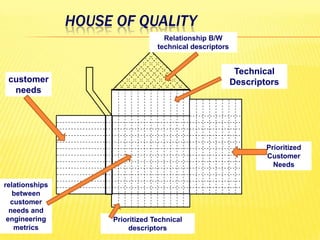
HOUSE OF QUALITY
                                    Relationship B/W
                                  technical descriptors


                                                           Technical
 customer                                                 Descriptors
  needs


                                                                  Prioritized
                                                                  Customer
                                                                    Needs

relationships
   between
  customer
  needs and
 engineering         Prioritized Technical
   metrics               descriptors
By Prof. Raghavendran V


ASSIGNMENT TIME: TO BE SUBMITTED BEFORE
20TH OCT’ 2011.
1.   Explain in detail of QFD.
2.   Explain and construct House of quality.


                                                   24
By. Prof. Raghavendran V

END OF MODULE 6

TQM, VTU,Unit 6

  • 1.
    By Prof. RaghavendranV QUALITY FUNCTION DEPLOYMENT & FMEA
  • 2.
    By Prof. RaghavendranV FAILURE MODE AND EFFECT ANALYSIS(FMEA) FMEA is also known as Failure mode, effect & critical analysis(FMECA). Failure mode & Effect analysis is a group of activities intended to “recognize & evaluate the potential failure of a product or process and its effect before the product/ service being produced & used, identify actions that could eliminate or reduce the chances of potential failures and lastly documenting the process. 2
  • 3.
    By Prof. RaghavendranV  FMEA is an analytical technique that combines the technology & Experience of the people in identifying foreseeable failures modes of a product or process and planning for its elimination. It is “Before-an-Event” action requiring a team effort to easily and Inexpensive effect changes in design and production. 3
  • 4.
    By Prof. RaghavendranV FMEA is categorized in broadly 3 systems and they are: 1. Failure mode analysis 2. Failure effect analysis 3. Failure criticality analysis 4
  • 5.
    By Prof. RaghavendranV FAILURE MODE ANALYSIS It is analyzing the operations of the product or process to foresee, what are the most likely modes where the failure would occur. This would include the components involved, describing the components involved, the time, locations and many more. 5
  • 6.
    By Prof. RaghavendranV FAILURE EFFECT ANALYSIS It is study of the potential failure to ascertain the likely impact on the performance of the whole product, the process or service and related elements. 6
  • 7.
    By Prof. RaghavendranV FAILURE CRITICALITY ANALYSIS It is study of the criticality or intensity of potential failures of the product, process or service. The criticality may range from customer irritation to catastrophic occurrence. 7
  • 8.
    By Prof. RaghavendranV FMEA DOCUMENTATION  Block Diagram is very much needed to understand physical attributes of the product.  The Documentation of FMEA consists:  FMEA number  Item  Design responsibility  Prepared by  Model number/year  Key date  FMEA Date  Core Team  Function 8
  • 9.
    By Prof. RaghavendranV TYPES OF FMEA’S They are:  Design FMEA,  Process FMEA,  Concept FMEA,  Maintenance FMEA,  System FMEA,  Environmental FMEA,  Service FMEA. 9
  • 10.
    By Prof. RaghavendranV DESIGN FMEA FORM TEMPLATE 10
  • 11.
    By Prof. RaghavendranV FMEA Analysis FMEA Number…………….. Page………….. Of …………. Item……………………………………….Design Responsibility…………………………….Prepared by…………………… It Pote Poten S C Potenti O Curr D R Reco Respo Action Model Number/year…………………………..Key date……………………….FMEA Date e ntial tial la al (Orig)…………(Rev)………. ent P mme nsibili Results m Failu Effect Core s causes Desi N nded ty & / re team:………………………………………………………………………………………………… s of s mecha gn Actio Target ………………………………… A S O DR F Mod failur nism Con ns compl ct E C E P u e e of trols etion io V C T N n failure dates n c T ti a o k n e n 11
  • 12.
    By Prof. RaghavendranV BENEFITS OF FMEA  Systematic review of component failures.  Determining the effects that any failure will have on other items in the product or process and their functions.  Determining those parts of the product or process whose failure will have critical effect or impact on product or process.  Helping uncover oversights, misjudgments and errors that may have been made.  Helping reduce development time and cost of manufacturing process. 12
  • 13.
    By Prof. RaghavendranV QUALITY FUNCTIONAL DEPLOYMENT It is invented by Dr. Mizuno, professor of Tokyo institute of technology. It is planning tool which can be applied to any organization to fulfill customer expectations. It focuses on customers expectations or need, often referred to as customer’s voice. It is team based tool in which customer needs are the driving force for the product development process. Conflicting needs are identified early in QFD Process and can be resolved before production. 13
  • 14.
    QUALITY FUNCTION DEPLOYMENT A systematic method for transferring customer wants/needs/expectations into product and process characteristics
  • 15.
    QUALITY FUNCTION DEPLOYMENT  Quality Function Deployment  Voice of the customer  House of Quality QFD: An approach that integrates the “voice of the customer” into the product and service development process.
  • 16.
    By Prof. RaghavendranV QUALITY FUNCTIONAL DEPLOYMENT QFD employed to translate customers expectations, in terms of specific requirements, into directions & actions, in terms of engineering or technical characteristics, that can be employed through:  Product Planning  Part Development  Process Planning  Production Planning  Services 16
  • 17.
    By Prof. RaghavendranV QFD TEAM  There are two types of teams 1. One is existing team with fewer members 2. Other team composed of marketing, design, quality, finance and product. 17
  • 18.
    By Prof. RaghavendranV BENEFITS OF QFD  Improves customer satisfaction  Focus on requirement  competitive information  prioritizes resources  Identifies items that can be acted upon  Reduces implementation time  Decrease midstream design changes  Limits production problems  Avoid future redundancies  Identifies future application opportunities 18
  • 19.
    By Prof. RaghavendranV BENEFITS OF QFD  Promotes team work  Based on consensus  Creates communication at surfaces  Identifies actions at interfaces  Create global views of details  Provides documentation  Documents rationale for design  Is easy to assimilate  Adapts to changes  Provides framework to sensitivity analysis 19
  • 20.
    By Prof. RaghavendranV HOUSE OF QUALITY The primary planning tool used in QFD is the House Of Quality. HoQ translates voice of customers into design requirements that meet specific targets. Managers and Engineers consider the house of quality to be primary chart in quality planning 20
  • 21.
    By Prof. RaghavendranV HOUSE OF QUALITY’S PART DESCRIPTION: 1) The exterior walls of the house are the customer requirements. On the left side is a listing of the voice of customer. On right side are prioritized customer requirements. 2) The ceiling shows technical descriptors, consistency of the product is provided by engineering characteristics, design constraints and parameters. 21
  • 22.
    By Prof. RaghavendranV HOUSE OF QUALITY’S PART DESCRIPTION: 3) The interior walls are relationship between customer requirements and technical descriptors. Customers expectations (requirements) are translated into engineering characteristics (technical descriptors). 4) The roof is the interrelationship between the technical descriptors. 5) The foundation or base is known as prioritized technical descriptors. 22
  • 23.
    HOUSE OF QUALITY Relationship B/W technical descriptors Technical customer Descriptors needs Prioritized Customer Needs relationships between customer needs and engineering Prioritized Technical metrics descriptors
  • 24.
    By Prof. RaghavendranV ASSIGNMENT TIME: TO BE SUBMITTED BEFORE 20TH OCT’ 2011. 1. Explain in detail of QFD. 2. Explain and construct House of quality. 24
  • 25.
    By. Prof. RaghavendranV END OF MODULE 6