Prof Raghavendran Venugopal
SIX SIGMA
 MEANING OF SIX SIGMA
 HISTORY OF SIX SIGMA
 IMPLEMENTATIN OF SIX SIGMA
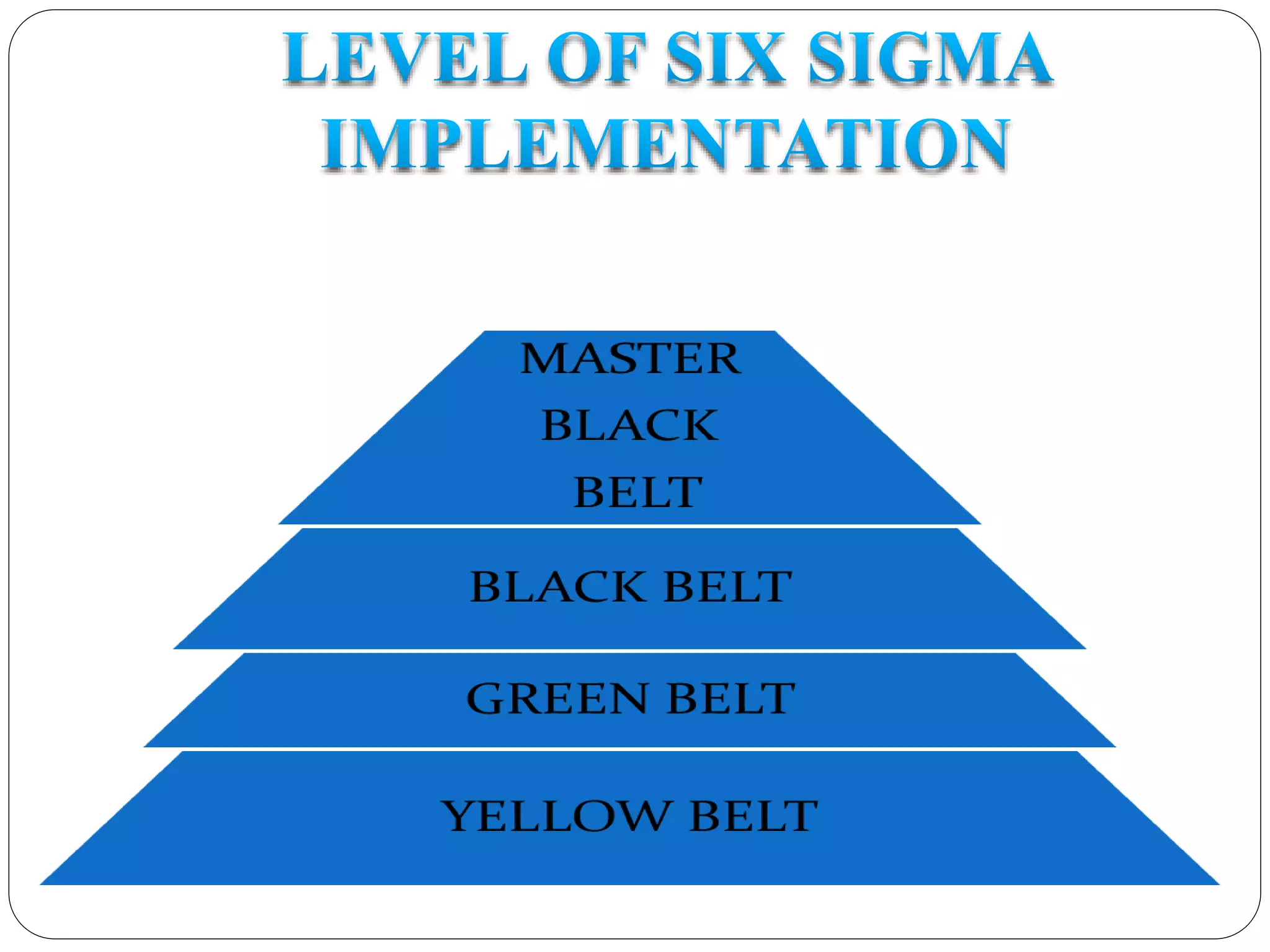
 LEVEL OF SIX SIGMA
 DIMAC
 DMADV
Six Sigma relies heavily on advanced statistical methods that
complement and reduce the process and product variations. It
is a new way of doing business that would eliminate the
existing defects efficiently and would prevent defects from
occurring
Motorola company that invented Six Sigma.
The term “Six Sigma” was coined by Bill Smith, an
engineer with Motorola
Late 1970s - Motorola started experimenting with
problem solving through statistical analysis
1987 - Motorola officially launched it’s Six Sigma
program
Motorola saved more than $ 15 billion in the first 10
years of its Six Sigma effort
Motorola saved more than $17 billion from 1986 to 2013,
reflecting hundreds of individual successes in all
Motorola business areas including:
• Sales and marketing
• Product design
• Manufacturing
• Customer service
• Transactional processes
• Supply chain management
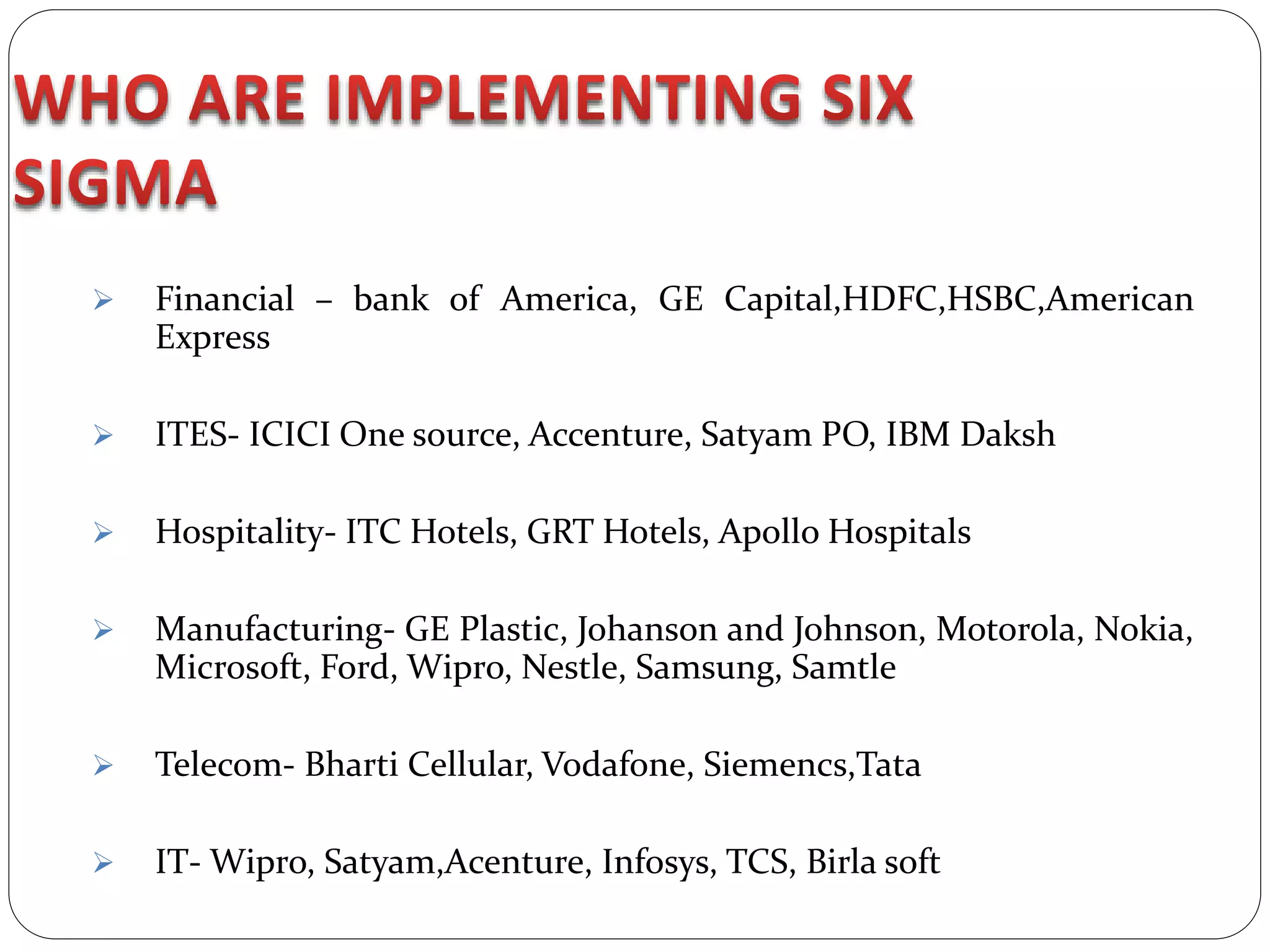
 Financial – bank of America, GE Capital,HDFC,HSBC,American
Express
 ITES- ICICI One source, Accenture, Satyam PO, IBM Daksh
 Hospitality- ITC Hotels, GRT Hotels, Apollo Hospitals
 Manufacturing- GE Plastic, Johanson and Johnson, Motorola, Nokia,
Microsoft, Ford, Wipro, Nestle, Samsung, Samtle
 Telecom- Bharti Cellular, Vodafone, Siemencs,Tata
 IT- Wipro, Satyam,Acenture, Infosys, TCS, Birla soft
CONTINUE…
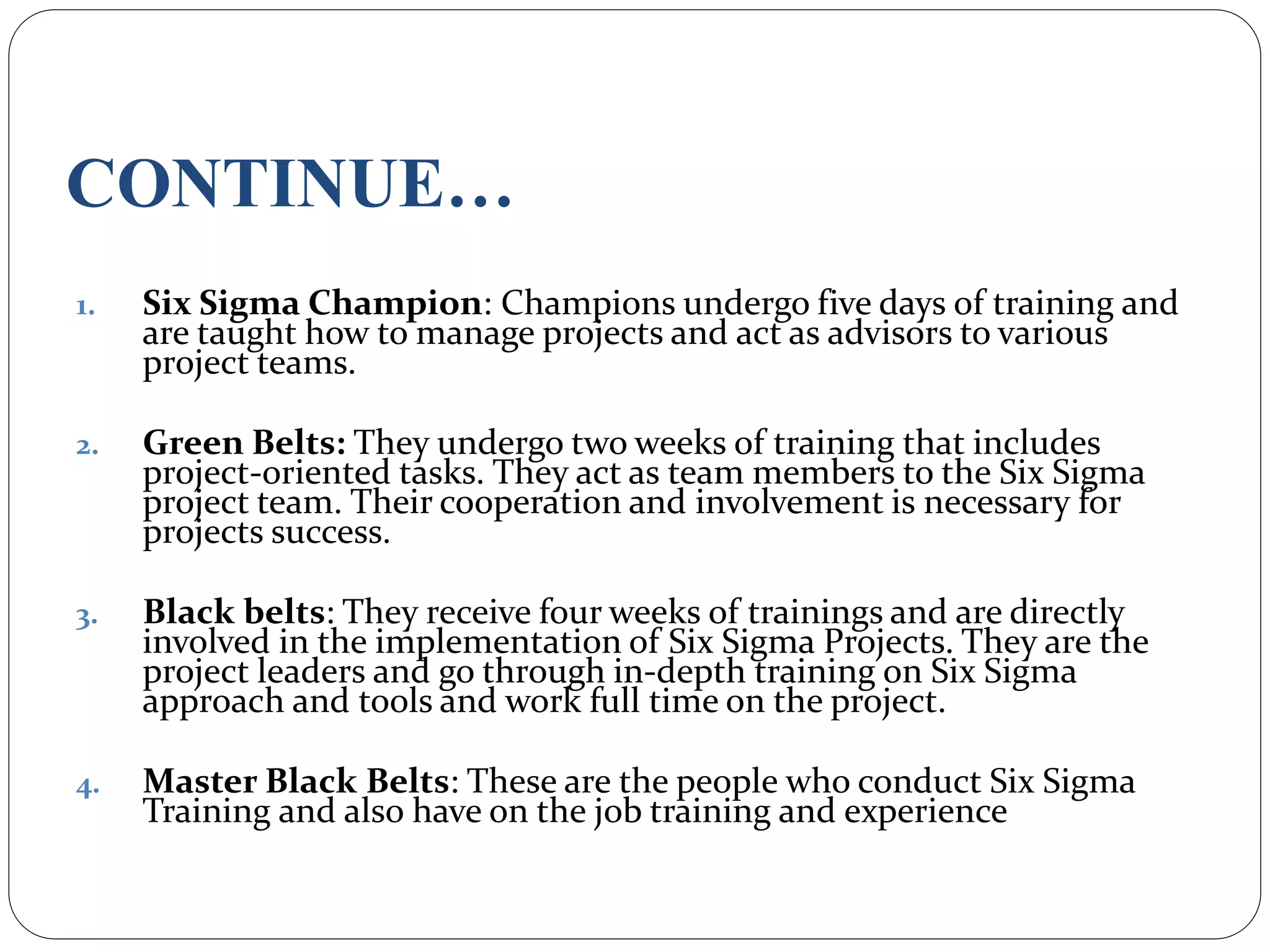
1. Six Sigma Champion: Champions undergo five days of training and
are taught how to manage projects and act as advisors to various
project teams.
2. Green Belts: They undergo two weeks of training that includes
project-oriented tasks. They act as team members to the Six Sigma
project team. Their cooperation and involvement is necessary for
projects success.
3. Black belts: They receive four weeks of trainings and are directly
involved in the implementation of Six Sigma Projects. They are the
project leaders and go through in-depth training on Six Sigma
approach and tools and work full time on the project.
4. Master Black Belts: These are the people who conduct Six Sigma
Training and also have on the job training and experience
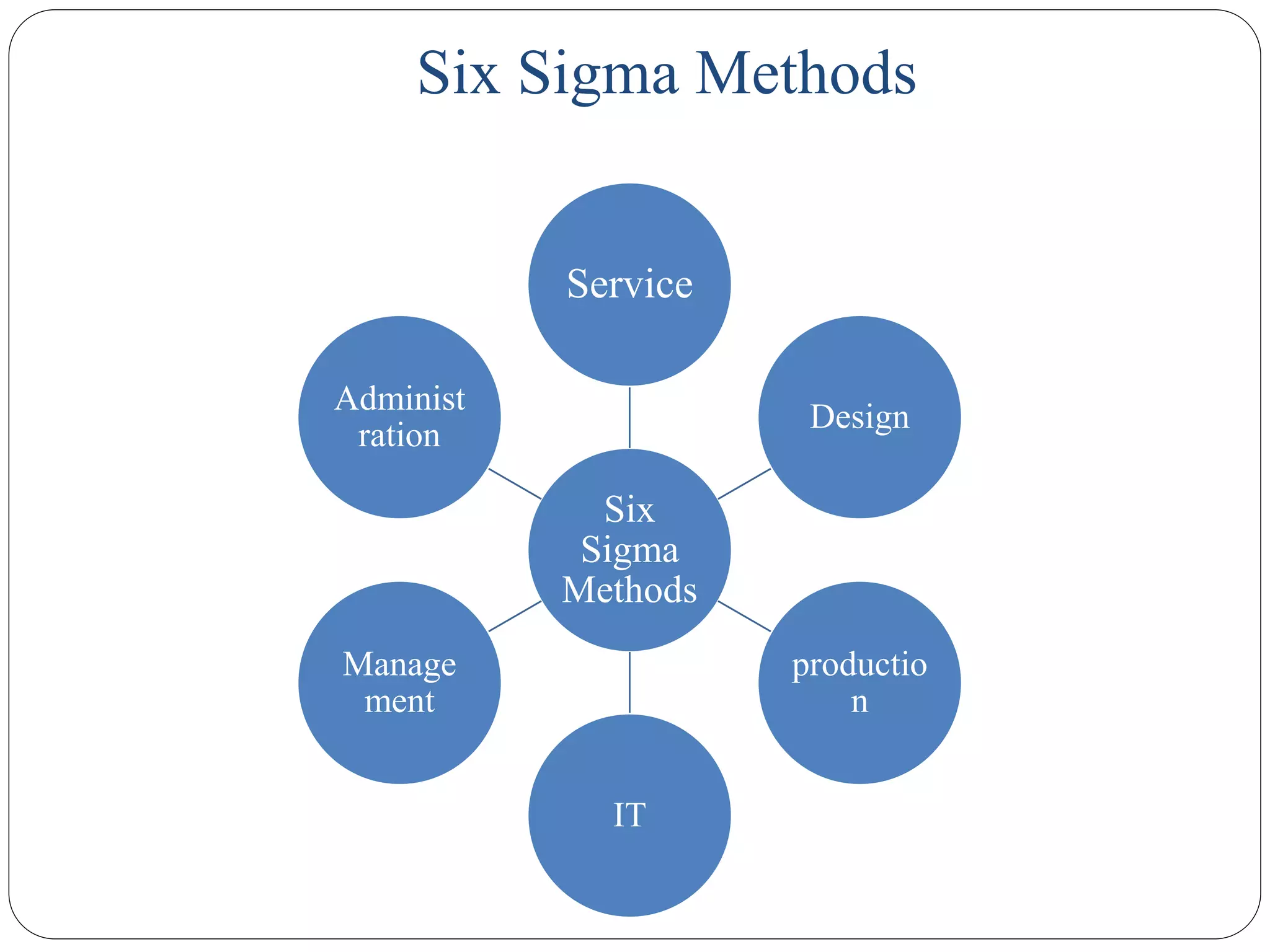
Six Sigma Methods
Six
Sigma
Methods
Service
Design
productio
n
IT
Manage
ment
Administ
ration
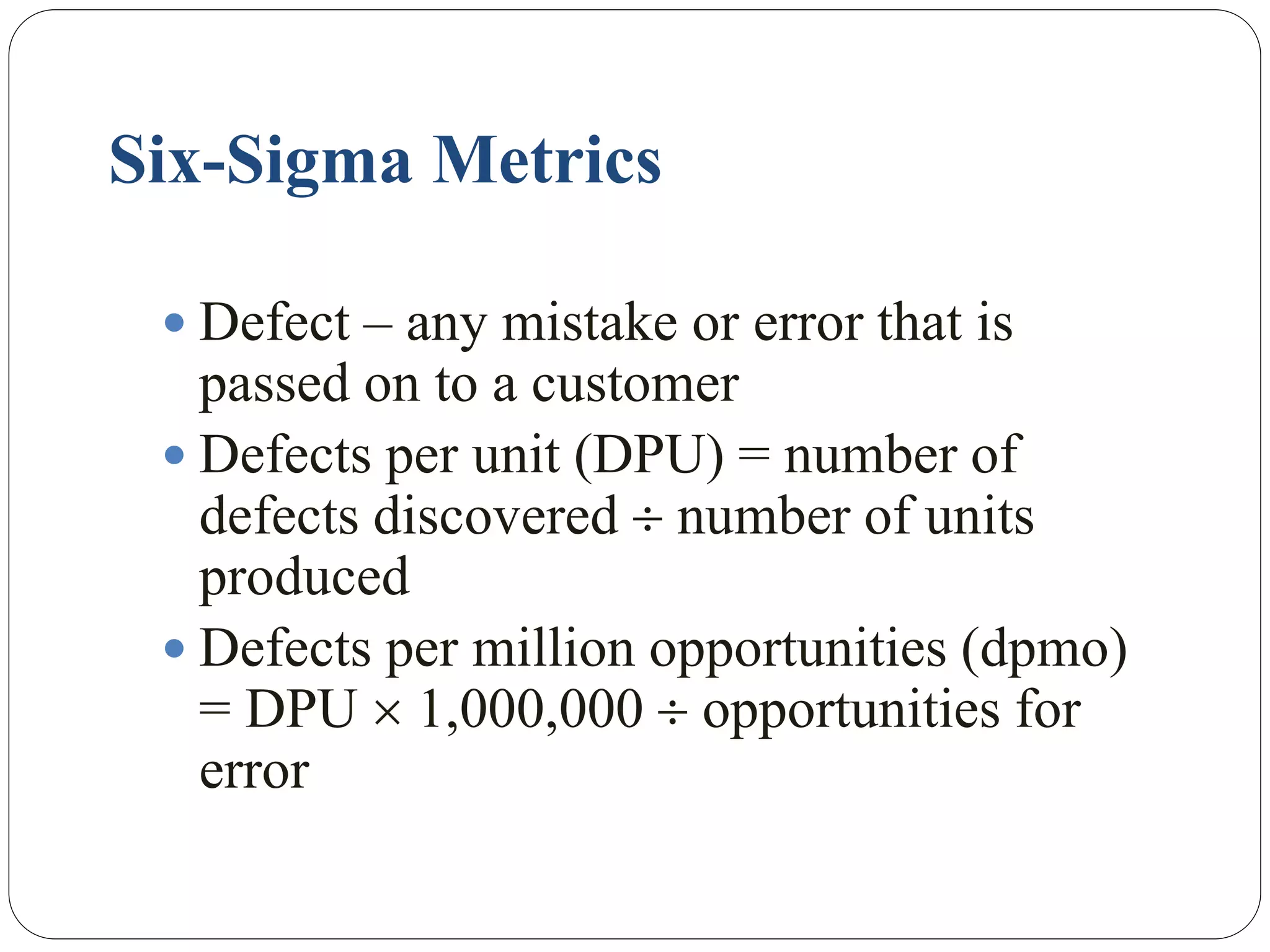
Six-Sigma Metrics
 Defect – any mistake or error that is
passed on to a customer
 Defects per unit (DPU) = number of
defects discovered  number of units
produced
 Defects per million opportunities (dpmo)
= DPU  1,000,000  opportunities for
error
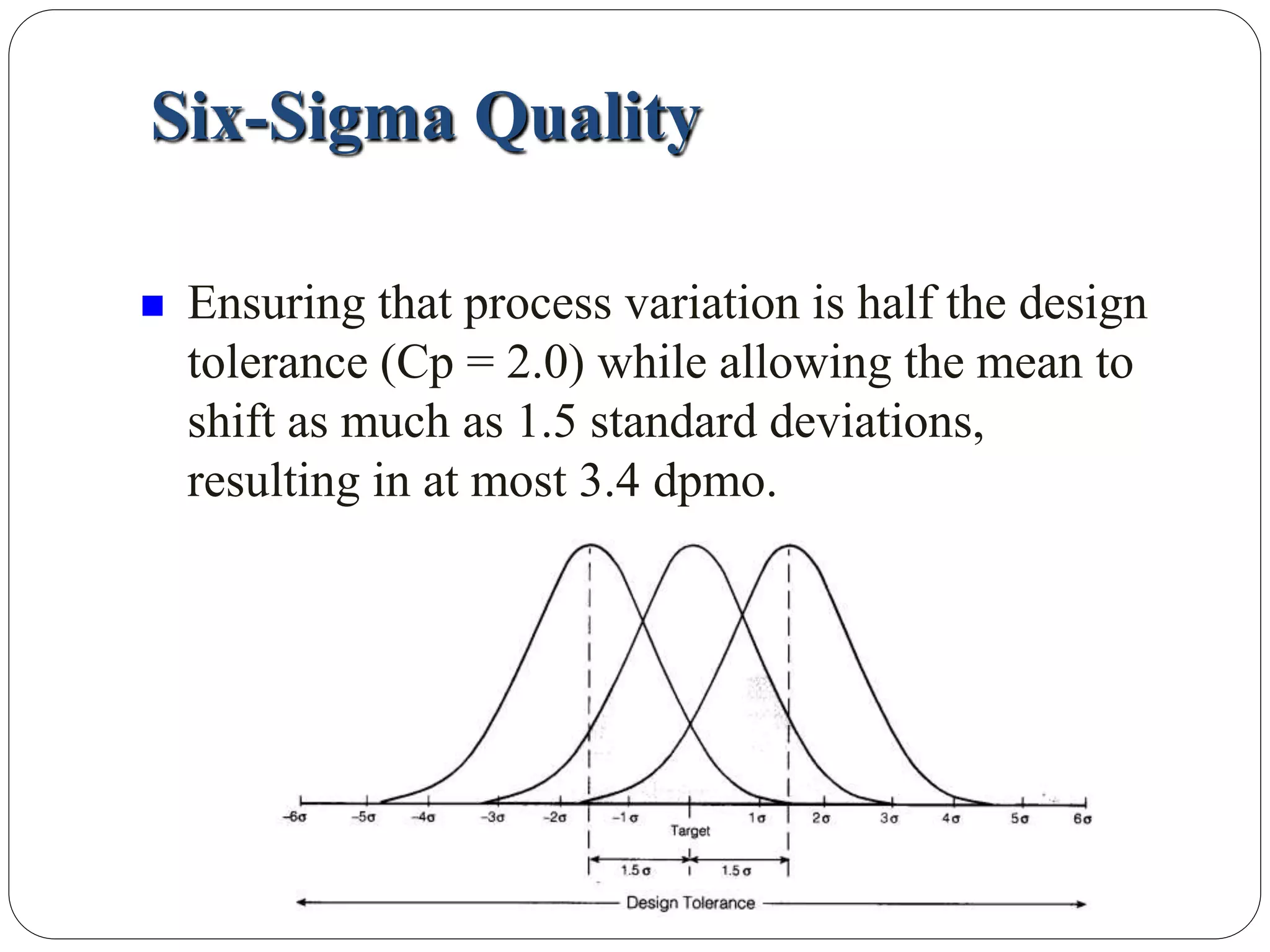
Six-Sigma Quality
 Ensuring that process variation is half the design
tolerance (Cp = 2.0) while allowing the mean to
shift as much as 1.5 standard deviations,
resulting in at most 3.4 dpmo.
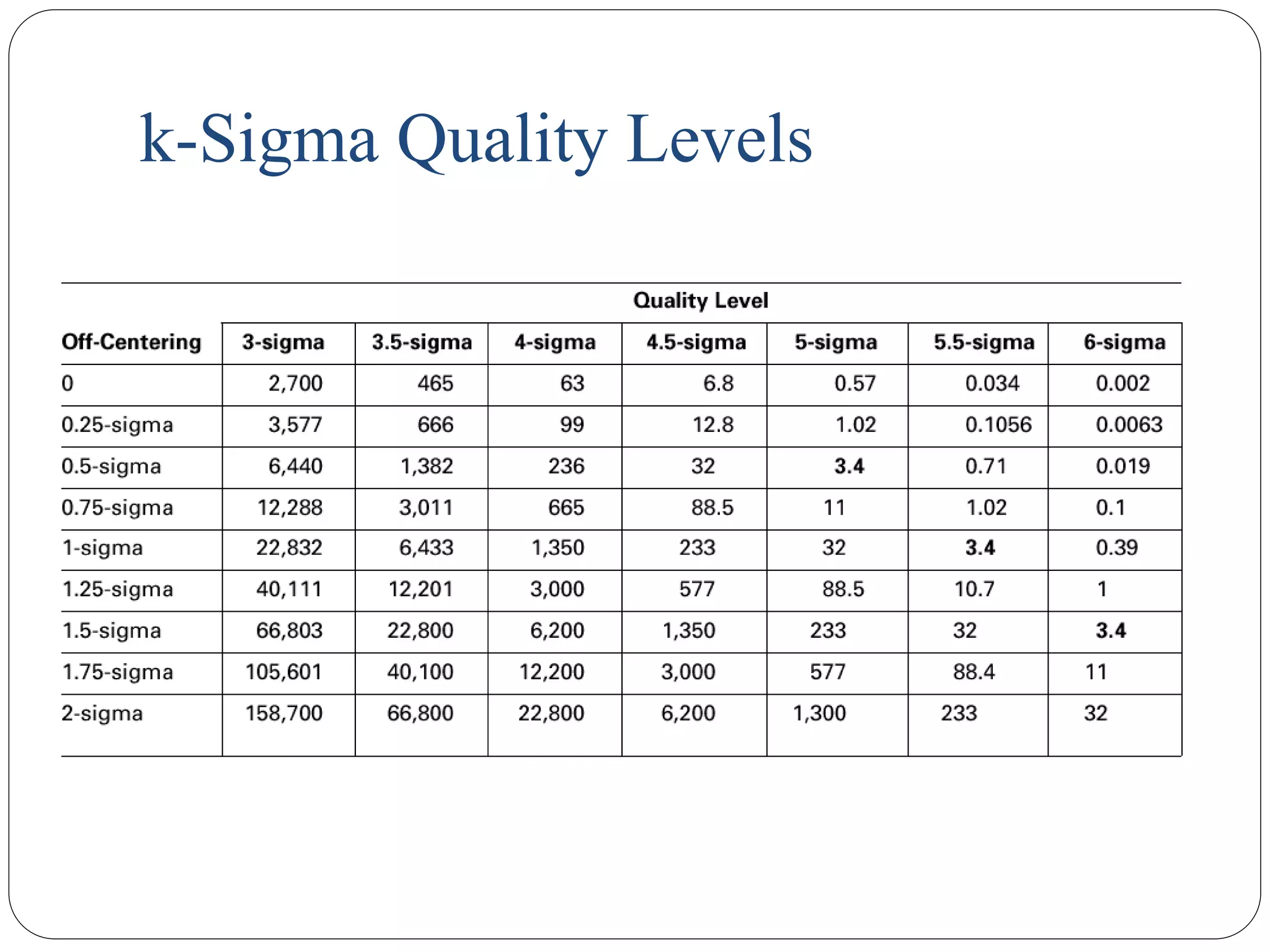
k-Sigma Quality Levels
13
Problem Solving
 Problem: any deviation between what “should
be” and what “is” that is important enough to
need correcting
 Structured
 Semistructured
 Ill-structured
 Problem Solving: the activity associated with
changing the state of what “is” to what “should
be”
Quality Problem Types
1. Conformance problems
2. Unstructured performance problems
3. Efficiency problems
4. Product design problems
5. Process design problems
Key Factors in Six Sigma Project
Selection
 Financial return, as measured by costs associated
with quality and process performance, and impacts
on revenues and market share
 Impacts on customers and organizational
effectiveness
 Probability of success
 Impact on employees
 Fit to strategy and competitive advantage
Problem Solving Process
1. Redefining and analyzing the
problem
2. Generating ideas
3. Evaluating and selecting ideas
4. Implementing ideas
APPROACHES OF SIX SIGMA

THIS IS ORGANIZATIONAL BASED

THIS IS BASED ON CUSTOMER NEEDS
AND SATIFACTIONS
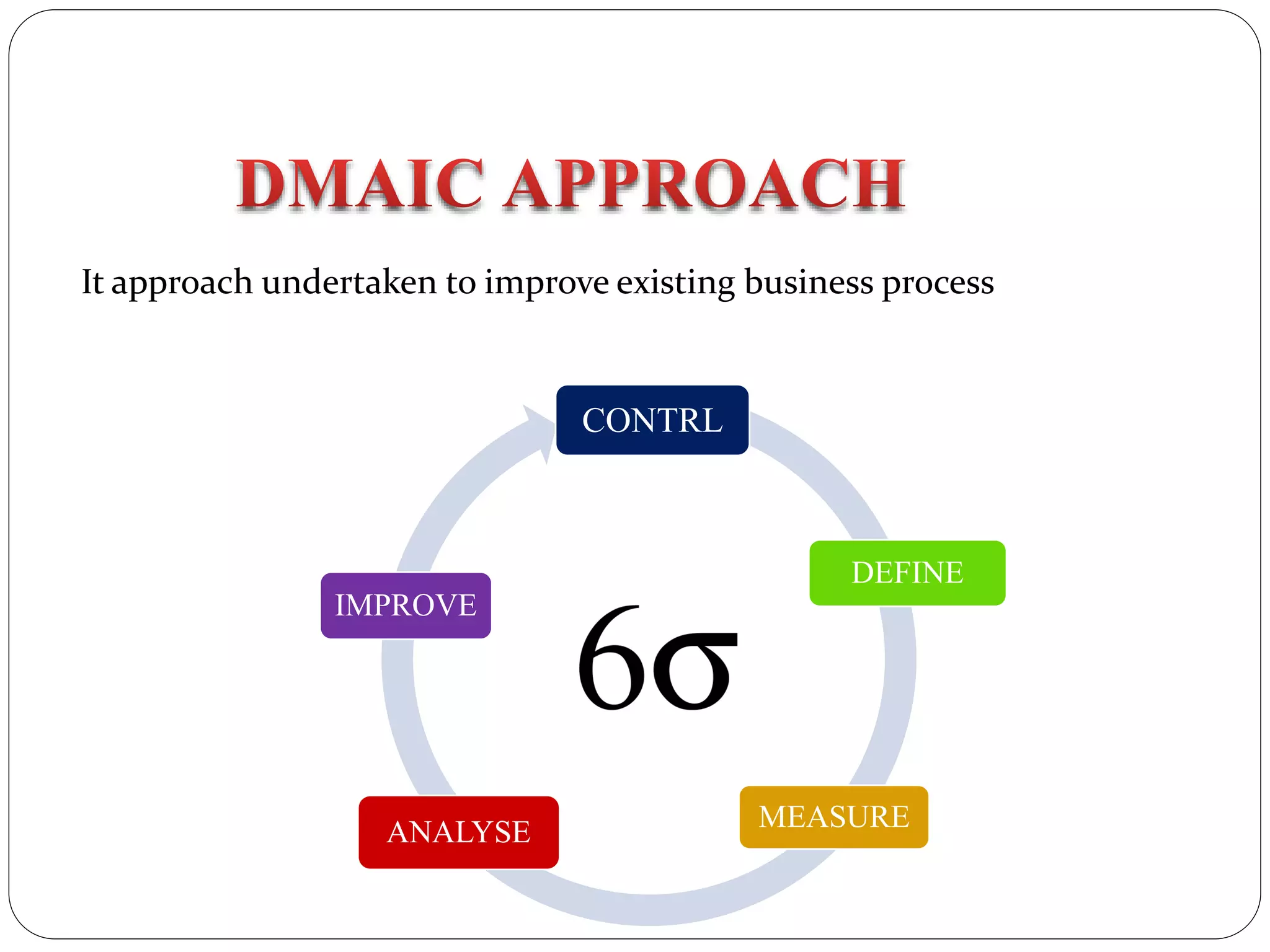
It approach undertaken to improve existing business process
CONTRL
DEFINE
MEASUREANALYSE
IMPROVE
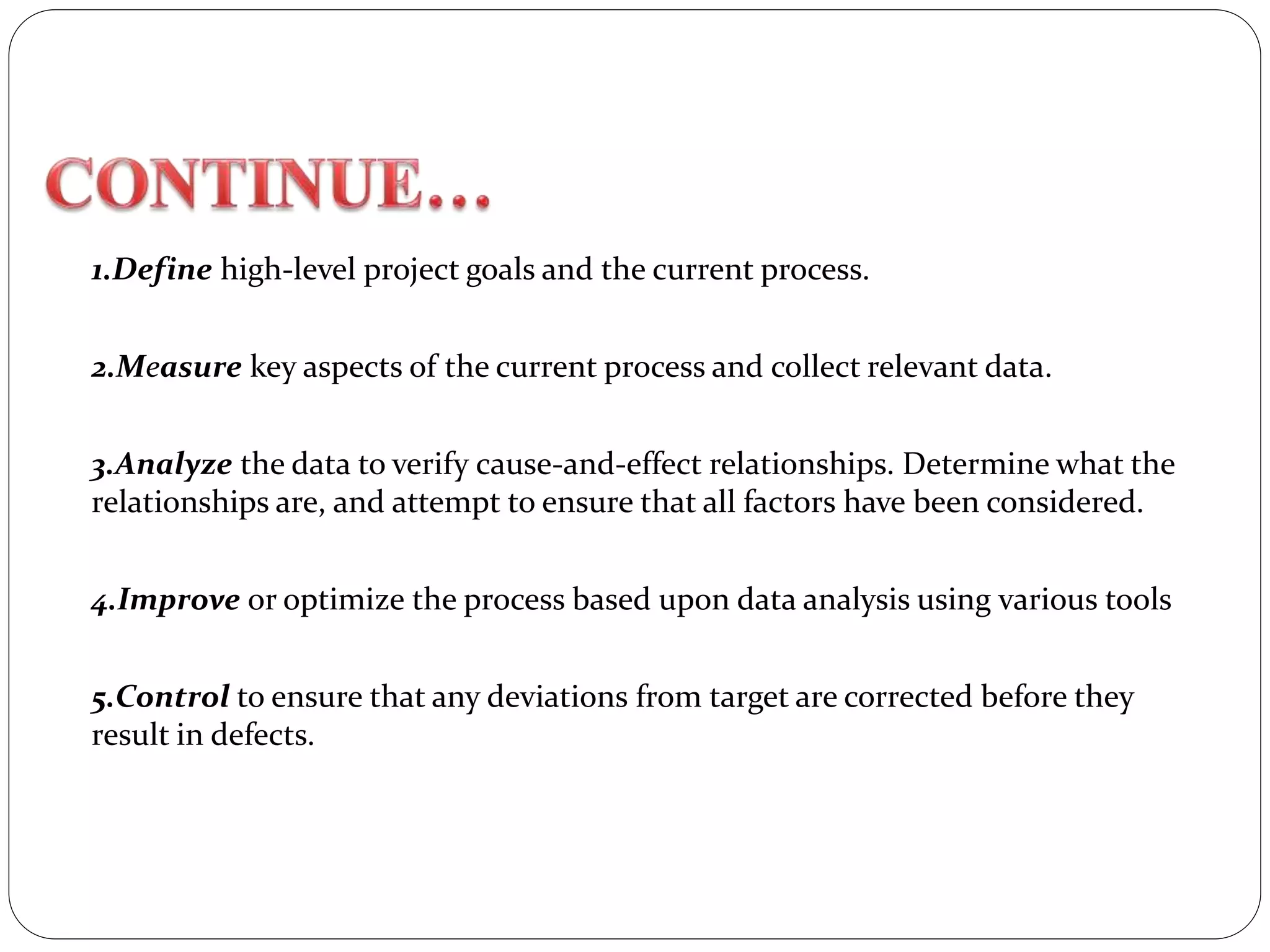
1.Define high-level project goals and the current process.
2.Measure key aspects of the current process and collect relevant data.
3.Analyze the data to verify cause-and-effect relationships. Determine what the
relationships are, and attempt to ensure that all factors have been considered.
4.Improve or optimize the process based upon data analysis using various tools
5.Control to ensure that any deviations from target are corrected before they
result in defects.
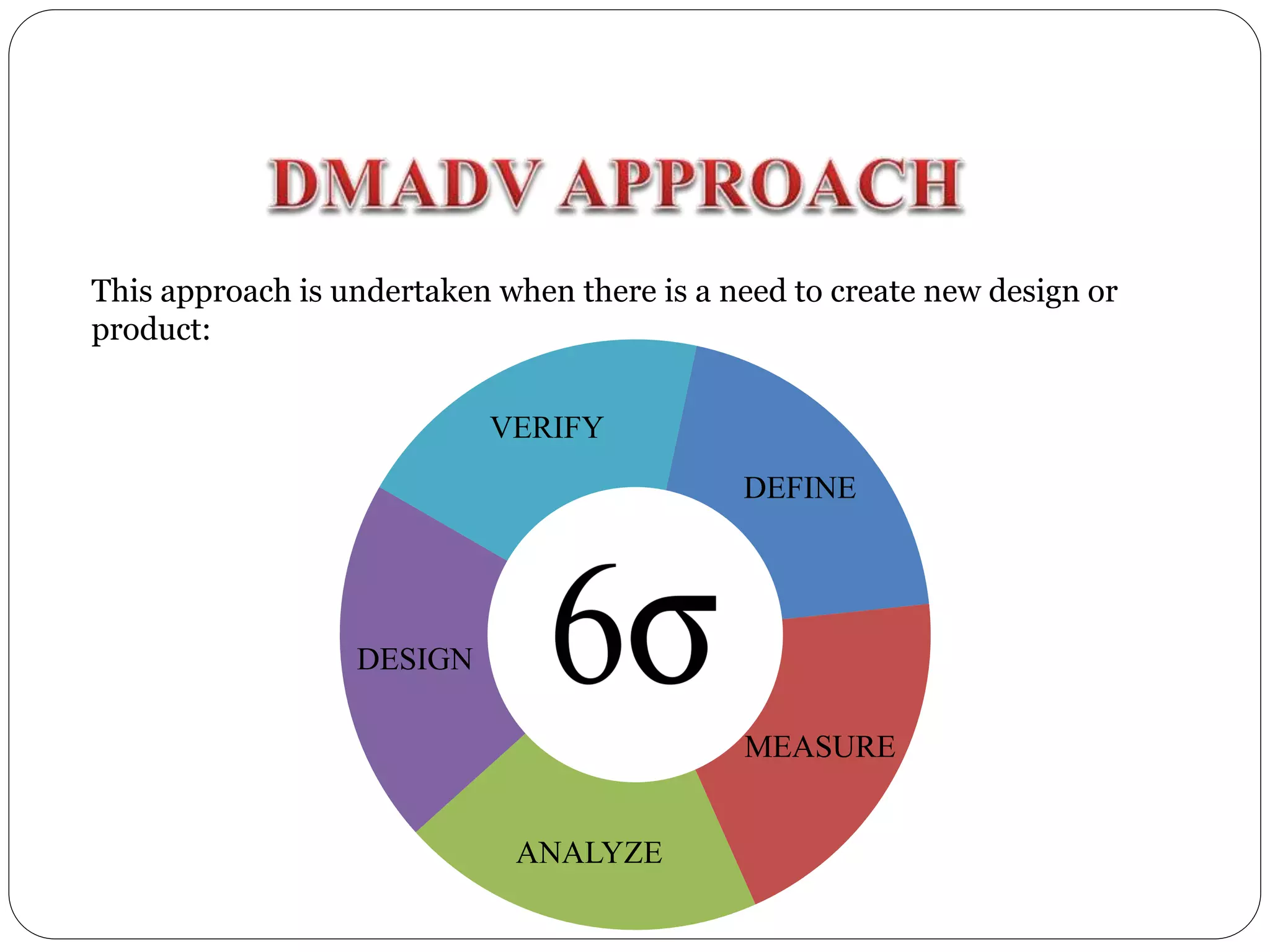
This approach is undertaken when there is a need to create new design or
product:
DEFINE
MEASURE
ANALYZE
DESIGN
VERIFY
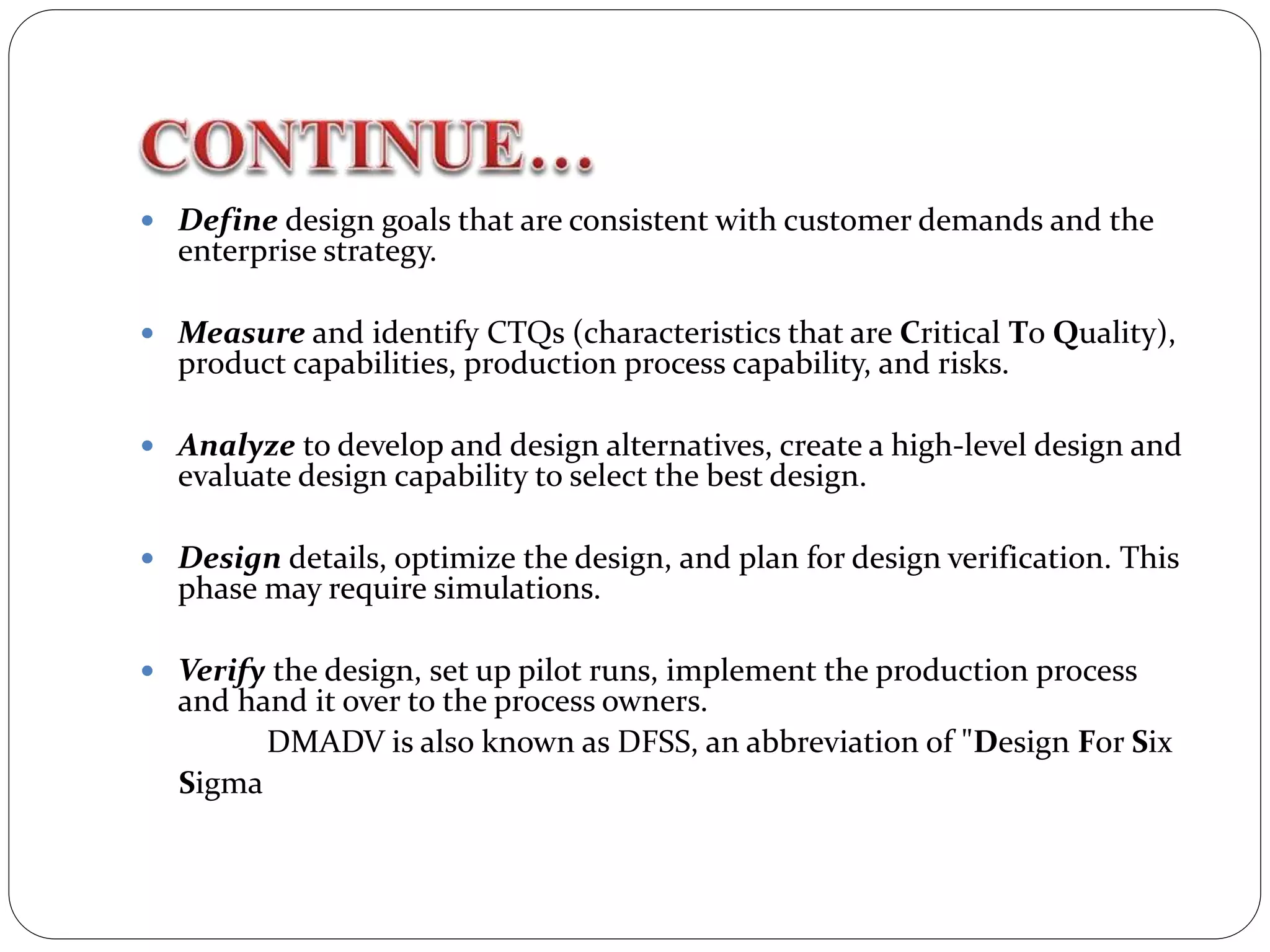
 Define design goals that are consistent with customer demands and the
enterprise strategy.
 Measure and identify CTQs (characteristics that are Critical To Quality),
product capabilities, production process capability, and risks.
 Analyze to develop and design alternatives, create a high-level design and
evaluate design capability to select the best design.
 Design details, optimize the design, and plan for design verification. This
phase may require simulations.
 Verify the design, set up pilot runs, implement the production process
and hand it over to the process owners.
DMADV is also known as DFSS, an abbreviation of "Design For Six
Sigma
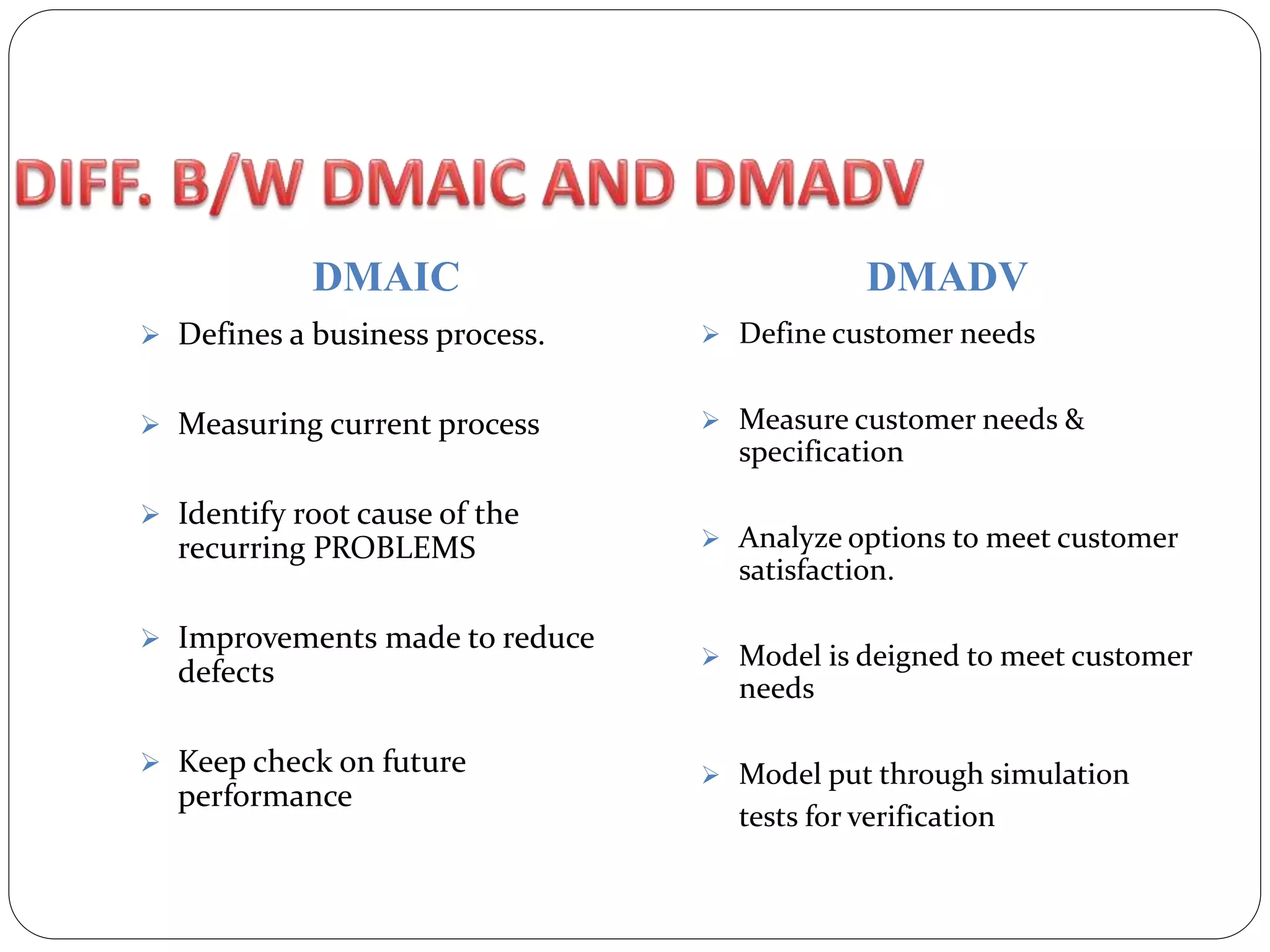
DMAIC DMADV
 Defines a business process.
 Measuring current process
 Identify root cause of the
recurring PROBLEMS
 Improvements made to reduce
defects
 Keep check on future
performance
 Define customer needs
 Measure customer needs &
specification
 Analyze options to meet customer
satisfaction.
 Model is deigned to meet customer
needs
 Model put through simulation
tests for verification
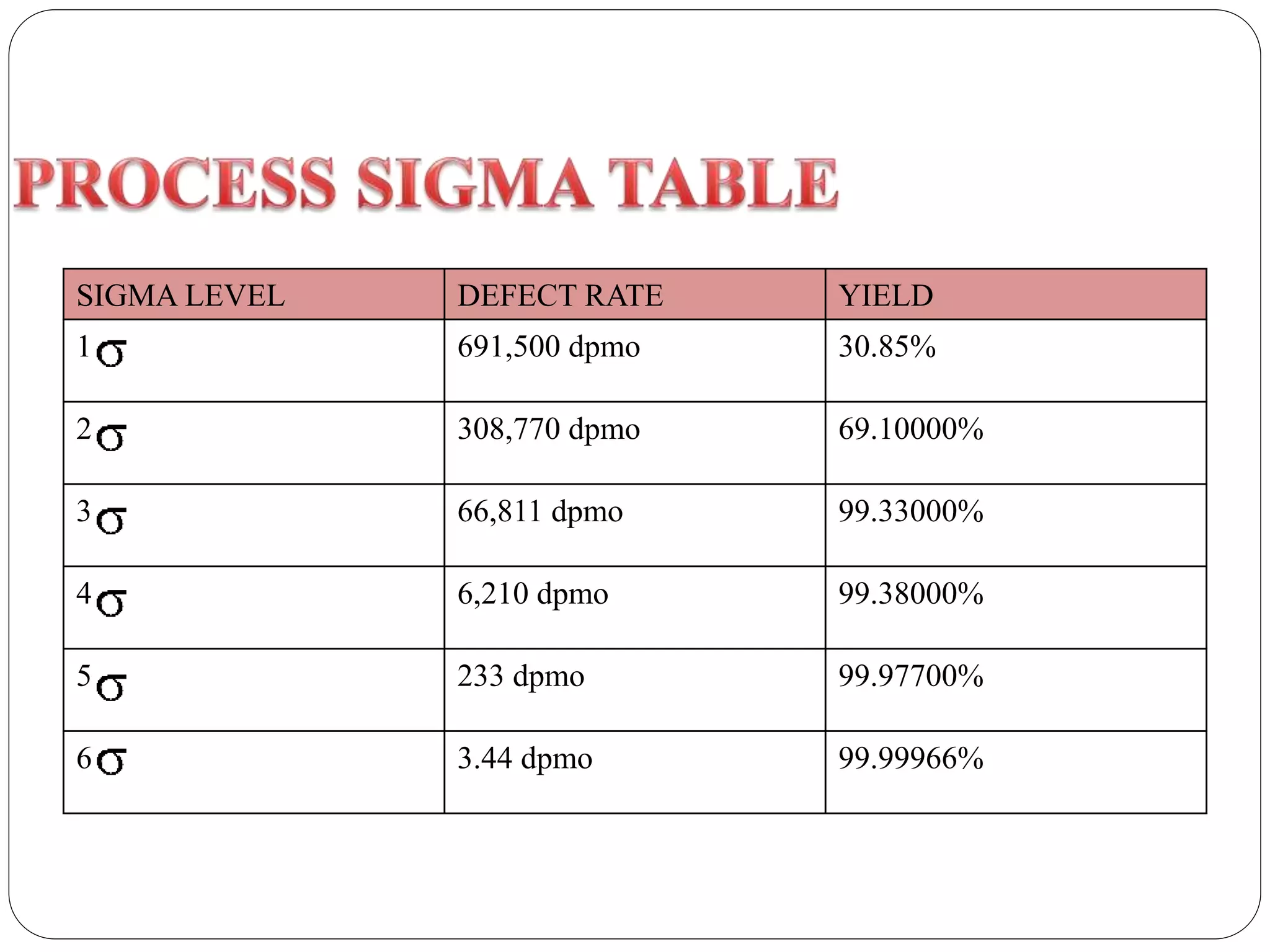
SIGMA LEVEL DEFECT RATE YIELD
1 691,500 dpmo 30.85%
2 308,770 dpmo 69.10000%
3 66,811 dpmo 99.33000%
4 6,210 dpmo 99.38000%
5 233 dpmo 99.97700%
6 3.44 dpmo 99.99966%
24
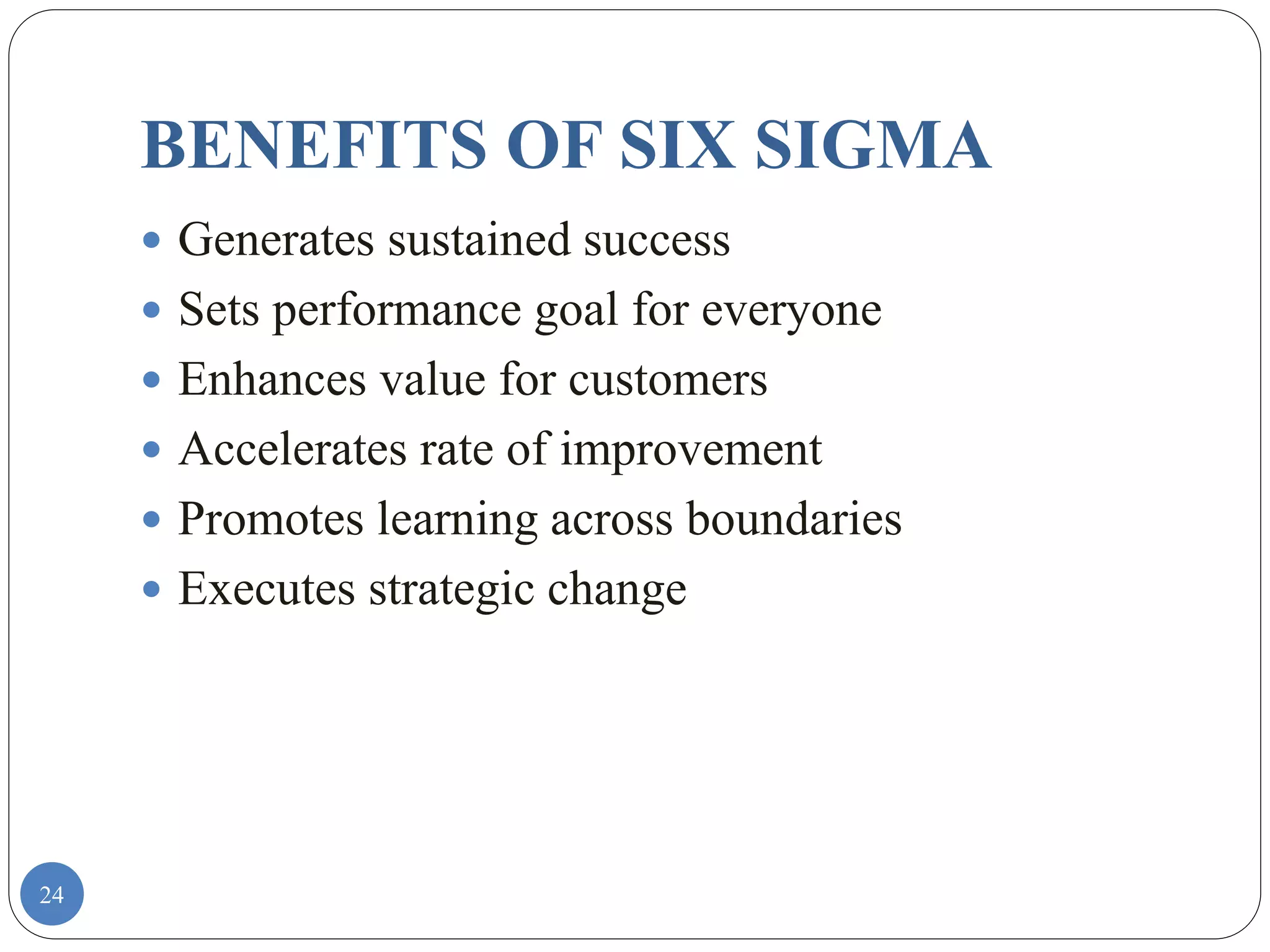
BENEFITS OF SIX SIGMA
 Generates sustained success
 Sets performance goal for everyone
 Enhances value for customers
 Accelerates rate of improvement
 Promotes learning across boundaries
 Executes strategic change
25
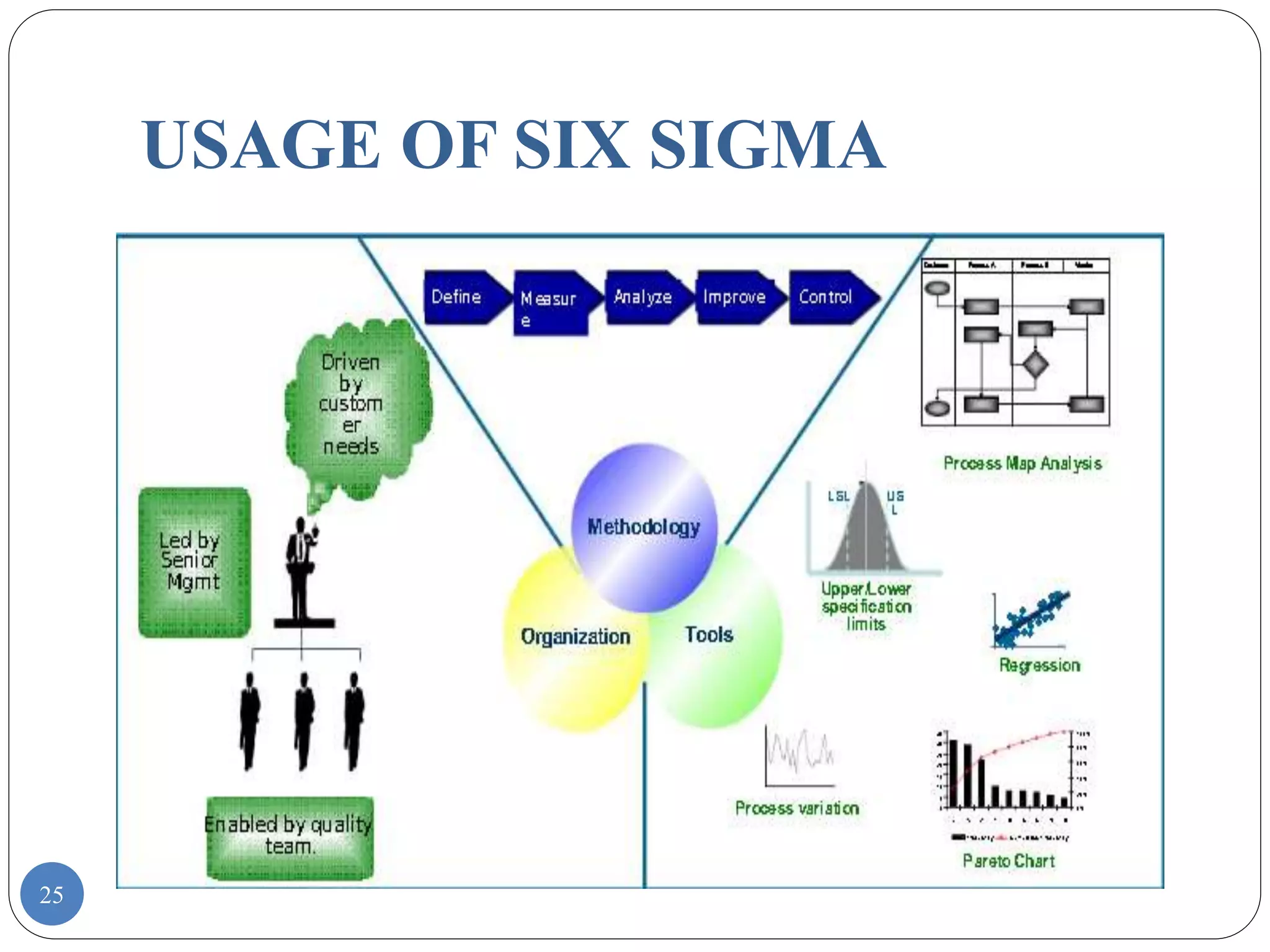
USAGE OF SIX SIGMA
26
SIX SIGMA MANAGEMENT
When practiced as a management system, Six Sigma is a
high performance system for executing business
strategy.
Six Sigma is a top down solution to help organizations:
 Align their business strategy to critical improvement
efforts
 Mobilize teams to attack high impact projects
 Accelerate improved business results
 Govern efforts to ensure improvements are sustained
27
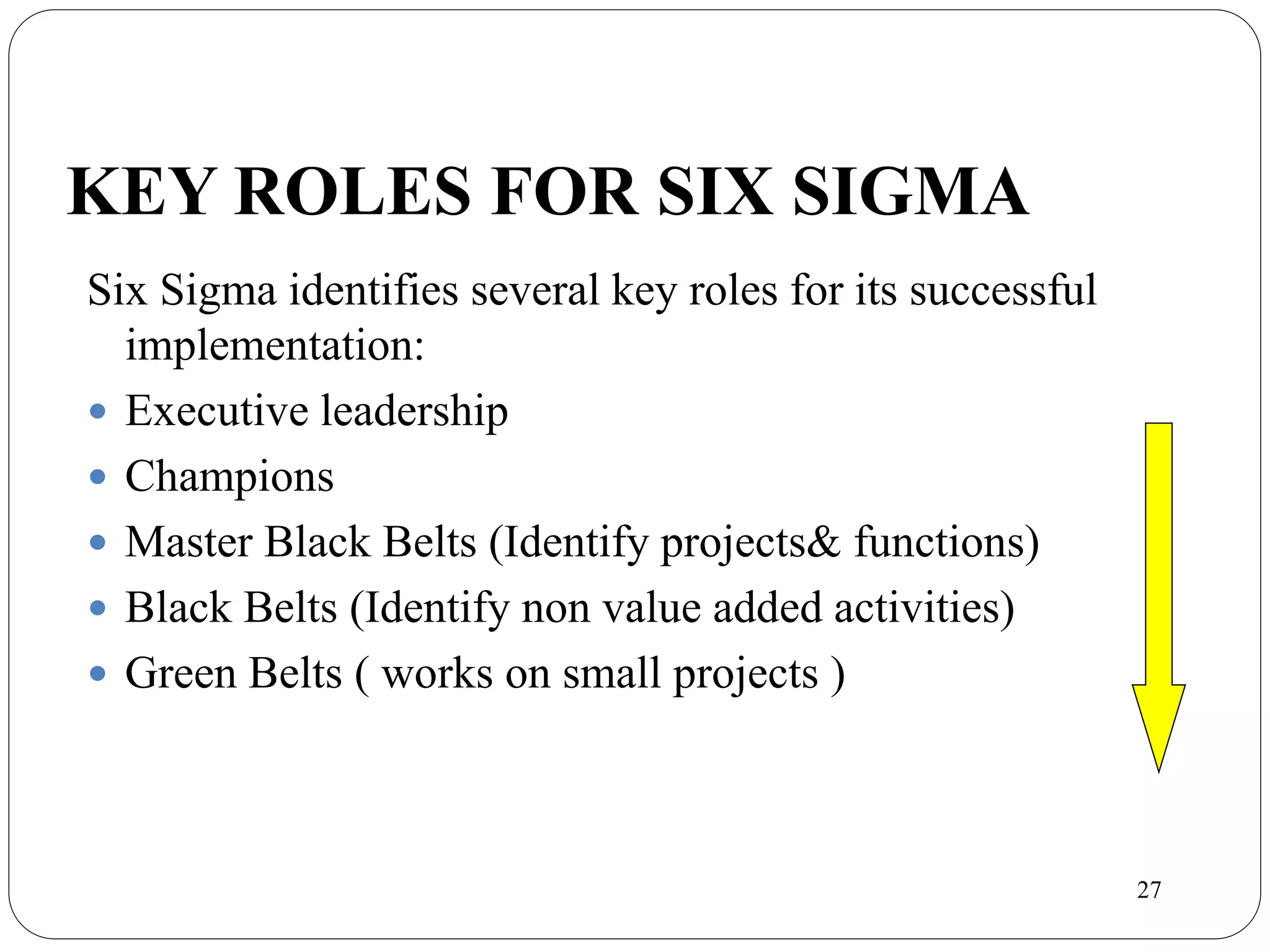
KEY ROLES FOR SIX SIGMA
Six Sigma identifies several key roles for its successful
implementation:
 Executive leadership
 Champions
 Master Black Belts (Identify projects& functions)
 Black Belts (Identify non value added activities)
 Green Belts ( works on small projects )
Top
Bottom
28
TOOLS & TECHNIQUES
 7QC tools
Check Sheets (collect data to make improvements)
Pareto Charts( define problem and frequency)
Cause and effect diagram (Identify possible causes
to solve problem)
Histogram (Bar charts of accumulated data to
evaluate distribution of data)
Scatter diagram (plots many data points and pattern
between two variables)
Flow Chart (Identify unwanted steps)
Control charts (Control limits around mean value)
29
TRAININGS & CERTIFICATIONS
If you want to make yourself more valuable and
attractive to employers then get training and certification
 Option I – Certification as Six Sigma Green Belt
 Option II – Certification as Six Sigma Black Belt
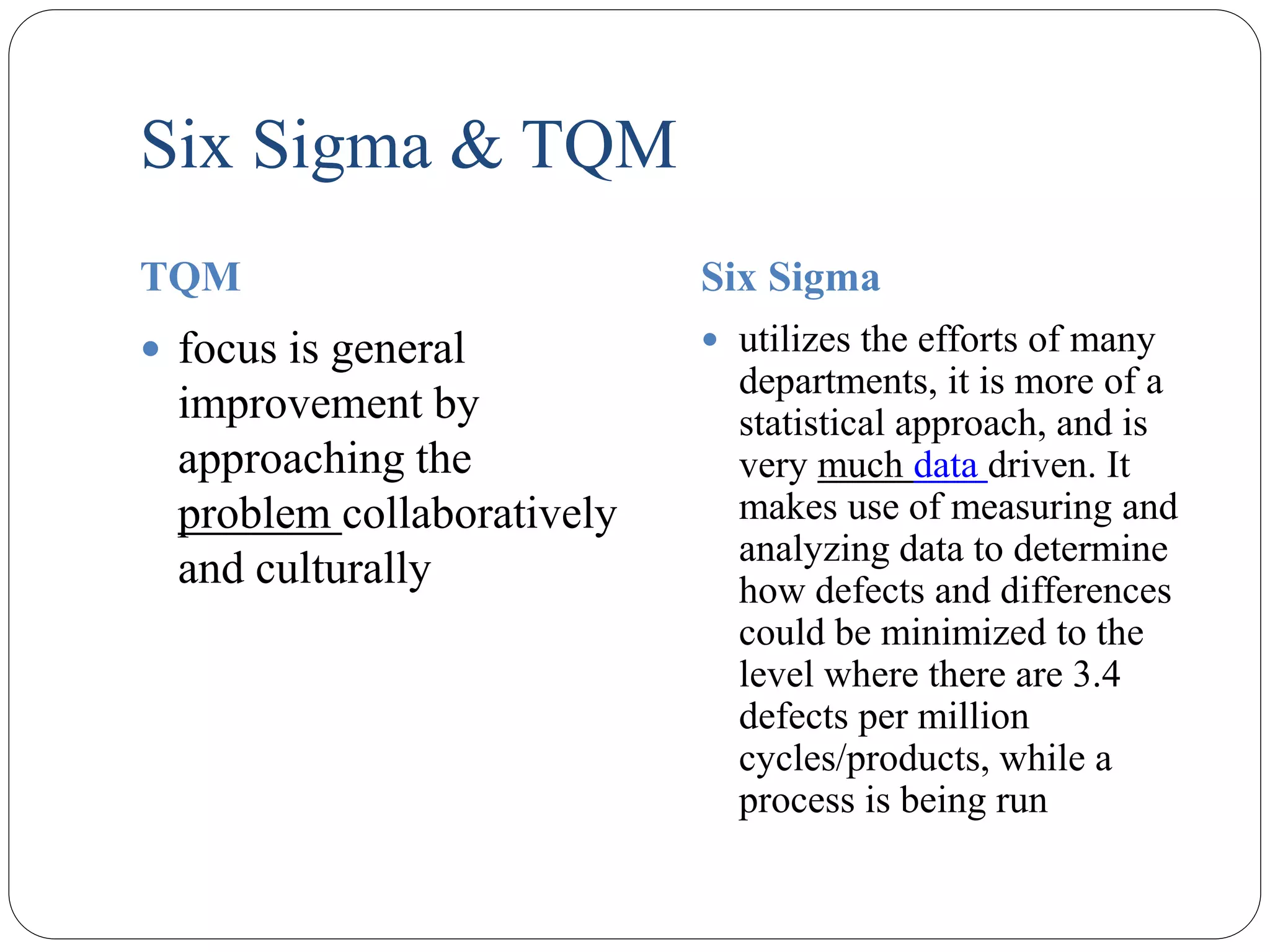
Six Sigma & TQM
TQM Six Sigma
 focus is general
improvement by
approaching the
problem collaboratively
and culturally
 utilizes the efforts of many
departments, it is more of a
statistical approach, and is
very much data driven. It
makes use of measuring and
analyzing data to determine
how defects and differences
could be minimized to the
level where there are 3.4
defects per million
cycles/products, while a
process is being run
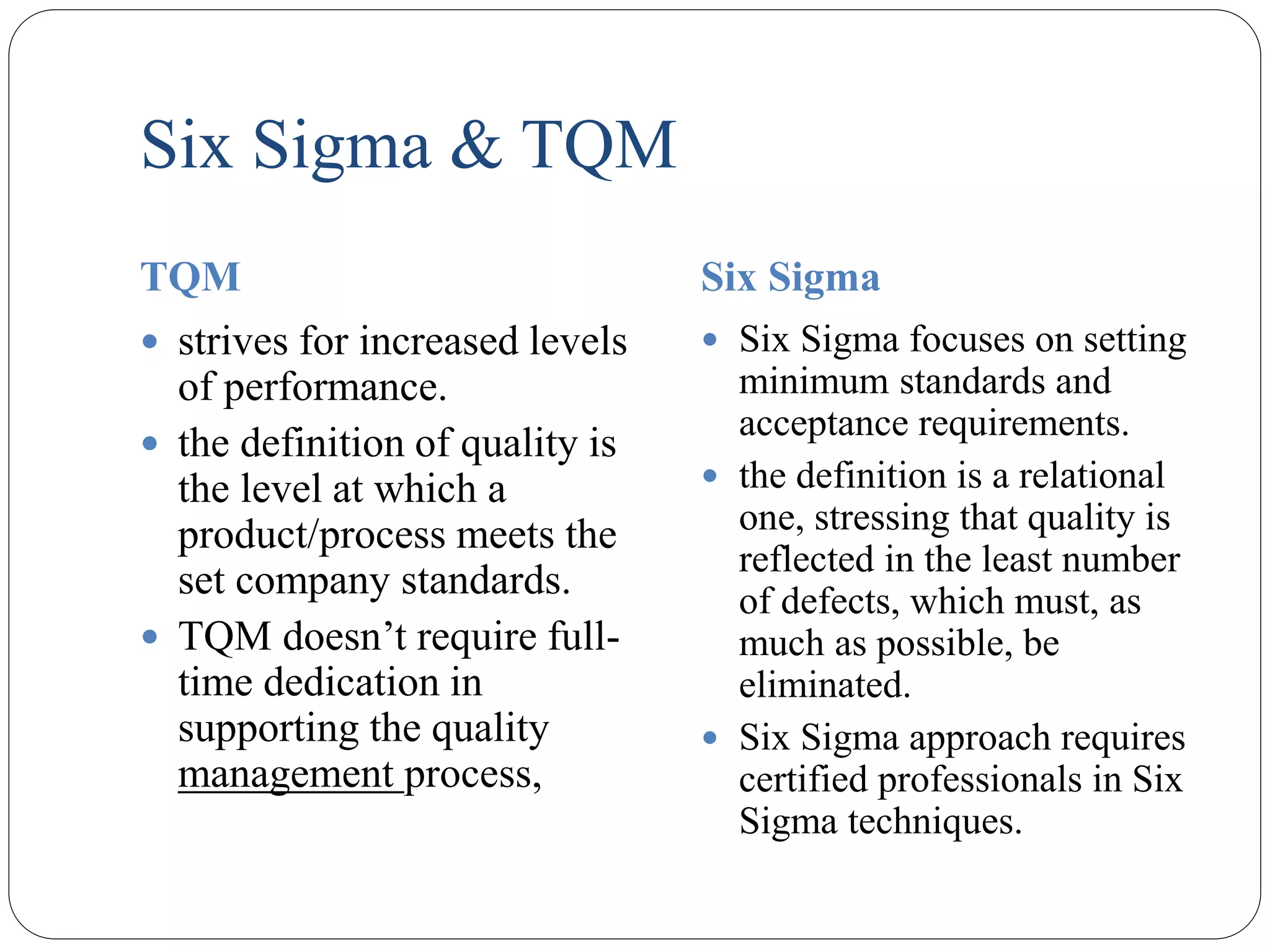
Six Sigma & TQM
TQM Six Sigma
 strives for increased levels
of performance.
 the definition of quality is
the level at which a
product/process meets the
set company standards.
 TQM doesn’t require full-
time dedication in
supporting the quality
management process,
 Six Sigma focuses on setting
minimum standards and
acceptance requirements.
 the definition is a relational
one, stressing that quality is
reflected in the least number
of defects, which must, as
much as possible, be
eliminated.
 Six Sigma approach requires
certified professionals in Six
Sigma techniques.
By Prof. Raghavendran Venugopal
Module 8 Completed

VTU Syllabus, MBA TQM, Module 8

  • 1.
  • 2.
     MEANING OFSIX SIGMA  HISTORY OF SIX SIGMA  IMPLEMENTATIN OF SIX SIGMA  LEVEL OF SIX SIGMA  DIMAC  DMADV
  • 3.
    Six Sigma reliesheavily on advanced statistical methods that complement and reduce the process and product variations. It is a new way of doing business that would eliminate the existing defects efficiently and would prevent defects from occurring
  • 4.
    Motorola company thatinvented Six Sigma. The term “Six Sigma” was coined by Bill Smith, an engineer with Motorola Late 1970s - Motorola started experimenting with problem solving through statistical analysis 1987 - Motorola officially launched it’s Six Sigma program Motorola saved more than $ 15 billion in the first 10 years of its Six Sigma effort
  • 5.
    Motorola saved morethan $17 billion from 1986 to 2013, reflecting hundreds of individual successes in all Motorola business areas including: • Sales and marketing • Product design • Manufacturing • Customer service • Transactional processes • Supply chain management
  • 6.
     Financial –bank of America, GE Capital,HDFC,HSBC,American Express  ITES- ICICI One source, Accenture, Satyam PO, IBM Daksh  Hospitality- ITC Hotels, GRT Hotels, Apollo Hospitals  Manufacturing- GE Plastic, Johanson and Johnson, Motorola, Nokia, Microsoft, Ford, Wipro, Nestle, Samsung, Samtle  Telecom- Bharti Cellular, Vodafone, Siemencs,Tata  IT- Wipro, Satyam,Acenture, Infosys, TCS, Birla soft
  • 8.
    CONTINUE… 1. Six SigmaChampion: Champions undergo five days of training and are taught how to manage projects and act as advisors to various project teams. 2. Green Belts: They undergo two weeks of training that includes project-oriented tasks. They act as team members to the Six Sigma project team. Their cooperation and involvement is necessary for projects success. 3. Black belts: They receive four weeks of trainings and are directly involved in the implementation of Six Sigma Projects. They are the project leaders and go through in-depth training on Six Sigma approach and tools and work full time on the project. 4. Master Black Belts: These are the people who conduct Six Sigma Training and also have on the job training and experience
  • 9.
  • 10.
    Six-Sigma Metrics  Defect– any mistake or error that is passed on to a customer  Defects per unit (DPU) = number of defects discovered  number of units produced  Defects per million opportunities (dpmo) = DPU  1,000,000  opportunities for error
  • 11.
    Six-Sigma Quality  Ensuringthat process variation is half the design tolerance (Cp = 2.0) while allowing the mean to shift as much as 1.5 standard deviations, resulting in at most 3.4 dpmo.
  • 12.
  • 13.
    13 Problem Solving  Problem:any deviation between what “should be” and what “is” that is important enough to need correcting  Structured  Semistructured  Ill-structured  Problem Solving: the activity associated with changing the state of what “is” to what “should be”
  • 14.
    Quality Problem Types 1.Conformance problems 2. Unstructured performance problems 3. Efficiency problems 4. Product design problems 5. Process design problems
  • 15.
    Key Factors inSix Sigma Project Selection  Financial return, as measured by costs associated with quality and process performance, and impacts on revenues and market share  Impacts on customers and organizational effectiveness  Probability of success  Impact on employees  Fit to strategy and competitive advantage
  • 16.
    Problem Solving Process 1.Redefining and analyzing the problem 2. Generating ideas 3. Evaluating and selecting ideas 4. Implementing ideas
  • 17.
    APPROACHES OF SIXSIGMA  THIS IS ORGANIZATIONAL BASED  THIS IS BASED ON CUSTOMER NEEDS AND SATIFACTIONS
  • 18.
    It approach undertakento improve existing business process CONTRL DEFINE MEASUREANALYSE IMPROVE
  • 19.
    1.Define high-level projectgoals and the current process. 2.Measure key aspects of the current process and collect relevant data. 3.Analyze the data to verify cause-and-effect relationships. Determine what the relationships are, and attempt to ensure that all factors have been considered. 4.Improve or optimize the process based upon data analysis using various tools 5.Control to ensure that any deviations from target are corrected before they result in defects.
  • 20.
    This approach isundertaken when there is a need to create new design or product: DEFINE MEASURE ANALYZE DESIGN VERIFY
  • 21.
     Define designgoals that are consistent with customer demands and the enterprise strategy.  Measure and identify CTQs (characteristics that are Critical To Quality), product capabilities, production process capability, and risks.  Analyze to develop and design alternatives, create a high-level design and evaluate design capability to select the best design.  Design details, optimize the design, and plan for design verification. This phase may require simulations.  Verify the design, set up pilot runs, implement the production process and hand it over to the process owners. DMADV is also known as DFSS, an abbreviation of "Design For Six Sigma
  • 22.
    DMAIC DMADV  Definesa business process.  Measuring current process  Identify root cause of the recurring PROBLEMS  Improvements made to reduce defects  Keep check on future performance  Define customer needs  Measure customer needs & specification  Analyze options to meet customer satisfaction.  Model is deigned to meet customer needs  Model put through simulation tests for verification
  • 23.
    SIGMA LEVEL DEFECTRATE YIELD 1 691,500 dpmo 30.85% 2 308,770 dpmo 69.10000% 3 66,811 dpmo 99.33000% 4 6,210 dpmo 99.38000% 5 233 dpmo 99.97700% 6 3.44 dpmo 99.99966%
  • 24.
    24 BENEFITS OF SIXSIGMA  Generates sustained success  Sets performance goal for everyone  Enhances value for customers  Accelerates rate of improvement  Promotes learning across boundaries  Executes strategic change
  • 25.
  • 26.
    26 SIX SIGMA MANAGEMENT Whenpracticed as a management system, Six Sigma is a high performance system for executing business strategy. Six Sigma is a top down solution to help organizations:  Align their business strategy to critical improvement efforts  Mobilize teams to attack high impact projects  Accelerate improved business results  Govern efforts to ensure improvements are sustained
  • 27.
    27 KEY ROLES FORSIX SIGMA Six Sigma identifies several key roles for its successful implementation:  Executive leadership  Champions  Master Black Belts (Identify projects& functions)  Black Belts (Identify non value added activities)  Green Belts ( works on small projects ) Top Bottom
  • 28.
    28 TOOLS & TECHNIQUES 7QC tools Check Sheets (collect data to make improvements) Pareto Charts( define problem and frequency) Cause and effect diagram (Identify possible causes to solve problem) Histogram (Bar charts of accumulated data to evaluate distribution of data) Scatter diagram (plots many data points and pattern between two variables) Flow Chart (Identify unwanted steps) Control charts (Control limits around mean value)
  • 29.
    29 TRAININGS & CERTIFICATIONS Ifyou want to make yourself more valuable and attractive to employers then get training and certification  Option I – Certification as Six Sigma Green Belt  Option II – Certification as Six Sigma Black Belt
  • 30.
    Six Sigma &TQM TQM Six Sigma  focus is general improvement by approaching the problem collaboratively and culturally  utilizes the efforts of many departments, it is more of a statistical approach, and is very much data driven. It makes use of measuring and analyzing data to determine how defects and differences could be minimized to the level where there are 3.4 defects per million cycles/products, while a process is being run
  • 31.
    Six Sigma &TQM TQM Six Sigma  strives for increased levels of performance.  the definition of quality is the level at which a product/process meets the set company standards.  TQM doesn’t require full- time dedication in supporting the quality management process,  Six Sigma focuses on setting minimum standards and acceptance requirements.  the definition is a relational one, stressing that quality is reflected in the least number of defects, which must, as much as possible, be eliminated.  Six Sigma approach requires certified professionals in Six Sigma techniques.
  • 32.
    By Prof. RaghavendranVenugopal Module 8 Completed