Part 2:
                         Part 2:
               Using FMEA, DFR, Test and 
              Failure Analysis in Lean NPD

                          John J. Paschkewitz
                            ©2011 ASQ & Presentation John
                            Presented live on Feb 24th, 2011


http://reliabilitycalendar.org/The_Re
liability_Calendar/Short_Courses/Sh
liability Calendar/Short Courses/Sh
ort_Courses.html
ASQ Reliability Division 
                 ASQ Reliability Division
                  Short Course Series
                  Short Course Series
                     The ASQ Reliability Division is pleased to 
                     present a regular series of short courses 
                   featuring leading international practitioners, 
                           academics, and consultants.
                           academics and consultants

                  The goal is to provide a forum for the basic and 
                  The goal is to provide a forum for the basic and
                        continuing education of reliability 
                                    professionals.


http://reliabilitycalendar.org/The_Re
liability_Calendar/Short_Courses/Sh
liability Calendar/Short Courses/Sh
ort_Courses.html
Part 2:
Using FMEA, DFR, Test and
Failure Analysis in Lean NPD
Overview
• Introduction and Definitions
• Part 1: Lean Product Development
   – Lean vs. Traditional Product Development
   – Key Elements of Lean NPD
        • Customer Defines Value
        • Front Loaded and Knowledge Based
        • Eliminate Redesign Waste
   – Reliability Requirements
• Part 2: Reliability Elements of Lean NPD
   –   Lean FMEA and DRBFM
   –   Critical Characteristics
   –   DFR and Physics of Failure
   –   Accelerated Testing to Failure
   –   Failure Analysis and Knowledge Capture
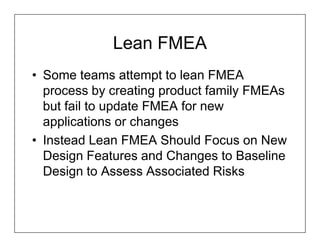
Lean FMEA
• Some teams attempt to lean FMEA
  process by creating product family FMEAs
  but fail to update FMEA for new
  applications or changes
• Instead Lean FMEA Should Focus on New
  Design Features and Changes to Baseline
  Design to Assess Associated Risks
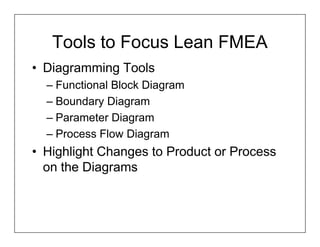
Tools to Focus Lean FMEA
• Diagramming Tools
  – Functional Block Diagram
  – Boundary Diagram
  – Parameter Diagram
  – Process Flow Diagram
• Highlight Changes to Product or Process
  on the Diagrams
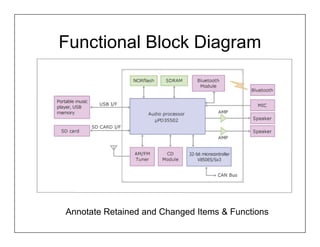
Functional Block Diagram


Annotate Retained and Changed Items & Functions
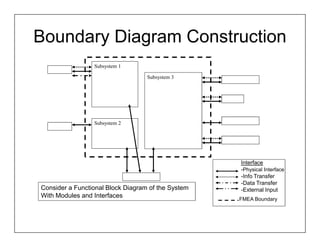
Boundary Diagram Construction
                 Subsystem 1

                                   Subsystem 3


                 Subsystem 2


                                                    Interface
                                                    -Physical Interface
                                                    -Info Transfer
                                                    -Data Transfer
Consider a Functional Block Diagram of the System   -External Input
With Modules and Interfaces                         FMEA Boundary
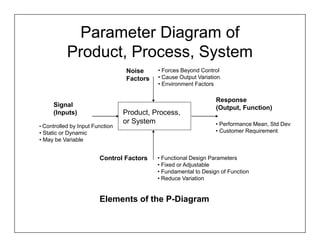
Parameter Diagram of
           Product, Process, System
                                 Noise     • Forces Beyond Control
                                 Factors   • Cause Output Variation
                                           • Environment Factors

                                                                 Response
     Signal                                                      (Output, Function)
     (Inputs)                    Product, Process,
                                 or System                       • Performance Mean, Std Dev
• Controlled by Input Function
• Static or Dynamic                                              • Customer Requirement
• May be Variable


                        Control Factors    • Functional Design Parameters
                                           • Fixed or Adjustable
                                           • Fundamental to Design of Function
                                           • Reduce Variation


                        Elements of the P-Diagram
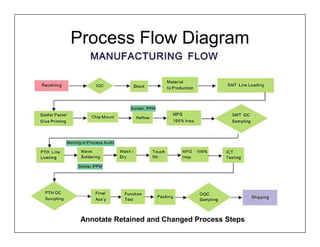
Process Flow Diagram


 Annotate Retained and Changed Process Steps
Selecting Process Steps for Analysis
• On Process Flow Map:
  – Identify Steps Being Modified
  – Identify New Steps Required for New Product
• Drill Down to Identify Sub-Steps Within the
  Target Steps Identified for Analysis
• Complete Lean PFMEA on Selected
  Process Steps
• Integrate with Previous PFMEA on
  Standard / Unchanged Process Steps
Key Characteristics
• Include:
  – Product Features
  – Manufacturing Processes
  – Assembly Characteristics
• That Significantly Affect:
  – Product Performance
  – Form, Fit, Function
• Lean NPD Focuses on the Critical Few
  Characteristics the Customer Values
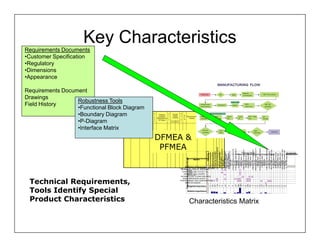
Key Characteristics
Requirements Documents
•Customer Specification
•Regulatory
•Dimensions
•Appearance

Requirements Document
Drawings
                  Robustness Tools
Field History
                  •Functional Block Diagram
                  •Boundary DiagramItem /
                                   Process
                                   Step
                                               Potential
                                                Failure
                                                            Potential
                                                           Effect(s) of
                                                                          S
                                                                          e
                                                                              C
                                                                              l
                                                                              a
                                                                                    Potential
                                                                                   Cause(s)/
                                                                                               O
                                                                                               c
                                                                                               c
                                                                                                     Current
                                                                                                     Design
                                                                                                     Controls
                                                                                                                     D
                                                                                                                     e
                                                                                                                     t
                                                                                                                         R
                                                                                                                         P
                                                                                                                                                Response &
                                                                                                                                     Recommended Target
                                                                                                                                                               Action Results


                                                                                                                                                           Action
                                                                                                                                                                     S O D R


                  •P-Diagram
                                                                                  Mechanism(s)                                          Actions  Complete            E C E P
                                                Mode         Failure      v   s                u                     e   N                                 Taken
                                                                                   Of Failure                                                      Date              V C T N
                                    Function
                                                                              s                r                     c
                                                                                                   Prevent Detect


                  •Interface Matrix
                                                                              DFMEA &
                                                                               PFMEA


                                                                                                                                                                       Component Manufacture


                                                                                                                                                                                          Mandrel to main shaft bore I.D.

                                                                                                                                                                                          Re-load fixture #2 and mandrel


                                                                                                                                                                                          Chain adj sub assy to housing
                                                                                                                                                                                          Pre-load main shaft oil seal to
                                                                                                                                                                                          PRE-LOAD DOWEL PINS TO


                                                                                                                                                                                          Pre-load bearing to fixture #2


                                                                                                                                                                                           Wave washer to shifter lever
                                                                                                                                                                                           Move or stage for final assy
                                                                                                                                                                                           Retaining ring to top groove


                                                                                                                                                                                           Retaining ring to top groove


                                                                                                                                                                                           Shifter lever to shifter tube
                                                                                                                                                                                           PRE-LOAD JACK SHAFT


                                                                                                                                                                                            Lubricate bushing & seal
                                                                                                                                                                                           HOUSING BUSHING TO
                                                                                                                                                                                                                      Process Steps


                                                                                                                                                                        Shipping Damage
                                                                                                                                                                                                                                                             Customer


                                                                                                                                                                        Vehicle Assembly
                                                                                                                                                                        Material handling


                                                                                                                                                                                             Shifter tube to housing
                                                                                                                                                                        Receive Material


                                                                                                                                                                                             Assemble shifter lever


                                                                                                                                                                                             Que for final assy line
                                                                                                                                                                                            PRE-LOAD PRIMARY
                                                                                                                                                                                                                                                            Assessment


                                                                                                                                                                               Severity
                                                                                                                                                                                                                Primary Drive Manufacturing Process Steps


                                                                                                                                                                                             Housing to fixture #2
                                                                                                                                                                                             Housing to fixture #1


                                                                                                                                                                                             Clamp to shifter tube
                                                                                                                                                                                             O-ring to shifter tube
                                                                                                                                                                                             SEAL TO FIXTURE


                                                                                                                                                                                              Reload fixture #1


                                                                                                                                                                                              Housing to table
                                                                                                                                                                                               Op 100 Step 1
                                                                                                                                                                                               Op 100 Step 2
                                                                                                                                                                                               Op 100 Step 3


                                                                                                                                                                                               Operate press
                                                                                                                                                                                               Operate press


                                                                                                                                                                                               Operate press
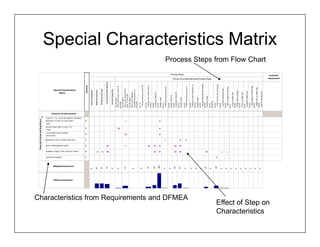
                                                                                                                                  Special Characteristics


                                                                                                                             Potential Critical and Significant
                                                                                                                                         Matrix


                                                                                                                                                                                                Reserved
                                                                                                                                                                                                FIXTURE
                                                                                                                                                                                                FIXTURE


                                                                                                                                                                                                 mandrel


                                                                                                                                                                                                 OP 340


                                                                                                                                                                                                 Op 430


                                                                                                                                                                                                 Op 520
                                                                                                                                                                                                 Op 445

                                                                                                                                                                                                 Op 500
                                                                                                                                                                                                 Op 510


                                                                                                                                                                                                 Op 530
                                                                                                                                                                                                 Op 535
                                                                                                                                                                                                 Op 120

                                                                                                                                                                                                 Op 200
                                                                                                                                                                                                 Op 210


                                                                                                                                                                                                 Op 330
                                                                                                                                                                                                 Op 110


                                                                                                                                                                                                 Op 220
                                                                                                                                                                                                 Op 230
                                                                                                                                                                                                 Op 300
                                                                                                                                                                                                 Op 310
                                                                                                                                                                                                 Op 320


                                                                                                                                                                                                 Op 350
                                                                                                                                                                                                 Op 400
                                                                                                                                                                                                 Op 410
                                                                                                                                                                                                 Op 420


                                                                                                                                                                                                  Op 20
                                                                                                                                                                                                  Op 10
                                                                                                                          Direction of Improvement
                                                                                                                    1.090 TO 1.110 " FACE OF PRIMARY HOUSING
                                                                                                                       BUSHING TO FACE OF JACK SHAFT
                                                                                                                               SEAL
                                                                                                                                                     5                                             G                F
                                                                                                                        DOWEL PINS 0.260 TO 0.270 " TO
                                                                                                                                                     3
                                                                                                                               FACE
                                                                                                                         JACK SHAFT SEAL AGAINST 9
                                                                                                                                                                                               H                    F
                                                                                                                             SHOULDER                                                              H                F
                                                                                                                      BEARING FLUSH TO SNAP RING FACE3                                                                  G    F G

 Technical Requirements,
                                                                                                                        SEAL COMPRESSION HEIGHT 9                                   H              G            H HF        HH
                                                                                                                     PRIMARY GASKET SEAL SURFACE FINISH F
                                                                                                                                                     9  F                           Y                             HH        HH            H        GG
                                                                                                                           SERATION DAMAGE           5                                                                                         F


                                                                                                                                                                                                                261
                                                                                                                                                                          81
                                                                                                                                                                          81
                                                                                                                                                                          72


                                                                                                                                                                                                   41


                                                                                                                                                                                                                27
                                                                                                                                                                                                                54


                                                                                                                                                                                                                54
                                                                                                                                                                                                                81


                                                                                                                                                                                                                27

                                                                                                                                                                                                                45
                                                                                                                                     Weighted Importance


                                                                                                                                                                                                            0


                                                                                                                                                                                                                0
                                                                                                                                                                          0


                                                                                                                                                                          0
                                                                                                                                                                          9


                                                                                                                                                                                                        0


                                                                                                                                                                                                                3
                                                                                                                                                                                                                0


                                                                                                                                                                                                                3

                                                                                                                                                                                                                0
                                                                                                                                                                                                                0

                                                                                                                                                                                                                0

                                                                                                                                                                                                                9
                                                                                                                                                                                                                9
                                                                                                                                                                                                                0
                                                                                                                                                                                                                0
                                                                                                                                                                                                                0
                                                                                                                                                                                                                0
                                                                                                                                                                                                                0
                                                                                                                                                                                                                0
                                                                                                                                                                                                                0
 Tools Identify Special                                                                                                                    Relative Importance


 Product Characteristics                                                                                                                                          Characteristics Matrix
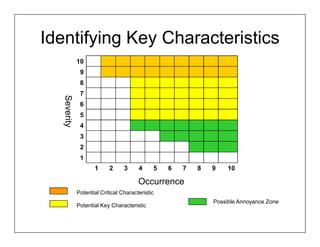
Identifying Key Characteristics
             10
              9
              8
              7
  Severity


              6
              5
              4
              3
              2
              1
                    1      2     3     4     5   6   7   8   9    10

                                       Occurrence
             Potential Critical Characteristic
                                                             Possible Annoyance Zone
             Potential Key Characteristic
Potential Critical and Significant


                                                                                                                                                                                                                                                                                                             SEAL


                                                                                                                                                                                                                                                                     FACE


                                                                                                                                                                                                                                SHOULDER


                                                                                                          SERATION DAMAGE
                                                                                                                                                                                                                                                                                                                                                                                                                                                    Matrix


                                                                                                                                                                                                                                           JACK SHAFT SEAL AGAINST


                                                                                                                                                                    SEAL COMPRESSION HEIGHT
                                                                                                                                                                                                                                                                            DOWEL PINS 0.260 TO 0.270 " TO


                                                          Relative Importance
                                                                                    Weighted Importance
                                                                                                                                                                                                                                                                                                                    BUSHING TO FACE OF JACK SHAFT


                                                                                                                                                                                              BEARING FLUSH TO SNAP RING FACE
                                                                                                                                                                                                                                                                                                                                                                                                                                               Special Characteristics


                                                                                                                                                                                                                                                                                                                                                                                               Direction of Improvement


                                                                                                                            PRIMARY GASKET SEAL SURFACE FINISH
                                                                                                                                                                                                                                                                                                                                                    1.090 TO 1.110 " FACE OF PRIMARY HOUSING


                                                                                                          5
                                                                                                                            9
                                                                                                                                                                    9
                                                                                                                                                                                              3
                                                                                                                                                                                                                                    9
                                                                                                                                                                                                                                                                       3
                                                                                                                                                                                                                                                                                                                    5
                                                                                                                                                                                                                                                                                                                                                                                                                                                    Severity

                                                                                0                                                                                                                                                                                                                                                                                                                                             Receive Material

                                                                                81                                                                                                                                                                                                                                                                                                                                           Material handling


                                                                                                                            H
                                                                                81                                                                                                                                                                                                                                                                                                                                            Shipping Damage


                                                                                                                            H
                                                                                72                                                                                                                                                                                                                                                                                                                                             Component Manufacture


                                                                                                                                                                   M

                                                                                                                            M
                                                                                0                                                                                                                                                                                                                                                                                                                                             Vehicle Assembly
                                                                                                                                                                                                                                                                                                                                                                                                                           Op 100 Step 1
                                                                                9                                                                                                                                                                                                                                                                                                                                          PRE-LOAD DOWEL PINS TO


                                                                                                                                                                                                                                                                      M
                                                                                                                                                                                                                                                                                                                                                                                                                          FIXTURE
                                                                                                                                                                                                                                                                                                                                                                                                                           Op 100 Step 2
                                                                                41                                                                                                                                                                                                                                                                                                                                          PRE-LOAD JACK SHAFT


                                                                                                                                                                   L
                                                                                                                                                                                                                                                                                                                L


                                                                                                                                                                                                                                  M
                                                                                                                                                                                                                                                                                                                                                                                                                           SEAL TO FIXTURE
                                                                                                                                                                                                                                                                                                                                                                                                                          Op 100 Step 3
                                                                                                                                                                                                                                                                                                                                                                                                                          PRE-LOAD PRIMARY
                                                                                0
                                                                                                                                                                                                                                                                                                                                                                                                                           HOUSING BUSHING TO
                                                                                                                                                                                                                                                                                                                                                                                                                          FIXTURE

                                                                                                                                                                                                                                                                                                                                                                                                                          Op 110
                                                                                0
                                                                                                                                                                                                                                                                                                                                                                                                                            Pre-load bearing to fixture #2

                                                                                                                                                                                                                                                                                                                                                                                                                          Op 120
                                                                                27                                                                                                                                                                                                                                                                                                                                         Pre-load main shaft oil seal to
                                                                                                                                                                   M
                                                                                                                                                                                                                                                                                                                                                                                                                          mandrel
                                                                                                                                                                                                                                                                                                                                                                                                                          Op 200
                                                                                54
                                                                                                                            M
                                                                                                                                                                   M


                                                                                                                                                                                                                                                                                                                                                                                                                           Housing to fixture #1
                                                                                                                                                                                                                                                                                                                                                                                                                          Op 210
                                                                                261
                                                                                                                                                                   H
                                                                                                                                                                                                                                  H
                                                                                                                                                                                                                                                                      H
                                                                                                                                                                                                                                                                                                                H


                                                                                                                            M


                                                                                                                                                                                                                                                                                                                                                                                                                          Operate press
                                                                                                                                                                                                                                                                                                                                                                                                                          Op 220
                                                                                3
                                                                                                                                                                                              L


                                                                                                                                                                                                                                                                                                                                                                                                                           Retaining ring to top groove
                                                                                                                                                                                                                                                                                                                                                                                                                          Op 230
                                                                                0
                                                                                                                                                                                                                                                                                                                                                                                                                           Reload fixture #1
                                                                                                                                                                                                                                                                                                                                                                                                                          Op 300
                                                                                54
                                                                                                                            M
                                                                                                                                                                   M


                                                                                                                                                                                                                                                                                                                                                                                                                           Housing to fixture #2
                                                                                                                                                                                                                                                                                                                                                                                                                          Op 310
                                                                                81
                                                                                                                                                                                              H


                                                                                                                            M
                                                                                                                                                                   M


                                                                                                                                                                                                                                                                                                                                                                                                                          Operate press
                                                                                                                                                                                                                                                                                                                                                                                                                                                                                                                     Process Steps


                                                                                                                                                                                                                                                                                                                                                                                                                          Op 320
                                                                                3
                                                                                                                                                                                              H


                                                                                                                                                                                                                                                                                                                                                                                                                           Retaining ring to top groove


            Characteristics from Requirements and DFMEA
                                                                                                                                                                                                                                                                                                                                                                                                                          Op 330
                                                                                0
                                                                                                                                                                                                                                                                                                                                                                                                                           Mandrel to main shaft bore I.D.
                                                                                                                                                                                                                                                                                                                                                                                                                          OP 340
                                                                                0
                                                                                                                                                                                                                                                                                                                                                                                                                          Operate press
                                                                                                                                                                                                                                                                                                                                                                                                                          Op 350
                                                                                0
                                                                                                                                                                                                                                                                                                                                                                                                                            Re-load fixture #2 and mandrel
                                                                                                                                                                                                                                                                                                                                                                                                                          Op 400
                                                                                27
                                                                                                                            M


                                                                                                                                                                                                                                                                                                                                                                                                                           Housing to table
                                                                                                                                                                                                                                                                                                                                                                                                                          Op 410
                                                                                                                                                                                                                                                                                                                                                                                                                                                                         Primary Drive Manufacturing Process Steps


                                                                                0
                                                                                                                                                                                                                                                                                                                                                                                                                          Reserved
                                                                                                                                                                                                                                                                                                                                                                                                                          Op 420
                                                                                45
                                                                                                          H


                                                                                                                                                                                                                                                                                                                                                                                                                            Chain adj sub assy to housing
                                                                                                                                                                                                                                                                                                                                                                                                                          Op 430
                                                                                9
                                                                                                                            L


                                                                                                                                                                                                                                                                                                                                                                                                                           Lubricate bushing & seal
                                                                                                                                                                                                                                                                                                                                                                                                                          Op 445
                                                                                9
                                                                                                                            L


                                                                                                                                                                                                                                                                                                                                                                                                                            Move or stage for final assy
                                                                                                                                                                                                                                                                                                                                                                                                                          Op 10
                                                                                0
                                                                                                                                                                                                                                                                                                                                                                                                                           O-ring to shifter tube
                                                                                                                                                                                                                                                                                                                                                                                                                          Op 500
                                                                                0
                                                                                                                                                                                                                                                                                                                                                                                                                           Shifter tube to housing
                                                                                                                                                                                                                                                                                                                                                                                                                          Op 510
                                                                                0
                                                                                                                                                                                                                                                                                                                                                                                                                           Clamp to shifter tube
                                                                                                                                                                                                                                                                                                                                                                                                                          Op 20
                                                                                0
                                                                                                                                                                                                                                                                                                                                                                                                                           Assemble shifter lever
                                                                                                                                                                                                                                                                                                                                                                                                                          Op 520
                                                                                0
                                                                                                                                                                                                                                                                                                                                                                                                                            Wave washer to shifter lever
                                                                                                                                                                                                                                                                                                                                                                                                                          Op 530
                                                                                0
                                                                                                                                                                                                                                                                                                                                                                                                                           Shifter lever to shifter tube
                                                                                                                                                                                                                                                                                                                                                                                                                          Op 535
                                                                                0
                                                                                                                                                                                                                                                                                                                                                                                                                           Que for final assy line
Characteristics
                                                                                                                                                                                                                                                                                                                                                                                                                                                                                                                                     Process Steps from Flow Chart


Effect of Step on
                                                                                                                                                                                                                                                                                                                                                                                                                                                                                                                                                                     Special Characteristics Matrix
                                                                                                                                                                                                                                                                                                                                                                                                                                                                                Customer
                                                                                                                                                                                                                                                                                                                                                                                                                                                                               Assessment
Developing the Control Plan
• Prioritize Process Risks Identified in the
  PFMEA and the Special Characteristics
  Matrix
• Process Flow Diagram
• Lessons Learned from Similar Processes
• Process Control Data from Related
  Processes
• Measurements Required for Process Control
• SPC Control Limits
• Complete the Items in Control Plan Template
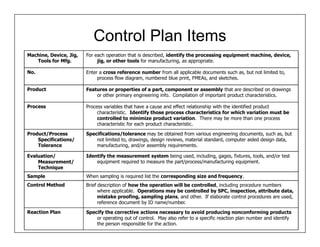
Control Plan Items
Machine, Device, Jig,   For each operation that is described, identify the processing equipment machine, device,
   Tools for Mfg.            jig, or other tools for manufacturing, as appropriate.

No.                     Enter a cross reference number from all applicable documents such as, but not limited to,
                             process flow diagram, numbered blue print, FMEAs, and sketches.

Product                 Features or properties of a part, component or assembly that are described on drawings
                            or other primary engineering info. Compilation of important product characteristics.

Process                 Process variables that have a cause and effect relationship with the identified product
                             characteristic. Identify those process characteristics for which variation must be
                             controlled to minimize product variation. There may be more than one process
                             characteristic for each product characteristic.

Product/Process         Specifications/tolerance may be obtained from various engineering documents, such as, but
    Specifications/         not limited to, drawings, design reviews, material standard, computer aided design data,
    Tolerance               manufacturing, and/or assembly requirements.

Evaluation/             Identify the measurement system being used, including, gages, fixtures, tools, and/or test
    Measurement/            equipment required to measure the part/process/manufacturing equipment.
    Technique
Sample                  When sampling is required list the corresponding size and frequency.
Control Method          Brief description of how the operation will be controlled, including procedure numbers
                              where applicable. Operations may be controlled by SPC, inspection, attribute data,
                              mistake proofing, sampling plans, and other. If elaborate control procedures are used,
                              reference document by ID name/number.

Reaction Plan           Specify the corrective actions necessary to avoid producing nonconforming products
                            or operating out of control. May also refer to a specific reaction plan number and identify
                            the person responsible for the action.
Using the Control Plan
• For Critical Characteristics, Use Control
  Plan to Identify:
  – Measurements: How, When, How Often
  – Controls to Keep Characteristic in Tolerance
  – Actions if Characteristic Out of Tolerance
     • Containment
     • Corrective Actions
• Robust Design + Controlled Processes =
  Reliable Products
DRBFM and DRBTR
Design Review Based on Failure Modes & Test Results


  Key Elements of Mizenboushi
  (Reliability Problem Prevention)

  GD3 (Good Design, Good Discussion,
  Good Dissection)

  Toyota’s “Creative FMEA” Method
Problem Prevention – GD3
• Good Design = Robust Design
  – Design for Reliability (DFR)
  – Design for Six Sigma (DFSS)
• Good Discussion = Eliminate Risk
  – Apply Design Review Based on Failure
    Modes (DRBFM) to identify problems and
    develop countermeasures or corrections
• Good Dissection = Effective Validation
  – Apply Design Review Based on Test Results
    (DRBTR) to Evaluate Effectiveness. Test to
    Failure & Analysis of Test Failures is Critical
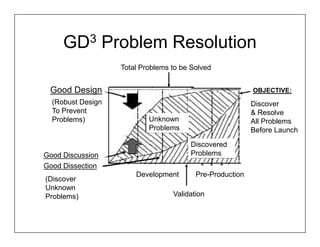
GD3 Problem Resolution
                   Total Problems to be Solved


 Good Design                                              OBJECTIVE:
  (Robust Design                                          Discover
  To Prevent                                              & Resolve
  Problems)                Unknown                        All Problems
                           Problems                       Before Launch
                                       Discovered
Good Discussion                        Problems
Good Dissection
                       Development       Pre-Production
(Discover
Unknown
Problems)                         Validation
DRBFM Approach
• Elements from FMEA, FTA, and Design
  Review
  – These tools previously used for management
    and control of projects
  – Toyota developed “creative FMEA” approach
  – Shift focus to improve perceptiveness and
    problem solving
• Focus is on finding and preventing
  problems – not completing forms and
  checklists (which de-motivate participants)
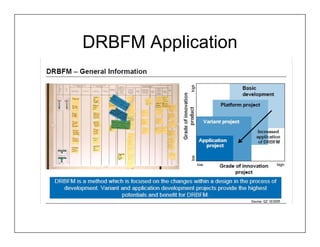
DRBFM Application
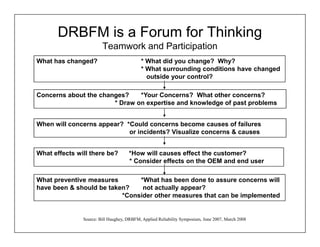
DRBFM is a Forum for Thinking
                        Teamwork and Participation
What has changed?                          * What did you change? Why?
                                           * What surrounding conditions have changed
                                             outside your control?

Concerns about the changes?    *Your Concerns? What other concerns?
                       * Draw on expertise and knowledge of past problems


When will concerns appear? *Could concerns become causes of failures
                            or incidents? Visualize concerns & causes


What effects will there be?          *How will causes effect the customer?
                                     * Consider effects on the OEM and end user

What preventive measures       *What has been done to assure concerns will
have been & should be taken?    not actually appear?
                          *Consider other measures that can be implemented


               Source: Bill Haughey, DRBFM, Applied Reliability Symposium, June 2007, March 2008
How is DRBFM Done?
•   Preparation for the Design Review
•   Conducting the DRBFM
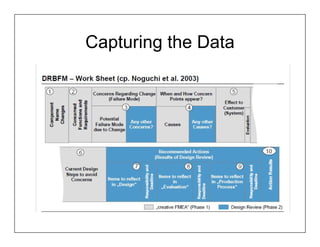
•   Capturing the Inputs
•   Assigning and Tracking Actions to
    Completion
Pre-Work for the DRBFM
• Design Engineer or Core Team:
  –   Functional Diagram, Operating Environment
  –   Changes from Previous Baseline Design
  –   Drawings and Analysis
  –   Failed and Sectioned Parts
  –   Draft DRBFM with Components / Changes, Concerns
      with Causes and Factors, Effect on Customer, Design
      to Eliminate Concerns
• Participants (Functional Experts):
  – Perceptive mindset, interest in improving product
  – Past experience and knowledge on similar items
Capturing the Data
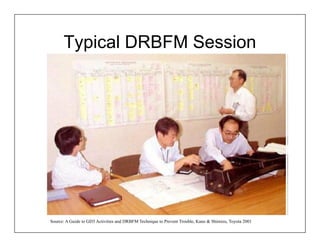
Typical DRBFM Session


Source: A Guide to GD3 Activities and DRBFM Technique to Prevent Trouble, Kano & Shimizu, Toyota 2001
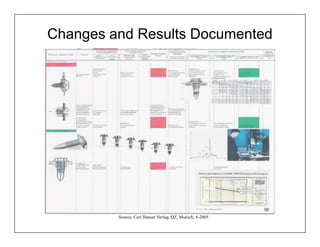
Changes and Results Documented


         Source: Carl Hanser Verlag, QZ, Munich, 4-2005
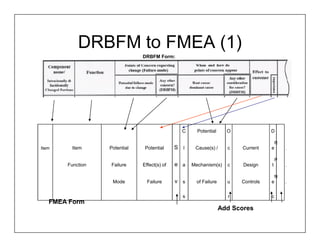
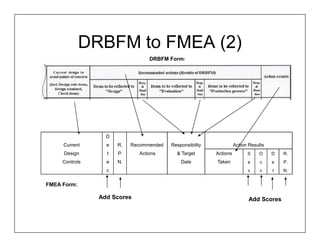
Linking DRBFM with FMEA
• DRBFM captures the information needed
  for FMEA except scoring
• Scoring columns can be added to fill need
  for FMEA if required by customer or
  standards
DRBFM to FMEA (1)
                              DRBFM Form:


                                               C     Potential      O              D

                                                                                       R
Item    Item      Potential    Potential     S l    Cause(s) /      c   Current    e       .

                                                                                       P
       Function   Failure     Effect(s) of   e a   Mechanism(s)     c    Design    t       .

                                                                                       N
                   Mode         Failure      v s     of Failure     u   Controls   e       .


                                               s                    r              c
   FMEA Form
                                                                  Add Scores
DRBFM to FMEA (2)
                                  DRBFM Form:


                  D
     Current      e   R.   Recommended   Responsibility             Action Results
     Design       t   P.      Actions      & Target       Actions         S    O     D   R.
     Controls     e   N.                     Date         Taken           e     c    e   P.
                  c                                                       v     c    t   N.


FMEA Form:

                Add Scores                                                 Add Scores
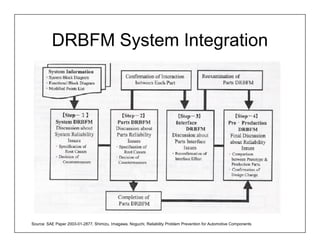
DRBFM System Integration


Source: SAE Paper 2003-01-2877, Shimizu, Imagawa, Noguchi, Reliability Problem Prevention for Automotive Components
Applying DRBFM in Lean NPD
• Use “Missing Knowledge” Decision Flow
  from Lean QFD as starting point
• These unknowns and known changes
  from current technology or design are the
  greatest risks
• Focus DRBFM on these unknown and
  changed areas during concept and
  prototype team reviews & Integration
  Points
Integrating Product & Process
               Design
• DFMA – Design for Manufacturing and
  Assembly
• Integrated Product and Process FMEA /
  DRBFM
• Concurrent Engineering Team
• Visual Management – Decision Flow and
  Value Stream Map to Manage Tasks
Impact of Lean Focused FMEA
• Allocation of Resources Targeted to
  Reduce Highest Risks and Unknowns
• Impact Product and Process Design
• Drive Test Planning and Analysis to
  Resolve Issues and Understand
  Unknowns
• Verify Corrective Action Effectiveness
• Critical Characteristics and Process
  Measurement / Control
Lean FMEA Summary
• Focus FMEA on Changes in Design or
  Process
• Use Supporting Tools to Narrow Focus:
  – Parameter & Boundary Diagrams
  – Process Flow Charts
  – DRBFM Techniques
  – Characteristics Matrix
• Use Lean NPD Tools to Identify
  Unknowns, Apply Resources, Assign
  Tasks
Design for Reliability and
      Robustness
How do we Design-in Reliability?
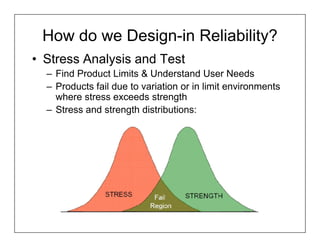
• Stress Analysis and Test
  – Find Product Limits & Understand User Needs
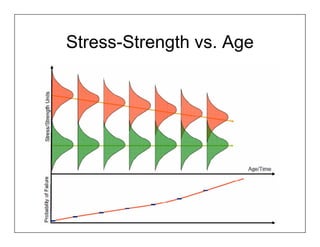
  – Products fail due to variation or in limit environments
    where stress exceeds strength
  – Stress and strength distributions:
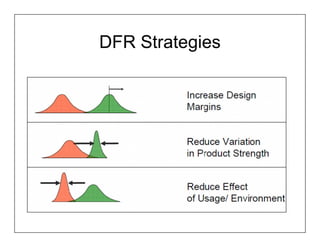
DFR Strategies
Stress-Strength vs. Age
Reducing Stress / Strength
            Interference
• Increase strength of the part
  –   Understand operating environment stresses
  –   Select more robust parts or materials
  –   Increase design margin
  –   Supplement deterministic design with probabilistic
      tools
• Reduce part strength variability
  – Understand sources of part variation and deterioration
  – Controlled production process (SPC)
  – Protect vulnerable components
• ROBUST DESIGN + CONTROLLED
  PROCESSES = RELIABLE PRODUCT
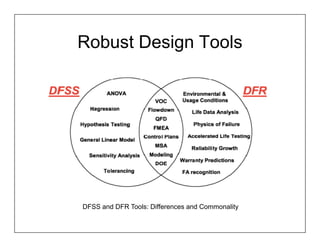
Robust Design Tools


DFSS and DFR Tools: Differences and Commonality
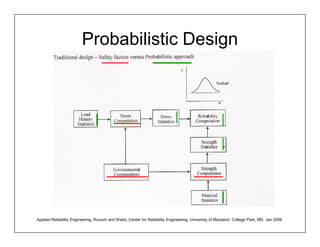
Probabilistic Design


Applied Reliability Engineering, Rousch and Webb, Center for Reliability Engineering, University of Maryland, College Park, MD. Jan 2006
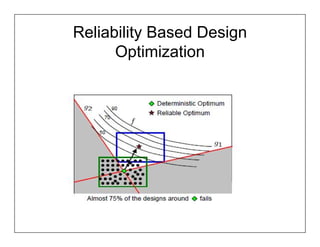
Reliability Based Design
      Optimization
Elements of Probabilistic Design
• Understand physics of failure and stresses
  that precipitate failure
• Use predictive modeling and accelerated
  test to failure to estimate probability of
  failure
• Consider variability of applied stresses
  and variability of product strength
• Eliminate stress-strength interference
Physics of Failure Approach
• Robust Design Considerations
• FMEA or DRBFM Methods
  – Design Review Based on Failure Modes
    Integrates FMEA and Design Review
• Test to Failure and Understand Cause
  Mechanisms
• Failure Analysis Methods
Understand Physics of Failure
• What physical phenomenon in the part is caused
  by the stresses applied?
• If we understand the root cause, we can improve
  strength or reduce variability to prevent or
  mitigate the failure.
• Most hardware failures can be traced to four
  physical categories / mechanisms:
  –   Wear
  –   Corrosion / Contamination
  –   Mechanical Failure (fatigue, vibration resonance, etc.)
  –   Overstress (electrical or mechanical, transients)
Physics of Failure Tools
• Tools Used in Physics of Failure Analysis
    – Principal Physics Model
    – CAD Drawings / Solid Modeling
    – Finite Element Analysis
•   Dynamic Simulation (Transients)
•   Fatigue Analysis (Cumulative Damage)
•   Thermal Analysis
•   Accelerated Testing
•   Simulation
Design of Experiments (DOE)
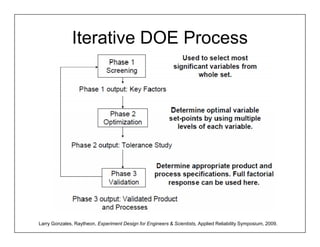
• Tool to Evaluate Design Alternatives
• Determine Factors and Response
• May need Two Phased DOE Approach
  – Fractional Design to Find Main Factors
  – Full Factorial Design to Evaluate Effects and
    Interactions on Reduced Set of Factors
  – Consider Time and Cost
• Analysis of Results and Optimization of
  Solution
Iterative DOE Process


Larry Gonzales, Raytheon, Experiment Design for Engineers & Scientists, Applied Reliability Symposium, 2009.
Use Trade-Off Curves to Capture
           Knowledge

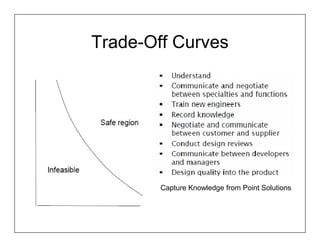
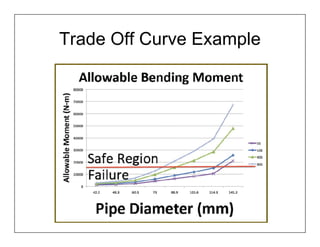
• Point Data from Analysis and Experiments
• Relationship Between Key Parameters
• Apply to Support Design Decisions
Trade-Off Curves


        Capture Knowledge from Point Solutions
Trade Off Curve Example
Key is Understanding
•   Methods Build Knowledge of Alternatives
    – Physics of Failure
    – Design of Experiments
    – Design for Robustness and Reliability
•   Enable Better Design Decisions
•   Eliminate or Reduce Redesign Waste
Reliability Testing and Data
           Analysis
Phased Robustness Testing
• Prototype Phase
  – Accelerated Test to Failure (Well beyond Spec –
    HALT, Step Stress, Specific Stresses and Failure
    Modes)
• Design Verification Phase
  – Quantitative Accelerated Life Test
  – Selected Qualification Tests
• Production Validation
  – Demonstrate Corrective Action is Effective
  – Validate Final Product Made on Production Tools
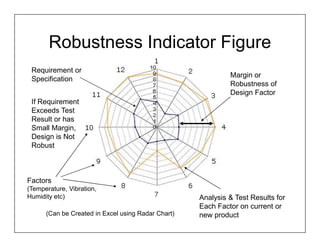
Robustness Indicator Figure
 Requirement or
                                                             Margin or
 Specification
                                                             Robustness of
                                                             Design Factor
 If Requirement
 Exceeds Test
 Result or has
 Small Margin,
 Design is Not
 Robust


Factors
(Temperature, Vibration,
Humidity etc)                                       Analysis & Test Results for
                                                    Each Factor on current or
      (Can be Created in Excel using Radar Chart)   new product
General Approach to Accelerated
            Life Test (ALT)
• Understand Failure mechanisms
• Understand Operating and Design Limits
• Clarify Use Level Stress Application
• Conduct Qualitative tests like HALT or step-
  stress tests to define product limits and failure
  modes
• Conduct Quantitative ALT to extrapolate life at
  use level conditions
    – Times to Failure at Accelerated Stress Levels
    – Use life-stress relationships and distributions
ALT Plan
•   Stresses to be Considered
•   Life-Stress Relationship for Each Stress
•   Application Use Level for Each Stress
•   Use Level Failure Criteria / Threshold
•   Test Duration and Resources Available
•   Consider Use of DOE to help estimate:
    –   Stress Factors with Most Effect
    –   Probability of Failure at Specified Use Level
    –   Probability of Failure at Maximum Stress
    –   Interactions to Help Define Life-Stress Relationship
Highly Accelerated Life Test
       (HALT) – Qualitative ALT
1. Improve Reliability by Finding
   Weaknesses and Correcting
   Them Early.
2. Establish Upper and Lower
   Operating and Destruct Limits of
   Environmental Stressors
3. Typically done in Temperature &
   Vibration Chamber for
   Electronics & Electromechanical
   Products
4. Concept can be Applied to Other
   Stressors (Voltage, Current,
   Mechanical Loads, etc.)
Quantitative ALT
• Test to Failure at Multiple Accelerated
  Stress Levels
• Use Analysis to Extrapolate Reliability or
  Life at Application Use Level Stress
• Can be Used to Demonstrate Ability to
  Meet Reliability Requirements
Cautions on Acceleration
• Understanding product limits helps prevent accelerating
  to unrepresentative stresses and failure modes
• Time
   – Consider Heat Buildup
   – Effects of Cycling
• Temperature
   – Material Phase transitions
   – Non-linear response
   – High temperature or thermal cycling?
• Power
   – Protective and limit devices
   – Transients
• Vibration
   – Mechanical limits or resonances
• What failure mechanism are we accelerating?
Data Collected
• Test Parameters Measured
  – Temperature, Power Density, Cycle Rate, Vibration,
    Humidity, Voltage, etc. applied
  – Product Response or Function (monitor during test)
• Time to Failure or Run Time (Suspended)
  – At least 3 Different Stress Levels
  – Fit Data Points to Appropriate Distribution
• Product Limits from Step Stress Test
• Failure Mode Observations
Data Analysis
• Analyze Data and Extrapolate Life at Use Level
  Stress
• Life-Stress Relationships (predictive models)
  –   Arrhenius – Temperature
  –   Eyring – Temperature or humidity
  –   Inverse Power Law – Voltage, Power, Mechanical
  –   Multiple Life-Stress Models
       •   Temperature / Humidity
       •   Temperature / Non-Thermal: Temp / Voltage or Power
       •   General Log Linear: multiple accelerating stresses
       •   Proportional Hazards: multiple covariates
       •   Cumulative Damage – Time varying stress profiles
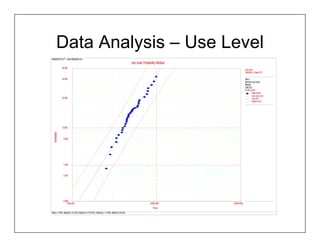
Data Analysis – Use Level
ReliaSoft ALTA 7 - www.ReliaSoft.com
                                                                                       Use Level Probability Weibull
                 99.000
                                                                                                                                    Use Level
                                                                                                                                    CB@90% 1-Sided TB

                 90.000                                                                                                             Data 1
                                                                                                                                    General Log-Linear
                                                                                                                                    Weibull
                                                                                                                                    328|10|1
                                                                                                                                    F=35 | S=51
                                                                                                                                            Data Points
                                                                                                                                            Use Level Line
                 50.000                                                                                                                     Top CB-I
                                                                                                                                            Bottom CB-I


                 10.000
 Unreliability


                  5.000


                  1.000


                  0.500


                                                                                                                                    John Paschkewitz
                                                                                                                                    Watlow Electric Mfg Co
                                                                                                                                    2/4/2008
                  0.100                                                                                                             3:39:07 PM
                      1000.000                                                                         10000.000       100000.000
                                                                                                         Time
Beta=3.7483; Alpha(0)=-6.0220; Alpha(1)=5776.9341; Alpha(2)=-1.4340; Alpha(3)=0.6242
Data Analysis - Distribution
ReliaSoft ALTA 7 - www.ReliaSoft.com
                                                                                       Probability Density Function
            3.000E-4
                                                                                                                                                          Pdf

                                                                                                                                                          Data 1
                                                                                                                                                          General Log-Linear
                                                                                                                                                          Weibull
                                                                                                                                                          328|10|1
                                                                                                                                                          F=35 | S=51
                                                                                                                                                                  Pdf Line
            2.400E-4


            1.800E-4
 f(t)


            1.200E-4


            6.000E-5


                                                                                                                                                          John Paschkewitz
                                                                                                                                                          Watlow Electric Mfg Co
                                                                                                                                                          2/4/2008
                0.000                                                                                                                                     3:41:01 PM
                        0.000                             4000.000                       8000.000                     12000.000   16000.000   20000.000
                                                                                                         Time
Beta=3.7483; Alpha(0)=-6.0220; Alpha(1)=5776.9341; Alpha(2)=-1.4340; Alpha(3)=0.6242
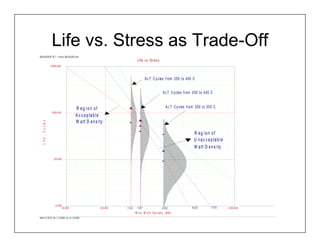
Life vs. Stress as Trade-Off
Re l i a S o ft AL T A 7 - w w w .Re l i a S o ft.c o m
                                                                                    L if e v s S t r e s s
               1 0 0 0 0 .0 0 0
                                                                                                                                                                              L i fe
                                                                                                                                                                              CB@ 9 0 % 1 -S i d e d T B


                                                                                           A L T C y c le s f r o m 2 5 0 t o 4 0 0 C                                         Ax c e l i s AL T N i Cr W W D L -S
                                                                                                                                                                              I n v e rs e P o w e r L a w
                                                                                                                                                                              L o g n o rm a l
                                                                                                                                                                              1 3 2 .4
                                                                                                                                                                              F = 5 | S= 1
                                                                                                             A L T C y c le s f r o m 2 5 0 t o 4 3 0 C                                  M e a n L i fe L i n e
                                                                                                                                                                                         T o p CB M e a n
                                                                                                                                                                                         Bo tto m CB M e a n
                                                                                                                                                                              1 5 7 .8
                                                                                                                                                                                         S tre s s L e v e l P o i n ts
                                               R eg ion of                                                     A L T C y c le s f r o m 2 5 0 t o 5 0 0 C                                M edia n Point
                                                                                                                                                                                         I m pos ed Pdf
                 1 0 0 0 .0 0 0                                                                                                                                               1 8 6 .7
                                               A c c e p ta b l e                                                                                                                        S tre s s L e v e l P o i n ts
  C y c le s


                                                                                                                                                                                         M edia n Point
                                               W a tt D e n s i ty                                                                                                            2 8 1 .6
                                                                                                                                                                                         I m pos ed Pdf

                                                                                                                                                                                         S tre s s L e v e l P o i n ts
                                                                                                                                                                                         M edia n Point
                                                                                                                                    R eg ion of                                          I m pos ed Pdf
  L if e ,


                                                                                                                                    U n a c c e p ta b l e             0 . 1 6 8 " d ia s h e a t h
                                                                                                                                    W a tt D e n s i ty                . 0 2 1 " d ia P C N iC r
                                                                                                                                                                       w ir e c y c le d u s in g
                   1 0 0 .0 0 0
                                                                                                                                                                      c o n t r o lle d d u t y c y c le
                                                                                                                                                                      ram p ov er 78
                                                                                                                                                                      m in u t e c y c le


                                                                                                                                                                              J o h n P a s c h k e w i tz
                                                                                                                                                                              W a tl o w E l e c tri c M fg Co
                                                                                                                                                                              10/ 8/ 2009
                     1 0 .0 0 0                                                                                                                                               3 :0 6 :0 5 P M
                               5 0 .0 0 0                     1 0 0 .0 0 0   132    187                      282                   500            700        1 0 0 0 .0 0 0
                                                                                   W ir e W a t t D e n s,it y s i
                                                                                                             w
S td = 0 .7 9 3 7 ; K= 7 .1 3 5 0 E -1 2 ; n = 3 .6 5 5 6
Production Validation Test
• Repeat selected Qualification Tests on
  any Changes in Product or Process
• Test Samples made on Production
  Processes
• On-Going Reliability Test (ORT)
  – HASS – Highly Accelerated Stress Screening
  – HASA – Highly Accelerated Stress Audit
  – Periodic HALT Re-Test on Production Units
Failure Analysis / FRACAS
Failure Analysis Tools
• Basic
  – Recovery of Failed Samples
  – Electrical Test, Microscopy, Digital Photography
• Non-Destructive Methods
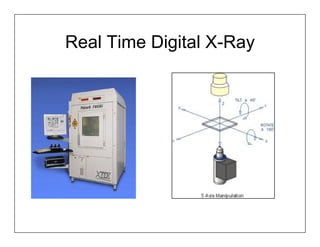
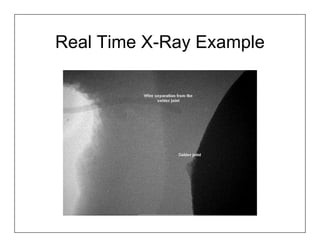
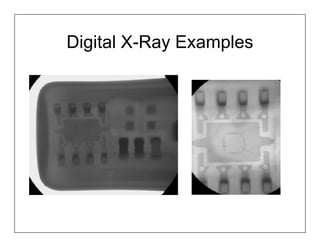
  – X-Ray (Real Time Digital is Particularly Helpful)
• Disassembly / De-capsulation
  – Tools or Chemicals to remove layers
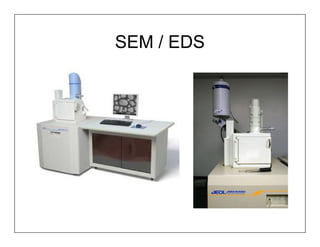
• Scanning Electron Microscopy & EDS
  – Defects, Corrosion, Material Failure
• Acoustic Microscopy / Imaging (Voids / Defects)
• Some Internal, Others at Outside Labs
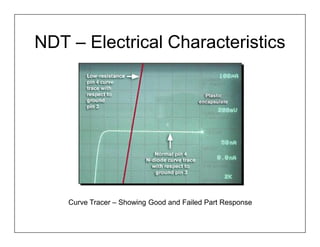
NDT – Electrical Characteristics


    Curve Tracer – Showing Good and Failed Part Response
Real Time Digital X-Ray
Real Time X-Ray Example
Digital X-Ray Examples
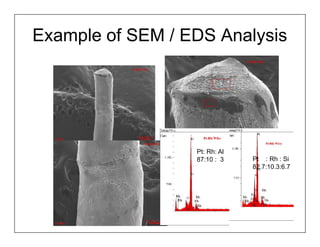
SEM / EDS
Example of SEM / EDS Analysis


                  Pt: Rh: Al
                  87:10 : 3    Pt : Rh : Si
                               82.7:10.3:6.7
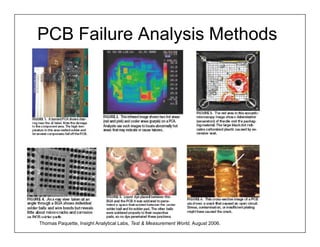
PCB Failure Analysis Methods


Thomas Paquette, Insight Analytical Labs, Test & Measurement World, August 2006.
Failure Analysis Summary
• Progressive Use of Tools from NDT to
  Dissection and Cross-Section Exam
• Objective is to Find Physical Evidence of
  Failure Mechanism
• Document with Photos and Analysis to
  Capture Knowledge Gained
• Update FMEA or DRBFM with FA Findings
FRACAS
   Failure Reporting, Analysis & Corrective Action System

• Build Knowledge Base
• Process and Tool
  – Reliability & Quality of Product, Service, Process or
    Software is Tracked, Measured, and Improved
  – Applies to Entire Product Life Cycle
  – Consistently Ranked Among the Most Important
    Reliability Tasks
  – Closed Loop: Ability to Feed Root Cause & Corrective
    Action Information Back Into Design Process for
    Further Improvement
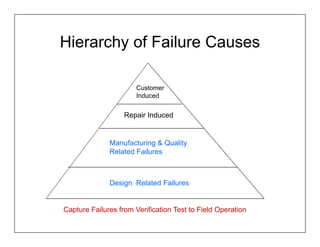
Hierarchy of Failure Causes

                       Customer
                       Induced


                   Repair Induced


              Manufacturing & Quality
              Related Failures


              Design Related Failures


Capture Failures from Verification Test to Field Operation
Capturing FA Knowledge
• Capture Failure Analysis Results in
  Searchable Tool
  – Commercial Data Base Tool
  – A3 Format Documents with Keywords
  – SharePoint (Microsoft)
• Key is Ability to Retrieve Knowledge with
  Minimal Search Effort
• Lean NPD is Knowledge Based – Key is
  Continually Adding to Accessible
  Knowledge
Summary
• Features of Lean NPD for Reliability
  – Front End Focus to Gain Knowledge
     • Basis for Better Design Decisions
  – Design for Robustness, Reliability
  – Understand Physics of Failure
• Testing to Learn and Verify
  – Test to Failure and Understand Causes
• Knowledge Capture for Future Re-use
• Develop & Control Critical Characteristics
References
• King, John P. and Jewett, William S.;
  Robustness Development and Reliability
  Growth; Prentice-Hall, Boston, 2010.
• SAE International, J1211, April 2009, Handbook
  for Robustness Validation of Automotive
  Electrical / Electronic Modules.
• Robustness Validation Manual, ZVEI, January
  2010; www.zvei.org/RobustnessValidation
• Jusko, Jill; New Models for Product
  Development, Industry Week, April 21, 2010.
• Morgan, James and Liker, Jeffrey; The Toyota
  Product Development System, Productivity
  Press, New York, 2006.
References
• Sarakakis, Georgios; Fundamentals of Life Data
  Analysis: Concepts and Applications, Tutorial, 2010
  Applied Reliability Symposium Proceedings, June 17,
  2010.
• Wiggins, Brian, “A Simpler Look at Product
  Development”, Product Design & Development, October
  8, 2010.
• Mascatelli, R., The Lean Product Development
  Guidebook, 2007.
• Soderborg, Dr. Nathan, Lean Product Development,
  WCBF DFSS Conference, Feb. 2008
• Using DOE Results in Design of ALT, Reliability Edge,
  Vol 10, Issue 2, pp. 1-7.
References
• SAE 2003-01-2877, Reliability Problem Prevention
  Method for Automotive Components, H. Shimizu, T.
  Imagawa, H. Noguchi.
• A Guide to GD3 Activities and DRBFM Technique to
  Prevent Trouble, S. Kano, H. Shimizu, Toyota, 2001.
• Lean Product Development, Eric Rebentisch, Oct 5,
  2005, MIT Open Courseware,
  http://ocw.mit.edu/courses/aeronautics-and-astronautics/16-852j-
  integrating-the-lean-enterprise-fall-2005/lecture-notes/8_rebentisc_leng.pdf
• Bill Haughey, DRBFM, Applied Reliability Symposium,
  June 2007, March 2008
• Lean FMEA Training, Quality Associates International, at
  www.quality-one.com
• AIAG, FMEA, 4th Edition, June 2008, pp.135-138.
Feedback / Follow-up
• Please provide your feedback on this web
  based short course: e-mail to
  jjpengr@gmail.com or to ASQ RD
• One day seminar on this topic available
  through:
  http://www.hobbsengr.com/Accelerated_R
  eliability_Seminar_Schedule.htm
  – Apr 13, 2011 in Chicago, IL
  – May 2, 2011 in Minneapolis, MN

Ensuring reliability in lean new product development part2of2 24

  • 1.
    Part 2: Part 2: Using FMEA, DFR, Test and  Failure Analysis in Lean NPD John J. Paschkewitz ©2011 ASQ & Presentation John Presented live on Feb 24th, 2011 http://reliabilitycalendar.org/The_Re liability_Calendar/Short_Courses/Sh liability Calendar/Short Courses/Sh ort_Courses.html
  • 2.
    ASQ Reliability Division  ASQ Reliability Division Short Course Series Short Course Series The ASQ Reliability Division is pleased to  present a regular series of short courses  featuring leading international practitioners,  academics, and consultants. academics and consultants The goal is to provide a forum for the basic and  The goal is to provide a forum for the basic and continuing education of reliability  professionals. http://reliabilitycalendar.org/The_Re liability_Calendar/Short_Courses/Sh liability Calendar/Short Courses/Sh ort_Courses.html
  • 3.
    Part 2: Using FMEA,DFR, Test and Failure Analysis in Lean NPD
  • 4.
    Overview • Introduction andDefinitions • Part 1: Lean Product Development – Lean vs. Traditional Product Development – Key Elements of Lean NPD • Customer Defines Value • Front Loaded and Knowledge Based • Eliminate Redesign Waste – Reliability Requirements • Part 2: Reliability Elements of Lean NPD – Lean FMEA and DRBFM – Critical Characteristics – DFR and Physics of Failure – Accelerated Testing to Failure – Failure Analysis and Knowledge Capture
  • 5.
    Lean FMEA • Someteams attempt to lean FMEA process by creating product family FMEAs but fail to update FMEA for new applications or changes • Instead Lean FMEA Should Focus on New Design Features and Changes to Baseline Design to Assess Associated Risks
  • 6.
    Tools to FocusLean FMEA • Diagramming Tools – Functional Block Diagram – Boundary Diagram – Parameter Diagram – Process Flow Diagram • Highlight Changes to Product or Process on the Diagrams
  • 7.
    Functional Block Diagram AnnotateRetained and Changed Items & Functions
  • 8.
    Boundary Diagram Construction Subsystem 1 Subsystem 3 Subsystem 2 Interface -Physical Interface -Info Transfer -Data Transfer Consider a Functional Block Diagram of the System -External Input With Modules and Interfaces FMEA Boundary
  • 9.
    Parameter Diagram of Product, Process, System Noise • Forces Beyond Control Factors • Cause Output Variation • Environment Factors Response Signal (Output, Function) (Inputs) Product, Process, or System • Performance Mean, Std Dev • Controlled by Input Function • Static or Dynamic • Customer Requirement • May be Variable Control Factors • Functional Design Parameters • Fixed or Adjustable • Fundamental to Design of Function • Reduce Variation Elements of the P-Diagram
  • 10.
    Process Flow Diagram Annotate Retained and Changed Process Steps
  • 11.
    Selecting Process Stepsfor Analysis • On Process Flow Map: – Identify Steps Being Modified – Identify New Steps Required for New Product • Drill Down to Identify Sub-Steps Within the Target Steps Identified for Analysis • Complete Lean PFMEA on Selected Process Steps • Integrate with Previous PFMEA on Standard / Unchanged Process Steps
  • 12.
    Key Characteristics • Include: – Product Features – Manufacturing Processes – Assembly Characteristics • That Significantly Affect: – Product Performance – Form, Fit, Function • Lean NPD Focuses on the Critical Few Characteristics the Customer Values
  • 13.
    Key Characteristics Requirements Documents •CustomerSpecification •Regulatory •Dimensions •Appearance Requirements Document Drawings Robustness Tools Field History •Functional Block Diagram •Boundary DiagramItem / Process Step Potential Failure Potential Effect(s) of S e C l a Potential Cause(s)/ O c c Current Design Controls D e t R P Response & Recommended Target Action Results Action S O D R •P-Diagram Mechanism(s) Actions Complete E C E P Mode Failure v s u e N Taken Of Failure Date V C T N Function s r c Prevent Detect •Interface Matrix DFMEA & PFMEA Component Manufacture Mandrel to main shaft bore I.D. Re-load fixture #2 and mandrel Chain adj sub assy to housing Pre-load main shaft oil seal to PRE-LOAD DOWEL PINS TO Pre-load bearing to fixture #2 Wave washer to shifter lever Move or stage for final assy Retaining ring to top groove Retaining ring to top groove Shifter lever to shifter tube PRE-LOAD JACK SHAFT Lubricate bushing & seal HOUSING BUSHING TO Process Steps Shipping Damage Customer Vehicle Assembly Material handling Shifter tube to housing Receive Material Assemble shifter lever Que for final assy line PRE-LOAD PRIMARY Assessment Severity Primary Drive Manufacturing Process Steps Housing to fixture #2 Housing to fixture #1 Clamp to shifter tube O-ring to shifter tube SEAL TO FIXTURE Reload fixture #1 Housing to table Op 100 Step 1 Op 100 Step 2 Op 100 Step 3 Operate press Operate press Operate press Special Characteristics Potential Critical and Significant Matrix Reserved FIXTURE FIXTURE mandrel OP 340 Op 430 Op 520 Op 445 Op 500 Op 510 Op 530 Op 535 Op 120 Op 200 Op 210 Op 330 Op 110 Op 220 Op 230 Op 300 Op 310 Op 320 Op 350 Op 400 Op 410 Op 420 Op 20 Op 10 Direction of Improvement 1.090 TO 1.110 " FACE OF PRIMARY HOUSING BUSHING TO FACE OF JACK SHAFT SEAL 5 G F DOWEL PINS 0.260 TO 0.270 " TO 3 FACE JACK SHAFT SEAL AGAINST 9 H F SHOULDER H F BEARING FLUSH TO SNAP RING FACE3 G F G Technical Requirements, SEAL COMPRESSION HEIGHT 9 H G H HF HH PRIMARY GASKET SEAL SURFACE FINISH F 9 F Y HH HH H GG SERATION DAMAGE 5 F 261 81 81 72 41 27 54 54 81 27 45 Weighted Importance 0 0 0 0 9 0 3 0 3 0 0 0 9 9 0 0 0 0 0 0 0 Tools Identify Special Relative Importance Product Characteristics Characteristics Matrix
  • 14.
    Identifying Key Characteristics 10 9 8 7 Severity 6 5 4 3 2 1 1 2 3 4 5 6 7 8 9 10 Occurrence Potential Critical Characteristic Possible Annoyance Zone Potential Key Characteristic
  • 15.
    Potential Critical andSignificant SEAL FACE SHOULDER SERATION DAMAGE Matrix JACK SHAFT SEAL AGAINST SEAL COMPRESSION HEIGHT DOWEL PINS 0.260 TO 0.270 " TO Relative Importance Weighted Importance BUSHING TO FACE OF JACK SHAFT BEARING FLUSH TO SNAP RING FACE Special Characteristics Direction of Improvement PRIMARY GASKET SEAL SURFACE FINISH 1.090 TO 1.110 " FACE OF PRIMARY HOUSING 5 9 9 3 9 3 5 Severity 0 Receive Material 81 Material handling H 81 Shipping Damage H 72 Component Manufacture M M 0 Vehicle Assembly Op 100 Step 1 9 PRE-LOAD DOWEL PINS TO M FIXTURE Op 100 Step 2 41 PRE-LOAD JACK SHAFT L L M SEAL TO FIXTURE Op 100 Step 3 PRE-LOAD PRIMARY 0 HOUSING BUSHING TO FIXTURE Op 110 0 Pre-load bearing to fixture #2 Op 120 27 Pre-load main shaft oil seal to M mandrel Op 200 54 M M Housing to fixture #1 Op 210 261 H H H H M Operate press Op 220 3 L Retaining ring to top groove Op 230 0 Reload fixture #1 Op 300 54 M M Housing to fixture #2 Op 310 81 H M M Operate press Process Steps Op 320 3 H Retaining ring to top groove Characteristics from Requirements and DFMEA Op 330 0 Mandrel to main shaft bore I.D. OP 340 0 Operate press Op 350 0 Re-load fixture #2 and mandrel Op 400 27 M Housing to table Op 410 Primary Drive Manufacturing Process Steps 0 Reserved Op 420 45 H Chain adj sub assy to housing Op 430 9 L Lubricate bushing & seal Op 445 9 L Move or stage for final assy Op 10 0 O-ring to shifter tube Op 500 0 Shifter tube to housing Op 510 0 Clamp to shifter tube Op 20 0 Assemble shifter lever Op 520 0 Wave washer to shifter lever Op 530 0 Shifter lever to shifter tube Op 535 0 Que for final assy line Characteristics Process Steps from Flow Chart Effect of Step on Special Characteristics Matrix Customer Assessment
  • 16.
    Developing the ControlPlan • Prioritize Process Risks Identified in the PFMEA and the Special Characteristics Matrix • Process Flow Diagram • Lessons Learned from Similar Processes • Process Control Data from Related Processes • Measurements Required for Process Control • SPC Control Limits • Complete the Items in Control Plan Template
  • 17.
    Control Plan Items Machine,Device, Jig, For each operation that is described, identify the processing equipment machine, device, Tools for Mfg. jig, or other tools for manufacturing, as appropriate. No. Enter a cross reference number from all applicable documents such as, but not limited to, process flow diagram, numbered blue print, FMEAs, and sketches. Product Features or properties of a part, component or assembly that are described on drawings or other primary engineering info. Compilation of important product characteristics. Process Process variables that have a cause and effect relationship with the identified product characteristic. Identify those process characteristics for which variation must be controlled to minimize product variation. There may be more than one process characteristic for each product characteristic. Product/Process Specifications/tolerance may be obtained from various engineering documents, such as, but Specifications/ not limited to, drawings, design reviews, material standard, computer aided design data, Tolerance manufacturing, and/or assembly requirements. Evaluation/ Identify the measurement system being used, including, gages, fixtures, tools, and/or test Measurement/ equipment required to measure the part/process/manufacturing equipment. Technique Sample When sampling is required list the corresponding size and frequency. Control Method Brief description of how the operation will be controlled, including procedure numbers where applicable. Operations may be controlled by SPC, inspection, attribute data, mistake proofing, sampling plans, and other. If elaborate control procedures are used, reference document by ID name/number. Reaction Plan Specify the corrective actions necessary to avoid producing nonconforming products or operating out of control. May also refer to a specific reaction plan number and identify the person responsible for the action.
  • 18.
    Using the ControlPlan • For Critical Characteristics, Use Control Plan to Identify: – Measurements: How, When, How Often – Controls to Keep Characteristic in Tolerance – Actions if Characteristic Out of Tolerance • Containment • Corrective Actions • Robust Design + Controlled Processes = Reliable Products
  • 19.
    DRBFM and DRBTR DesignReview Based on Failure Modes & Test Results Key Elements of Mizenboushi (Reliability Problem Prevention) GD3 (Good Design, Good Discussion, Good Dissection) Toyota’s “Creative FMEA” Method
  • 20.
    Problem Prevention –GD3 • Good Design = Robust Design – Design for Reliability (DFR) – Design for Six Sigma (DFSS) • Good Discussion = Eliminate Risk – Apply Design Review Based on Failure Modes (DRBFM) to identify problems and develop countermeasures or corrections • Good Dissection = Effective Validation – Apply Design Review Based on Test Results (DRBTR) to Evaluate Effectiveness. Test to Failure & Analysis of Test Failures is Critical
  • 21.
    GD3 Problem Resolution Total Problems to be Solved Good Design OBJECTIVE: (Robust Design Discover To Prevent & Resolve Problems) Unknown All Problems Problems Before Launch Discovered Good Discussion Problems Good Dissection Development Pre-Production (Discover Unknown Problems) Validation
  • 22.
    DRBFM Approach • Elementsfrom FMEA, FTA, and Design Review – These tools previously used for management and control of projects – Toyota developed “creative FMEA” approach – Shift focus to improve perceptiveness and problem solving • Focus is on finding and preventing problems – not completing forms and checklists (which de-motivate participants)
  • 23.
  • 24.
    DRBFM is aForum for Thinking Teamwork and Participation What has changed? * What did you change? Why? * What surrounding conditions have changed outside your control? Concerns about the changes? *Your Concerns? What other concerns? * Draw on expertise and knowledge of past problems When will concerns appear? *Could concerns become causes of failures or incidents? Visualize concerns & causes What effects will there be? *How will causes effect the customer? * Consider effects on the OEM and end user What preventive measures *What has been done to assure concerns will have been & should be taken? not actually appear? *Consider other measures that can be implemented Source: Bill Haughey, DRBFM, Applied Reliability Symposium, June 2007, March 2008
  • 25.
    How is DRBFMDone? • Preparation for the Design Review • Conducting the DRBFM • Capturing the Inputs • Assigning and Tracking Actions to Completion
  • 26.
    Pre-Work for theDRBFM • Design Engineer or Core Team: – Functional Diagram, Operating Environment – Changes from Previous Baseline Design – Drawings and Analysis – Failed and Sectioned Parts – Draft DRBFM with Components / Changes, Concerns with Causes and Factors, Effect on Customer, Design to Eliminate Concerns • Participants (Functional Experts): – Perceptive mindset, interest in improving product – Past experience and knowledge on similar items
  • 27.
  • 28.
    Typical DRBFM Session Source:A Guide to GD3 Activities and DRBFM Technique to Prevent Trouble, Kano & Shimizu, Toyota 2001
  • 29.
    Changes and ResultsDocumented Source: Carl Hanser Verlag, QZ, Munich, 4-2005
  • 30.
    Linking DRBFM withFMEA • DRBFM captures the information needed for FMEA except scoring • Scoring columns can be added to fill need for FMEA if required by customer or standards
  • 31.
    DRBFM to FMEA(1) DRBFM Form: C Potential O D R Item Item Potential Potential S l Cause(s) / c Current e . P Function Failure Effect(s) of e a Mechanism(s) c Design t . N Mode Failure v s of Failure u Controls e . s r c FMEA Form Add Scores
  • 32.
    DRBFM to FMEA(2) DRBFM Form: D Current e R. Recommended Responsibility Action Results Design t P. Actions & Target Actions S O D R. Controls e N. Date Taken e c e P. c v c t N. FMEA Form: Add Scores Add Scores
  • 33.
    DRBFM System Integration Source:SAE Paper 2003-01-2877, Shimizu, Imagawa, Noguchi, Reliability Problem Prevention for Automotive Components
  • 34.
    Applying DRBFM inLean NPD • Use “Missing Knowledge” Decision Flow from Lean QFD as starting point • These unknowns and known changes from current technology or design are the greatest risks • Focus DRBFM on these unknown and changed areas during concept and prototype team reviews & Integration Points
  • 35.
    Integrating Product &Process Design • DFMA – Design for Manufacturing and Assembly • Integrated Product and Process FMEA / DRBFM • Concurrent Engineering Team • Visual Management – Decision Flow and Value Stream Map to Manage Tasks
  • 36.
    Impact of LeanFocused FMEA • Allocation of Resources Targeted to Reduce Highest Risks and Unknowns • Impact Product and Process Design • Drive Test Planning and Analysis to Resolve Issues and Understand Unknowns • Verify Corrective Action Effectiveness • Critical Characteristics and Process Measurement / Control
  • 37.
    Lean FMEA Summary •Focus FMEA on Changes in Design or Process • Use Supporting Tools to Narrow Focus: – Parameter & Boundary Diagrams – Process Flow Charts – DRBFM Techniques – Characteristics Matrix • Use Lean NPD Tools to Identify Unknowns, Apply Resources, Assign Tasks
  • 38.
    Design for Reliabilityand Robustness
  • 39.
    How do weDesign-in Reliability? • Stress Analysis and Test – Find Product Limits & Understand User Needs – Products fail due to variation or in limit environments where stress exceeds strength – Stress and strength distributions:
  • 40.
  • 41.
  • 42.
    Reducing Stress /Strength Interference • Increase strength of the part – Understand operating environment stresses – Select more robust parts or materials – Increase design margin – Supplement deterministic design with probabilistic tools • Reduce part strength variability – Understand sources of part variation and deterioration – Controlled production process (SPC) – Protect vulnerable components • ROBUST DESIGN + CONTROLLED PROCESSES = RELIABLE PRODUCT
  • 43.
    Robust Design Tools DFSSand DFR Tools: Differences and Commonality
  • 44.
    Probabilistic Design Applied ReliabilityEngineering, Rousch and Webb, Center for Reliability Engineering, University of Maryland, College Park, MD. Jan 2006
  • 45.
  • 46.
    Elements of ProbabilisticDesign • Understand physics of failure and stresses that precipitate failure • Use predictive modeling and accelerated test to failure to estimate probability of failure • Consider variability of applied stresses and variability of product strength • Eliminate stress-strength interference
  • 47.
    Physics of FailureApproach • Robust Design Considerations • FMEA or DRBFM Methods – Design Review Based on Failure Modes Integrates FMEA and Design Review • Test to Failure and Understand Cause Mechanisms • Failure Analysis Methods
  • 48.
    Understand Physics ofFailure • What physical phenomenon in the part is caused by the stresses applied? • If we understand the root cause, we can improve strength or reduce variability to prevent or mitigate the failure. • Most hardware failures can be traced to four physical categories / mechanisms: – Wear – Corrosion / Contamination – Mechanical Failure (fatigue, vibration resonance, etc.) – Overstress (electrical or mechanical, transients)
  • 49.
    Physics of FailureTools • Tools Used in Physics of Failure Analysis – Principal Physics Model – CAD Drawings / Solid Modeling – Finite Element Analysis • Dynamic Simulation (Transients) • Fatigue Analysis (Cumulative Damage) • Thermal Analysis • Accelerated Testing • Simulation
  • 50.
    Design of Experiments(DOE) • Tool to Evaluate Design Alternatives • Determine Factors and Response • May need Two Phased DOE Approach – Fractional Design to Find Main Factors – Full Factorial Design to Evaluate Effects and Interactions on Reduced Set of Factors – Consider Time and Cost • Analysis of Results and Optimization of Solution
  • 51.
    Iterative DOE Process LarryGonzales, Raytheon, Experiment Design for Engineers & Scientists, Applied Reliability Symposium, 2009.
  • 52.
    Use Trade-Off Curvesto Capture Knowledge • Point Data from Analysis and Experiments • Relationship Between Key Parameters • Apply to Support Design Decisions
  • 53.
    Trade-Off Curves Capture Knowledge from Point Solutions
  • 54.
  • 55.
    Key is Understanding • Methods Build Knowledge of Alternatives – Physics of Failure – Design of Experiments – Design for Robustness and Reliability • Enable Better Design Decisions • Eliminate or Reduce Redesign Waste
  • 56.
  • 57.
    Phased Robustness Testing •Prototype Phase – Accelerated Test to Failure (Well beyond Spec – HALT, Step Stress, Specific Stresses and Failure Modes) • Design Verification Phase – Quantitative Accelerated Life Test – Selected Qualification Tests • Production Validation – Demonstrate Corrective Action is Effective – Validate Final Product Made on Production Tools
  • 58.
    Robustness Indicator Figure Requirement or Margin or Specification Robustness of Design Factor If Requirement Exceeds Test Result or has Small Margin, Design is Not Robust Factors (Temperature, Vibration, Humidity etc) Analysis & Test Results for Each Factor on current or (Can be Created in Excel using Radar Chart) new product
  • 59.
    General Approach toAccelerated Life Test (ALT) • Understand Failure mechanisms • Understand Operating and Design Limits • Clarify Use Level Stress Application • Conduct Qualitative tests like HALT or step- stress tests to define product limits and failure modes • Conduct Quantitative ALT to extrapolate life at use level conditions – Times to Failure at Accelerated Stress Levels – Use life-stress relationships and distributions
  • 60.
    ALT Plan • Stresses to be Considered • Life-Stress Relationship for Each Stress • Application Use Level for Each Stress • Use Level Failure Criteria / Threshold • Test Duration and Resources Available • Consider Use of DOE to help estimate: – Stress Factors with Most Effect – Probability of Failure at Specified Use Level – Probability of Failure at Maximum Stress – Interactions to Help Define Life-Stress Relationship
  • 61.
    Highly Accelerated LifeTest (HALT) – Qualitative ALT 1. Improve Reliability by Finding Weaknesses and Correcting Them Early. 2. Establish Upper and Lower Operating and Destruct Limits of Environmental Stressors 3. Typically done in Temperature & Vibration Chamber for Electronics & Electromechanical Products 4. Concept can be Applied to Other Stressors (Voltage, Current, Mechanical Loads, etc.)
  • 62.
    Quantitative ALT • Testto Failure at Multiple Accelerated Stress Levels • Use Analysis to Extrapolate Reliability or Life at Application Use Level Stress • Can be Used to Demonstrate Ability to Meet Reliability Requirements
  • 63.
    Cautions on Acceleration •Understanding product limits helps prevent accelerating to unrepresentative stresses and failure modes • Time – Consider Heat Buildup – Effects of Cycling • Temperature – Material Phase transitions – Non-linear response – High temperature or thermal cycling? • Power – Protective and limit devices – Transients • Vibration – Mechanical limits or resonances • What failure mechanism are we accelerating?
  • 64.
    Data Collected • TestParameters Measured – Temperature, Power Density, Cycle Rate, Vibration, Humidity, Voltage, etc. applied – Product Response or Function (monitor during test) • Time to Failure or Run Time (Suspended) – At least 3 Different Stress Levels – Fit Data Points to Appropriate Distribution • Product Limits from Step Stress Test • Failure Mode Observations
  • 65.
    Data Analysis • AnalyzeData and Extrapolate Life at Use Level Stress • Life-Stress Relationships (predictive models) – Arrhenius – Temperature – Eyring – Temperature or humidity – Inverse Power Law – Voltage, Power, Mechanical – Multiple Life-Stress Models • Temperature / Humidity • Temperature / Non-Thermal: Temp / Voltage or Power • General Log Linear: multiple accelerating stresses • Proportional Hazards: multiple covariates • Cumulative Damage – Time varying stress profiles
  • 66.
    Data Analysis –Use Level ReliaSoft ALTA 7 - www.ReliaSoft.com Use Level Probability Weibull 99.000 Use Level CB@90% 1-Sided TB 90.000 Data 1 General Log-Linear Weibull 328|10|1 F=35 | S=51 Data Points Use Level Line 50.000 Top CB-I Bottom CB-I 10.000 Unreliability 5.000 1.000 0.500 John Paschkewitz Watlow Electric Mfg Co 2/4/2008 0.100 3:39:07 PM 1000.000 10000.000 100000.000 Time Beta=3.7483; Alpha(0)=-6.0220; Alpha(1)=5776.9341; Alpha(2)=-1.4340; Alpha(3)=0.6242
  • 67.
    Data Analysis -Distribution ReliaSoft ALTA 7 - www.ReliaSoft.com Probability Density Function 3.000E-4 Pdf Data 1 General Log-Linear Weibull 328|10|1 F=35 | S=51 Pdf Line 2.400E-4 1.800E-4 f(t) 1.200E-4 6.000E-5 John Paschkewitz Watlow Electric Mfg Co 2/4/2008 0.000 3:41:01 PM 0.000 4000.000 8000.000 12000.000 16000.000 20000.000 Time Beta=3.7483; Alpha(0)=-6.0220; Alpha(1)=5776.9341; Alpha(2)=-1.4340; Alpha(3)=0.6242
  • 68.
    Life vs. Stressas Trade-Off Re l i a S o ft AL T A 7 - w w w .Re l i a S o ft.c o m L if e v s S t r e s s 1 0 0 0 0 .0 0 0 L i fe CB@ 9 0 % 1 -S i d e d T B A L T C y c le s f r o m 2 5 0 t o 4 0 0 C Ax c e l i s AL T N i Cr W W D L -S I n v e rs e P o w e r L a w L o g n o rm a l 1 3 2 .4 F = 5 | S= 1 A L T C y c le s f r o m 2 5 0 t o 4 3 0 C M e a n L i fe L i n e T o p CB M e a n Bo tto m CB M e a n 1 5 7 .8 S tre s s L e v e l P o i n ts R eg ion of A L T C y c le s f r o m 2 5 0 t o 5 0 0 C M edia n Point I m pos ed Pdf 1 0 0 0 .0 0 0 1 8 6 .7 A c c e p ta b l e S tre s s L e v e l P o i n ts C y c le s M edia n Point W a tt D e n s i ty 2 8 1 .6 I m pos ed Pdf S tre s s L e v e l P o i n ts M edia n Point R eg ion of I m pos ed Pdf L if e , U n a c c e p ta b l e 0 . 1 6 8 " d ia s h e a t h W a tt D e n s i ty . 0 2 1 " d ia P C N iC r w ir e c y c le d u s in g 1 0 0 .0 0 0 c o n t r o lle d d u t y c y c le ram p ov er 78 m in u t e c y c le J o h n P a s c h k e w i tz W a tl o w E l e c tri c M fg Co 10/ 8/ 2009 1 0 .0 0 0 3 :0 6 :0 5 P M 5 0 .0 0 0 1 0 0 .0 0 0 132 187 282 500 700 1 0 0 0 .0 0 0 W ir e W a t t D e n s,it y s i w S td = 0 .7 9 3 7 ; K= 7 .1 3 5 0 E -1 2 ; n = 3 .6 5 5 6
  • 69.
    Production Validation Test •Repeat selected Qualification Tests on any Changes in Product or Process • Test Samples made on Production Processes • On-Going Reliability Test (ORT) – HASS – Highly Accelerated Stress Screening – HASA – Highly Accelerated Stress Audit – Periodic HALT Re-Test on Production Units
  • 70.
  • 71.
    Failure Analysis Tools •Basic – Recovery of Failed Samples – Electrical Test, Microscopy, Digital Photography • Non-Destructive Methods – X-Ray (Real Time Digital is Particularly Helpful) • Disassembly / De-capsulation – Tools or Chemicals to remove layers • Scanning Electron Microscopy & EDS – Defects, Corrosion, Material Failure • Acoustic Microscopy / Imaging (Voids / Defects) • Some Internal, Others at Outside Labs
  • 72.
    NDT – ElectricalCharacteristics Curve Tracer – Showing Good and Failed Part Response
  • 73.
  • 74.
  • 75.
  • 76.
  • 77.
    Example of SEM/ EDS Analysis Pt: Rh: Al 87:10 : 3 Pt : Rh : Si 82.7:10.3:6.7
  • 78.
    PCB Failure AnalysisMethods Thomas Paquette, Insight Analytical Labs, Test & Measurement World, August 2006.
  • 79.
    Failure Analysis Summary •Progressive Use of Tools from NDT to Dissection and Cross-Section Exam • Objective is to Find Physical Evidence of Failure Mechanism • Document with Photos and Analysis to Capture Knowledge Gained • Update FMEA or DRBFM with FA Findings
  • 80.
    FRACAS Failure Reporting, Analysis & Corrective Action System • Build Knowledge Base • Process and Tool – Reliability & Quality of Product, Service, Process or Software is Tracked, Measured, and Improved – Applies to Entire Product Life Cycle – Consistently Ranked Among the Most Important Reliability Tasks – Closed Loop: Ability to Feed Root Cause & Corrective Action Information Back Into Design Process for Further Improvement
  • 81.
    Hierarchy of FailureCauses Customer Induced Repair Induced Manufacturing & Quality Related Failures Design Related Failures Capture Failures from Verification Test to Field Operation
  • 82.
    Capturing FA Knowledge •Capture Failure Analysis Results in Searchable Tool – Commercial Data Base Tool – A3 Format Documents with Keywords – SharePoint (Microsoft) • Key is Ability to Retrieve Knowledge with Minimal Search Effort • Lean NPD is Knowledge Based – Key is Continually Adding to Accessible Knowledge
  • 83.
    Summary • Features ofLean NPD for Reliability – Front End Focus to Gain Knowledge • Basis for Better Design Decisions – Design for Robustness, Reliability – Understand Physics of Failure • Testing to Learn and Verify – Test to Failure and Understand Causes • Knowledge Capture for Future Re-use • Develop & Control Critical Characteristics
  • 84.
    References • King, JohnP. and Jewett, William S.; Robustness Development and Reliability Growth; Prentice-Hall, Boston, 2010. • SAE International, J1211, April 2009, Handbook for Robustness Validation of Automotive Electrical / Electronic Modules. • Robustness Validation Manual, ZVEI, January 2010; www.zvei.org/RobustnessValidation • Jusko, Jill; New Models for Product Development, Industry Week, April 21, 2010. • Morgan, James and Liker, Jeffrey; The Toyota Product Development System, Productivity Press, New York, 2006.
  • 85.
    References • Sarakakis, Georgios;Fundamentals of Life Data Analysis: Concepts and Applications, Tutorial, 2010 Applied Reliability Symposium Proceedings, June 17, 2010. • Wiggins, Brian, “A Simpler Look at Product Development”, Product Design & Development, October 8, 2010. • Mascatelli, R., The Lean Product Development Guidebook, 2007. • Soderborg, Dr. Nathan, Lean Product Development, WCBF DFSS Conference, Feb. 2008 • Using DOE Results in Design of ALT, Reliability Edge, Vol 10, Issue 2, pp. 1-7.
  • 86.
    References • SAE 2003-01-2877,Reliability Problem Prevention Method for Automotive Components, H. Shimizu, T. Imagawa, H. Noguchi. • A Guide to GD3 Activities and DRBFM Technique to Prevent Trouble, S. Kano, H. Shimizu, Toyota, 2001. • Lean Product Development, Eric Rebentisch, Oct 5, 2005, MIT Open Courseware, http://ocw.mit.edu/courses/aeronautics-and-astronautics/16-852j- integrating-the-lean-enterprise-fall-2005/lecture-notes/8_rebentisc_leng.pdf • Bill Haughey, DRBFM, Applied Reliability Symposium, June 2007, March 2008 • Lean FMEA Training, Quality Associates International, at www.quality-one.com • AIAG, FMEA, 4th Edition, June 2008, pp.135-138.
  • 87.
    Feedback / Follow-up •Please provide your feedback on this web based short course: e-mail to jjpengr@gmail.com or to ASQ RD • One day seminar on this topic available through: http://www.hobbsengr.com/Accelerated_R eliability_Seminar_Schedule.htm – Apr 13, 2011 in Chicago, IL – May 2, 2011 in Minneapolis, MN