Total Quality Management
Module 2
By Raghavendran Venugopal
Guru’s of TQM
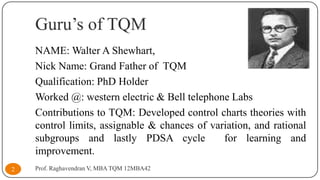
NAME: Walter A Shewhart,
Nick Name: Grand Father of TQM
Qualification: PhD Holder
Worked @: western electric & Bell telephone Labs
Contributions to TQM: Developed control charts theories with
control limits, assignable & chances of variation, and rational
subgroups and lastly PDSA cycle
for learning and
improvement.
2

Prof. Raghavendran V, MBA TQM 12MBA42
Guru’s of TQM
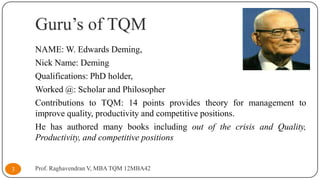
NAME: W. Edwards Deming,
Nick Name: Deming
Qualifications: PhD holder,
Worked @: Scholar and Philosopher
Contributions to TQM: 14 points provides theory for management to
improve quality, productivity and competitive positions.
He has authored many books including out of the crisis and Quality,
Productivity, and competitive positions

3

Prof. Raghavendran V, MBA TQM 12MBA42
Guru’s of TQM
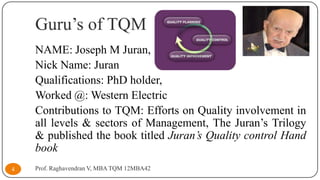
NAME: Joseph M Juran,
Nick Name: Juran
Qualifications: PhD holder,
Worked @: Western Electric
Contributions to TQM: Efforts on Quality involvement in
all levels & sectors of Management, The Juran’s Trilogy
& published the book titled Juran’s Quality control Hand
book
4

Prof. Raghavendran V, MBA TQM 12MBA42
Guru’s of TQM
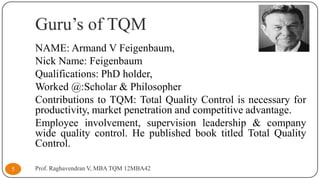
NAME: Armand V Feigenbaum,
Nick Name: Feigenbaum
Qualifications: PhD holder,
Worked @:Scholar & Philosopher
Contributions to TQM: Total Quality Control is necessary for
productivity, market penetration and competitive advantage.
Employee involvement, supervision leadership & company
wide quality control. He published book titled Total Quality
Control.
5

Prof. Raghavendran V, MBA TQM 12MBA42
Guru’s of TQM
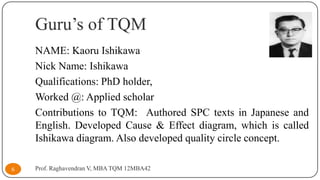
NAME: Kaoru Ishikawa
Nick Name: Ishikawa
Qualifications: PhD holder,
Worked @: Applied scholar
Contributions to TQM: Authored SPC texts in Japanese and
English. Developed Cause & Effect diagram, which is called
Ishikawa diagram. Also developed quality circle concept.
6

Prof. Raghavendran V, MBA TQM 12MBA42
Guru’s of the TQM
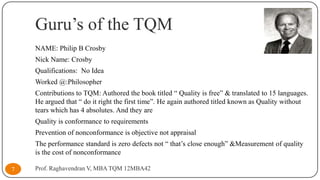
NAME: Philip B Crosby
Nick Name: Crosby
Qualifications: No Idea
Worked @:Philosopher
Contributions to TQM: Authored the book titled “ Quality is free” & translated to 15 languages.
He argued that “ do it right the first time”. He again authored titled known as Quality without
tears which has 4 absolutes. And they are
Quality is conformance to requirements
Prevention of nonconformance is objective not appraisal
The performance standard is zero defects not “ that’s close enough” &Measurement of quality
is the cost of nonconformance
7

Prof. Raghavendran V, MBA TQM 12MBA42
Guru’s of TQM
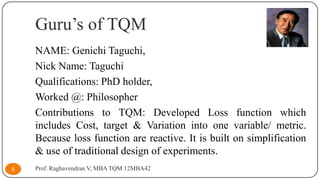
NAME: Genichi Taguchi,
Nick Name: Taguchi
Qualifications: PhD holder,
Worked @: Philosopher
Contributions to TQM: Developed Loss function which
includes Cost, target & Variation into one variable/ metric.
Because loss function are reactive. It is built on simplification
& use of traditional design of experiments.
8

Prof. Raghavendran V, MBA TQM 12MBA42
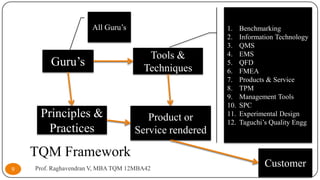
All Guru’s

Guru’s

Principles &
Practices

Tools &
Techniques

Product or
Service rendered

1.
2.
3.
4.
5.
6.
7.
8.
9.
10.
11.
12.

Benchmarking
Information Technology
QMS
EMS
QFD
FMEA
Products & Service
TPM
Management Tools
SPC
Experimental Design
Taguchi’s Quality Engg

TQM Framework
9

Prof. Raghavendran V, MBA TQM 12MBA42

Customer
Deming’s Philosophy
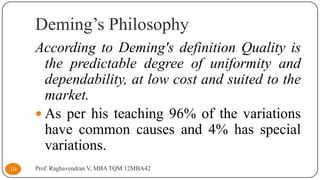
According to Deming's definition Quality is
the predictable degree of uniformity and
dependability, at low cost and suited to the
market.
 As per his teaching 96% of the variations
have common causes and 4% has special
variations.
10

Prof. Raghavendran V, MBA TQM 12MBA42
Deming’s Philosophy
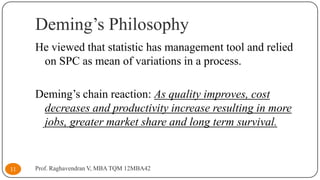
He viewed that statistic has management tool and relied
on SPC as mean of variations in a process.
Deming’s chain reaction: As quality improves, cost
decreases and productivity increase resulting in more
jobs, greater market share and long term survival.

11

Prof. Raghavendran V, MBA TQM 12MBA42
Deming’s Philosophy
14 principles are listed below:
1. Create consistency of purpose with the plan
2. Adopt the new philosophy of quality

3. Stop dependence on mass production
4. End the practice of choosing the suppliers

based solely on price
12

Prof. Raghavendran V, MBA TQM 12MBA42
Deming’s Philosophy
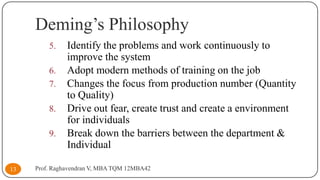
5.
6.
7.
8.
9.

13

Identify the problems and work continuously to
improve the system
Adopt modern methods of training on the job
Changes the focus from production number (Quantity
to Quality)
Drive out fear, create trust and create a environment
for individuals
Break down the barriers between the department &
Individual

Prof. Raghavendran V, MBA TQM 12MBA42
Deming’s Philosophy
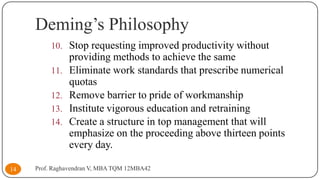
10. Stop requesting improved productivity without
11.
12.
13.
14.

14

providing methods to achieve the same
Eliminate work standards that prescribe numerical
quotas
Remove barrier to pride of workmanship
Institute vigorous education and retraining
Create a structure in top management that will
emphasize on the proceeding above thirteen points
every day.

Prof. Raghavendran V, MBA TQM 12MBA42
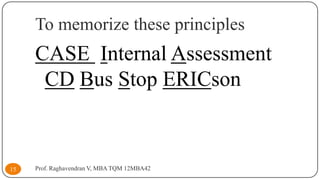
To memorize these principles

CASE Internal Assessment
CD Bus Stop ERICson

15

Prof. Raghavendran V, MBA TQM 12MBA42
PDSA or PDCA CYCLE

16

Prof. Raghavendran V, MBA TQM 12MBA42
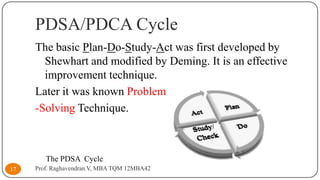
PDSA/PDCA Cycle
The basic Plan-Do-Study-Act was first developed by
Shewhart and modified by Deming. It is an effective
improvement technique.
Later it was known Problem
-Solving Technique.

The PDSA Cycle
17

Prof. Raghavendran V, MBA TQM 12MBA42
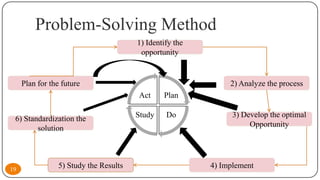
Problem- Solving Method
It is the extension of PDSA/PDCA Cycle
with scientific adaption/ approach which
yield great results, but in this method there
are 7 phases and all are integrated upon the
previous phase. These phase are the
framework of the objectives.
18

Prof. Raghavendran V, MBA TQM 12MBA42
Problem-Solving Method
1) Identify the
opportunity

Plan for the future

2) Analyze the process
Act

6) Standardization the
solution

19

5) Study the Results

Plan

Study

Do

3) Develop the optimal
Opportunity

4) Implement
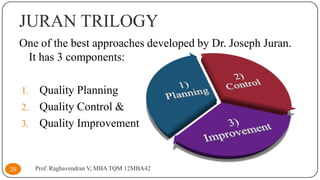
JURAN TRILOGY
One of the best approaches developed by Dr. Joseph Juran.
It has 3 components:
Quality Planning
2. Quality Control &
3. Quality Improvement
1.

20

Prof. Raghavendran V, MBA TQM 12MBA42
Trilogy
Quality Planning: It begins with external customers,
1. Once the customers are identified
2. Their needs are discovered.
3. Develop product or service features that respond to
customer needs.
4. Stabilize and optimize the product features to meet the
organizational & Customer needs

21

Prof. Raghavendran V, MBA TQM 12MBA42
Trilogy

22

Quality Control: it is used by operating forces to help and
meet the product, process and service requirements. It uses
the feedback loop and consist of the following steps:
Determine items to be controlled and their unit of measure.
Set goals for the controls & determine what sensors need to
be put in place to measure the product.
Measure the actual performance,
Compare actual performance to goals.
ActProf. Raghavendran V, MBA TQM 12MBA42
on the difference.
Juran’s Categories of Quality costs
Juran’s analytical methods could identify areas needing
improvement & could help make & track changes. They
were mostly Shop floor problems, he advocated a cost of
quality accounting system to make understand Top level
management and they were four distinct types.
 Internal Failure Cost
 External Failure Cost
 Appraisal Cost
 Prevention Cost
23

Prof. Raghavendran V, MBA TQM 12MBA42
 Internal Failure Cost: Scrap, Rework, Retest, Downtime,

Yield losses and Disposition.
 External Failure Cost: Complaint adjustment, Returned
Material, Warranty Charges and Allowance.
 Appraisal Cost: Incoming material inspection, Inspection &
Test, Maintaining accuracy of test equipment, Material &
Service consumed and Evaluation of Stocks
 Prevention Cost: Quality Planning, New product review,
training, process cost, data acquisition & analysis, reporting
and Improvement projects.
24

Prof. Raghavendran V, MBA TQM 12MBA42
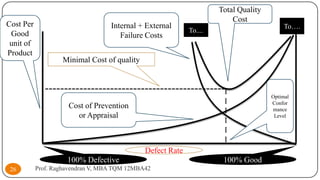
Minimizing the Cost of quality
 COQ not only provided Management with a rupee cost

for defective product, it also established the goal of
quality programmes to keep improving quality.
 2 assumptions were made and they are
 Failure cost approached zero as defect became fewer and

fewer.
 Prevention and Appraisal together approach infinity as
defects to lower to lower levels
25

Prof. Raghavendran V, MBA TQM 12MBA42
Cost Per
Good
unit of
Product

Internal + External
Failure Costs

Total Quality
Cost
To....

Minimal Cost of quality

------------------------------------------------I
I
I
I
I
I

Cost of Prevention
or Appraisal

Defect Rate
100% Defective
26

To….

Prof. Raghavendran V, MBA TQM 12MBA42

100% Good

Optimal
Confor
mance
Level
Juran’s Breakthrough Sequence:
 Breakthrough in attitudes
 Identify the vital few projects/task

 Organize breakthrough in Knowledge
 Conduct the Analysis

 Determine how to overcome resistance to change
 Institute the change
 Institute controls
27

Prof. Raghavendran V, MBA TQM 12MBA42
Crosby’s 14 point programme
 Management Commitment
 Q Improvement Team

 Zero defects day

 Q Measurement

 Goal Setting

 Cost of Quality Evaluation

 Error cause removal

 Q Awareness

 Recognition

 Corrective action

 Q Councils

 Zero defect Planning
28

 Supervisor Training

 Do it all over again

Prof. Raghavendran V, MBA TQM 12MBA42
Taguchi’s Loss Function
 It is a statistical method to improve the Quality of

Manufacturing goods. He has contributed to statistics
are
 Taguchi’s loss function
 Philosophy of Off-Line Quality Control

 Innovation in the Design of Experiments (DOE)

29

Prof. Raghavendran V, MBA TQM 12MBA42
Taguchi’s Loss Function
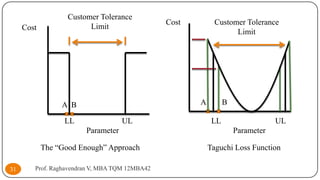
 It was shown that if the design intent of the target

value was the value at which the design, whether
product or process, functioned best, then any deviation
from that value meant an incremental deterioration of
performance and incurred a loss.
 This loss was passes to next customer (Internal or External).
 Ultimately both company and society face the loss in some

way.
30

Prof. Raghavendran V, MBA TQM 12MBA42
Cost

Customer Tolerance
Limit

Customer Tolerance
Limit

A

A B
LL

UL
Parameter

The “Good Enough” Approach
31

Cost

Prof. Raghavendran V, MBA TQM 12MBA42

B
LL

UL
Parameter

Taguchi Loss Function
Quality Circles
Objectives
 To give an opportunity to employees to use their wisdom &
creativity.
 To reduce errors & enhance quality productivity.
 To encourage team spirit and cohesive culture.
 To promote job involvement & participation.
 Increase employee motivation
 Harness problem solving capability.
 To build an attitude of problem prevention.
 To improve communication.
32

Prof. Raghavendran V, MBA TQM 12MBA42
Quality circles
 To improve internal house keeping.
 To improve customer service.

 To facilitate achievement of business goals
 To improve & develop of the organization.

 To respect humanity & build happy bright work place

which are meaningful to work in.

33

Prof. Raghavendran V, MBA TQM 12MBA42
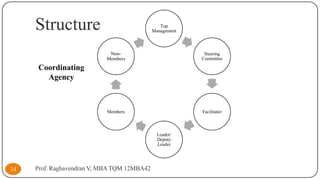
Structure

Top
Management

NonMembers

Steering
Committee

Members

Facilitator

Coordinating
Agency

Leader/
Deputy
Leader

34

Prof. Raghavendran V, MBA TQM 12MBA42
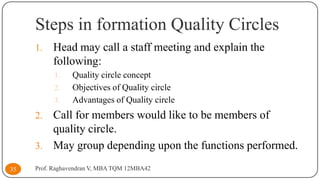
Steps in formation Quality Circles
1.

Head may call a staff meeting and explain the
following:
1.
2.
3.

Quality circle concept
Objectives of Quality circle
Advantages of Quality circle

Call for members would like to be members of
quality circle.
3. May group depending upon the functions performed.
2.

35

Prof. Raghavendran V, MBA TQM 12MBA42
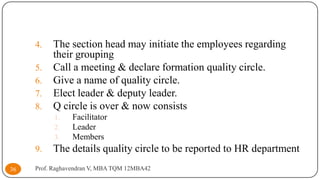
4.
5.
6.
7.
8.

The section head may initiate the employees regarding
their grouping
Call a meeting & declare formation quality circle.
Give a name of quality circle.
Elect leader & deputy leader.
Q circle is over & now consists
1.
2.
3.

9.
36

Facilitator
Leader
Members

The details quality circle to be reported to HR department

Prof. Raghavendran V, MBA TQM 12MBA42

VTU MBA-TQM 12MBA42 Module 2

  • 1.
    Total Quality Management Module2 By Raghavendran Venugopal
  • 2.
    Guru’s of TQM NAME:Walter A Shewhart, Nick Name: Grand Father of TQM Qualification: PhD Holder Worked @: western electric & Bell telephone Labs Contributions to TQM: Developed control charts theories with control limits, assignable & chances of variation, and rational subgroups and lastly PDSA cycle for learning and improvement. 2 Prof. Raghavendran V, MBA TQM 12MBA42
  • 3.
    Guru’s of TQM NAME:W. Edwards Deming, Nick Name: Deming Qualifications: PhD holder, Worked @: Scholar and Philosopher Contributions to TQM: 14 points provides theory for management to improve quality, productivity and competitive positions. He has authored many books including out of the crisis and Quality, Productivity, and competitive positions 3 Prof. Raghavendran V, MBA TQM 12MBA42
  • 4.
    Guru’s of TQM NAME:Joseph M Juran, Nick Name: Juran Qualifications: PhD holder, Worked @: Western Electric Contributions to TQM: Efforts on Quality involvement in all levels & sectors of Management, The Juran’s Trilogy & published the book titled Juran’s Quality control Hand book 4 Prof. Raghavendran V, MBA TQM 12MBA42
  • 5.
    Guru’s of TQM NAME:Armand V Feigenbaum, Nick Name: Feigenbaum Qualifications: PhD holder, Worked @:Scholar & Philosopher Contributions to TQM: Total Quality Control is necessary for productivity, market penetration and competitive advantage. Employee involvement, supervision leadership & company wide quality control. He published book titled Total Quality Control. 5 Prof. Raghavendran V, MBA TQM 12MBA42
  • 6.
    Guru’s of TQM NAME:Kaoru Ishikawa Nick Name: Ishikawa Qualifications: PhD holder, Worked @: Applied scholar Contributions to TQM: Authored SPC texts in Japanese and English. Developed Cause & Effect diagram, which is called Ishikawa diagram. Also developed quality circle concept. 6 Prof. Raghavendran V, MBA TQM 12MBA42
  • 7.
    Guru’s of theTQM NAME: Philip B Crosby Nick Name: Crosby Qualifications: No Idea Worked @:Philosopher Contributions to TQM: Authored the book titled “ Quality is free” & translated to 15 languages. He argued that “ do it right the first time”. He again authored titled known as Quality without tears which has 4 absolutes. And they are Quality is conformance to requirements Prevention of nonconformance is objective not appraisal The performance standard is zero defects not “ that’s close enough” &Measurement of quality is the cost of nonconformance 7 Prof. Raghavendran V, MBA TQM 12MBA42
  • 8.
    Guru’s of TQM NAME:Genichi Taguchi, Nick Name: Taguchi Qualifications: PhD holder, Worked @: Philosopher Contributions to TQM: Developed Loss function which includes Cost, target & Variation into one variable/ metric. Because loss function are reactive. It is built on simplification & use of traditional design of experiments. 8 Prof. Raghavendran V, MBA TQM 12MBA42
  • 9.
    All Guru’s Guru’s Principles & Practices Tools& Techniques Product or Service rendered 1. 2. 3. 4. 5. 6. 7. 8. 9. 10. 11. 12. Benchmarking Information Technology QMS EMS QFD FMEA Products & Service TPM Management Tools SPC Experimental Design Taguchi’s Quality Engg TQM Framework 9 Prof. Raghavendran V, MBA TQM 12MBA42 Customer
  • 10.
    Deming’s Philosophy According toDeming's definition Quality is the predictable degree of uniformity and dependability, at low cost and suited to the market.  As per his teaching 96% of the variations have common causes and 4% has special variations. 10 Prof. Raghavendran V, MBA TQM 12MBA42
  • 11.
    Deming’s Philosophy He viewedthat statistic has management tool and relied on SPC as mean of variations in a process. Deming’s chain reaction: As quality improves, cost decreases and productivity increase resulting in more jobs, greater market share and long term survival. 11 Prof. Raghavendran V, MBA TQM 12MBA42
  • 12.
    Deming’s Philosophy 14 principlesare listed below: 1. Create consistency of purpose with the plan 2. Adopt the new philosophy of quality 3. Stop dependence on mass production 4. End the practice of choosing the suppliers based solely on price 12 Prof. Raghavendran V, MBA TQM 12MBA42
  • 13.
    Deming’s Philosophy 5. 6. 7. 8. 9. 13 Identify theproblems and work continuously to improve the system Adopt modern methods of training on the job Changes the focus from production number (Quantity to Quality) Drive out fear, create trust and create a environment for individuals Break down the barriers between the department & Individual Prof. Raghavendran V, MBA TQM 12MBA42
  • 14.
    Deming’s Philosophy 10. Stoprequesting improved productivity without 11. 12. 13. 14. 14 providing methods to achieve the same Eliminate work standards that prescribe numerical quotas Remove barrier to pride of workmanship Institute vigorous education and retraining Create a structure in top management that will emphasize on the proceeding above thirteen points every day. Prof. Raghavendran V, MBA TQM 12MBA42
  • 15.
    To memorize theseprinciples CASE Internal Assessment CD Bus Stop ERICson 15 Prof. Raghavendran V, MBA TQM 12MBA42
  • 16.
    PDSA or PDCACYCLE 16 Prof. Raghavendran V, MBA TQM 12MBA42
  • 17.
    PDSA/PDCA Cycle The basicPlan-Do-Study-Act was first developed by Shewhart and modified by Deming. It is an effective improvement technique. Later it was known Problem -Solving Technique. The PDSA Cycle 17 Prof. Raghavendran V, MBA TQM 12MBA42
  • 18.
    Problem- Solving Method Itis the extension of PDSA/PDCA Cycle with scientific adaption/ approach which yield great results, but in this method there are 7 phases and all are integrated upon the previous phase. These phase are the framework of the objectives. 18 Prof. Raghavendran V, MBA TQM 12MBA42
  • 19.
    Problem-Solving Method 1) Identifythe opportunity Plan for the future 2) Analyze the process Act 6) Standardization the solution 19 5) Study the Results Plan Study Do 3) Develop the optimal Opportunity 4) Implement
  • 20.
    JURAN TRILOGY One ofthe best approaches developed by Dr. Joseph Juran. It has 3 components: Quality Planning 2. Quality Control & 3. Quality Improvement 1. 20 Prof. Raghavendran V, MBA TQM 12MBA42
  • 21.
    Trilogy Quality Planning: Itbegins with external customers, 1. Once the customers are identified 2. Their needs are discovered. 3. Develop product or service features that respond to customer needs. 4. Stabilize and optimize the product features to meet the organizational & Customer needs 21 Prof. Raghavendran V, MBA TQM 12MBA42
  • 22.
    Trilogy 22 Quality Control: itis used by operating forces to help and meet the product, process and service requirements. It uses the feedback loop and consist of the following steps: Determine items to be controlled and their unit of measure. Set goals for the controls & determine what sensors need to be put in place to measure the product. Measure the actual performance, Compare actual performance to goals. ActProf. Raghavendran V, MBA TQM 12MBA42 on the difference.
  • 23.
    Juran’s Categories ofQuality costs Juran’s analytical methods could identify areas needing improvement & could help make & track changes. They were mostly Shop floor problems, he advocated a cost of quality accounting system to make understand Top level management and they were four distinct types.  Internal Failure Cost  External Failure Cost  Appraisal Cost  Prevention Cost 23 Prof. Raghavendran V, MBA TQM 12MBA42
  • 24.
     Internal FailureCost: Scrap, Rework, Retest, Downtime, Yield losses and Disposition.  External Failure Cost: Complaint adjustment, Returned Material, Warranty Charges and Allowance.  Appraisal Cost: Incoming material inspection, Inspection & Test, Maintaining accuracy of test equipment, Material & Service consumed and Evaluation of Stocks  Prevention Cost: Quality Planning, New product review, training, process cost, data acquisition & analysis, reporting and Improvement projects. 24 Prof. Raghavendran V, MBA TQM 12MBA42
  • 25.
    Minimizing the Costof quality  COQ not only provided Management with a rupee cost for defective product, it also established the goal of quality programmes to keep improving quality.  2 assumptions were made and they are  Failure cost approached zero as defect became fewer and fewer.  Prevention and Appraisal together approach infinity as defects to lower to lower levels 25 Prof. Raghavendran V, MBA TQM 12MBA42
  • 26.
    Cost Per Good unit of Product Internal+ External Failure Costs Total Quality Cost To.... Minimal Cost of quality ------------------------------------------------I I I I I I Cost of Prevention or Appraisal Defect Rate 100% Defective 26 To…. Prof. Raghavendran V, MBA TQM 12MBA42 100% Good Optimal Confor mance Level
  • 27.
    Juran’s Breakthrough Sequence: Breakthrough in attitudes  Identify the vital few projects/task  Organize breakthrough in Knowledge  Conduct the Analysis  Determine how to overcome resistance to change  Institute the change  Institute controls 27 Prof. Raghavendran V, MBA TQM 12MBA42
  • 28.
    Crosby’s 14 pointprogramme  Management Commitment  Q Improvement Team  Zero defects day  Q Measurement  Goal Setting  Cost of Quality Evaluation  Error cause removal  Q Awareness  Recognition  Corrective action  Q Councils  Zero defect Planning 28  Supervisor Training  Do it all over again Prof. Raghavendran V, MBA TQM 12MBA42
  • 29.
    Taguchi’s Loss Function It is a statistical method to improve the Quality of Manufacturing goods. He has contributed to statistics are  Taguchi’s loss function  Philosophy of Off-Line Quality Control  Innovation in the Design of Experiments (DOE) 29 Prof. Raghavendran V, MBA TQM 12MBA42
  • 30.
    Taguchi’s Loss Function It was shown that if the design intent of the target value was the value at which the design, whether product or process, functioned best, then any deviation from that value meant an incremental deterioration of performance and incurred a loss.  This loss was passes to next customer (Internal or External).  Ultimately both company and society face the loss in some way. 30 Prof. Raghavendran V, MBA TQM 12MBA42
  • 31.
    Cost Customer Tolerance Limit Customer Tolerance Limit A AB LL UL Parameter The “Good Enough” Approach 31 Cost Prof. Raghavendran V, MBA TQM 12MBA42 B LL UL Parameter Taguchi Loss Function
  • 32.
    Quality Circles Objectives  Togive an opportunity to employees to use their wisdom & creativity.  To reduce errors & enhance quality productivity.  To encourage team spirit and cohesive culture.  To promote job involvement & participation.  Increase employee motivation  Harness problem solving capability.  To build an attitude of problem prevention.  To improve communication. 32 Prof. Raghavendran V, MBA TQM 12MBA42
  • 33.
    Quality circles  Toimprove internal house keeping.  To improve customer service.  To facilitate achievement of business goals  To improve & develop of the organization.  To respect humanity & build happy bright work place which are meaningful to work in. 33 Prof. Raghavendran V, MBA TQM 12MBA42
  • 34.
  • 35.
    Steps in formationQuality Circles 1. Head may call a staff meeting and explain the following: 1. 2. 3. Quality circle concept Objectives of Quality circle Advantages of Quality circle Call for members would like to be members of quality circle. 3. May group depending upon the functions performed. 2. 35 Prof. Raghavendran V, MBA TQM 12MBA42
  • 36.
    4. 5. 6. 7. 8. The section headmay initiate the employees regarding their grouping Call a meeting & declare formation quality circle. Give a name of quality circle. Elect leader & deputy leader. Q circle is over & now consists 1. 2. 3. 9. 36 Facilitator Leader Members The details quality circle to be reported to HR department Prof. Raghavendran V, MBA TQM 12MBA42