Contents
• Introduction.
• Concepts of TQM.
• Benefits of TQM.
• Characteristics of TQM.
• Key elements of TQM
TOTAL QUALITY
MANAGEMENT
2
Introduction
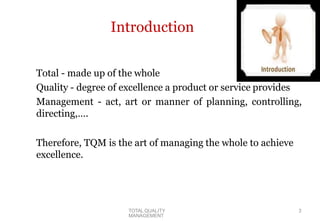
Total - made up of the whole
Quality - degree of excellence a product or service provides
Management - act, art or manner of planning, controlling,
directing,….
Therefore, TQM is the art of managing the whole to achieve
excellence.
TOTAL QUALITY
MANAGEMENT
3
TOTAL QUALITY
MANAGEMENT
4
The Concept of TQM
• Produce quality work the first time and
always at all times
• Focus on the customer.
• Have a strategic approach to improvement.
• Improve continuously.
• Encourage mutual respect and teamwork.
Various Definitions
 Total quality management (TQM) has been defined as an
integrated organizational effort designed to improve quality at
every level.
 The process to produce a perfect product by a series of measures
require an organized effort by the entire company to prevent or
eliminate errors at every stage in production is called total
quality management.
 According to international organization for standards defined
tqm as, “TQM is a management approach for an organization,
centered on quality, based on the participation of all its
members and aiming at long-term success through customer
satisfaction and benefits to all members of the organization and
to the society. TOTAL QUALITY MANAGEMENT 5
TOTAL QUALITY
MANAGEMENT
6
Characteristics of TQM
 Committed management.
 Adopting and communicating
management.
 Closer customer relations.
 Closer provider relations.
 Benchmarking.
 Increased training.
 Open organization
 Employee empowerment.
 Flexible production.
 Process improvements.
 Process measuring
about total quality
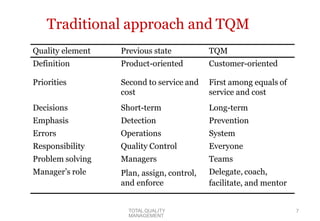
Traditional approach and TQM
Quality element Previous state TQM
Definition Product-oriented Customer-oriented
TOTAL QUALITY
MANAGEMENT
7
Priorities Second to service and
cost
Short-term
Detection
Operations
Quality Control
Managers
Plan, assign, control,
and enforce
First among equals of
service and cost
Long-term
Prevention
System
Everyone
Teams
Delegate, coach,
facilitate, and mentor
Decisions
Emphasis
Errors
Responsibility
Problem solving
Manager’s role
The three aspects of TQM
Counting
TOTAL QUALITY
MANAGEMENT
8
Customers
Culture
Tools, techniques, and training in
their use for analyzing,
understanding, and solving quality
problems
Quality for the customer as a
driving force and central concern.
Shared values and beliefs,
expressed by leaders, that define
and support quality.
TOTAL QUALITY
MANAGEMENT
9
Principles of TQM
1. Produce quality work the first time and every time.
2. Focus on the customer.
3. Have a strategic approach to improvement.
4. Improve continuously.
5. Encourage mutual respect and teamwork
TOTAL QUALITY
MANAGEMENT
10
The key elements of the TQM
 Focus on the customer.
 Employee involvement
 Continuous improvement
Focus on the customer
• It is important to identify the organization’s customers.
• External customers consume the organization’s product
or service.
• Internal customers are employees who receive the output
of other employees.
TOTAL QUALITY
MANAGEMENT
11
• Since the quality is considered the job of all employees,
employees should be involved in quality initiatives.
• Front line employees are likely to have the closest contact with
external customers and thus can make the most valuable
contribution to quality.
• Therefore, employees must have the authority to innovate and
improve quality.
Employee Involvement
TOTAL QUALITY
MANAGEMENT
12
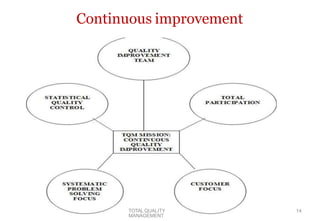
Continuous improvement
TOTAL QUALITY
MANAGEMENT
13
Continuous improvement
TOTAL QUALITY
MANAGEMENT
14
TOTAL QUALITY
MANAGEMENT
15
CONTINUOUS IMPROVEMENT
• The quest for quality is a never-ending process in which people
are continuously working to improve the performance, speed and
number of features of the product or service.
• Continuous improvement means that small, incremental
improvement that occurs on a regular basis will eventually add up
to vast improvement in quality.
• TQM is the management process used to make continuous
improvements to all functions.
• TQM represents an ongoing, continuous commitment to
improvement.
• The foundation of total quality is a management philosophy that
supports meeting customer requirements through continuous
improvement.
TOTAL QUALITY
MANAGEMENT
16
Continuous Process Improvement.
 View all work as process – production and business.
 Process – purchasing, design, invoicing, etc.
 Inputs – process – outputs.
 Process improvement – increased customer satisfaction.
 Improvement – 5 ways:
• Reduce resources
• Reduce errors
• Meet expectations of downstream customers
• Make process safer
• Make process more satisfying to the person doing
THE TQM SYSTEM
Custom
er
Focus
Process
Improvem
ent
Total
Involvem
ent
Supportive
Reward and
Leadership
Education and Training
structure
Communications
recognition
Measurement
Continuous
Improvement
TOTAL QUALITY
MANAGEMENT
17
Objective
Principles
Elements
TOTAL QUALITY
MANAGEMENT
18
BENEFITS OF TQM:
• Improved quality.
• Employee participation.
• Team work.
• Working relationships.
• Customer satisfaction.
• Employee satisfaction.
• Productivity.
• Communication.
• Profitability.
• Market share.
TOTAL QUALITY
MANAGEMENT
19
BENEFITS OF TOTAL QUALITY
MANAGEMENT
• Financial benefits include lower costs, higher returns on sales and
investment, and the ability to charge higher rather than
competitive prices.
• Improved access to global markets, higher customer retention
levels,
• Less time required to develop new innovations, and a reputation
as a quality firm.
• Total quality management (tqm) is one such approach that seeks
to improve quality and
• Performance which will meet or exceed customer expectations.
CONCLUSION:
• TQM encourages participation amongst employees, managers and
organization as whole.
• Using Quality management reduces rework nearly to zero in an achievable
goal .The responsibilities either its professional, social, legal one that rest with
the pharmaceutical manufacturer for the assurance of quality of product are
tremendous and it can only be achieved by well organised.
• Work culture and complete engagement of the employees at the work place. It
should be realised that national & international regulations must be
implemented systematically and process.
• Control should be practiced rigorously.
• Thus quality is critically important ingredient to organisational success today
which can be achieved by TQM, an organisational approach that focusses on
quality as an over achieving goals, aimed at the prevention of defects rather
than detection of defects..
TOTAL QUALITY
MANAGEMENT
20
Reference:
• Text book of Total Quality Management by L.Suganthi and
Anand A.Samuel,2nd edition,2005,pageno.49-61.
• Total Quality Management by R.S Nagarajan,
A.A.Arivalangar,new age international publishers,1st
edition,2009,page no.21.
• www.slideshare.com/tqm in pharma industry.
TOTAL QUALITY
MANAGEMENT
21
TOTAL QUALITY
MANAGEMENT
22

TQM -L1.pptx

  • 2.
    Contents • Introduction. • Conceptsof TQM. • Benefits of TQM. • Characteristics of TQM. • Key elements of TQM TOTAL QUALITY MANAGEMENT 2
  • 3.
    Introduction Total - madeup of the whole Quality - degree of excellence a product or service provides Management - act, art or manner of planning, controlling, directing,…. Therefore, TQM is the art of managing the whole to achieve excellence. TOTAL QUALITY MANAGEMENT 3
  • 4.
    TOTAL QUALITY MANAGEMENT 4 The Conceptof TQM • Produce quality work the first time and always at all times • Focus on the customer. • Have a strategic approach to improvement. • Improve continuously. • Encourage mutual respect and teamwork.
  • 5.
    Various Definitions  Totalquality management (TQM) has been defined as an integrated organizational effort designed to improve quality at every level.  The process to produce a perfect product by a series of measures require an organized effort by the entire company to prevent or eliminate errors at every stage in production is called total quality management.  According to international organization for standards defined tqm as, “TQM is a management approach for an organization, centered on quality, based on the participation of all its members and aiming at long-term success through customer satisfaction and benefits to all members of the organization and to the society. TOTAL QUALITY MANAGEMENT 5
  • 6.
    TOTAL QUALITY MANAGEMENT 6 Characteristics ofTQM  Committed management.  Adopting and communicating management.  Closer customer relations.  Closer provider relations.  Benchmarking.  Increased training.  Open organization  Employee empowerment.  Flexible production.  Process improvements.  Process measuring about total quality
  • 7.
    Traditional approach andTQM Quality element Previous state TQM Definition Product-oriented Customer-oriented TOTAL QUALITY MANAGEMENT 7 Priorities Second to service and cost Short-term Detection Operations Quality Control Managers Plan, assign, control, and enforce First among equals of service and cost Long-term Prevention System Everyone Teams Delegate, coach, facilitate, and mentor Decisions Emphasis Errors Responsibility Problem solving Manager’s role
  • 8.
    The three aspectsof TQM Counting TOTAL QUALITY MANAGEMENT 8 Customers Culture Tools, techniques, and training in their use for analyzing, understanding, and solving quality problems Quality for the customer as a driving force and central concern. Shared values and beliefs, expressed by leaders, that define and support quality.
  • 9.
    TOTAL QUALITY MANAGEMENT 9 Principles ofTQM 1. Produce quality work the first time and every time. 2. Focus on the customer. 3. Have a strategic approach to improvement. 4. Improve continuously. 5. Encourage mutual respect and teamwork
  • 10.
    TOTAL QUALITY MANAGEMENT 10 The keyelements of the TQM  Focus on the customer.  Employee involvement  Continuous improvement
  • 11.
    Focus on thecustomer • It is important to identify the organization’s customers. • External customers consume the organization’s product or service. • Internal customers are employees who receive the output of other employees. TOTAL QUALITY MANAGEMENT 11
  • 12.
    • Since thequality is considered the job of all employees, employees should be involved in quality initiatives. • Front line employees are likely to have the closest contact with external customers and thus can make the most valuable contribution to quality. • Therefore, employees must have the authority to innovate and improve quality. Employee Involvement TOTAL QUALITY MANAGEMENT 12
  • 13.
  • 14.
  • 15.
    TOTAL QUALITY MANAGEMENT 15 CONTINUOUS IMPROVEMENT •The quest for quality is a never-ending process in which people are continuously working to improve the performance, speed and number of features of the product or service. • Continuous improvement means that small, incremental improvement that occurs on a regular basis will eventually add up to vast improvement in quality. • TQM is the management process used to make continuous improvements to all functions. • TQM represents an ongoing, continuous commitment to improvement. • The foundation of total quality is a management philosophy that supports meeting customer requirements through continuous improvement.
  • 16.
    TOTAL QUALITY MANAGEMENT 16 Continuous ProcessImprovement.  View all work as process – production and business.  Process – purchasing, design, invoicing, etc.  Inputs – process – outputs.  Process improvement – increased customer satisfaction.  Improvement – 5 ways: • Reduce resources • Reduce errors • Meet expectations of downstream customers • Make process safer • Make process more satisfying to the person doing
  • 17.
    THE TQM SYSTEM Custom er Focus Process Improvem ent Total Involvem ent Supportive Rewardand Leadership Education and Training structure Communications recognition Measurement Continuous Improvement TOTAL QUALITY MANAGEMENT 17 Objective Principles Elements
  • 18.
    TOTAL QUALITY MANAGEMENT 18 BENEFITS OFTQM: • Improved quality. • Employee participation. • Team work. • Working relationships. • Customer satisfaction. • Employee satisfaction. • Productivity. • Communication. • Profitability. • Market share.
  • 19.
    TOTAL QUALITY MANAGEMENT 19 BENEFITS OFTOTAL QUALITY MANAGEMENT • Financial benefits include lower costs, higher returns on sales and investment, and the ability to charge higher rather than competitive prices. • Improved access to global markets, higher customer retention levels, • Less time required to develop new innovations, and a reputation as a quality firm. • Total quality management (tqm) is one such approach that seeks to improve quality and • Performance which will meet or exceed customer expectations.
  • 20.
    CONCLUSION: • TQM encouragesparticipation amongst employees, managers and organization as whole. • Using Quality management reduces rework nearly to zero in an achievable goal .The responsibilities either its professional, social, legal one that rest with the pharmaceutical manufacturer for the assurance of quality of product are tremendous and it can only be achieved by well organised. • Work culture and complete engagement of the employees at the work place. It should be realised that national & international regulations must be implemented systematically and process. • Control should be practiced rigorously. • Thus quality is critically important ingredient to organisational success today which can be achieved by TQM, an organisational approach that focusses on quality as an over achieving goals, aimed at the prevention of defects rather than detection of defects.. TOTAL QUALITY MANAGEMENT 20
  • 21.
    Reference: • Text bookof Total Quality Management by L.Suganthi and Anand A.Samuel,2nd edition,2005,pageno.49-61. • Total Quality Management by R.S Nagarajan, A.A.Arivalangar,new age international publishers,1st edition,2009,page no.21. • www.slideshare.com/tqm in pharma industry. TOTAL QUALITY MANAGEMENT 21
  • 22.