TOTAL QUALITY MANAGEMENT
Contents
TOTAL QUALITY MANAGEMENT 2
• Introduction.
• Concepts of tqm.
• Benefits of tqm.
• Characteristics of tqm.
• Key elements of tqm.
• Tqm in pharma industry.
• Advantages.
• Disadvantages.
• Conclusion.
• References.
Introduction
TOTAL QUALITY MANAGEMENT 3
Total - made up of the whole
Quality - degree of excellence a product or service provides
Management - act, art or manner of planning, controlling,
directing,....
Therefore, TQM is the art of managing the whole to achieve
excellence.
Various Definitions
>Total quality management (TQM) has been defined as an
integrated organizational effort designed to improve quality at
every level.
>The process to produce a perfect product by a series of measures
require an organized effort by the entire company to prevent or
eliminate errors at every stage in production is called total quality
management.
>According to international organization for standards defined
tqm as, “TQM is a management approach for an organization,
centered on quality, based on the participation of all its members
and aiming at long-term success through customer satisfaction
and benefits to all members of the organization and to the society.
TOTAL QUALITY MANAGEMENT 5
Characteristics of TQM
> Committed management.
> Adopting and communicating about total quality
management.
> Closer customer relations.
> Closer provider relations.
> Benchmarking.
> Increased training.
> Open organization
> Employee empowerment.
> Flexible production.
> Process improvements.
> Process measuring TOTAL QUALITY MANAGEMENT 6
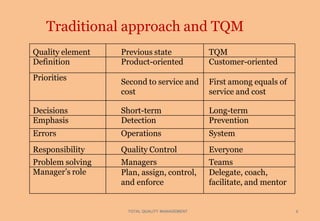
Traditional approach and TQM
TOTAL QUALITY MANAGEMENT 6
Quality element Previous state TQM
Definition Product-oriented Customer-oriented
Priorities
Second to service and
cost
First among equals of
service and cost
Decisions Short-term Long-term
Emphasis Detection Prevention
Errors Operations System
Responsibility Quality Control Everyone
Problem solving Managers Teams
Manager’s role Plan, assign, control,
and enforce
Delegate, coach,
facilitate, and mentor
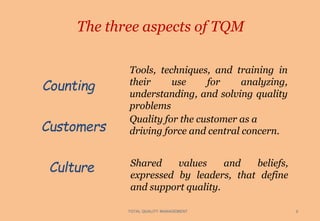
The three aspects of TQM
TOTAL QUALITY MANAGEMENT 8
Counting
Customers
Culture
Tools, techniques, and training in
their use for analyzing,
understanding, and solving quality
problems
Quality for the customer as a
driving force and central concern.
Shared values and beliefs,
expressed by leaders, that define
and support quality.
Principles of tqm
TOTAL QUALITY MANAGEMENT 11
1. Produce quality work the first time
and every time.
2. Focus on the customer.
3. Have a strategic approach to
improvement.
4. Improve continuously.
5. Encourage mutual respect and
teamwork
The key elements of the TQM
TOTAL QUALITY MANAGEMENT 12
> Focus on the customer.
> Employee involvement
> Continuous improvement
Focus on the customer
TOTAL QUALITY MANAGEMENT 18
• It is important to identify the organization’s customers.
• External customers consume the organization’s product
or service.
• Internal customers are employees who receive the output
of other employees.
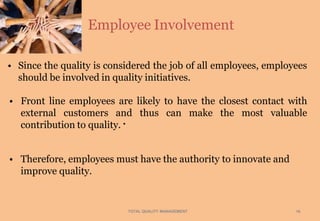
Employee Involvement
TOTAL QUALITY MANAGEMENT 19
• Since the quality is considered the job of all employees, employees
should be involved in quality initiatives.
• Front line employees are likely to have the closest contact with
external customers and thus can make the most valuable
contribution to quality. •
• Therefore, employees must have the authority to innovate and
improve quality.
Continuous improvement
TOTAL QUALITY MANAGEMENT 20
CONTINUOUS IMPROVEMENT
TOTAL QUALITY MANAGEMENT 21
• The quest for quality is a never-ending process in which people are
continuously working to improve the performance, speed and
number of features of the product or service.
• Continuous improvement means that small, incremental
improvement that occurs on a regular basis will eventually add up
to vast improvement in quality.
• TQM is the management process used to make continuous
continuous commitment to
improvements to all functions.
• TQM represents an ongoing,
improvement.
Continuous Process Improvement.
TOTAL QUALITY MANAGEMENT 22
■ View all work as process - production and business.
■ Process - purchasing, design, invoicing, etc.
■ Inputs - process - outputs.
■ Process improvement - increased customer satisfaction.
■ Improvement - 5 ways:
■ Reduce resources, reduce errors, meet expectations of
downstream customers, make process safer, make process
more satisfying to the person doing
BENEFITS OF TQM:
TOTAL QUALITY MANAGEMENT 23
• Improved quality.
• Employee participation.
• Team work.
• Working relationships.
• Customer satisfaction.
• Employee satisfaction.
• Productivity.
• Communication.
• Profitability.
• Market share.
Importance of TQM in pharma industry
TOTAL QUALITY MANAGEMENT 20
Handling:
• Containers should be opened carefully and subsequently
resealed in an approved manner.
• Highly sensitizing material such as penicillins and
cephalosporins should be handled in separate production
areas.
• Highly active or toxic API (e.g. certain steroids, cytostatic
substances) should be manufactured in a dedicated area and
using dedicated equipment.
• Pure and final API should be handled in an environment
giving adequate protection against contamination.
Storage:
• Secure storage facilities should be designated for use to
prevent damage or deterioration of materials.
• These should be kept clean and tidy and subject to appropriate
pest control measures.
• Environmental conditions should be recorded.
• The condition of stored material should be assessed at
appropriate intervals.
• Storage conditions for api should be based upon stability
studies taking into account time, temperature, humidity,
light etc TOTAL QUALITY MANAGEMENT 21
Packaging:
•Labelling and packaging processes should be defined and
controlled to ensure that correct packaging materials are used
correctly and other specified requirements are met.
•Printed labels should be securely stored to avoid mix-ups
arising.
•Marking and labelling should be legible and durable, provide
sufficient information, for accurate identification and indicate,
if appropriate, required storage conditions, retest and/or
expiry date.
TOTAL QUALITY MANAGEMENT 22
Facilities and equipment:
• The location, design, and construction of buildings
should be suitable for the type and stage of manufacture
involved, protecting the product from contamination
(including cross-contamination) and protecting operators
and the environment from the product.
• Equipment surfaces in contact with materials used in api
manufacture should be non-reactive.
TOTAL QUALITY MANAGEMENT 23
Sterile area
• Personnel suffering from an infectious disease or having
open lesions on the exposed surface of the body should
avoid activities which could compromise the quality of
API.
• Smoking, eating, drinking, chewing and storage of food
should be restricted to designated areas separated from
production or control areas.
TOTAL QUALITY MANAGEMENT 24
Labelling
TOTAL QUALITY MANAGEMENT 25
• Each container should be identified by an appropriate label,
showing at least the product identification and the
assigned batch code, or any other easily understandable
combination of both.
• Containers for external distribution may require additional
labels.
Computerised systems
• . Computer systems should be designed and operated to
prevent unauthorised entries or changes to the
programme.
• In the case of manual entry of quality critical data there
should be a second independent check to verify accuracy
of the initial entry.
• A back-up system should be provided of all quality critical
data.
TOTAL QUALITY MANAGEMENT 26
Advantages of tqm
TOTAL QUALITY MANAGEMENT 27
•Improves reputation- faults and problems are spotted and
sorted quicker.
•Higher employee morale- workers motivated by extra
responsibility ,team work and involvement indecisions of
tqm.
• Lower cost.
•Decrease waste as fewer defective products and no need for
separate.
Disadvantages of tqm
TOTAL QUALITY MANAGEMENT 28
• Initial introduction cost.
• Benefits may not be seen for several years.
• Workers may be resistant to change.
A model for organization management.
TOTAL QUALITY MANAGEMENT 29
Models of tqm
TOTAL QUALITY MANAGEMENT 30
BENEFITS OF TOTAL QUALITY
MANAGEMENT
TOTAL QUALITY MANAGEMENT 31
• Financial benefits include lower costs, higher returns on sales and
investment, and the ability to charge higher rather than
competitive prices.
• Improved access to global markets, higher customer retention
levels, less
• Time required to develop new innovations, and a reputation as a
quality firm.
• Total quality management (tqm) is one such approach that seeks
to improve quality and
• Performance which will meet or exceed customer expectations.
CONCLUSION:
TOTAL QUALITY MANAGEMENT 32
• TQM encourages participation amongst employees, managers and organization
as whole.
• Using Quality management reduces rework nearly to zero in an achievable goal
.The responsibilities either its professional, social, legal one that rest with the
pharmaceutical manufacturer for the assurance of quality of product are
tremendous and it can only be achieved by well organised.
• Work culture and complete engagement of the employees at the work place. It
should be realized that national & international regulations must be
implemented systematically and process.
• Control should be practiced rigorously.
• Thus quality is critically important ingredient to organisational success today
which can be achieved by TQM, an organisational approach that focusses on
quality as an over achieving goals, aimed at aimed at the prevention of defects
rather than detection of defects..
Reference:
TOTAL QUALITY MANAGEMENT 33
• Text book of Total Quality Management by L.Suganthi
and Anand A.Samuel,2nd edition,2005,page no.49-61.
• Total Quality Management by R.S Nagarajan,
A.A.Arivalangar,new age international publishers,1st
edition,2009,page no.21.
• www.slideshare.com/tqm in pharma industry.

Total-Quality-Management.pptx

  • 1.
  • 2.
    Contents TOTAL QUALITY MANAGEMENT2 • Introduction. • Concepts of tqm. • Benefits of tqm. • Characteristics of tqm. • Key elements of tqm. • Tqm in pharma industry. • Advantages. • Disadvantages. • Conclusion. • References.
  • 3.
    Introduction TOTAL QUALITY MANAGEMENT3 Total - made up of the whole Quality - degree of excellence a product or service provides Management - act, art or manner of planning, controlling, directing,.... Therefore, TQM is the art of managing the whole to achieve excellence.
  • 4.
    Various Definitions >Total qualitymanagement (TQM) has been defined as an integrated organizational effort designed to improve quality at every level. >The process to produce a perfect product by a series of measures require an organized effort by the entire company to prevent or eliminate errors at every stage in production is called total quality management. >According to international organization for standards defined tqm as, “TQM is a management approach for an organization, centered on quality, based on the participation of all its members and aiming at long-term success through customer satisfaction and benefits to all members of the organization and to the society. TOTAL QUALITY MANAGEMENT 5
  • 5.
    Characteristics of TQM >Committed management. > Adopting and communicating about total quality management. > Closer customer relations. > Closer provider relations. > Benchmarking. > Increased training. > Open organization > Employee empowerment. > Flexible production. > Process improvements. > Process measuring TOTAL QUALITY MANAGEMENT 6
  • 6.
    Traditional approach andTQM TOTAL QUALITY MANAGEMENT 6 Quality element Previous state TQM Definition Product-oriented Customer-oriented Priorities Second to service and cost First among equals of service and cost Decisions Short-term Long-term Emphasis Detection Prevention Errors Operations System Responsibility Quality Control Everyone Problem solving Managers Teams Manager’s role Plan, assign, control, and enforce Delegate, coach, facilitate, and mentor
  • 8.
    The three aspectsof TQM TOTAL QUALITY MANAGEMENT 8 Counting Customers Culture Tools, techniques, and training in their use for analyzing, understanding, and solving quality problems Quality for the customer as a driving force and central concern. Shared values and beliefs, expressed by leaders, that define and support quality.
  • 11.
    Principles of tqm TOTALQUALITY MANAGEMENT 11 1. Produce quality work the first time and every time. 2. Focus on the customer. 3. Have a strategic approach to improvement. 4. Improve continuously. 5. Encourage mutual respect and teamwork
  • 12.
    The key elementsof the TQM TOTAL QUALITY MANAGEMENT 12 > Focus on the customer. > Employee involvement > Continuous improvement
  • 18.
    Focus on thecustomer TOTAL QUALITY MANAGEMENT 18 • It is important to identify the organization’s customers. • External customers consume the organization’s product or service. • Internal customers are employees who receive the output of other employees.
  • 19.
    Employee Involvement TOTAL QUALITYMANAGEMENT 19 • Since the quality is considered the job of all employees, employees should be involved in quality initiatives. • Front line employees are likely to have the closest contact with external customers and thus can make the most valuable contribution to quality. • • Therefore, employees must have the authority to innovate and improve quality.
  • 20.
  • 21.
    CONTINUOUS IMPROVEMENT TOTAL QUALITYMANAGEMENT 21 • The quest for quality is a never-ending process in which people are continuously working to improve the performance, speed and number of features of the product or service. • Continuous improvement means that small, incremental improvement that occurs on a regular basis will eventually add up to vast improvement in quality. • TQM is the management process used to make continuous continuous commitment to improvements to all functions. • TQM represents an ongoing, improvement.
  • 22.
    Continuous Process Improvement. TOTALQUALITY MANAGEMENT 22 ■ View all work as process - production and business. ■ Process - purchasing, design, invoicing, etc. ■ Inputs - process - outputs. ■ Process improvement - increased customer satisfaction. ■ Improvement - 5 ways: ■ Reduce resources, reduce errors, meet expectations of downstream customers, make process safer, make process more satisfying to the person doing
  • 23.
    BENEFITS OF TQM: TOTALQUALITY MANAGEMENT 23 • Improved quality. • Employee participation. • Team work. • Working relationships. • Customer satisfaction. • Employee satisfaction. • Productivity. • Communication. • Profitability. • Market share.
  • 24.
    Importance of TQMin pharma industry TOTAL QUALITY MANAGEMENT 20 Handling: • Containers should be opened carefully and subsequently resealed in an approved manner. • Highly sensitizing material such as penicillins and cephalosporins should be handled in separate production areas. • Highly active or toxic API (e.g. certain steroids, cytostatic substances) should be manufactured in a dedicated area and using dedicated equipment. • Pure and final API should be handled in an environment giving adequate protection against contamination.
  • 25.
    Storage: • Secure storagefacilities should be designated for use to prevent damage or deterioration of materials. • These should be kept clean and tidy and subject to appropriate pest control measures. • Environmental conditions should be recorded. • The condition of stored material should be assessed at appropriate intervals. • Storage conditions for api should be based upon stability studies taking into account time, temperature, humidity, light etc TOTAL QUALITY MANAGEMENT 21
  • 26.
    Packaging: •Labelling and packagingprocesses should be defined and controlled to ensure that correct packaging materials are used correctly and other specified requirements are met. •Printed labels should be securely stored to avoid mix-ups arising. •Marking and labelling should be legible and durable, provide sufficient information, for accurate identification and indicate, if appropriate, required storage conditions, retest and/or expiry date. TOTAL QUALITY MANAGEMENT 22
  • 27.
    Facilities and equipment: •The location, design, and construction of buildings should be suitable for the type and stage of manufacture involved, protecting the product from contamination (including cross-contamination) and protecting operators and the environment from the product. • Equipment surfaces in contact with materials used in api manufacture should be non-reactive. TOTAL QUALITY MANAGEMENT 23
  • 28.
    Sterile area • Personnelsuffering from an infectious disease or having open lesions on the exposed surface of the body should avoid activities which could compromise the quality of API. • Smoking, eating, drinking, chewing and storage of food should be restricted to designated areas separated from production or control areas. TOTAL QUALITY MANAGEMENT 24
  • 29.
    Labelling TOTAL QUALITY MANAGEMENT25 • Each container should be identified by an appropriate label, showing at least the product identification and the assigned batch code, or any other easily understandable combination of both. • Containers for external distribution may require additional labels.
  • 30.
    Computerised systems • .Computer systems should be designed and operated to prevent unauthorised entries or changes to the programme. • In the case of manual entry of quality critical data there should be a second independent check to verify accuracy of the initial entry. • A back-up system should be provided of all quality critical data. TOTAL QUALITY MANAGEMENT 26
  • 31.
    Advantages of tqm TOTALQUALITY MANAGEMENT 27 •Improves reputation- faults and problems are spotted and sorted quicker. •Higher employee morale- workers motivated by extra responsibility ,team work and involvement indecisions of tqm. • Lower cost. •Decrease waste as fewer defective products and no need for separate.
  • 32.
    Disadvantages of tqm TOTALQUALITY MANAGEMENT 28 • Initial introduction cost. • Benefits may not be seen for several years. • Workers may be resistant to change.
  • 33.
    A model fororganization management. TOTAL QUALITY MANAGEMENT 29
  • 34.
    Models of tqm TOTALQUALITY MANAGEMENT 30
  • 35.
    BENEFITS OF TOTALQUALITY MANAGEMENT TOTAL QUALITY MANAGEMENT 31 • Financial benefits include lower costs, higher returns on sales and investment, and the ability to charge higher rather than competitive prices. • Improved access to global markets, higher customer retention levels, less • Time required to develop new innovations, and a reputation as a quality firm. • Total quality management (tqm) is one such approach that seeks to improve quality and • Performance which will meet or exceed customer expectations.
  • 36.
    CONCLUSION: TOTAL QUALITY MANAGEMENT32 • TQM encourages participation amongst employees, managers and organization as whole. • Using Quality management reduces rework nearly to zero in an achievable goal .The responsibilities either its professional, social, legal one that rest with the pharmaceutical manufacturer for the assurance of quality of product are tremendous and it can only be achieved by well organised. • Work culture and complete engagement of the employees at the work place. It should be realized that national & international regulations must be implemented systematically and process. • Control should be practiced rigorously. • Thus quality is critically important ingredient to organisational success today which can be achieved by TQM, an organisational approach that focusses on quality as an over achieving goals, aimed at aimed at the prevention of defects rather than detection of defects..
  • 37.
    Reference: TOTAL QUALITY MANAGEMENT33 • Text book of Total Quality Management by L.Suganthi and Anand A.Samuel,2nd edition,2005,page no.49-61. • Total Quality Management by R.S Nagarajan, A.A.Arivalangar,new age international publishers,1st edition,2009,page no.21. • www.slideshare.com/tqm in pharma industry.