TOTAL QUALITY MANAGEMENT
Presented by
LINGESWARA RAO.PUNATI
Associate professor,
Pharmaceutical Analysis,
Mizan – Tepi university, Ethiopia
TOTAL QUALITY MANAGEMENT
Total - made up of the whole
Quality - degree of excellence a product or service
provides
Management - act, art or manner of planning,
controlling, directing,….
Therefore, TQM is the art of managing the whole to
achieve excellence.
QUALITY:
In general, the quality can be defined as degree of customer
satisfaction.
As per ISO, standard quality is defined as “the totality of
characteristics of an entity that bear on its ability to satisfy stated
and implied needs”.
Dimensions of Quality:
Three dimensions of quality
 Quality Design
 Quality Conformance
 Quality Peformance
Quality Dimensions:
It means the intentions of designers to include or exclude feature in a
product or service i.e the degree to which the quality characteristics
are embedded into the product or service.
Quality Conformance:
It means how well the product or service meet the specification
determined by designer
Quality Performance:
The quality performance is associated with reliability of the product
or service.
• It means the product, part or system is performing its intended
function under a prescribed set of conditions.
• It has an impact on repeated sales, reflects on the products image
and if it poor, it can create legal implications.
Quality means:
 meeting patient requirements (stated or implied)
 Through the totality of product or service.
 By conforming to a specified standard.
 At a given time over a period of time.
 At a price the patient can afford and is willing to pay
Characteristics :
• Technological
Strength, hardness, surface finish
• Psychological
Taste, status,
• Time – oriented
Reliability, maintainability - availability
• Contractual
Guarantee. Provision
• Ethical
Courtesy and honesty
Quality System’s Organization
Design Controls
Material
Controls
Records,
Documents, &
Change Controls
Equipment &
Facility Controls
Production &
Process Controls
Corrective &
Preventive
Actions
Management
Quality Control
The sum of all factors which contribute directly or
indirectly to the safety, effectiveness and reliability
of the product.
These properties are built into drug products through
research and during the manufacturing process by
procedures collectively referred to as Quality
Control.
Quality control limits
i. Free of impurities
ii. Physically and chemically stable
iii. The amount of active ingredient(s) as stated on
the label
iv. Provides optimal release of active ingredient(s)
when the product is administered.
Quality control following
characteristics
1. A drug should be genuine quality and good nature.
2. A drug should be physically and chemically pure.
3. The drug should contain the same amount of
ingredient as stated on the label.
4. The drug should be rendered in such a form that it
is effective after administration.
5. A drug should retain quality in terms of shelf – life
or stability
6. A drug should not have toxic impurities which
render it practically useless.
Importance of Quality Control
The drugs which are used for the life saving and
treatment of diseases are derived from
animal, plants or synthesised in the laboratory
(synthetic drugs). The life is at stake and the
doctors who wants to cure patients must get
quality drugs.
What does TQM mean?
Total Quality Management means that the
organization's culture is defined by and
supports the constant attainment of customer
satisfaction through an integrated system of
tools, techniques, and training. This involves
the continuous improvement of organizational
processes, resulting in high quality products
and services.
What’s the goal of TQM?
“Do the right things right the first
time, every time.”
Six basic concepts of TQM
TQM requires six basic concepts:
They are
1. A committed and involved management to provide
long term top – to – bottom organization support.
2. An unwavering focus on the customer, both
internally and externally.
3. Effective involvement and utilization of the entire
work force.
Contd. …
4. Continuous improvement of the business and
production process.
5. Treating suppliers of the business and
production process .
6. Establishing the performance measures.
Another way to put it
• At it’s simplest, TQM is all managers leading
and facilitating all contributors in everyone’s
two main objectives:
(1) total client satisfaction through quality
products and services; and
(2) continuous improvements to processes,
systems, people, suppliers, partners, products,
and services.
Productivity and TQM
• Traditional view:
– Quality cannot be improved without significant
losses in productivity.
• TQM view:
– Improved quality leads to improved productivity.
Basic Tenets of TQM
• 1. The customer makes the ultimate determination
of quality.
• 2. Top management must provide leadership and
support for all quality initiatives.
• 3. Preventing variability is the key to producing
high quality.
• 4. Quality goals are a moving target, thereby
requiring a commitment toward continuous
improvement.
• 5. Improving quality requires the establishment of
effective metrics. We must speak with data and
facts not just opinions.
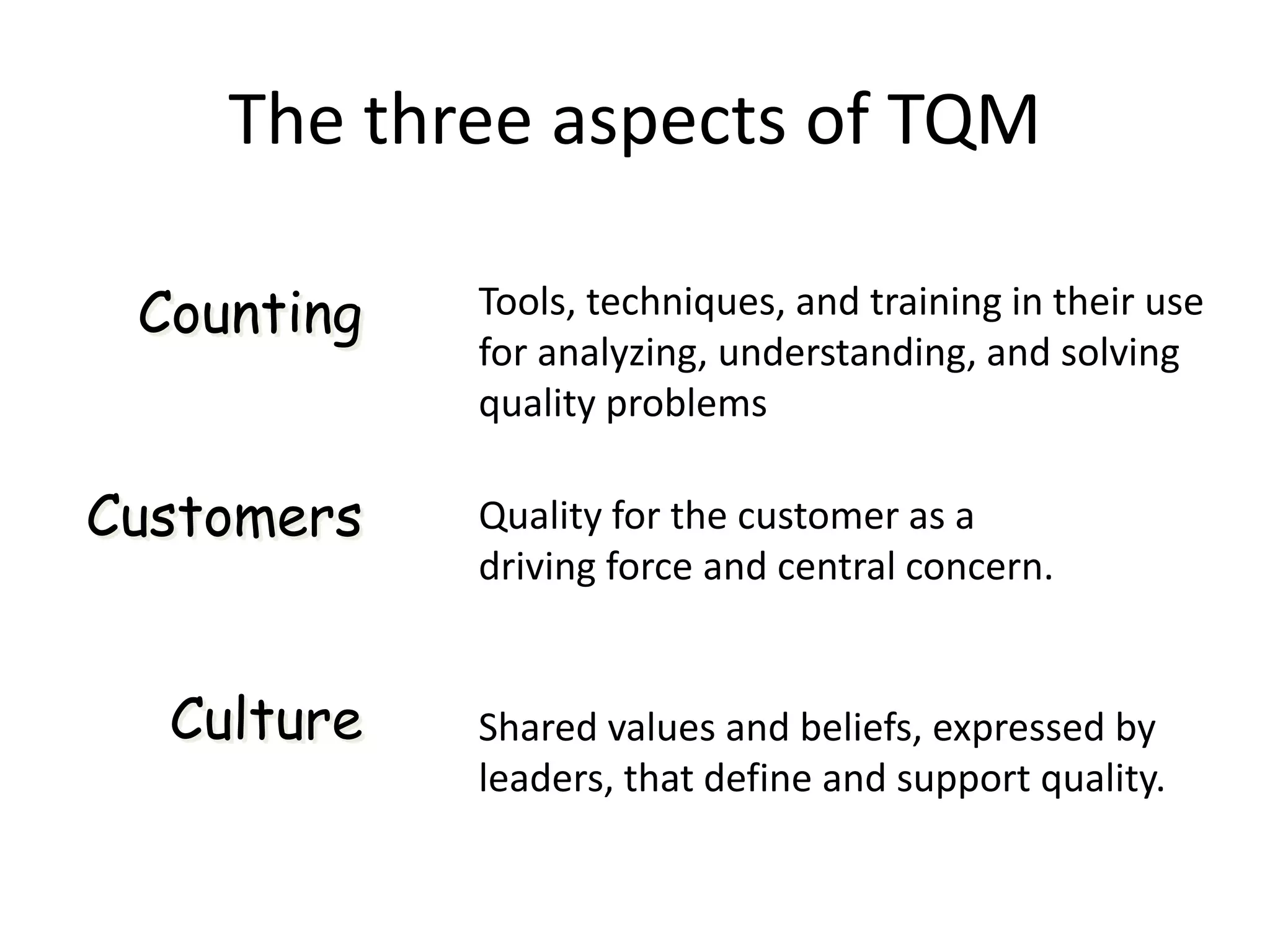
The three aspects of TQM
Counting
Customers
Culture
Tools, techniques, and training in their use
for analyzing, understanding, and solving
quality problems
Quality for the customer as a
driving force and central concern.
Shared values and beliefs, expressed by
leaders, that define and support quality.
Total Quality Management
and Continuous Improvement
• TQM is the management process used to
make continuous improvements to all
functions.
• TQM represents an ongoing, continuous
commitment to improvement.
• The foundation of total quality is a
management philosophy that supports
meeting customer requirements through
continuous improvement.
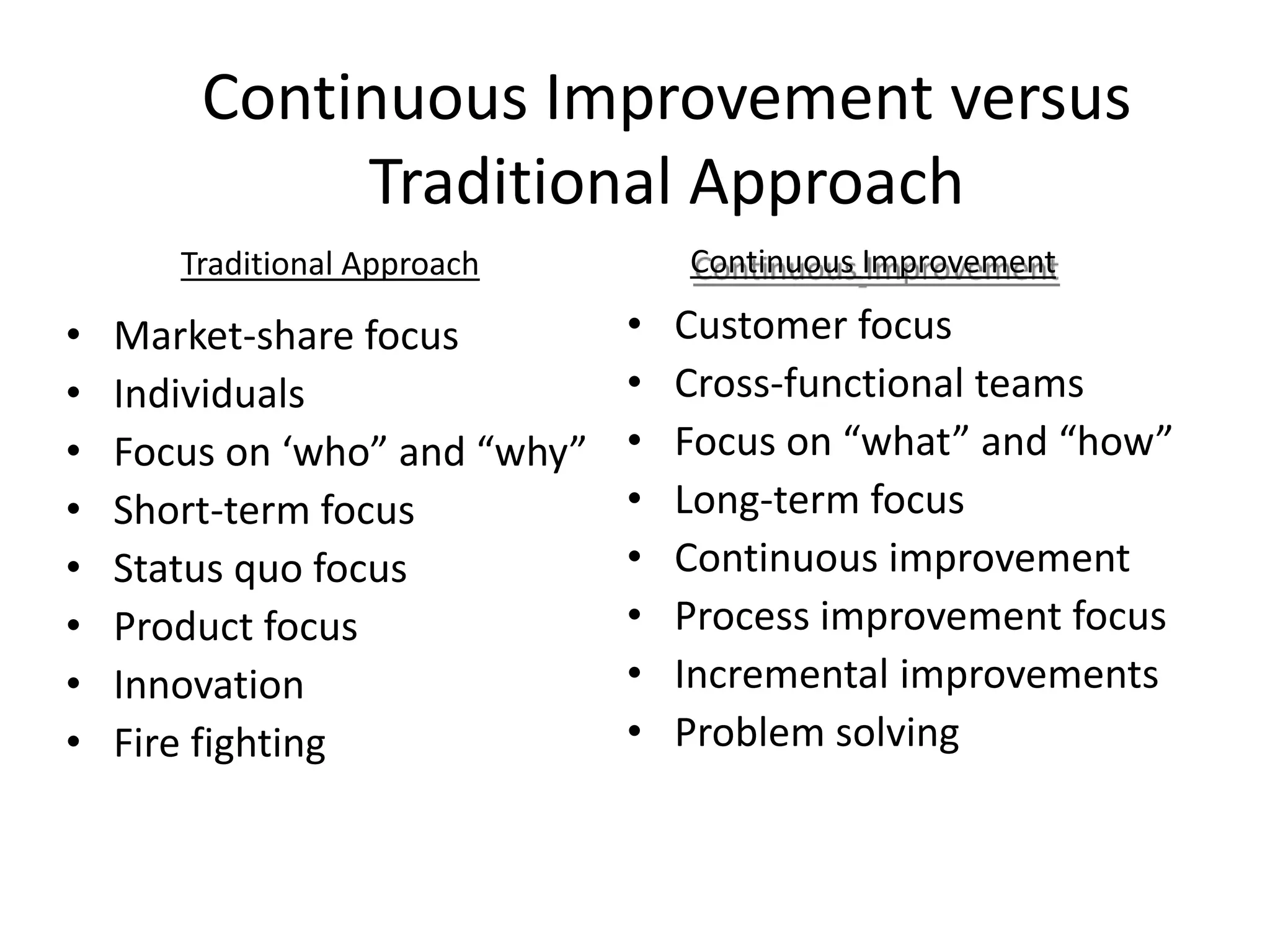
Continuous Improvement versus
Traditional Approach
• Market-share focus
• Individuals
• Focus on ‘who” and “why”
• Short-term focus
• Status quo focus
• Product focus
• Innovation
• Fire fighting
• Customer focus
• Cross-functional teams
• Focus on “what” and “how”
• Long-term focus
• Continuous improvement
• Process improvement focus
• Incremental improvements
• Problem solving
Traditional Approach Continuous Improvement
Quality Throughout
• “A Customer’s impression of quality begins with
the initial contact with the company and continues
through the life of the product.”
– Customers look to the total package - sales, service
during the sale, packaging, deliver, and service after the
sale.
– Quality extends to how the receptionist answers the
phone, how managers treat subordinates, how
courteous sales and repair people are, and how the
product is serviced after the sale.
• “All departments of the company must strive to
improve the quality of their operations.”
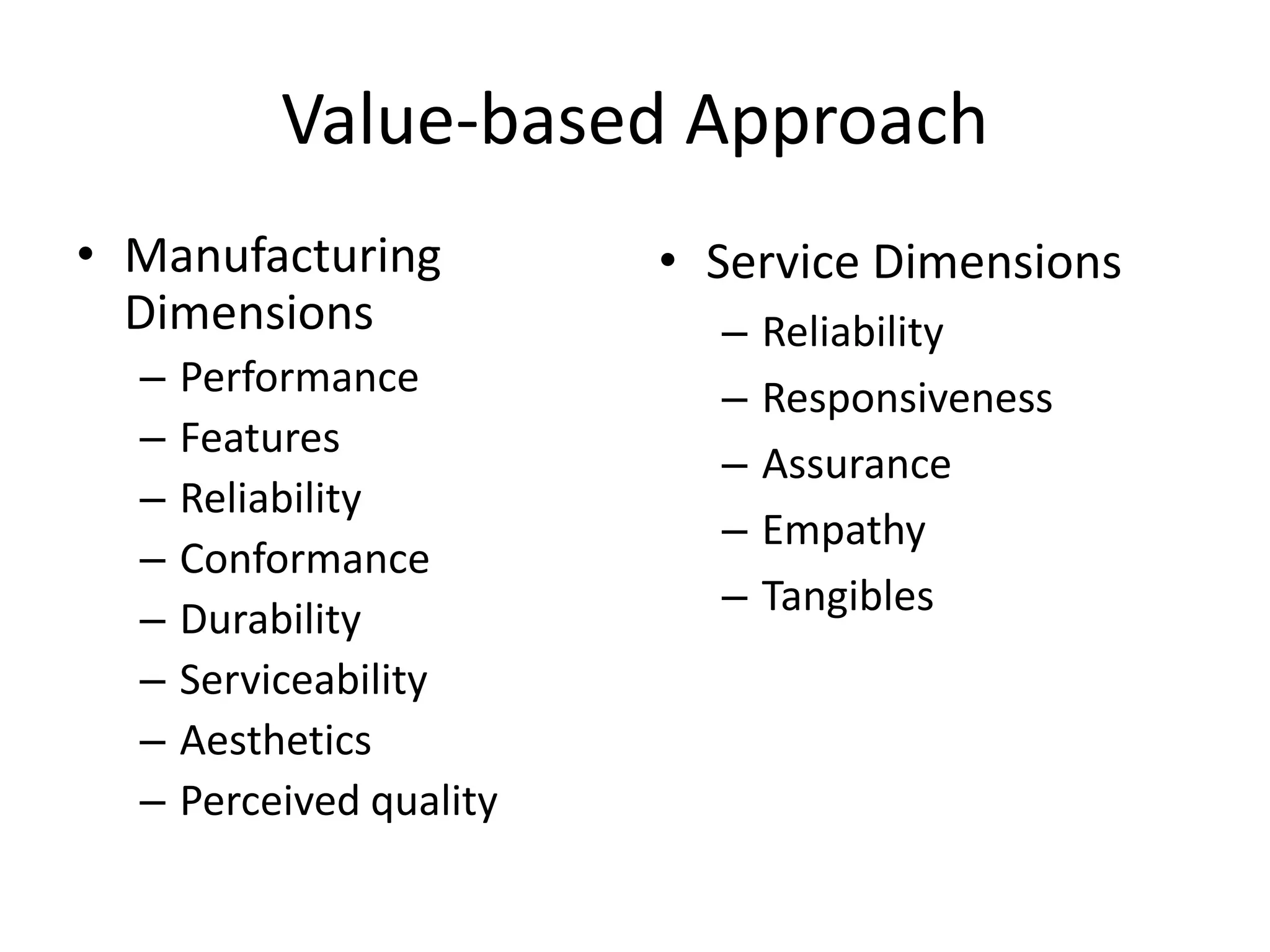
Value-based Approach
• Manufacturing
Dimensions
– Performance
– Features
– Reliability
– Conformance
– Durability
– Serviceability
– Aesthetics
– Perceived quality
• Service Dimensions
– Reliability
– Responsiveness
– Assurance
– Empathy
– Tangibles
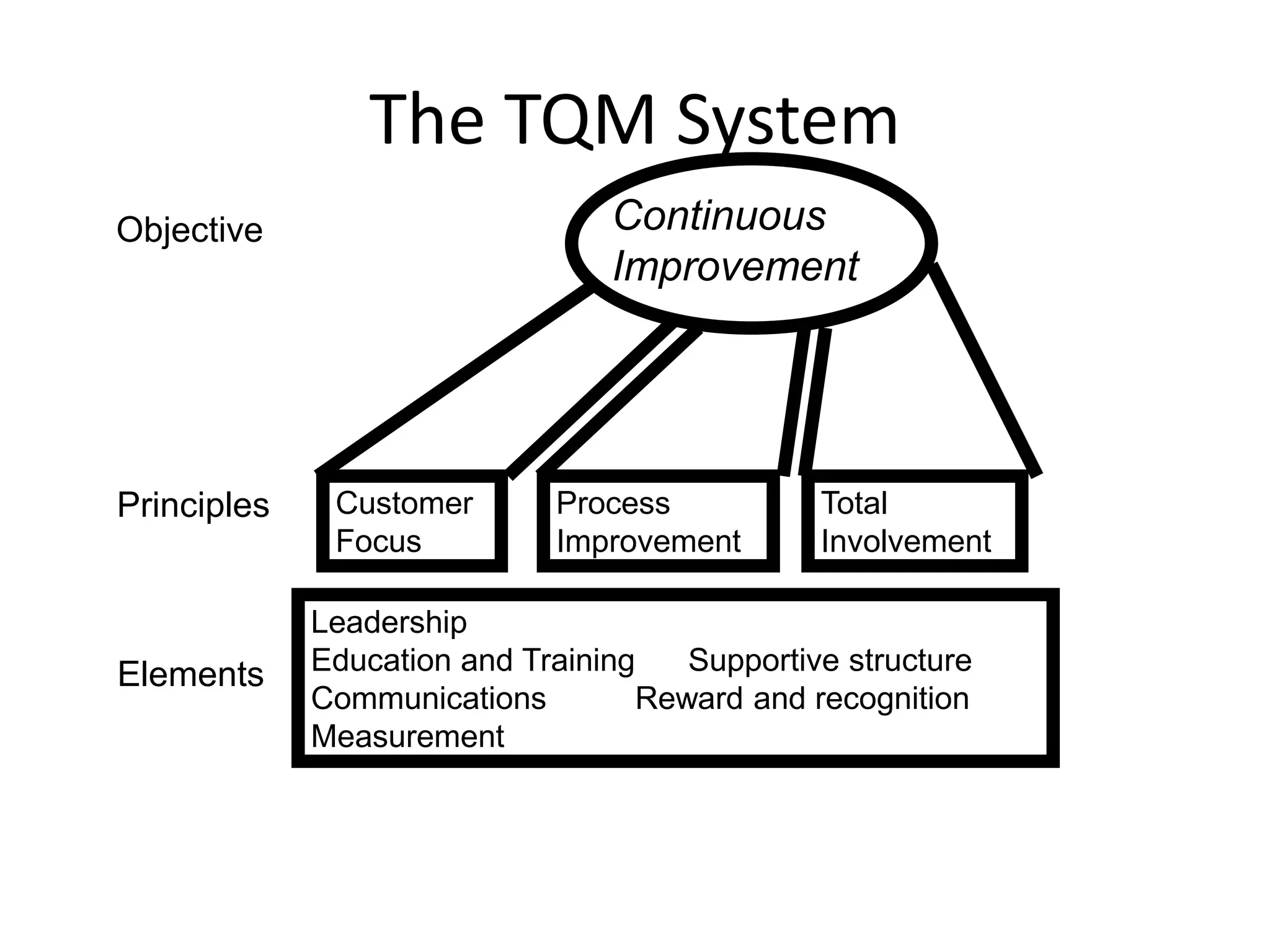
The TQM System
Customer
Focus
Process
Improvement
Total
Involvement
Leadership
Education and Training Supportive structure
Communications Reward and recognition
Measurement
Continuous
Improvement
Objective
Principles
Elements
• The essence of TQM is improvement of the
PROCESS.
• The foundation of carrying out process is the
employees involved in the process.
• For the TQM to be successful, the management
must give the encouragement to the employees to
share their ideas, and act on them.
• Therefore, the TQM process requires high degree of
communication and contact, response and
adaptation coordination and sequencing, this them
is the environment that should be created in a
superior work team.
Problem solving
a. The team should be small enough to be efficient
and effective.
b. Proper training should be given to the members in
the skills required.
c. Should be provided with adequate time work on
the problem.
d. Should be empowered to solve and implement the
solution.
e. The team should have a designated “champion” to
help the team to clear the road – blocks.
HOLSTIC APPROACH
 Unlike the concept of QC or QA, which is focused
towards the products / services offered as the main
business of organization, TQM focuses on the whole
organization or enterprise.
 All interrelated functions of the organization come
under its purview.
 Therefore, the common denominator, i.e human
resource which populates very nook and corner of
the organization is addressed.
How to harness of the human capital
This rests on three pillars:
1. Information sharing and transparency of operation
2. Involvement in decision making
3. Cultural transformation for excellence in all
spheres of activity.
Tool and techniques of TQM
1. Information sharing & transparency of operation:
Divide between “management” and “employees” is
bridged by establishing several institutionalized
mechanisms / platforms for information sharing.
Example:
Departmental
notice board
magazines
organizational newsletter
Contd. …..
• The focus is both on internal and external
information. External information and news
(example, market information, competitors activity
etc..) as well as internal information (example,
company’s strategic plans, company’s annual
budgets, company’s periodic performance, major
orders won/ lost, company’s periodic cost,
performance and contribution profit performance
etc..
2. Involvement in decision making
Institutionalized platforms for interaction at various
levels between employees and management.
Small group of activity (SGA): cross functional team
for problem solving at inter – departmental level or
organizational level.
Quality circle for problem solving at departmental
level.
KAIZEN for unleashing the innovative / creative
Potential at the individual employee level.
3. Cultural transformation for excellence in all spheres
of activity :
Top management administering commitment to
TQM by practicing what is preached.
Appointing champions as torch bearers for various
movements, like time management, cost control
energy saving, waste reduction, house keeping etc..
Recognizing and eulogizing hero‘s for excellence in
performance in various forms of activity, kaizen,
house keeping, energy saving etc…
MANAGEMENT OF
PROCESS QUALITY
HUMAN RESOURCE
DEVELOPMENT AND
MANAGEMENT
STRATEGIC QUALITY
PLANNING
INFORMATION
AND ANALYSIS
CUSTOMER
FOCUS
AND
SATISFACTION
QUALITY
AND
OPERATIONAL
RESULTS
SENIOR
EXECUTIVE
LEADERSHIP
System Approach for TQM
Driver
System
Customer Satisfaction
Three Part System
Customer Expectations
Company Operations
(Processes)
Customer Satisfaction

Total Quality Management (TQO)

  • 1.
    TOTAL QUALITY MANAGEMENT Presentedby LINGESWARA RAO.PUNATI Associate professor, Pharmaceutical Analysis, Mizan – Tepi university, Ethiopia
  • 2.
    TOTAL QUALITY MANAGEMENT Total- made up of the whole Quality - degree of excellence a product or service provides Management - act, art or manner of planning, controlling, directing,…. Therefore, TQM is the art of managing the whole to achieve excellence.
  • 3.
    QUALITY: In general, thequality can be defined as degree of customer satisfaction. As per ISO, standard quality is defined as “the totality of characteristics of an entity that bear on its ability to satisfy stated and implied needs”. Dimensions of Quality: Three dimensions of quality  Quality Design  Quality Conformance  Quality Peformance
  • 4.
    Quality Dimensions: It meansthe intentions of designers to include or exclude feature in a product or service i.e the degree to which the quality characteristics are embedded into the product or service. Quality Conformance: It means how well the product or service meet the specification determined by designer Quality Performance: The quality performance is associated with reliability of the product or service. • It means the product, part or system is performing its intended function under a prescribed set of conditions. • It has an impact on repeated sales, reflects on the products image and if it poor, it can create legal implications.
  • 5.
    Quality means:  meetingpatient requirements (stated or implied)  Through the totality of product or service.  By conforming to a specified standard.  At a given time over a period of time.  At a price the patient can afford and is willing to pay
  • 6.
    Characteristics : • Technological Strength,hardness, surface finish • Psychological Taste, status, • Time – oriented Reliability, maintainability - availability • Contractual Guarantee. Provision • Ethical Courtesy and honesty
  • 7.
    Quality System’s Organization DesignControls Material Controls Records, Documents, & Change Controls Equipment & Facility Controls Production & Process Controls Corrective & Preventive Actions Management
  • 8.
    Quality Control The sumof all factors which contribute directly or indirectly to the safety, effectiveness and reliability of the product. These properties are built into drug products through research and during the manufacturing process by procedures collectively referred to as Quality Control.
  • 9.
    Quality control limits i.Free of impurities ii. Physically and chemically stable iii. The amount of active ingredient(s) as stated on the label iv. Provides optimal release of active ingredient(s) when the product is administered.
  • 10.
    Quality control following characteristics 1.A drug should be genuine quality and good nature. 2. A drug should be physically and chemically pure. 3. The drug should contain the same amount of ingredient as stated on the label. 4. The drug should be rendered in such a form that it is effective after administration. 5. A drug should retain quality in terms of shelf – life or stability 6. A drug should not have toxic impurities which render it practically useless.
  • 11.
    Importance of QualityControl The drugs which are used for the life saving and treatment of diseases are derived from animal, plants or synthesised in the laboratory (synthetic drugs). The life is at stake and the doctors who wants to cure patients must get quality drugs.
  • 12.
    What does TQMmean? Total Quality Management means that the organization's culture is defined by and supports the constant attainment of customer satisfaction through an integrated system of tools, techniques, and training. This involves the continuous improvement of organizational processes, resulting in high quality products and services.
  • 14.
    What’s the goalof TQM? “Do the right things right the first time, every time.”
  • 16.
    Six basic conceptsof TQM TQM requires six basic concepts: They are 1. A committed and involved management to provide long term top – to – bottom organization support. 2. An unwavering focus on the customer, both internally and externally. 3. Effective involvement and utilization of the entire work force.
  • 17.
    Contd. … 4. Continuousimprovement of the business and production process. 5. Treating suppliers of the business and production process . 6. Establishing the performance measures.
  • 19.
    Another way toput it • At it’s simplest, TQM is all managers leading and facilitating all contributors in everyone’s two main objectives: (1) total client satisfaction through quality products and services; and (2) continuous improvements to processes, systems, people, suppliers, partners, products, and services.
  • 20.
    Productivity and TQM •Traditional view: – Quality cannot be improved without significant losses in productivity. • TQM view: – Improved quality leads to improved productivity.
  • 21.
    Basic Tenets ofTQM • 1. The customer makes the ultimate determination of quality. • 2. Top management must provide leadership and support for all quality initiatives. • 3. Preventing variability is the key to producing high quality. • 4. Quality goals are a moving target, thereby requiring a commitment toward continuous improvement. • 5. Improving quality requires the establishment of effective metrics. We must speak with data and facts not just opinions.
  • 22.
    The three aspectsof TQM Counting Customers Culture Tools, techniques, and training in their use for analyzing, understanding, and solving quality problems Quality for the customer as a driving force and central concern. Shared values and beliefs, expressed by leaders, that define and support quality.
  • 23.
    Total Quality Management andContinuous Improvement • TQM is the management process used to make continuous improvements to all functions. • TQM represents an ongoing, continuous commitment to improvement. • The foundation of total quality is a management philosophy that supports meeting customer requirements through continuous improvement.
  • 24.
    Continuous Improvement versus TraditionalApproach • Market-share focus • Individuals • Focus on ‘who” and “why” • Short-term focus • Status quo focus • Product focus • Innovation • Fire fighting • Customer focus • Cross-functional teams • Focus on “what” and “how” • Long-term focus • Continuous improvement • Process improvement focus • Incremental improvements • Problem solving Traditional Approach Continuous Improvement
  • 25.
    Quality Throughout • “ACustomer’s impression of quality begins with the initial contact with the company and continues through the life of the product.” – Customers look to the total package - sales, service during the sale, packaging, deliver, and service after the sale. – Quality extends to how the receptionist answers the phone, how managers treat subordinates, how courteous sales and repair people are, and how the product is serviced after the sale. • “All departments of the company must strive to improve the quality of their operations.”
  • 26.
    Value-based Approach • Manufacturing Dimensions –Performance – Features – Reliability – Conformance – Durability – Serviceability – Aesthetics – Perceived quality • Service Dimensions – Reliability – Responsiveness – Assurance – Empathy – Tangibles
  • 27.
    The TQM System Customer Focus Process Improvement Total Involvement Leadership Educationand Training Supportive structure Communications Reward and recognition Measurement Continuous Improvement Objective Principles Elements
  • 28.
    • The essenceof TQM is improvement of the PROCESS. • The foundation of carrying out process is the employees involved in the process. • For the TQM to be successful, the management must give the encouragement to the employees to share their ideas, and act on them. • Therefore, the TQM process requires high degree of communication and contact, response and adaptation coordination and sequencing, this them is the environment that should be created in a superior work team.
  • 29.
    Problem solving a. Theteam should be small enough to be efficient and effective. b. Proper training should be given to the members in the skills required. c. Should be provided with adequate time work on the problem. d. Should be empowered to solve and implement the solution. e. The team should have a designated “champion” to help the team to clear the road – blocks.
  • 30.
    HOLSTIC APPROACH  Unlikethe concept of QC or QA, which is focused towards the products / services offered as the main business of organization, TQM focuses on the whole organization or enterprise.  All interrelated functions of the organization come under its purview.  Therefore, the common denominator, i.e human resource which populates very nook and corner of the organization is addressed.
  • 31.
    How to harnessof the human capital This rests on three pillars: 1. Information sharing and transparency of operation 2. Involvement in decision making 3. Cultural transformation for excellence in all spheres of activity.
  • 32.
    Tool and techniquesof TQM 1. Information sharing & transparency of operation: Divide between “management” and “employees” is bridged by establishing several institutionalized mechanisms / platforms for information sharing. Example: Departmental notice board magazines organizational newsletter
  • 33.
    Contd. ….. • Thefocus is both on internal and external information. External information and news (example, market information, competitors activity etc..) as well as internal information (example, company’s strategic plans, company’s annual budgets, company’s periodic performance, major orders won/ lost, company’s periodic cost, performance and contribution profit performance etc..
  • 34.
    2. Involvement indecision making Institutionalized platforms for interaction at various levels between employees and management. Small group of activity (SGA): cross functional team for problem solving at inter – departmental level or organizational level. Quality circle for problem solving at departmental level. KAIZEN for unleashing the innovative / creative Potential at the individual employee level.
  • 35.
    3. Cultural transformationfor excellence in all spheres of activity : Top management administering commitment to TQM by practicing what is preached. Appointing champions as torch bearers for various movements, like time management, cost control energy saving, waste reduction, house keeping etc.. Recognizing and eulogizing hero‘s for excellence in performance in various forms of activity, kaizen, house keeping, energy saving etc…
  • 36.
    MANAGEMENT OF PROCESS QUALITY HUMANRESOURCE DEVELOPMENT AND MANAGEMENT STRATEGIC QUALITY PLANNING INFORMATION AND ANALYSIS CUSTOMER FOCUS AND SATISFACTION QUALITY AND OPERATIONAL RESULTS SENIOR EXECUTIVE LEADERSHIP System Approach for TQM Driver System
  • 37.
    Customer Satisfaction Three PartSystem Customer Expectations Company Operations (Processes) Customer Satisfaction

Editor's Notes

  • #8 http://ebookbrowse.com/elibrary-pdf-d12169078