Engr. Marvin  Darius  M. Lagasca Professor:  Jo B. Bitonio ME 215 Mangement of Change & Transition
Introduction Total  –  Made up of the whole (or) Complete. Quality  – Degree of Excellence a product or service provides to the customer in present and future. Management  – Act , art, or manner of handling , controlling, directing, etc. TQM  is the art of managing the whole to achieve excellence.
Definition Total Quality Management  ( TQM ) is a management strategy aimed at embedding  awareness of quality  in all organizational processes.
Explanation TQM requires that the company maintain this  quality standard  in all aspects of its business.  This requires ensuring that things are done right the first time and that defects and waste are eliminated from operations.
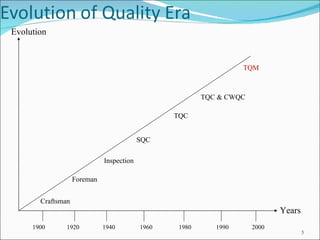
1900  1920  1940  1960  1980  1990  2000 Craftsman Foreman Inspection SQC TQC TQM TQC & CWQC Evolution Years
Basic Approach A committed and involved management to provide long-term,  top - to - bottom organizational support. An unwavering focus on the customer, both internally and externally.  Effective involvement and utilization  of the  entire work force.
Basic Approach Continuous improvement of  the business and production process. Treating suppliers as partners. Establish performance measures for the processes.
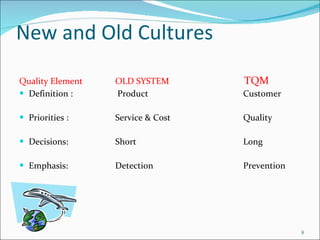
New and Old Cultures Quality Element  OLD SYSTEM   TQM Definition :   Product    Customer Priorities :  Service & Cost  Quality Decisions:   Short    Long  Emphasis:   Detection  Prevention
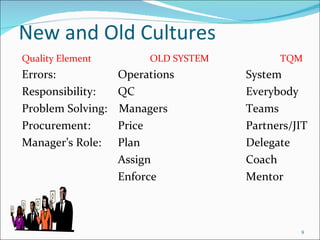
New and Old Cultures Quality Element  OLD SYSTEM   TQM Errors:  Operations  System Responsibility: QC  Everybody  Problem Solving:  Managers  Teams Procurement: Price  Partners/JIT Manager’s Role:  Plan  Delegate  Assign  Coach  Enforce  Mentor
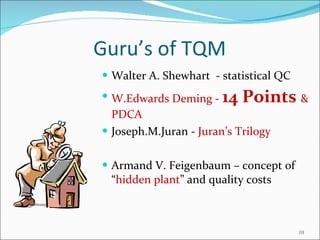
Guru’s of TQM Walter A. Shewhart  - statistical QC W.Edwards Deming -  14 Points  & PDCA Joseph.M.Juran -  Juran’s Trilogy Armand V. Feigenbaum – concept of “ hidden plant ” and quality costs
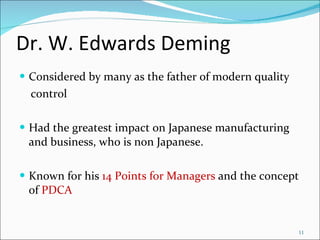
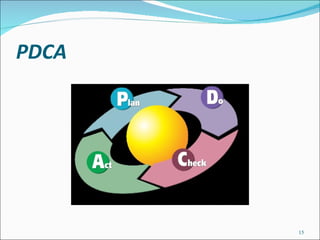
Dr. W. Edwards Deming Considered by many as the father of modern quality control Had the greatest impact on Japanese manufacturing and business, who is non Japanese. Known for his  14 Points for Managers  and the concept of  PDCA
Deming’s 14 Points for Managers 1. Create constancy of purpose  2. Adopt a new philosophy  3 .Cease dependence on inspection to achieve quality.  4. End the practice of awarding business on the basis of price tag.  5. Improve constantly and forever the system of production
Deming’s 14 Points for Managers  6. Institute training on the job.  7. Institute supervision  8. Drive out fear  9. Break down the barriers between departments.  10. Eliminate slogans and targets for the work force  11. Eliminate work standards that prescribe    numerical quotas
Deming’s 14 Points for Managers  12. Remove barriers to pride of workmanship  13. Institute a vigorous program of education and  retraining.  14. Put everybody in the company to work to    accomplish the transformation
PDCA
Guru’s of TQM Kaoru Ishikawa-Disciple of Juran & Feigenbaum. TQC in Japan, SPC, Cause &Effect Diagram,QC. Philips.B.Crosby. Four Absolutes-Quality-Req, Prevention of NC,Zero Defects & Measure of NC. Taguchi.G-Loss Function.
Improved Quality  Employee Participation  Team Work Internal & External Customer Satisfaction Productivity ,Communication Profitability & Market Share

Tqm intro 2

  • 1.
    Engr. Marvin Darius M. Lagasca Professor: Jo B. Bitonio ME 215 Mangement of Change & Transition
  • 2.
    Introduction Total – Made up of the whole (or) Complete. Quality – Degree of Excellence a product or service provides to the customer in present and future. Management – Act , art, or manner of handling , controlling, directing, etc. TQM is the art of managing the whole to achieve excellence.
  • 3.
    Definition Total QualityManagement ( TQM ) is a management strategy aimed at embedding awareness of quality in all organizational processes.
  • 4.
    Explanation TQM requiresthat the company maintain this quality standard in all aspects of its business. This requires ensuring that things are done right the first time and that defects and waste are eliminated from operations.
  • 5.
    1900 1920 1940 1960 1980 1990 2000 Craftsman Foreman Inspection SQC TQC TQM TQC & CWQC Evolution Years
  • 6.
    Basic Approach Acommitted and involved management to provide long-term, top - to - bottom organizational support. An unwavering focus on the customer, both internally and externally. Effective involvement and utilization of the entire work force.
  • 7.
    Basic Approach Continuousimprovement of the business and production process. Treating suppliers as partners. Establish performance measures for the processes.
  • 8.
    New and OldCultures Quality Element OLD SYSTEM TQM Definition : Product Customer Priorities : Service & Cost Quality Decisions: Short Long Emphasis: Detection Prevention
  • 9.
    New and OldCultures Quality Element OLD SYSTEM TQM Errors: Operations System Responsibility: QC Everybody Problem Solving: Managers Teams Procurement: Price Partners/JIT Manager’s Role: Plan Delegate Assign Coach Enforce Mentor
  • 10.
    Guru’s of TQMWalter A. Shewhart - statistical QC W.Edwards Deming - 14 Points & PDCA Joseph.M.Juran - Juran’s Trilogy Armand V. Feigenbaum – concept of “ hidden plant ” and quality costs
  • 11.
    Dr. W. EdwardsDeming Considered by many as the father of modern quality control Had the greatest impact on Japanese manufacturing and business, who is non Japanese. Known for his 14 Points for Managers and the concept of PDCA
  • 12.
    Deming’s 14 Pointsfor Managers 1. Create constancy of purpose 2. Adopt a new philosophy 3 .Cease dependence on inspection to achieve quality. 4. End the practice of awarding business on the basis of price tag. 5. Improve constantly and forever the system of production
  • 13.
    Deming’s 14 Pointsfor Managers 6. Institute training on the job. 7. Institute supervision 8. Drive out fear 9. Break down the barriers between departments. 10. Eliminate slogans and targets for the work force 11. Eliminate work standards that prescribe numerical quotas
  • 14.
    Deming’s 14 Pointsfor Managers 12. Remove barriers to pride of workmanship 13. Institute a vigorous program of education and retraining. 14. Put everybody in the company to work to accomplish the transformation
  • 15.
  • 16.
    Guru’s of TQMKaoru Ishikawa-Disciple of Juran & Feigenbaum. TQC in Japan, SPC, Cause &Effect Diagram,QC. Philips.B.Crosby. Four Absolutes-Quality-Req, Prevention of NC,Zero Defects & Measure of NC. Taguchi.G-Loss Function.
  • 17.
    Improved Quality Employee Participation Team Work Internal & External Customer Satisfaction Productivity ,Communication Profitability & Market Share