By: Srishti Singh
Neeharika Tripathi
TOPIC: Total Quality Management
(TQM)
PARTICIPATIVE MANAGEMENT
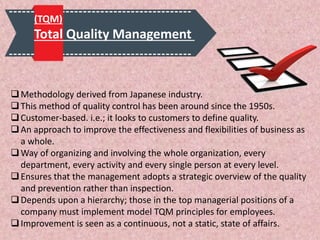
Methodology derived from Japanese industry.
This method of quality control has been around since the 1950s.
Customer-based. i.e.; it looks to customers to define quality.
An approach to improve the effectiveness and flexibilities of business as
a whole.
Way of organizing and involving the whole organization, every
department, every activity and every single person at every level.
Ensures that the management adopts a strategic overview of the quality
and prevention rather than inspection.
Depends upon a hierarchy; those in the top managerial positions of a
company must implement model TQM principles for employees.
Improvement is seen as a continuous, not a static, state of affairs.
(TQM)
Total Quality Management
Principles
Father of TQM
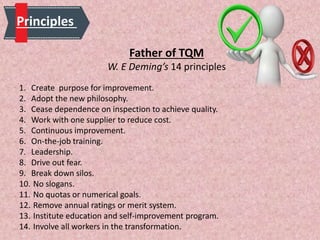
W. E Deming’s 14 principles
1. Create purpose for improvement.
2. Adopt the new philosophy.
3. Cease dependence on inspection to achieve quality.
4. Work with one supplier to reduce cost.
5. Continuous improvement.
6. On-the-job training.
7. Leadership.
8. Drive out fear.
9. Break down silos.
10. No slogans.
11. No quotas or numerical goals.
12. Remove annual ratings or merit system.
13. Institute education and self-improvement program.
14. Involve all workers in the transformation.
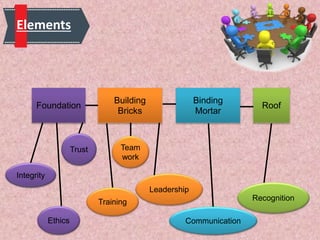
Elements
Foundation
Building
Bricks
Binding
Mortar
Roof
Integrity
Trust
Ethics
Training
Team
work
Leadership
Communication
Recognition
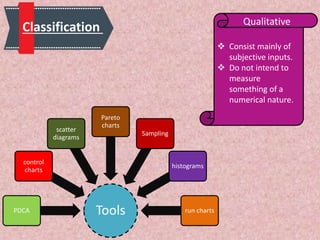
ToolsPDCA
control
charts
scatter
diagrams
Pareto
charts
Sampling
histograms
run charts
Classification
 Consist mainly of
subjective inputs.
 Do not intend to
measure
something of a
numerical nature.
Qualitative
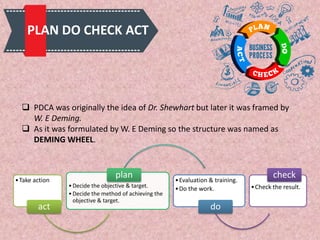
•Take action
act
•Decide the objective & target.
•Decide the method of achieving the
objective & target.
plan •Evaluation & training.
•Do the work.
do
•Check the result.
check
 PDCA was originally the idea of Dr. Shewhart but later it was framed by
W. E Deming.
 As it was formulated by W. E Deming so the structure was named as
DEMING WHEEL.
PLAN DO CHECK ACT
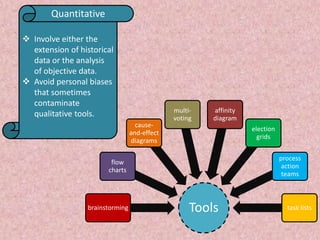
 Involve either the
extension of historical
data or the analysis
of objective data.
 Avoid personal biases
that sometimes
contaminate
qualitative tools.
Quantitative
Toolsbrainstorming
flow
charts
cause-
and-effect
diagrams
multi-
voting
affinity
diagram
election
grids
process
action
teams
task lists
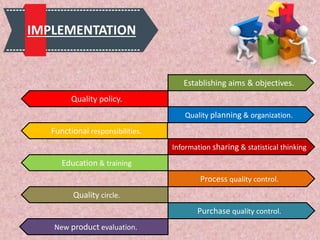
IMPLEMENTATION
Purchase quality control.
New product evaluation.
Information sharing & statistical thinking
Quality circle.
Process quality control.
Education & training
Quality planning & organization.
Functional responsibilities.
Establishing aims & objectives.
Quality policy.
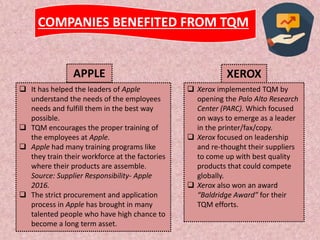
COMPANIES BENEFITED FROM TQM
 It has helped the leaders of Apple
understand the needs of the employees
needs and fulfill them in the best way
possible.
 TQM encourages the proper training of
the employees at Apple.
 Apple had many training programs like
they train their workforce at the factories
where their products are assemble.
Source: Supplier Responsibility- Apple
2016.
 The strict procurement and application
process in Apple has brought in many
talented people who have high chance to
become a long term asset.
APPLE
 Xerox implemented TQM by
opening the Palo Alto Research
Center (PARC). Which focused
on ways to emerge as a leader
in the printer/fax/copy.
 Xerox focused on leadership
and re-thought their suppliers
to come up with best quality
products that could compete
globally.
 Xerox also won an award
“Baldridge Award” for their
TQM efforts.
XEROX
 Currently FORD needs to downsize and it needs to have realistic
economic goals.
 Downsizing would help to scale down FORD’S operation to a size that
is more easily manageable so that it can serve its customer more
efficiently and remain profitable.
 Downsizing would guarantee the company’s competitiveness in the
long-term.
 After setting goals, the company has integrated TQM principles.
 The overall reasons of creating these goals are to streamline operation
and increase productivity.
 In above context, FORD improved assembly line practices to
manufacture even more vehicles, while keeping quality levels high.
 Today at Ford Motor Company, their most popular slogan is “Ford Has
a Better Idea”.
FORD
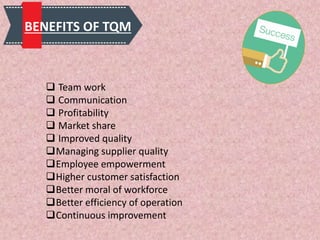
BENEFITS OF TQM
 Team work
 Communication
 Profitability
 Market share
 Improved quality
Managing supplier quality
Employee empowerment
Higher customer satisfaction
Better moral of workforce
Better efficiency of operation
Continuous improvement
REASONS FOR FAILURE
Lack of genuine quality culture.
Lack of top management support and commitment.
Over and under reliance on statistical process control methods.
Anti-competitive.
Lack of customer focus.
No performance measure or targets are set, so progress cannot
be measured.
Processes are not analyzed, systems are weak and procedures
are not written down.
CONCLUSION
 TQM encourages participation amongst employees, managers and
organization as whole.
 Work culture and complete engagement of the employees at the work
place.
 Thus, quality is critically important ingredient to organizational success
today which can be achieved by TQM, an organizational approach that
focusses on quality as an over achieving goals, aimed at the prevention
of defects rather than detection of defects.
TQM ppt

TQM ppt

  • 1.
    By: Srishti Singh NeeharikaTripathi TOPIC: Total Quality Management (TQM) PARTICIPATIVE MANAGEMENT
  • 2.
    Methodology derived fromJapanese industry. This method of quality control has been around since the 1950s. Customer-based. i.e.; it looks to customers to define quality. An approach to improve the effectiveness and flexibilities of business as a whole. Way of organizing and involving the whole organization, every department, every activity and every single person at every level. Ensures that the management adopts a strategic overview of the quality and prevention rather than inspection. Depends upon a hierarchy; those in the top managerial positions of a company must implement model TQM principles for employees. Improvement is seen as a continuous, not a static, state of affairs. (TQM) Total Quality Management
  • 3.
    Principles Father of TQM W.E Deming’s 14 principles 1. Create purpose for improvement. 2. Adopt the new philosophy. 3. Cease dependence on inspection to achieve quality. 4. Work with one supplier to reduce cost. 5. Continuous improvement. 6. On-the-job training. 7. Leadership. 8. Drive out fear. 9. Break down silos. 10. No slogans. 11. No quotas or numerical goals. 12. Remove annual ratings or merit system. 13. Institute education and self-improvement program. 14. Involve all workers in the transformation.
  • 4.
  • 5.
    ToolsPDCA control charts scatter diagrams Pareto charts Sampling histograms run charts Classification  Consistmainly of subjective inputs.  Do not intend to measure something of a numerical nature. Qualitative
  • 6.
    •Take action act •Decide theobjective & target. •Decide the method of achieving the objective & target. plan •Evaluation & training. •Do the work. do •Check the result. check  PDCA was originally the idea of Dr. Shewhart but later it was framed by W. E Deming.  As it was formulated by W. E Deming so the structure was named as DEMING WHEEL. PLAN DO CHECK ACT
  • 7.
     Involve eitherthe extension of historical data or the analysis of objective data.  Avoid personal biases that sometimes contaminate qualitative tools. Quantitative Toolsbrainstorming flow charts cause- and-effect diagrams multi- voting affinity diagram election grids process action teams task lists
  • 8.
    IMPLEMENTATION Purchase quality control. Newproduct evaluation. Information sharing & statistical thinking Quality circle. Process quality control. Education & training Quality planning & organization. Functional responsibilities. Establishing aims & objectives. Quality policy.
  • 9.
    COMPANIES BENEFITED FROMTQM  It has helped the leaders of Apple understand the needs of the employees needs and fulfill them in the best way possible.  TQM encourages the proper training of the employees at Apple.  Apple had many training programs like they train their workforce at the factories where their products are assemble. Source: Supplier Responsibility- Apple 2016.  The strict procurement and application process in Apple has brought in many talented people who have high chance to become a long term asset. APPLE  Xerox implemented TQM by opening the Palo Alto Research Center (PARC). Which focused on ways to emerge as a leader in the printer/fax/copy.  Xerox focused on leadership and re-thought their suppliers to come up with best quality products that could compete globally.  Xerox also won an award “Baldridge Award” for their TQM efforts. XEROX
  • 10.
     Currently FORDneeds to downsize and it needs to have realistic economic goals.  Downsizing would help to scale down FORD’S operation to a size that is more easily manageable so that it can serve its customer more efficiently and remain profitable.  Downsizing would guarantee the company’s competitiveness in the long-term.  After setting goals, the company has integrated TQM principles.  The overall reasons of creating these goals are to streamline operation and increase productivity.  In above context, FORD improved assembly line practices to manufacture even more vehicles, while keeping quality levels high.  Today at Ford Motor Company, their most popular slogan is “Ford Has a Better Idea”. FORD
  • 11.
    BENEFITS OF TQM Team work  Communication  Profitability  Market share  Improved quality Managing supplier quality Employee empowerment Higher customer satisfaction Better moral of workforce Better efficiency of operation Continuous improvement
  • 12.
    REASONS FOR FAILURE Lackof genuine quality culture. Lack of top management support and commitment. Over and under reliance on statistical process control methods. Anti-competitive. Lack of customer focus. No performance measure or targets are set, so progress cannot be measured. Processes are not analyzed, systems are weak and procedures are not written down.
  • 13.
    CONCLUSION  TQM encouragesparticipation amongst employees, managers and organization as whole.  Work culture and complete engagement of the employees at the work place.  Thus, quality is critically important ingredient to organizational success today which can be achieved by TQM, an organizational approach that focusses on quality as an over achieving goals, aimed at the prevention of defects rather than detection of defects.