Chapter 6:  Managing Quality ÖZGE ÇELİK 8th April 2011
Learning Objectives Explain quality robust products and Taguchi concepts Use the seven tools of TQM 1.  Check Sheets 2.  Scatter Diagrams 3.  Cause-and-Effect Diagrams 4.  Pareto Charts 5.  Flowcharts 6.  Histograms 7.  Statistical Process Control Charts
Taguchi Concepts Engineering and experimental design methods to improve product and process design -  Identify key component and process variables affecting product variation Taguchi Concepts -  Quality robustness -  Quality loss function -  Target-oriented quality
Quality Robustness Ability to produce products uniformly in adverse manufacturing and environmental conditions -  Remove the effects of adverse conditions -  Small variations in materials and process do not destroy product quality
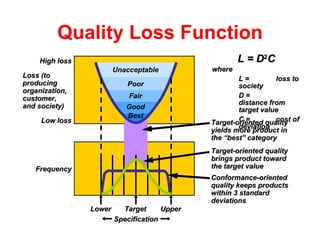
Quality Loss Function Shows that costs increase as the product moves away from what the customer wants Costs include customer  dissatisfaction, warranty  and service, internal  scrap and repair, and costs to society Traditional conformance specifications are too simplistic Target-oriented quality
Quality Loss Function Unacceptable Poor Good Best Fair High loss Loss (to producing organization, customer, and society) Low loss Frequency Lower Target Upper Specification Target-oriented quality yields more product in the “best” category Target-oriented quality brings product toward the target value Conformance-oriented quality keeps products within 3 standard deviations L = D 2 C where L = loss to society D = distance from target value C = cost of deviation
Tools of TQM Tools for Generating Ideas Check sheets Scatter diagrams Cause-and-effect diagrams Tools to Organize the Data Pareto charts Flowcharts Tools for Identifying Problems Histogram Statistical process control chart
Seven Tools of TQM / / / / /// / // /// // //// /// // / Hour Defect 1 2 3 4 5 6 7 8 A B C / / // / 1.  Check Sheet: An organized method of recording data
Seven Tools of TQM 2. Scatter Diagram: A graph of the value of one variable vs. another variable Absenteeism Productivity
Seven Tools of TQM 3. Cause-and-Effect Diagram: A tool that identifies process elements (causes) that might effect an outcome Cause Materials Methods Manpower Machinery Effect
Cause-and-Effect Diagrams Material (ball) Method (shooting process) Machine (hoop & backboard) Manpower (shooter) Missed  free-throws Rim alignment Rim size Backboard stability Rim height Follow-through Hand position Aiming point Bend knees Balance Size of ball Lopsidedness Grain/Feel (grip) Air pressure Training Conditioning Motivation Concentration Consistency
Seven Tools of TQM 4. Pareto Chart: A graph to identify and plot problems or defects in descending order of frequency Frequency Percent A B C D E
Pareto Charts Number of occurrences Room svc Check-in Pool hours Minibar Misc. 72% 16% 5% 4% 3% 12 4 3 2 54 –   100 –   93 –   88 –   72 70  – 60  – 50  – 40  – 30  – 20  – 10  – 0  – Frequency (number) Causes and percent of the total Cumulative percent Data for October
Seven Tools of TQM 5. Flowchart (Process Diagram): A chart that describes the steps in a process
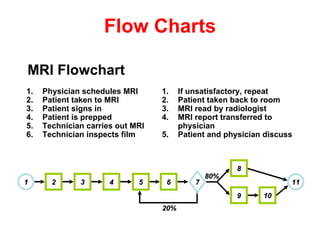
Flow Charts MRI Flowchart Physician schedules MRI Patient taken to MRI Patient signs in Patient is prepped Technician carries out MRI Technician inspects film If unsatisfactory, repeat Patient taken back to room MRI read by radiologist MRI report transferred to physician Patient and physician discuss 11 10 20% 9 8 80% 1 2 3 4 5 6 7
Seven Tools of TQM 6. Histogram: A distribution showing the frequency of occurrences of a variable Distribution Repair time (minutes) Frequency
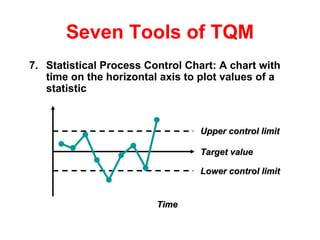
Seven Tools of TQM 7.  Statistical Process Control Chart: A chart with time on the horizontal axis to plot values of a statistic Upper control limit Target value Lower control limit Time
Statistical Process Control (SPC) Uses statistics and control charts to tell when to take corrective action Drives process improvement Four key steps -  Measure the process -  When a change is indicated, find the assignable cause -  Eliminate or incorporate the cause -  Restart the revised process
An SPC Chart Upper control limit Coach’s target value Lower control limit Game number | | | | | | | | | 1 2 3 4 5 6 7 8 9 20% 10% 0% Plots the percent of free throws missed
Inspection Involves examining items to see if an item is good or defective Detect a defective product Does not correct deficiencies in process or product It is expensive Issues When to inspect Where in process to inspect
When and Where to Inspect At the supplier’s plant while the supplier is producing At your facility upon receipt of goods from the supplier Before costly or irreversible processes During the step-by-step production process When production or service is complete Before delivery to your customer At the point of customer contact
Inspection Many problems Worker fatigue Measurement error Process variability Cannot inspect quality into a product Robust design, empowered employees, and sound processes are better solutions
Source Inspection Also known as source control The next step in the process is your customer Ensure perfect product  to your customer Poka-yoke is the concept of foolproof devices or techniques designed to pass only acceptable product
Service Industry Inspection Attractive, well-organized, stocked, good lighting Rotation of goods, organized, clean Neat, courteous, very knowledgeable Display areas Stockrooms Salesclerks Nordstrom Department  Store Standard What is Inspected Organization
Attributes Versus Variables Attributes Items are either good or bad, acceptable or unacceptable Does not address  degree  of failure Variables Measures dimensions such as weight, speed, height, or strength Falls within an acceptable range Use different statistical techniques
TQM In Services Service quality is more difficult to measure than the quality of goods Service quality perceptions depend on  Intangible differences between products Intangible expectations customers have of those products
Service Quality The  o perations  m anager must recognize: The tangible component of services is important The service process is important The service is judged against the customer’s expectations Exceptions will occur
Determinants of Service Quality Reliability Responsiveness Competence Access Courtesy Communication Credibility Security Understanding/ knowing the customer Tangibles
Service Recovery Strategy Managers should have a plan for when services fail Marriott’s LEARN routine L isten E mpathize A pologize R eact N otify
Managerial Implications We will have plan for when services fail. We will recognize that the service is judged against the customer’s expentations.

Managing Quality

  • 1.
    Chapter 6: Managing Quality ÖZGE ÇELİK 8th April 2011
  • 2.
    Learning Objectives Explainquality robust products and Taguchi concepts Use the seven tools of TQM 1. Check Sheets 2. Scatter Diagrams 3. Cause-and-Effect Diagrams 4. Pareto Charts 5. Flowcharts 6. Histograms 7. Statistical Process Control Charts
  • 3.
    Taguchi Concepts Engineeringand experimental design methods to improve product and process design - Identify key component and process variables affecting product variation Taguchi Concepts - Quality robustness - Quality loss function - Target-oriented quality
  • 4.
    Quality Robustness Abilityto produce products uniformly in adverse manufacturing and environmental conditions - Remove the effects of adverse conditions - Small variations in materials and process do not destroy product quality
  • 5.
    Quality Loss FunctionShows that costs increase as the product moves away from what the customer wants Costs include customer dissatisfaction, warranty and service, internal scrap and repair, and costs to society Traditional conformance specifications are too simplistic Target-oriented quality
  • 6.
    Quality Loss FunctionUnacceptable Poor Good Best Fair High loss Loss (to producing organization, customer, and society) Low loss Frequency Lower Target Upper Specification Target-oriented quality yields more product in the “best” category Target-oriented quality brings product toward the target value Conformance-oriented quality keeps products within 3 standard deviations L = D 2 C where L = loss to society D = distance from target value C = cost of deviation
  • 7.
    Tools of TQMTools for Generating Ideas Check sheets Scatter diagrams Cause-and-effect diagrams Tools to Organize the Data Pareto charts Flowcharts Tools for Identifying Problems Histogram Statistical process control chart
  • 8.
    Seven Tools ofTQM / / / / /// / // /// // //// /// // / Hour Defect 1 2 3 4 5 6 7 8 A B C / / // / 1. Check Sheet: An organized method of recording data
  • 9.
    Seven Tools ofTQM 2. Scatter Diagram: A graph of the value of one variable vs. another variable Absenteeism Productivity
  • 10.
    Seven Tools ofTQM 3. Cause-and-Effect Diagram: A tool that identifies process elements (causes) that might effect an outcome Cause Materials Methods Manpower Machinery Effect
  • 11.
    Cause-and-Effect Diagrams Material(ball) Method (shooting process) Machine (hoop & backboard) Manpower (shooter) Missed free-throws Rim alignment Rim size Backboard stability Rim height Follow-through Hand position Aiming point Bend knees Balance Size of ball Lopsidedness Grain/Feel (grip) Air pressure Training Conditioning Motivation Concentration Consistency
  • 12.
    Seven Tools ofTQM 4. Pareto Chart: A graph to identify and plot problems or defects in descending order of frequency Frequency Percent A B C D E
  • 13.
    Pareto Charts Numberof occurrences Room svc Check-in Pool hours Minibar Misc. 72% 16% 5% 4% 3% 12 4 3 2 54 – 100 – 93 – 88 – 72 70 – 60 – 50 – 40 – 30 – 20 – 10 – 0 – Frequency (number) Causes and percent of the total Cumulative percent Data for October
  • 14.
    Seven Tools ofTQM 5. Flowchart (Process Diagram): A chart that describes the steps in a process
  • 15.
    Flow Charts MRIFlowchart Physician schedules MRI Patient taken to MRI Patient signs in Patient is prepped Technician carries out MRI Technician inspects film If unsatisfactory, repeat Patient taken back to room MRI read by radiologist MRI report transferred to physician Patient and physician discuss 11 10 20% 9 8 80% 1 2 3 4 5 6 7
  • 16.
    Seven Tools ofTQM 6. Histogram: A distribution showing the frequency of occurrences of a variable Distribution Repair time (minutes) Frequency
  • 17.
    Seven Tools ofTQM 7. Statistical Process Control Chart: A chart with time on the horizontal axis to plot values of a statistic Upper control limit Target value Lower control limit Time
  • 18.
    Statistical Process Control(SPC) Uses statistics and control charts to tell when to take corrective action Drives process improvement Four key steps - Measure the process - When a change is indicated, find the assignable cause - Eliminate or incorporate the cause - Restart the revised process
  • 19.
    An SPC ChartUpper control limit Coach’s target value Lower control limit Game number | | | | | | | | | 1 2 3 4 5 6 7 8 9 20% 10% 0% Plots the percent of free throws missed
  • 20.
    Inspection Involves examiningitems to see if an item is good or defective Detect a defective product Does not correct deficiencies in process or product It is expensive Issues When to inspect Where in process to inspect
  • 21.
    When and Whereto Inspect At the supplier’s plant while the supplier is producing At your facility upon receipt of goods from the supplier Before costly or irreversible processes During the step-by-step production process When production or service is complete Before delivery to your customer At the point of customer contact
  • 22.
    Inspection Many problemsWorker fatigue Measurement error Process variability Cannot inspect quality into a product Robust design, empowered employees, and sound processes are better solutions
  • 23.
    Source Inspection Alsoknown as source control The next step in the process is your customer Ensure perfect product to your customer Poka-yoke is the concept of foolproof devices or techniques designed to pass only acceptable product
  • 24.
    Service Industry InspectionAttractive, well-organized, stocked, good lighting Rotation of goods, organized, clean Neat, courteous, very knowledgeable Display areas Stockrooms Salesclerks Nordstrom Department Store Standard What is Inspected Organization
  • 25.
    Attributes Versus VariablesAttributes Items are either good or bad, acceptable or unacceptable Does not address degree of failure Variables Measures dimensions such as weight, speed, height, or strength Falls within an acceptable range Use different statistical techniques
  • 26.
    TQM In ServicesService quality is more difficult to measure than the quality of goods Service quality perceptions depend on Intangible differences between products Intangible expectations customers have of those products
  • 27.
    Service Quality The o perations m anager must recognize: The tangible component of services is important The service process is important The service is judged against the customer’s expectations Exceptions will occur
  • 28.
    Determinants of ServiceQuality Reliability Responsiveness Competence Access Courtesy Communication Credibility Security Understanding/ knowing the customer Tangibles
  • 29.
    Service Recovery StrategyManagers should have a plan for when services fail Marriott’s LEARN routine L isten E mpathize A pologize R eact N otify
  • 30.
    Managerial Implications Wewill have plan for when services fail. We will recognize that the service is judged against the customer’s expentations.