Outline Introduction TQM TQM and  airline  Industry Elements of Tqm  in  airline  Benefits of TQM  for airline The Difficulties in Implementing
INTRODUCTION Some of the airline  problems such as fluctuation of demand (non-steady state) create difficulties in TQM implementation and TQM could only help the industry to cope with such fluctuations
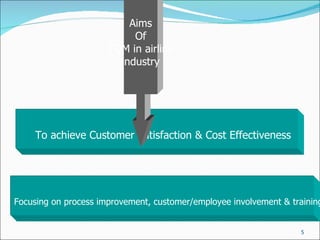
To achieve Customer Satisfaction & Cost Effectiveness Focusing on process improvement, customer/employee involvement & training Aims Of TQM in airline industry
TQM , Quality Control (QC) and Quality Assurance (QA),  QA and QC are applied during project implementation while TQM is a strategic philosophy adopted by an organization and implemented on a continuous basis, even if the organization is waiting to perform a new project
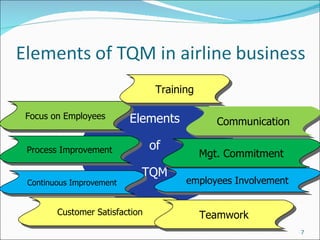
Elements of TQM Continuous Improvement Communication Focus on Employees Customer Satisfaction Mgt. Commitment Training Teamwork Process Improvement employees Involvement
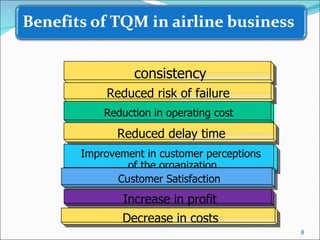
consistency Reduced risk of failure  Improvement in customer perceptions  of the organization Reduction in operating cost  Reduced delay time Customer Satisfaction Increase in profit Decrease in costs
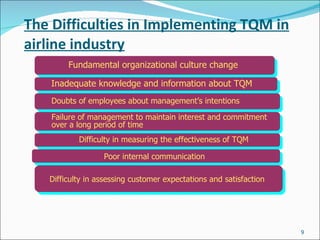
The Difficulties in Implementing TQM in airline industry Fundamental organizational culture change Inadequate knowledge and information about TQM Doubts of employees about management’s intentions Difficulty in measuring the effectiveness of TQM Poor internal communication Difficulty in assessing customer expectations and satisfaction Failure of management to maintain interest and commitment over a long period of time
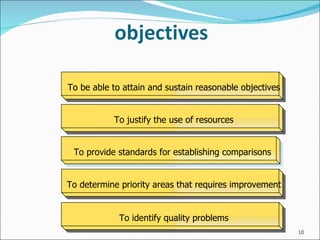
To be able to attain and sustain reasonable objectives To justify the use of resources To identify quality problems To provide standards for establishing comparisons To determine priority areas that requires improvement
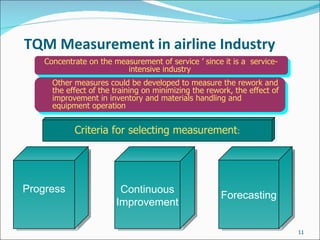
TQM Measurement in airline Industry Concentrate on the measurement of service ’ since it is a  service-intensive industry Other measures could be developed to measure the rework and the effect of the training on minimizing the rework, the effect of improvement in inventory and materials handling and equipment operation Criteria for selecting measurement : Progress Continuous Improvement Forecasting
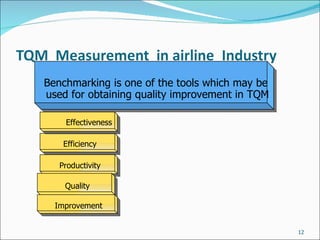
Benchmarking is one of the tools which may be  used for obtaining quality improvement in TQM Efficiency Effectiveness Productivity Quality Improvement
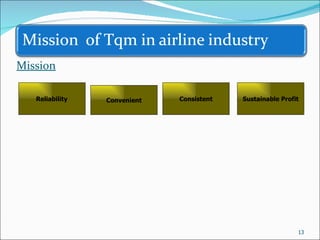
Mission Reliability Sustainable Profit Convenient Consistent
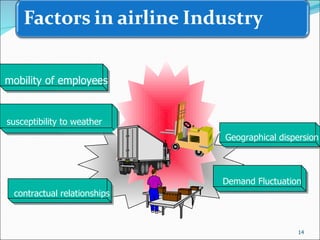
Geographical dispersion mobility of employees Demand Fluctuation contractual relationships susceptibility to weather
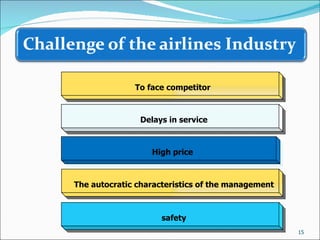
To face competitor  Delays in service safety High price The autocratic characteristics of the management
THANK YOU

Airline industry

  • 3.
    Outline Introduction TQMTQM and airline Industry Elements of Tqm in airline Benefits of TQM for airline The Difficulties in Implementing
  • 4.
    INTRODUCTION Some ofthe airline problems such as fluctuation of demand (non-steady state) create difficulties in TQM implementation and TQM could only help the industry to cope with such fluctuations
  • 5.
    To achieve CustomerSatisfaction & Cost Effectiveness Focusing on process improvement, customer/employee involvement & training Aims Of TQM in airline industry
  • 6.
    TQM , QualityControl (QC) and Quality Assurance (QA), QA and QC are applied during project implementation while TQM is a strategic philosophy adopted by an organization and implemented on a continuous basis, even if the organization is waiting to perform a new project
  • 7.
    Elements of TQMContinuous Improvement Communication Focus on Employees Customer Satisfaction Mgt. Commitment Training Teamwork Process Improvement employees Involvement
  • 8.
    consistency Reduced riskof failure Improvement in customer perceptions of the organization Reduction in operating cost Reduced delay time Customer Satisfaction Increase in profit Decrease in costs
  • 9.
    The Difficulties inImplementing TQM in airline industry Fundamental organizational culture change Inadequate knowledge and information about TQM Doubts of employees about management’s intentions Difficulty in measuring the effectiveness of TQM Poor internal communication Difficulty in assessing customer expectations and satisfaction Failure of management to maintain interest and commitment over a long period of time
  • 10.
    To be ableto attain and sustain reasonable objectives To justify the use of resources To identify quality problems To provide standards for establishing comparisons To determine priority areas that requires improvement
  • 11.
    TQM Measurement inairline Industry Concentrate on the measurement of service ’ since it is a service-intensive industry Other measures could be developed to measure the rework and the effect of the training on minimizing the rework, the effect of improvement in inventory and materials handling and equipment operation Criteria for selecting measurement : Progress Continuous Improvement Forecasting
  • 12.
    Benchmarking is oneof the tools which may be used for obtaining quality improvement in TQM Efficiency Effectiveness Productivity Quality Improvement
  • 13.
    Mission Reliability SustainableProfit Convenient Consistent
  • 14.
    Geographical dispersion mobilityof employees Demand Fluctuation contractual relationships susceptibility to weather
  • 15.
    To face competitor Delays in service safety High price The autocratic characteristics of the management
  • 16.