



ORGANISATIONDEVELOPMENT AND CHANGEHUMAN RESOURCES MANGEMENT INTERVENTIONPRESENTED BY:-               1.Kawaljit Singh2.Sudhir Basoya3.Rupinder Singh4.Neha Jain5.Suraj Kumar1
WHAT IS OD INTERVENTIONThe term OD intervention refers to the planned activities clients and consultants participate in during the course of an organizational development program.
These activities are designed to improve the organization's functioning by helping organization members better manage their team and organization cultures and processes.2
Intervention Overview Human Process Interventions
 Techno structural Interventions
 Human Resources Management Interventions
 Strategic Interventions3
GOAL SETTING=(compensation + Benefits)*Performance Mangement4
Definition of Goal Setting“The moment of enlightenment is when a person’s dreams of possibilitiesbecome images of probabilities.”Vic BradenDon’t be afraid of the space between your dreams and reality. If you can dream it, you can make it so.”Belva Davis5
WHAT IS GOAL SETTING ?Goal setting is a process for thinking about your ideal future and for motivating yourself to turn this vision of the future into reality.
The process of goal setting will help you where you want to go in life.
Properly set goals can be incredibly motivating and as you get into the habit of setting and achieving goals ,you will find your self confidence builds fast.6
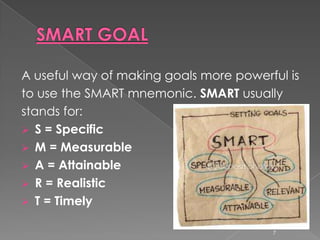
SMART GOALA useful way of making goals more powerful isto use the SMART mnemonic. SMART usuallystands for:S = Specific
M = Measurable
A = Attainable
R = Realistic
T = Timely7
Be SpecificGoals should be straightforward and emphasize what you want to happen. Specific is the What, Why, and How of the SMART model.WHAT are you going to do? Use action words such as direct, organize, coordinate, lead, develop, plan, build etc.
WHY is this important to do at this time? What do you want to ultimately accomplish?
HOW are you going to do it?8
MeasurableIf you can’t measure it, you can’t manage itChoose a goal with measurable progress, so you can see the change occur. Be specific! Establish criteria for measuring progress toward the attainment of each goal .When you measure your progress, you stay on track, reach your target dates, and experience the exhilaration of achievement that spurs you on to continued effort required to reach your goals.9
AttainableWhen you identify goals that are most important to you, you begin to figure out ways you can make them come true. You develop that attitudes, abilities, skills, and financial capacity to reach them. Goals you set which are too far out of your reach, you probably won’t commit to doing10
RealisticRealistic, in this case, means “do-able” not easy. A realistic project may push the skills and knowledge of the people working on it but it shouldn’t break them.Devise a plan or a way of getting there which makes the goal realistic. Be sure to set goals that you can attain with some effort.Set the bar high enough for a satisfying achievement.11
Time TargetedSet a time target on all goals. This keeps you focused and hold you accountableIf you don’t set a time, the commitment is too vague.
Without a time limit, there’s no urgency to start taking action now.Split it up in to steps if the goal is overwhelming12
PERFORMANCEAPPRAISAL13
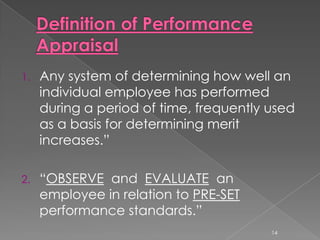
Definition of Performance  AppraisalAny system of determining how well an individual employee has performed during a period of time, frequently used as a basis for determining merit increases.”“OBSERVE  and  EVALUATE  an employee in relation to PRE-SET  performance standards.”14
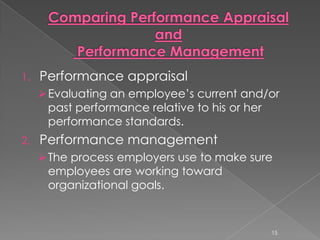
Comparing Performance Appraisal and Performance ManagementPerformance appraisalEvaluating an employee’s current and/or past performance relative to his or her performance standards.Performance managementThe process employers use to make sure employees are working toward organizational goals.15
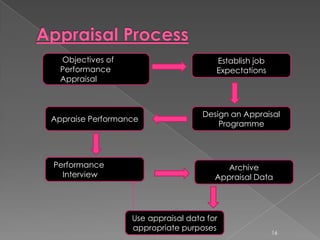
Appraisal ProcessEstablish job Expectations     Objectives of Performance AppraisalDesign an Appraisal ProgrammeAppraise PerformancePerformance InterviewArchiveAppraisal DataUse appraisal data for appropriate purposes16
An Introduction to AppraisingPerformanceWhy appraise performance?Appraisals play an integral role in the employer’s performance management process.
Appraisals help in planning for correcting deficiencies and reinforce things done correctly.
Appraisals, in identifying employee strengths and weaknesses, are useful for career planning
Appraisals affect the employer’s salary raise decisions.17
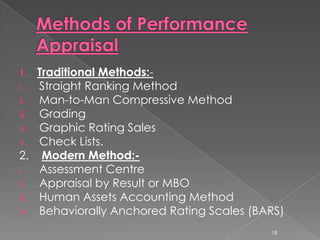
Methods of Performance AppraisalTraditional Methods:-Straight Ranking MethodMan-to-Man Compressive MethodGradingGraphic Rating SalesCheck Lists.2.    Modern Method:-Assessment CentreAppraisal by Result or MBOHuman Assets Accounting MethodBehaviorally Anchored Rating Scales (BARS)18
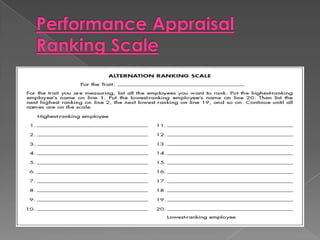
Performance Appraisal Ranking Scale
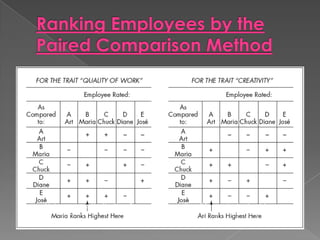
Ranking Employees by the Paired Comparison MethodNote: + means “better than.” − means “worse than.” For each chart, add up the number of 1’s in each column to get the highest-ranked employee.
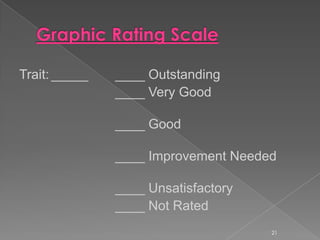
Graphic Rating ScaleTrait:	_____	____ Outstanding					____ Very Good							____ Good								____ Improvement Needed					____ Unsatisfactory				____ Not Rated 21
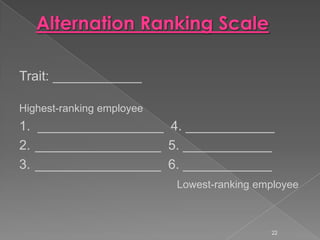
Alternation Ranking ScaleTrait: ____________Highest-ranking employee1.  _________________  4. ____________2.	_________________  5. ____________3.	_________________  6. ____________Lowest-ranking employee22
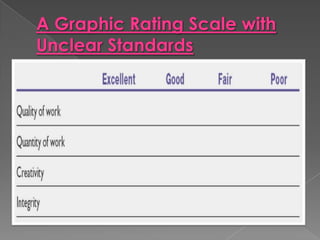
A Graphic Rating Scale with Unclear Standards
REWARD SYSTEM24
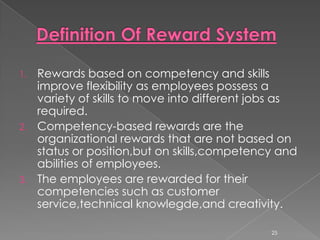
Definition Of Reward SystemRewards based on competency and skills improve flexibility as employees possess a variety of skills to move into different jobs asrequired.Competency-based rewards are the organizational rewards that are not based on status or position,but on skills,competency and abilities of employees.The employees are rewarded for their competencies such as customer service,technicalknowlegde,and creativity.25

Intervention 2011

  • 1.
    ORGANISATIONDEVELOPMENT AND CHANGEHUMANRESOURCES MANGEMENT INTERVENTIONPRESENTED BY:- 1.Kawaljit Singh2.Sudhir Basoya3.Rupinder Singh4.Neha Jain5.Suraj Kumar1
  • 2.
    WHAT IS ODINTERVENTIONThe term OD intervention refers to the planned activities clients and consultants participate in during the course of an organizational development program.
  • 3.
    These activities aredesigned to improve the organization's functioning by helping organization members better manage their team and organization cultures and processes.2
  • 4.
    Intervention Overview HumanProcess Interventions
  • 5.
    Techno structuralInterventions
  • 6.
    Human ResourcesManagement Interventions
  • 7.
  • 8.
    GOAL SETTING=(compensation +Benefits)*Performance Mangement4
  • 9.
    Definition of GoalSetting“The moment of enlightenment is when a person’s dreams of possibilitiesbecome images of probabilities.”Vic BradenDon’t be afraid of the space between your dreams and reality. If you can dream it, you can make it so.”Belva Davis5
  • 10.
    WHAT IS GOALSETTING ?Goal setting is a process for thinking about your ideal future and for motivating yourself to turn this vision of the future into reality.
  • 11.
    The process ofgoal setting will help you where you want to go in life.
  • 12.
    Properly set goalscan be incredibly motivating and as you get into the habit of setting and achieving goals ,you will find your self confidence builds fast.6
  • 13.
    SMART GOALA usefulway of making goals more powerful isto use the SMART mnemonic. SMART usuallystands for:S = Specific
  • 14.
  • 15.
  • 16.
  • 17.
  • 18.
    Be SpecificGoals shouldbe straightforward and emphasize what you want to happen. Specific is the What, Why, and How of the SMART model.WHAT are you going to do? Use action words such as direct, organize, coordinate, lead, develop, plan, build etc.
  • 19.
    WHY is thisimportant to do at this time? What do you want to ultimately accomplish?
  • 20.
    HOW are yougoing to do it?8
  • 21.
    MeasurableIf you can’tmeasure it, you can’t manage itChoose a goal with measurable progress, so you can see the change occur. Be specific! Establish criteria for measuring progress toward the attainment of each goal .When you measure your progress, you stay on track, reach your target dates, and experience the exhilaration of achievement that spurs you on to continued effort required to reach your goals.9
  • 22.
    AttainableWhen you identifygoals that are most important to you, you begin to figure out ways you can make them come true. You develop that attitudes, abilities, skills, and financial capacity to reach them. Goals you set which are too far out of your reach, you probably won’t commit to doing10
  • 23.
    RealisticRealistic, in thiscase, means “do-able” not easy. A realistic project may push the skills and knowledge of the people working on it but it shouldn’t break them.Devise a plan or a way of getting there which makes the goal realistic. Be sure to set goals that you can attain with some effort.Set the bar high enough for a satisfying achievement.11
  • 24.
    Time TargetedSet atime target on all goals. This keeps you focused and hold you accountableIf you don’t set a time, the commitment is too vague.
  • 25.
    Without a timelimit, there’s no urgency to start taking action now.Split it up in to steps if the goal is overwhelming12
  • 26.
  • 27.
    Definition of Performance AppraisalAny system of determining how well an individual employee has performed during a period of time, frequently used as a basis for determining merit increases.”“OBSERVE and EVALUATE an employee in relation to PRE-SET performance standards.”14
  • 28.
    Comparing Performance Appraisaland Performance ManagementPerformance appraisalEvaluating an employee’s current and/or past performance relative to his or her performance standards.Performance managementThe process employers use to make sure employees are working toward organizational goals.15
  • 29.
    Appraisal ProcessEstablish jobExpectations Objectives of Performance AppraisalDesign an Appraisal ProgrammeAppraise PerformancePerformance InterviewArchiveAppraisal DataUse appraisal data for appropriate purposes16
  • 30.
    An Introduction toAppraisingPerformanceWhy appraise performance?Appraisals play an integral role in the employer’s performance management process.
  • 31.
    Appraisals help inplanning for correcting deficiencies and reinforce things done correctly.
  • 32.
    Appraisals, in identifyingemployee strengths and weaknesses, are useful for career planning
  • 33.
    Appraisals affect theemployer’s salary raise decisions.17
  • 34.
    Methods of PerformanceAppraisalTraditional Methods:-Straight Ranking MethodMan-to-Man Compressive MethodGradingGraphic Rating SalesCheck Lists.2. Modern Method:-Assessment CentreAppraisal by Result or MBOHuman Assets Accounting MethodBehaviorally Anchored Rating Scales (BARS)18
  • 35.
  • 36.
    Ranking Employees bythe Paired Comparison MethodNote: + means “better than.” − means “worse than.” For each chart, add up the number of 1’s in each column to get the highest-ranked employee.
  • 37.
    Graphic Rating ScaleTrait: _____ ____Outstanding ____ Very Good ____ Good ____ Improvement Needed ____ Unsatisfactory ____ Not Rated 21
  • 38.
    Alternation Ranking ScaleTrait:____________Highest-ranking employee1. _________________ 4. ____________2. _________________ 5. ____________3. _________________ 6. ____________Lowest-ranking employee22
  • 39.
    A Graphic RatingScale with Unclear Standards
  • 40.
  • 41.
    Definition Of RewardSystemRewards based on competency and skills improve flexibility as employees possess a variety of skills to move into different jobs asrequired.Competency-based rewards are the organizational rewards that are not based on status or position,but on skills,competency and abilities of employees.The employees are rewarded for their competencies such as customer service,technicalknowlegde,and creativity.25