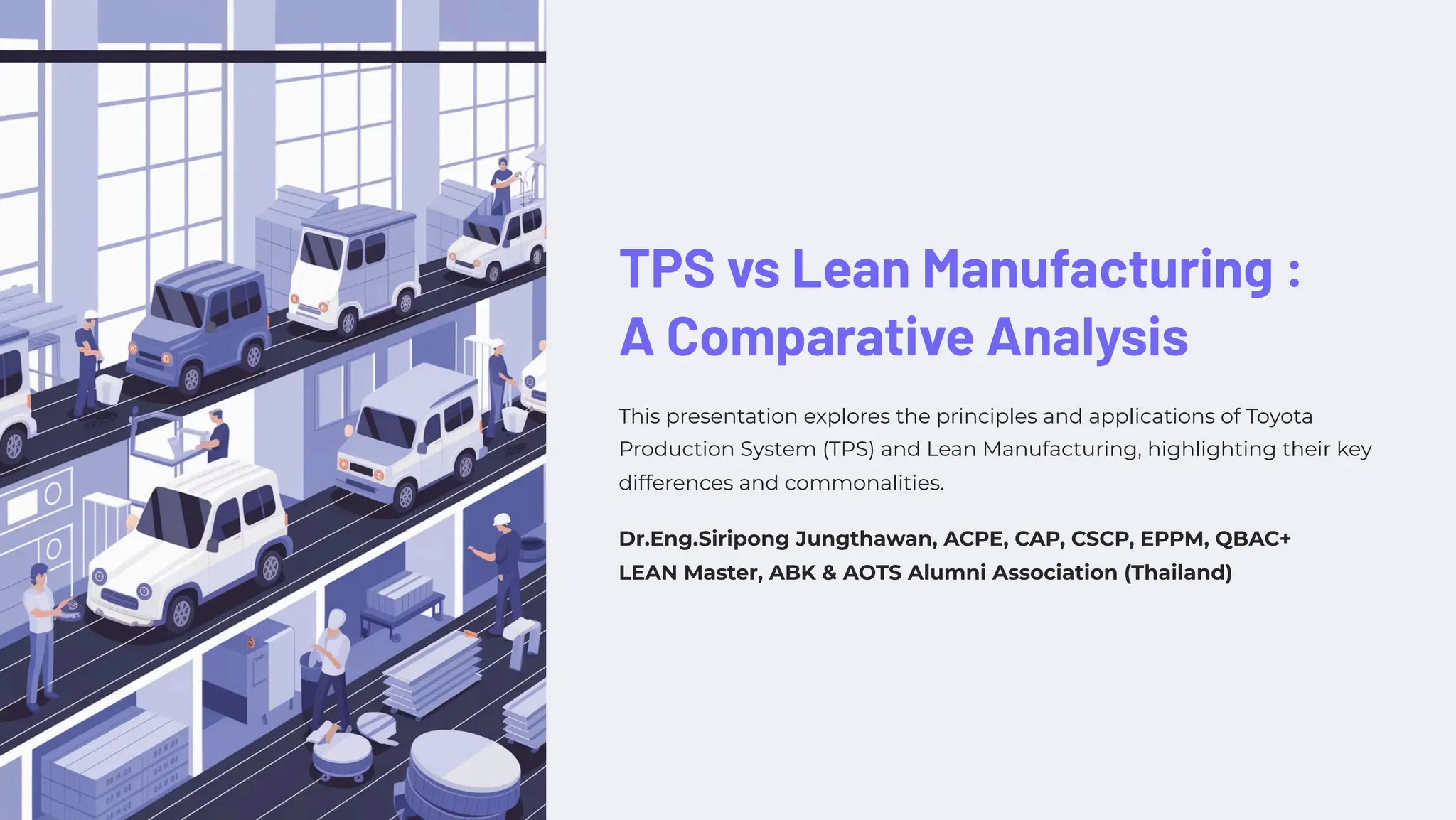
TPS vs Lean Manufacturing :
A Comparative Analysis
This presentation explores the principles and applications of Toyota
Production System (TPS) and Lean Manufacturing, highlighting their key
differences and commonalities.
Dr.Eng.Siripong Jungthawan, ACPE, CAP, CSCP, EPPM, QBAC+
LEAN Master, ABK & AOTS Alumni Association (Thailand)
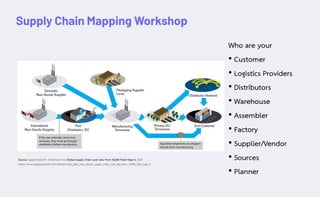
Supply Chain Mapping Workshop
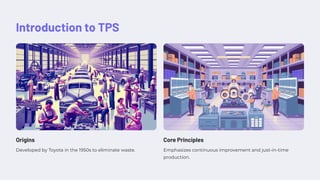
Introduction to TPS
Origins
Developed by Toyota in the 1950s to eliminate waste.
Core Principles
Emphasizes continuous improvement and just-in-time
production.
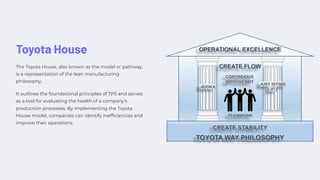
Toyota House
The Toyota House, also known as the model or pathway,
is a representation of the lean manufacturing
philosophy.
It outlines the foundational principles of TPS and serves
as a tool for evaluating the health of a company's
production processes. By implementing the Toyota
House model, companies can identify inefficiencies and
improve their operations.
Jidoka: Automation
with Error Detection
Definition
Jidoka involves
automating processes
and incorporating error
detection mechanisms.
Benefits
It reduces human error,
improves product quality,
and enhances overall
production efficiency.
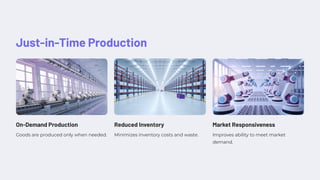
Just-in-Time Production
On-Demand Production
Goods are produced only when needed.
Reduced Inventory
Minimizes inventory costs and waste.
Market Responsiveness
Improves ability to meet market
demand.
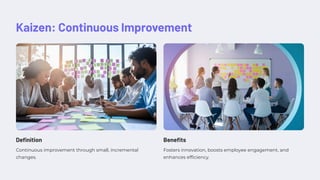
Kaizen: Continuous Improvement
Definition
Continuous improvement through small, incremental
changes.
Benefits
Fosters innovation, boosts employee engagement, and
enhances efficiency.
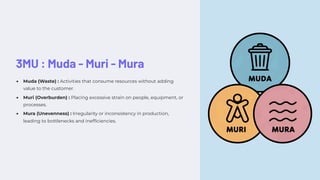
3MU : Muda - Muri - Mura
Muda (Waste) : Activities that consume resources without adding
value to the customer.
Muri (Overburden) : Placing excessive strain on people, equipment, or
processes.
Mura (Unevenness) : Irregularity or inconsistency in production,
leading to bottlenecks and inefficiencies.
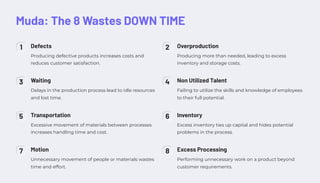
Muda: The 8 Wastes DOWN TIME
1 Defects
Producing defective products increases costs and
reduces customer satisfaction.
2 Overproduction
Producing more than needed, leading to excess
inventory and storage costs.
3 Waiting
Delays in the production process lead to idle resources
and lost time.
4 Non Utilized Talent
Failing to utilize the skills and knowledge of employees
to their full potential.
5 Transportation
Excessive movement of materials between processes
increases handling time and cost.
6 Inventory
Excess inventory ties up capital and hides potential
problems in the process.
7 Motion
Unnecessary movement of people or materials wastes
time and effort.
8 Excess Processing
Performing unnecessary work on a product beyond
customer requirements.
8 WASTES Workshop :
8 Mins to Brainstorm
A4 paper per person
Fold in half 3 times
8 blocks
8 minutes to write the 8 wastes
Muri: Overburden
Definition
Overworking employees or equipment.
Impact
Fatigue, errors, and breakdowns.
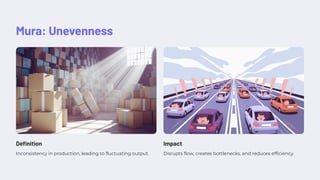
Mura: Unevenness
Definition
Inconsistency in production, leading to fluctuating output.
Impact
Disrupts flow, creates bottlenecks, and reduces efficiency.
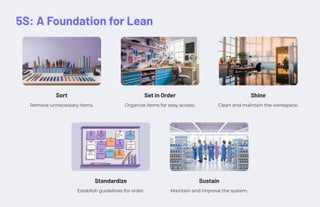
5S: A Foundation for Lean
Sort
Remove unnecessary items.
Set in Order
Organize items for easy access.
Shine
Clean and maintain the workspace.
Standardize
Establish guidelines for order.
Sustain
Maintain and improve the system.
Extending 5S
1 Safety
Prioritize employee safety by
addressing hazards and
implementing preventive
measures.
2 Standardization
Develop standard operating
procedures and best practices to
ensure consistency.
3 Skills
Invest in employee training and
development to enhance their
skills and knowledge.
4 Sustainability
Promote environmentally friendly practices and reduce
the environmental impact of production.
5 Servitization
Shift from product-centric to service-centric offerings,
providing value-added services to customers.
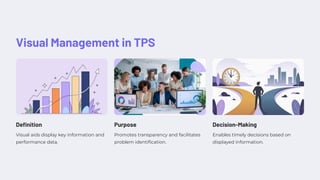
Visual Management in TPS
Definition
Visual aids display key information and
performance data.
Purpose
Promotes transparency and facilitates
problem identification.
Decision-Making
Enables timely decisions based on
displayed information.
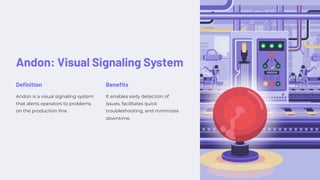
Andon: Visual Signaling System
Definition
Andon is a visual signaling system
that alerts operators to problems
on the production line.
Benefits
It enables early detection of
issues, facilitates quick
troubleshooting, and minimizes
downtime.
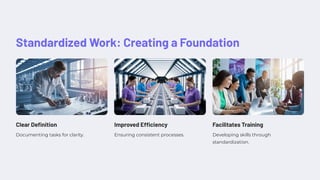
Standardized Work: Creating a Foundation
Clear Definition
Documenting tasks for clarity.
Improved Efficiency
Ensuring consistent processes.
Facilitates Training
Developing skills through
standardization.
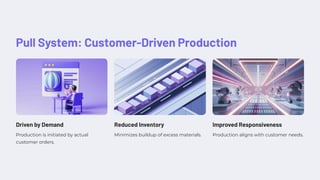
Pull System: Customer-Driven Production
Driven by Demand
Production is initiated by actual
customer orders.
Reduced Inventory
Minimizes buildup of excess materials.
Improved Responsiveness
Production aligns with customer needs.
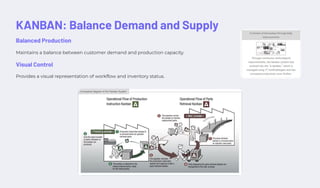
KANBAN: Balance Demand and Supply
Balanced Production
Maintains a balance between customer demand and production capacity.
Visual Control
Provides a visual representation of workflow and inventory status.
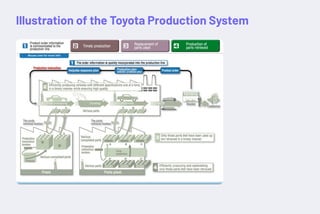
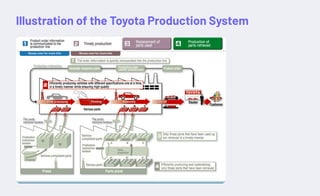
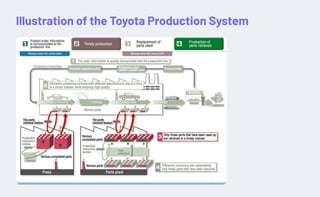
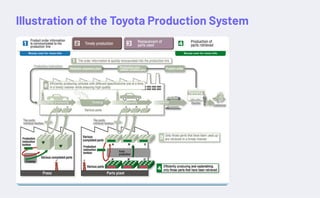
Illustration of the Toyota Production System
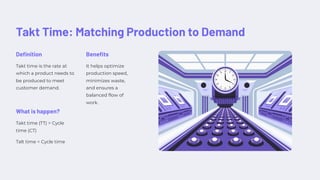
Takt Time: Matching Production to Demand
Definition
Takt time is the rate at
which a product needs to
be produced to meet
customer demand.
What is happen?
Takt time (TT) > Cycle
time (CT)
Talt time < Cycle time
Benefits
It helps optimize
production speed,
minimizes waste,
and ensures a
balanced flow of
work.
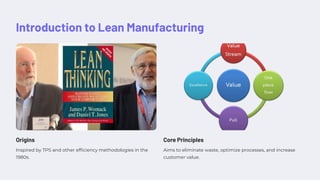
Introduction to Lean Manufacturing
Origins
Inspired by TPS and other efficiency methodologies in the
1980s.
Core Principles
Aims to eliminate waste, optimize processes, and increase
customer value.
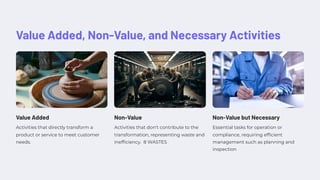
Value Added, Non-Value, and Necessary Activities
Value Added
Activities that directly transform a
product or service to meet customer
needs.
Non-Value
Activities that don't contribute to the
transformation, representing waste and
inefficiency. 8 WASTES
Non-Value but Necessary
Essential tasks for operation or
compliance, requiring efficient
management such as planning and
inspection
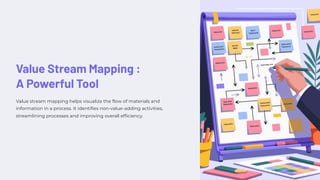
Value Stream Mapping :
A Powerful Tool
Value stream mapping helps visualize the flow of materials and
information in a process. It identifies non-value-adding activities,
streamlining processes and improving overall efficiency.
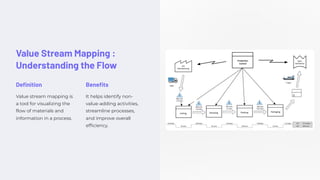
Value Stream Mapping :
Understanding the Flow
Definition
Value stream mapping is
a tool for visualizing the
flow of materials and
information in a process.
Benefits
It helps identify non-
value-adding activities,
streamline processes,
and improve overall
efficiency.
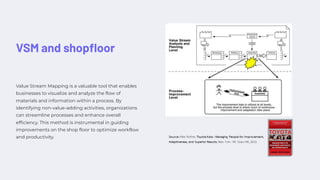
VSM and shopfloor
Value Stream Mapping is a valuable tool that enables
businesses to visualize and analyze the flow of
materials and information within a process. By
identifying non-value-adding activities, organizations
can streamline processes and enhance overall
efficiency. This method is instrumental in guiding
improvements on the shop floor to optimize workflow
and productivity.
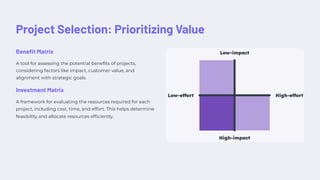
Project Selection: Prioritizing Value
Benefit Matrix
A tool for assessing the potential benefits of projects,
considering factors like impact, customer value, and
alignment with strategic goals.
Investment Matrix
A framework for evaluating the resources required for each
project, including cost, time, and effort. This helps determine
feasibility and allocate resources efficiently.
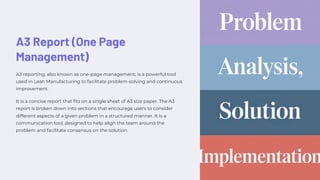
A3 Report (One Page
Management)
A3 reporting, also known as one-page management, is a powerful tool
used in Lean Manufacturing to facilitate problem-solving and continuous
improvement.
It is a concise report that fits on a single sheet of A3 size paper. The A3
report is broken down into sections that encourage users to consider
different aspects of a given problem in a structured manner. It is a
communication tool, designed to help align the team around the
problem and facilitate consensus on the solution.
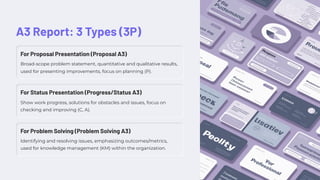
A3 Report: 3 Types (3P)
For Proposal Presentation (Proposal A3)
Broad-scope problem statement, quantitative and qualitative results,
used for presenting improvements, focus on planning (P).
For Status Presentation (Progress/Status A3)
Show work progress, solutions for obstacles and issues, focus on
checking and improving (C, A).
For Problem Solving (Problem Solving A3)
Identifying and resolving issues, emphasizing outcomes/metrics,
used for knowledge management (KM) within the organization.
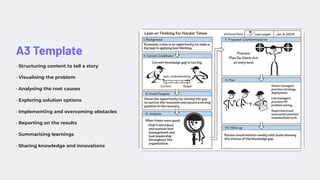
A3 Template
â€Ē Structuring content to tell a story
â€Ē Visualising the problem
â€Ē Analysing the root causes
â€Ē Exploring solution options
â€Ē Implementing and overcoming obstacles
â€Ē Reporting on the results
â€Ē Summarising learnings
â€Ē Sharing knowledge and innovations
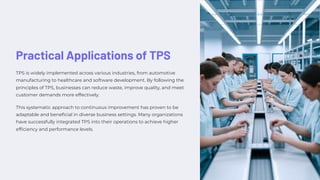
Practical Applications of TPS
TPS is widely implemented across various industries, from automotive
manufacturing to healthcare and software development. By following the
principles of TPS, businesses can reduce waste, improve quality, and meet
customer demands more effectively.
This systematic approach to continuous improvement has proven to be
adaptable and beneficial in diverse business settings. Many organizations
have successfully integrated TPS into their operations to achieve higher
efficiency and performance levels.
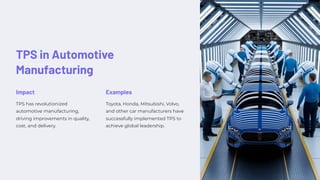
TPS in Automotive
Manufacturing
Impact
TPS has revolutionized
automotive manufacturing,
driving improvements in quality,
cost, and delivery.
Examples
Toyota, Honda, Mitsubishi, Volvo,
and other car manufacturers have
successfully implemented TPS to
achieve global leadership.
TPS in Healthcare
Impact
TPS principles can improve patient care, reduce errors, and
optimize resource utilization.
Examples
Hospitals and clinics are using TPS to enhance patient flow,
reduce wait times, and improve overall efficiency.
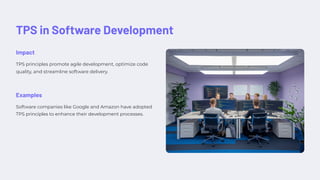
TPS in Software Development
Impact
TPS principles promote agile development, optimize code
quality, and streamline software delivery.
Examples
Software companies like Google and Amazon have adopted
TPS principles to enhance their development processes.
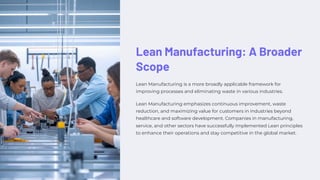
Lean Manufacturing: A Broader
Scope
Lean Manufacturing is a more broadly applicable framework for
improving processes and eliminating waste in various industries.
Lean Manufacturing emphasizes continuous improvement, waste
reduction, and maximizing value for customers in industries beyond
healthcare and software development. Companies in manufacturing,
service, and other sectors have successfully implemented Lean principles
to enhance their operations and stay competitive in the global market.
Lean in Manufacturing
Impact
Lean Manufacturing has
transformed traditional
manufacturing processes, driving
efficiency and productivity gains.
Examples
Companies in sectors like
aerospace, electronics, and food
processing have implemented
Lean principles successfully.
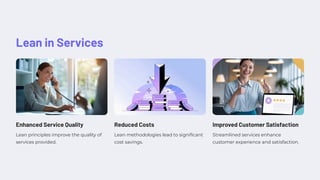
Lean in Services
Enhanced Service Quality
Lean principles improve the quality of
services provided.
Reduced Costs
Lean methodologies lead to significant
cost savings.
Improved Customer Satisfaction
Streamlined services enhance
customer experience and satisfaction.
Lean in Healthcare
Impact
Lean principles can improve
patient flow, reduce wait times,
and enhance the overall
healthcare experience.
Examples
Hospitals and clinics are
implementing Lean
methodologies to optimize their
operations and provide better
patient care.
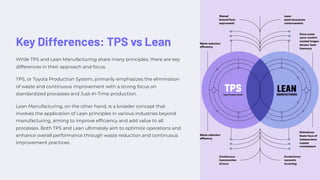
Key Differences: TPS vs Lean
While TPS and Lean Manufacturing share many principles, there are key
differences in their approach and focus.
TPS, or Toyota Production System, primarily emphasizes the elimination
of waste and continuous improvement with a strong focus on
standardized processes and Just-In-Time production.
Lean Manufacturing, on the other hand, is a broader concept that
involves the application of Lean principles in various industries beyond
manufacturing, aiming to improve efficiency and add value to all
processes. Both TPS and Lean ultimately aim to optimize operations and
enhance overall performance through waste reduction and continuous
improvement practices.
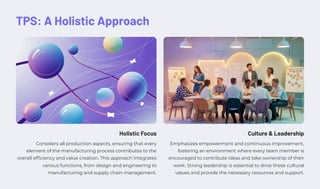
TPS: A Holistic Approach
Holistic Focus
Considers all production aspects, ensuring that every
element of the manufacturing process contributes to the
overall efficiency and value creation. This approach integrates
various functions, from design and engineering to
manufacturing and supply chain management.
Culture & Leadership
Emphasizes empowerment and continuous improvement,
fostering an environment where every team member is
encouraged to contribute ideas and take ownership of their
work. Strong leadership is essential to drive these cultural
values and provide the necessary resources and support.
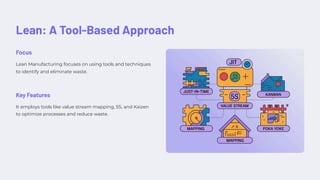
Lean: A Tool-Based Approach
Focus
Lean Manufacturing focuses on using tools and techniques
to identify and eliminate waste.
Key Features
It employs tools like value stream mapping, 5S, and Kaizen
to optimize processes and reduce waste.
TPS: Focused on Value
Customer Needs
TPS prioritizes delivering what
customers truly value.
Quality & Reliability
Emphasizes quality and reliability in
every product.
Customer Satisfaction
Aims for high customer satisfaction
through valuable products.
Lean: Focused on Efficiency
Maximizing Efficiency
Lean focuses on efficient
processes.
Minimizing Waste
Lean aims to reduce waste in
all forms.
Reducing Costs
Lean methodologies lead to
cost savings.
Streamlined Approach
Lean provides a streamlined
way of working.
TPS: Strong Culture of Continuous Improvement
Employee Empowerment
Engaged employees drive innovation
and continuous improvement.
Continuous Improvement
Actively seeking ways to enhance
processes and eliminate waste.
Leadership Support
Supportive leadership fosters a culture
of innovation and progress.
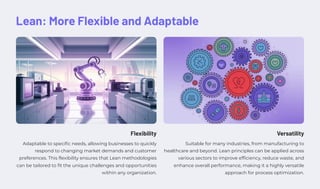
Lean: More Flexible and Adaptable
Flexibility
Adaptable to specific needs, allowing businesses to quickly
respond to changing market demands and customer
preferences. This flexibility ensures that Lean methodologies
can be tailored to fit the unique challenges and opportunities
within any organization.
Versatility
Suitable for many industries, from manufacturing to
healthcare and beyond. Lean principles can be applied across
various sectors to improve efficiency, reduce waste, and
enhance overall performance, making it a highly versatile
approach for process optimization.
Current Trends in Lean Manufacturing
Lean Manufacturing is continuously evolving, incorporating new technologies and methodologies to improve efficiency and
effectiveness.
Lean 4.0: Integration of digital technologies like IoT, cloud computing, and cyber-physical systems to create smart, connected
factories.
Digital Twins: Creating virtual replicas of physical assets and processes to simulate and optimize performance.
Artificial Intelligence in Lean: Using AI and machine learning to automate tasks, predict outcomes, and improve decision-
making.
Big Data Analytics in Lean: Leveraging data analytics to identify patterns, optimize processes, and reduce waste.
Lean for Sustainability: Focusing on reducing environmental impact through waste reduction, energy efficiency, and
sustainable materials.
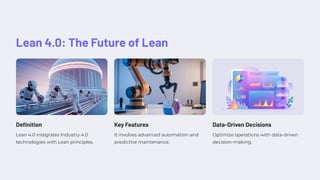
Lean 4.0: The Future of Lean
Definition
Lean 4.0 integrates Industry 4.0
technologies with Lean principles.
Key Features
It involves advanced automation and
predictive maintenance.
Data-Driven Decisions
Optimize operations with data-driven
decision-making.
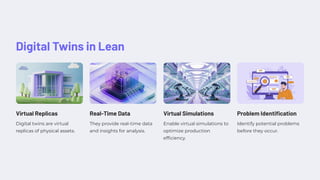
Digital Twins in Lean
Virtual Replicas
Digital twins are virtual
replicas of physical assets.
Real-Time Data
They provide real-time data
and insights for analysis.
Virtual Simulations
Enable virtual simulations to
optimize production
efficiency.
Problem Identification
Identify potential problems
before they occur.
Artificial Intelligence in Lean
Applications
AI can automate tasks, predict
equipment failures, and optimize
resource allocation.
Benefits
It improves efficiency, reduces
downtime, and enhances the
overall production process.
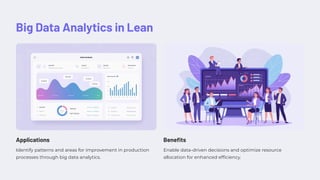
Big Data Analytics in Lean
Applications
Identify patterns and areas for improvement in production
processes through big data analytics.
Benefits
Enable data-driven decisions and optimize resource
allocation for enhanced efficiency.
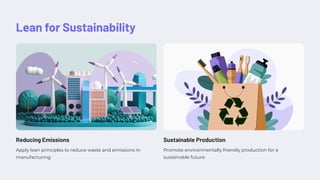
Lean for Sustainability
Reducing Emissions
Apply lean principles to reduce waste and emissions in
manufacturing.
Sustainable Production
Promote environmentally friendly production for a
sustainable future.
Lean for Innovation
Focus
Lean principles can foster
innovation by encouraging
creativity, experimentation, and
rapid prototyping.
Benefits
It helps companies develop new
products faster, respond to
market changes, and stay
competitive.
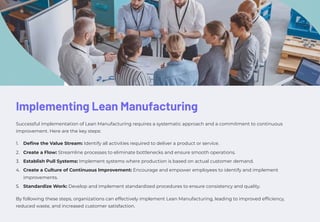
Implementing Lean Manufacturing
Successful implementation of Lean Manufacturing requires a systematic approach and a commitment to continuous
improvement. Here are the key steps:
Define the Value Stream: Identify all activities required to deliver a product or service.
1.
Create a Flow: Streamline processes to eliminate bottlenecks and ensure smooth operations.
2.
Establish Pull Systems: Implement systems where production is based on actual customer demand.
3.
Create a Culture of Continuous Improvement: Encourage and empower employees to identify and implement
improvements.
4.
Standardize Work: Develop and implement standardized procedures to ensure consistency and quality.
5.
By following these steps, organizations can effectively implement Lean Manufacturing, leading to improved efficiency,
reduced waste, and increased customer satisfaction.
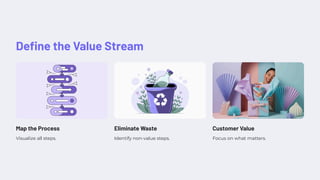
Define the Value Stream
Map the Process
Visualize all steps.
Eliminate Waste
Identify non-value steps.
Customer Value
Focus on what matters.
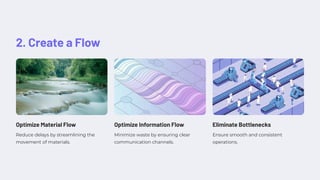
2. Create a Flow
Optimize Material Flow
Reduce delays by streamlining the
movement of materials.
Optimize Information Flow
Minimize waste by ensuring clear
communication channels.
Eliminate Bottlenecks
Ensure smooth and consistent
operations.
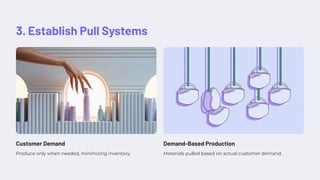
3. Establish Pull Systems
Customer Demand
Produce only when needed, minimizing inventory.
Demand-Based Production
Materials pulled based on actual customer demand.
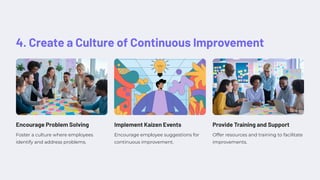
4. Create a Culture of Continuous Improvement
Encourage Problem Solving
Foster a culture where employees
identify and address problems.
Implement Kaizen Events
Encourage employee suggestions for
continuous improvement.
Provide Training and Support
Offer resources and training to facilitate
improvements.
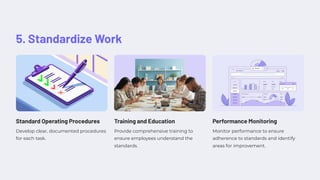
5. Standardize Work
Standard Operating Procedures
Develop clear, documented procedures
for each task.
Training and Education
Provide comprehensive training to
ensure employees understand the
standards.
Performance Monitoring
Monitor performance to ensure
adherence to standards and identify
areas for improvement.
Challenges of Lean
Implementation
Implementing Lean Manufacturing successfully can be challenging,
requiring a combination of leadership, commitment, and a willingness to
change.
Companies must be prepared to invest resources in training and
development to successfully implement Lean Manufacturing. This
includes ongoing support and reinforcement of Lean principles to sustain
long-term success.
Resistance to Change
Challenge
Employees may resist changes to familiar processes and
routines.
Solution
Communicate the benefits of Lean, provide training and
support, and involve employees in the process.
Lack of Leadership Commitment
Challenge
Without commitment from leadership, Lean initiatives can
fail.
Solution
Leadership should support Lean, sharing the vision and
providing resources.
Insufficient Training and Support
Lack of Skills
Employees may lack the skills to implement Lean.
Comprehensive Training
Provide training to master Lean techniques.
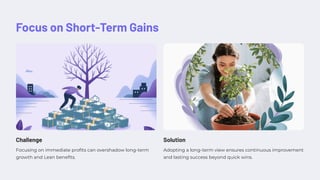
Focus on Short-Term Gains
Challenge
Focusing on immediate profits can overshadow long-term
growth and Lean benefits.
Solution
Adopting a long-term view ensures continuous improvement
and lasting success beyond quick wins.
Measuring Lean
Success
Measuring Lean success is crucial to track progress,
identify areas for improvement, and demonstrate the
value of Lean initiatives.
Implement key performance indicators (KPIs) to
monitor Lean success metrics accurately. Regularly
review KPIs to assess the impact of Lean initiatives and
adjust strategies as needed. This data-driven approach
helps in effectively measuring the success of Lean
implementation and guiding continuous improvement
efforts.
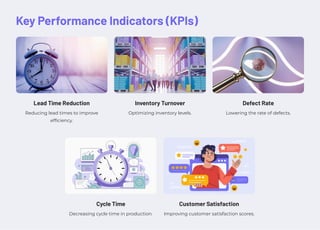
Key Performance Indicators (KPIs)
Lead Time Reduction
Reducing lead times to improve
efficiency.
Inventory Turnover
Optimizing inventory levels.
Defect Rate
Lowering the rate of defects.
Cycle Time
Decreasing cycle time in production.
Customer Satisfaction
Improving customer satisfaction scores.
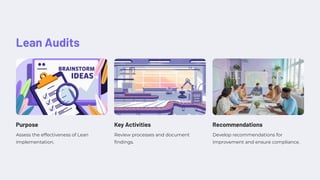
Lean Audits
Purpose
Assess the effectiveness of Lean
implementation.
Key Activities
Review processes and document
findings.
Recommendations
Develop recommendations for
improvement and ensure compliance.
Continuous Improvement: The
Lean Mindset
The core of Lean Manufacturing is a commitment to continuous
improvement, a mindset that drives constant innovation and
optimization.
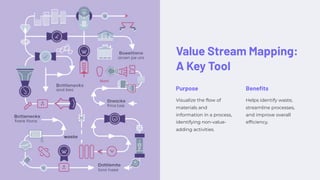
Value Stream Mapping:
A Key Tool
Purpose
Visualize the flow of
materials and
information in a process,
identifying non-value-
adding activities.
Benefits
Helps identify waste,
streamline processes,
and improve overall
efficiency.
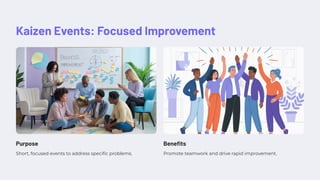
Kaizen Events: Focused Improvement
Purpose
Short, focused events to address specific problems.
Benefits
Promote teamwork and drive rapid improvement.
Lean for the Future
Lean Manufacturing is constantly evolving, embracing new technologies
and adapting to changing market demands.
The evolution of Lean Manufacturing includes the incorporation of new
technologies to enhance efficiency, as well as the flexibility to adjust
strategies in response to shifting market dynamics. This ongoing
adaptation ensures that Lean principles remain relevant and effective in
meeting the demands of the future.
Industry 4.0 and Lean
Impact
Industry 4.0 technologies are transforming Lean
Manufacturing, enabling greater automation and
optimization.
Benefits
It leads to increased efficiency, improved quality, and greater
adaptability to changing market conditions.
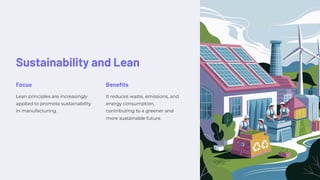
Sustainability and Lean
Focus
Lean principles are increasingly
applied to promote sustainability
in manufacturing.
Benefits
It reduces waste, emissions, and
energy consumption,
contributing to a greener and
more sustainable future.
Conclusion: A Journey of
Continuous Improvement
TPS and Lean Manufacturing provide a framework for achieving
operational excellence, driving efficiency, and delivering value to
customers. By embracing a culture of continuous improvement,
organizations can leverage Lean principles to adapt to changing market
dynamics and thrive in the competitive landscape.

TPS vs Lean Manufacturing A Comparative Analysis

  • 1.
    TPS vs LeanManufacturing : A Comparative Analysis This presentation explores the principles and applications of Toyota Production System (TPS) and Lean Manufacturing, highlighting their key differences and commonalities. Dr.Eng.Siripong Jungthawan, ACPE, CAP, CSCP, EPPM, QBAC+ LEAN Master, ABK & AOTS Alumni Association (Thailand)
  • 7.
  • 9.
    Introduction to TPS Origins Developedby Toyota in the 1950s to eliminate waste. Core Principles Emphasizes continuous improvement and just-in-time production.
  • 10.
    Toyota House The ToyotaHouse, also known as the model or pathway, is a representation of the lean manufacturing philosophy. It outlines the foundational principles of TPS and serves as a tool for evaluating the health of a company's production processes. By implementing the Toyota House model, companies can identify inefficiencies and improve their operations.
  • 11.
    Jidoka: Automation with ErrorDetection Definition Jidoka involves automating processes and incorporating error detection mechanisms. Benefits It reduces human error, improves product quality, and enhances overall production efficiency.
  • 12.
    Just-in-Time Production On-Demand Production Goodsare produced only when needed. Reduced Inventory Minimizes inventory costs and waste. Market Responsiveness Improves ability to meet market demand.
  • 14.
    Kaizen: Continuous Improvement Definition Continuousimprovement through small, incremental changes. Benefits Fosters innovation, boosts employee engagement, and enhances efficiency.
  • 15.
    3MU : Muda- Muri - Mura Muda (Waste) : Activities that consume resources without adding value to the customer. Muri (Overburden) : Placing excessive strain on people, equipment, or processes. Mura (Unevenness) : Irregularity or inconsistency in production, leading to bottlenecks and inefficiencies.
  • 16.
    Muda: The 8Wastes DOWN TIME 1 Defects Producing defective products increases costs and reduces customer satisfaction. 2 Overproduction Producing more than needed, leading to excess inventory and storage costs. 3 Waiting Delays in the production process lead to idle resources and lost time. 4 Non Utilized Talent Failing to utilize the skills and knowledge of employees to their full potential. 5 Transportation Excessive movement of materials between processes increases handling time and cost. 6 Inventory Excess inventory ties up capital and hides potential problems in the process. 7 Motion Unnecessary movement of people or materials wastes time and effort. 8 Excess Processing Performing unnecessary work on a product beyond customer requirements.
  • 17.
    8 WASTES Workshop: 8 Mins to Brainstorm A4 paper per person Fold in half 3 times 8 blocks 8 minutes to write the 8 wastes
  • 18.
    Muri: Overburden Definition Overworking employeesor equipment. Impact Fatigue, errors, and breakdowns.
  • 19.
    Mura: Unevenness Definition Inconsistency inproduction, leading to fluctuating output. Impact Disrupts flow, creates bottlenecks, and reduces efficiency.
  • 20.
    5S: A Foundationfor Lean Sort Remove unnecessary items. Set in Order Organize items for easy access. Shine Clean and maintain the workspace. Standardize Establish guidelines for order. Sustain Maintain and improve the system.
  • 21.
    Extending 5S 1 Safety Prioritizeemployee safety by addressing hazards and implementing preventive measures. 2 Standardization Develop standard operating procedures and best practices to ensure consistency. 3 Skills Invest in employee training and development to enhance their skills and knowledge. 4 Sustainability Promote environmentally friendly practices and reduce the environmental impact of production. 5 Servitization Shift from product-centric to service-centric offerings, providing value-added services to customers.
  • 22.
    Visual Management inTPS Definition Visual aids display key information and performance data. Purpose Promotes transparency and facilitates problem identification. Decision-Making Enables timely decisions based on displayed information.
  • 23.
    Andon: Visual SignalingSystem Definition Andon is a visual signaling system that alerts operators to problems on the production line. Benefits It enables early detection of issues, facilitates quick troubleshooting, and minimizes downtime.
  • 24.
    Standardized Work: Creatinga Foundation Clear Definition Documenting tasks for clarity. Improved Efficiency Ensuring consistent processes. Facilitates Training Developing skills through standardization.
  • 25.
    Pull System: Customer-DrivenProduction Driven by Demand Production is initiated by actual customer orders. Reduced Inventory Minimizes buildup of excess materials. Improved Responsiveness Production aligns with customer needs.
  • 26.
    KANBAN: Balance Demandand Supply Balanced Production Maintains a balance between customer demand and production capacity. Visual Control Provides a visual representation of workflow and inventory status.
  • 27.
    Illustration of theToyota Production System
  • 28.
    Illustration of theToyota Production System
  • 29.
    Illustration of theToyota Production System
  • 30.
    Illustration of theToyota Production System
  • 31.
    Takt Time: MatchingProduction to Demand Definition Takt time is the rate at which a product needs to be produced to meet customer demand. What is happen? Takt time (TT) > Cycle time (CT) Talt time < Cycle time Benefits It helps optimize production speed, minimizes waste, and ensures a balanced flow of work.
  • 32.
    Introduction to LeanManufacturing Origins Inspired by TPS and other efficiency methodologies in the 1980s. Core Principles Aims to eliminate waste, optimize processes, and increase customer value.
  • 33.
    Value Added, Non-Value,and Necessary Activities Value Added Activities that directly transform a product or service to meet customer needs. Non-Value Activities that don't contribute to the transformation, representing waste and inefficiency. 8 WASTES Non-Value but Necessary Essential tasks for operation or compliance, requiring efficient management such as planning and inspection
  • 35.
    Value Stream Mapping: A Powerful Tool Value stream mapping helps visualize the flow of materials and information in a process. It identifies non-value-adding activities, streamlining processes and improving overall efficiency.
  • 36.
    Value Stream Mapping: Understanding the Flow Definition Value stream mapping is a tool for visualizing the flow of materials and information in a process. Benefits It helps identify non- value-adding activities, streamline processes, and improve overall efficiency.
  • 40.
    VSM and shopfloor ValueStream Mapping is a valuable tool that enables businesses to visualize and analyze the flow of materials and information within a process. By identifying non-value-adding activities, organizations can streamline processes and enhance overall efficiency. This method is instrumental in guiding improvements on the shop floor to optimize workflow and productivity.
  • 41.
    Project Selection: PrioritizingValue Benefit Matrix A tool for assessing the potential benefits of projects, considering factors like impact, customer value, and alignment with strategic goals. Investment Matrix A framework for evaluating the resources required for each project, including cost, time, and effort. This helps determine feasibility and allocate resources efficiently.
  • 42.
    A3 Report (OnePage Management) A3 reporting, also known as one-page management, is a powerful tool used in Lean Manufacturing to facilitate problem-solving and continuous improvement. It is a concise report that fits on a single sheet of A3 size paper. The A3 report is broken down into sections that encourage users to consider different aspects of a given problem in a structured manner. It is a communication tool, designed to help align the team around the problem and facilitate consensus on the solution.
  • 43.
    A3 Report: 3Types (3P) For Proposal Presentation (Proposal A3) Broad-scope problem statement, quantitative and qualitative results, used for presenting improvements, focus on planning (P). For Status Presentation (Progress/Status A3) Show work progress, solutions for obstacles and issues, focus on checking and improving (C, A). For Problem Solving (Problem Solving A3) Identifying and resolving issues, emphasizing outcomes/metrics, used for knowledge management (KM) within the organization.
  • 44.
    A3 Template â€Ē Structuringcontent to tell a story â€Ē Visualising the problem â€Ē Analysing the root causes â€Ē Exploring solution options â€Ē Implementing and overcoming obstacles â€Ē Reporting on the results â€Ē Summarising learnings â€Ē Sharing knowledge and innovations
  • 45.
    Practical Applications ofTPS TPS is widely implemented across various industries, from automotive manufacturing to healthcare and software development. By following the principles of TPS, businesses can reduce waste, improve quality, and meet customer demands more effectively. This systematic approach to continuous improvement has proven to be adaptable and beneficial in diverse business settings. Many organizations have successfully integrated TPS into their operations to achieve higher efficiency and performance levels.
  • 46.
    TPS in Automotive Manufacturing Impact TPShas revolutionized automotive manufacturing, driving improvements in quality, cost, and delivery. Examples Toyota, Honda, Mitsubishi, Volvo, and other car manufacturers have successfully implemented TPS to achieve global leadership.
  • 47.
    TPS in Healthcare Impact TPSprinciples can improve patient care, reduce errors, and optimize resource utilization. Examples Hospitals and clinics are using TPS to enhance patient flow, reduce wait times, and improve overall efficiency.
  • 48.
    TPS in SoftwareDevelopment Impact TPS principles promote agile development, optimize code quality, and streamline software delivery. Examples Software companies like Google and Amazon have adopted TPS principles to enhance their development processes.
  • 49.
    Lean Manufacturing: ABroader Scope Lean Manufacturing is a more broadly applicable framework for improving processes and eliminating waste in various industries. Lean Manufacturing emphasizes continuous improvement, waste reduction, and maximizing value for customers in industries beyond healthcare and software development. Companies in manufacturing, service, and other sectors have successfully implemented Lean principles to enhance their operations and stay competitive in the global market.
  • 50.
    Lean in Manufacturing Impact LeanManufacturing has transformed traditional manufacturing processes, driving efficiency and productivity gains. Examples Companies in sectors like aerospace, electronics, and food processing have implemented Lean principles successfully.
  • 51.
    Lean in Services EnhancedService Quality Lean principles improve the quality of services provided. Reduced Costs Lean methodologies lead to significant cost savings. Improved Customer Satisfaction Streamlined services enhance customer experience and satisfaction.
  • 52.
    Lean in Healthcare Impact Leanprinciples can improve patient flow, reduce wait times, and enhance the overall healthcare experience. Examples Hospitals and clinics are implementing Lean methodologies to optimize their operations and provide better patient care.
  • 53.
    Key Differences: TPSvs Lean While TPS and Lean Manufacturing share many principles, there are key differences in their approach and focus. TPS, or Toyota Production System, primarily emphasizes the elimination of waste and continuous improvement with a strong focus on standardized processes and Just-In-Time production. Lean Manufacturing, on the other hand, is a broader concept that involves the application of Lean principles in various industries beyond manufacturing, aiming to improve efficiency and add value to all processes. Both TPS and Lean ultimately aim to optimize operations and enhance overall performance through waste reduction and continuous improvement practices.
  • 54.
    TPS: A HolisticApproach Holistic Focus Considers all production aspects, ensuring that every element of the manufacturing process contributes to the overall efficiency and value creation. This approach integrates various functions, from design and engineering to manufacturing and supply chain management. Culture & Leadership Emphasizes empowerment and continuous improvement, fostering an environment where every team member is encouraged to contribute ideas and take ownership of their work. Strong leadership is essential to drive these cultural values and provide the necessary resources and support.
  • 55.
    Lean: A Tool-BasedApproach Focus Lean Manufacturing focuses on using tools and techniques to identify and eliminate waste. Key Features It employs tools like value stream mapping, 5S, and Kaizen to optimize processes and reduce waste.
  • 56.
    TPS: Focused onValue Customer Needs TPS prioritizes delivering what customers truly value. Quality & Reliability Emphasizes quality and reliability in every product. Customer Satisfaction Aims for high customer satisfaction through valuable products.
  • 57.
    Lean: Focused onEfficiency Maximizing Efficiency Lean focuses on efficient processes. Minimizing Waste Lean aims to reduce waste in all forms. Reducing Costs Lean methodologies lead to cost savings. Streamlined Approach Lean provides a streamlined way of working.
  • 58.
    TPS: Strong Cultureof Continuous Improvement Employee Empowerment Engaged employees drive innovation and continuous improvement. Continuous Improvement Actively seeking ways to enhance processes and eliminate waste. Leadership Support Supportive leadership fosters a culture of innovation and progress.
  • 59.
    Lean: More Flexibleand Adaptable Flexibility Adaptable to specific needs, allowing businesses to quickly respond to changing market demands and customer preferences. This flexibility ensures that Lean methodologies can be tailored to fit the unique challenges and opportunities within any organization. Versatility Suitable for many industries, from manufacturing to healthcare and beyond. Lean principles can be applied across various sectors to improve efficiency, reduce waste, and enhance overall performance, making it a highly versatile approach for process optimization.
  • 60.
    Current Trends inLean Manufacturing Lean Manufacturing is continuously evolving, incorporating new technologies and methodologies to improve efficiency and effectiveness. Lean 4.0: Integration of digital technologies like IoT, cloud computing, and cyber-physical systems to create smart, connected factories. Digital Twins: Creating virtual replicas of physical assets and processes to simulate and optimize performance. Artificial Intelligence in Lean: Using AI and machine learning to automate tasks, predict outcomes, and improve decision- making. Big Data Analytics in Lean: Leveraging data analytics to identify patterns, optimize processes, and reduce waste. Lean for Sustainability: Focusing on reducing environmental impact through waste reduction, energy efficiency, and sustainable materials.
  • 61.
    Lean 4.0: TheFuture of Lean Definition Lean 4.0 integrates Industry 4.0 technologies with Lean principles. Key Features It involves advanced automation and predictive maintenance. Data-Driven Decisions Optimize operations with data-driven decision-making.
  • 62.
    Digital Twins inLean Virtual Replicas Digital twins are virtual replicas of physical assets. Real-Time Data They provide real-time data and insights for analysis. Virtual Simulations Enable virtual simulations to optimize production efficiency. Problem Identification Identify potential problems before they occur.
  • 63.
    Artificial Intelligence inLean Applications AI can automate tasks, predict equipment failures, and optimize resource allocation. Benefits It improves efficiency, reduces downtime, and enhances the overall production process.
  • 64.
    Big Data Analyticsin Lean Applications Identify patterns and areas for improvement in production processes through big data analytics. Benefits Enable data-driven decisions and optimize resource allocation for enhanced efficiency.
  • 65.
    Lean for Sustainability ReducingEmissions Apply lean principles to reduce waste and emissions in manufacturing. Sustainable Production Promote environmentally friendly production for a sustainable future.
  • 66.
    Lean for Innovation Focus Leanprinciples can foster innovation by encouraging creativity, experimentation, and rapid prototyping. Benefits It helps companies develop new products faster, respond to market changes, and stay competitive.
  • 67.
    Implementing Lean Manufacturing Successfulimplementation of Lean Manufacturing requires a systematic approach and a commitment to continuous improvement. Here are the key steps: Define the Value Stream: Identify all activities required to deliver a product or service. 1. Create a Flow: Streamline processes to eliminate bottlenecks and ensure smooth operations. 2. Establish Pull Systems: Implement systems where production is based on actual customer demand. 3. Create a Culture of Continuous Improvement: Encourage and empower employees to identify and implement improvements. 4. Standardize Work: Develop and implement standardized procedures to ensure consistency and quality. 5. By following these steps, organizations can effectively implement Lean Manufacturing, leading to improved efficiency, reduced waste, and increased customer satisfaction.
  • 68.
    Define the ValueStream Map the Process Visualize all steps. Eliminate Waste Identify non-value steps. Customer Value Focus on what matters.
  • 69.
    2. Create aFlow Optimize Material Flow Reduce delays by streamlining the movement of materials. Optimize Information Flow Minimize waste by ensuring clear communication channels. Eliminate Bottlenecks Ensure smooth and consistent operations.
  • 70.
    3. Establish PullSystems Customer Demand Produce only when needed, minimizing inventory. Demand-Based Production Materials pulled based on actual customer demand.
  • 71.
    4. Create aCulture of Continuous Improvement Encourage Problem Solving Foster a culture where employees identify and address problems. Implement Kaizen Events Encourage employee suggestions for continuous improvement. Provide Training and Support Offer resources and training to facilitate improvements.
  • 72.
    5. Standardize Work StandardOperating Procedures Develop clear, documented procedures for each task. Training and Education Provide comprehensive training to ensure employees understand the standards. Performance Monitoring Monitor performance to ensure adherence to standards and identify areas for improvement.
  • 73.
    Challenges of Lean Implementation ImplementingLean Manufacturing successfully can be challenging, requiring a combination of leadership, commitment, and a willingness to change. Companies must be prepared to invest resources in training and development to successfully implement Lean Manufacturing. This includes ongoing support and reinforcement of Lean principles to sustain long-term success.
  • 74.
    Resistance to Change Challenge Employeesmay resist changes to familiar processes and routines. Solution Communicate the benefits of Lean, provide training and support, and involve employees in the process.
  • 75.
    Lack of LeadershipCommitment Challenge Without commitment from leadership, Lean initiatives can fail. Solution Leadership should support Lean, sharing the vision and providing resources.
  • 76.
    Insufficient Training andSupport Lack of Skills Employees may lack the skills to implement Lean. Comprehensive Training Provide training to master Lean techniques.
  • 77.
    Focus on Short-TermGains Challenge Focusing on immediate profits can overshadow long-term growth and Lean benefits. Solution Adopting a long-term view ensures continuous improvement and lasting success beyond quick wins.
  • 78.
    Measuring Lean Success Measuring Leansuccess is crucial to track progress, identify areas for improvement, and demonstrate the value of Lean initiatives. Implement key performance indicators (KPIs) to monitor Lean success metrics accurately. Regularly review KPIs to assess the impact of Lean initiatives and adjust strategies as needed. This data-driven approach helps in effectively measuring the success of Lean implementation and guiding continuous improvement efforts.
  • 79.
    Key Performance Indicators(KPIs) Lead Time Reduction Reducing lead times to improve efficiency. Inventory Turnover Optimizing inventory levels. Defect Rate Lowering the rate of defects. Cycle Time Decreasing cycle time in production. Customer Satisfaction Improving customer satisfaction scores.
  • 80.
    Lean Audits Purpose Assess theeffectiveness of Lean implementation. Key Activities Review processes and document findings. Recommendations Develop recommendations for improvement and ensure compliance.
  • 81.
    Continuous Improvement: The LeanMindset The core of Lean Manufacturing is a commitment to continuous improvement, a mindset that drives constant innovation and optimization.
  • 82.
    Value Stream Mapping: AKey Tool Purpose Visualize the flow of materials and information in a process, identifying non-value- adding activities. Benefits Helps identify waste, streamline processes, and improve overall efficiency.
  • 83.
    Kaizen Events: FocusedImprovement Purpose Short, focused events to address specific problems. Benefits Promote teamwork and drive rapid improvement.
  • 84.
    Lean for theFuture Lean Manufacturing is constantly evolving, embracing new technologies and adapting to changing market demands. The evolution of Lean Manufacturing includes the incorporation of new technologies to enhance efficiency, as well as the flexibility to adjust strategies in response to shifting market dynamics. This ongoing adaptation ensures that Lean principles remain relevant and effective in meeting the demands of the future.
  • 85.
    Industry 4.0 andLean Impact Industry 4.0 technologies are transforming Lean Manufacturing, enabling greater automation and optimization. Benefits It leads to increased efficiency, improved quality, and greater adaptability to changing market conditions.
  • 86.
    Sustainability and Lean Focus Leanprinciples are increasingly applied to promote sustainability in manufacturing. Benefits It reduces waste, emissions, and energy consumption, contributing to a greener and more sustainable future.
  • 87.
    Conclusion: A Journeyof Continuous Improvement TPS and Lean Manufacturing provide a framework for achieving operational excellence, driving efficiency, and delivering value to customers. By embracing a culture of continuous improvement, organizations can leverage Lean principles to adapt to changing market dynamics and thrive in the competitive landscape.