WHAT ARE LEAN TOOLS? WHY SHOULD YOU
UTILIZE THEM?
Lean Tools are the medium through which “Lean Manufacturing” is carried
out, with an aim to “Create Value for Customers by reducing Non-value added
activities /efforts and thus, reduce Production time and cost’’.
“The Toyota Way” is Toyota’s 1930 operating model that led to the idea of “Lean
Manufacturing” to optimize production and supply chain practice and achieve
Operational Excellence. Lean Manufacturing or Lean Production is a practice that
focuses on the reduction of utilization of resources other than creating value for
the end customer, and thus a target for minimizing waste and optimizing the
process.
The term “Lean” was coined in 1988 by John Krafcik and defined in 1996 by James
Womack and Daniel Jones. The practice consists of five main principles.

Precisely specify a value for the product.

Identify value adding & non- value added activities for process.

Make value flow without interruptions

Let customer pull value from the producer

Pursue perfection
WHAT IS A LEAN ORGANIZATION ?
A lean practicing organization understands the customer value and consistently
works towards providing a comprehensive value to consumers by following a
perfect value creation process with zero waste. They follow a lean practice and
utilize the lean tools to fulfill the aim.
WHAT IS WASTE ?
Waste is any expense or effort that does not add any value to the customer. Since
the elimination of waste is one of the major objectives of Lean, the ‘waste’ is
defined in three types.

Muri (overburden): Focuses on preparation and planning of the process, or
what work can be avoided proactively by design.

Mura (unevenness): Focuses on the work design process and the elimination of
fluctuation at the scheduling or operations level, such as quality and volume.

Muda (waste): This is discovered after the process is in place and is dealt with
reactively. It is seen through variation in output. It is the role of management to
examine the muda.
The original seven mudas (wastes) are:

Transport

Inventory

Motion

Waiting

Overproduction

Over Processing

Defects
WHAT ARE LEAN TOOLS?
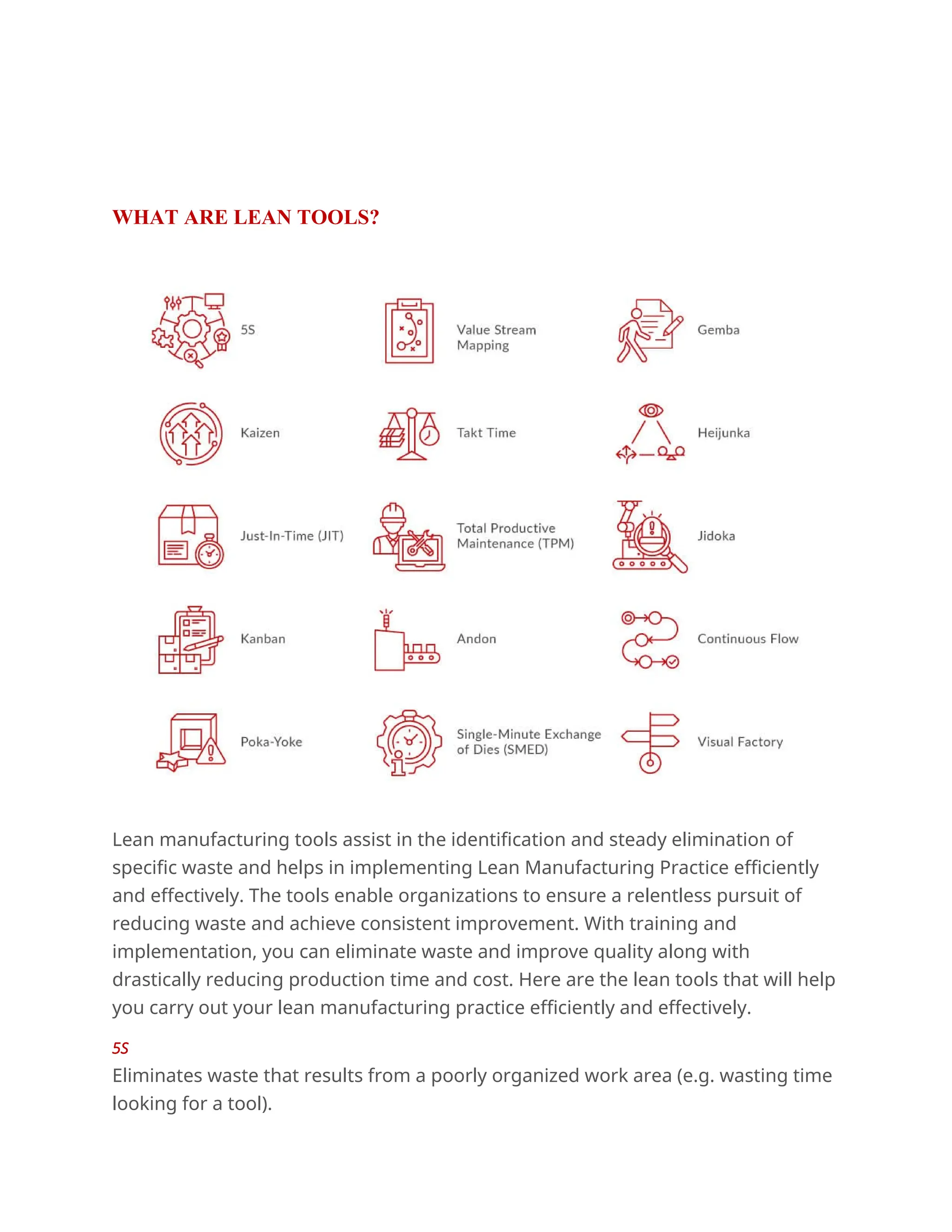
Lean manufacturing tools assist in the identification and steady elimination of
specific waste and helps in implementing Lean Manufacturing Practice efficiently
and effectively. The tools enable organizations to ensure a relentless pursuit of
reducing waste and achieve consistent improvement. With training and
implementation, you can eliminate waste and improve quality along with
drastically reducing production time and cost. Here are the lean tools that will help
you carry out your lean manufacturing practice efficiently and effectively.
5S
Eliminates waste that results from a poorly organized work area (e.g. wasting time
looking for a tool).

Sort (eliminate that which is not needed)

Set In Order (organize remaining items)

Shine (clean and inspect work area)

Standardize (write standards for above)

Sustain (regularly apply the standards)
Kaizen
Kaizen stands for continuous improvement. It focuses on a strategy where
employees work together proactively to achieve regular, incremental
improvements in the manufacturing process.
Just-In-Time (JIT)
Just-In-Time pull parts through production based on customer demand instead of
pushing parts through production based on projected demand.
Kanban
Kanban means pull system. It is a method of regulating the flow of goods both
within the factory and with outside suppliers and customers. Kanban eliminates
waste from inventory and overproduction.
Poka-Yoke
Poka-Yoke is error proofing. It designs error detection and prevention into
production processes with the goal of achieving zero defects. Since it is
challenging and expensive to find all defects through inspection, and correcting
defects gets significantly more expensive at each stage of production, this tool
enables you to ensure error-proofing throughout.
Value Stream Mapping
Value Stream Mapping is a tool used to visually map the flow of production. It
creates detailed visualization of all the steps in your process. Also, it shows the
complete flow of goods right from supplier to the customer through the entire
organization and, in a way, highlights opportunities for improvement.
Takt Time
Takt Time is the total amount of time required to produce a product in order to
meet the customer demand. It focuses on aligning the pace of production with
customer demand. It is calculated as Planned Production Time / Customer
Demand.
Total Productive Maintenance (TPM)
TPM is a holistic methodology that aims to maintain the continuous proactive
production process and integrity of the work process to maximize the operational
time of equipment. It creates a shared responsibility for equipment and boosts
floor workers to take a greater involvement in maintenance.
Andon
Andon means a status-display notion. It is a visual feedback system for the plant
floor designed to alert operators and managers about real-time issues so that
corrective measures can be taken immediately.
Continuous Flow
It is a method where work-in-process smoothly flows through production with
minimal (or no) buffers between steps of the manufacturing process.
Gemba
Gemba means ‘The Actual Place’. It is a philosophy that dictates to get out of
offices and spend time on the plant floor – the place where the real action occurs.
Gemba aims to promote the understanding of the real-world manufacturing issues
– by first-hand observation and by talking with plant floor employees.
Heijunka
Heijunka stands for level scheduling. It reduces the unevenness in the production
process, minimizes the chances or possibilities of overburden.
Jidoka
Jidoka deals with the quality of the product. Widely known as autonomation, it
protects your company from delivering low-quality or defective products.
Single-Minute Exchange of Dies (SMED)
SMED reduces setup (changeover) time to less than 10 minutes. Techniques
include:

Convert setup steps to be external (performed while the process is running)

Simplify internal setup (e.g. replace bolts with knobs and levers)

Eliminate non-essential operations

Create Standardized Work instructions
Visual Factory
Visual indicators, displays and controls are used throughout manufacturing plants
to improve communication of information. It consists of a set of charts, direction
signage, information representation that enables quick dissemination of data.
Our Lean Manufacturing Consultants have experience in all verticals of business
and are experts in providing lean manufacturing training with a solution, Total
Quality Management that’s cost-effective, efficient and reliable in the long-run. 4C
team has provided lean tool services and training to 45+ clients and 1300+ training
hours along with 60+ certifications. To know more about how you can practice lean
manufacturing in your organization, talk to our consultant now.

WHAT ARE LEAN TOOLS : WHY SHOULD YOU UTILIZE THEM

  • 1.
    WHAT ARE LEANTOOLS? WHY SHOULD YOU UTILIZE THEM? Lean Tools are the medium through which “Lean Manufacturing” is carried out, with an aim to “Create Value for Customers by reducing Non-value added activities /efforts and thus, reduce Production time and cost’’. “The Toyota Way” is Toyota’s 1930 operating model that led to the idea of “Lean Manufacturing” to optimize production and supply chain practice and achieve Operational Excellence. Lean Manufacturing or Lean Production is a practice that focuses on the reduction of utilization of resources other than creating value for the end customer, and thus a target for minimizing waste and optimizing the process. The term “Lean” was coined in 1988 by John Krafcik and defined in 1996 by James Womack and Daniel Jones. The practice consists of five main principles.  Precisely specify a value for the product.
  • 2.
     Identify value adding& non- value added activities for process.  Make value flow without interruptions  Let customer pull value from the producer  Pursue perfection WHAT IS A LEAN ORGANIZATION ? A lean practicing organization understands the customer value and consistently works towards providing a comprehensive value to consumers by following a perfect value creation process with zero waste. They follow a lean practice and utilize the lean tools to fulfill the aim. WHAT IS WASTE ? Waste is any expense or effort that does not add any value to the customer. Since the elimination of waste is one of the major objectives of Lean, the ‘waste’ is defined in three types.  Muri (overburden): Focuses on preparation and planning of the process, or what work can be avoided proactively by design.  Mura (unevenness): Focuses on the work design process and the elimination of fluctuation at the scheduling or operations level, such as quality and volume.  Muda (waste): This is discovered after the process is in place and is dealt with reactively. It is seen through variation in output. It is the role of management to examine the muda. The original seven mudas (wastes) are:  Transport  Inventory  Motion  Waiting  Overproduction  Over Processing  Defects
  • 3.
    WHAT ARE LEANTOOLS? Lean manufacturing tools assist in the identification and steady elimination of specific waste and helps in implementing Lean Manufacturing Practice efficiently and effectively. The tools enable organizations to ensure a relentless pursuit of reducing waste and achieve consistent improvement. With training and implementation, you can eliminate waste and improve quality along with drastically reducing production time and cost. Here are the lean tools that will help you carry out your lean manufacturing practice efficiently and effectively. 5S Eliminates waste that results from a poorly organized work area (e.g. wasting time looking for a tool).
  • 4.
     Sort (eliminate thatwhich is not needed)  Set In Order (organize remaining items)  Shine (clean and inspect work area)  Standardize (write standards for above)  Sustain (regularly apply the standards) Kaizen Kaizen stands for continuous improvement. It focuses on a strategy where employees work together proactively to achieve regular, incremental improvements in the manufacturing process. Just-In-Time (JIT) Just-In-Time pull parts through production based on customer demand instead of pushing parts through production based on projected demand. Kanban Kanban means pull system. It is a method of regulating the flow of goods both within the factory and with outside suppliers and customers. Kanban eliminates waste from inventory and overproduction. Poka-Yoke Poka-Yoke is error proofing. It designs error detection and prevention into production processes with the goal of achieving zero defects. Since it is challenging and expensive to find all defects through inspection, and correcting defects gets significantly more expensive at each stage of production, this tool enables you to ensure error-proofing throughout. Value Stream Mapping Value Stream Mapping is a tool used to visually map the flow of production. It creates detailed visualization of all the steps in your process. Also, it shows the complete flow of goods right from supplier to the customer through the entire organization and, in a way, highlights opportunities for improvement. Takt Time Takt Time is the total amount of time required to produce a product in order to meet the customer demand. It focuses on aligning the pace of production with customer demand. It is calculated as Planned Production Time / Customer Demand.
  • 5.
    Total Productive Maintenance(TPM) TPM is a holistic methodology that aims to maintain the continuous proactive production process and integrity of the work process to maximize the operational time of equipment. It creates a shared responsibility for equipment and boosts floor workers to take a greater involvement in maintenance. Andon Andon means a status-display notion. It is a visual feedback system for the plant floor designed to alert operators and managers about real-time issues so that corrective measures can be taken immediately. Continuous Flow It is a method where work-in-process smoothly flows through production with minimal (or no) buffers between steps of the manufacturing process. Gemba Gemba means ‘The Actual Place’. It is a philosophy that dictates to get out of offices and spend time on the plant floor – the place where the real action occurs. Gemba aims to promote the understanding of the real-world manufacturing issues – by first-hand observation and by talking with plant floor employees. Heijunka Heijunka stands for level scheduling. It reduces the unevenness in the production process, minimizes the chances or possibilities of overburden. Jidoka Jidoka deals with the quality of the product. Widely known as autonomation, it protects your company from delivering low-quality or defective products. Single-Minute Exchange of Dies (SMED) SMED reduces setup (changeover) time to less than 10 minutes. Techniques include:  Convert setup steps to be external (performed while the process is running)  Simplify internal setup (e.g. replace bolts with knobs and levers)  Eliminate non-essential operations  Create Standardized Work instructions
  • 6.
    Visual Factory Visual indicators,displays and controls are used throughout manufacturing plants to improve communication of information. It consists of a set of charts, direction signage, information representation that enables quick dissemination of data. Our Lean Manufacturing Consultants have experience in all verticals of business and are experts in providing lean manufacturing training with a solution, Total Quality Management that’s cost-effective, efficient and reliable in the long-run. 4C team has provided lean tool services and training to 45+ clients and 1300+ training hours along with 60+ certifications. To know more about how you can practice lean manufacturing in your organization, talk to our consultant now.