Tips and Tools to be effective
Toyota Way for Continuous Improvement
Anita Rao
June 2013
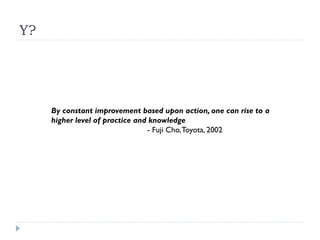
Y?
By constant improvement based upon action, one can rise to a
higher level of practice and knowledge
- Fuji Cho,Toyota, 2002
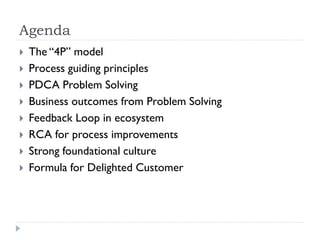
Agenda
 The “4P” model
 Process guiding principles
 PDCA Problem Solving
 Business outcomes from Problem Solving
 Feedback Loop in ecosystem
 RCA for process improvements
 Strong foundational culture
 Formula for Delighted Customer
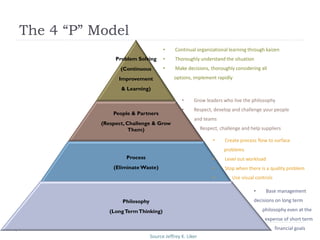
The 4 “P” Model
Process
(Eliminate Waste)
People & Partners
(Respect, Challenge & Grow
Them)
Problem Solving
(Continuous
Improvement
& Learning)
• Continual organizational learning through kaizen
• Thoroughly understand the situation
• Make decisions, thoroughly considering all
options, implement rapidly
• Base management
decisions on long term
philosophy even at the
expense of short term
financial goals
• Create process flow to surface
problems
• Level out workload
• Stop when there is a quality problem
• Use visual controls
• Grow leaders who live the philosophy
• Respect, develop and challenge your people
and teams
• Respect, challenge and help suppliers
Philosophy
(LongTermThinking)
Source Jeffrey K. Liker
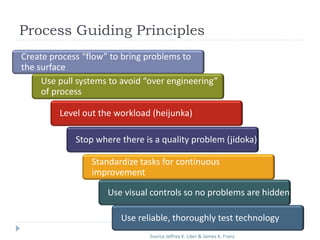
Process Guiding Principles
Create process “flow” to bring problems to
the surface
Use pull systems to avoid “over engineering”
of process
Level out the workload (heijunka)
Stop where there is a quality problem (jidoka)
Standardize tasks for continuous
improvement
Use visual controls so no problems are hidden
Use reliable, thoroughly test technology
Source Jeffrey K. Liker & James K. Franz
PDCA Problem Solving
1. Monitor Progress of
Implementation Plan
2. Modify Plan if Necessary
3. Monitor Results
1. Develop implementation plan
2. Communicate Plan
3. Execute Plan
1. Evaluate
Results
2. Standardize
Effective Counter
Measures
3. Identify Further Improvement
4. Spread Best Practices
5. Start PDCA Again
1. Identify gap to target
2. Analyze root cause
3. Formulate counter
measure
Grasp
the
Situation
CheckAdjust
Plan Do
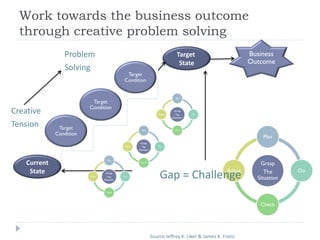
Work towards the business outcome
through creative problem solving
Current
State
Target
Condition
Target
State
Business
Outcome
Target
Condition
Target
Condition
Creative
Tension
Problem
Solving
Grasp
The
Situation
Plan
Do
Check
Adjust
Grasp
The
Situation
Plan
Do
Check
Adjust
Grasp
The
Situation
Plan
Do
Check
Adjust
Grasp
The
Situation
Plan
Do
Check
Adjust
Gap = Challenge
Source Jeffrey K. Liker & James K. Franz
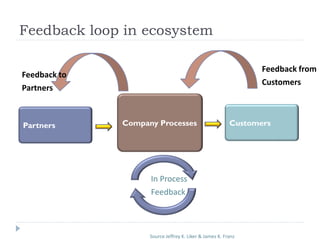
Feedback loop in ecosystem
Partners CustomersCompany Processes
In Process
Feedback
Feedback from
Customers
Feedback to
Partners
Source Jeffrey K. Liker & James K. Franz
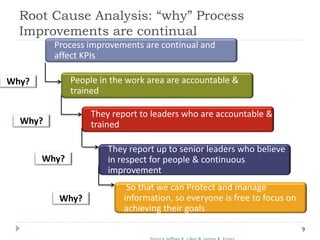
Root Cause Analysis: “why” Process
Improvements are continual
9
Why?
Process improvements are continual and
affect KPIs
People in the work area are accountable &
trained
They report to leaders who are accountable &
trained
They report up to senior leaders who believe
in respect for people & continuous
improvement
So that we can Protect and manage
information, so everyone is free to focus on
achieving their goals
Why?
Why?
Why?
Guiding Leadership builds a strong
foundational culture
Highly Developed Work
Groups
Middle Managers
as Coaches
Executives as
visionaries and
guides
Continuous Checking
and Adjusting
Consistency of Direction
Through
Hoshin Kanri
Culture of continuous improvement : Skills & Commitment
Source Jeffrey K. Liker & James K. Franz
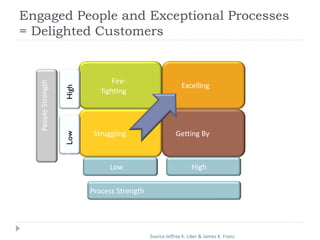
Engaged People and Exceptional Processes
= Delighted Customers
Struggling Getting By
Fire-
fighting
Excelling
HighLow
Process Strength
S
t
e
p
4
L
o
w
S
t
e
p
4
S
t
e
p
4
LowHigh
PeopleStrength
Source Jeffrey K. Liker & James K. Franz
LowHigh
ThankYou
Twitter @anitaprao;
Blog:
http://anitapaulrao.wordpress.com/
Linkedin:
www.linkedin.com/in/anitarao/

Continuous Improvement using the Toyota Way

  • 1.
    Tips and Toolsto be effective Toyota Way for Continuous Improvement Anita Rao June 2013
  • 2.
    Y? By constant improvementbased upon action, one can rise to a higher level of practice and knowledge - Fuji Cho,Toyota, 2002
  • 3.
    Agenda  The “4P”model  Process guiding principles  PDCA Problem Solving  Business outcomes from Problem Solving  Feedback Loop in ecosystem  RCA for process improvements  Strong foundational culture  Formula for Delighted Customer
  • 4.
    The 4 “P”Model Process (Eliminate Waste) People & Partners (Respect, Challenge & Grow Them) Problem Solving (Continuous Improvement & Learning) • Continual organizational learning through kaizen • Thoroughly understand the situation • Make decisions, thoroughly considering all options, implement rapidly • Base management decisions on long term philosophy even at the expense of short term financial goals • Create process flow to surface problems • Level out workload • Stop when there is a quality problem • Use visual controls • Grow leaders who live the philosophy • Respect, develop and challenge your people and teams • Respect, challenge and help suppliers Philosophy (LongTermThinking) Source Jeffrey K. Liker
  • 5.
    Process Guiding Principles Createprocess “flow” to bring problems to the surface Use pull systems to avoid “over engineering” of process Level out the workload (heijunka) Stop where there is a quality problem (jidoka) Standardize tasks for continuous improvement Use visual controls so no problems are hidden Use reliable, thoroughly test technology Source Jeffrey K. Liker & James K. Franz
  • 6.
    PDCA Problem Solving 1.Monitor Progress of Implementation Plan 2. Modify Plan if Necessary 3. Monitor Results 1. Develop implementation plan 2. Communicate Plan 3. Execute Plan 1. Evaluate Results 2. Standardize Effective Counter Measures 3. Identify Further Improvement 4. Spread Best Practices 5. Start PDCA Again 1. Identify gap to target 2. Analyze root cause 3. Formulate counter measure Grasp the Situation CheckAdjust Plan Do
  • 7.
    Work towards thebusiness outcome through creative problem solving Current State Target Condition Target State Business Outcome Target Condition Target Condition Creative Tension Problem Solving Grasp The Situation Plan Do Check Adjust Grasp The Situation Plan Do Check Adjust Grasp The Situation Plan Do Check Adjust Grasp The Situation Plan Do Check Adjust Gap = Challenge Source Jeffrey K. Liker & James K. Franz
  • 8.
    Feedback loop inecosystem Partners CustomersCompany Processes In Process Feedback Feedback from Customers Feedback to Partners Source Jeffrey K. Liker & James K. Franz
  • 9.
    Root Cause Analysis:“why” Process Improvements are continual 9 Why? Process improvements are continual and affect KPIs People in the work area are accountable & trained They report to leaders who are accountable & trained They report up to senior leaders who believe in respect for people & continuous improvement So that we can Protect and manage information, so everyone is free to focus on achieving their goals Why? Why? Why?
  • 10.
    Guiding Leadership buildsa strong foundational culture Highly Developed Work Groups Middle Managers as Coaches Executives as visionaries and guides Continuous Checking and Adjusting Consistency of Direction Through Hoshin Kanri Culture of continuous improvement : Skills & Commitment Source Jeffrey K. Liker & James K. Franz
  • 11.
    Engaged People andExceptional Processes = Delighted Customers Struggling Getting By Fire- fighting Excelling HighLow Process Strength S t e p 4 L o w S t e p 4 S t e p 4 LowHigh PeopleStrength Source Jeffrey K. Liker & James K. Franz LowHigh
  • 12.