Presented By:
         Fatima
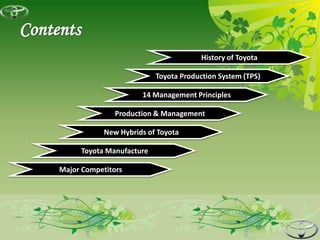
History of Toyota

                          Toyota Production System (TPS)

                      14 Management Principles

               Production & Management

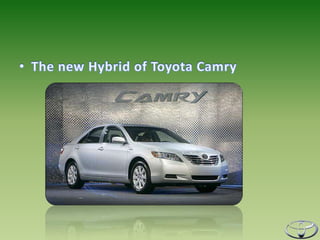
            New Hybrids of Toyota

     Toyota Manufacture

Major Competitors
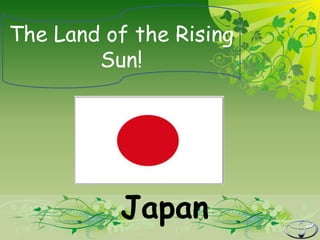
The Land of the Rising
        Sun!


          Japan
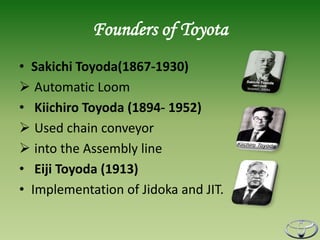
Founders of Toyota
• Sakichi Toyoda(1867-1930)
 Automatic Loom
• Kiichiro Toyoda (1894- 1952)
 Used chain conveyor
 into the Assembly line
• Eiji Toyoda (1913)
• Implementation of Jidoka and JIT.
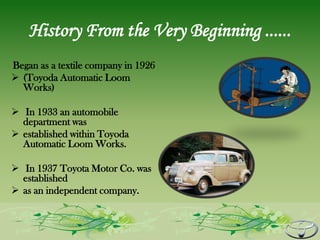
History From the Very Beginning ......
Began as a textile company in 1926
 (Toyoda Automatic Loom
  Works)

 In 1933 an automobile
  department was
 established within Toyoda
  Automatic Loom Works.
 In 1937 Toyota Motor Co. was
  established
 as an independent company.
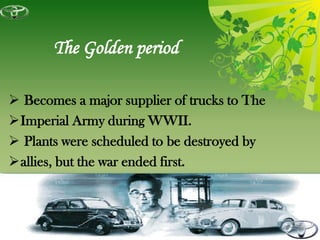
The Golden period

 Becomes a major supplier of trucks to The
Imperial Army during WWII.
 Plants were scheduled to be destroyed by
allies, but the war ended first.
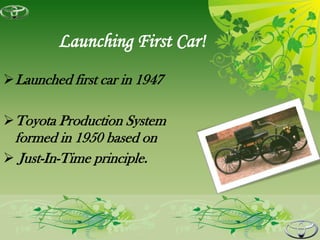
Launching First Car!
 Launched first car in 1947

 Toyota Production System
 formed in 1950 based on
 Just-In-Time principle.
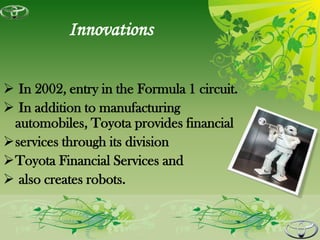
Innovations

 In 2002, entry in the Formula 1 circuit.
 In addition to manufacturing
 automobiles, Toyota provides financial
services through its division
Toyota Financial Services and
 also creates robots.
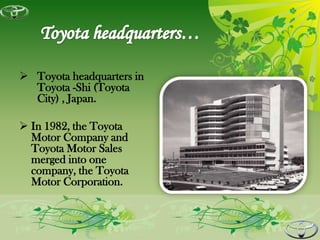
 Toyota headquarters in
  Toyota -Shi (Toyota
  City) , Japan.

 In 1982, the Toyota
  Motor Company and
  Toyota Motor Sales
  merged into one
  company, the Toyota
  Motor Corporation.
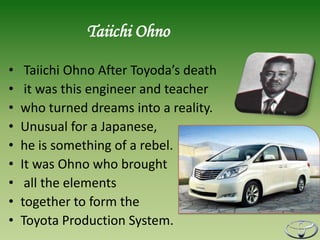
Taiichi Ohno

•    Taiichi Ohno After Toyoda’s death
•    it was this engineer and teacher
•   who turned dreams into a reality.
•   Unusual for a Japanese,
•   he is something of a rebel.
•   It was Ohno who brought
•    all the elements
•   together to form the
•   Toyota Production System.
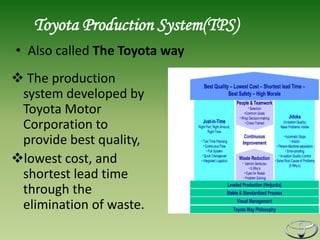
Toyota Production System(TPS)
• Also called The Toyota way
 The production
 system developed by
 Toyota Motor
 Corporation to
 provide best quality,
lowest cost, and
 shortest lead time
 through the
 elimination of waste.
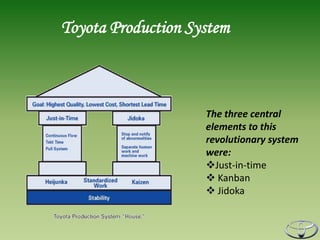
Toyota Production System


                    The three central
                    elements to this
                    revolutionary system
                    were:
                    Just-in-time
                     Kanban
                     Jidoka
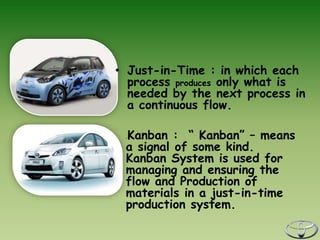
• Just-in-Time : in which each
  process produces only what is
  needed by the next process in
  a continuous flow.

 Kanban : “ Kanban” – means
 •


 a signal of some kind.
 Kanban System is used for
 managing and ensuring the
 flow and Production of
 materials in a just-in-time
 production system.
•   Jidoka : Automation with
    a human touch Means
    that when a problem
    occurs, the equipment
    stops
    immediately, preventing
    defective products from
    being produced.
Think…
What are the benefits of Just-in-time?


 What are the costs of Just-in-time?
Presented by : Anam
PRODUCTION & OPERATIONS
 MANAGEMENT OF TOYOTA


 Presented By:
             Marvi
QUALITY POLICY
• “We will strive to meet customer’s
  expectations by providing world-class
  products and services through total employee
  commitment and continuous improvement.”
BASIC CONCEPT OF QUALITY
              ASSURANCE
•   Toyota purchases components
•    from as many as two hundred
•   suppliers it is very difficult
•   to conduct detailed acceptance
•   inspection.
•   Therefore, in order to secure
•   quality of the components
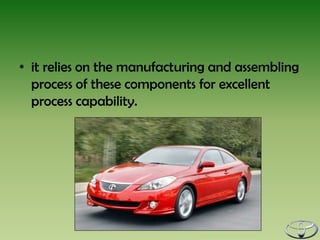
• it relies on the manufacturing and assembling
  process of these components for excellent
  process capability.
TOYOTA’S APPROACH TO QUALITY
Toyota’s approach to quality
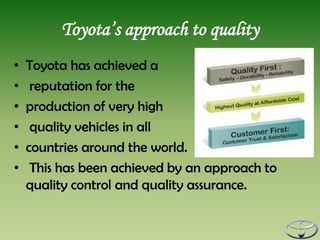
•   Toyota has achieved a
•    reputation for the
•   production of very high
•    quality vehicles in all
•   countries around the world.
•    This has been achieved by an approach to
    quality control and quality assurance.
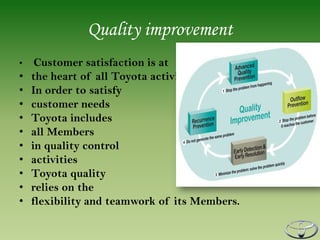
Quality improvement
•    Customer satisfaction is at
•   the heart of all Toyota activities.
•   In order to satisfy
•   customer needs
•   Toyota includes
•   all Members
•   in quality control
•   activities
•   Toyota quality
•   relies on the
•   flexibility and teamwork of its Members.
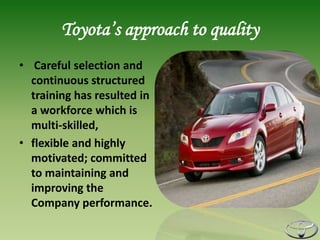
Toyota’s approach to quality
• Careful selection and
  continuous structured
  training has resulted in
  a workforce which is
  multi-skilled,
• flexible and highly
  motivated; committed
  to maintaining and
  improving the
  Company performance.
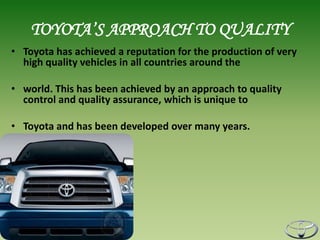
TOYOTA’S APPROACH TO QUALITY
• Toyota has achieved a reputation for the production of very
  high quality vehicles in all countries around the

• world. This has been achieved by an approach to quality
  control and quality assurance, which is unique to

• Toyota and has been developed over many years.
New Hybrids OF


      Presented By:
               Maryam
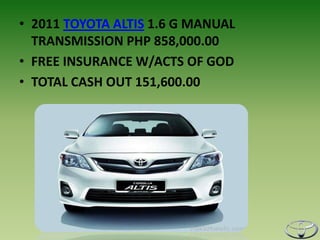
• 2011 TOYOTA ALTIS 1.6 G MANUAL
  TRANSMISSION PHP 858,000.00
• FREE INSURANCE W/ACTS OF GOD
• TOTAL CASH OUT 151,600.00
AMAZING PROMO FOR 2012

• 2012 TOYOTA ALTIS 1.6 E M/T PHP
  803,000.00
• FREE INSURANCE W/ ACTS OF GOD
• TOTAL CASH OUT ALL IN 140,800.00
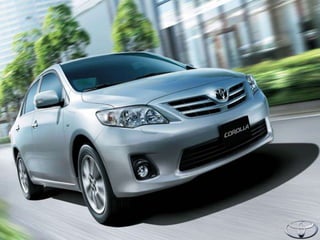
Brief History and the New 2012 Toyota Corolla
Since its introduction in 1966, the Corolla has long been
regarded as one of the best family sedans because of its
features and its rather inexpensive price tag. For this
reason, it is one of the most well-known sedans
internationally.
 2012 Toyota Corolla Design
Despite not belonging to the same price range as its more
expensive counterparts, the 2012 Toyota Corolla still
features a smooth design that appeals even to drivers with
a sense of style. It makes up for in its cost and its comfort.
Toyota motor manufacturing

• Customer satisfaction is at the heart of
  all Toyota activities. In order to satisfy
  customer needs Toyota

• includes all Members in quality control
  activities. Everybody from research and
  development to

• manufacturing, retailing and servicing
  contribute to the quality control process.
  All Members have two
Toyota motor manufacturing
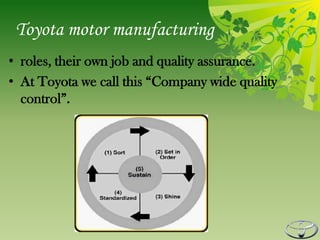
• roles, their own job and quality assurance.
• At Toyota we call this “Company wide quality
  control”.
Toyota motor manufacturing
• Some people understand quality assurance to mean
  thoroughly inspecting parts after they are made or by


• promptly complying with claims on products in the
  market. This is not the belief at Toyota. Total quality
Toyota motor manufacturing

• control is carried out using two basic
  principles:
• quality is built in at every stage.
• quality is continually improved.

• To achieve total quality control Toyota
  Manufacturing UK involves each and every
  Member to ensure that
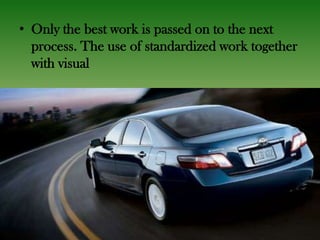
• Only the best work is passed on to the next
  process. The use of standardized work together
  with visual
Presented By:
            Salma
Ford
 An American Multinational.
 Head office at Dearborn, Michigan.(USA)
 Incorporated on June 16, 1903.
 Major Products :
 Ford Fiesta
 Ford Mustang
 Ford Explorer
 Ford Mondeo
Volkswagen

   A German Multinational Co.
 Incorporated in 1937.
 Head Office at Wolfsburg, Germany.
 Major Products :
     Passat
     Jetta
     Taureg
Honda
•   A Japanese Multinational Co.
• Incorporated on 24 September 1948.
• Headquarters at Minato, Tokyo (Japan)
 Major Products :
     Civic
     Accord
     CRV
General Motors
 An American automobile co.
 Incorporated in 1908.
Head office at Detroit, Michigan (USA)
Popular Brands :
Chevrolet, Holden
Major Products :
     Aveo
     Optra
     Commbador
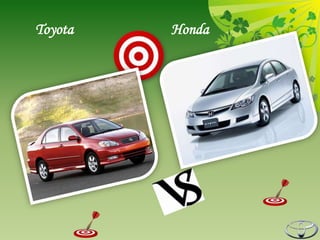
Toyota   Honda
Where is Toyota Today?

   Second Largest automaker, but most profitable
   51 manufacturing companies in 26 countries
   Produce a vehicle every 6 seconds
   Brands: Toyota, Lexus, Scion
   Business partners with Daihatsu and Hino
   automotive business accounted for 90% of
   revenues
   Other 10%: housing, marine, GAZOO,
   telecommunications, ITS, Biotechnology and
   A forestation
   Success attributed to Toyota Production System
Toyota company

Toyota company

  • 1.
  • 3.
    History of Toyota Toyota Production System (TPS) 14 Management Principles Production & Management New Hybrids of Toyota Toyota Manufacture Major Competitors
  • 4.
    The Land ofthe Rising Sun! Japan
  • 5.
    Founders of Toyota •Sakichi Toyoda(1867-1930)  Automatic Loom • Kiichiro Toyoda (1894- 1952)  Used chain conveyor  into the Assembly line • Eiji Toyoda (1913) • Implementation of Jidoka and JIT.
  • 6.
    History From theVery Beginning ...... Began as a textile company in 1926  (Toyoda Automatic Loom Works)  In 1933 an automobile department was  established within Toyoda Automatic Loom Works.  In 1937 Toyota Motor Co. was established  as an independent company.
  • 7.
    The Golden period Becomes a major supplier of trucks to The Imperial Army during WWII.  Plants were scheduled to be destroyed by allies, but the war ended first.
  • 8.
    Launching First Car! Launched first car in 1947  Toyota Production System formed in 1950 based on  Just-In-Time principle.
  • 9.
    Innovations  In 2002,entry in the Formula 1 circuit.  In addition to manufacturing automobiles, Toyota provides financial services through its division Toyota Financial Services and  also creates robots.
  • 10.
     Toyota headquartersin Toyota -Shi (Toyota City) , Japan.  In 1982, the Toyota Motor Company and Toyota Motor Sales merged into one company, the Toyota Motor Corporation.
  • 12.
    Taiichi Ohno • Taiichi Ohno After Toyoda’s death • it was this engineer and teacher • who turned dreams into a reality. • Unusual for a Japanese, • he is something of a rebel. • It was Ohno who brought • all the elements • together to form the • Toyota Production System.
  • 13.
    Toyota Production System(TPS) •Also called The Toyota way  The production system developed by Toyota Motor Corporation to provide best quality, lowest cost, and shortest lead time through the elimination of waste.
  • 14.
    Toyota Production System The three central elements to this revolutionary system were: Just-in-time  Kanban  Jidoka
  • 15.
    • Just-in-Time :in which each process produces only what is needed by the next process in a continuous flow. Kanban : “ Kanban” – means • a signal of some kind. Kanban System is used for managing and ensuring the flow and Production of materials in a just-in-time production system.
  • 16.
    Jidoka : Automation with a human touch Means that when a problem occurs, the equipment stops immediately, preventing defective products from being produced.
  • 17.
    Think… What are thebenefits of Just-in-time? What are the costs of Just-in-time?
  • 18.
  • 33.
    PRODUCTION & OPERATIONS MANAGEMENT OF TOYOTA Presented By: Marvi
  • 34.
    QUALITY POLICY • “Wewill strive to meet customer’s expectations by providing world-class products and services through total employee commitment and continuous improvement.”
  • 35.
    BASIC CONCEPT OFQUALITY ASSURANCE • Toyota purchases components • from as many as two hundred • suppliers it is very difficult • to conduct detailed acceptance • inspection. • Therefore, in order to secure • quality of the components
  • 36.
    • it relieson the manufacturing and assembling process of these components for excellent process capability.
  • 37.
  • 38.
    Toyota’s approach toquality • Toyota has achieved a • reputation for the • production of very high • quality vehicles in all • countries around the world. • This has been achieved by an approach to quality control and quality assurance.
  • 39.
    Quality improvement • Customer satisfaction is at • the heart of all Toyota activities. • In order to satisfy • customer needs • Toyota includes • all Members • in quality control • activities • Toyota quality • relies on the • flexibility and teamwork of its Members.
  • 40.
    Toyota’s approach toquality • Careful selection and continuous structured training has resulted in a workforce which is multi-skilled, • flexible and highly motivated; committed to maintaining and improving the Company performance.
  • 41.
    TOYOTA’S APPROACH TOQUALITY • Toyota has achieved a reputation for the production of very high quality vehicles in all countries around the • world. This has been achieved by an approach to quality control and quality assurance, which is unique to • Toyota and has been developed over many years.
  • 42.
    New Hybrids OF Presented By: Maryam
  • 48.
    • 2011 TOYOTAALTIS 1.6 G MANUAL TRANSMISSION PHP 858,000.00 • FREE INSURANCE W/ACTS OF GOD • TOTAL CASH OUT 151,600.00
  • 50.
    AMAZING PROMO FOR2012 • 2012 TOYOTA ALTIS 1.6 E M/T PHP 803,000.00 • FREE INSURANCE W/ ACTS OF GOD • TOTAL CASH OUT ALL IN 140,800.00
  • 53.
    Brief History andthe New 2012 Toyota Corolla Since its introduction in 1966, the Corolla has long been regarded as one of the best family sedans because of its features and its rather inexpensive price tag. For this reason, it is one of the most well-known sedans internationally. 2012 Toyota Corolla Design Despite not belonging to the same price range as its more expensive counterparts, the 2012 Toyota Corolla still features a smooth design that appeals even to drivers with a sense of style. It makes up for in its cost and its comfort.
  • 55.
    Toyota motor manufacturing •Customer satisfaction is at the heart of all Toyota activities. In order to satisfy customer needs Toyota • includes all Members in quality control activities. Everybody from research and development to • manufacturing, retailing and servicing contribute to the quality control process. All Members have two
  • 56.
    Toyota motor manufacturing •roles, their own job and quality assurance. • At Toyota we call this “Company wide quality control”.
  • 57.
    Toyota motor manufacturing •Some people understand quality assurance to mean thoroughly inspecting parts after they are made or by • promptly complying with claims on products in the market. This is not the belief at Toyota. Total quality
  • 58.
    Toyota motor manufacturing •control is carried out using two basic principles: • quality is built in at every stage. • quality is continually improved. • To achieve total quality control Toyota Manufacturing UK involves each and every Member to ensure that
  • 59.
    • Only thebest work is passed on to the next process. The use of standardized work together with visual
  • 60.
  • 62.
    Ford  An AmericanMultinational.  Head office at Dearborn, Michigan.(USA)  Incorporated on June 16, 1903.  Major Products :  Ford Fiesta  Ford Mustang  Ford Explorer  Ford Mondeo
  • 63.
    Volkswagen  A German Multinational Co.  Incorporated in 1937.  Head Office at Wolfsburg, Germany.  Major Products :  Passat  Jetta  Taureg
  • 64.
    Honda • A Japanese Multinational Co. • Incorporated on 24 September 1948. • Headquarters at Minato, Tokyo (Japan)  Major Products :  Civic  Accord  CRV
  • 65.
    General Motors  AnAmerican automobile co.  Incorporated in 1908. Head office at Detroit, Michigan (USA) Popular Brands : Chevrolet, Holden Major Products :  Aveo  Optra  Commbador
  • 66.
    Toyota Honda
  • 67.
    Where is ToyotaToday?  Second Largest automaker, but most profitable  51 manufacturing companies in 26 countries  Produce a vehicle every 6 seconds  Brands: Toyota, Lexus, Scion  Business partners with Daihatsu and Hino  automotive business accounted for 90% of  revenues  Other 10%: housing, marine, GAZOO,  telecommunications, ITS, Biotechnology and  A forestation  Success attributed to Toyota Production System