Fundamental Principles of Lean Thinking, CMMI and Process Quality Improvement-Shantanu Dey
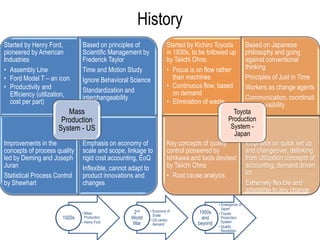
History
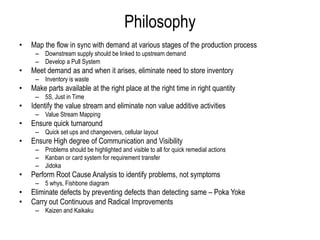
PhilosophyMap the flow in sync with demand at various stages of the production processDownstream supply should be linked to upstream demandDevelop a Pull SystemMeet demand as and when it arises, eliminate need to store inventoryInventory is wasteMake parts available at the right place at the right time in right quantity 5S, Just in TimeIdentify the value stream and eliminate non value additive activitiesValue Stream MappingEnsure quick turnaroundQuick set ups and changeovers, cellular layoutEnsure High degree of Communication and VisibilityProblems should be highlighted and visible to all for quick remedial actionsKanban or card system for requirement transferJidokaPerform Root Cause Analysis to identify problems, not symptoms5 whys, Fishbone diagramEliminate defects by preventing defects than detecting same – Poka YokeCarry out Continuous and Radical ImprovementsKaizen and Kaikaku
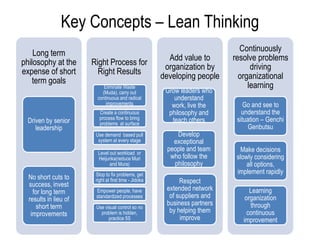
Key Concepts – Lean Thinking
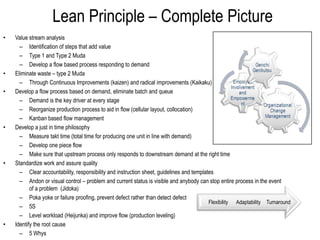
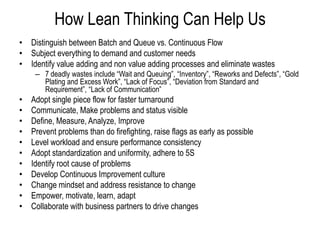
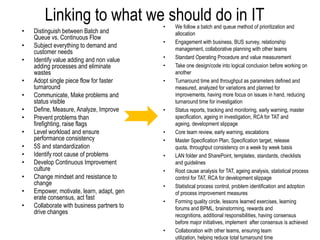
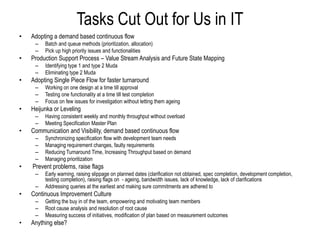
Lean Principle – Complete Picture Value stream analysisIdentification of steps that add valueType 1 and Type 2 MudaDevelop a flow based process responding to demandEliminate waste – type 2 MudaThrough Continuous Improvements (kaizen) and radical improvements (Kaikaku)Develop a flow process based on demand, eliminate batch and queueDemand is the key driver at every stageReorganize production process to aid in flow (cellular layout, collocation)Kanban based flow managementDevelop a just in time philosophyMeasure takt time (total time for producing one unit in line with demand)Develop one piece flow Make sure that upstream process only responds to downstream demand at the right timeStandardize work and assure qualityClear accountability, responsibility and instruction sheet, guidelines and templatesAndon or visual control – problem and current status is visible and anybody can stop entire process in the event of a problem  (Jidoka)Poka yoke or failure proofing, prevent defect rather than detect defect5SLevel workload (Heijunka) and improve flow (production leveling)Identify the root cause5 Whys
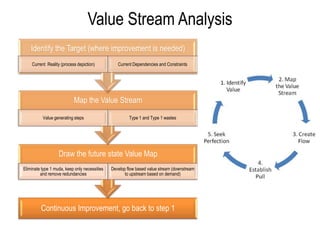
Value Stream Analysis
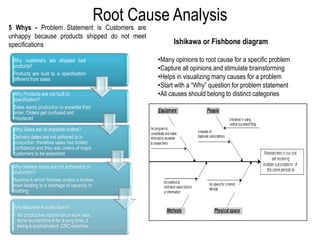
Root Cause Analysis5 Whys - Problem Statement is Customers are unhappy because products shipped do not meet specificationsIshikawa or Fishbone diagramMany opinions to root cause for a specific problem
Capture all opinions and stimulate brainstorming
Helps in visualizing many causes for a problem
Start with a “Why” question for problem statement
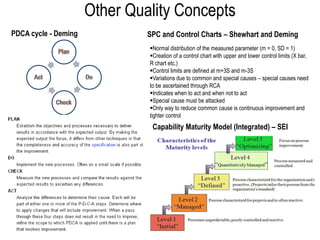
All causes should belong to distinct categoriesOther Quality ConceptsPDCA cycle - DemingSPC and Control Charts – Shewhart and DemingNormal distribution of the measured parameter (m = 0, SD = 1)

Lean thinking

  • 1.
    Fundamental Principles ofLean Thinking, CMMI and Process Quality Improvement-Shantanu Dey
  • 2.
  • 3.
    PhilosophyMap the flowin sync with demand at various stages of the production processDownstream supply should be linked to upstream demandDevelop a Pull SystemMeet demand as and when it arises, eliminate need to store inventoryInventory is wasteMake parts available at the right place at the right time in right quantity 5S, Just in TimeIdentify the value stream and eliminate non value additive activitiesValue Stream MappingEnsure quick turnaroundQuick set ups and changeovers, cellular layoutEnsure High degree of Communication and VisibilityProblems should be highlighted and visible to all for quick remedial actionsKanban or card system for requirement transferJidokaPerform Root Cause Analysis to identify problems, not symptoms5 whys, Fishbone diagramEliminate defects by preventing defects than detecting same – Poka YokeCarry out Continuous and Radical ImprovementsKaizen and Kaikaku
  • 4.
    Key Concepts –Lean Thinking
  • 5.
    Lean Principle –Complete Picture Value stream analysisIdentification of steps that add valueType 1 and Type 2 MudaDevelop a flow based process responding to demandEliminate waste – type 2 MudaThrough Continuous Improvements (kaizen) and radical improvements (Kaikaku)Develop a flow process based on demand, eliminate batch and queueDemand is the key driver at every stageReorganize production process to aid in flow (cellular layout, collocation)Kanban based flow managementDevelop a just in time philosophyMeasure takt time (total time for producing one unit in line with demand)Develop one piece flow Make sure that upstream process only responds to downstream demand at the right timeStandardize work and assure qualityClear accountability, responsibility and instruction sheet, guidelines and templatesAndon or visual control – problem and current status is visible and anybody can stop entire process in the event of a problem (Jidoka)Poka yoke or failure proofing, prevent defect rather than detect defect5SLevel workload (Heijunka) and improve flow (production leveling)Identify the root cause5 Whys
  • 6.
  • 7.
    Root Cause Analysis5Whys - Problem Statement is Customers are unhappy because products shipped do not meet specificationsIshikawa or Fishbone diagramMany opinions to root cause for a specific problem
  • 8.
    Capture all opinionsand stimulate brainstorming
  • 9.
    Helps in visualizingmany causes for a problem
  • 10.
    Start with a“Why” question for problem statement
  • 11.
    All causes shouldbelong to distinct categoriesOther Quality ConceptsPDCA cycle - DemingSPC and Control Charts – Shewhart and DemingNormal distribution of the measured parameter (m = 0, SD = 1)