PROBLEM-SOLVING and
DECISION-MAKING TOOLS
Presented by:
Karen Deering,
Jon Ross, Mark Kesler
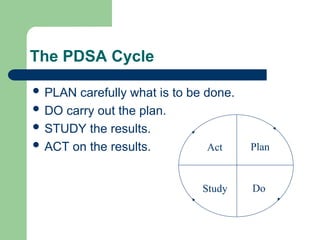
THE PDSA CYCLE
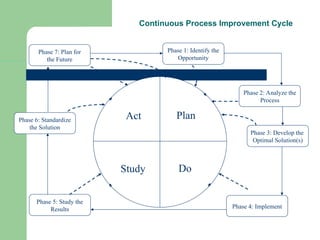
CONTINUOUS PROCESS
IMPROVEMENT CYCLE
THE SEVEN PHASES TO THE
PROBLEM SOLVING METHOD
6 PRINCIPLES OF TQM
Mark…
Leadership and Customer Service
Jon…
Employee Involvement and Continuous
Process Improvement
Karen…
Supplier Partnerships and Performance
Measures
LEADERSHIP
As organizations are searching for new and/or better
ways to be successful, more attention and
accountability are being placed on those responsible
for charting the course, navigating the changes, and
keeping the organization afloat. The forces and factors
impacting organizations in the new millennium are
more interdependent, dramatic, fast paced, and
unpredictable. The complexity of what decision makers
in organizations must know and be able to do if
organizations survive and thrive is being influenced by
its leaders…
Leadership…Why, What and How?
 Why…to motivate and inspire to a common
goal or purpose. Providing direction,
engagement, and encouragement
 What…ethical, realistic, consistent,
responsible, courageous, visionary
 How…”know where to go”. Have a vision
and create cohesion of the team
Empower your employees to allow them
to have the confidence, ability, and
commitment to take the responsibility
and ownership to improve the process
and initiate the necessary steps to satisfy
customer expectations – within well-
defined boundaries in order to achieve
organizational values and goals
TEAM PROBLEM-SOLVING
 Is a process that uses a group of people in a
team setting with the objective of resolving a
problem or improving an existing process at
any level of the organization
Six Sigma
 Refers to the number of standard deviations
found between the process central tendency
and the closest specifications.
Six Sigma Methodology
Disciplined team problem solving approach
using metrics and measurements to track
loss…statistical tools to ensure best results
“8D”
 8 Disciplines in problem solving which follows a
fact based approach that fits well with Decision
– Making and PDSA models
 DO - Prepare for the 8D Process
 D1 - Establish the team
 D2 – Describe the problem
 D3 – Develop the Interim Containment Action
and Verification
 D4 – Define and Verify Root Cause and Escape
Point
 D5 – Choose and Verify Permanent Corrective
Actions for Root Cause and Escape Point
 D6 – Implement and Validate Permanent Corrective
Action
 D7 – Prevent Recurrence
 D8 – Recognize Team and Individual Contributions
OTHER LEADERSHIP TOOLS
 Psychological Type Theory (MBTI)
 ORJI
 Left – hand Column
 Herman’s Brain Model
 Dialogue
MODELS and THEORIES
 THE NORMATIVE DECISION MODEL
 THE SITUATION LEADERSHIP THEORY
 THE CONTINGENCY MODEL
 THE PATH GOAL THEORY
 POST-HEROIC LEADERSHIP
 TRANSACTIONAL AND
TRANSFORMATIONAL LEADERSHIP
 7 HABITS OF HIGHLY EFFECTIVE PEOPLE
CUSTOMER SERVICE
CUSTOMER SERVICE
 WHY FOCUS ON CUSTOMERS?
 WHO ARE OUR CUSTOMERS?
 WHAT DO CUSTOMERS WANT?
 HOW DO WE BETTER UNDERSTAND OUR
CUSTOMERS?
 HOW DO WE TRANSLATE CUSTOMER
NEEDS INTO
SPECIFICATIONS/STANDARDS?
CUSTOMER SERVICE
CUSTOMER SERVICE
 Why? Customers are the most important
asset. They determine the “bottom line”.
 Who? External and Internal Customers
 What? Quality, durability, and price.
Most critical or important…
function or reliability
How? Standards such as ISO 9000
HOW DO WE BETTER UNDERSTAND
OUR CUSTOMER
 Comment cards
 Surveys
 Focus Groups
 Telephone
 Customer Visits
 Report Cards
 Internet
 Employee Feedback
MEET SID THE CAB DRIVER
Academic Assessment
Employee
participation
and
continuous
improvement
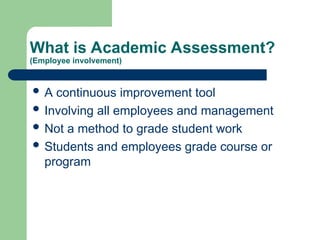
What is Academic Assessment?
(Employee involvement)
 A continuous improvement tool
 Involving all employees and management
 Not a method to grade student work
 Students and employees grade course or
program
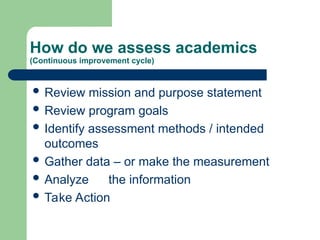
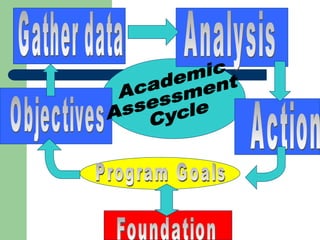
How do we assess academics
(Continuous improvement cycle)
 Review mission and purpose statement
 Review program goals
 Identify assessment methods / intended
outcomes
 Gather data – or make the measurement
 Analyze the information
 Take Action
Review of mission and purpose /
Program goals
 Courses and programs must be aligned with
mission and purpose of the entire
organization
 Changes should be made at this level if
alignment is not found
Measurement tools
 Timing of assessment
– Pre enrollment data
– Process – (during course) data
– Post enrollment data
 Assessment tools
– Direct measures
– Indirect measures
Direct Measurement Assessment
Tools
 Pre/post test
 Course embedded tests
 Portfolios
 Capstone exam/project
 Standardized exams
 Performance assessment
 Primary trait analysis
 Professional certification
Indirect Measurement Assessment
Tools
 Focus groups
 Graduate survey / interview
 Employer/faculty survey
Interpretation of measurements
 What did you measure?
 Are the results what you predicted?
 Can you use the data?
 What other factors may have influenced the
data?
 Help in statistical measurement maybe
needed
Use the data to make changes
 Slight variation may require small changes
 Larger variations require new curriculum or
further study
 Repeated large variations may require new
focus in mission or purpose.
Variations of assessment plans
 Plans and methods will vary between
institutions
 Plans and methods will vary internal to the
institution
 Plans will vary based on needs and
resources
How to be sure assessment
successful
 Why is assessment being done?
 Management must support and provide resources for
assessment
 Employees must understand the benefits and use
the method
 Multiple sections of a course and multiple instructors
will complicate method
 Communication is vital
 Success should be rewarded
Review
 Assessment (PSDA) cycles are not just for
manufacturing business
 Assessment methods can be used on small
scale projects or large scale operations
 Find a process and follow it.
 Several cycles will be needed to have valid
data
Tools for Solving Problems
and Making Decisions
Supplier Partnerships
and Performance Measures
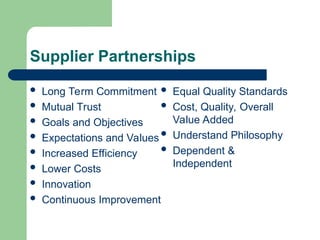
Supplier Partnerships
 Long Term Commitment
 Mutual Trust
 Goals and Objectives
 Expectations and Values
 Increased Efficiency
 Lower Costs
 Innovation
 Continuous Improvement
 Equal Quality Standards
 Cost, Quality, Overall
Value Added
 Understand Philosophy
 Dependent &
Independent
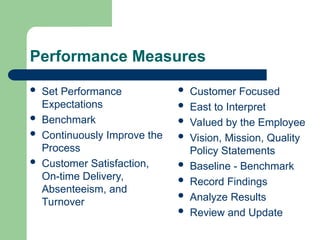
Performance Measures
 Set Performance
Expectations
 Benchmark
 Continuously Improve the
Process
 Customer Satisfaction,
On-time Delivery,
Absenteeism, and
Turnover
 Customer Focused
 East to Interpret
 Valued by the Employee
 Vision, Mission, Quality
Policy Statements
 Baseline - Benchmark
 Record Findings
 Analyze Results
 Review and Update
Solving
Problems
Making
Decisions
The PDSA Cycle
 PLAN carefully what is to be done.
 DO carry out the plan.
 STUDY the results.
 ACT on the results. Act Plan
Do
Study
Act Plan
Do
Study
Continuous Process Improvement Cycle
Phase 1: Identify the
Opportunity
Phase 7: Plan for
the Future
Phase 6: Standardize
the Solution
Phase 5: Study the
Results Phase 4: Implement
Phase 3: Develop the
Optimal Solution(s)
Phase 2: Analyze the
Process
Using a systematic, orderly approach will yield
the highest probability of success.

PROBLEM_SOLVING(Jon_Mark_Karen).ppt Sample ppt

  • 1.
    PROBLEM-SOLVING and DECISION-MAKING TOOLS Presentedby: Karen Deering, Jon Ross, Mark Kesler
  • 3.
    THE PDSA CYCLE CONTINUOUSPROCESS IMPROVEMENT CYCLE THE SEVEN PHASES TO THE PROBLEM SOLVING METHOD
  • 4.
    6 PRINCIPLES OFTQM Mark… Leadership and Customer Service Jon… Employee Involvement and Continuous Process Improvement Karen… Supplier Partnerships and Performance Measures
  • 5.
    LEADERSHIP As organizations aresearching for new and/or better ways to be successful, more attention and accountability are being placed on those responsible for charting the course, navigating the changes, and keeping the organization afloat. The forces and factors impacting organizations in the new millennium are more interdependent, dramatic, fast paced, and unpredictable. The complexity of what decision makers in organizations must know and be able to do if organizations survive and thrive is being influenced by its leaders…
  • 6.
    Leadership…Why, What andHow?  Why…to motivate and inspire to a common goal or purpose. Providing direction, engagement, and encouragement  What…ethical, realistic, consistent, responsible, courageous, visionary  How…”know where to go”. Have a vision and create cohesion of the team
  • 7.
    Empower your employeesto allow them to have the confidence, ability, and commitment to take the responsibility and ownership to improve the process and initiate the necessary steps to satisfy customer expectations – within well- defined boundaries in order to achieve organizational values and goals
  • 8.
    TEAM PROBLEM-SOLVING  Isa process that uses a group of people in a team setting with the objective of resolving a problem or improving an existing process at any level of the organization
  • 9.
    Six Sigma  Refersto the number of standard deviations found between the process central tendency and the closest specifications. Six Sigma Methodology Disciplined team problem solving approach using metrics and measurements to track loss…statistical tools to ensure best results
  • 10.
    “8D”  8 Disciplinesin problem solving which follows a fact based approach that fits well with Decision – Making and PDSA models  DO - Prepare for the 8D Process  D1 - Establish the team  D2 – Describe the problem  D3 – Develop the Interim Containment Action and Verification
  • 11.
     D4 –Define and Verify Root Cause and Escape Point  D5 – Choose and Verify Permanent Corrective Actions for Root Cause and Escape Point  D6 – Implement and Validate Permanent Corrective Action  D7 – Prevent Recurrence  D8 – Recognize Team and Individual Contributions
  • 12.
    OTHER LEADERSHIP TOOLS Psychological Type Theory (MBTI)  ORJI  Left – hand Column  Herman’s Brain Model  Dialogue
  • 13.
    MODELS and THEORIES THE NORMATIVE DECISION MODEL  THE SITUATION LEADERSHIP THEORY  THE CONTINGENCY MODEL  THE PATH GOAL THEORY  POST-HEROIC LEADERSHIP  TRANSACTIONAL AND TRANSFORMATIONAL LEADERSHIP  7 HABITS OF HIGHLY EFFECTIVE PEOPLE
  • 14.
    CUSTOMER SERVICE CUSTOMER SERVICE WHY FOCUS ON CUSTOMERS?  WHO ARE OUR CUSTOMERS?  WHAT DO CUSTOMERS WANT?  HOW DO WE BETTER UNDERSTAND OUR CUSTOMERS?  HOW DO WE TRANSLATE CUSTOMER NEEDS INTO SPECIFICATIONS/STANDARDS?
  • 15.
    CUSTOMER SERVICE CUSTOMER SERVICE Why? Customers are the most important asset. They determine the “bottom line”.  Who? External and Internal Customers  What? Quality, durability, and price. Most critical or important… function or reliability How? Standards such as ISO 9000
  • 16.
    HOW DO WEBETTER UNDERSTAND OUR CUSTOMER  Comment cards  Surveys  Focus Groups  Telephone  Customer Visits  Report Cards  Internet  Employee Feedback
  • 17.
    MEET SID THECAB DRIVER
  • 18.
  • 19.
    What is AcademicAssessment? (Employee involvement)  A continuous improvement tool  Involving all employees and management  Not a method to grade student work  Students and employees grade course or program
  • 20.
    How do weassess academics (Continuous improvement cycle)  Review mission and purpose statement  Review program goals  Identify assessment methods / intended outcomes  Gather data – or make the measurement  Analyze the information  Take Action
  • 22.
    Review of missionand purpose / Program goals  Courses and programs must be aligned with mission and purpose of the entire organization  Changes should be made at this level if alignment is not found
  • 23.
    Measurement tools  Timingof assessment – Pre enrollment data – Process – (during course) data – Post enrollment data  Assessment tools – Direct measures – Indirect measures
  • 24.
    Direct Measurement Assessment Tools Pre/post test  Course embedded tests  Portfolios  Capstone exam/project  Standardized exams  Performance assessment  Primary trait analysis  Professional certification
  • 25.
    Indirect Measurement Assessment Tools Focus groups  Graduate survey / interview  Employer/faculty survey
  • 26.
    Interpretation of measurements What did you measure?  Are the results what you predicted?  Can you use the data?  What other factors may have influenced the data?  Help in statistical measurement maybe needed
  • 27.
    Use the datato make changes  Slight variation may require small changes  Larger variations require new curriculum or further study  Repeated large variations may require new focus in mission or purpose.
  • 28.
    Variations of assessmentplans  Plans and methods will vary between institutions  Plans and methods will vary internal to the institution  Plans will vary based on needs and resources
  • 29.
    How to besure assessment successful  Why is assessment being done?  Management must support and provide resources for assessment  Employees must understand the benefits and use the method  Multiple sections of a course and multiple instructors will complicate method  Communication is vital  Success should be rewarded
  • 30.
    Review  Assessment (PSDA)cycles are not just for manufacturing business  Assessment methods can be used on small scale projects or large scale operations  Find a process and follow it.  Several cycles will be needed to have valid data
  • 31.
    Tools for SolvingProblems and Making Decisions Supplier Partnerships and Performance Measures
  • 32.
    Supplier Partnerships  LongTerm Commitment  Mutual Trust  Goals and Objectives  Expectations and Values  Increased Efficiency  Lower Costs  Innovation  Continuous Improvement  Equal Quality Standards  Cost, Quality, Overall Value Added  Understand Philosophy  Dependent & Independent
  • 33.
    Performance Measures  SetPerformance Expectations  Benchmark  Continuously Improve the Process  Customer Satisfaction, On-time Delivery, Absenteeism, and Turnover  Customer Focused  East to Interpret  Valued by the Employee  Vision, Mission, Quality Policy Statements  Baseline - Benchmark  Record Findings  Analyze Results  Review and Update
  • 34.
  • 35.
    The PDSA Cycle PLAN carefully what is to be done.  DO carry out the plan.  STUDY the results.  ACT on the results. Act Plan Do Study
  • 36.
    Act Plan Do Study Continuous ProcessImprovement Cycle Phase 1: Identify the Opportunity Phase 7: Plan for the Future Phase 6: Standardize the Solution Phase 5: Study the Results Phase 4: Implement Phase 3: Develop the Optimal Solution(s) Phase 2: Analyze the Process
  • 37.
    Using a systematic,orderly approach will yield the highest probability of success.