PDCA Cycle | Plan
Do Check Act |
Implementation
PDCA CYCLE
2
FREE
TUTORIAL
What is the PDCA cycle in TQM?
3
 The full name is the Plan-Do-Check-Act Cycle and it is one of the popular Problem
Solving Method and Continuous Improvement Methodology.
 It is often referred to as the Deming wheel or Deming cycle.
 Shewhart and Deming are recognized as pioneers in the Quality Management
movement.
 Shewhart introduced the PDSA cycle, (Plan-Do-Study-Act).
 He believed that data analysis is an essential part of any improvement effort and
checking does not necessarily imply an in-depth study.
What is the PDCA model of
continuous improvement?
4
 PDCA is widely recognized as the basis of continually improving the Quality of
Products processes, and services and also it is a simple structured approach
for solving quality-related problems. It may be necessary to solve the problem
permanently and reach the ultimate goal state.
 Used to verify the feasibility of a proposed idea whether it is an incremental or a
breakthrough improvement.
 Plan-Do-Check-Act approach is the base for TQM, ISO 9001:2015 Quality
Management System Standard, A3 thinking methodology, and IATF
16949:2016 Automotive QMS Standard.
 This methodology relies on trial and error, however, it keeps on improving until
it achieves excellence.
 It is one of the most popular Lean Manufacturing Tool across the manufacturing
industries.
Continuous Improvement Cycle
5
What are the four steps in the PDCA
cycle?
6
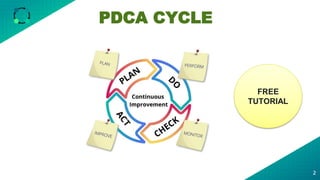
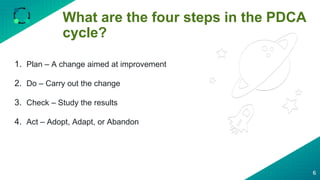
1. Plan – A change aimed at improvement
2. Do – Carry out the change
3. Check – Study the results
4. Act – Adopt, Adapt, or Abandon
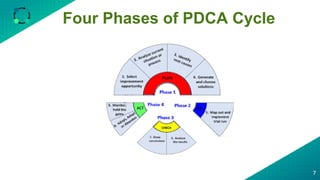
Four Phases of PDCA Cycle
7
How to Implement the PDCA Cycle?
Example:
Implementation of Plan Phase:
8
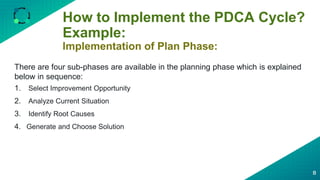
There are four sub-phases are available in the planning phase which is explained
below in sequence:
1. Select Improvement Opportunity
2. Analyze Current Situation
3. Identify Root Causes
4. Generate and Choose Solution
[1] Select Improvement Opportunity:
9
 Generate a list and select
 Redefine team
 Write problem / opportunity / aim statement
 Describe the problem
 Management review
 The team selects the problem to be solved (to be improved)
 The problem and objectives are clearly identified
 The current situation is analyzed.
 Solution alternatives are identified, selected and scheduled
[2] Analyze Current Situation:
10
 Define the process/problem to be solved
 Identify the customer(s).
 Prepare Baseline data
 Check any Performance gaps are available?
 Look at benchmarks, standards, regulatory requirements
 Validate problem and statement
 Management review
[3] Identify Root Causes:
11
 This is a very very important step
 Utilize the Cause and Effect Diagram (Fishbone Diagram or Ishikawa Diagram, or Why-
Why analysis to identify the most likely cause(s).
 Use Genchi Gembutsu Method
 Select root cause
 Management review
[4] Generate and Choose Solutions:
12
 Generate a list and select solutions
 Directly linked to root cause & supported by data
 Team brainstorming and shared decision making
 Be honest about barriers
 Choose the best solution based on criteria
 Define and map out a solution
 Develop solution(s) to remove the root cause(s)
 Select the best solution(s) to remove the root cause(s)
 Verify that effectiveness of the selected solutions
 Verify that selected solutions do not cause any undesirable effects
 Set a Target that you want to achieve
Implementation of Do Phase:
[5] Map Out and Implement a Trial Run:
13
 Map out a trial run
 Communication and education/training are key factors
 Be specific
 Implement a trial run
 Ensure all the countermeasures are completed
 It involves collecting data for later analysis
 It ensures the solution is appropriately tested
Implementation of Check Phase:
 The check phase has two sub-phases which are mentioned below.
6. Analyze the Results
7. Draw Conclusions
[6] Analyze the Results:
14
 Evaluate results based on collected data
 Team-based analysis
 Objective and subjective data
 Revisit the process as it was mapped out
 Be honest!
 Evaluate both Results and Process
 Involves analyzing the collected data and comparing the actual results against the
planned objectives.
 Allows discussing whether further improvements are possible
 You may have to repeat the Do and Check a number of times until you get the optimum
results
[7] Draw Conclusions:
15
 Team-based discussion
 Was the root cause eliminated?
 What worked?
 Did the desired change occur?
 What didn’t work?
 What could be improved/changed?
 Implement the best solution(s) to remove the root cause(s)
 What did we learn?
 Implement the best solution(s) to address the escape point(s)
 Validate the effectiveness of the implemented solutions by Customer's perspective
 Monitor the effectiveness of the implemented solutions and assure that they do not
cause any undesirable effects
 Remove Interim Containment Actions
Implementation of Act Phase:
The last phase is the act phase and it has two sub-phases as mentioned below.
8. Adopt, Adapt, or Abandon the Intervention
9. Monitor; Hold the gains
[8] Adopt, Adapt, or Abandon the
Intervention:
16
 Team-based discussion and beyond
 Test again on a larger scale?
 Communication, education, and training
 Revise plan and repeat trial
 Communication, education, and training
 Revisit root cause analysis and/or list of solutions
 Need additional/new members on the team?
 Involves acting on the feedback and lessons learned and implementing the solution
 It is also concerned with: Standardizing, Documenting, Sustaining the improved
process
 Integrating it into the organization’s system.
[9] Monitor; Hold the gains:
17
 Standardize the change
 Change to department policy?
 Continue to monitor improvement
 Same data collection tools and process
 Continue reporting to staff and management
 Move to new improvement opportunity
 Standardize Success and Learn from Failures
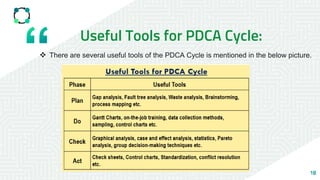
Useful Tools for PDCA Cycle:
18
 There are several useful tools of the PDCA Cycle is mentioned in the below picture.
What are the benefits of the PDCA
cycle?
19
• PDCA approach encourages the way of problem-solving and implementing solutions
• PDCA (Plan-Do-Check-Act) approach ensures that you plan, test, and include
feedback before you start full-scale implementation
• Repeating the PDCA_Cycle frequently will help to implement Kaizen and other
continuous improvement initiatives.
• PDCA_approach brings you closer to your goals as knowledge is increased: from
solving problems, from failures, from the feedback received.
• This approach Improves the critical thinking skills of your team
THANKS!
Any questions?
You can find me at:
⦿ @username
⦿ user@mail.me
20

PDCA.pdf

  • 1.
    PDCA Cycle |Plan Do Check Act | Implementation
  • 2.
  • 3.
    What is thePDCA cycle in TQM? 3  The full name is the Plan-Do-Check-Act Cycle and it is one of the popular Problem Solving Method and Continuous Improvement Methodology.  It is often referred to as the Deming wheel or Deming cycle.  Shewhart and Deming are recognized as pioneers in the Quality Management movement.  Shewhart introduced the PDSA cycle, (Plan-Do-Study-Act).  He believed that data analysis is an essential part of any improvement effort and checking does not necessarily imply an in-depth study.
  • 4.
    What is thePDCA model of continuous improvement? 4  PDCA is widely recognized as the basis of continually improving the Quality of Products processes, and services and also it is a simple structured approach for solving quality-related problems. It may be necessary to solve the problem permanently and reach the ultimate goal state.  Used to verify the feasibility of a proposed idea whether it is an incremental or a breakthrough improvement.  Plan-Do-Check-Act approach is the base for TQM, ISO 9001:2015 Quality Management System Standard, A3 thinking methodology, and IATF 16949:2016 Automotive QMS Standard.  This methodology relies on trial and error, however, it keeps on improving until it achieves excellence.  It is one of the most popular Lean Manufacturing Tool across the manufacturing industries.
  • 5.
  • 6.
    What are thefour steps in the PDCA cycle? 6 1. Plan – A change aimed at improvement 2. Do – Carry out the change 3. Check – Study the results 4. Act – Adopt, Adapt, or Abandon
  • 7.
    Four Phases ofPDCA Cycle 7
  • 8.
    How to Implementthe PDCA Cycle? Example: Implementation of Plan Phase: 8 There are four sub-phases are available in the planning phase which is explained below in sequence: 1. Select Improvement Opportunity 2. Analyze Current Situation 3. Identify Root Causes 4. Generate and Choose Solution
  • 9.
    [1] Select ImprovementOpportunity: 9  Generate a list and select  Redefine team  Write problem / opportunity / aim statement  Describe the problem  Management review  The team selects the problem to be solved (to be improved)  The problem and objectives are clearly identified  The current situation is analyzed.  Solution alternatives are identified, selected and scheduled
  • 10.
    [2] Analyze CurrentSituation: 10  Define the process/problem to be solved  Identify the customer(s).  Prepare Baseline data  Check any Performance gaps are available?  Look at benchmarks, standards, regulatory requirements  Validate problem and statement  Management review
  • 11.
    [3] Identify RootCauses: 11  This is a very very important step  Utilize the Cause and Effect Diagram (Fishbone Diagram or Ishikawa Diagram, or Why- Why analysis to identify the most likely cause(s).  Use Genchi Gembutsu Method  Select root cause  Management review
  • 12.
    [4] Generate andChoose Solutions: 12  Generate a list and select solutions  Directly linked to root cause & supported by data  Team brainstorming and shared decision making  Be honest about barriers  Choose the best solution based on criteria  Define and map out a solution  Develop solution(s) to remove the root cause(s)  Select the best solution(s) to remove the root cause(s)  Verify that effectiveness of the selected solutions  Verify that selected solutions do not cause any undesirable effects  Set a Target that you want to achieve
  • 13.
    Implementation of DoPhase: [5] Map Out and Implement a Trial Run: 13  Map out a trial run  Communication and education/training are key factors  Be specific  Implement a trial run  Ensure all the countermeasures are completed  It involves collecting data for later analysis  It ensures the solution is appropriately tested Implementation of Check Phase:  The check phase has two sub-phases which are mentioned below. 6. Analyze the Results 7. Draw Conclusions
  • 14.
    [6] Analyze theResults: 14  Evaluate results based on collected data  Team-based analysis  Objective and subjective data  Revisit the process as it was mapped out  Be honest!  Evaluate both Results and Process  Involves analyzing the collected data and comparing the actual results against the planned objectives.  Allows discussing whether further improvements are possible  You may have to repeat the Do and Check a number of times until you get the optimum results
  • 15.
    [7] Draw Conclusions: 15 Team-based discussion  Was the root cause eliminated?  What worked?  Did the desired change occur?  What didn’t work?  What could be improved/changed?  Implement the best solution(s) to remove the root cause(s)  What did we learn?  Implement the best solution(s) to address the escape point(s)  Validate the effectiveness of the implemented solutions by Customer's perspective  Monitor the effectiveness of the implemented solutions and assure that they do not cause any undesirable effects  Remove Interim Containment Actions Implementation of Act Phase: The last phase is the act phase and it has two sub-phases as mentioned below. 8. Adopt, Adapt, or Abandon the Intervention 9. Monitor; Hold the gains
  • 16.
    [8] Adopt, Adapt,or Abandon the Intervention: 16  Team-based discussion and beyond  Test again on a larger scale?  Communication, education, and training  Revise plan and repeat trial  Communication, education, and training  Revisit root cause analysis and/or list of solutions  Need additional/new members on the team?  Involves acting on the feedback and lessons learned and implementing the solution  It is also concerned with: Standardizing, Documenting, Sustaining the improved process  Integrating it into the organization’s system.
  • 17.
    [9] Monitor; Holdthe gains: 17  Standardize the change  Change to department policy?  Continue to monitor improvement  Same data collection tools and process  Continue reporting to staff and management  Move to new improvement opportunity  Standardize Success and Learn from Failures
  • 18.
    Useful Tools forPDCA Cycle: 18  There are several useful tools of the PDCA Cycle is mentioned in the below picture.
  • 19.
    What are thebenefits of the PDCA cycle? 19 • PDCA approach encourages the way of problem-solving and implementing solutions • PDCA (Plan-Do-Check-Act) approach ensures that you plan, test, and include feedback before you start full-scale implementation • Repeating the PDCA_Cycle frequently will help to implement Kaizen and other continuous improvement initiatives. • PDCA_approach brings you closer to your goals as knowledge is increased: from solving problems, from failures, from the feedback received. • This approach Improves the critical thinking skills of your team
  • 20.
    THANKS! Any questions? You canfind me at: ⦿ @username ⦿ user@mail.me 20