Leading Change
Driving Institutional Process Improvement
Against the Odds
Amy H. Kimball | CEO, Boston VA Research Institute
Daniel Norton | Entrepreneur & Startup Advisor
Image Source: https://images.app.goo.gl/fiFKn2JhEwiXpSVP9
Background
• We all agree we don’t like the way we’re doing things and want to
change
• We have buy-in on proposed solutions, but change not taking off
• Every day, work is like drinking from a firehose
• Hiring and reorganizing shows promise, but not fixing the problems
• Team frustrated
• We’re spinning our wheels
• We want to get better, but nothing is working
• Morale low
Image Source: https://images.app.goo.gl/TQsLw7nRy8PneGNo9
Learning
Objectives
1. Reframe our definition of process
improvement
2. Recognize the difference between factory
work and knowledge work
3. Recognize the impact of unseen inefficiencies
in knowledge work
4. Shift the problem solving dynamic from solo
to team sport
5. Evaluate what problem to solve
6. Structure and embed process improvement
into our organizations
Reframing our definition of
process improvement
Not just structural,
also cultural and political
Source: Roberto Fernandez, William F. Pounds Professor in Management, MIT Sloan School of Management
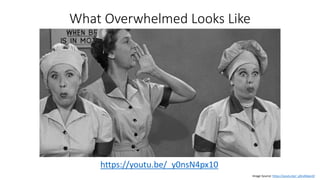
What Overwhelmed Looks Like
Image Source: https://youtu.be/_y0nsN4px10
https://youtu.be/_y0nsN4px10
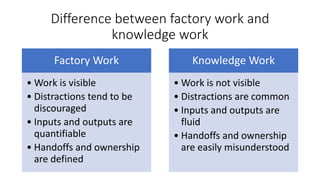
Factory Work
• Work is visible
• Distractions tend to be
discouraged
• Inputs and outputs are
quantifiable
• Handoffs and ownership
are defined
Knowledge Work
• Work is not visible
• Distractions are common
• Inputs and outputs are
fluid
• Handoffs and ownership
are easily misunderstood
Difference between factory work and
knowledge work
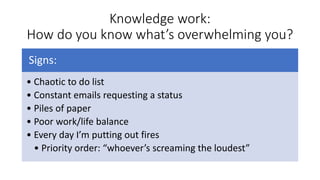
Knowledge work:
How do you know what’s overwhelming you?
Signs:
• Chaotic to do list
• Constant emails requesting a status
• Piles of paper
• Poor work/life balance
• Every day I’m putting out fires
• Priority order: “whoever’s screaming the loudest”
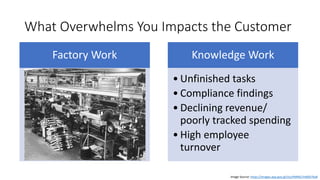
What Overwhelms You Impacts the Customer
Factory Work Knowledge Work
• Unfinished tasks
• Compliance findings
• Declining revenue/
poorly tracked spending
• High employee
turnover
Image Source: https://images.app.goo.gl/ULyYNRRG7mBXD7kx8
Who should be involved in problem solving?
• Who would really understand what’s behind the problem?
• History
• Context
• Who is doing the work day-to-day?
• Who else is involved in the daily process?
• Who isn’t involved in the daily process but is affected by it?
Source: Nelson Repenning, PhD & Don Kieffer, MIT Sloan School of Management
Your role as the leader
• Setting the tone
• Showing commitment
• Showing vulnerability
• Facilitating
1. Inclusive
2. Open dialogue: non-judgmental, respectful disagreement
3. Productive: action-oriented (parking lot)
4. Accountable
5. Team-oriented (this is about the organization, not individuals)
Source: MIT Sloan EMBA; Lencioni, Five Dysfunctions of a Team
Is it the leader’s job to solve
problems?
• Think about a day-to-day problem you’ve faced in
your workplace
• Have you ever had someone above you try to force
their solutions on you?
• What happened?
• How did it make you feel?
• How did adoption go?
• How did rollout go?
• How sustained was the change?
• Did it solve the problem?
Putting the theory to work
How can we get started back at the office?
Evaluating what problem to solve
Start with problems that:
• Touch multiple people
• Are important, impactful
• Are within the scope of your organization’s influence
• Have behavioral elements—not just technical
• Have been plaguing you and others
If you get stuck:
a. Walk away for a while (lets your subconscious work on it)
b. Reframe your problem as a question; ask what other ways you could solve it
Source: Nelson Repenning, School of Management Distinguished Professor of System Dynamics and Organization Studies, MIT Sloan School of Management; Roth’s The Achievement Habit
Process improvement kickoff
• Whole team - in person if possible
• Half day
• Assure them they will have the 2nd half to get their work done
• Future sessions can be shorter & more routine
• Feed them!
• Establish the tone
• Discuss what we’re doing and why
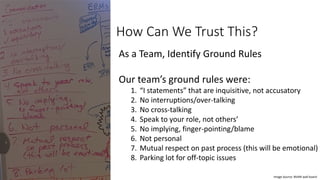
How Can We Trust This?
As a Team, Identify Ground Rules
Our team’s ground rules were:
1. “I statements” that are inquisitive, not accusatory
2. No interruptions/over-talking
3. No cross-talking
4. Speak to your role, not others’
5. No implying, finger-pointing/blame
6. Not personal
7. Mutual respect on past process (this will be emotional)
8. Parking lot for off-topic issues
Image Source: BVARI wall board
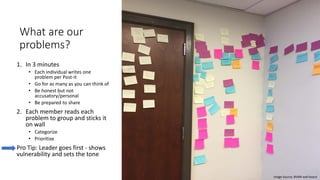
What are our
problems?
1. In 3 minutes
• Each individual writes one
problem per Post-it
• Go for as many as you can think of
• Be honest but not
accusatory/personal
• Be prepared to share
2. Each member reads each
problem to group and sticks it
on wall
• Categorize
• Prioritize
Pro Tip: Leader goes first - shows
vulnerability and sets the tone
Image Source: BVARI wall board
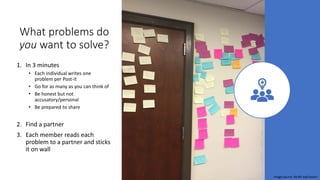
What problems do
you want to solve?
1. In 3 minutes
• Each individual writes one
problem per Post-it
• Go for as many as you can think of
• Be honest but not
accusatory/personal
• Be prepared to share
2. Find a partner
3. Each member reads each
problem to a partner and sticks
it on wall
Image Source: BVARI wall board
Transitioning from identifying to solving
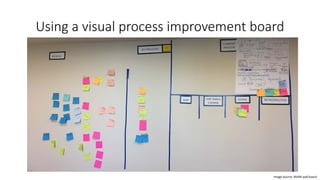
Using a visual process improvement board
Image Source: BVARI wall board
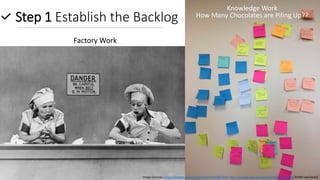
Knowledge Work
Factory Work
Step 1 Establish the Backlog
Image Sources: https://images.app.goo.gl/U2eRTVA8vdfbCibi9; https://images.app.goo.gl/Lq9cnXHF58PfDSJ69; BVARI wall board
Knowledge Work
How Many Chocolates are Piling Up??
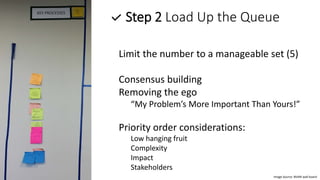
Limit the number to a manageable set (5)
Consensus building
Removing the ego
“My Problem’s More Important Than Yours!”
Priority order considerations:
Low hanging fruit
Complexity
Impact
Stakeholders
Step 2 Load Up the Queue
Image Source: BVARI wall board
Step 3 Map The Current Process
But first:
• Assess your starting point so you can measure improvement
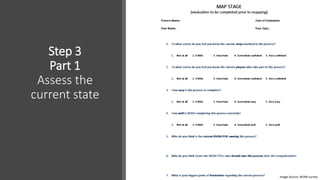
Step 3
Part 1
Assess the
current state
Image Source: BVARI survey
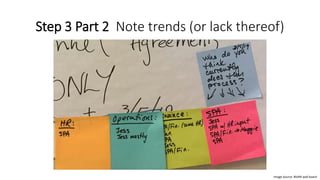
Step 3 Part 2 Note trends (or lack thereof)
Image Source: BVARI wall board
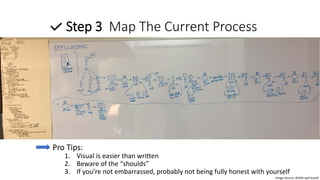
Step 3 Map The Current Process
Pro Tips:
1. Visual is easier than written
2. Beware of the “shoulds”
3. If you’re not embarrassed, probably not being fully honest with yourself
Image Source: BVARI wall board
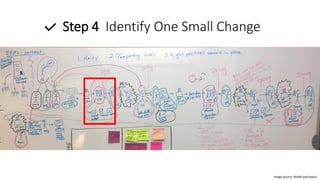
Step 4 Identify One Small Change
Image Source: BVARI wall board
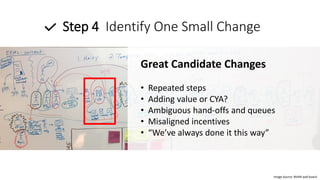
Step 4 Identify One Small Change
Great Candidate Changes
• Repeated steps
• Adding value or CYA?
• Ambiguous hand-offs and queues
• Misaligned incentives
• “We’ve always done it this way”
Image Source: BVARI wall board
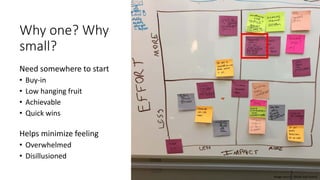
Why one? Why
small?
Need somewhere to start
• Buy-in
• Low hanging fruit
• Achievable
• Quick wins
Helps minimize feeling
• Overwhelmed
• Disillusioned
Image Source: BVARI wall board
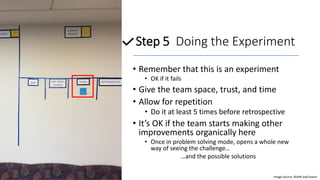
Step 5 Doing the Experiment
• Remember that this is an experiment
• OK if it fails
• Give the team space, trust, and time
• Allow for repetition
• Do it at least 5 times before retrospective
• It’s OK if the team starts making other
improvements organically here
• Once in problem solving mode, opens a whole new
way of seeing the challenge…
…and the possible solutions
Image Source: BVARI wall board
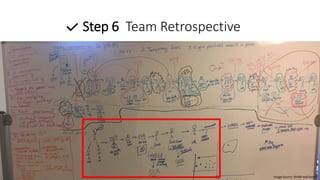
Step 6 Team Retrospective
Image Source: BVARI wall board
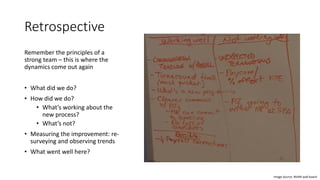
Retrospective
Remember the principles of a
strong team – this is where the
dynamics come out again
• What did we do?
• How did we do?
• What’s working about the
new process?
• What’s not?
• Measuring the improvement: re-
surveying and observing trends
• What went well here?
Image Source: BVARI wall board
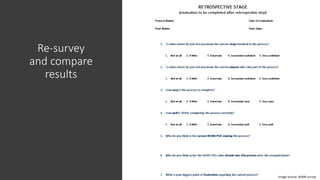
Re-survey
and compare
results
Image Source: BVARI survey
Our first process improvement - outcome
Change we identified
• Move first of 2 Sponsored Programs reviews from Step
4 to Step 1
Changes we’ve made
• Move first Sponsored Programs review from
Step 4 to Step 1
• Eliminate 3 instances of HR scanning the
document
• Transition completion of form from HR to SP
• Transition entry of ERM into grant spending
projection from Finance to Sponsored
Programs
• SP gains PI signature
• Form is now eSignable!
• Consolidate process from 3 departments to 2
• Eliminated 2 extra sets of hands doing slivers of overall
process
Image Source: BVARI wall board
Our first process
improvement - impact
• Tensions reduced among team
• Trust improved
• Administrative cost of processing an ERM down
• Proactive ERM changes on grants
• Prevents revenue loss from unspent funds
• Improves customer service
• Ultimately, improves veterans’ access to innovative medicine (thanks to
personnel working timely on project)
• Kicked off the change envisioned under “right people, right jobs”
• Processing time improved by over 2 weeks!
• From: can’t get to it, too busy putting out fires, always goes to the
bottom of the pile
• To: I understand the process and priority, and my role in completing it
Image Source: BVARI wall board
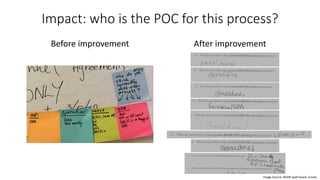
Impact: who is the POC for this process?
Before improvement After improvement
Image Source: BVARI wall board, survey
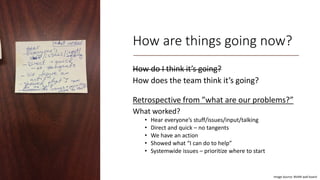
How are things going now?
How do I think it’s going?
How does the team think it’s going?
Retrospective from ”what are our problems?”
What worked?
• Hear everyone’s stuff/issues/input/talking
• Direct and quick – no tangents
• We have an action
• Showed what “I can do to help”
• Systemwide issues – prioritize where to start
Image Source: BVARI wall board
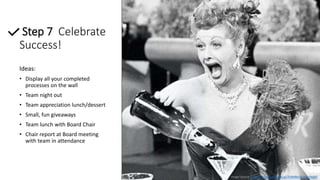
Step 7 Celebrate
Success!
Ideas:
• Display all your completed
processes on the wall
• Team night out
• Team appreciation lunch/dessert
• Small, fun giveaways
• Team lunch with Board Chair
• Chair report at Board meeting
with team in attendance
Image Source: https://images.app.goo.gl/7E8MMLirCXnCVhdN7
Summary
1. Process improvement is not
just structural
a. It’s also cultural and
political
b. Tensions, emotions run
high!
2. In factory work, you can see
when you are backing up; in
knowledge work, you don’t
always know why you’re
overwhelmed
3. The unseen inefficiencies of
knowledge work have
serious consequences on
a. You
b. Your team
c. Your customers
4. Problem solving needs to come from the team
a. Create a safe environment
b. Facilitate
c. Remember Lencioni’s Five Dysfunctions of
a Team
5. Ask yourself what problem you are trying to solve.
Repeat until you find what’s at the core.
a. Move from answers to questions
6. The best way to embed process improvement into our organization is to use a systematic, replicable approach
a. Establish the backlog
b. Load up the queue
c. Survey the current process and map it
d. Identify one small change
e. Do the experiment (5 times)
f. Retrospective survey and discussion - what worked and didn’t
Citations & Suggested Reading
• Five Dysfunctions of a Team, Patrick Lencioni
• The Leadership Challenge, James M. Kouzes & Barry Z. Posner
• The Coaching Habit, Michael Bungay Stanier
• The Achievement Habit, Bernard Roth
• The Power of Habit, Charles Duhigg
• Getting to Yes, Roger Fisher, et al.
• Mindset, Carol Dweck
• A New Approach to Designing Work, MIT Sloan Management Review
https://sloanreview.mit.edu/article/a-new-approach-to-designing-work/
• Managing for the Future (slides, Three Lenses)
https://slideplayer.com/slide/4955672/
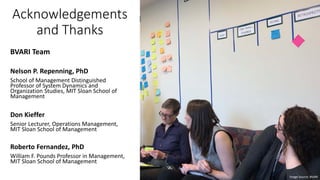
Acknowledgements
and Thanks
BVARI Team
Nelson P. Repenning, PhD
School of Management Distinguished
Professor of System Dynamics and
Organization Studies, MIT Sloan School of
Management
Don Kieffer
Senior Lecturer, Operations Management,
MIT Sloan School of Management
Roberto Fernandez, PhD
William F. Pounds Professor in Management,
MIT Sloan School of Management
Image Source: BVARI
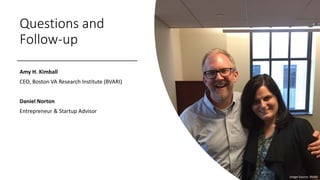
Questions and
Follow-up
Amy H. Kimball
CEO, Boston VA Research Institute (BVARI)
Daniel Norton
Entrepreneur & Startup Advisor
Image Source: BVARI

Leading Change

  • 1.
    Leading Change Driving InstitutionalProcess Improvement Against the Odds Amy H. Kimball | CEO, Boston VA Research Institute Daniel Norton | Entrepreneur & Startup Advisor Image Source: https://images.app.goo.gl/fiFKn2JhEwiXpSVP9
  • 2.
    Background • We allagree we don’t like the way we’re doing things and want to change • We have buy-in on proposed solutions, but change not taking off • Every day, work is like drinking from a firehose • Hiring and reorganizing shows promise, but not fixing the problems • Team frustrated • We’re spinning our wheels • We want to get better, but nothing is working • Morale low Image Source: https://images.app.goo.gl/TQsLw7nRy8PneGNo9
  • 3.
    Learning Objectives 1. Reframe ourdefinition of process improvement 2. Recognize the difference between factory work and knowledge work 3. Recognize the impact of unseen inefficiencies in knowledge work 4. Shift the problem solving dynamic from solo to team sport 5. Evaluate what problem to solve 6. Structure and embed process improvement into our organizations
  • 4.
    Reframing our definitionof process improvement Not just structural, also cultural and political Source: Roberto Fernandez, William F. Pounds Professor in Management, MIT Sloan School of Management
  • 5.
    What Overwhelmed LooksLike Image Source: https://youtu.be/_y0nsN4px10 https://youtu.be/_y0nsN4px10
  • 6.
    Factory Work • Workis visible • Distractions tend to be discouraged • Inputs and outputs are quantifiable • Handoffs and ownership are defined Knowledge Work • Work is not visible • Distractions are common • Inputs and outputs are fluid • Handoffs and ownership are easily misunderstood Difference between factory work and knowledge work
  • 7.
    Knowledge work: How doyou know what’s overwhelming you? Signs: • Chaotic to do list • Constant emails requesting a status • Piles of paper • Poor work/life balance • Every day I’m putting out fires • Priority order: “whoever’s screaming the loudest”
  • 8.
    What Overwhelms YouImpacts the Customer Factory Work Knowledge Work • Unfinished tasks • Compliance findings • Declining revenue/ poorly tracked spending • High employee turnover Image Source: https://images.app.goo.gl/ULyYNRRG7mBXD7kx8
  • 9.
    Who should beinvolved in problem solving? • Who would really understand what’s behind the problem? • History • Context • Who is doing the work day-to-day? • Who else is involved in the daily process? • Who isn’t involved in the daily process but is affected by it? Source: Nelson Repenning, PhD & Don Kieffer, MIT Sloan School of Management
  • 10.
    Your role asthe leader • Setting the tone • Showing commitment • Showing vulnerability • Facilitating 1. Inclusive 2. Open dialogue: non-judgmental, respectful disagreement 3. Productive: action-oriented (parking lot) 4. Accountable 5. Team-oriented (this is about the organization, not individuals) Source: MIT Sloan EMBA; Lencioni, Five Dysfunctions of a Team
  • 11.
    Is it theleader’s job to solve problems? • Think about a day-to-day problem you’ve faced in your workplace • Have you ever had someone above you try to force their solutions on you? • What happened? • How did it make you feel? • How did adoption go? • How did rollout go? • How sustained was the change? • Did it solve the problem?
  • 12.
    Putting the theoryto work How can we get started back at the office?
  • 13.
    Evaluating what problemto solve Start with problems that: • Touch multiple people • Are important, impactful • Are within the scope of your organization’s influence • Have behavioral elements—not just technical • Have been plaguing you and others If you get stuck: a. Walk away for a while (lets your subconscious work on it) b. Reframe your problem as a question; ask what other ways you could solve it Source: Nelson Repenning, School of Management Distinguished Professor of System Dynamics and Organization Studies, MIT Sloan School of Management; Roth’s The Achievement Habit
  • 14.
    Process improvement kickoff •Whole team - in person if possible • Half day • Assure them they will have the 2nd half to get their work done • Future sessions can be shorter & more routine • Feed them! • Establish the tone • Discuss what we’re doing and why
  • 15.
    How Can WeTrust This? As a Team, Identify Ground Rules Our team’s ground rules were: 1. “I statements” that are inquisitive, not accusatory 2. No interruptions/over-talking 3. No cross-talking 4. Speak to your role, not others’ 5. No implying, finger-pointing/blame 6. Not personal 7. Mutual respect on past process (this will be emotional) 8. Parking lot for off-topic issues Image Source: BVARI wall board
  • 16.
    What are our problems? 1.In 3 minutes • Each individual writes one problem per Post-it • Go for as many as you can think of • Be honest but not accusatory/personal • Be prepared to share 2. Each member reads each problem to group and sticks it on wall • Categorize • Prioritize Pro Tip: Leader goes first - shows vulnerability and sets the tone Image Source: BVARI wall board
  • 17.
    What problems do youwant to solve? 1. In 3 minutes • Each individual writes one problem per Post-it • Go for as many as you can think of • Be honest but not accusatory/personal • Be prepared to share 2. Find a partner 3. Each member reads each problem to a partner and sticks it on wall Image Source: BVARI wall board
  • 18.
  • 19.
    Using a visualprocess improvement board Image Source: BVARI wall board
  • 20.
    Knowledge Work Factory Work Step1 Establish the Backlog Image Sources: https://images.app.goo.gl/U2eRTVA8vdfbCibi9; https://images.app.goo.gl/Lq9cnXHF58PfDSJ69; BVARI wall board Knowledge Work How Many Chocolates are Piling Up??
  • 21.
    Limit the numberto a manageable set (5) Consensus building Removing the ego “My Problem’s More Important Than Yours!” Priority order considerations: Low hanging fruit Complexity Impact Stakeholders Step 2 Load Up the Queue Image Source: BVARI wall board
  • 22.
    Step 3 MapThe Current Process But first: • Assess your starting point so you can measure improvement
  • 23.
    Step 3 Part 1 Assessthe current state Image Source: BVARI survey
  • 24.
    Step 3 Part2 Note trends (or lack thereof) Image Source: BVARI wall board
  • 25.
    Step 3 MapThe Current Process Pro Tips: 1. Visual is easier than written 2. Beware of the “shoulds” 3. If you’re not embarrassed, probably not being fully honest with yourself Image Source: BVARI wall board
  • 26.
    Step 4 IdentifyOne Small Change Image Source: BVARI wall board
  • 27.
    Step 4 IdentifyOne Small Change Great Candidate Changes • Repeated steps • Adding value or CYA? • Ambiguous hand-offs and queues • Misaligned incentives • “We’ve always done it this way” Image Source: BVARI wall board
  • 28.
    Why one? Why small? Needsomewhere to start • Buy-in • Low hanging fruit • Achievable • Quick wins Helps minimize feeling • Overwhelmed • Disillusioned Image Source: BVARI wall board
  • 29.
    Step 5 Doingthe Experiment • Remember that this is an experiment • OK if it fails • Give the team space, trust, and time • Allow for repetition • Do it at least 5 times before retrospective • It’s OK if the team starts making other improvements organically here • Once in problem solving mode, opens a whole new way of seeing the challenge… …and the possible solutions Image Source: BVARI wall board
  • 30.
    Step 6 TeamRetrospective Image Source: BVARI wall board
  • 31.
    Retrospective Remember the principlesof a strong team – this is where the dynamics come out again • What did we do? • How did we do? • What’s working about the new process? • What’s not? • Measuring the improvement: re- surveying and observing trends • What went well here? Image Source: BVARI wall board
  • 32.
  • 33.
    Our first processimprovement - outcome Change we identified • Move first of 2 Sponsored Programs reviews from Step 4 to Step 1 Changes we’ve made • Move first Sponsored Programs review from Step 4 to Step 1 • Eliminate 3 instances of HR scanning the document • Transition completion of form from HR to SP • Transition entry of ERM into grant spending projection from Finance to Sponsored Programs • SP gains PI signature • Form is now eSignable! • Consolidate process from 3 departments to 2 • Eliminated 2 extra sets of hands doing slivers of overall process Image Source: BVARI wall board
  • 34.
    Our first process improvement- impact • Tensions reduced among team • Trust improved • Administrative cost of processing an ERM down • Proactive ERM changes on grants • Prevents revenue loss from unspent funds • Improves customer service • Ultimately, improves veterans’ access to innovative medicine (thanks to personnel working timely on project) • Kicked off the change envisioned under “right people, right jobs” • Processing time improved by over 2 weeks! • From: can’t get to it, too busy putting out fires, always goes to the bottom of the pile • To: I understand the process and priority, and my role in completing it Image Source: BVARI wall board
  • 35.
    Impact: who isthe POC for this process? Before improvement After improvement Image Source: BVARI wall board, survey
  • 36.
    How are thingsgoing now? How do I think it’s going? How does the team think it’s going? Retrospective from ”what are our problems?” What worked? • Hear everyone’s stuff/issues/input/talking • Direct and quick – no tangents • We have an action • Showed what “I can do to help” • Systemwide issues – prioritize where to start Image Source: BVARI wall board
  • 37.
    Step 7 Celebrate Success! Ideas: •Display all your completed processes on the wall • Team night out • Team appreciation lunch/dessert • Small, fun giveaways • Team lunch with Board Chair • Chair report at Board meeting with team in attendance Image Source: https://images.app.goo.gl/7E8MMLirCXnCVhdN7
  • 38.
    Summary 1. Process improvementis not just structural a. It’s also cultural and political b. Tensions, emotions run high! 2. In factory work, you can see when you are backing up; in knowledge work, you don’t always know why you’re overwhelmed 3. The unseen inefficiencies of knowledge work have serious consequences on a. You b. Your team c. Your customers 4. Problem solving needs to come from the team a. Create a safe environment b. Facilitate c. Remember Lencioni’s Five Dysfunctions of a Team 5. Ask yourself what problem you are trying to solve. Repeat until you find what’s at the core. a. Move from answers to questions 6. The best way to embed process improvement into our organization is to use a systematic, replicable approach a. Establish the backlog b. Load up the queue c. Survey the current process and map it d. Identify one small change e. Do the experiment (5 times) f. Retrospective survey and discussion - what worked and didn’t
  • 39.
    Citations & SuggestedReading • Five Dysfunctions of a Team, Patrick Lencioni • The Leadership Challenge, James M. Kouzes & Barry Z. Posner • The Coaching Habit, Michael Bungay Stanier • The Achievement Habit, Bernard Roth • The Power of Habit, Charles Duhigg • Getting to Yes, Roger Fisher, et al. • Mindset, Carol Dweck • A New Approach to Designing Work, MIT Sloan Management Review https://sloanreview.mit.edu/article/a-new-approach-to-designing-work/ • Managing for the Future (slides, Three Lenses) https://slideplayer.com/slide/4955672/
  • 40.
    Acknowledgements and Thanks BVARI Team NelsonP. Repenning, PhD School of Management Distinguished Professor of System Dynamics and Organization Studies, MIT Sloan School of Management Don Kieffer Senior Lecturer, Operations Management, MIT Sloan School of Management Roberto Fernandez, PhD William F. Pounds Professor in Management, MIT Sloan School of Management Image Source: BVARI
  • 41.
    Questions and Follow-up Amy H.Kimball CEO, Boston VA Research Institute (BVARI) Daniel Norton Entrepreneur & Startup Advisor Image Source: BVARI