High Performing Teams
Offsite Team Building
November 12 & 14, 2013
Objective of the session

An understanding of the traits of
a high performing team
Discussion on how we can build
one

Note – Adapted from The 5 Dysfunctions of a Team by Patrick Lencioni

2
5 traits in this discussion
•Trust
•Commitment
•Conflict
•Accountability
•Results

3
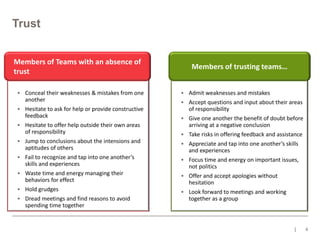
Trust
Members of Teams with an absence of
trust
• Conceal their weaknesses & mistakes from one
another
• Hesitate to ask for help or provide constructive
feedback
• Hesitate to offer help outside their own areas
of responsibility
• Jump to conclusions about the intensions and
aptitudes of others
• Fail to recognize and tap into one another’s
skills and experiences
• Waste time and energy managing their
behaviors for effect
• Hold grudges
• Dread meetings and find reasons to avoid
spending time together

Members of trusting teams…
• Admit weaknesses and mistakes
• Accept questions and input about their areas
of responsibility
• Give one another the benefit of doubt before
arriving at a negative conclusion
• Take risks in offering feedback and assistance
• Appreciate and tap into one another’s skills
and experiences
• Focus time and energy on important issues,
not politics
• Offer and accept apologies without
hesitation
• Look forward to meetings and working
together as a group

4
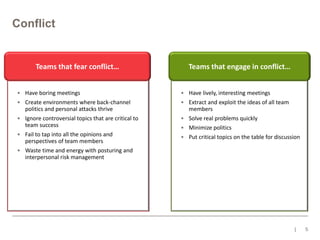
Conflict

Teams that fear conflict…

Teams that engage in conflict…

• Have boring meetings
• Create environments where back-channel
politics and personal attacks thrive
• Ignore controversial topics that are critical to
team success
• Fail to tap into all the opinions and
perspectives of team members
• Waste time and energy with posturing and
interpersonal risk management

• Have lively, interesting meetings
• Extract and exploit the ideas of all team
members
• Solve real problems quickly
• Minimize politics
• Put critical topics on the table for discussion

5
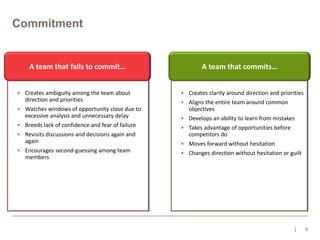
Commitment

A team that fails to commit…
• Creates ambiguity among the team about
direction and priorities
• Watches windows of opportunity close due to
excessive analysis and unnecessary delay
• Breeds lack of confidence and fear of failure
• Revisits discussions and decisions again and
again
• Encourages second-guessing among team
members

A team that commits…
• Creates clarity around direction and priorities
• Aligns the entire team around common
objectives
• Develops an ability to learn from mistakes
• Takes advantage of opportunities before
competitors do
• Moves forward without hesitation
• Changes direction without hesitation or guilt

6
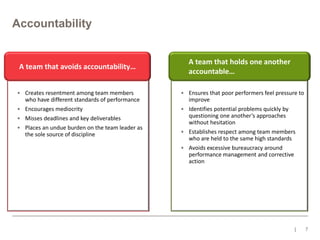
Accountability

A team that avoids accountability…
• Creates resentment among team members
who have different standards of performance
• Encourages mediocrity
• Misses deadlines and key deliverables
• Places an undue burden on the team leader as
the sole source of discipline

A team that holds one another
accountable…
• Ensures that poor performers feel pressure to
improve
• Identifies potential problems quickly by
questioning one another’s approaches
without hesitation
• Establishes respect among team members
who are held to the same high standards
• Avoids excessive bureaucracy around
performance management and corrective
action

7
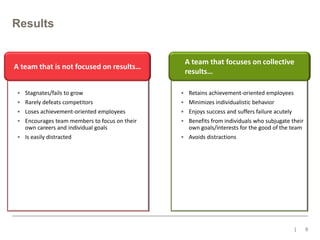
Results
A team that focuses on collective
results…

A team that is not focused on results…
•
•
•
•

Stagnates/fails to grow
Rarely defeats competitors
Loses achievement-oriented employees
Encourages team members to focus on their
own careers and individual goals
• Is easily distracted

•
•
•
•

Retains achievement-oriented employees
Minimizes individualistic behavior
Enjoys success and suffers failure acutely
Benefits from individuals who subjugate their
own goals/interests for the good of the team
• Avoids distractions

8
Thank You
Anita Rao

Build a High Performing Team

  • 1.
    High Performing Teams OffsiteTeam Building November 12 & 14, 2013
  • 2.
    Objective of thesession An understanding of the traits of a high performing team Discussion on how we can build one Note – Adapted from The 5 Dysfunctions of a Team by Patrick Lencioni 2
  • 3.
    5 traits inthis discussion •Trust •Commitment •Conflict •Accountability •Results 3
  • 4.
    Trust Members of Teamswith an absence of trust • Conceal their weaknesses & mistakes from one another • Hesitate to ask for help or provide constructive feedback • Hesitate to offer help outside their own areas of responsibility • Jump to conclusions about the intensions and aptitudes of others • Fail to recognize and tap into one another’s skills and experiences • Waste time and energy managing their behaviors for effect • Hold grudges • Dread meetings and find reasons to avoid spending time together Members of trusting teams… • Admit weaknesses and mistakes • Accept questions and input about their areas of responsibility • Give one another the benefit of doubt before arriving at a negative conclusion • Take risks in offering feedback and assistance • Appreciate and tap into one another’s skills and experiences • Focus time and energy on important issues, not politics • Offer and accept apologies without hesitation • Look forward to meetings and working together as a group 4
  • 5.
    Conflict Teams that fearconflict… Teams that engage in conflict… • Have boring meetings • Create environments where back-channel politics and personal attacks thrive • Ignore controversial topics that are critical to team success • Fail to tap into all the opinions and perspectives of team members • Waste time and energy with posturing and interpersonal risk management • Have lively, interesting meetings • Extract and exploit the ideas of all team members • Solve real problems quickly • Minimize politics • Put critical topics on the table for discussion 5
  • 6.
    Commitment A team thatfails to commit… • Creates ambiguity among the team about direction and priorities • Watches windows of opportunity close due to excessive analysis and unnecessary delay • Breeds lack of confidence and fear of failure • Revisits discussions and decisions again and again • Encourages second-guessing among team members A team that commits… • Creates clarity around direction and priorities • Aligns the entire team around common objectives • Develops an ability to learn from mistakes • Takes advantage of opportunities before competitors do • Moves forward without hesitation • Changes direction without hesitation or guilt 6
  • 7.
    Accountability A team thatavoids accountability… • Creates resentment among team members who have different standards of performance • Encourages mediocrity • Misses deadlines and key deliverables • Places an undue burden on the team leader as the sole source of discipline A team that holds one another accountable… • Ensures that poor performers feel pressure to improve • Identifies potential problems quickly by questioning one another’s approaches without hesitation • Establishes respect among team members who are held to the same high standards • Avoids excessive bureaucracy around performance management and corrective action 7
  • 8.
    Results A team thatfocuses on collective results… A team that is not focused on results… • • • • Stagnates/fails to grow Rarely defeats competitors Loses achievement-oriented employees Encourages team members to focus on their own careers and individual goals • Is easily distracted • • • • Retains achievement-oriented employees Minimizes individualistic behavior Enjoys success and suffers failure acutely Benefits from individuals who subjugate their own goals/interests for the good of the team • Avoids distractions 8
  • 9.