Japan / Korea Trip Presentation: Toyota Aaron Fyke  Yuki Wada Gary Mi  Grace Webber Tony Palumbo
Agenda Headline facts: Toyota Global auto industry trends Japanese auto industry history Toyota company background Company history Production history Business segments The Toyota Production System Toyota’s strategy Our questions for Toyota
Headline Facts: Toyota Toyota has annual sales of $120 Billion Produces ~5.5 million vehicles per year From 56 manufacturing plants across 6 continents Employs ~200,000 people 3 rd  largest automotive manufacturer
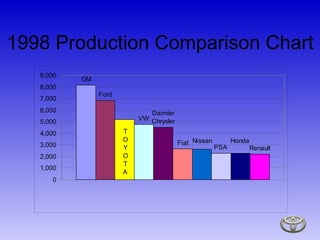
1998 Production Comparison Chart
Global auto industry trends Overcapacity Economic downturn Shifting consumer demands European trade barrier reductions
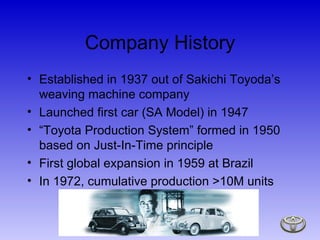
Company History Established in 1937 out of Sakichi Toyoda’s weaving machine company Launched first car (SA Model) in 1947  “ Toyota Production System” formed in 1950 based on Just-In-Time principle First global expansion in 1959 at Brazil In 1972, cumulative production >10M units
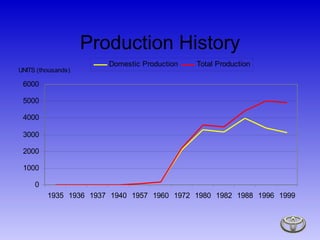
Production History
Business segments Automotive Design, manufacture and sales of passenger cars, recreational vehicles, SUVs and related parts Financial services Provisions of loans to car buyers  and car dealers Others Industrial vehicles (forklifts,  etc. )
The Toyota Production System Revolutionized manufacturing industry At its core is “lean”  a relentless drive to improve efficiency and eliminate waste Beginnings of TPS were born out of necessity due to lack of resources in post-war Japan.
Toyota Production System Key Main Concepts SMED  Single Minute Exchange of Dies  Promoted flexibility of production runs JIT  Just In Time manufacturing Small batches which reduced inventory costs, tightened relationship with suppliers and improved quality control
“5 Whys” Quality Asking “Why?” 5 times to locate source of problems Stopping the production line whenever there are quality problems to ensure they are not repeated Low cost supplier  Long term supplier relationships Toyota Production System Key Main Concepts
Toyota’s Strategy Increase competitive strength through advanced technology Environmental technology fuel consumption, emission, recoverability Hybrid vehicles and next generation fuel cells Cost-reduction efforts discontinuation, integration of older models Increased emphasis on financial services and information communication system
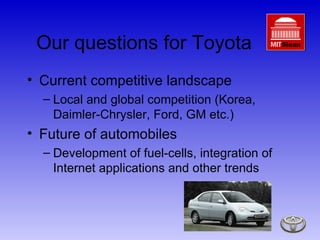
Our questions for Toyota Current competitive landscape Local and global competition (Korea, Daimler-Chrysler, Ford, GM etc.) Future of automobiles Development of fuel-cells, integration of Internet applications and other trends
Japanese auto industry history From follower to leader From domestic producer to exporter Interventionist government

Toyota presentation

  • 1.
    Japan / KoreaTrip Presentation: Toyota Aaron Fyke Yuki Wada Gary Mi Grace Webber Tony Palumbo
  • 2.
    Agenda Headline facts:Toyota Global auto industry trends Japanese auto industry history Toyota company background Company history Production history Business segments The Toyota Production System Toyota’s strategy Our questions for Toyota
  • 3.
    Headline Facts: ToyotaToyota has annual sales of $120 Billion Produces ~5.5 million vehicles per year From 56 manufacturing plants across 6 continents Employs ~200,000 people 3 rd largest automotive manufacturer
  • 4.
  • 5.
    Global auto industrytrends Overcapacity Economic downturn Shifting consumer demands European trade barrier reductions
  • 6.
    Company History Establishedin 1937 out of Sakichi Toyoda’s weaving machine company Launched first car (SA Model) in 1947 “ Toyota Production System” formed in 1950 based on Just-In-Time principle First global expansion in 1959 at Brazil In 1972, cumulative production >10M units
  • 7.
  • 8.
    Business segments AutomotiveDesign, manufacture and sales of passenger cars, recreational vehicles, SUVs and related parts Financial services Provisions of loans to car buyers and car dealers Others Industrial vehicles (forklifts, etc. )
  • 9.
    The Toyota ProductionSystem Revolutionized manufacturing industry At its core is “lean” a relentless drive to improve efficiency and eliminate waste Beginnings of TPS were born out of necessity due to lack of resources in post-war Japan.
  • 10.
    Toyota Production SystemKey Main Concepts SMED Single Minute Exchange of Dies Promoted flexibility of production runs JIT Just In Time manufacturing Small batches which reduced inventory costs, tightened relationship with suppliers and improved quality control
  • 11.
    “5 Whys” QualityAsking “Why?” 5 times to locate source of problems Stopping the production line whenever there are quality problems to ensure they are not repeated Low cost supplier Long term supplier relationships Toyota Production System Key Main Concepts
  • 12.
    Toyota’s Strategy Increasecompetitive strength through advanced technology Environmental technology fuel consumption, emission, recoverability Hybrid vehicles and next generation fuel cells Cost-reduction efforts discontinuation, integration of older models Increased emphasis on financial services and information communication system
  • 13.
    Our questions forToyota Current competitive landscape Local and global competition (Korea, Daimler-Chrysler, Ford, GM etc.) Future of automobiles Development of fuel-cells, integration of Internet applications and other trends
  • 14.
    Japanese auto industryhistory From follower to leader From domestic producer to exporter Interventionist government