Japan / Korea Trip Presentation:
            Toyota
      Aaron Fyke Yuki Wada
      Gary Mi Grace Webber
           Tony Palumbo
Agenda
•   Headline facts: Toyota
•   Global auto industry trends
•   Japanese auto industry history
•   Toyota company background
    – Company history
    – Production history
    – Business segments
• The Toyota Production System
• Toyota’s strategy
• Our questions for Toyota
Headline Facts: Toyota
• Toyota has annual sales of $120 Billion
• Produces ~5.5 million vehicles per year
• From 56 manufacturing plants across
  6 continents
• Employs ~200,000 people
• 3rd largest automotive manufacturer
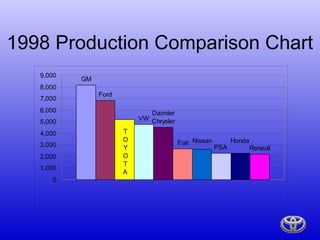
1998 Production Comparison Chart
   9,000
           GM
   8,000
                Ford
   7,000
   6,000                      Daimler
                           VW Chrysler
   5,000
   4,000               T
                       O
   3,000                                 Fiat Nissan         Honda
                       Y                               PSA           Renault
   2,000               O
                       T
   1,000
                       A
      0
Global auto industry trends
•   Overcapacity
•   Economic downturn
•   Shifting consumer demands
•   European trade barrier reductions
Company History
• Established in 1937 out of Sakichi Toyoda’s
  weaving machine company
• Launched first car (SA Model) in 1947
• “Toyota Production System” formed in 1950
  based on Just-In-Time principle
• First global expansion in 1959 at Brazil
• In 1972, cumulative production >10M units
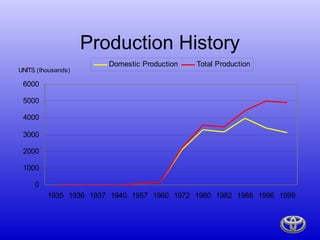
Production History
                       Domestic Production   Total Production
UNITS (thousands)

 6000

 5000

 4000

 3000

 2000

 1000

     0
         1935 1936 1937 1940 1957 1960 1972 1980 1982 1988 1996 1999
Business segments
• Automotive
  – Design, manufacture and sales of
    passenger cars, recreational vehicles,
    SUVs and related parts
• Financial services
  – Provisions of loans to car buyers
    and car dealers
• Others
  – Industrial vehicles (forklifts, etc.)
The Toyota Production System

• Revolutionized manufacturing industry
• At its core is “lean”
  – a relentless drive to improve efficiency and
    eliminate waste
• Beginnings of TPS were born out of
  necessity due to lack of resources in
  post-war Japan.
Toyota Production System
   Key Main Concepts
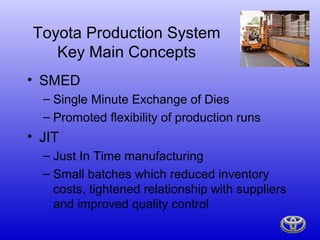
• SMED
  – Single Minute Exchange of Dies
  – Promoted flexibility of production runs
• JIT
  – Just In Time manufacturing
  – Small batches which reduced inventory
    costs, tightened relationship with suppliers
    and improved quality control
Toyota Production System
   Key Main Concepts
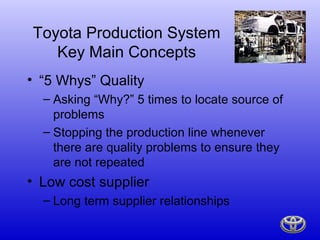
• “5 Whys” Quality
  – Asking “Why?” 5 times to locate source of
    problems
  – Stopping the production line whenever
    there are quality problems to ensure they
    are not repeated
• Low cost supplier
  – Long term supplier relationships
Toyota’s Strategy
• Increase competitive strength through
  advanced technology
  – Environmental technology
    • fuel consumption, emission, recoverability
  – Hybrid vehicles and next generation fuel
    cells
  – Cost-reduction efforts
    • discontinuation, integration of older models
  – Increased emphasis on financial services
    and information communication system
Our questions for Toyota
• Current competitive landscape
  – Local and global competition (Korea,
    Daimler-Chrysler, Ford, GM etc.)
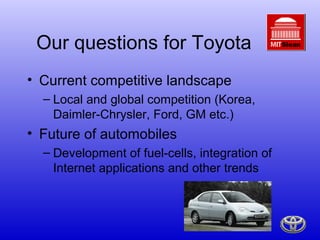
• Future of automobiles
  – Development of fuel-cells, integration of
    Internet applications and other trends
Japanese auto industry history
• From follower to leader
• From domestic producer to exporter
• Interventionist government

Toyota presentation

  • 1.
    Japan / KoreaTrip Presentation: Toyota Aaron Fyke Yuki Wada Gary Mi Grace Webber Tony Palumbo
  • 2.
    Agenda • Headline facts: Toyota • Global auto industry trends • Japanese auto industry history • Toyota company background – Company history – Production history – Business segments • The Toyota Production System • Toyota’s strategy • Our questions for Toyota
  • 3.
    Headline Facts: Toyota •Toyota has annual sales of $120 Billion • Produces ~5.5 million vehicles per year • From 56 manufacturing plants across 6 continents • Employs ~200,000 people • 3rd largest automotive manufacturer
  • 4.
    1998 Production ComparisonChart 9,000 GM 8,000 Ford 7,000 6,000 Daimler VW Chrysler 5,000 4,000 T O 3,000 Fiat Nissan Honda Y PSA Renault 2,000 O T 1,000 A 0
  • 5.
    Global auto industrytrends • Overcapacity • Economic downturn • Shifting consumer demands • European trade barrier reductions
  • 6.
    Company History • Establishedin 1937 out of Sakichi Toyoda’s weaving machine company • Launched first car (SA Model) in 1947 • “Toyota Production System” formed in 1950 based on Just-In-Time principle • First global expansion in 1959 at Brazil • In 1972, cumulative production >10M units
  • 7.
    Production History Domestic Production Total Production UNITS (thousands) 6000 5000 4000 3000 2000 1000 0 1935 1936 1937 1940 1957 1960 1972 1980 1982 1988 1996 1999
  • 8.
    Business segments • Automotive – Design, manufacture and sales of passenger cars, recreational vehicles, SUVs and related parts • Financial services – Provisions of loans to car buyers and car dealers • Others – Industrial vehicles (forklifts, etc.)
  • 9.
    The Toyota ProductionSystem • Revolutionized manufacturing industry • At its core is “lean” – a relentless drive to improve efficiency and eliminate waste • Beginnings of TPS were born out of necessity due to lack of resources in post-war Japan.
  • 10.
    Toyota Production System Key Main Concepts • SMED – Single Minute Exchange of Dies – Promoted flexibility of production runs • JIT – Just In Time manufacturing – Small batches which reduced inventory costs, tightened relationship with suppliers and improved quality control
  • 11.
    Toyota Production System Key Main Concepts • “5 Whys” Quality – Asking “Why?” 5 times to locate source of problems – Stopping the production line whenever there are quality problems to ensure they are not repeated • Low cost supplier – Long term supplier relationships
  • 12.
    Toyota’s Strategy • Increasecompetitive strength through advanced technology – Environmental technology • fuel consumption, emission, recoverability – Hybrid vehicles and next generation fuel cells – Cost-reduction efforts • discontinuation, integration of older models – Increased emphasis on financial services and information communication system
  • 13.
    Our questions forToyota • Current competitive landscape – Local and global competition (Korea, Daimler-Chrysler, Ford, GM etc.) • Future of automobiles – Development of fuel-cells, integration of Internet applications and other trends
  • 14.
    Japanese auto industryhistory • From follower to leader • From domestic producer to exporter • Interventionist government