Presentation on Toyota Motors Supriya Rani Ekta Jindal Sakshi Kundra Harsimran Kaur PRESENTED BY V.P. Mishra Sir PRESENTED TO
Agenda Introduction of Toyota motors History of Toyota auto industry Global auto industry trend Toyota company background Production history Business segments Toyota total sales by region Toyota Production System -Goal,Principles Toyota’s strategy List of toyota vehicles Non-automotive activities Worldwide Presence and Ranking Results
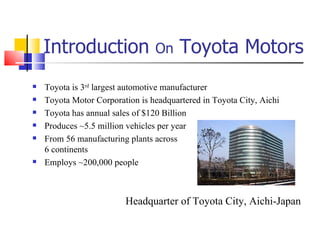
Introduction  On  Toyota Motors Toyota is 3 rd  largest automotive manufacturer Toyota Motor Corporation is headquartered in Toyota City, Aichi Toyota has annual sales of $120 Billion Produces ~5.5 million vehicles per year From 56 manufacturing plants across 6 continents Employs ~200,000 people Headquarter of Toyota City, Aichi-Japan
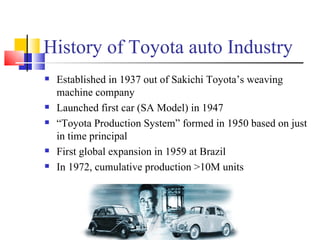
History of Toyota auto Industry Established in 1937 out of Sakichi Toyota’s weaving machine company Launched first car (SA Model) in 1947 “ Toyota Production System” formed in 1950 based on just in time principal First global expansion in 1959 at Brazil In 1972, cumulative production >10M units
Global Auto Industry Trends Overcapacity Economic downturn Shifting consumer demands European trade barrier reductions
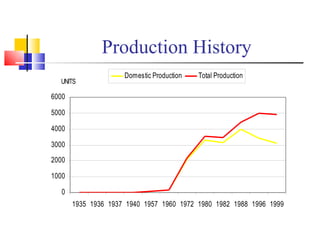
Production History
Business segments Automotive Design, manufacture and sales of passenger cars, recreational vehicles, SUVs and related parts Financial services Provisions of loans to car buyers and car deales Others Industrial vehicles (forklifts,  etc. )
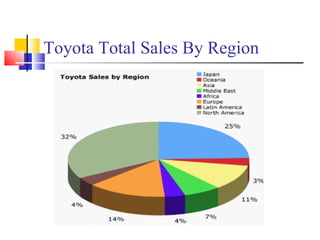
Toyota Total Sales By Region
The Toyota Production System Revolutionized manufacturing industry At its core is “lean” a relentless drive to improve efficiency and eliminate waste Beginnings of TPS were born out of necessity due to lack of resources in post-war Japan.
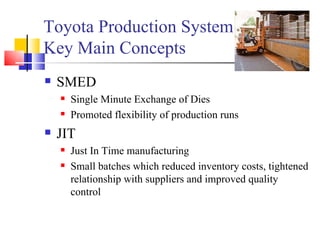
Toyota Production System Key Main Concepts SMED Single Minute Exchange of Dies  Promoted flexibility of production runs JIT Just In Time manufacturing Small batches which reduced inventory costs, tightened relationship with suppliers and improved quality control
GOALS The main objectives of the TPS are to design out overburden  and inconsistency , and to eliminate waste.
SEVEN KINDS OF MUDAS over-production motion (of operator or machine) waiting (of operator or machine) conveyance processing itself inventory (raw material) correction (rework and scrap)
Toyota’s Strategy Increase competitive strength through advanced technology Environmental technology fuel consumption, emission, recoverability Hybrid vehicles and next generation fuel cells Cost-reduction efforts discontinuation, integration of older models Increased emphasis on financial services and information communication system
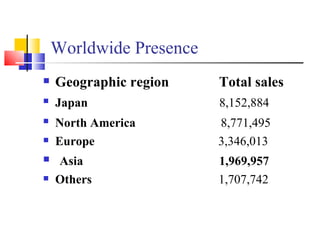
Worldwide Presence Geographic region  Total sales   Japan   8,152,884  North America  8,771,495  Europe  3,346,013 Asia  1,969,957 Others  1,707,742
Ranking Top 3 Automakers Global, OICA, 2010 Group Unit %share Toyota 8,557,351   11.0 Gm 8,476,192 10.9 Volkswagen 7,341,065 9.4
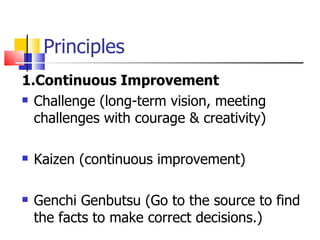
Principles 1.Continuous Improvement Challenge (long-term vision, meeting challenges with courage & creativity) Kaizen (continuous improvement) Genchi Genbutsu (Go to the source to find the facts to make correct decisions.)
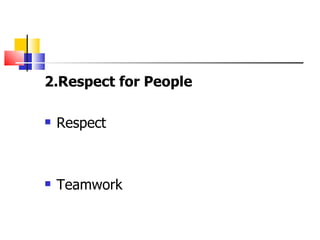
2.Respect for People Respect  Teamwork
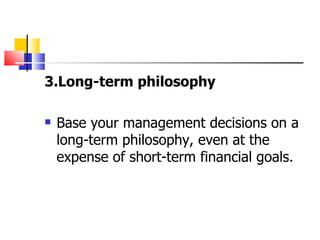
3.Long-term philosophy Base your management decisions on a long-term philosophy, even at the expense of short-term financial goals.
4.The right process will produce the right results Create continuous process flow to bring problems to the surface. Use the "pull" system to avoid overproduction. Level out the workload (Work like the tortoise, not the hare.)
Build a culture of stopping to fix problems, to get quality right from the first. Standardized tasks are the foundation for continuous improvement and employee empowerment.
Use visual control so no problems are hidden. Use only reliable, thoroughly tested technology that serves your people and processes.
5.Add value to the organization by developing your people and partners Grow leaders Develop exceptional people and teams  Respect your extended network of partners and suppliers by challenging them and helping them.
6.Continuously solving root problems drives organizational learning Used to thoroughly understand the situation  Make decisions slowly by consensus, thoroughly considering all options  Become a learning organization through relentless  reflection  and continuous improvement
Results Reduction in leadtime and cost using the TPS This enabled it to become one of the ten largest companies in the world. It is currently as profitable as all the other car companies combined and became the largest car manufacturer in 2007.

Presentation on toyota_motors[1]

  • 1.
    Presentation on ToyotaMotors Supriya Rani Ekta Jindal Sakshi Kundra Harsimran Kaur PRESENTED BY V.P. Mishra Sir PRESENTED TO
  • 2.
    Agenda Introduction ofToyota motors History of Toyota auto industry Global auto industry trend Toyota company background Production history Business segments Toyota total sales by region Toyota Production System -Goal,Principles Toyota’s strategy List of toyota vehicles Non-automotive activities Worldwide Presence and Ranking Results
  • 3.
    Introduction On Toyota Motors Toyota is 3 rd largest automotive manufacturer Toyota Motor Corporation is headquartered in Toyota City, Aichi Toyota has annual sales of $120 Billion Produces ~5.5 million vehicles per year From 56 manufacturing plants across 6 continents Employs ~200,000 people Headquarter of Toyota City, Aichi-Japan
  • 4.
    History of Toyotaauto Industry Established in 1937 out of Sakichi Toyota’s weaving machine company Launched first car (SA Model) in 1947 “ Toyota Production System” formed in 1950 based on just in time principal First global expansion in 1959 at Brazil In 1972, cumulative production >10M units
  • 5.
    Global Auto IndustryTrends Overcapacity Economic downturn Shifting consumer demands European trade barrier reductions
  • 6.
  • 7.
    Business segments AutomotiveDesign, manufacture and sales of passenger cars, recreational vehicles, SUVs and related parts Financial services Provisions of loans to car buyers and car deales Others Industrial vehicles (forklifts, etc. )
  • 8.
  • 9.
    The Toyota ProductionSystem Revolutionized manufacturing industry At its core is “lean” a relentless drive to improve efficiency and eliminate waste Beginnings of TPS were born out of necessity due to lack of resources in post-war Japan.
  • 10.
    Toyota Production SystemKey Main Concepts SMED Single Minute Exchange of Dies Promoted flexibility of production runs JIT Just In Time manufacturing Small batches which reduced inventory costs, tightened relationship with suppliers and improved quality control
  • 11.
    GOALS The mainobjectives of the TPS are to design out overburden and inconsistency , and to eliminate waste.
  • 12.
    SEVEN KINDS OFMUDAS over-production motion (of operator or machine) waiting (of operator or machine) conveyance processing itself inventory (raw material) correction (rework and scrap)
  • 13.
    Toyota’s Strategy Increasecompetitive strength through advanced technology Environmental technology fuel consumption, emission, recoverability Hybrid vehicles and next generation fuel cells Cost-reduction efforts discontinuation, integration of older models Increased emphasis on financial services and information communication system
  • 14.
    Worldwide Presence Geographicregion Total sales Japan 8,152,884 North America 8,771,495 Europe 3,346,013 Asia 1,969,957 Others 1,707,742
  • 15.
    Ranking Top 3Automakers Global, OICA, 2010 Group Unit %share Toyota 8,557,351 11.0 Gm 8,476,192 10.9 Volkswagen 7,341,065 9.4
  • 16.
    Principles 1.Continuous ImprovementChallenge (long-term vision, meeting challenges with courage & creativity) Kaizen (continuous improvement) Genchi Genbutsu (Go to the source to find the facts to make correct decisions.)
  • 17.
    2.Respect for PeopleRespect Teamwork
  • 18.
    3.Long-term philosophy Baseyour management decisions on a long-term philosophy, even at the expense of short-term financial goals.
  • 19.
    4.The right processwill produce the right results Create continuous process flow to bring problems to the surface. Use the "pull" system to avoid overproduction. Level out the workload (Work like the tortoise, not the hare.)
  • 20.
    Build a cultureof stopping to fix problems, to get quality right from the first. Standardized tasks are the foundation for continuous improvement and employee empowerment.
  • 21.
    Use visual controlso no problems are hidden. Use only reliable, thoroughly tested technology that serves your people and processes.
  • 22.
    5.Add value tothe organization by developing your people and partners Grow leaders Develop exceptional people and teams Respect your extended network of partners and suppliers by challenging them and helping them.
  • 23.
    6.Continuously solving rootproblems drives organizational learning Used to thoroughly understand the situation Make decisions slowly by consensus, thoroughly considering all options Become a learning organization through relentless reflection and continuous improvement
  • 24.
    Results Reduction inleadtime and cost using the TPS This enabled it to become one of the ten largest companies in the world. It is currently as profitable as all the other car companies combined and became the largest car manufacturer in 2007.