Downloaded 55 times
![Some tips before you start.
• The vowel sound schwa /ə/ is never stressed.
• The vowel sound /e/ doesn’t have long sound.
• In RP, with a long vowel before r , the
consonant is not pronounced. EG:
– Board [bː:d] ; bird [bɜ:d] ; work [wɜ:k];
poor [pː:]](https://image.slidesharecdn.com/theenglishvowelsystem-140126111151-phpapp01/85/The-english-vowel-system-3-320.jpg)
![/i: /
It is found in the tonic Castillian /i/ accompanied by dental or
palatal consonants.
e.g. capilla, castillo, sí (emphatic), chino
Most important spellings that represent /i:/
• ee see [si:].
• ea beach [bi:tʃ],
• ie field [fi:ld]
• e scene [si:n]
• eo people [pi:pl]
• ey key [ki:]
• ay quay [ki:]](https://image.slidesharecdn.com/theenglishvowelsystem-140126111151-phpapp01/85/The-english-vowel-system-4-320.jpg)
![/i/
We can find an approximate production when the Castilian /i/ is
in unstressed position:
e.g. Último, cursi, pitar.
Sometimes it may sound seemed as /e/.
Most important spellings:
• i rich [ritʃ] , pitch [pɪtʃ] , think [θɪŋk]
• y, lady [leɪdi], body [bɒdi], tiny [taɪni]
As you can see, in the word tiny, the i is not
represented by /i/ but as the diphthong /ai/.](https://image.slidesharecdn.com/theenglishvowelsystem-140126111151-phpapp01/85/The-english-vowel-system-5-320.jpg)
![/e/
The Castilian /e/ is usually more closed and tenser that the English
equivalent. Nevertheless you can get a more open realization in the
following cases:
1. when it is in contact with the vibrant / r /: perro, red.
2. followed by / x / (jota): agujero, sonajero
3. diphthong / ei /: peine
Most important spellings that represent /e/
• e bed [bed] , length [leŋθ]
• ea death [deθ]
• a many [meni]](https://image.slidesharecdn.com/theenglishvowelsystem-140126111151-phpapp01/85/The-english-vowel-system-6-320.jpg)
![/æ /
In Castilian there is not a similar vowel. A didactic resource to get
an approach would be to pronounce the phoneme /e/ with a much
bigger separation between the jaws.
Most important spellings:
• a mass [mæs], bad [bæd], flash [flæʃ],
match[mætʃ]](https://image.slidesharecdn.com/theenglishvowelsystem-140126111151-phpapp01/85/The-english-vowel-system-7-320.jpg)
![/a: /
There is no similar vowel in Castilian; this vowel and / æ / and / / are
a focus of confusion for beginners. Some Spanish people pronounce
/g / as a guttural instead of velar, specially between vowels, this /a/ is
similar to the English corresponding.
· e.g. haga, traga, saga, ...
The important aspect is to give double quantity, because it’s a long
vowel.
Most important spellings:
• a bark [ba:k], car [ka:], ask [a:sk]
• er clerk [cla:k]
• ear heart [ha:t]
• al palm [pa:m], half [ha:f]
• au aunt [a:nt], laugh[la:f]](https://image.slidesharecdn.com/theenglishvowelsystem-140126111151-phpapp01/85/The-english-vowel-system-8-320.jpg)
![/ː/ ɒ/
/
The articulation organs maintain very similar positions to those of / a: /, but the
lips can be lightly widened for / o /. Another difference is the double duration of
/ a: /.
e.g. Morder, portal, foro
Most important spellings that represent
• o not [bɒt], box [bɒks], dog [dɒg].
• a want [wɒnt]
• au because [bikɒz], nevertheless you also can
find with schwa [bɪkəz]
• ou cough [kɒf]](https://image.slidesharecdn.com/theenglishvowelsystem-140126111151-phpapp01/85/The-english-vowel-system-9-320.jpg)
![/ː: /
Most important spellings:
• or horse [hː:s]
• oor poor [pː:]
• ore more [mː:]
• aw saw [sː:]
• oar board [bː:d] , roar [rː:]
• ou bought [bː:t]
• our four [fː:]
• a all [ː:l] , call [kː:l]](https://image.slidesharecdn.com/theenglishvowelsystem-140126111151-phpapp01/85/The-english-vowel-system-10-320.jpg)
![/ʊ/
The Spanish sound is produced at the back and it is more tenser.
A similar sound can be heard when it is next to “r” and “l”: curso,
hurto, pulso, tumulto…
Most important spellings that represent.
• o full[fʊl], put[pʊt].
• oo book [bʊk], took [tʊk]
• ou could [kʊd], should[ʃʊd].
• o woman [wʊmən]](https://image.slidesharecdn.com/theenglishvowelsystem-140126111151-phpapp01/85/The-english-vowel-system-11-320.jpg)
![/ u: /
It is more closed and tenser than the Spanish “u” ( apart from being
longer).
Most important spellings that represent that represent /u: /
• oo spoon[spu:n], shoot [ʃu:t], root [ru:t], choose [tʃu:z]
• ou soup[su:p], route [ru:t]
• o do [du:]
• u flu [fl:u]
• ew jewellery [dʒuːlri jewel [dʒuːl
],
]
• ue blue [blu:]
• ui suit [su:t]
• oe shoe [ʃu:]](https://image.slidesharecdn.com/theenglishvowelsystem-140126111151-phpapp01/85/The-english-vowel-system-12-320.jpg)
![/ʌ /
This phoneme together with /a:/ and /æ/ is a focus of confusion for Spanish
speakers who can assimilate it to an “a” sound. This sound seems to be more
approximate to the Spanish “A” when it is accompanied by velar consonants:
regate, coja, jaque
Most important spellings that represent.
• u sun[sʌn], funny [fʌni].
• o won[wʌn], come [kʌm], done[dʌn].
• ou country[kʌntri], southern[sʌðən], young [yʌŋ].
• oo blood[blʌd], flood[flʌd].](https://image.slidesharecdn.com/theenglishvowelsystem-140126111151-phpapp01/85/The-english-vowel-system-13-320.jpg)
![/ə/
This is the schwa vowel sound. We don’t have any seemed in
Spanish.
The most common English vowel.
Most common spellings:
• It has no regular character to represent it.
• Any vowel or group of vowels may, in
unstressed position, represent /ə/.
• e.g. famous [feiməs], woman [wʊmən]; letter
[letə], cupboard [kʌbəd], should [ʃəd] (in
weak pronunciation)](https://image.slidesharecdn.com/theenglishvowelsystem-140126111151-phpapp01/85/The-english-vowel-system-14-320.jpg)
![/ə: /
/ɜ:/
Long schwa.
A good tip to produce it well is to to produce a Spanish “e” and,
little by little, to approximate it to an “o”, not reaching it.
Most important spellings that represent it.
• ir first [fɜ:st]
• er serve [sɜ:v]
• ear earth [ɜ:θ]
• ur nurse [nɜ:s]
• or word [wɜ:d]
• our journey [dʒɜ:ni]](https://image.slidesharecdn.com/theenglishvowelsystem-140126111151-phpapp01/85/The-english-vowel-system-15-320.jpg)

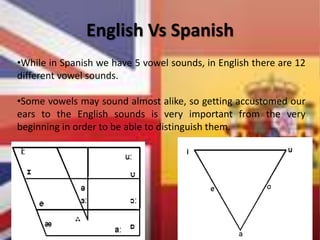
This document provides an overview of the English vowel system compared to the Spanish vowel system. It notes that English has 12 vowel sounds while Spanish only has 5. It then proceeds to describe each English vowel sound in detail, including typical spellings, examples of words, and similarities or differences to Spanish vowel sounds to aid Spanish speakers in pronunciation. Tips are also provided for some of the most challenging vowels for Spanish learners.


![Ipa pronunciation session[1]](https://cdn.slidesharecdn.com/ss_thumbnails/ipapronunciationsession1-100503153304-phpapp02-thumbnail.jpg?width=640&height=640&fit=bounds)


