Parents guide for teaching early reading and writing skills. Presented by Kari Willett
When should I start teaching my child to read and write?  Foundations for good reading skills can start at birth. Start by reading to your baby daily before naptimes.  Develop a positive atmosphere for story time. Do not initiate story time if the baby is upset or over tired. Choose books that appeal to your child such as favorite cartoons, animals, or dinosaur books. Reading to your child will increase their willingness to learn to read on their own when it is time.  A  good indication that your child is ready to read is when they mimic the books that you read them.  Another good indicator is when child knows most of the alphabet song with minimal prompts from caregivers.
Aren’t children taught to read and write in school?  Most children between 14 months and two years are able to recall images. This is an ideal time to introduce flashcards.  With the majority of kindergarteners attending pre-school and daycare. Many are able to read prior to early elementary education.  Waiting on the schools to teach reading and writing skills may leave to your child being behind or overwhelmed in class.  Children are more able to identify the importance of reading when they are read to by a parent.
Reading Starts at Home. It is a proven fact that children who are read to regularly learn to read and write faster then children that are not read to.  Starting a reading program at home provides a stable atmosphere for learning, plus it offers quality time together.
What tools will help with early skill building?  A variety of books Flash cards  Crayons  Large lined paper  Finger paint Shaving cream Building Blocks or legos
Teaching phonetics  Teach child sounds of each letter makes but no more then three letters a week.  Use flash cards and picture cards as prompts. Show the “A” card. Tell her A and make the phonetic sound that the A makes. Aaa, Apple.  With in 60 seconds ask the child to repeat what you have just taught her. Offer praise immediately when she is correct.  Remain positive keeping sessions short at first. Work up to singing the whole alphabet with phonics sounds.
Mastering Phonetics Once your child has learned a letter it is important to introduce the letter often to help maintain learning.  Take flashcards everywhere, grandmas house, restaurants, doctors office. This will help establish learning skills in multiple environments.  Sing the alphabet making phonics sounds in the car.
Maintaining Phonetics At the start of each session show flashcards that have already been introduced to child.  Continue to offer praise for correct answers. Put cards answered correctly twice in a row in one pile, these will be considered mastered. Then place incorrect cards in another pile.  Keep introducing the un-mastered cards over the next few sessions. Offer prompts when necessary. Praise immediately for correct answers. Introduce the mastered cards once a week to maintain learned skills.
What is after Phonics?  After phonics are established, slowly start adding flashcards of small words.  Use flashcards that share both the word “cat” and a picture prompt of a cat.  Follow steps like we did with phonics but now using words.  Help child to sound out each letter. “Ccaa, aa, tt” As child masters flashcards with pictures, replace those cards with word only cards.  Offer assistance when needed, withdraw assistance as child masters skills.  Do not forget to offer praise for your emerging reader.  Remember to be consistent with reading sessions.
Parents Tips for Teaching Reading Skills Remember that all children learn at their own pace.  Do not expect this process to be quick.  If child seems forgetful, get out mastered cards and slow down your sessions for a day or two.  Offer new material only when previous material has been mastered. Continue to show mastered cards to maintain learned skills.  Don’t overwhelm our young learner, only offer three new cards a week.  Consistently provide praise. Avoid frustration. Make this learning time fun.
So when do I introduce writing skills?  Start to teach writing skills when child clearly recognizes letters by name.  If she sees and “A” but calls it a “B”, she is not quite ready to write, instead work on phonics more. When child is comfortable with phonics, then it is time to start teaching writing skills.
Writing 101 Your child has mastered sight recognition of the alphabet.  Your child enjoys coloring with crayons and pencils.  It is time to learn to write!
Writing for fun!  Children often enjoy “messy learning” Let them practice writing letters with finger paint. It doubles as great gifts for grandma.  Also try shaving cream. Put a plastic reusable tablecloth down, apply a generous amount of shaving cream then allow child to draw in it. By simply running a hand across the shaving cream the child will have a new work space for practicing. Practice until child seems disinterested. Practice often and make it fun!
Hand over Hand Visual prompts are great for new writers. Buy a notebook of large lined paper with dotted letters and crayons.  Hold your childs hand as you help her trace the dots with a crayon. Repeat a few times, then allow her to try on her own.  Offer praise “Good job” or “you did it”. Be sure to smile.  Offer assistance only when needed.  Put crayons and paper away if child becomes upset.  Allow time for daily sessions. Make this learning time fun.
My child doesn’t want to learn, what do I do?  Children learn at different paces. If you introduce phonics or writing and your child seems disinterested. Wait a week and try again.  Keep trying at different times of the day.  Make sure the environment is learning friendly. TV is off, minimize distractions, child is fed and happy at introduction of new tasks.  Make television or other fun activity contingent on a few minuets of learning time. Increase learning time as child performs tasks when asked.
Consult a pediatrician if you suspect medical issues that may be delaying learning.  Medical issues to watch for: Vision or hearing impairment ADHD Learning Disabilities Dyslexia  Developmental issues
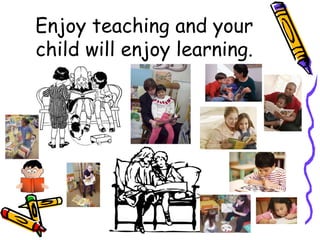
Enjoy teaching and your child will enjoy learning.
Resources Berk, Laura.  Infants, Children, And Adolescents . Fifth Edition. Print.  Cooper, John, Timothy Heron, and William Heward.  Applied Behavior Analysis . Second Edition. Print.  Malott, Richard.  Principles of Behavior . Sixth Edition. Print.  http://www.earlyliterature.ecsd.net/reading.htm http://www2.ed.gov/family/RWN/Activ97/early.html

C:\documents and settings\kwillett\desktop\abadevelopment

  • 1.
    Parents guide forteaching early reading and writing skills. Presented by Kari Willett
  • 2.
    When should Istart teaching my child to read and write? Foundations for good reading skills can start at birth. Start by reading to your baby daily before naptimes. Develop a positive atmosphere for story time. Do not initiate story time if the baby is upset or over tired. Choose books that appeal to your child such as favorite cartoons, animals, or dinosaur books. Reading to your child will increase their willingness to learn to read on their own when it is time. A good indication that your child is ready to read is when they mimic the books that you read them. Another good indicator is when child knows most of the alphabet song with minimal prompts from caregivers.
  • 3.
    Aren’t children taughtto read and write in school? Most children between 14 months and two years are able to recall images. This is an ideal time to introduce flashcards. With the majority of kindergarteners attending pre-school and daycare. Many are able to read prior to early elementary education. Waiting on the schools to teach reading and writing skills may leave to your child being behind or overwhelmed in class. Children are more able to identify the importance of reading when they are read to by a parent.
  • 4.
    Reading Starts atHome. It is a proven fact that children who are read to regularly learn to read and write faster then children that are not read to. Starting a reading program at home provides a stable atmosphere for learning, plus it offers quality time together.
  • 5.
    What tools willhelp with early skill building? A variety of books Flash cards Crayons Large lined paper Finger paint Shaving cream Building Blocks or legos
  • 6.
    Teaching phonetics Teach child sounds of each letter makes but no more then three letters a week. Use flash cards and picture cards as prompts. Show the “A” card. Tell her A and make the phonetic sound that the A makes. Aaa, Apple. With in 60 seconds ask the child to repeat what you have just taught her. Offer praise immediately when she is correct. Remain positive keeping sessions short at first. Work up to singing the whole alphabet with phonics sounds.
  • 7.
    Mastering Phonetics Onceyour child has learned a letter it is important to introduce the letter often to help maintain learning. Take flashcards everywhere, grandmas house, restaurants, doctors office. This will help establish learning skills in multiple environments. Sing the alphabet making phonics sounds in the car.
  • 8.
    Maintaining Phonetics Atthe start of each session show flashcards that have already been introduced to child. Continue to offer praise for correct answers. Put cards answered correctly twice in a row in one pile, these will be considered mastered. Then place incorrect cards in another pile. Keep introducing the un-mastered cards over the next few sessions. Offer prompts when necessary. Praise immediately for correct answers. Introduce the mastered cards once a week to maintain learned skills.
  • 9.
    What is afterPhonics? After phonics are established, slowly start adding flashcards of small words. Use flashcards that share both the word “cat” and a picture prompt of a cat. Follow steps like we did with phonics but now using words. Help child to sound out each letter. “Ccaa, aa, tt” As child masters flashcards with pictures, replace those cards with word only cards. Offer assistance when needed, withdraw assistance as child masters skills. Do not forget to offer praise for your emerging reader. Remember to be consistent with reading sessions.
  • 10.
    Parents Tips forTeaching Reading Skills Remember that all children learn at their own pace. Do not expect this process to be quick. If child seems forgetful, get out mastered cards and slow down your sessions for a day or two. Offer new material only when previous material has been mastered. Continue to show mastered cards to maintain learned skills. Don’t overwhelm our young learner, only offer three new cards a week. Consistently provide praise. Avoid frustration. Make this learning time fun.
  • 11.
    So when doI introduce writing skills? Start to teach writing skills when child clearly recognizes letters by name. If she sees and “A” but calls it a “B”, she is not quite ready to write, instead work on phonics more. When child is comfortable with phonics, then it is time to start teaching writing skills.
  • 12.
    Writing 101 Yourchild has mastered sight recognition of the alphabet. Your child enjoys coloring with crayons and pencils. It is time to learn to write!
  • 13.
    Writing for fun! Children often enjoy “messy learning” Let them practice writing letters with finger paint. It doubles as great gifts for grandma. Also try shaving cream. Put a plastic reusable tablecloth down, apply a generous amount of shaving cream then allow child to draw in it. By simply running a hand across the shaving cream the child will have a new work space for practicing. Practice until child seems disinterested. Practice often and make it fun!
  • 14.
    Hand over HandVisual prompts are great for new writers. Buy a notebook of large lined paper with dotted letters and crayons. Hold your childs hand as you help her trace the dots with a crayon. Repeat a few times, then allow her to try on her own. Offer praise “Good job” or “you did it”. Be sure to smile. Offer assistance only when needed. Put crayons and paper away if child becomes upset. Allow time for daily sessions. Make this learning time fun.
  • 15.
    My child doesn’twant to learn, what do I do? Children learn at different paces. If you introduce phonics or writing and your child seems disinterested. Wait a week and try again. Keep trying at different times of the day. Make sure the environment is learning friendly. TV is off, minimize distractions, child is fed and happy at introduction of new tasks. Make television or other fun activity contingent on a few minuets of learning time. Increase learning time as child performs tasks when asked.
  • 16.
    Consult a pediatricianif you suspect medical issues that may be delaying learning. Medical issues to watch for: Vision or hearing impairment ADHD Learning Disabilities Dyslexia Developmental issues
  • 17.
    Enjoy teaching andyour child will enjoy learning.
  • 18.
    Resources Berk, Laura. Infants, Children, And Adolescents . Fifth Edition. Print. Cooper, John, Timothy Heron, and William Heward. Applied Behavior Analysis . Second Edition. Print. Malott, Richard. Principles of Behavior . Sixth Edition. Print. http://www.earlyliterature.ecsd.net/reading.htm http://www2.ed.gov/family/RWN/Activ97/early.html