TEFL
TOTAL PHYSICAL RESPONSE
Elih Sutisna Yanto
ENGLISH EDUCATION
PROGRAMME Unsika, West-Java,
Indonesia
elihsutisnayanto@gmail.com
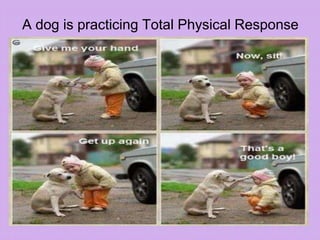
A dog is practicing Total Physical Response
Background
Total Physical Response is a method
developed by James J.Ashers, a

professor of psychology at San Jose
State University, California. Dr. Ashers
began experimenting with TPR in the
1960s. The method has been
developed from developmental
psychology, learning theory and
language learning procedures.
Background
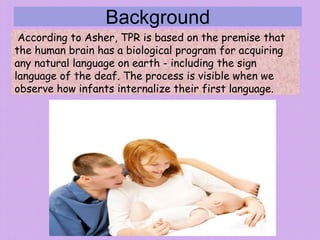
According to Asher, TPR is based on the premise that
the human brain has a biological program for acquiring
any natural language on earth - including the sign
language of the deaf. The process is visible when we
observe how infants internalize their first language.
Background
Based on the developmental psychology,
the proponents of TPR claim that memory
is increased if it is stimulated through
association with motor activity and the
process of learning a foreign language is a
parallel process to learning the first
language (Brown, 1987:163)
Background
 Children do a lot of listening before they
learn to speak and they do a lot of physical
activities in learning their first language,
such as reaching, moving and grabbing.
 In having children learn the first language
commands from the adult dominate the
communication and children respond
physically before they begin to produce
verbal responses (Richards and Rodgers,
1986:87)
Background
 Asher sees successful adult second
language learning as a parallel process to
child first language acquisition.
 Asher feels that adults should recapitulate
the processes by which children acquire
their native language.
 He shares with the school of humanistic
psychology a concern for the role of
affective (emotional) factors in language
learning.
Background
 A method that is undemanding in
terms of linguistic production and that
involves gamelike movement reduces
learner stress, he believes, and
create a positive mood in the learner,
which facilitate learning.
 TPR emphasizes on comprehension
and delays the production of
language. This process the one by
which children acquire their L1.
A Research of TPR
 Many people believe that TPR is
only appropriate for children since the
method relies on imperatives.
 However, Ashers (1988:31) believes
that the method can be used to teach
any foreign language not only to
children but also adults.
A Research of TPR
 A research on language teaching
through TPR conducted by Ashers
and Brice (1982) provided data that
when adults learn a second language
under the same conditions as
children, adults outperform children.
 The only advantage children have is
acquiring a near-native pronunciation.
A Research of TPR
 Ashers suggests that the time per session
should vary depending on the age of the
learners.
 The older the learners are, the longer the
time they can learn effectively.
 Thirty minutes of training one time will be
effective for children. Junior and senior
high school students respond well to 50-
minute sessions while university students
can handle up to 3-hour sessions.
Approach: Theory of language and learning
 TPR reflects a grammar-based view of
language.
 Asher states that “most of the
grammatical structure of the target
language and hundreds of vocabulary
items can be learned from the skillful use
of the imperative by the instructor”
(1977:4)
 He views the verb, and particularly the verb
in the imperative, as the central linguistic
motif around which language use and
learning are organized.
Approach: Theory of language and learning
 Asher sees a stimulus-response view as
providing the learning theory underlying
language teaching pedagogy.
 TPR can also be linked to the “trace theory”
of memory in psychology (e.g., Katona 1940),
which holds that the more often or the more
intensively a memory connection is traced,
the stronger the memory association will be
and the more likely it will be recalled.
 Retracing can be done verbally (e.g., by rote
repetition) and/or in association with motor
activity.
Approach: Theory of language and learning
Combined tracing activities,
such as verbal rehearsal
accompanied by motor activity,
hence increase the possibility of
successful recall.
Approach: Theory of language and learning
In addition, Asher has elaborated an account of
what he feels facilitates or inhibits foreign
language learning.
He draws on three rather influential learning
hypotheses:
1. There is exists a specific innate bio-program for
language learning, which defines an optimal path for
first and second language development.
2. Brain lateralization defines different learning functions
in the left-and right-brain hemispheres.
3. Stress (an affective filter) intervenes between the act of
learning and what is to be learned; the lower the stress,
the greater the learning.
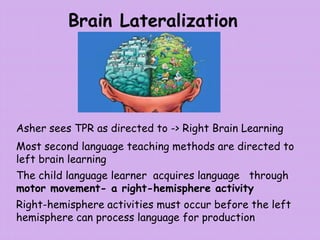
Asher sees TPR as directed to -> Right Brain Learning
The child language learner acquires language through
motor movement- a right-hemisphere activity
Brain Lateralization
Most second language teaching methods are directed to
left brain learning
Right-hemisphere activities must occur before the left
hemisphere can process language for production
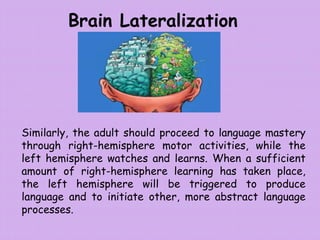
Brain Lateralization
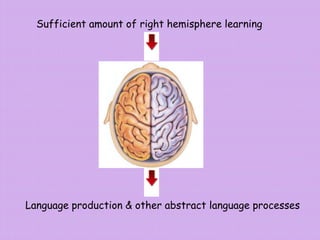
Similarly, the adult should proceed to language mastery
through right-hemisphere motor activities, while the
left hemisphere watches and learns. When a sufficient
amount of right-hemisphere learning has taken place,
the left hemisphere will be triggered to produce
language and to initiate other, more abstract language
processes.
Sufficient amount of right hemisphere learning
Language production & other abstract language processes
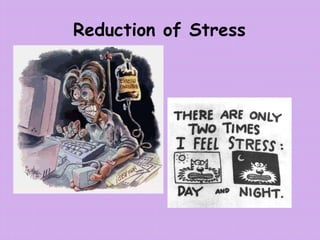
Reduction of Stress
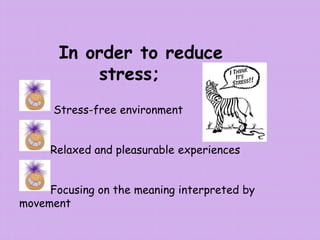
Stress-free environment
Relaxed and pleasurable experiences
Focusing on the meaning interpreted by
movement
In order to reduce
stress;
Reduction of Stress
An important condition for successful language learning is
the absence of stress. First language acquisition takes
place in a stress-free environment
 The adult language learning environment often causes
considerable stress and anxiety.
 The key to stress-free learning is to tap into the natural
bio-program for language development and thus to
recapture the relaxed and pleasurable experiences that
accompany first language learning.
 By focusing on meaning interpreted through movement,
rather than on language forms studied in the abstract, the
learner is said to be liberated from self-conscious and
stressful situations and is able to devote full energy to
learning.
Approach: Theory of language and learning
Asher sees first language and second language
learning as parallel process. He sees three
processes as central
1. Children develop listening competence before they
develop the ability to speak. At the early stages of first
language acquisition, they can understand complex
utterances that they cannot spontaneously produce or
imitate.
2. Children’s ability in listening comprehension is acquired
because children are required to respond physically to
spoken language in the form of parental commands.
3. Once a foundation in listening comprehension has been
established, speech evolves naturally and effortlessly
out of it.
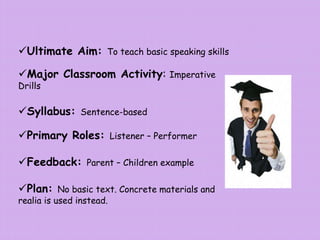
Design
Ultimate Aim: To teach basic speaking skills
Major Classroom Activity: Imperative
Drills
Syllabus: Sentence-based
Primary Roles: Listener – Performer
Feedback: Parent – Children example
Plan: No basic text. Concrete materials and
realia is used instead.
Objectives
To teach oral proficiency at a beginning
level and the ultimate aim is to teach basic
speaking skills.
To produce learners who are capable of
free communication, which is
understandable to a native speaker.
Syllabus
The syllabus is predictable from the exercises
used in the class: A sentence-based syllabus
with grammatical & lexical criteria being
primary in selecting teaching items.
TPR requires initial attention to meaning
rather than to the form of items. Grammar is
thus taught inductively.
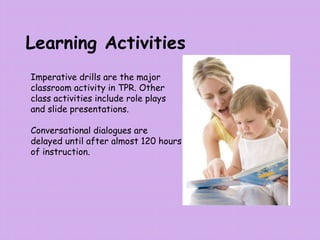
Learning Activities
Imperative drills are the major
classroom activity in TPR. Other
class activities include role plays
and slide presentations.
Conversational dialogues are
delayed until after almost 120 hours
of instruction.
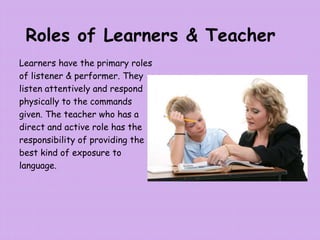
Roles of Learners & Teacher
Learners have the primary roles
of listener & performer. They
listen attentively and respond
physically to the commands
given. The teacher who has a
direct and active role has the
responsibility of providing the
best kind of exposure to
language.
“It is wise to write out the exact utterances
you will be using and especially the novel
commands because the action is so fast
moving, there is usually not time for create
spontenaously.”
-Asher (1977:42)
Materials
For absolute beginners lessons
may not require the use of
materials since the teacher’s
voice, actions and gestures may be
sufficient. The teacher can use
basic classroom objects such as
books, pens etc. As the course
develops, the teacher will need to
collect new materials. These may
include pictures, realia, slides,
word charts.
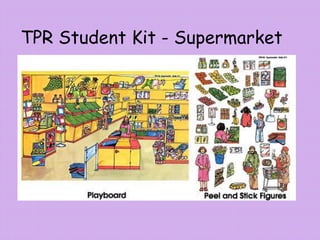
TPR Student Kit - Supermarket
Procedure
•Review
•New Commands
•Role Reversal
•Reading and Writing
Review
• Teacher gives a summary
of the last lesson.
• Teacher repeats the
verbs/items etc. that
were learned in
the previous lesson.
New commands
• Giving the commands.
• Three commands at a time.
• Varying the sequence of
commands.
How much of a language
can be taught
through the use of
imperatives
An Advanced Lesson of TPR
Teacher: Rachel, walk to the whiteboard.
(Rachel gets up and walks to the whiteboard.)
Teacher: Class, if Rachel walked to the whiteboard, stand up.
(The class stands up.)
Teacher: Rachel, write your name on the whiteboard.
(Rachel writes her name on the whiteboard.)
Teacher: Class, if Rachel wrote her name on the whiteboard, sit down.
(The class sits down.)
Role Reversal
• Students commanding their teacher and
classmates.
Reading and Writing
• Writing the new items on the board.
Some Characteristics of TPR
• Focusing on meaning and comprehension.
• Seated in a semi-circle.
• Great deal of listening and acting.
• Directing a performance in which the
students are actors.
• Verbal response is not necessary.
• Humor is easy to introduce.
• Teacher always uses the target language.
• Overcoming the fear of speaking
Advantages of TPR
• Students enjoying moving around the
classroom.
• It is very memorable
• Not preparing long hours
• It is good for kinesthetic leaners.
• Effective for both adult and young learners.
• It involves both left and right-brained
learning.
Disadvantages of TPR
• Best suitable for beginners.
• Challenging for shy students.
• It is not flexibly used to teach
everything
• It tends to neglect narrative,
descriptions, and conversation forms of
language
Conclusion
 Total Physical Response means that second language
learning should be based on the model of first language
learning. It has three vital aspects: a). understanding the
spoken language must come before speaking, b).
understanding is developed through body movements ,
and c). the listening period creates a readiness to speak
 TPR was very popular because of its support by those
who emphasize the role of comprehension in second
language acquisition.
 Total Physical Response should be used in association
with other methods and technique.
PROCEDURE OF PRESENTING THE MATERIALS
BY USING TPR
Using hand signals, motion four students to come up to the front of the classroom.
Then gesture for two students to sit on either side of you facing the class. Other
students in the class are often seated in a semi-circle so that there is a rather large
space for the action.
Then say “stand up!” and immediately stand up as you motion the students
seated on either side of you to stand up. Next say, “Sit down!” and immediately sit
down along with the four students. If any student tries to repeat what you have said,
signal silence by touching your lips with your index finger. Then say “Stand up!” , and
the group, including the instructor, should stand up; and then “Sit down!” each
followed by the appropriate action until all respond confidently without hesitation
(Ashers, 1988:2-4)
The beginning above is the beginning activities in teaching English. The
teacher introduced two verbs of commands “stand up” and “Sit down”. These two
verbs are easy to be presented. As mentioned earlier that TPR follows the language
sequence of how an infant learns his/her mother tongue. After the learners can
respond the command confidently, the learners may practice giving the commands
among them. The procedure above can continue by introducing the verbs “walk, stop,
turn around, jump”. If the teacher observes the hesitation of the students in
responding, the teacher should model the actions and commands with the students
until the students can individually respond quickly and accurately. When the learners
are ready for an expansion of utterance, the activities below can follow.
PROCEDURE OF PRESENTING THE MATERIALS
BY USING TPR
Point to the door. (The teacher and the students point to the door.)
Point to the chairs. (The teacher and the students point to the
chairs.)
Point to the table. (The teacher and the students point to the table.)
(Ashers, 1988:3-4)
Through the activities above the class is not only introduced the
verb”point to” but also the nouns “door, chairs, and table”.
After the students have enough understanding of the words, the language to
teach can be expanded and the commands may consist of longer utterances.
The teacher should always consider the language the students have
mastered. The commands may consist of two or three actions but most (or
all) of the words used in the commands must be familiar.
Point to the door. Walk to the door. (The teacher and the students
point to the door and walk to the door.)
Touch the door. (The teacher and the students touch the door.)
(Ashers, 1988:3-4)
PROCEDURE OF PRESENTING THE MATERIALS
BY USING TPR
Listening and comprehension can also be practiced by giving
scenarios to the students. The scenarios below are taken from
Garcia (1996:V-3)
Go to the table. Touch the table. Sit on the table. Point to the
table with your hands. Squat in front of the table. Turn around.
Get up. Return to your seat.
Go to the table. Pick up the green book. Read the book. Scratch
your stomach with the green book. Put the book in the box of
fruit. Put your head in the box of fruit. Pick up the box of fruit.
Put your head in the box of fruit. Take your head out of the box
of fruit.
Go to the chalkboard. Salute the flag. Jump twice. Touch the
chalkboard with your nose. Scratch your right foot.
Go to the chalkboard. Draw a school. Erase the roof of the
school. Write the name of the teacher of English.
PROCEDURE OF PRESENTING THE MATERIALS
BY USING TPR
When the students reach a certain level of understanding of the
target language through body movement, the students are
ready for role reversal: they play the teacher’s role and utter
directions in the target language to cause action from other
students or the teacher. The role reversal should be done
gradually since the very essence of TPR is listening and
comprehension before production. The teacher does not hurry
the students into speaking.
More advanced students can be encouraged to speak in
the target language by providing scenarios.
PROCEDURE OF PRESENTING THE MATERIALS
BY USING TPR
The following are examples of learning scenarios for advances
students (Garcia,1996:V-27)
You arrive at your home. The neighbor’s kids are playing in your
front yard. They are pulling flowers, playing with the water hose,
etc. Give some commands suitable for the occasion.
You need some groceries from the store, You ask your friend to
do it for you because you are very busy. Ask your friend to bring
you a few things (vegetables and foodstuff).
You are in the wilderness. You come upon a place with tall grass
and thick shrubs. Suddenly you see a snake. You have three
friends with you. React to the situation with some commands.
You find a four-year-old girl in the middle of the street. She is
crying and frightened. Try to communicate with her with several
command.
PROCEDURE OF PRESENTING THE MATERIALS
BY USING TPR
Writing and reading
So far the class deals with understanding and listening (to some
extent speaking as well). Writing may be introduced in the first
days if needed. TPR flows from comprehension to speaking;
from comprehension into reading and writing. Reading and
writing in TPR may flow after the students are able to
comprehend the commands. It is assumed in the following
activities that the students have learned the words “run, go,
board, chalkboard”. The main material to teach is “name”. The
word “write” may or may not have been introduced. The main
consideration in giving commands is that there is no more than
one new word. If there more than one new word. If there are
more than one new word, the understanding of the commands
is relatively difficult.
PROCEDURE OF PRESENTING THE MATERIALS
BY USING TPR
The following activities are meant to teach writing. This
is the beginning of writing class and the commands
are simple.
I will write my name on the board.
Juan, run to the chalkboard and write your name.
Jaime, go to the chalkboard and write your
name.
Everyone, write your name on your paper.
(Asher, 1988:4-8)
PROCEDURE OF PRESENTING THE MATERIALS
BY USING TPR
For more advanced students, students’ names can be
replaced with other concrete nouns , as follow:
Juan, go to the chalkboard and write what you
see.
Jaime, walk to the chalkboard and write what
you touch.
The commands are not only used to teach verbs
of imperatives but they can be used to teach tenses.
The following examples are the activities used to teach
present continuous tense.
PROCEDURE OF PRESENTING THE MATERIALS
BY USING TPR
Rita, touch the table. (Pause) Shirou, touch the table
that Rita is touching.
Juan, touch the chalkboard. (Pause) Maria,
touch the chalkboard that Juan is touching.
Miguel, draw a square on the chalkboard. (Pause)
draw a circle around the square that Miguel is drawing.
Maria, write your name on the chalkboard. (Pause)
Juan, erase the name that Maria is writing.
(Ashers, 1988:4-24 – 4-25)
It is assumed that in the above activities, the students
have learned the verbs touch, draw, erase, write, and
the nouns square, circle, table, chalkboard.
PROCEDURE OF PRESENTING THE MATERIALS
BY USING TPR
The following is another procedure suggested by
Ashers (cited in Richards and Rodgers, 1986:97). The
instructor wrote on the chalkboard each new
vocabulary item and a sentence to illustrate the item.
Then she spoke each item and acted out the sentence.
The students listened as she read the material. Some
copied the information in their notebooks.
PROCEDURE OF PRESENTING THE MATERIALS
BY USING TPR
The TPR allows language learners to learn the
target language in a manner similar to a child learns
his/her mother tongue. In a class that is taught through
the TPR, a language teacher begins the class by
modeling actions and students observe and act the
same actions. The students guess meanings by
observing and acting the commands from the teacher.
The students fellow classmates. Gradually, the
students themselves will direct the class and decide
who has to give commands.
PROCEDURE OF PRESENTING THE MATERIALS
BY USING TPR
Language teachers or prospective language teachers
have to ask themselves which principles can be
implemented in English teaching in their condition and
situation. As suggested by Asher, the TPR should be
used in association with other methods and
techniques. Language teachers may develop some
techniques deriving from the principles of the TPR and
try out the techniques in teaching English in Indonesia.
They do not necessarily take the whole procedure of
the TPR. They may consider some of the underlying
principles and the techniques which can be
implemented in their language classes.
PROCEDURE OF PRESENTING THE MATERIALS
BY USING TPR
Example of TPR
Listen and Look
Stand …walk to the door… Stop… Back to your chair….
Stand…walk to the window…Stop…Back to your chair…
Stand…walk to the whiteboard…Stop… Back to your
chair…
Stand…walk to the door…Stop… Back to your chair…
Listen and Repeat
T: door S: door
T:whiteboard S:Whiteboard
T:chair S: chair
T: Window S: window
(Classically, group or individually)
PROCEDURE OF PRESENTING THE MATERIALS
BY USING TPR
Listen and Do
Stand …walk to the door… Stop… Back to
your chair….
Stand…walk to the window…Stop…Back
to your chair…
Stand…walk to the whiteboard…Stop…
Back to your chair…
Stand…walk to the door…Stop… Back to
your chair…
ReferencesBooks
Ashers, 1977.Learning Another Language Through Actions: The Complete Teacher’s
Guidebook.. Los Gatos, CA: Sky Oaks Production, Inc.
___________.1988.Learning Another Language Through Actions: The Complete
Teacher’s Guidebook.2nd eds. Los Gatos, CA: Sky Oaks Production, Inc.
Brown, H.D.1987. Principle of Language Learning and Teaching . New Jersey: Prentice-
Hall, Inc.
C.Richards, J., & S.Rodgers, T. 1986. Approaches and Methods in Language Teaching.
Cambridge University Press.
C.Richards, J., & S.Rodgers, T. 2001. Approaches and Methods in Language Teaching.
Cambridge University Press.
D.Moore, K. 2005. Effective Instructional Strategies. Sage Publications, Inc.
Herrell, A., & Jordan, M. 2004 Fifty Strategies for Teaching English Language
Learners. Pearson Education, Inc.
Larsen-Freeman, D. 2000. Techniques and Principles in Language Teaching. Oxford
University Press.
Web Sites
• http://faculty.ucmerced.edu/khakuta/LAU/ICLangLit/NaturalApproach.htm
• http://naturalway.awardspace.com/articles/article002.htm
• http://www.tpr-world.com
Articles
• The Learning Strategy of the Total Physical Response: A Review
James J. Asher http://www.jstor.org/stable/323182
Thank You For
Listening

Day 7 total physical response

  • 1.
    TEFL TOTAL PHYSICAL RESPONSE ElihSutisna Yanto ENGLISH EDUCATION PROGRAMME Unsika, West-Java, Indonesia elihsutisnayanto@gmail.com
  • 2.
    A dog ispracticing Total Physical Response
  • 3.
    Background Total Physical Responseis a method developed by James J.Ashers, a professor of psychology at San Jose State University, California. Dr. Ashers began experimenting with TPR in the 1960s. The method has been developed from developmental psychology, learning theory and language learning procedures.
  • 4.
    Background According to Asher,TPR is based on the premise that the human brain has a biological program for acquiring any natural language on earth - including the sign language of the deaf. The process is visible when we observe how infants internalize their first language.
  • 5.
    Background Based on thedevelopmental psychology, the proponents of TPR claim that memory is increased if it is stimulated through association with motor activity and the process of learning a foreign language is a parallel process to learning the first language (Brown, 1987:163)
  • 6.
    Background  Children doa lot of listening before they learn to speak and they do a lot of physical activities in learning their first language, such as reaching, moving and grabbing.  In having children learn the first language commands from the adult dominate the communication and children respond physically before they begin to produce verbal responses (Richards and Rodgers, 1986:87)
  • 7.
    Background  Asher seessuccessful adult second language learning as a parallel process to child first language acquisition.  Asher feels that adults should recapitulate the processes by which children acquire their native language.  He shares with the school of humanistic psychology a concern for the role of affective (emotional) factors in language learning.
  • 8.
    Background  A methodthat is undemanding in terms of linguistic production and that involves gamelike movement reduces learner stress, he believes, and create a positive mood in the learner, which facilitate learning.  TPR emphasizes on comprehension and delays the production of language. This process the one by which children acquire their L1.
  • 9.
    A Research ofTPR  Many people believe that TPR is only appropriate for children since the method relies on imperatives.  However, Ashers (1988:31) believes that the method can be used to teach any foreign language not only to children but also adults.
  • 10.
    A Research ofTPR  A research on language teaching through TPR conducted by Ashers and Brice (1982) provided data that when adults learn a second language under the same conditions as children, adults outperform children.  The only advantage children have is acquiring a near-native pronunciation.
  • 11.
    A Research ofTPR  Ashers suggests that the time per session should vary depending on the age of the learners.  The older the learners are, the longer the time they can learn effectively.  Thirty minutes of training one time will be effective for children. Junior and senior high school students respond well to 50- minute sessions while university students can handle up to 3-hour sessions.
  • 12.
    Approach: Theory oflanguage and learning  TPR reflects a grammar-based view of language.  Asher states that “most of the grammatical structure of the target language and hundreds of vocabulary items can be learned from the skillful use of the imperative by the instructor” (1977:4)  He views the verb, and particularly the verb in the imperative, as the central linguistic motif around which language use and learning are organized.
  • 13.
    Approach: Theory oflanguage and learning  Asher sees a stimulus-response view as providing the learning theory underlying language teaching pedagogy.  TPR can also be linked to the “trace theory” of memory in psychology (e.g., Katona 1940), which holds that the more often or the more intensively a memory connection is traced, the stronger the memory association will be and the more likely it will be recalled.  Retracing can be done verbally (e.g., by rote repetition) and/or in association with motor activity.
  • 14.
    Approach: Theory oflanguage and learning Combined tracing activities, such as verbal rehearsal accompanied by motor activity, hence increase the possibility of successful recall.
  • 15.
    Approach: Theory oflanguage and learning In addition, Asher has elaborated an account of what he feels facilitates or inhibits foreign language learning. He draws on three rather influential learning hypotheses: 1. There is exists a specific innate bio-program for language learning, which defines an optimal path for first and second language development. 2. Brain lateralization defines different learning functions in the left-and right-brain hemispheres. 3. Stress (an affective filter) intervenes between the act of learning and what is to be learned; the lower the stress, the greater the learning.
  • 16.
    Asher sees TPRas directed to -> Right Brain Learning The child language learner acquires language through motor movement- a right-hemisphere activity Brain Lateralization Most second language teaching methods are directed to left brain learning Right-hemisphere activities must occur before the left hemisphere can process language for production
  • 17.
    Brain Lateralization Similarly, theadult should proceed to language mastery through right-hemisphere motor activities, while the left hemisphere watches and learns. When a sufficient amount of right-hemisphere learning has taken place, the left hemisphere will be triggered to produce language and to initiate other, more abstract language processes.
  • 18.
    Sufficient amount ofright hemisphere learning Language production & other abstract language processes
  • 19.
  • 20.
    Stress-free environment Relaxed andpleasurable experiences Focusing on the meaning interpreted by movement In order to reduce stress;
  • 21.
    Reduction of Stress Animportant condition for successful language learning is the absence of stress. First language acquisition takes place in a stress-free environment  The adult language learning environment often causes considerable stress and anxiety.  The key to stress-free learning is to tap into the natural bio-program for language development and thus to recapture the relaxed and pleasurable experiences that accompany first language learning.  By focusing on meaning interpreted through movement, rather than on language forms studied in the abstract, the learner is said to be liberated from self-conscious and stressful situations and is able to devote full energy to learning.
  • 22.
    Approach: Theory oflanguage and learning Asher sees first language and second language learning as parallel process. He sees three processes as central 1. Children develop listening competence before they develop the ability to speak. At the early stages of first language acquisition, they can understand complex utterances that they cannot spontaneously produce or imitate. 2. Children’s ability in listening comprehension is acquired because children are required to respond physically to spoken language in the form of parental commands. 3. Once a foundation in listening comprehension has been established, speech evolves naturally and effortlessly out of it.
  • 23.
  • 24.
    Ultimate Aim: Toteach basic speaking skills Major Classroom Activity: Imperative Drills Syllabus: Sentence-based Primary Roles: Listener – Performer Feedback: Parent – Children example Plan: No basic text. Concrete materials and realia is used instead.
  • 25.
    Objectives To teach oralproficiency at a beginning level and the ultimate aim is to teach basic speaking skills. To produce learners who are capable of free communication, which is understandable to a native speaker.
  • 26.
    Syllabus The syllabus ispredictable from the exercises used in the class: A sentence-based syllabus with grammatical & lexical criteria being primary in selecting teaching items. TPR requires initial attention to meaning rather than to the form of items. Grammar is thus taught inductively.
  • 27.
    Learning Activities Imperative drillsare the major classroom activity in TPR. Other class activities include role plays and slide presentations. Conversational dialogues are delayed until after almost 120 hours of instruction.
  • 28.
    Roles of Learners& Teacher Learners have the primary roles of listener & performer. They listen attentively and respond physically to the commands given. The teacher who has a direct and active role has the responsibility of providing the best kind of exposure to language.
  • 29.
    “It is wiseto write out the exact utterances you will be using and especially the novel commands because the action is so fast moving, there is usually not time for create spontenaously.” -Asher (1977:42)
  • 30.
    Materials For absolute beginnerslessons may not require the use of materials since the teacher’s voice, actions and gestures may be sufficient. The teacher can use basic classroom objects such as books, pens etc. As the course develops, the teacher will need to collect new materials. These may include pictures, realia, slides, word charts.
  • 31.
    TPR Student Kit- Supermarket
  • 32.
  • 33.
  • 34.
    Review • Teacher givesa summary of the last lesson. • Teacher repeats the verbs/items etc. that were learned in the previous lesson.
  • 35.
    New commands • Givingthe commands. • Three commands at a time. • Varying the sequence of commands.
  • 36.
    How much ofa language can be taught through the use of imperatives
  • 37.
    An Advanced Lessonof TPR Teacher: Rachel, walk to the whiteboard. (Rachel gets up and walks to the whiteboard.) Teacher: Class, if Rachel walked to the whiteboard, stand up. (The class stands up.) Teacher: Rachel, write your name on the whiteboard. (Rachel writes her name on the whiteboard.) Teacher: Class, if Rachel wrote her name on the whiteboard, sit down. (The class sits down.)
  • 38.
    Role Reversal • Studentscommanding their teacher and classmates. Reading and Writing • Writing the new items on the board.
  • 39.
    Some Characteristics ofTPR • Focusing on meaning and comprehension. • Seated in a semi-circle. • Great deal of listening and acting. • Directing a performance in which the students are actors. • Verbal response is not necessary. • Humor is easy to introduce. • Teacher always uses the target language. • Overcoming the fear of speaking
  • 40.
    Advantages of TPR •Students enjoying moving around the classroom. • It is very memorable • Not preparing long hours • It is good for kinesthetic leaners. • Effective for both adult and young learners. • It involves both left and right-brained learning.
  • 41.
    Disadvantages of TPR •Best suitable for beginners. • Challenging for shy students. • It is not flexibly used to teach everything • It tends to neglect narrative, descriptions, and conversation forms of language
  • 42.
    Conclusion  Total PhysicalResponse means that second language learning should be based on the model of first language learning. It has three vital aspects: a). understanding the spoken language must come before speaking, b). understanding is developed through body movements , and c). the listening period creates a readiness to speak  TPR was very popular because of its support by those who emphasize the role of comprehension in second language acquisition.  Total Physical Response should be used in association with other methods and technique.
  • 43.
    PROCEDURE OF PRESENTINGTHE MATERIALS BY USING TPR Using hand signals, motion four students to come up to the front of the classroom. Then gesture for two students to sit on either side of you facing the class. Other students in the class are often seated in a semi-circle so that there is a rather large space for the action. Then say “stand up!” and immediately stand up as you motion the students seated on either side of you to stand up. Next say, “Sit down!” and immediately sit down along with the four students. If any student tries to repeat what you have said, signal silence by touching your lips with your index finger. Then say “Stand up!” , and the group, including the instructor, should stand up; and then “Sit down!” each followed by the appropriate action until all respond confidently without hesitation (Ashers, 1988:2-4) The beginning above is the beginning activities in teaching English. The teacher introduced two verbs of commands “stand up” and “Sit down”. These two verbs are easy to be presented. As mentioned earlier that TPR follows the language sequence of how an infant learns his/her mother tongue. After the learners can respond the command confidently, the learners may practice giving the commands among them. The procedure above can continue by introducing the verbs “walk, stop, turn around, jump”. If the teacher observes the hesitation of the students in responding, the teacher should model the actions and commands with the students until the students can individually respond quickly and accurately. When the learners are ready for an expansion of utterance, the activities below can follow.
  • 44.
    PROCEDURE OF PRESENTINGTHE MATERIALS BY USING TPR Point to the door. (The teacher and the students point to the door.) Point to the chairs. (The teacher and the students point to the chairs.) Point to the table. (The teacher and the students point to the table.) (Ashers, 1988:3-4) Through the activities above the class is not only introduced the verb”point to” but also the nouns “door, chairs, and table”. After the students have enough understanding of the words, the language to teach can be expanded and the commands may consist of longer utterances. The teacher should always consider the language the students have mastered. The commands may consist of two or three actions but most (or all) of the words used in the commands must be familiar. Point to the door. Walk to the door. (The teacher and the students point to the door and walk to the door.) Touch the door. (The teacher and the students touch the door.) (Ashers, 1988:3-4)
  • 45.
    PROCEDURE OF PRESENTINGTHE MATERIALS BY USING TPR Listening and comprehension can also be practiced by giving scenarios to the students. The scenarios below are taken from Garcia (1996:V-3) Go to the table. Touch the table. Sit on the table. Point to the table with your hands. Squat in front of the table. Turn around. Get up. Return to your seat. Go to the table. Pick up the green book. Read the book. Scratch your stomach with the green book. Put the book in the box of fruit. Put your head in the box of fruit. Pick up the box of fruit. Put your head in the box of fruit. Take your head out of the box of fruit. Go to the chalkboard. Salute the flag. Jump twice. Touch the chalkboard with your nose. Scratch your right foot. Go to the chalkboard. Draw a school. Erase the roof of the school. Write the name of the teacher of English.
  • 46.
    PROCEDURE OF PRESENTINGTHE MATERIALS BY USING TPR When the students reach a certain level of understanding of the target language through body movement, the students are ready for role reversal: they play the teacher’s role and utter directions in the target language to cause action from other students or the teacher. The role reversal should be done gradually since the very essence of TPR is listening and comprehension before production. The teacher does not hurry the students into speaking. More advanced students can be encouraged to speak in the target language by providing scenarios.
  • 47.
    PROCEDURE OF PRESENTINGTHE MATERIALS BY USING TPR The following are examples of learning scenarios for advances students (Garcia,1996:V-27) You arrive at your home. The neighbor’s kids are playing in your front yard. They are pulling flowers, playing with the water hose, etc. Give some commands suitable for the occasion. You need some groceries from the store, You ask your friend to do it for you because you are very busy. Ask your friend to bring you a few things (vegetables and foodstuff). You are in the wilderness. You come upon a place with tall grass and thick shrubs. Suddenly you see a snake. You have three friends with you. React to the situation with some commands. You find a four-year-old girl in the middle of the street. She is crying and frightened. Try to communicate with her with several command.
  • 48.
    PROCEDURE OF PRESENTINGTHE MATERIALS BY USING TPR Writing and reading So far the class deals with understanding and listening (to some extent speaking as well). Writing may be introduced in the first days if needed. TPR flows from comprehension to speaking; from comprehension into reading and writing. Reading and writing in TPR may flow after the students are able to comprehend the commands. It is assumed in the following activities that the students have learned the words “run, go, board, chalkboard”. The main material to teach is “name”. The word “write” may or may not have been introduced. The main consideration in giving commands is that there is no more than one new word. If there more than one new word. If there are more than one new word, the understanding of the commands is relatively difficult.
  • 49.
    PROCEDURE OF PRESENTINGTHE MATERIALS BY USING TPR The following activities are meant to teach writing. This is the beginning of writing class and the commands are simple. I will write my name on the board. Juan, run to the chalkboard and write your name. Jaime, go to the chalkboard and write your name. Everyone, write your name on your paper. (Asher, 1988:4-8)
  • 50.
    PROCEDURE OF PRESENTINGTHE MATERIALS BY USING TPR For more advanced students, students’ names can be replaced with other concrete nouns , as follow: Juan, go to the chalkboard and write what you see. Jaime, walk to the chalkboard and write what you touch. The commands are not only used to teach verbs of imperatives but they can be used to teach tenses. The following examples are the activities used to teach present continuous tense.
  • 51.
    PROCEDURE OF PRESENTINGTHE MATERIALS BY USING TPR Rita, touch the table. (Pause) Shirou, touch the table that Rita is touching. Juan, touch the chalkboard. (Pause) Maria, touch the chalkboard that Juan is touching. Miguel, draw a square on the chalkboard. (Pause) draw a circle around the square that Miguel is drawing. Maria, write your name on the chalkboard. (Pause) Juan, erase the name that Maria is writing. (Ashers, 1988:4-24 – 4-25) It is assumed that in the above activities, the students have learned the verbs touch, draw, erase, write, and the nouns square, circle, table, chalkboard.
  • 52.
    PROCEDURE OF PRESENTINGTHE MATERIALS BY USING TPR The following is another procedure suggested by Ashers (cited in Richards and Rodgers, 1986:97). The instructor wrote on the chalkboard each new vocabulary item and a sentence to illustrate the item. Then she spoke each item and acted out the sentence. The students listened as she read the material. Some copied the information in their notebooks.
  • 53.
    PROCEDURE OF PRESENTINGTHE MATERIALS BY USING TPR The TPR allows language learners to learn the target language in a manner similar to a child learns his/her mother tongue. In a class that is taught through the TPR, a language teacher begins the class by modeling actions and students observe and act the same actions. The students guess meanings by observing and acting the commands from the teacher. The students fellow classmates. Gradually, the students themselves will direct the class and decide who has to give commands.
  • 54.
    PROCEDURE OF PRESENTINGTHE MATERIALS BY USING TPR Language teachers or prospective language teachers have to ask themselves which principles can be implemented in English teaching in their condition and situation. As suggested by Asher, the TPR should be used in association with other methods and techniques. Language teachers may develop some techniques deriving from the principles of the TPR and try out the techniques in teaching English in Indonesia. They do not necessarily take the whole procedure of the TPR. They may consider some of the underlying principles and the techniques which can be implemented in their language classes.
  • 55.
    PROCEDURE OF PRESENTINGTHE MATERIALS BY USING TPR Example of TPR Listen and Look Stand …walk to the door… Stop… Back to your chair…. Stand…walk to the window…Stop…Back to your chair… Stand…walk to the whiteboard…Stop… Back to your chair… Stand…walk to the door…Stop… Back to your chair… Listen and Repeat T: door S: door T:whiteboard S:Whiteboard T:chair S: chair T: Window S: window (Classically, group or individually)
  • 56.
    PROCEDURE OF PRESENTINGTHE MATERIALS BY USING TPR Listen and Do Stand …walk to the door… Stop… Back to your chair…. Stand…walk to the window…Stop…Back to your chair… Stand…walk to the whiteboard…Stop… Back to your chair… Stand…walk to the door…Stop… Back to your chair…
  • 57.
    ReferencesBooks Ashers, 1977.Learning AnotherLanguage Through Actions: The Complete Teacher’s Guidebook.. Los Gatos, CA: Sky Oaks Production, Inc. ___________.1988.Learning Another Language Through Actions: The Complete Teacher’s Guidebook.2nd eds. Los Gatos, CA: Sky Oaks Production, Inc. Brown, H.D.1987. Principle of Language Learning and Teaching . New Jersey: Prentice- Hall, Inc. C.Richards, J., & S.Rodgers, T. 1986. Approaches and Methods in Language Teaching. Cambridge University Press. C.Richards, J., & S.Rodgers, T. 2001. Approaches and Methods in Language Teaching. Cambridge University Press. D.Moore, K. 2005. Effective Instructional Strategies. Sage Publications, Inc. Herrell, A., & Jordan, M. 2004 Fifty Strategies for Teaching English Language Learners. Pearson Education, Inc. Larsen-Freeman, D. 2000. Techniques and Principles in Language Teaching. Oxford University Press. Web Sites • http://faculty.ucmerced.edu/khakuta/LAU/ICLangLit/NaturalApproach.htm • http://naturalway.awardspace.com/articles/article002.htm • http://www.tpr-world.com Articles • The Learning Strategy of the Total Physical Response: A Review James J. Asher http://www.jstor.org/stable/323182
  • 58.