By: Ahendour
Mustapha
TPR
(Total Physical Response)
English Department
Ref:
Khrystyna Hudyma
Outline
1.Introduction
2.The Origins
3.TPR is…
4.Learning fundamentals
5.Principles
6.Objectives
7.Roles of Learners
8.Roles of a Teacher
12.Myths about TPR
11.Disadvantages
10.Advantages
9.Learning process
1.Introduction
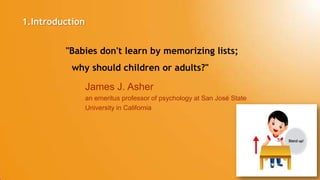
"Babies don't learn by memorizing lists;
why should children or adults?"
James J. Asher
an emeritus professor of psychology at San José State
University in California
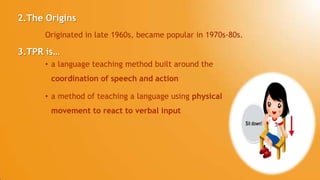
3.TPR is…
• a language teaching method built around the
coordination of speech and action
• a method of teaching a language using physical
movement to react to verbal input
Originated in late 1960s, became popular in 1970s-80s.
2.The Origins
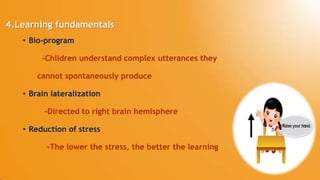
• Bio-program
-Children understand complex utterances they
cannot spontaneously produce
• Brain lateralization
-Directed to right brain hemisphere
• Reduction of stress
-The lower the stress, the better the learning
4.Learning fundamentals
5.Principles
• Spoken language preferred over
written language
• Understanding should evolve through
the movement of the student’s body
• Meaning of TL words conveyed
through actions
• To produce learners who are capable
of free communication, which is
understandable to a native speaker.
• To teach oral proficiency (at a
beginning level), and the ultimate aim
is to teach basic speaking skills
6.Objectives
7.Roles of Learners
• Listener & performer
• Recognize and respond to novel
• combinations of previously taught items
• Produce novel combinations
• Encouraged to speak not until they feel
ready
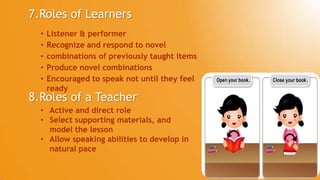
8.Roles of a Teacher
• Active and direct role
• Select supporting materials, and
model the lesson
• Allow speaking abilities to develop in
natural pace
9.Learning process
• Review
• Teacher repeats items from previous time
• New commands
• Teacher gives new commands, repeat and
vary them
• Role reversal
• Student command their teacher and
classmates
• Reading and writing
• Teacher writes new items on the blackboard
10.Materials
• Generally no basic text
• Initially: teacher’s voice, actions and gestures,
later – classroom objects and/or supporting
materials
11.Advantages
• TPR is fun and easy.
• Good tool for building vocabulary for long-
term retention.
• Does not require long preparations.
• Effective for both adult and young learners.
12.Disadvantages
• Challenge for shy students.
• No opportunity to talk in a creative manner.
• Can become too repetitive and boring.
• Preparation becomes an issue at higher levels.
13.Myths about TPR
• TPR only works for children
• TPR is limited to imperative
• TPR is limited to beginning students
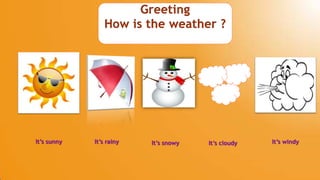
It’s sunny It’s rainy It’s snowy It’s cloudy It’s windy
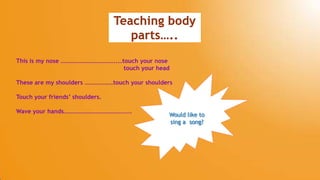
This is my nose ………………………………....touch your nose
touch your head
These are my shoulders ……………….touch your shoulders
Touch your friends’ shoulders.
Wave your hands……………………………………….
Would like to
sing a song?
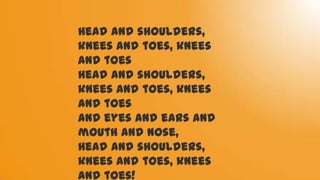
Head and shoulders,
knees and toes, knees
and toes
Head and shoulders,
knees and toes, knees
and toes
and eyes and ears and
mouth and nose,
Head and shoulders,
knees and toes, knees
and toes!
Thank you for your
attention ladies and
gentlemen

Total physical response

  • 1.
    By: Ahendour Mustapha TPR (Total PhysicalResponse) English Department Ref: Khrystyna Hudyma
  • 2.
    Outline 1.Introduction 2.The Origins 3.TPR is… 4.Learningfundamentals 5.Principles 6.Objectives 7.Roles of Learners 8.Roles of a Teacher 12.Myths about TPR 11.Disadvantages 10.Advantages 9.Learning process
  • 3.
    1.Introduction "Babies don't learnby memorizing lists; why should children or adults?" James J. Asher an emeritus professor of psychology at San José State University in California
  • 4.
    3.TPR is… • alanguage teaching method built around the coordination of speech and action • a method of teaching a language using physical movement to react to verbal input Originated in late 1960s, became popular in 1970s-80s. 2.The Origins
  • 5.
    • Bio-program -Children understandcomplex utterances they cannot spontaneously produce • Brain lateralization -Directed to right brain hemisphere • Reduction of stress -The lower the stress, the better the learning 4.Learning fundamentals
  • 6.
    5.Principles • Spoken languagepreferred over written language • Understanding should evolve through the movement of the student’s body • Meaning of TL words conveyed through actions • To produce learners who are capable of free communication, which is understandable to a native speaker. • To teach oral proficiency (at a beginning level), and the ultimate aim is to teach basic speaking skills 6.Objectives
  • 7.
    7.Roles of Learners •Listener & performer • Recognize and respond to novel • combinations of previously taught items • Produce novel combinations • Encouraged to speak not until they feel ready 8.Roles of a Teacher • Active and direct role • Select supporting materials, and model the lesson • Allow speaking abilities to develop in natural pace
  • 8.
    9.Learning process • Review •Teacher repeats items from previous time • New commands • Teacher gives new commands, repeat and vary them • Role reversal • Student command their teacher and classmates • Reading and writing • Teacher writes new items on the blackboard
  • 9.
    10.Materials • Generally nobasic text • Initially: teacher’s voice, actions and gestures, later – classroom objects and/or supporting materials 11.Advantages • TPR is fun and easy. • Good tool for building vocabulary for long- term retention. • Does not require long preparations. • Effective for both adult and young learners.
  • 10.
    12.Disadvantages • Challenge forshy students. • No opportunity to talk in a creative manner. • Can become too repetitive and boring. • Preparation becomes an issue at higher levels.
  • 11.
    13.Myths about TPR •TPR only works for children • TPR is limited to imperative • TPR is limited to beginning students
  • 13.
    It’s sunny It’srainy It’s snowy It’s cloudy It’s windy
  • 14.
    This is mynose ………………………………....touch your nose touch your head These are my shoulders ……………….touch your shoulders Touch your friends’ shoulders. Wave your hands………………………………………. Would like to sing a song?
  • 15.
    Head and shoulders, kneesand toes, knees and toes Head and shoulders, knees and toes, knees and toes and eyes and ears and mouth and nose, Head and shoulders, knees and toes, knees and toes!
  • 16.
    Thank you foryour attention ladies and gentlemen