TOTAL PHYSICAL RESPONSE
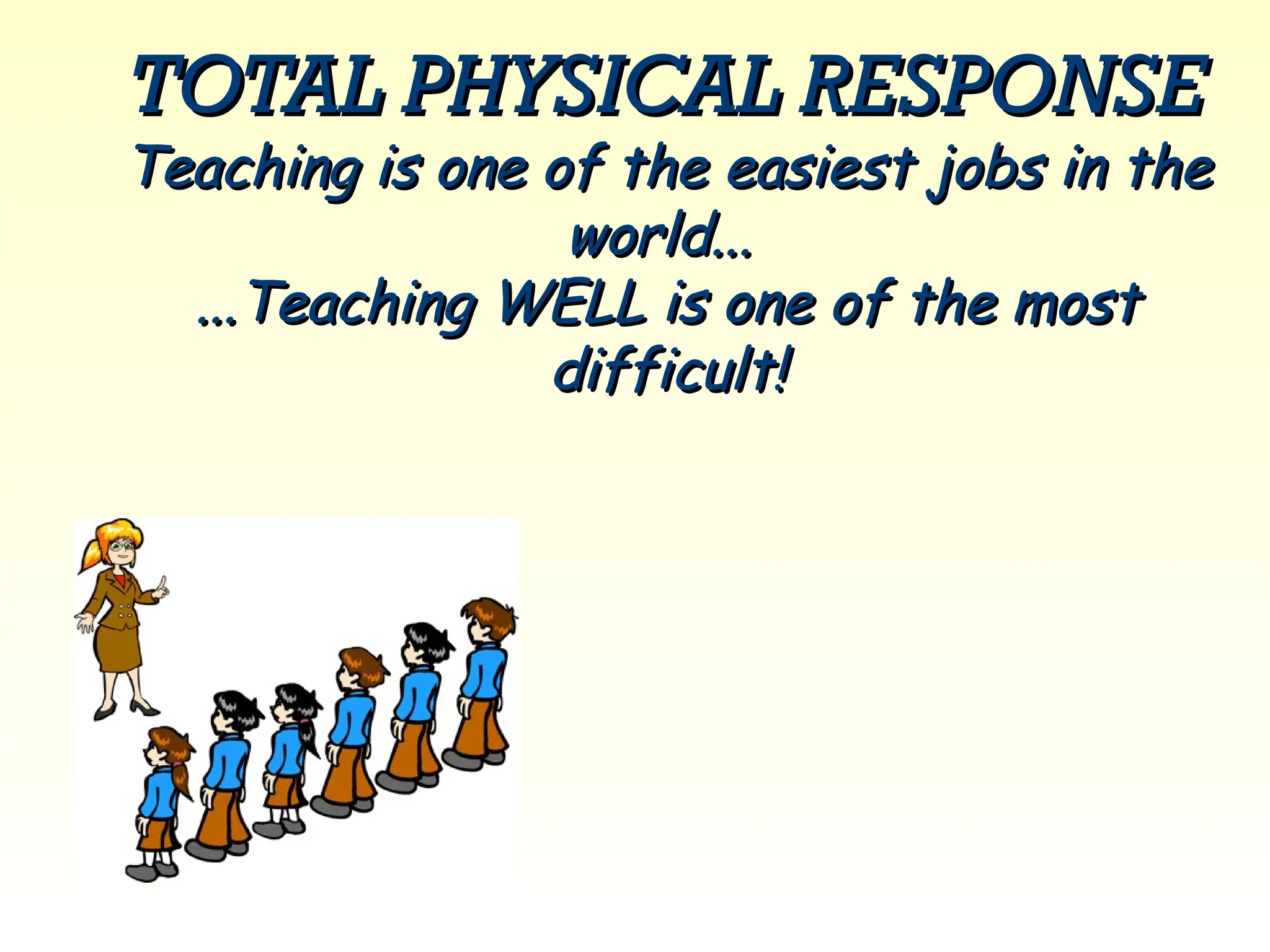
Teaching is one of the easiest jobs in the
world...
world...
...Teaching WELL is one of the most
difficult!
difficult!
T P R
(TOTAL PHYSICAL RESPONSE)
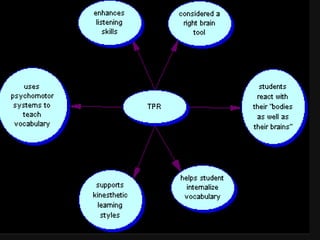
 TPR is a method in language teaching which is based
on the coordination of speech and action.
 It allows students to react to language without
thinking too much.
 The students are required to carry out the
instructions by physically performing the activities.
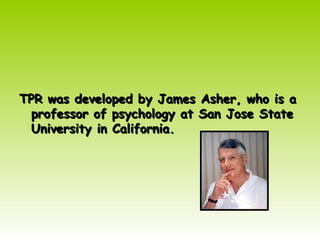
TPR was developed by James Asher, who is a
professor of psychology at San Jose State
University in California.
What is the aim of this method?

The aim is to teach language via

physical(motor) activity.
*Asher also pays attention to;

Language teaching procedures
+
+
Developmental psychology
Learning theory
Learning theory
Humanistic pedagogy
Humanistic pedagogy
James Asher
James Asher thinks that;
thinks that;
* Second language learning is
parallel to first language learning.
* Both of them have parallel processes.
* Speech Commands
►
* Commands Physical response
►
* Physical response Verbal response
►
**Gamelike movements and understandable linguistic
production;
production;
►
► reduce stress.
reduce stress.
►
► create a positive mood in the learner.
create a positive mood in the learner.
►
► facilitate learning.
♦
♦ Theory of language
Theory of language
→
→ A grammar based view of language
A grammar based view of language
→
→ Verb In ımperative form
►
Verb In ımperative form
►
♦
♦ Theory of language learning
Theory of language learning
→
→ A stimulus-response view
A stimulus-response view
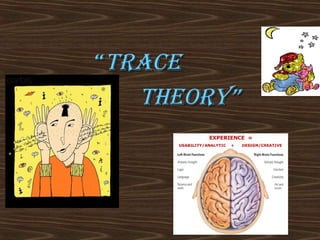
“
“TRACE
TRACE
THEORY”
THEORY”
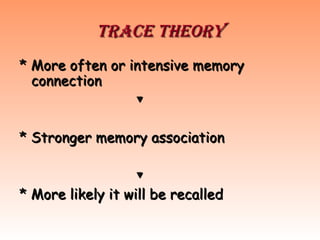
Trace theory
Trace theory
* More often or intensive memory
connection
connection
▼
▼
* Stronger memory association
▼
▼
* More likely it will be recalled
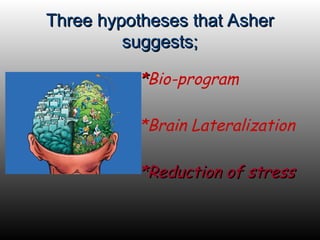
Three hypotheses that Asher
suggests;
suggests;
*
*Bio-program
*Brain Lateralization
*Reduction of stress
The bio-program
The bio-program
* Innate
* Innate
* First listening competence and then the ability
to speak
to speak
* Listening comprehension ►
* Listening comprehension ► To respond
To respond
physically to spoken language
* Establishment of listening comprehension
►
► Speech evolves naturally and effortlessly
Speech evolves naturally and effortlessly.
.
.
. Listening=> Accompanied by physical
Listening=> Accompanied by physical
movement
movement
. Speech and other productive skills
. Sequence= Listening before speaking
. Mode= To synchronize language with the
individual’s body.
individual’s body.
Brain Lateralization
* Jean Piaget
* Jean Piaget
* Asher says that TPR is directed to right brain
learning while most second language teaching
theories are directed to left brain learning.
* Right-left-brain learning (different learning
functions)
functions)
- Right-brain activity
- Right-brain activity ►
► Motor movement
Motor movement
- Left-brain activity
- Left-brain activity ►
► Watching and learning
Watching and learning
Reduction of Stress
• Absence of stress ►An important condition
for successful language learning
• Asher;
** Language acquisition: In a stress-free
environment
** Adult language learning environment:
Stress and anxiety
. The lower the stress, the greater the
learning.
☼ The keys to stress-free learning:
► Using natural bio-program.
► Remembering relaxed and enjoyable
experiences.
► Focusing on meaning.
► Getting away from self-conscious and
stressful situations.
► Devoting full energy to learning.
► Not forcing student to speak
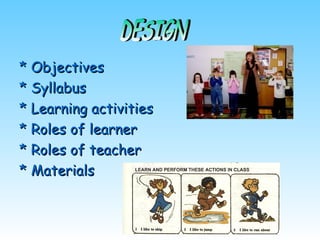
* Objectives
* Objectives
* Syllabus
* Syllabus
* Learning activities
* Roles of learner
* Roles of learner
* Roles of teacher
* Roles of teacher
* Materials
* Materials
OBJECTIVES
OBJECTIVES
♣
♣ Using action-based drills in the imperative
Using action-based drills in the imperative
form.
form.
♣
♣ Teaching oral proficiency at a beginning
Teaching oral proficiency at a beginning
level.
level.
♣
♣ Teaching basic speaking skills.
Teaching basic speaking skills.
♣
♣ Using comprehension as a means to speaking.
Using comprehension as a means to speaking.
♣
♣ Facilitating a suitable “comprehension” and
Facilitating a suitable “comprehension” and
“speaking” period.
“speaking” period.
SYLLABUS
SYLLABUS
* Seeing the rules in context (inductively).
* Using sentence-based grammatical syllabus.
* Paying attention to meaning rather than the
form and text
*
* TPR works best with about 8 students.
* A fixed number of items
( Assimilating 12 to 36 new lexical
İtems)
Learning Activities
Learning Activities
► Using objects
► Role plays and slide presentations
► Story telling
► Games
► Imperative exercises
Roles of learners
*
* Primary roles : Listener and performer
* Listening attentively
* Responding physically
To commands given by the teacher
* Recognizing and responding to new
combinations of previously taught items
* Producing new combinations on their own
* Monitoring and evaluating their own progress
* Being encouraged to speak
*Speaking when become ready
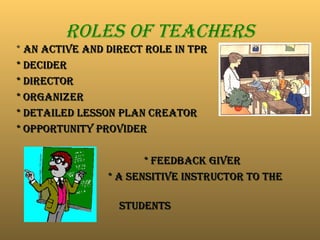
Roles of Teachers
* An active and direct role in TPR
An active and direct role in TPR
* Decider
* Decider
* Director
* Director
* Organizer
* Organizer
* Detailed lesson plan creator
* OPPORTUNITY PROVIDER
* Feedback giver
* Feedback giver
* A sensitive instructor to the
STUDENTS
STUDENTS
● No basic text
● For beginners;
- Teacher’s voice
- Actions
- Gestures
● After a period of
learning
- Books, pens, cup, furniture
● In later learning stages;
- Materials( pictures,
word charts etc.)
- Realia
● Kits
☺ Review A fast-moving warm up
►
☺ New commands
☺ Asking simple questions
☺ Role reversal
☺ Reading and writing
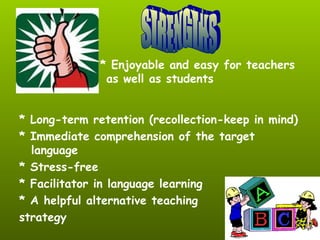
* Long-term retention (recollection-keep in mind)
* Immediate comprehension of the target
language
* Stress-free
* Facilitator in language learning
* A helpful alternative teaching
strategy
* Enjoyable and easy for teachers
as well as students
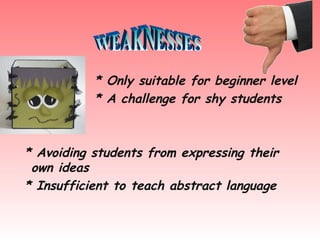
* Only suitable for beginner level
* A challenge for shy students
* Avoiding students from expressing their
own ideas
* Insufficient to teach abstract language
CONCLUSION
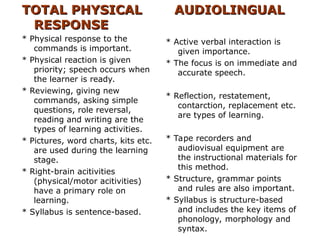
TOTAL PHYSICAL
TOTAL PHYSICAL
RESPONSE
RESPONSE
* Physical response to the
commands is important.
* Physical reaction is given
priority; speech occurs when
the learner is ready.
* Reviewing, giving new
commands, asking simple
questions, role reversal,
reading and writing are the
types of learning activities.
* Pictures, word charts, kits etc.
are used during the learning
stage.
* Right-brain acitivities
(physical/motor acitivities)
have a primary role on
learning.
* Syllabus is sentence-based.
AUDIOLINGUAL
AUDIOLINGUAL
* Active verbal interaction is
given importance.
* The focus is on immediate and
accurate speech.
* Reflection, restatement,
contarction, replacement etc.
are types of learning.
* Tape recorders and
audiovisual equipment are
the instructional materials for
this method.
* Structure, grammar points
and rules are also important.
* Syllabus is structure-based
and includes the key items of
phonology, morphology and
syntax.
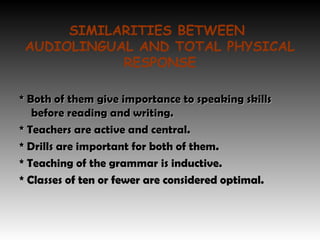
SIMILARITIES BETWEEN
AUDIOLINGUAL AND TOTAL PHYSICAL
RESPONSE
* Both of them give importance to speaking skills
before reading and writing.
* Teachers are active and central.
* Drills are important for both of them.
* Teaching of the grammar is inductive.
* Classes of ten or fewer are considered optimal.
REFERENCES
REFERENCES
* Richards,C. Jack & Rodgers,S.Theodore (2002) Cambridge University
Press Approaches and Methods in Language Teaching
*http://www.sil.org/LinguaLinks/LanguageLearning/
WaysToApproachLanguageLearning/TotalPhysicalResponse.htm
* http://www.teacherjoe.us/TeachersTPR.html
*
* http://www.onestopenglish.com/section.asp?docid=146503
* http://coe.sdsu.edu/people/jmora/almmethods.htm#TPR
*
* http://www.c-english.com/files/tpr.pdf
*http://209.85.135.132/search?
q=cache:G1lF__GfxQ4J:www.springinstitute.org/Files/
tpr4.pdf+total+physical+response&cd=17&hl=tr&ct=clnk&gl=tr
*
* http://www.teachingenglish.org.uk/think/articles/total-physical-
response-tpr
* http://conference.nie.edu.sg/paper/new%20converted/ab00466.pdf
* http://wiki.galbijim.com/Total_Physical_Response#Disadvantages
*
* http://www.foreignlanguagesweb.com/teaching/methods/tpr.htm

englishteachingmethodtotalphysicalresponse

  • 1.
    TOTAL PHYSICAL RESPONSE TOTALPHYSICAL RESPONSE Teaching is one of the easiest jobs in the Teaching is one of the easiest jobs in the world... world... ...Teaching WELL is one of the most ...Teaching WELL is one of the most difficult! difficult!
  • 2.
    T P R (TOTALPHYSICAL RESPONSE)  TPR is a method in language teaching which is based on the coordination of speech and action.  It allows students to react to language without thinking too much.  The students are required to carry out the instructions by physically performing the activities.
  • 3.
    TPR was developedby James Asher, who is a TPR was developed by James Asher, who is a professor of psychology at San Jose State professor of psychology at San Jose State University in California. University in California.
  • 4.
    What is theaim of this method? What is the aim of this method?  The aim is to teach language via The aim is to teach language via  physical(motor) activity. physical(motor) activity. *Asher also pays attention to; *Asher also pays attention to;  Language teaching procedures Language teaching procedures + + Developmental psychology Developmental psychology Learning theory Learning theory Humanistic pedagogy Humanistic pedagogy
  • 5.
    James Asher James Asherthinks that; thinks that; * Second language learning is parallel to first language learning. * Both of them have parallel processes. * Speech Commands ► * Commands Physical response ► * Physical response Verbal response ►
  • 6.
    **Gamelike movements andunderstandable linguistic **Gamelike movements and understandable linguistic production; production; ► ► reduce stress. reduce stress. ► ► create a positive mood in the learner. create a positive mood in the learner. ► ► facilitate learning.
  • 7.
    ♦ ♦ Theory oflanguage Theory of language → → A grammar based view of language A grammar based view of language → → Verb In ımperative form ► Verb In ımperative form ► ♦ ♦ Theory of language learning Theory of language learning → → A stimulus-response view A stimulus-response view
  • 8.
  • 9.
    Trace theory Trace theory *More often or intensive memory * More often or intensive memory connection connection ▼ ▼ * Stronger memory association * Stronger memory association ▼ ▼ * More likely it will be recalled * More likely it will be recalled
  • 10.
    Three hypotheses thatAsher Three hypotheses that Asher suggests; suggests; * *Bio-program *Brain Lateralization *Reduction of stress *Reduction of stress
  • 11.
    The bio-program The bio-program *Innate * Innate * First listening competence and then the ability * First listening competence and then the ability to speak to speak * Listening comprehension ► * Listening comprehension ► To respond To respond physically to spoken language physically to spoken language * Establishment of listening comprehension * Establishment of listening comprehension ► ► Speech evolves naturally and effortlessly Speech evolves naturally and effortlessly. .
  • 12.
    . . Listening=> Accompaniedby physical Listening=> Accompanied by physical movement movement . Speech and other productive skills . Speech and other productive skills . Sequence= Listening before speaking . Sequence= Listening before speaking . Mode= To synchronize language with the . Mode= To synchronize language with the individual’s body. individual’s body.
  • 13.
    Brain Lateralization * JeanPiaget * Jean Piaget * Asher says that TPR is directed to right brain * Asher says that TPR is directed to right brain learning while most second language teaching learning while most second language teaching theories are directed to left brain learning. theories are directed to left brain learning. * Right-left-brain learning (different learning * Right-left-brain learning (different learning functions) functions) - Right-brain activity - Right-brain activity ► ► Motor movement Motor movement - Left-brain activity - Left-brain activity ► ► Watching and learning Watching and learning
  • 14.
    Reduction of Stress •Absence of stress ►An important condition for successful language learning • Asher; ** Language acquisition: In a stress-free environment ** Adult language learning environment: Stress and anxiety . The lower the stress, the greater the learning.
  • 15.
    ☼ The keysto stress-free learning: ► Using natural bio-program. ► Remembering relaxed and enjoyable experiences. ► Focusing on meaning. ► Getting away from self-conscious and stressful situations. ► Devoting full energy to learning. ► Not forcing student to speak
  • 16.
    * Objectives * Objectives *Syllabus * Syllabus * Learning activities * Learning activities * Roles of learner * Roles of learner * Roles of teacher * Roles of teacher * Materials * Materials
  • 17.
    OBJECTIVES OBJECTIVES ♣ ♣ Using action-baseddrills in the imperative Using action-based drills in the imperative form. form. ♣ ♣ Teaching oral proficiency at a beginning Teaching oral proficiency at a beginning level. level. ♣ ♣ Teaching basic speaking skills. Teaching basic speaking skills. ♣ ♣ Using comprehension as a means to speaking. Using comprehension as a means to speaking. ♣ ♣ Facilitating a suitable “comprehension” and Facilitating a suitable “comprehension” and “speaking” period. “speaking” period.
  • 18.
    SYLLABUS SYLLABUS * Seeing therules in context (inductively). * Using sentence-based grammatical syllabus. * Paying attention to meaning rather than the form and text * * TPR works best with about 8 students. * A fixed number of items ( Assimilating 12 to 36 new lexical İtems)
  • 19.
    Learning Activities Learning Activities ►Using objects ► Role plays and slide presentations ► Story telling ► Games ► Imperative exercises
  • 20.
    Roles of learners * *Primary roles : Listener and performer * Listening attentively * Responding physically To commands given by the teacher
  • 21.
    * Recognizing andresponding to new * Recognizing and responding to new combinations of previously taught items combinations of previously taught items * Producing new combinations on their own * Producing new combinations on their own * Monitoring and evaluating their own progress * Monitoring and evaluating their own progress * Being encouraged to speak * Being encouraged to speak *Speaking when become ready *Speaking when become ready
  • 22.
    Roles of Teachers *An active and direct role in TPR An active and direct role in TPR * Decider * Decider * Director * Director * Organizer * Organizer * Detailed lesson plan creator * Detailed lesson plan creator * OPPORTUNITY PROVIDER * OPPORTUNITY PROVIDER * Feedback giver * Feedback giver * A sensitive instructor to the * A sensitive instructor to the STUDENTS STUDENTS
  • 23.
    ● No basictext ● For beginners; - Teacher’s voice - Actions - Gestures ● After a period of learning - Books, pens, cup, furniture
  • 24.
    ● In laterlearning stages; - Materials( pictures, word charts etc.) - Realia ● Kits
  • 25.
    ☺ Review Afast-moving warm up ► ☺ New commands ☺ Asking simple questions ☺ Role reversal ☺ Reading and writing
  • 26.
    * Long-term retention(recollection-keep in mind) * Immediate comprehension of the target language * Stress-free * Facilitator in language learning * A helpful alternative teaching strategy * Enjoyable and easy for teachers as well as students
  • 27.
    * Only suitablefor beginner level * A challenge for shy students * Avoiding students from expressing their own ideas * Insufficient to teach abstract language
  • 29.
  • 30.
    TOTAL PHYSICAL TOTAL PHYSICAL RESPONSE RESPONSE *Physical response to the commands is important. * Physical reaction is given priority; speech occurs when the learner is ready. * Reviewing, giving new commands, asking simple questions, role reversal, reading and writing are the types of learning activities. * Pictures, word charts, kits etc. are used during the learning stage. * Right-brain acitivities (physical/motor acitivities) have a primary role on learning. * Syllabus is sentence-based. AUDIOLINGUAL AUDIOLINGUAL * Active verbal interaction is given importance. * The focus is on immediate and accurate speech. * Reflection, restatement, contarction, replacement etc. are types of learning. * Tape recorders and audiovisual equipment are the instructional materials for this method. * Structure, grammar points and rules are also important. * Syllabus is structure-based and includes the key items of phonology, morphology and syntax.
  • 31.
    SIMILARITIES BETWEEN AUDIOLINGUAL ANDTOTAL PHYSICAL RESPONSE * Both of them give importance to speaking skills * Both of them give importance to speaking skills before reading and writing. before reading and writing. * Teachers are active and central. * Teachers are active and central. * Drills are important for both of them. * Drills are important for both of them. * Teaching of the grammar is inductive. * Teaching of the grammar is inductive. * Classes of ten or fewer are considered optimal. * Classes of ten or fewer are considered optimal.
  • 32.
    REFERENCES REFERENCES * Richards,C. Jack& Rodgers,S.Theodore (2002) Cambridge University Press Approaches and Methods in Language Teaching *http://www.sil.org/LinguaLinks/LanguageLearning/ WaysToApproachLanguageLearning/TotalPhysicalResponse.htm * http://www.teacherjoe.us/TeachersTPR.html * * http://www.onestopenglish.com/section.asp?docid=146503 * http://coe.sdsu.edu/people/jmora/almmethods.htm#TPR * * http://www.c-english.com/files/tpr.pdf *http://209.85.135.132/search? q=cache:G1lF__GfxQ4J:www.springinstitute.org/Files/ tpr4.pdf+total+physical+response&cd=17&hl=tr&ct=clnk&gl=tr * * http://www.teachingenglish.org.uk/think/articles/total-physical- response-tpr * http://conference.nie.edu.sg/paper/new%20converted/ab00466.pdf * http://wiki.galbijim.com/Total_Physical_Response#Disadvantages * * http://www.foreignlanguagesweb.com/teaching/methods/tpr.htm