UNIVERSITY OF SOCIAL SCIENCES AND HUMANITIES
FACULTY OF ENGLISH LINGUISTICS AND ITERATURE
Phan Chí Thạch
1
CONTENTS
2. APPROACH
3. DESIGN
2
4. PROCEDURE
5. CONCLUSION
1. BACKGROUND
1. BACKGROUND
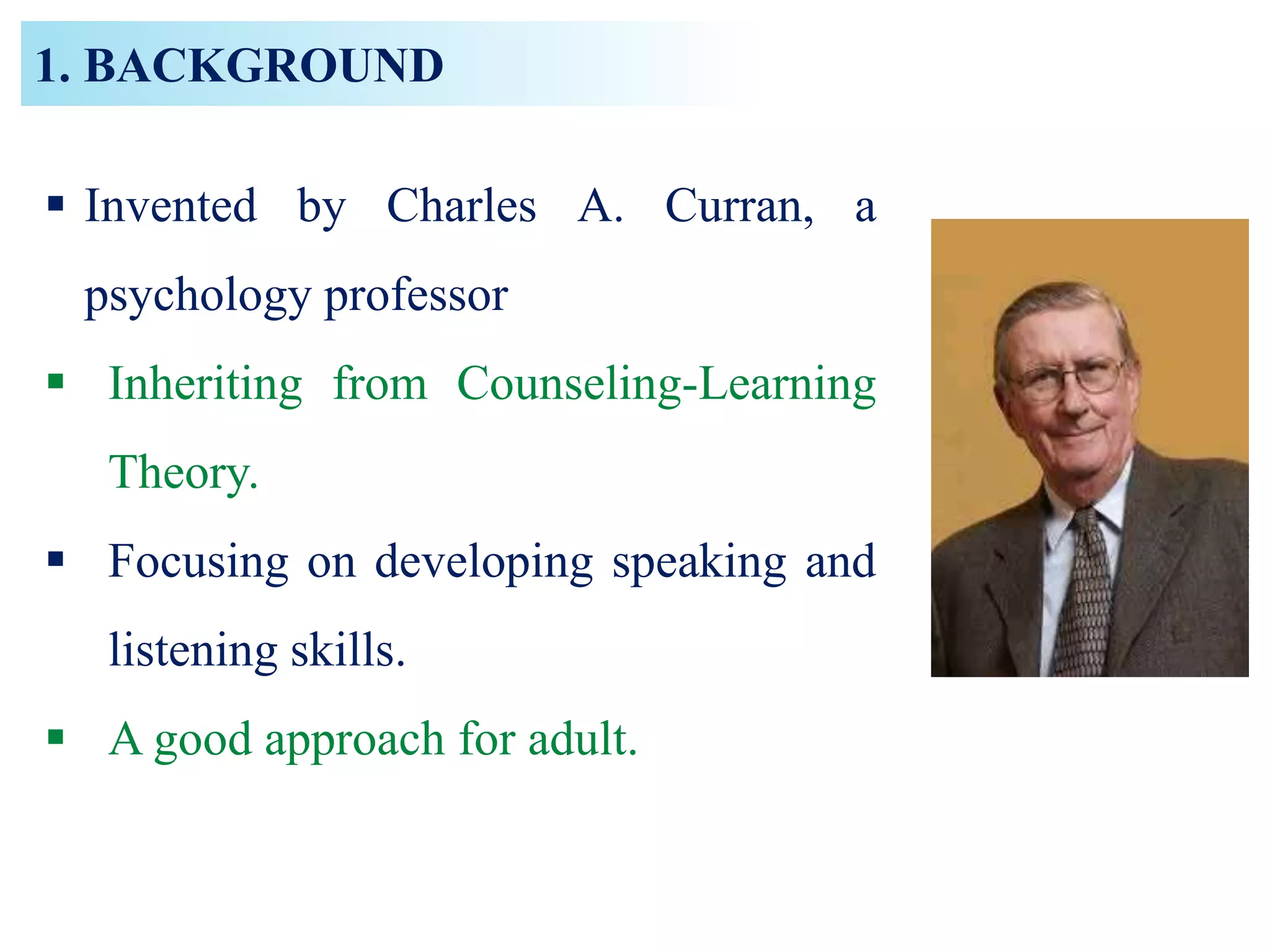
 Invented by Charles A. Curran, a
psychology professor
 Inheriting from Counseling-Learning
Theory.
 Focusing on developing speaking and
listening skills.
 A good approach for adult.
1. BACKGROUND
 Redefining the roles of teacher and student: teacher as
counselor, student as client.
 Being an instance of Humanistic Approach by dealing
with:
+ Emotions and feelings
+ Linguistics knowledge and skills
=> forming the definition of "Whole - Person"
2. APPROACH
 Theory of language
 Starting with standard of sound features, sentences, and
abstract models of language.
 Learners tasks including understanding sound system,
developing lexicon and grammar skills of the foreign
language.
 Consisting of two types of interaction: learners - learners
and learners - knower .
2. APPROACH
 Interaction between learners
+ unpredicted contents
+ involving changing emotions
 Interaction between learners and knowers
+ initialized by the knowers
+ to help the learners
 Theory of language
2. APPROACH
 Applying techniques in counseling learning to teach
language.
 Viewing the learners as a holistic object including
cognitive and affective (to form the definition of "Whole
person").
 Taking place in a communicative situation to develop
communication skills.
 Theory of learning
2. APPROACH
5-step process
 Birth stage.
 Sense of independent.
 Speaking independently.
 Taking criticism.
 Improving style and knowledge of linguistic
appropriateness.
 Theory of learning
2. APPROACH
 Theory of learning
6 factors
 Security
 Attention
 Self-assertion and aggression
 Reflection
 Retention
 Discrimination
 Objectives
3. DESIGN
 The syllabus
 Types of learning and teaching activities
 Learner roles
 Teacher roles
 The role of instructional materials
 Objectives
 The goal of this method is to attain
near-native mastery of the target
language.
 Specific goals include developing a
whole person learning process; trusting
relationship among the members of the
class.
3. DESIGN
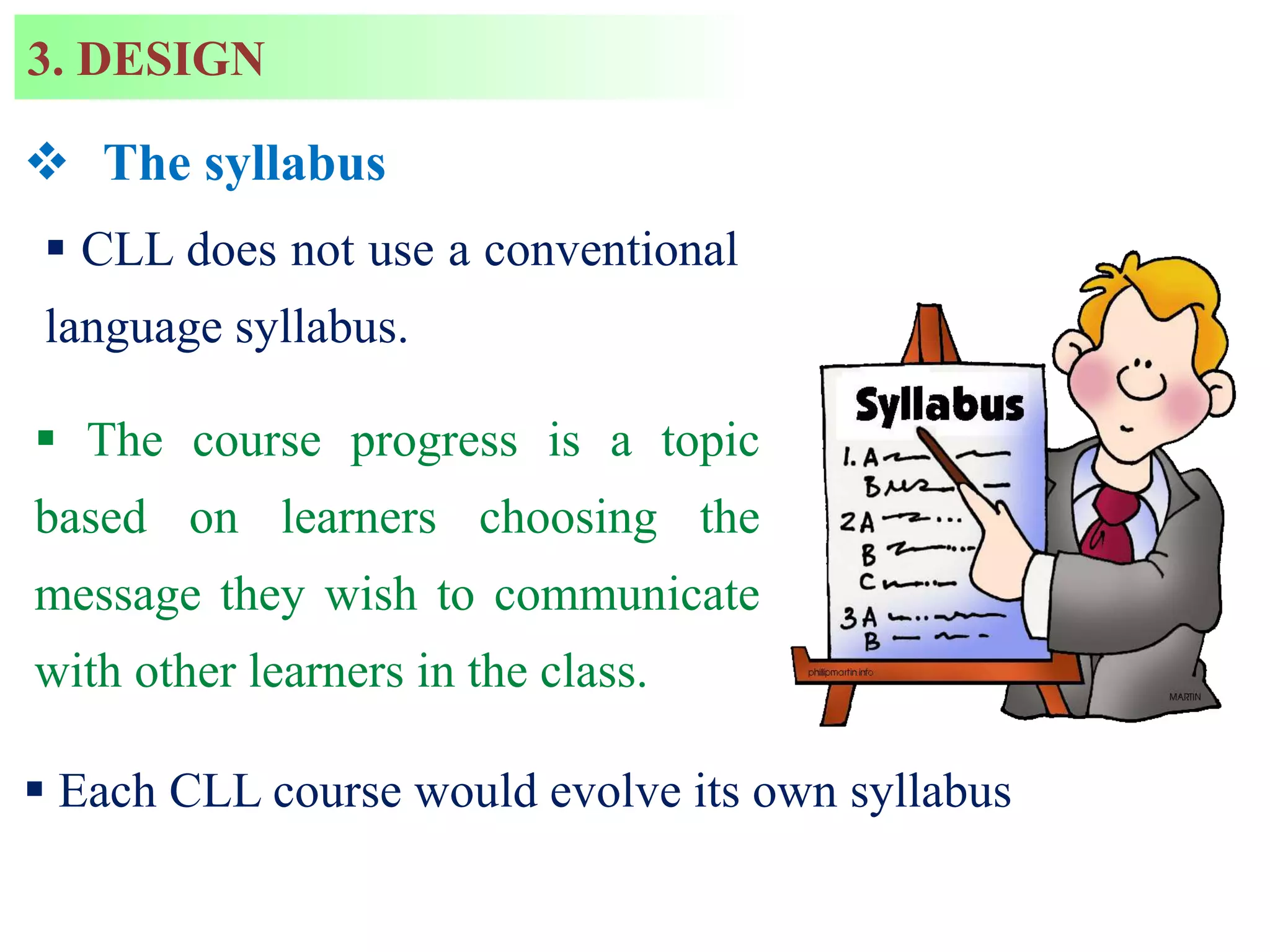
 The syllabus
 CLL does not use a conventional
language syllabus.
 The course progress is a topic
based on learners choosing the
message they wish to communicate
with other learners in the class.
 Each CLL course would evolve its own syllabus
3. DESIGN
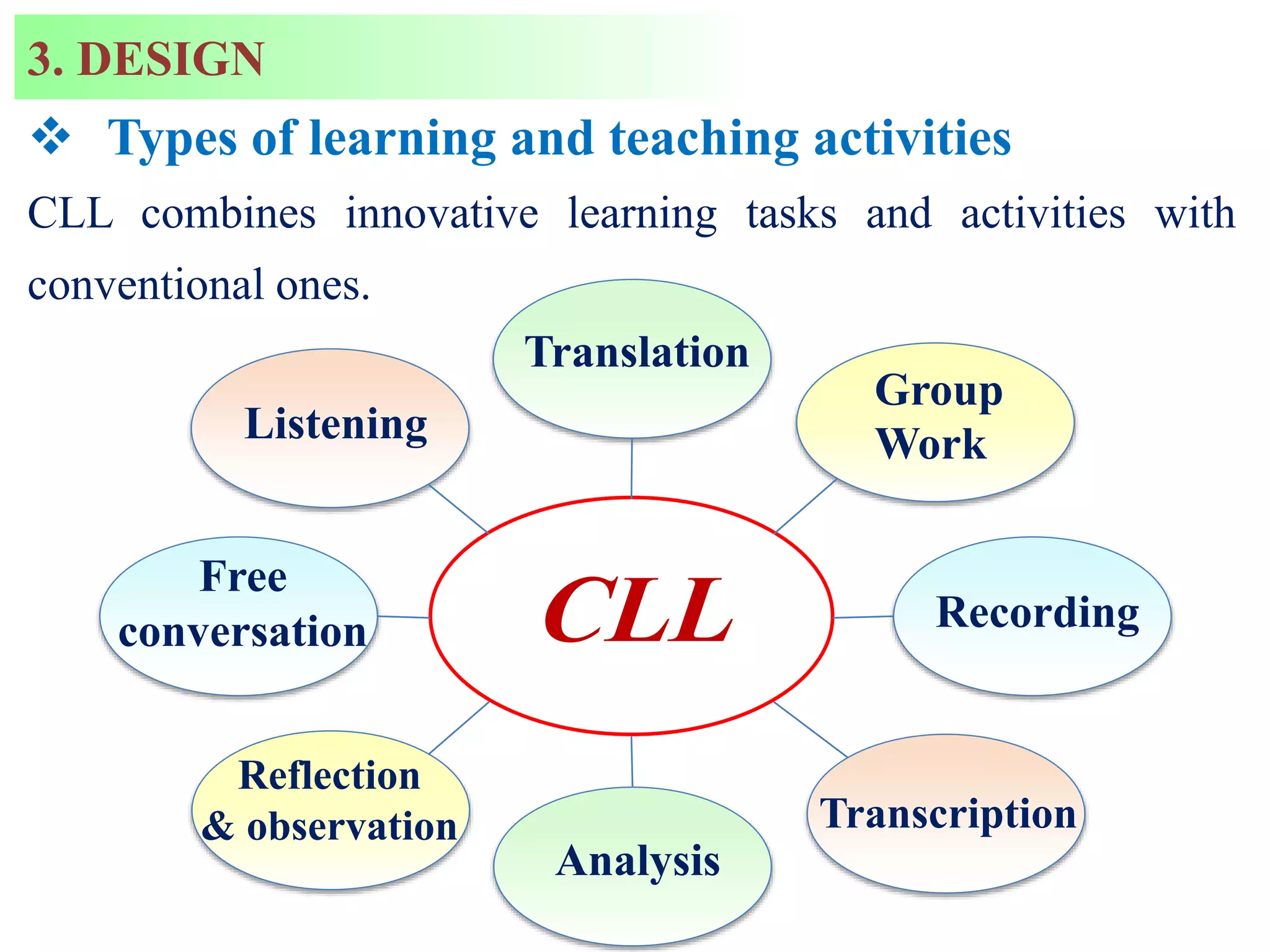
CLL
Translation
Analysis
Free
conversation Recording
Group
WorkListening
Transcription
Reflection
& observation
 Types of learning and teaching activities
CLL combines innovative learning tasks and activities with
conventional ones.
3. DESIGN
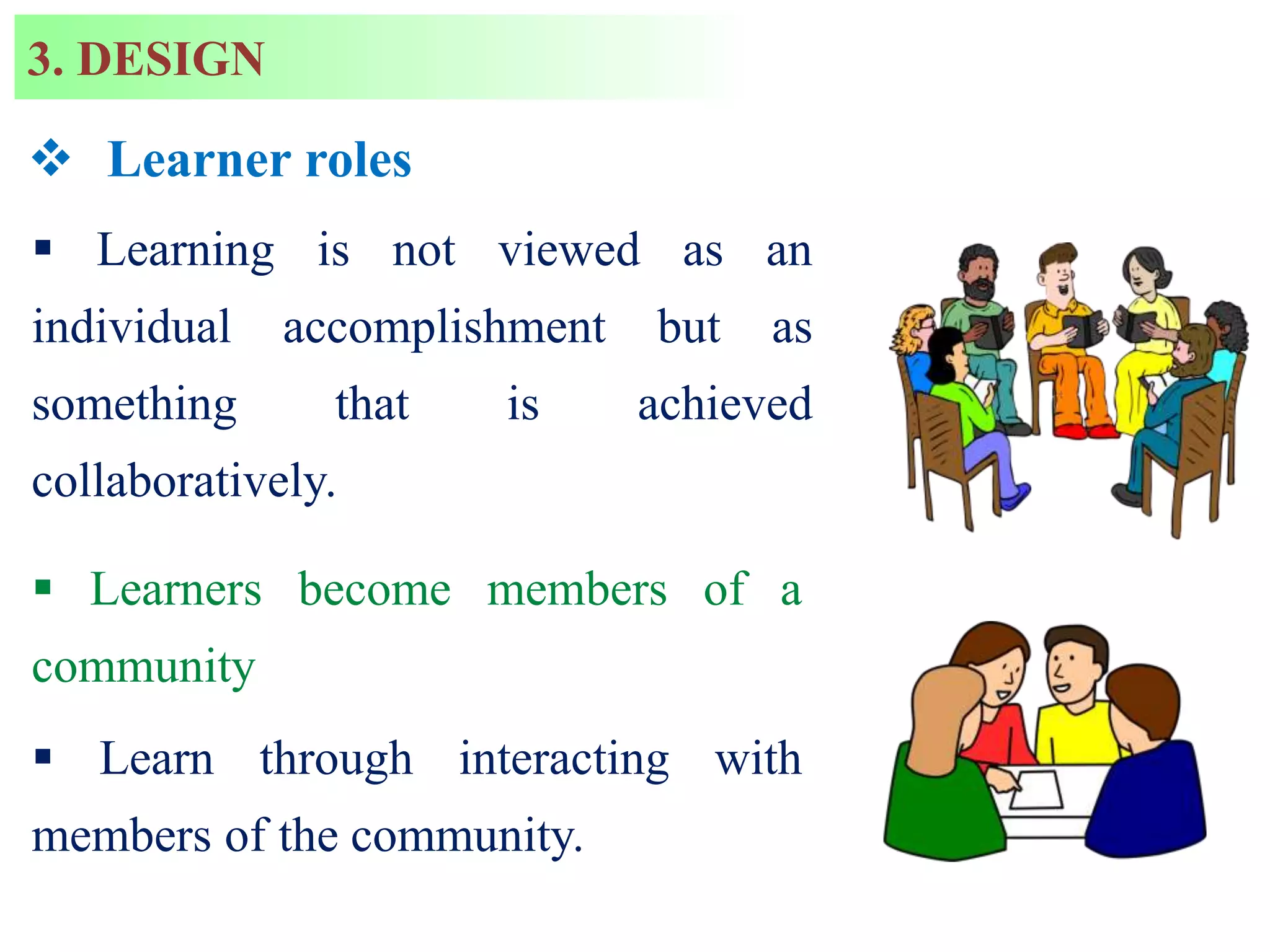
 Learner roles
 Learning is not viewed as an
individual accomplishment but as
something that is achieved
collaboratively.
 Learners become members of a
community
 Learn through interacting with
members of the community.
3. DESIGN
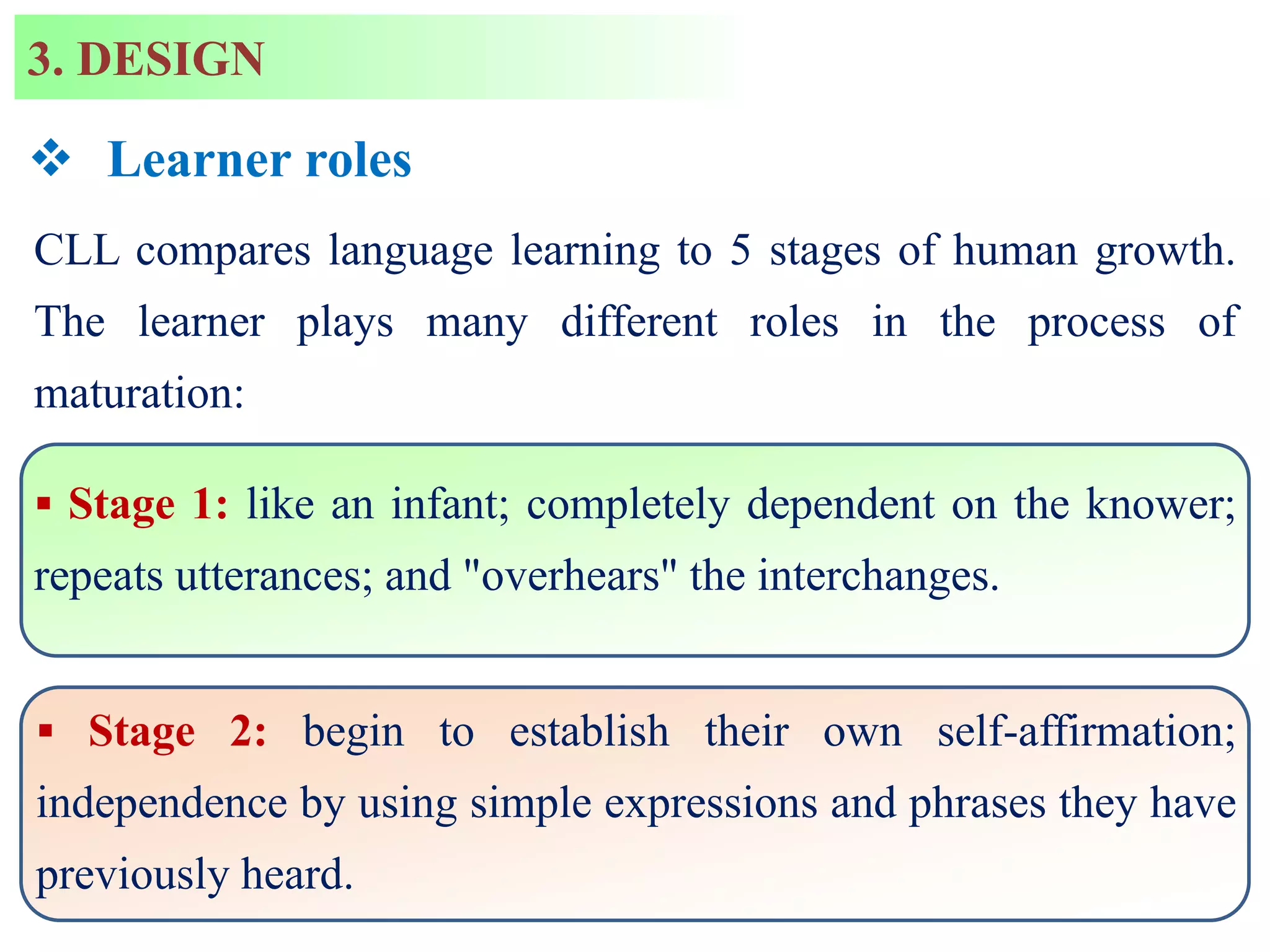
CLL compares language learning to 5 stages of human growth.
The learner plays many different roles in the process of
maturation:
 Stage 1: like an infant; completely dependent on the knower;
repeats utterances; and "overhears" the interchanges.
 Stage 2: begin to establish their own self-affirmation;
independence by using simple expressions and phrases they have
previously heard.
3. DESIGN
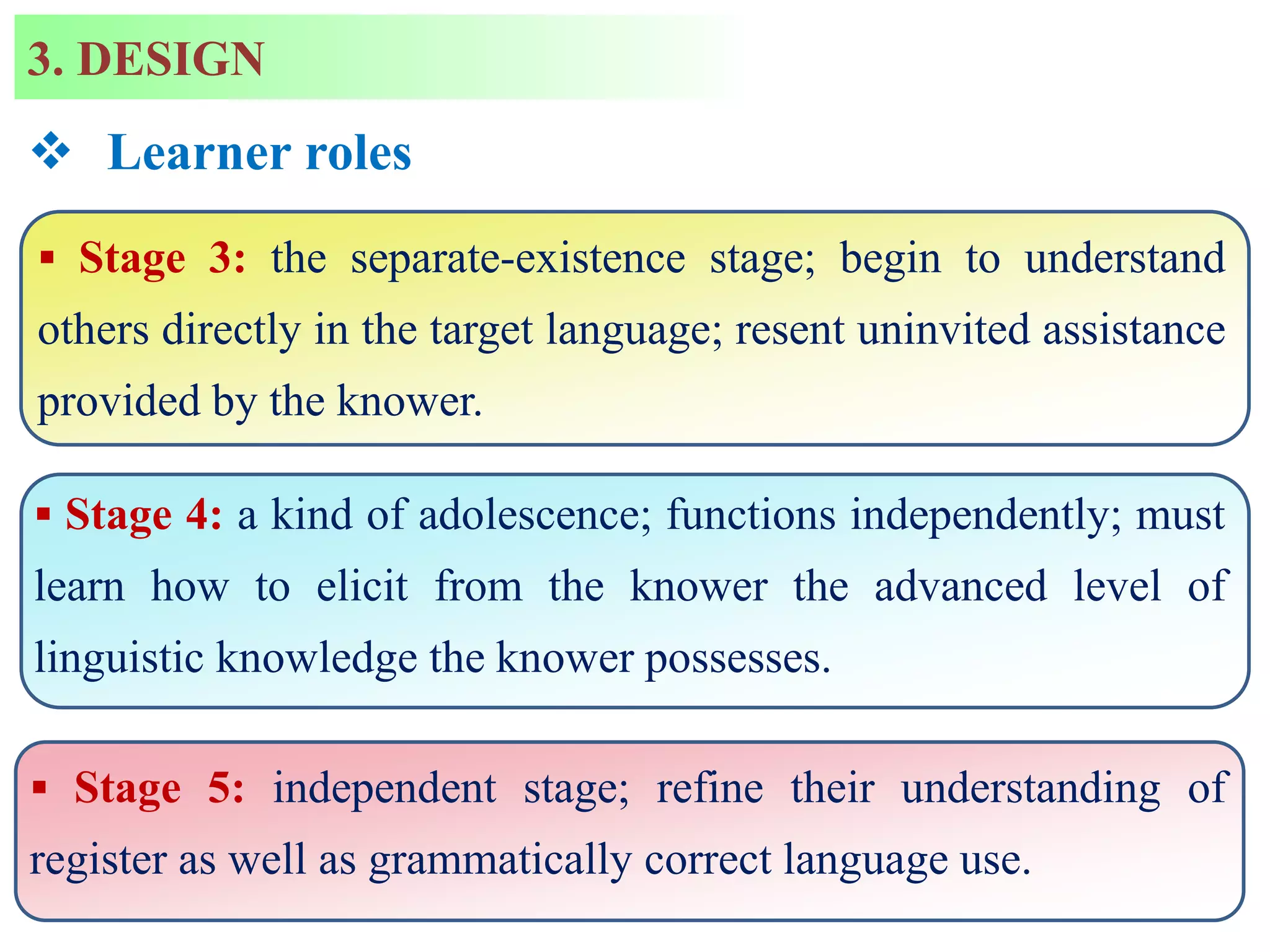
 Learner roles
 Stage 3: the separate-existence stage; begin to understand
others directly in the target language; resent uninvited assistance
provided by the knower.
 Stage 4: a kind of adolescence; functions independently; must
learn how to elicit from the knower the advanced level of
linguistic knowledge the knower possesses.
 Stage 5: independent stage; refine their understanding of
register as well as grammatically correct language use.
 Learner roles
3. DESIGN
 Respond calmly and nonjudgmentally
 Teacher roles
 Plays the role of counselor
 Having a supportive manner
 Help the client to understand the
problems better
 Provide a safe environment
3. DESIGN
 The role of instructional materials
 A CLL course evolves out of the interactions
of the community, a textbook is not considered
a necessary component.
 Materials may be developed by the teacher
as the course develops.
 Conversations may also be transcribed and
distributed for study and analysis.
 Learners may work in groups to produce
their own materials.
3. DESIGN
4. PROCEDURE
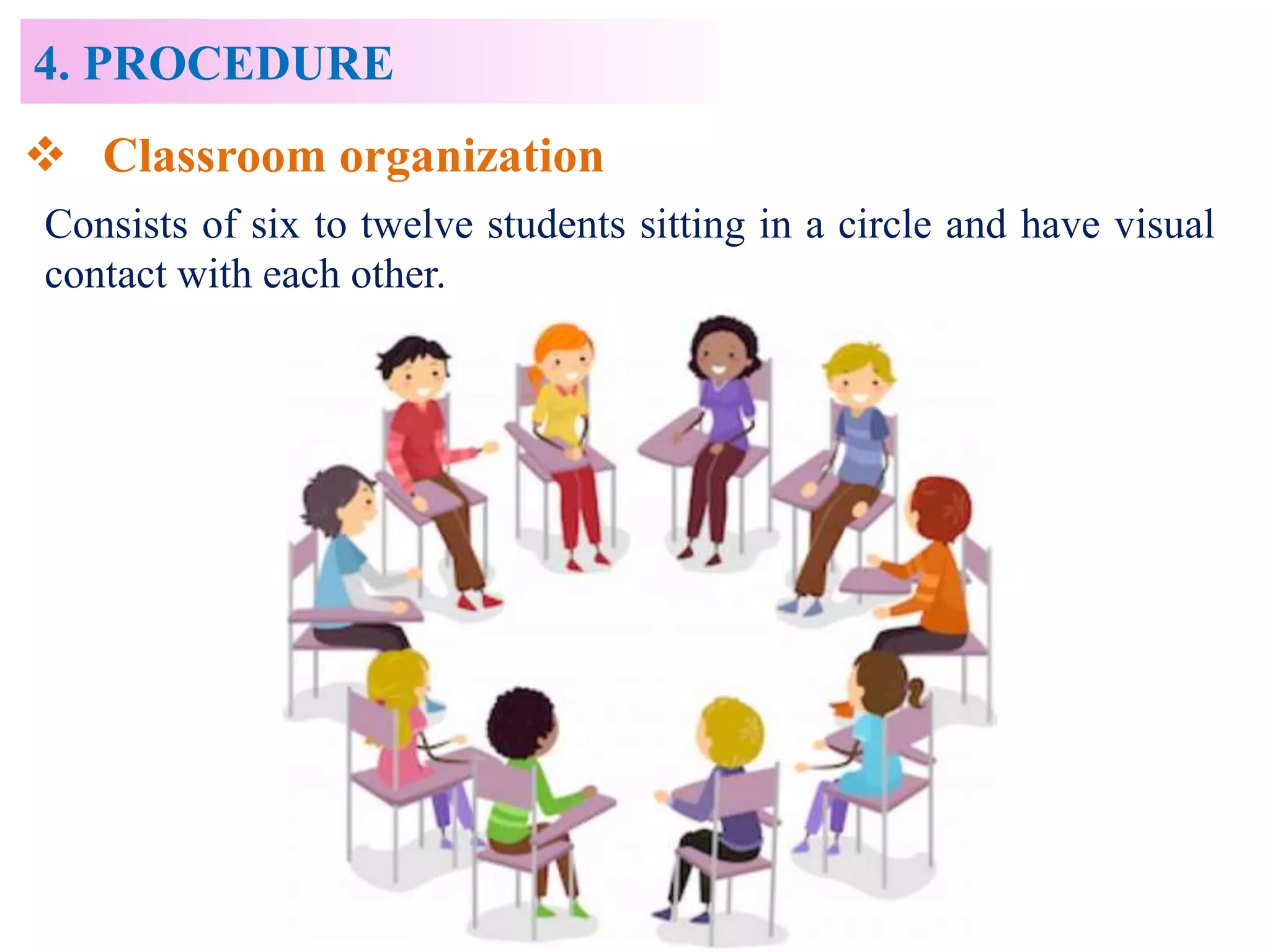
 Classroom organization
Consists of six to twelve students sitting in a circle and have visual
contact with each other.
4. PROCEDURE
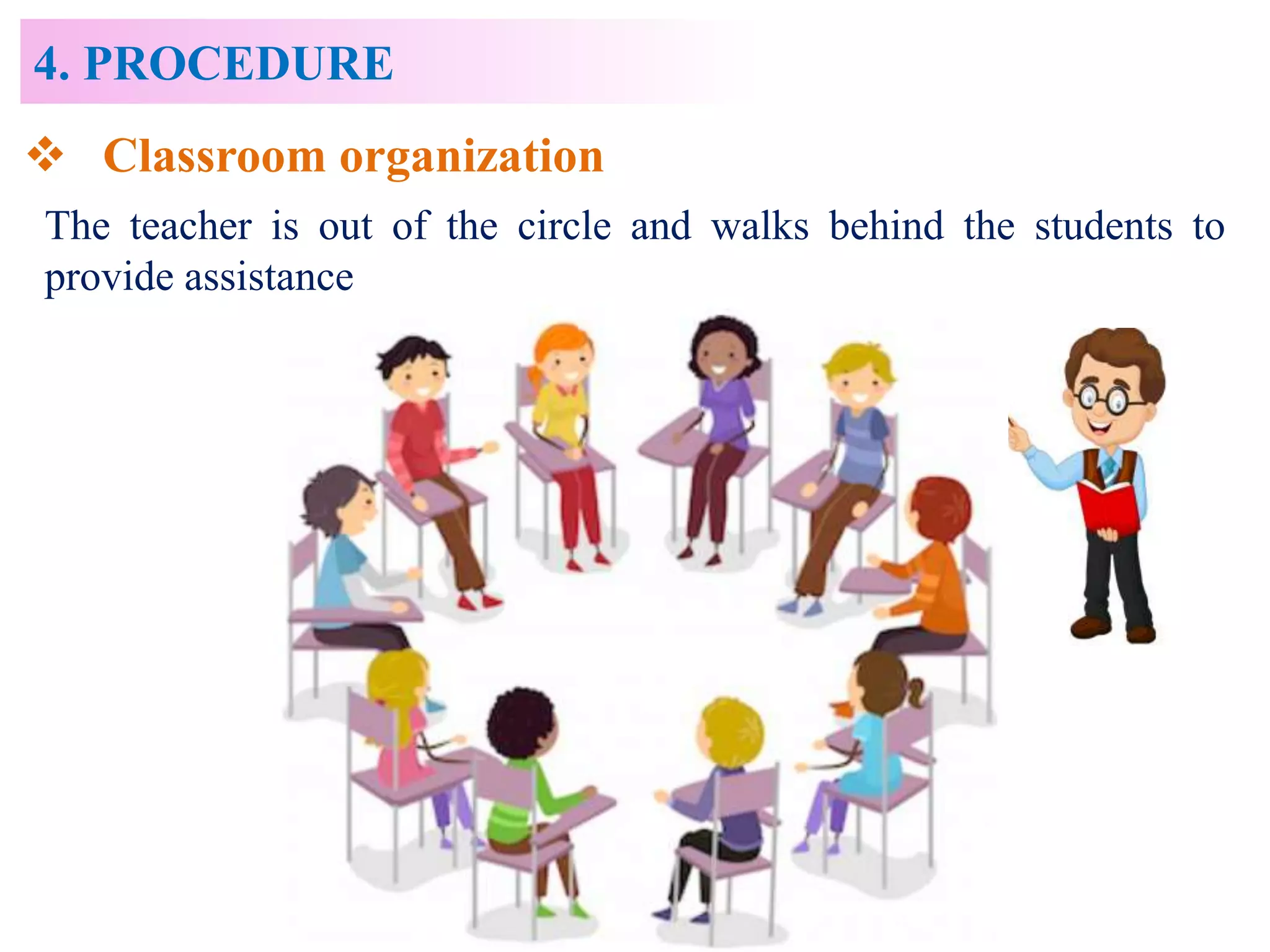
 Classroom organization
The teacher is out of the circle and walks behind the students to
provide assistance
4. PROCEDURE
 Activities in class:
1. The students introduce themselves to
each other in the native language.
2. The teacher explain the goals and
activities of the course.
4. PROCEDURE
 Activities in class:
3. A conservation in the foreign
language starts:
a) Everyone have visual contact with
each other and all are in easy reach of a
tape recorder microphone.
b) One student initiated conversation with
another student by giving a message in
the native language.
4. PROCEDURE
 Activities in class:
3. A conservation in the foreign language
starts:
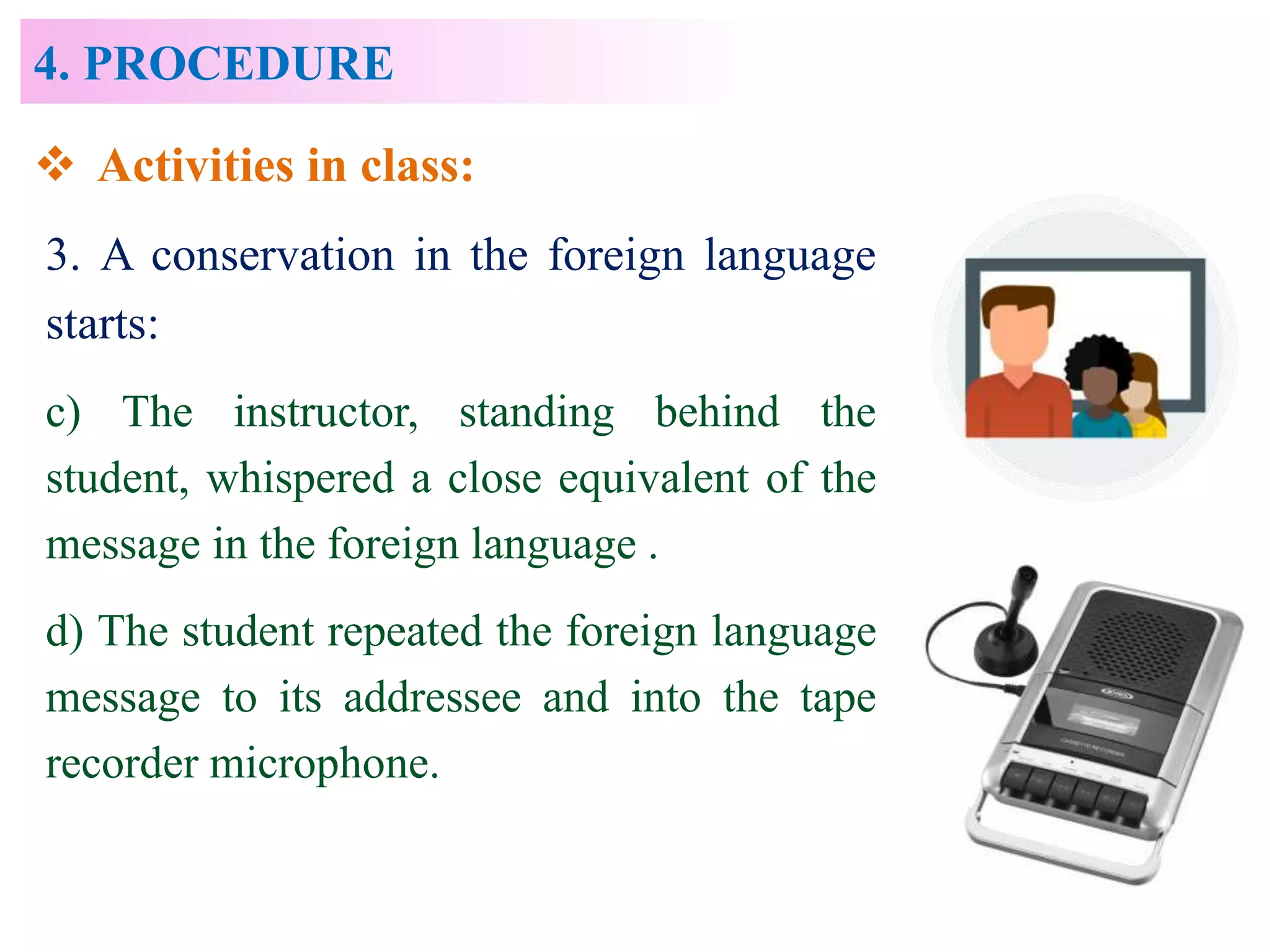
c) The instructor, standing behind the
student, whispered a close equivalent of the
message in the foreign language .
d) The student repeated the foreign language
message to its addressee and into the tape
recorder microphone.
4. PROCEDURE
 Activities in class:
3. A conservation in the foreign language
starts:
e) Each student had a chance to compose and
record a few messages.
f) The tape recorder was rewound and
replayed at intervals.
g) Each student repeated the meaning in the
native language of what he or she had said in
the foreign language and helped to refresh
the memory of others
4. PROCEDURE
4. Students think about the process and
they are asked to express theirs feelings
about the experience.
5. The teacher chooses some sentences
from the recorded material and writes
them on the board to discuss the elements
of language.
 Activities in class:
4. PROCEDURE
6. Students are encouraged to ask questions.
7. Students are encouraged to copy sentences
from the board with notes on meaning and
usage.
 Activities in class:
5. CONCLUSION
‘Learning is person’, which means that whole-person
learning of another language takes place best in a
relationship of trust, support, and cooperation between
teacher and students and among students.
‘Learning is dynamic and creative’, which means that
learning is an ongoing developmental process.
References
[1]. Jack C.Richards and Theodore S.Rodgers, Approaches and
methods in language teaching, Cambridge University Press.
[2]. Diane Larsen-Freeman and Marti Anderson, Techniques &
Principles in Language Teaching, Oxford University Press.
29
Community language learning (CLL)

Community language learning (CLL)

  • 1.
    UNIVERSITY OF SOCIALSCIENCES AND HUMANITIES FACULTY OF ENGLISH LINGUISTICS AND ITERATURE Phan Chí Thạch 1
  • 2.
    CONTENTS 2. APPROACH 3. DESIGN 2 4.PROCEDURE 5. CONCLUSION 1. BACKGROUND
  • 3.
    1. BACKGROUND  Inventedby Charles A. Curran, a psychology professor  Inheriting from Counseling-Learning Theory.  Focusing on developing speaking and listening skills.  A good approach for adult.
  • 4.
    1. BACKGROUND  Redefiningthe roles of teacher and student: teacher as counselor, student as client.  Being an instance of Humanistic Approach by dealing with: + Emotions and feelings + Linguistics knowledge and skills => forming the definition of "Whole - Person"
  • 5.
    2. APPROACH  Theoryof language  Starting with standard of sound features, sentences, and abstract models of language.  Learners tasks including understanding sound system, developing lexicon and grammar skills of the foreign language.  Consisting of two types of interaction: learners - learners and learners - knower .
  • 6.
    2. APPROACH  Interactionbetween learners + unpredicted contents + involving changing emotions  Interaction between learners and knowers + initialized by the knowers + to help the learners  Theory of language
  • 7.
    2. APPROACH  Applyingtechniques in counseling learning to teach language.  Viewing the learners as a holistic object including cognitive and affective (to form the definition of "Whole person").  Taking place in a communicative situation to develop communication skills.  Theory of learning
  • 8.
    2. APPROACH 5-step process Birth stage.  Sense of independent.  Speaking independently.  Taking criticism.  Improving style and knowledge of linguistic appropriateness.  Theory of learning
  • 9.
    2. APPROACH  Theoryof learning 6 factors  Security  Attention  Self-assertion and aggression  Reflection  Retention  Discrimination
  • 10.
     Objectives 3. DESIGN The syllabus  Types of learning and teaching activities  Learner roles  Teacher roles  The role of instructional materials
  • 11.
     Objectives  Thegoal of this method is to attain near-native mastery of the target language.  Specific goals include developing a whole person learning process; trusting relationship among the members of the class. 3. DESIGN
  • 12.
     The syllabus CLL does not use a conventional language syllabus.  The course progress is a topic based on learners choosing the message they wish to communicate with other learners in the class.  Each CLL course would evolve its own syllabus 3. DESIGN
  • 13.
    CLL Translation Analysis Free conversation Recording Group WorkListening Transcription Reflection & observation Types of learning and teaching activities CLL combines innovative learning tasks and activities with conventional ones. 3. DESIGN
  • 14.
     Learner roles Learning is not viewed as an individual accomplishment but as something that is achieved collaboratively.  Learners become members of a community  Learn through interacting with members of the community. 3. DESIGN
  • 15.
    CLL compares languagelearning to 5 stages of human growth. The learner plays many different roles in the process of maturation:  Stage 1: like an infant; completely dependent on the knower; repeats utterances; and "overhears" the interchanges.  Stage 2: begin to establish their own self-affirmation; independence by using simple expressions and phrases they have previously heard. 3. DESIGN  Learner roles
  • 16.
     Stage 3:the separate-existence stage; begin to understand others directly in the target language; resent uninvited assistance provided by the knower.  Stage 4: a kind of adolescence; functions independently; must learn how to elicit from the knower the advanced level of linguistic knowledge the knower possesses.  Stage 5: independent stage; refine their understanding of register as well as grammatically correct language use.  Learner roles 3. DESIGN
  • 17.
     Respond calmlyand nonjudgmentally  Teacher roles  Plays the role of counselor  Having a supportive manner  Help the client to understand the problems better  Provide a safe environment 3. DESIGN
  • 18.
     The roleof instructional materials  A CLL course evolves out of the interactions of the community, a textbook is not considered a necessary component.  Materials may be developed by the teacher as the course develops.  Conversations may also be transcribed and distributed for study and analysis.  Learners may work in groups to produce their own materials. 3. DESIGN
  • 19.
    4. PROCEDURE  Classroomorganization Consists of six to twelve students sitting in a circle and have visual contact with each other.
  • 20.
    4. PROCEDURE  Classroomorganization The teacher is out of the circle and walks behind the students to provide assistance
  • 21.
    4. PROCEDURE  Activitiesin class: 1. The students introduce themselves to each other in the native language. 2. The teacher explain the goals and activities of the course.
  • 22.
    4. PROCEDURE  Activitiesin class: 3. A conservation in the foreign language starts: a) Everyone have visual contact with each other and all are in easy reach of a tape recorder microphone. b) One student initiated conversation with another student by giving a message in the native language.
  • 23.
    4. PROCEDURE  Activitiesin class: 3. A conservation in the foreign language starts: c) The instructor, standing behind the student, whispered a close equivalent of the message in the foreign language . d) The student repeated the foreign language message to its addressee and into the tape recorder microphone.
  • 24.
    4. PROCEDURE  Activitiesin class: 3. A conservation in the foreign language starts: e) Each student had a chance to compose and record a few messages. f) The tape recorder was rewound and replayed at intervals. g) Each student repeated the meaning in the native language of what he or she had said in the foreign language and helped to refresh the memory of others
  • 25.
    4. PROCEDURE 4. Studentsthink about the process and they are asked to express theirs feelings about the experience. 5. The teacher chooses some sentences from the recorded material and writes them on the board to discuss the elements of language.  Activities in class:
  • 26.
    4. PROCEDURE 6. Studentsare encouraged to ask questions. 7. Students are encouraged to copy sentences from the board with notes on meaning and usage.  Activities in class:
  • 27.
    5. CONCLUSION ‘Learning isperson’, which means that whole-person learning of another language takes place best in a relationship of trust, support, and cooperation between teacher and students and among students. ‘Learning is dynamic and creative’, which means that learning is an ongoing developmental process.
  • 28.
    References [1]. Jack C.Richardsand Theodore S.Rodgers, Approaches and methods in language teaching, Cambridge University Press. [2]. Diane Larsen-Freeman and Marti Anderson, Techniques & Principles in Language Teaching, Oxford University Press.
  • 29.